THE LEVEL OF STRATEGIC MANAGEMENT APPLICATION BY
KUWAITI PUBLIC ADMINISTRATION AGENCIES FROM
EMPLOYEES’ PERSPECTIVE
Mohammad Q. Ahmad Al-Qarioti
Department of Public Administration
College of Administrative Sciences- Kuwait University, Kuwait.
Acknowledgement: This Study was Supported by a Grant from the Research Administration at
Kuwait University Project No. IU03/2015 March 2017.
ABSTRACT
This study examines strategic management (SM) in Kuwaiti public administration agencies,
(ministries, government authorities/institutions, and state-owned companies) and obstacles they face from employees’ perspectives. The study sample was a convenient stratified sample
consisting of (381) employees. Study results showed that (69.3%) of government agencies had
strategic plans while (30.7%) did not. Moreover, study results showed that strategy formulation
was a first priority, while strategy implementation and strategy evaluation processes were
respectively second and third priorities. With regard to obstacles, which government agencies
faced in adopting strategic management, results showed that lack of leadership was the prime
obstacle. Moreover, these results showed strong positive significant correlations and variations
between SM and demographic characteristics, and no significant variations between obstacles of
SM and demographic characteristics.
Key Words: Strategic management, public administration, Kuwait, administrative reform,
strategic planning.
International Research Journal of Human Resources and Social Sciences Vol. 4, Issue 3, March 2017 Impact Factor- 5.414 ISSN(O): (2349-4085) ISSN(P): (2394-4218)
© Associated Asia Research Foundation (AARF)
Introduction
Public administration agencies assume an important role in development in different
societies. This necessitates close attention and continuous efforts to improve performance
through adopting modern management methods. In this regard, SM is essential for any
government aiming to achieve developmental goals and meet challenges of continuing rapid
drastic changes. SM has been an important topic in management literature and was an evolution
of strategic planning. SM aims at examining present and future conditions simultaneously,
defining long and short-term goals, and diagnosing strengths and weaknesses of internal and
external circumstances. Henceforth, SM in various organizations refers to formulation strategies
that help achieve determined goals (O‟Regan & Ghobadian, 2002). Given the importance of
government role in managing economic, political, and social development, this requires that
governmental agencies adopt an integrated mindset, which focuses on managing public resources
efficiently and effectively by applying SM concepts. This study aims to investigate this process
and shed light on ways of activating efforts in this regard.
Problem Statement
Constant changes in government and private organizations make it essential to adopt SM due to
its ability to orient actions of governmental authorities towards initiation and innovation away
from the improvised and immediate actions based on reactionary responses to recurrent crises.
SM focuses on conducting SWOT analysis concerning strengths, weaknesses, threats, and
opportunities in internal and external contexts that affect government agencies more than other
types of organizations. This requires government organizations to adopt SM due to the relative
rigidity which characterizes them in comparison to private sector organizations (Jackson, Joshi,
and Erhardt, 2003). Government agencies most often do not keep up easily with changing social,
political, and economic conditions, as they are not market oriented and feel more secure in terms
of budgets. Nevertheless, government agencies need to adopt similar methods used by private
business organizations (Ring, and Perry, 1985; Drumaux & Goethals, 007). Therefore, this
study aims to investigate whether Kuwaiti government agencies apply SM and diagnose
Importance of the Study
This study is important from intellectual and practical perspectives. It can provide
researchers with knowledge concerning realities of SM practices in government agencies. In
comparison to multiple studies on SM in Western countries, SM studies in the Arab and GCC
countries are relatively scarce, as literature review reveals (Frost, 2003; Greenley et. al. 2004;
Schaffer and Willauer, 2003), which gives this study special importance. The present researcher
is not aware of any field study dealing with SM in Kuwaiti public administration agencies.
Henceforth, it is hoped that this study can contribute to efficiency and effectiveness of
governmental agencies in order to serve national development requirements. It also can draw
decision-makers‟ attention to the importance of SM and suggest best methods of how
government agencies can confront and overcome obstacles they face in their efforts toward
achieving this goal.
Study Objectives
The study aims to:
1. Examine SM practices in Kuwaiti public administration agencies from employees‟
perspectives.
2. Identify gaps in SM practices in public administration agencies from employees‟ perspectives
and ways to bridge them.
3. Shed light on the obstacles facing public administration agencies‟ efforts towards SM from
employees‟ perspectives
Research Questions and Hypotheses
The study aims to answer and test the following questions and hypotheses.
Questions
1. Do Kuwaiti governmental agencies pay enough attention to develop strategic plans in a formal
document?
2. Do Kuwaiti governmental agencies provide training for their employees in strategic
3. Do Kuwaiti governmental agencies give the same importance to various phases of strategic
management?
4. What are the main obstacles Kuwaiti government agencies face in their efforts to apply
strategic management?
Hypotheses
H1: Training employees in SM enhances their interest in adopting it.
H2: Staff knowledge that their organizations have strategic plans enhances effectiveness of
strategic planning.
H 3: Staff knowledge that their organizations have strategic plans enhances their abilities to
confront obstacles facing their implementation.
H 4: There are differences at significant levels in employees‟ perception of SM according to
type of agency, job title, gender, age, education, experience, and nationality.
H 5: There are differences at significant levels in employees‟ perception of SM obstacles
according to job, type of agency, experience, gender, age, education and nationality
Research Limitations
This study focused only at macro SM at the central level and did not include administrative units
within government agencies at the micro level.
Key Terms
Organization: It is a purposive social coordinated entity, with clear boundaries, works on a
permanent basis, to achieve a particular goal or set of goals (Al -Qarioti, 2015:49).
Strategic Management: It is a process of determining vision, mission, long-term objectives, and
interactions with environment to identify distinctive strengths, weaknesses, opportunities, and
threats (SWOT), in order to take strategic decisions and make necessary evaluations accordingly.
Moreover, SM takes a set of administrative and procedural decisions that determine long-term
performance efficiently and effectively, including strategy formulation, implementation and
Strategic Planning: It means adopting scientific methodology in predicting future changes,
analyzing internal and external conditions to benefit from opportunities, meet challenges and
execute strategies for new alternatives, in order to achieve determined objectives (Alcázar, et. al.
2013).
Strategy Formulation: It means preparing accurate and clear-cut plans allowing for competition
on a sound and realistic grounds.
Strategic Alternatives: They mean options which correspond to needs and priorities and are
capable of achieving objectives that can be implemented successfully (Thompson, 1997:606).
Strategic gap: It means gaps in performance comparing current with expected performance in
the strategic planning model.
Strategic Information: It refers to information collected from several sources outside
government agency, which needs processing in an integrated way for internal use (Roweibeh,
2004:153;Westphal, and Fredrickson, 2001).
Theoretical Framework and Literature Review
This part of the study includes a theoretical background and a literature review.
Theoretical Framework
Strategic planning and SM concepts are related. Nevertheless, SM is more comprehensive
than strategic planning, which is an important component of SM (Ansof and Hayes, 1976: 38-39).
SM is a response to disadvantages of strategic planning which focuses on plans without paying
enough attention to implementation and accomplishments in comparison to strategic management,
which represents managerial behavioral patterns, organizational structure, implementation and
monitoring processes (Davous and Deas, 1984:79-80). SM is an evolution of strategic planning
and a result of managing organizational change, organizational culture, managing resources and
environmental conditions. SM focuses on present and future by developing and implementing
plans in such a way as to ensure congruence between organizational mission, objectives, and
environment effectively and efficiently. (Assyed, 1999:2-5). Strategic planning focuses on long
range forecasting, and on allocating resources during planning period which enables organizations
to identify current and future objectives and formulate necessary action plans to accomplish goals,
SM is a decision-making process starting with defining mission, allocating and managing
resources, analyzing environmental factors, and making action plans to achieve desired goals and
objectives (Elbanna, 2011:387). SM in government organizations is relatively a new concept
where focus is on increased government response to citizens‟ demands, providing high-quality
services, creating a sense of empowerment among employees, and emphasizing mission and values
(Rainey, 1991; Bozeman and Straussman, 1990, Denardt, 1993). Poister and Streib, define SM as
determining future directions and long-term objectives, and choosing an appropriate strategic style
in view of internal and external environmental variables, implementing and evaluating strategy
(Poister and Streib, 2005:46).
The above-mentioned definitions show that SM determines long-range goals, takes
strategic decisions to achieve organizational mission, and justifies its existence. It is an integrated
system, which includes mission, goals and policies needed to achieve them, ways to implement
and follow up strategy, in line with changes in the environment based on internal potentials. It
includes design, implementation, and evaluation of strategies that will enable government agencies
to achieve goals (Al-Qarioti, 2015:162). According to Hensey, SM passed over several phases.
During first phase, the focus was on financial planning in terms of preparation and implementation
of annual budget, as government seeks to achieve financial targets in the short term. The second
phase during the 1950s, the focus shifted to planning, based on forecasting, analyzing external
environment and their influence on government, and then on externally oriented planning, where
the government is trying to respond to changes in the external environment, based on strategic
thinking. The third phase focuses on predicting future environmental developments. The fourth
stage, which began in the 1980s assuming that traditional planning, does not correspond to rapid
changes and their unpredictable surprises, which make strategic planning the suitable response
(Hensey, 1997:29-32). SM focuses on managing resources and preparing for the future, by the
appropriate governmental body to meet challenges of the twenty-first century. This phase focuses
on determining clear vision, mission, goals and objectives, forecasting, identifying strengths,
weaknesses, opportunities, and threats (SWOT analysis) and on ways how to bridge gaps. (Poister
& Stereib, 1999: 311-315; Almorsy et.al, 2002:28-31). Regarding levels and stages of SM, three
different levels, central government, activity unit, and administrative unit. (Al-Qarioti, 2015:163,
Maya et. al. 2007:195-197). Most researchers in the field of SM mention three core SM
2007:50; Poister & Stereib, 2005: 47-48). The formulation phase involves a series of activities to
identify mission, objectives, policies, plans, analysis and assessment of internal and external
conditions, identifying strategic alternatives, evaluating and selecting best alternatives (Ofori, and
Atiogbe, 2012). The implementation phase includes executing activities that put strategies into
practice through operational programs, budgets and procedures. It sets annual goals, schedules, and
resource allocation schedules, in addition to specifying operational procedures. This entails most
important elements, appropriate regulatory structure, and appropriateness of current policies,
policy modifications, and clarification of responsibilities for strategy implementation. At the
evaluation stage, the focus is on the extent of achieving predefined targets and on congruence
between actual and planned performance. This requires setting the performance standards by
which to evaluate organization's strategic position, compare actual performance levels to specific
standards, identifying obstacles to strategic management, and taking corrective actions to address
causes of failures and diagnosing deviations.
Literature Review
Many studies have addressed SM at international, regional, and GCC levels. Among
international studies, one study discussed how important for government organizations to adopt
similar mechanisms similar to those adopted by the private sector and make necessary steps
accordingly through identifying points of convergence and divergence between both sectors.
Lessons drawn from case studies from Germany are relevant to other industrialized countries
(Bodeman, 2014). A second study examined relationships between strategic planning and
performance management systems in federal government institutions in the United States. It
investigated the impact of SM on staff understanding of strategic planning, incentive systems,
fairness and accuracy of performance evaluation systems, efforts to improve performance, and
variations between staff understanding of these dimensions according to administrative levels.
Study results demonstrated interdependence of strategic planning components and those
dimensions in the public sector in accordance with administrative levels (Sa, 2013). A third study
of the Albanian Post Corporation focused on obstacles facing adopting SM in public services as a
means to satisfy beneficiaries of these services, and ways to overcome obstacles. Study results
showed success in increasing number of beneficiaries, improving quality of services provided, and
training staff in SM (Leskaj and Kume, 2013). A fourth study compared information technology
Malaysia. It examined importance of strategic planning in stimulating creativity, main problems
encountered in the development and implementation of such strategic plans, and in obtaining
necessary budgets. Study results emphasized the need for developing a methodology suited to
those institutions to enhance their effectiveness in achieving the desired innovation (Ishak, Alias,
Adam, and Suradi, 2013). A fifth study discussed SM process in Los Angeles local authorities, and
associated factors that were effective in improving organizational performance through improved
decision-making, developing and implementing strategies to improve performance in the public
sector. Study results showed the importance of SM in improving performance by enhancing
efficiency, effectiveness, flexibility, and speed in responding to public demands, and strong
correlations between SM and organizational culture (Esmaeil, Yarahmadzehi1, and Abtin, 2013).
A six study analyzed factors which managers in public sector organizations use their
powers to implement SM to achieve organizational goals, adopt behavioral patterns and attitudes
required to serve public interest. Study results showed that important factors which affect SM
include a sense of commitment, managing change, ability to translate general and specific
objectives to specific initiatives and projects, and capacity to strengthen organizational values such
as integrity, and ability to make substantive or operational decisions (Ayande, Sabouring, Vincent,
and Sefa 2012). A seventh comparative study examined key factors for success and challenges
encountering strategic planning process in the three State universities in Ghana. Study results
showed that nature, form, and information and communication technologies influence significantly
the success of strategic planning at the two universities and that senior management was more
committed for strategic planning than academics (Ofori, and Atiogbe, 2012). An eighth study
researched SM experiences in twelve local governments in Australia, Spain, Sweden, and the
United States. It examined factors influencing SM and their impact on implementation. Study
results showed that implementation was not consistent with goals, and that the conduct of staff
played an important factor in implementing SM (Pina et.al., 2011). A ninth study discussed main
obstacles facing SM application in the public sector. Study results showed obstacles included
ill-defined vision, poor ability to monitor environmental factors, ambiguity of goals, lack of effective
leadership in strategic planning and implementation plans, absence of a supportive organizational
culture, constant change of leadership, political pressure, lack of adequate resources, and weak
oversight of the implementation process of strategic plans (Fard, et al., 2011). A tenth study
discussed strategic planning and process management in municipalities of populations with more
experience, municipal administrators expressed enthusiasm for SM and for results achieved
(Poister and Streib, 2005).
At the regional level, one study discussed importance and possibilities of applying SM
from faculty‟s perspectives in the College of education at Damascus University. Study findings
emphasized SM as a change instrument in administrative development. Results showed that SM is
very important in providing major basic requirements for development. Moreover, results showed
that faculty responses differed according to job, qualifications, and experience with regard to
possibilities of adopting SM(Hanna, 2012). A second study from Syria discussed SM, its
components, requirements, and practical steps needed by business organizations, and the
relationship between the application of SM and performance. It recommended some measures to
improve business organizations performance (Maya et. al, 2007). A third study from Jordan
discussed major obstacles facing Ministry of education implementation of SM including financial,
administrative and technical problems. Study results showed differences in senior management
practices of SM attributed to administrative level and no differences attributed to gender, or
educational qualifications (Ashboul, 2005). A fourth study from Egypt was on SM practices in
(531) governmental and private organizations and joint-ownership or branches of global
organizations. Study results showed a weak degree of initial SM, which included preparing annual
budgets and annual plans. Weaknesses were due to lack of specialized skills in applying SM and
focusing on past and current problems rather than future ones. The study emphasized the
importance of reviewing functions and purposes of organizations so that they have a clear strategy
based on the analysis of external and internal conditions and resources (Abu Naim, 1994).
With regard to studies on GCC region, one Study discussed effectiveness of SM
application in human resources management in the Ministry of education in Oman, and problems
and challenges encountered. Study results showed SM was helpful in predicting and dealing
effectively with problems, predicting environmental changes, understanding future and preparing
educational organizations to participate in identifying missions and formulating strategic goals (Al
Shamsi, 2010). A second study examined obstacles, which Saudi Arabia government agencies had
faced in adopting SM. Study results showed that most of these agencies do not practice SM
because of many weaknesses in formulating and implementing strategy, lack of professionals in
strategic planning, and absence of competition. The study recommended that government agencies
effective strategies, switch from input and control rules and procedures and rules orientation to
output and impact orientation (Hashem, 2006). A third study examined strategic planning in PTC
desalinization in Saudi Arabia. Study results showed that main important pillars of strategic
planning include mission, objectives, scanning external and internal environment, main strategy
and sub strategies, employees‟ participation in implementing plans, attention to analyzing political,
economic and technical factors in planning, identification, and clarification of vision (Adelebhy,
1424h). A fourth study examined forecasting processes by central government agencies in Saudi
Arabia, to see the amount of time and interest spent in collecting information, and test sources and
methods of obtaining and use of this information. Study results showed that the average time spent
by officials in handling such information was (3,66) hours a day, and that internal sources of
information between superiors, subordinates, and colleagues, and that reports and internal memos
were more used than external sources. The study stressed importance of considering scanning
activity as an ongoing process, which should continue after making plans, to ensure officials with
information about environmental changes (Al-Hamad, 1993).
Regarding specific studies on Kuwait, only one study discussed the extent of awareness in
using strategic information by chief executive officers (CEOs) in (86) Kuwaiti public and private
institution. The findings showed that CEOs were not aware enough of environmental scanning, and
strategic information, and that their knowledge and awareness of these concepts was at a moderate
level (Roweibeh, 2004).
The above-mentioned SM studies showed that government organizations application of SM
is not up to expected levels. This is due to lack of awareness of senior management of SM
importance and its impact on performance. This means that government agencies in the State of
Kuwait have to reconsider administrative concepts and methods and apply SM in order to achieve
high performance levels and provide better public services. Moreover, despite obvious importance
of SM and its impact on improving government performance and responsiveness to external
pressures and beneficiaries, studies, which addressed SM practices in the public sector
organizations in the Gulf region, show that serious efforts in this regard are still at low levels.
Henceforth, it is hoped that this study will contribute to bridging that gap by recognizing the reality
of SM in Kuwaiti government agencies, identifing obstacles facing its implementation, and helping
Methodology, Population and Sample
This exploratory study adopted a descriptive approach in investigating employees‟
perspectives of Kuwaiti government agencies application of SM. Secondary data and primary data
collection methods were used in this endeavor. Secondary data included prior studies, research
papers, articles, books and the World Wide Web. Primary data collection included a self-designed
questionnaire developed by the researcher based upon literature review, in addition to a number of
interviews with a number of officials in government agencies. The questionnaire consisted of three
parts. The first part included (8) demographic items covering type of agency, position, gender, age,
education, years of experience, participation/non-participation in SM training, and familiarity and
non-familiarity with SM. The second part included (34) items dealing with SM phases and their
components. At the end of this part, there were two open questions. The first question asked
respondents about obstacles facing government agencies in adopting SM. The second question
asked respondents on how government agencies can better improve SM. The third part consisted of
(15) questions to employees in government agencies, which did not SM plans to identify obstacles
facing application of strategic management. Questionnaire‟s items were measured on a five-point
Likert scale (1) “strongly disagree,‟‟ (2) „„disagree,‟‟ (3) „„neutral,‟‟ (4) „„agree,‟‟ and (5) „„strongly agree‟‟. When measuring items, respondents showed their degree of dis/agreement.
Calculated weights of respondents‟ answers on a five points Likert‟s scale were interpreted as
follows: Less than 3 means low, 3-3.5 means good, 3.51-3.99 means very good, 4 or more means
excellent. As for data analysis of the open questions, the present researcher conducted content
analysis to summarize results.
The face validity of the questionnaire was ensured through a pilot study by presenting the
questionnaire to (25) respondents, where the format of the questionnaire was modified according
to their comments and suggestions. The value of Cronbach alpha of these constructs was (0.954)
for questions relating to the practice of strategic management, and (.899) for questions relating to
obstacles for adopting SM. These results indicate a high internal consistency as the most often
used measure of reliability ranges from (0 to 1) with values of (.60 to .70) deemed the lower limit
of acceptability. In addition to questionnaires, (12) interviews were conducted with two CEOs in
two agencies from each category of government agencies, which provided important information
Data Analysis and Methods of Statistical Analysis
Descriptive statistical methods which were used in analyzing data include frequencies,
percentages, means, standard deviation, variance, inferential statistics, One Way Variance Analysis
(ANOVA), and (T-test) using (version 23) of SPSS software.
Population and Sample
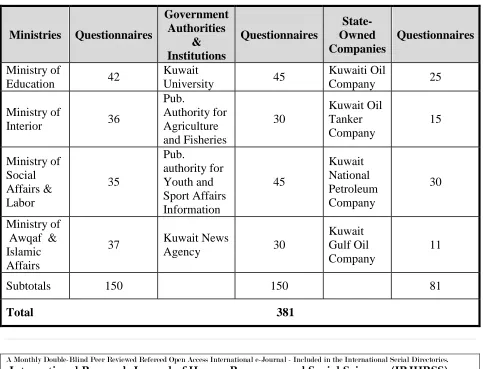
The study population as shown in table (1) consisted of employees in (12) government
agencies at the central level including (4) ministries, (4) government authorities/institutions, and
(4) state-owned companies. The study sample consisted of a convenient stratified sample of (450)
employees. A total number of (381) completed questionnaires were collected which accounts for
(85%) response rate. The researcher and two trained research assistants administered the
questionnaires during the spring of (2015).
Table (1)
Government Agencies and Returned Completed Questionnaires
Questionnaires State-Owned Companies Questionnaires Government Authorities & Institutions Questionnaires Ministries 25 Kuwaiti Oil Company 45 Kuwait University 42 Ministry of Education 15 Kuwait Oil Tanker Company 30 Pub. Authority for Agriculture and Fisheries 36 Ministry of Interior 30 Kuwait National Petroleum Company 45 Pub. authority for Youth and Sport Affairs Information 35 Ministry of Social Affairs & Labor 11 Kuwait Gulf Oil Company 30 Kuwait News Agency 37 Ministry of Awqaf & Islamic Affairs 81 150 150 Subtotals
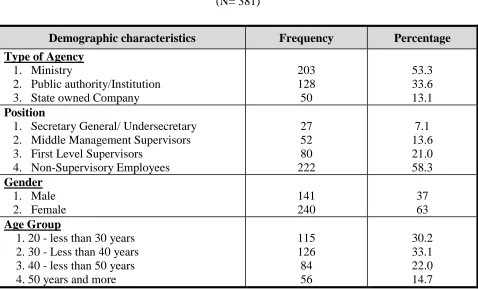
[image:12.612.66.549.363.732.2]The study sample as (Table 2) indicates that 53.3% of the respondents were from
ministries, 33.6% from government authorities and institutions, and 8.1% state-owned
companies. With regard to positions, 58.3% were ordinary employees, 21.0% middle
management supervisors, 13.6% top management employees, and 7.1% top leadership positions.
With regard to gender, females accounted 63% and males 37%. In terms of age 33.1% were
between 30-40 years, 30.2%, between 20-30 years, 22% were between 40-50 years, and 14.7%
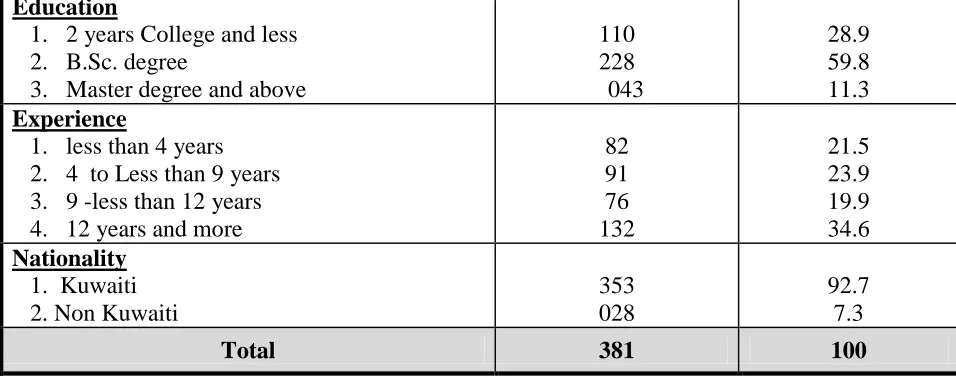
50 years and above. In terms of academic qualification, 59.8% had a first university degree,
28.9% had a two-year college degree or less, and 11.3% had a second university degree or more.
With regard to experience, 34.6% had more than 12 years, 23.9% had 4-9 years, and 21.5% had
less than 4 years and 19.9% had 9-12 years. Most of the respondents 92.7% were Kuwaitis and
7.3% were non-Kuwaitis. As shown in table (3) 44.9% of government agencies had strategies,
and 55.1% did not have strategies. This means that most of central government agencies did not
practice SM.
Table (2)
Profile of the Sample
(N= 381)
Demographic characteristics Frequency Percentage
Type of Agency
1. Ministry
2. Public authority/Institution 3. State owned Company
203 128 50 53.3 33.6 13.1 Position
1. Secretary General/ Undersecretary 2. Middle Management Supervisors 3. First Level Supervisors
4. Non-Supervisory Employees
27 52 80 222 7.1 13.6 21.0 58.3 Gender
1. Male 2. Female
141 240
37 63
Age Group
1. 20 - less than 30 years 2. 30 - Less than 40 years 3. 40 - less than 50 years 4. 50 years and more
[image:13.612.68.546.360.649.2]Education
1. 2 years College and less 2. B.Sc. degree
3. Master degree and above
110 228 043 28.9 59.8 11.3 Experience
1. less than 4 years 2. 4 to Less than 9 years 3. 9 -less than 12 years 4. 12 years and more
82 91 76 132 21.5 23.9 19.9 34.6 Nationality
1. Kuwaiti 2. Non Kuwaiti
353 028
92.7 7.3
Total 381 100
Results
Question One: Do Kuwaiti governmental agencies pay enough attention to develop strategic
plans in a formal document?
This question aimed at government agencies that had formal strategy document. Data collected
indicated as shown in (Table 3), that 69.3% of government agencies had strategies while 30.7%
did not.
Table (3)
Distribution of governmental Agencies between those did and those did not have a strategy
Formal Strategy Frequency Percentage
Government Agencies who have a formal strategy
Government Agencies Do not have a formal strategy Total 264 117 381 69.3 30.7 100
Question Two: Do Kuwaiti governmental agencies provide training for their employees in
strategic management?
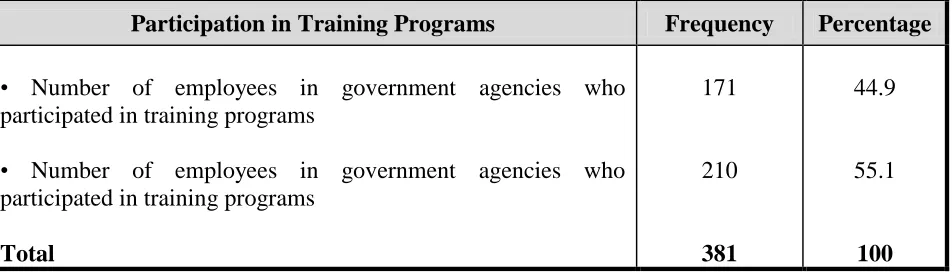
This question aimed at government agencies who had training programs in strategic
management. Data collected indicated, as shown in (Table 4) that 44.9% of the employees
[image:14.612.66.544.42.231.2]Table (4)
Distribution of Employees in Government Agencies who participated in SM Training Programs
Participation in Training Programs Frequency Percentage
• Number of employees in government agencies who participated in training programs
• Number of employees in government agencies who participated in training programs
Total
171
210
381
44.9
55.1
100
Question Three: Do Kuwaiti governmental agencies give the same importance to various phases
of strategic management.
Table 5 shows means of importance measured on Likert‟s five-point scale which government
agencies with strategic plans gave to different phases of strategic management. Means were
[image:15.612.66.546.87.225.2]respectively (3.51) for formulation, (3.50) for implementation, and (3.42) for evaluation.
Table (5)
Means and Standard Deviations of Importance that Government Agencies Gave to Various
Phases of Strategic Management
Rank S.
Deviations Means
The Phase
1 .80429
3.51 Strategy formulation
2 .91048
3.50 Strategy Implementation
3 1. 04533
3.42 Strategy Evaluation
.80533 3.48
Total
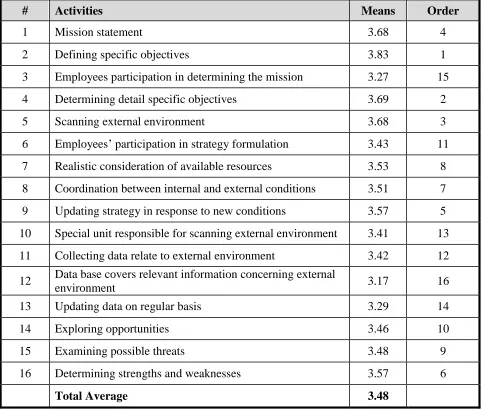
As far as degrees of importance given to various issues in the formulation phase of SM,
table (6) indicated that overall evaluation of the importance which government organizations
gave to strategy formulation activities was (3.48) on Likert‟s five points scale. The lowest
[image:15.612.72.548.89.226.2] [image:15.612.66.548.466.588.2]evaluation (3.83) was for defining specific objectives. Respondents‟ evaluations of strategy
management in the formulation phase activities ranged as shown in table (6) from (3.17- 3.83) on
Likert five-point scale. The highest evaluation (3.83) was for government agencies‟ defining
specific objectives, followed by governmental agencies efforts to detailed objectives in order to
[image:16.612.66.549.224.637.2]achieve strategy (3.69).
Table 6
Means of Importance, Which Government Agencies Gave to Various Activities in the
Formulation Phase of Strategic Management
Order Means Activities # 4 3.68 Mission statement 1 1 3.83
Defining specific objectives 2
15 3.27
Employees participation in determining the mission 3
2 3.69
Determining detail specific objectives 4
3 3.68
Scanning external environment 5
11 3.43
Employees‟ participation in strategy formulation 6
8 3.53
Realistic consideration of available resources 7
7 3.51
Coordination between internal and external conditions 8
5 3.57
Updating strategy in response to new conditions 9
13 3.41
Special unit responsible for scanning external environment 10
12 3.42
Collecting data relate to external environment 11
16 3.17
Data base covers relevant information concerning external environment
12
14 3.29
Updating data on regular basis 13 10 3.46 Exploring opportunities 14 9 3.48
Examining possible threats 15
6 3.57
Determining strengths and weaknesses 16
3.48 Total Average
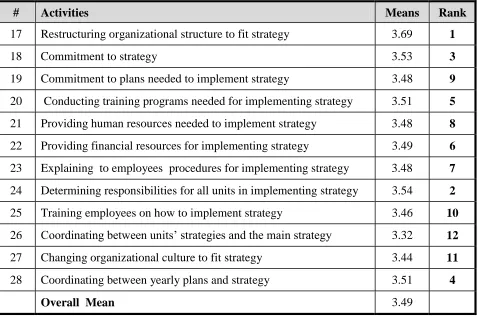
As far as implementation phase is concerned, table (7) showed that the overall evaluation
evaluation was for restructuring organizational structure to be in tune with the strategy and the
[image:17.612.70.548.175.493.2]lowest (3.32) was for coordination between units‟ strategies and the main strategy.
Table 7
Means of Importance that Government Agencies Give to Various Activities in the
Implementation Phase of SM
Rank Means Activities # 1 3.69 Restructuring organizational structure to fit strategy
17
3
3.53 Commitment to strategy
18
9
3.48 Commitment to plans needed to implement strategy
19
5
3.51 Conducting training programs needed for implementing strategy
20
8
3.48 Providing human resources needed to implement strategy
21
6
3.49 Providing financial resources for implementing strategy
22
7
3.48 Explaining to employees procedures for implementing strategy
23
2
3.54 Determining responsibilities for all units in implementing strategy
24
10
3.46 Training employees on how to implement strategy
25
12
3.32 Coordinating between units‟ strategies and the main strategy
26
11
3.44 Changing organizational culture to fit strategy
27
4
3.51 Coordinating between yearly plans and strategy
28
3.49
Overall Mean
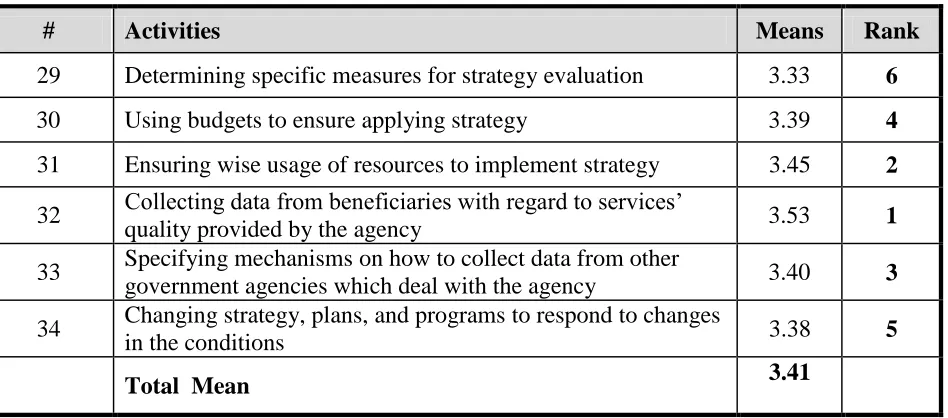
With respect to evaluation phase, table (8) showed the overall evaluation of its activities
was (3.41). The highest evaluation was for collecting data from beneficiaries with regard to
services‟ quality provided by the agency. Evaluations of other activities ensured wise usage of
resources to implement strategy, to specify mechanisms for collecting data from other
government agencies, use budgets to ensure applying strategy, changing strategy, plans, and
programs to respond to changing conditions, to determine specific measures for strategy
Table 8
Means of importance that government agencies give to various activities in the evaluation
stage of strategic management
Rank Means Activities # 6 3.33 Determining specific measures for strategy evaluation
29
4
3.39 Using budgets to ensure applying strategy
30
2
3.45 Ensuring wise usage of resources to implement strategy
31
1
3.53 Collecting data from beneficiaries with regard to services‟
quality provided by the agency 32
3
3.40 Specifying mechanisms on how to collect data from other
government agencies which deal with the agency 33
5
3.38 Changing strategy, plans, and programs to respond to changes
in the conditions 34
3.41 Total Mean
Question Four What are the main obstacles Kuwaiti government agencies face in their efforts to
apply strategic management?
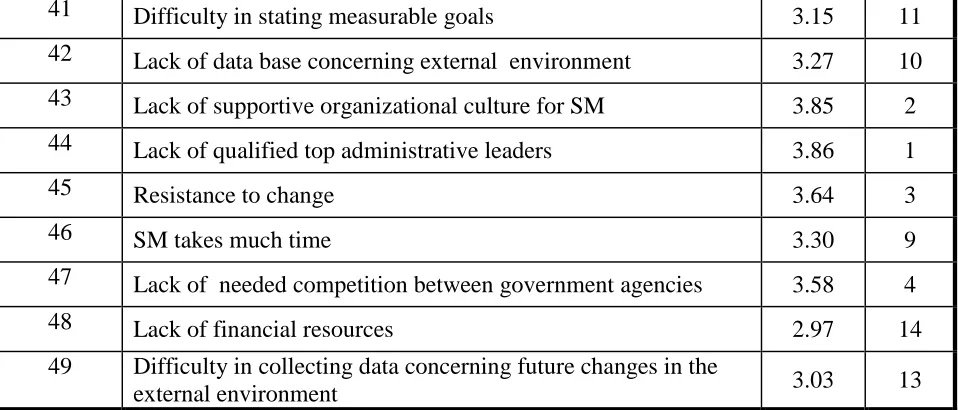
Many obstacles to SM application in government agencies were reported as Table (9) shows.
The highest evaluation of obstacles was low qualification of the staff (3.86) and the lowest
evaluation was for lack of financial resources (2.97).
Table 9
Means of Employees’ Evaluation of Obstacles to Strategic Management
Rank Means Obstacles # 15 2.94
Lack of appreciation of SM 35
7 3.40
No Written mission 36 5 3.47 No vision 37 6 3.47
No specialized administration for SM 38
8 3.39
Lack of specialized people in SM 39
12 3.14
[image:18.612.63.551.530.731.2]11 3.15
Difficulty in stating measurable goals 41
10 3.27
Lack of data base concerning external environment 42
2 3.85
Lack of supportive organizational culture for SM 43
1 3.86
Lack of qualified top administrative leaders 44
3 3.64
Resistance to change 45
9 3.30
SM takes much time 46
4 3.58
Lack of needed competition between government agencies 47
14 2.97
Lack of financial resources 48
13 3.03
Difficulty in collecting data concerning future changes in the external environment
49
Test of Hypotheses
H 1. Training employees in SM enhances their interest in adopting it.
To test this hypothesis, means, standard deviations, and (t) tests were computed to find out
the impact of the training received by staff in strategic planning on their interest in strategic
management. Table (10) showed that the (t) value is positive and significant (0.000), which
support validity of the hypothesis. This result was confirmed by results of other research (Fard et.
al., 2011).
Table (10)
T- Test of the Impact of Training in SM on Enhancing their Interest in the Subject
One-Sample Statistics
N Mean Std.
Deviation Std. Error Mean
TRAINING 381 1.5512 .49803 .02551
One-Sample Test
Test Value = 0
t df Sig. (2-tailed)
Mean Difference
95% Confidence Interval of the Difference
Lower Upper
[image:19.612.68.547.41.246.2]H 2. Staff knowledge that their organizations have strategic plans enhances effectiveness of
strategic planning.
To test this hypothesis, means, standard deviations, and (t) tests were computed to find out
whether the impact of staff knowledge of strategic plans in their organizations enhances
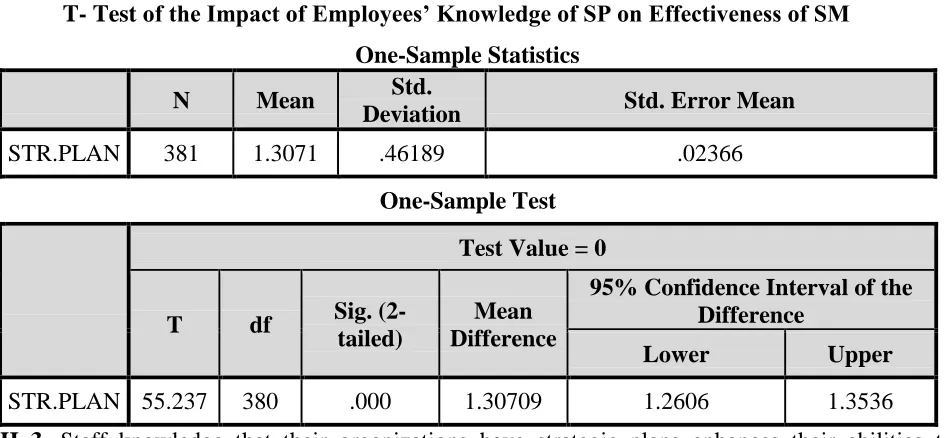
effectiveness of strategic plans. Table (11) showed the (t) value is positive (55.237) and significant
(0.000), which supports the validity of the hypothesis. This result was confirmed by other research
results (Hashem, 2006).
Table (11)
T- Test of the Impact of Employees’ Knowledge of SP on Effectiveness of SM
One-Sample Statistics
N Mean Std.
Deviation Std. Error Mean
STR.PLAN 381 1.3071 .46189 .02366
One-Sample Test
Test Value = 0
T df Sig.
(2-tailed)
Mean Difference
95% Confidence Interval of the Difference
Lower Upper
STR.PLAN 55.237 380 .000 1.30709 1.2606 1.3536
H 3. Staff knowledge that their organizations have strategic plans enhances their abilities to
confront obstacles facing their implementation.
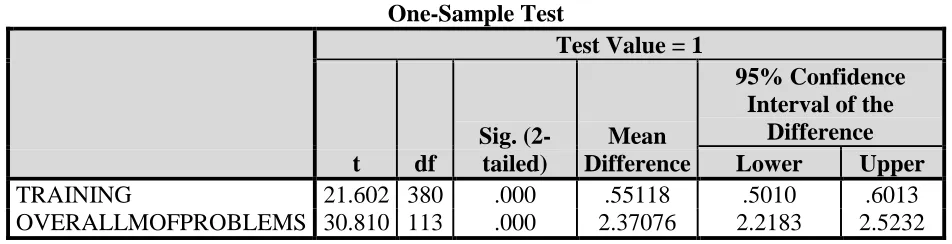
To test this hypothesis, means, standard deviations, and (t) tests were computed. Table
(12) showed that the (t) value is positive (21.602) and significant (0.000), which supports the
validity of the hypothesis.
Table (12)
T- Test of the Impact of Employees’ Knowledge of SP on Their Abilities to Confront those
Obstacles
One-Sample Statistics
N Mean Std. Deviation Std. Error Mean
[image:20.612.72.545.224.443.2]One-Sample Test
Test Value = 1
t df
Sig. (2-tailed)
Mean Difference
95% Confidence Interval of the
Difference Lower Upper
TRAINING 21.602 380 .000 .55118 .5010 .6013 OVERALLMOFPROBLEMS 30.810 113 .000 2.37076 2.2183 2.5232
H 4. There are differences at significant levels in employees‟ Perception of SM according to type
of agency, job title, gender, age, education, experience, and nationality.
To test this hypothesis, (ANOVA) test was conducted. The analysis showed, as table (13)
indicated, significant variations at significant levels in employees‟ perception of SM according to
type of agency, sex, age, experience, and nationality, which supports validity of the hypothesis.
Table (13)
ANOVA for the Perception of SM and Demographic Variables
The Variable F value Statistical
Significance
Acceptance/Rejection of Hypothesis
Type of Agency 9.181 .000** acceptance
Job Title .571 .634 rejection
Gender 14.56 .000** acceptance
Age Group 5.908 .001** acceptance
Qualifications 1.241 .291 rejection
Years of Experience 6.120 .000** acceptance
Nationality 3.863 .050* acceptance
**. Correlation is significant at the 0.01 level (2-tailed).
*. Correlation is significant at the 0.05 level (2-tailed).
H 5. There are differences at significant levels in employees‟ perception of SM obstacles
[image:21.612.68.544.64.186.2]To test this hypothesis, (ANOVA) test was conducted. The analysis showed, as (Table
14) indicated, no variations at significant levels in employees‟ perception of SM obstacles
according to job, type of agency, experience, gender, age, education and nationality, which does
not support the hypothesis.
Table (14)
ANOVA for the Perception of SM Obstacles and Demographic Variables
The Variable F value Statistical
Significance
Acceptance/Rejection of Hypothesis
Type of Agency 1.565 .214 rejection
Job Title .038 .990 rejection
Gender 3.091 .081 rejection
Age Group .278 .
841 rejection Qualifications .816 .445 rejection
Years of Experience .452 .716 rejection
Nationality .370 .544 rejection
**. Correlation is significant at the 0.01 level (2-tailed).
*. Correlation is significant at the 0.05 level (2-tailed).
Conclusions & Recommendations
The results of this study indicated that employees of government agencies who have
received training in SM form (44.9%) compared to (55.1%) who did not have such training. This
explains gaps in the field of SM and many obstacles confronting its adoption. Moreover, results
showed that most government agencies in Kuwait (69.3%) realize the importance of SM in
implementing strategic plans and in allocating resources. Besides, study results showed that
strategy formulation in government agencies was a first priority with a mean of (3.51) followed
respectively by implementation (3.50) and evaluation (3.42). The evaluation process was the
weakest point compared to formulation and implementation phases. This result can be attributed
to lack of specialized personnel in evaluation, which indicates the need for more training in this
[image:22.612.64.548.172.358.2]Regarding variations in employee‟s perceptions of SM and obstacles to its application in
government agencies, study results showed significant variation in employees‟ perception of SM
according to agency type, gender, age, years of experience, and citizenship. In contrast, study
results showed no significant variations in employees‟ perception of obstacles facing SM‟s
application according to any demographic variables, which reflects a consensus among
respondents with regard to obstacles confronting SM in government agencies.
With regard to obstacles encountering SM adoption in government agencies, the main
obstacles according to study findings included the following:
-Lack of specialists in strategic planning.
-Lack of specialized administrative units responsible for strategic planning.
-Lack of competition among government agencies.
-Employees‟ ignorance of their agencies having strategic plans.
- Lack of commitment by government agencies to SM.
- Government organizations‟ overemphasis on control inputs, implement actions and business
rules at the expense of outputs and results.
-Lack of focus on SM training.
Based on study results, some recommendations are presented as follows:
• Government agencies have to exert special efforts to involve all stakeholders of government
agencies in SM to ensure better understanding of their goals, and subsequently a mechanism for
preparing and implementing strategies.
• Government agencies should focus more on SM training for employees in general and those in
leadership positions because that can enable them to respond better to the dynamic changes in
the environment.
• Placing more emphasis by senior management on environment scanning on a regular basis,
which is very essential to effective SM.
• Increasing employee engagement in SM, for its positive impact on the development of skills in
• Better coordination between strategic plans and annual goals can have positive impact on
strategy implementation.
• Recognizing obstacles to SM application in government agencies, and exerting more efforts to
combat them by working on finding effective strategic information systems for collecting and
analyzing data on the external environment, in order to identify positive and negative impact on
functioning of the State apparatus.
•Providing all requirements for implementing SM plans including systems and structures,
organizational culture, financial, human and technical resources.
• Introducing competition among government agencies through total quality control methods and
incentives excellence awards, to simulate SM as a support tool to face competition, which can
enhance optimal use of material, technical and financial resources to ensure their competitive
advantage.
• Transforming input and control procedures and rules to outputs and outcomes orientation to
determine the level of achievements made by government agencies.
• Learning from experiences of other countries that have adopted SM in government, and
identifying obstacles encountered and how to confront and overcome them.
• Conducting seminars and workshops to clarify the concept and importance of SM practice by
highlighting its benefits.
Suggestions for Future Research
It is important that future studies on SM in the public sector focus specifically on
government effectiveness to assess methodology in different phases of strategic plans and
contrasting performance of government agencies that adopt SM with those which do not.
Moreover, other studies of SM in government agencies at activity and functional levels can be
References
1. Abu Naim, Abdul Hamid. (1994). the practice of Strategic Management in Egyptian
Organizations. Journal of Accounting, Management and Insurance, (46): 1-47.
2. Adelelbhy, Seif. (1424 h). Reality of Strategic Planning in the Public Authority for Treatment
of Salty Water in Saudi Arabia. Unpublished Master thesis, Riyadh: King Saud University.
(Arabic).
3. Alcázar ,Fernando Martín. et.al., (2013) "Workforce diversity in strategic human resource
management models: A critical review of the literature and implications for future
research", Cross Cultural Management: An International Journal, Vol. 20 Iss: 1, pp.39 –
49
4. Al Ghali, Mohsan Mansour and Wael Mohamed Sobhy Idrees. (2007). Strategic
Management: an Integrated Methodological Perspective. 1st edition. Amman: Dad Wael for
Publishing and Distribution. (Arabic).
5. Al-Hammad, Fahhad. (1993). Scanning the External Environment of the Central
Governmental Organizations: Sources and Methods of Obtaining Information on
Environmental Changes. Riyadh: Institute of Public Administration. (Arabic).
6. Al-Morsy, Jamal al-Din et. al.. (2002). Strategic Thinking and Strategic Management: an
Applied Approach. Alexandria: Addar Al-Jamiyah. (Arabic).
7. Al-Qarioti, Mohammed Qasem. (2015). Organization Theory and Organization. Fourth
Edition. Amman: Dar Wael for Publishing and Distribution. (Arabic).
8. Ansoff, H. I., & Hayes, R. L. (1976). Introduction. In H. I. Ansoff, R. P. Declerck & R. L.
Hayes (Eds.), From Strategic Planning to Strategic Management (pp. 1-14). London: John
Wiley & Sons.
9. Al Shamsi, Salem (2010). Measuring Effectiveness of the Application of Strategic Planning in
of the Ministry of Education in the Sultanate of Oman. Unpublished MA thesis, Tashreen
University. (Arabic).
10. AShboul, Munther (2005). Reality of Strategic Management in the Ministry of Education in
Jordan and Designing a Model for its Development. Unpublished Ph.D. dissertation, Amman:
University of Jordan, Jordan. (Arabic).
11. Assayed, Ismail Mohamed. (1999). Strategic Management: Concepts and Case Studies.
1st edition. Alexandria: Addar Aljamiah for Publishing and Distribution. (Arabic).
12. Ayande, Alpha, Sabouring, Vicent, and Sefa, Ergis. (2012). “Managerial Execution in Public
Administration: Practices of Managers When Implementing Strategic Objectives”. International
Journal of Business and Management. Vol. 7, No. 7. 19: 55-75.
13. Bozeman, Barry and Straussman, Jeffrey D. (1990). Public Management Strategies: Guide
Lines for Managerial Effectiveness. San Francisco, CA: Jossey-Bass.
14. Bruton, Garry D. & Ahlstorm, David. International Management. (2010). International
Management: Strategy and Culture in the Emerging world. (Mason: Southwestern Cengage
Learning).
15. Bryson, J. M. (2011). Strategic Planning for Public and Nonprofit Organizations: A
Guide to Strengthening and Sustaining Organizational Achievement. San Francisco, CA:
Jossey-Bass A Wiley Imprint.
16. Davous, P., & Deas, J. (1984). Design of a Consulting Intervention for Strategic
Management. In H. I. Ansoff, R. P. Declerck & R. L. Hayes (Eds.), From Strategic Planning to
Strategic Management (pp. 79-99). London: John Wiley & Sons.
17. Denhardt, Robert B. (1993). The Pursuit of Significance: Strategies for Managerial
18.Drumaux, Anne & Goethals, Christophe. (2007) "Strategic management: a tool for
public management?: An overview of the Belgian federal experience", International
Journal of Public Sector Management, Vol. 20 Iss: 7, pp.638 – 654.
19. Eisenhardt, K.M. and Martin, J.A. (2000), “Dynamic capabilities: what are they?”, Strategic
Management Journal, Vol. 21, pp. 1105‐21.
20. Elbanna, Said. (2011). “Strategic Planning in the United Arab Emirates”. International
Journal of Commerce and Commerce and Management. Vol. 20. No.1: 26-40.
21. Esmaeil, Zaei Mansour. Yarahmadzehi1, Mohammad Hossien and Abtin, Abdulaziz. (2013).
“Strategic Management Practices in the Local Authorities: Factors Associated with Adoption of
Strategic Management practices in the local authorities”. Interdisciplinary Journal of
Contemporary Research in Business. Vol. 5, No. 3. 735-744.
22. Fard, Hassan Danee. et al. (2011). Strategic Management in the Public Sector: Reflections on
its Applicability to Iranian Public Organizations. Public Organization Review. 11: 385-406.
23. Frost, F.A. (2003), “The Use of Strategic Tools by Small and Medium-Sized Enterprises: an
Australasian study”. Strategic Change. Vol. 12, Issue 1: 49-62.
24. Greenley, G.E., Hooley, G.J., Broderick, A.J. and Rudd, J.M. (2004), “Strategic Planning
Differences among Different Multiple Stakeholder Orientation Profiles”, Journal of Strategic
Marketing. Vol. 12, 3: 163-82.
25. Hanna, F. (2012). “Strategic Requirements for Adopting Strategic Management from Academic Staff Perspective in the Faculty of Education at Damascus University: A Field Study”.
Vol. 28. No. 4.: 59-112.
26. Hashem, Layla Bint Saad. (2006). "Reality of Strategic Management in Saudi Government
27. Hensey, M. (1997). Strategic planning: developments and improvements. Journal of
Management in Engineering, 29–32, March–April.
28. Ishak,I. S. R., Alias, R. A., Adam, U. and Suradi, Z. (2013). “ICT Strategic Planning in
Malaysia Public Research Institute “. International Journal of Education, Business,
e-Management and e Learning, Vol. 3, No. 5, October: 391-396.
29 Jackson, S.E., Joshi, A. and Erhardt, N.L. (2003), “Recent research on team and
organizational diversity: SWOT analysis and implications”, Journal of Management, Vol. 29
No. 6, pp. 801‐30.
30. Leskaj E., Lipi I. and Kume A. (2013). “Strategic Management Aspects in Public Services in
Albania Case of Albanian Post Company. Management Research and Practice. Vol. 5 Issue 1
(2013) pp: 67-78.
31. Maya, Ali, et. al. (2007). Strategic Management and its Impact on Raising Performance of
Business Organizations: a Field study on Public Industrial Organizations on the Syrian Coast.
Tishreen University. Journal for Scientific Studies and Research. Legal and Economic
Sciences. vol. (29) No. (1): 189-210. (Arabic)
32. Ofori, Daniel and Atiogbe, Esther. (2012). “Strategic Planning in Public Universities: A
Developing Country Perspective”. Journal of Management and Strategy Vol. 3, No. 1;
February: 67-82.
33. Pina, Vicenta, Lourdes, Torres, and Yetano, Ana. (2011) “The Implementation of Strategic
Management in Local Governments. an International Delphi Study.” PAQ winter: 551-590.
34. Poister, Theodore H., Pitts, David W. and Edwards, Lauren Hamilton (2010). “Strategic
Management Research in the Public Sector: A Review, Synthesis, and Future Directions”, the
35. Poister, Theodore H. and Streib, Gregory. (2005). “Elements of Strategic Planning and
Management in Municipal Government: Status after Two Decades” Public Administration
Review; Jan/Feb; 65, 1: 45-56.
36. Poister, T.H. and Streib, G.D. (1999). “Strategic Management in the Public Sector:
Concepts, Models, and Processes”. Public Productivity and Management Review. 23(3),
308-325.
37. Rainey, Hal G. (1991). Understanding and Managing Pubic Organizations. San
Francisco: Jossey-Bass.
38. Ramsey, David et.al. (2010) "Strategic Management: Formulation, Implementation, and
Control in a Dynamic Environment", International Journal of Commerce and
Management, Vol. 20 Iss: 2, pp.188 – 189.
39. Ring, P.S. and Perry, J.L. (1985), “Strategic management in public and private organizations:
implications of distinctive contexts and constraints”, The Academy of Management Review,
Vol. 10 No. 2, pp. 276‐86.
40. Roweibeh, Kamal. (2004). Study of the Extent of corporate Administrators‟ Awareness of
Using Strategic Information. Arabic Journal of Administrative Sciences, vol (11), (2):
149-181. (Arabic).
41. Sa, Yongjin. (2013). “Elements of Strategic Management Process and Performance
Management Systems in U.S. Federal Agencies: Do Employee Managerial Levels Matter?”
International Journal of Business and Management; Vol. 8, No. 9; 2013: 1833-1850.
42. Schaffer, U. and Willauer, B. (2003), “Strategic Planning as a Learning Process”,
Schmalenbach Business Review. Vol. 55, 2: 86-107.
43 Thompson, John L. (1997). Strategic Management: Awareness and Change. 3rd Edition.
44. Westphal, J.D. and Fredrickson, J.W. (2001), “Who directs strategic change? Director
Experience, the selection of new CEOs, and change”, Strategic Management Journal, Vol. 22,