Citation:
Stavropoulos, N (2018) Inside the intimate zone: The case of aural micro-space in multichannel
compositional practice.
In: Proceedings of the 15th Sound and Music Computing Conference
(SMC2018). Sound and Music Computing Network, pp. 113-117. ISBN 978-9963-697-30-4
Link to Leeds Beckett Repository record:
http://eprints.leedsbeckett.ac.uk/5304/
Document Version:
Book Section
The aim of the Leeds Beckett Repository is to provide open access to our research, as required by
funder policies and permitted by publishers and copyright law.
The Leeds Beckett repository holds a wide range of publications, each of which has been
checked for copyright and the relevant embargo period has been applied by the Research Services
team.
We operate on a standard take-down policy.
If you are the author or publisher of an output
and you would like it removed from the repository, please
contact us
and we will investigate on a
case-by-case basis.
INSIDE THE INTIMATE ZONE: THE CASE OF AURAL
MI-CRO_SPACE IN MULTICHANNEL COMPOSITION PRACTICE
Dr Nikos Stavropoulos
Leeds Beckett University
ABSTRACT
This paper aims to present the notion of aural micro-space, an area whose aural architecture is not accessible unless it is mediated by recording technology and discuss the exploration of this concept in compositional practice. The author analyses the characteristics of acoustic space from a spectromorphological, cultural and technical per-spective, with a focus on auditory intimacy and is propos-ing novel ways for workpropos-ing in this domain with refer-ences to two multichannel acousmatic works, Topophilia and Karst Grotto.
1. INTRODUCTION
The articulation of acoustic space as a feature of musical practice is something that has been discussed widely in the electroacoustic music literature over the last two dec-ades as a proliferation of works which utilise more than two channels indicated an increased sensibility towards aural architecture, immersivity and the articulation of acoustic space as a carrier of musical structure in elec-troacoustic music. Alongside the development of theo-retical concepts which allow the consideration of space in this context [1] and the analysis of compositional prac-tices specifically relating to the organisation of space [2] [3] [4], we have seen considerable developments in the tools that composers use to explore sound materials which cater for the realisation of existing processes (pan-ning, granular reconstruction, algorithmic organisations etc) in multichannel formats. The use of space, often re-ferred to as the final frontier, appears to be addressing issues relating the reception of electroacoustic music and to the materiality of acousmatic sound.
2. COMPOSING SPACE
Considering the evolution and increased sophistication of time and frequency domain processing strategies since the inception of a sound based musical language, in order to achieve the rich spectromorphological sound vocabu-lary which characterises current electroacoustic music works, the strategies employed to generate and organise acoustic space appear to have developed little in compari-son. These normally involve the placement of sounds in a field defined by the number of channels and their position around the listening spot, the panning of sounds in that
field and the presentation of acoustic space as resonance, defined by Macedo as the acoustic effects of the envi-ronment on sound [5]. The latter is either recorded, al-most always in stereo, or simulated using ubiquitous stu-dio techniques. A notable exception to this is the use of ambisonic recording techniques to capture a more de-tailed circumferential acoustic space however, the lack of B-Format sound processing tools hinder the use of such recordings in common workflow practices. A more re-cent addition to the above is the creation of acoustic space by embedding spatial dispersion of the output in time and frequency domain processing; distribution of grains in granular reconstruction / synthesis or distribu-tion of spectral bands respectively. These techniques are usually combined in the construction of acoustic space in multichannel works.
It should be noted here that although other at-tributes of the sound object, amplitude, timbre (including pitch) and duration, are considered collectively as a total-ity, the methodology outlined above suggests that space is considered separately. In discussions of compositional practice in this context, it is even suggested that the sound image consists of sounds and their spatial disposi-tions, two separate things [2]. Although this suggestion reflects a reality of spatio-musical compositional strategy, it indicates a visucentric approach rooted in the attributes of visual space, a concept whose characteristics are con-trasting those of acoustic space as discussed in detail by McLuhan [7]. McLuhan’s binary, reductive and essential-ist approach to the discussion of space provides a unique theoretical framework through which to examine spatial music practice in general and more pertinently, in mul-tichannel electroacoustic composition. The one-at-a-time approach to the consideration and construction of space is according to McLuhan rooted to the dominance of visual culture in the shaping of western thought and is contrast-ing the nature of acoustic space which is characterised by the lack of boundaries and the presence of centres every-where to be perceived simultaneously. The compositional practice discussed below aims to explore an approach to working with space informed by these concepts and in-vestigate, in the context of compositional practice, what McLuhan calls the “mentality of the multitude, or as Yeats put it: everything happening at once, in a state of constant flux” [7].
In addition, the approach to the construction of acoustic space in multichannel works, which more often
than not relies on the strategies outlined above, is some-what detached from the acousmatic working ethos, which is rooted in the collaboration between the composer and the qualities of the sound material [8]. A concrete way of working which favours an exploration of the qualities of raw materials for the construction of abstract musical meaning [6] over an architectonic approach to composi-tion, which is alluded to by the fragmentation and consid-eration of the attributes of the material in separation. The spectromorphological profiles of collected sound materi-als imbue the resulting sound world of the composition regardless of the ability of listeners and /or the composer to trace any relationship of the latter to the former. In the case of spatial attributes, although this might in some instances be also true in stereo works, it appears that spa-tial organisation of sound objects in multichannel works, and perhaps also in sound diffusion based performances, is subject to a more abstract way of thinking. The compo-sitional practice employed in the development of the two acousmatic works discussed below is an attempt to unify spatiomorphology and spectromorphology [9] in the workflow; to consider those in conjunction with each other during the development and arrangement stages of the compositional process.
3. AURAL MICRO-SPACE
The classification of our perception of space offered by the theory of proxemics [11] is a useful starting point to consider the acoustic spaces created by acousmatic works. Smalley discusses many of the about 50 different types of space defined in his seminal work on the subject in relation to the four distance zones: intimate, personal, social and public. The notion of intimacy in terms of aural experiences is used here in metaphorical terms i.e. gestural space but also in experiential terms, i.e. micro-phone space. The use of micromicro-phone techniques to invoke perception of proximity also appears in discussions of popular music techniques [10] and the ability of sound reproduction technologies to invoke aural intimacy through mediated sound is discussed in analyses of me-diatized culture [12]. The above refer to perceptions of sound events inside the intimate zone, defined as an area up to 45cm from the listening position. Aural intimacy also appears as a perception of sound events in personal and social space zones in discussions of aural architecture [13] and psychological perceptions of human presence.
A number of relatively recent acousmatic works appear to be occupied with notions of intimacy and prox-imity as it transpires from their titles and program notes. Examples include Stollery’s Shortuff, where the com-poser is making reference to sounds being “upfront with little middle or background”, Blackburn’s Switched On
and Time Will Tell, where the composer refers to micro-scale ticks, tocks, clanks and bumps as well as sonic mi-crostructures and Redolfi’s Micro Espaces 5808, where the composer is referring to “microscopic sound spaces picked up by close-miking.”
Henricksen, in his discussion of space as an es-sential element of expression in electroacoustic music
alludes to the effectiveness of musical activity in intimate space.“Intimacy and the expansion of musical space into the listener's psychological private sphere can be a pow-erful means in musical expression” [14].
The idea of intimate acoustic space is prevalent in the author’s previous work and has been implicit by the use of spectromorphological characteristics which suggest proximity: the absence of reflections, the preva-lence of high frequency content and impulse like onsets. In addition, the majority of the author’s compositional output makes use of acoustic space as a structural ele-ment of the work through the use of multichannel audio. The articulation of acoustic space here is used to enhance clarity of sound materials by exemplifying their character and musical functions [3] [4]. In these cases, acoustic space in the work of the author was constructed using the techniques discussed in the opening sections of this paper and separately from the development of derivative spec-tromorphologies from original recordings. The approach outlined below is an attempt to connect spatial behaviour to the other qualities of sound materials using multichan-nel recording techniques in what is here defined as aural micro-space. Aural space is defined by Blesser as “area where inhabitants can hear sonic events” [13]. The ability to hear sonic events allows inhabitants to perceive the structure of the acoustic space. Based on this concept, aural micro-space is defined as an area of acoustic space, which cannot be inhabited due to physical constraints, which relate to size. Aural architecture exists in micro space-but it is not accessible unless mediated by record-ing technology. It should be noted here that although the structure of acoustic space is not accessible, sound events themselves can be audible as a nested space [14].
4. COMPOSITIONAL PRACTICE
The sections below describe the author’s approach in recording and working with aural micro-space in the composition of two multichannel acousmatic works,
Topophilia and Karst Grotto.
4.1. The impulse
capture a pointillistic texture rather than the complex spatial behaviour observed in the video. This led to con-sidering the appropriation, the scaling down, of mul-tichannel recording techniques.
4.2. Microphone array design and initial observations
[image:4.595.338.508.117.286.2]Initial experiments involved attempts to record sound material using multichannel techniques in spaces compa-rable in size with the area covered by the phenomenon in the video. Evidently, the size of the microphone capsule was the single most problematic aspect of this endeavour. The size of microphones usually employed in standard multichannel recording arrays, which typically occupy planes with circumference of a few feet, was not much smaller than the size of the area that was to be recorded. The attempt to solve this issue involved scaling down a Polyhymnia pentagon, a surround microphone array in-vented by Dutch recording and post-production studio – Polyhymnia International, formerly Philips Classics Re-cording Department - which is used widely to record choirs and instrumental ensembles. This technique is based on five widely spaced omnidirectional micro-phones [16]. The test recordings where conducted using five DPA 4060 miniature omnidirectional microphones
Figure 1. Polyhymnia pentagon.
arranged in a circle with a diameter of circa 12cm (Figure 2). Recording subjects included an approximation of the observed phenomenon, which involved scattering pulse grains on hard surfaces around the microphone array, as well as circular movement of single grains in small cir-cumference (a few centimeters), gestural trajectories across the recorded space (scraping on different materi-als) and recordings inside resonating structures (the bell of a cymbal). Although it is not possible to evaluate the accuracy of the representation of the acoustic space that was recorded, as we were dealing with aural micro-space, recordings displayed a strong spatiality and a perceived increased materiality / tangibility. Concerns that the ex-treme proximity of the microphones would compromise channel separation to the extend that spatial cues will be rendered illegible were not corroborated.
Following these initial tests, the hypothesis that increased perceived materiality and tangibility of source sounds would positively affect signification – the process of a sequence of sounds acquiring musical meaning [17]
[image:4.595.104.273.365.497.2]was formed. This hypothesis is based on the notion that the material vehicle is closely related to the musical idea that it bears “musical signification changes substantially when sound materiality is changed” [17].
Figure 2. DPA array.
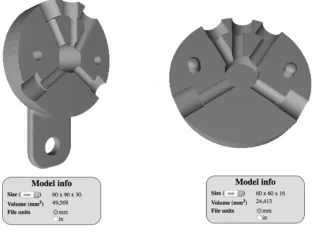
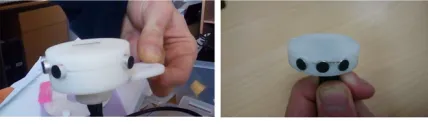
Initial tests were followed by attempts to reduce further the size of the array and to test alternatives to the expen-sive microphones used initially, in order to undertake recordings in less controlled and more challenging envi-ronments, like inside a hot frying pan. These attempts involved working with two sets of affordable electret condenser microphone capsules with a diameter of 1cm and 0.5 cm respectively. The challenge in this next phase was to retain the angular positions specified in the Poly-hymnia model. This was overcomed by the use of 3D printed casings, specifically designed to hold the micro-phones in the correct position whilst significantly reduc-ing the overall size of the array (Figures 3 and 4).
Figure 3. Microphone casing 3D designs.
[image:4.595.349.505.499.618.2]All sound materials collected using the DPA and the elec-tret condenser arrays where treated as 5 channel coherent audio stream sets [18] and where processed using mul-tichannel tracks in a DAW. Original recordings where only processed using
Figure 4. Mounted arrays.
plugins which catered for multichannel sources in an ef-fort to embed the characteristics of the sources’ acoustic space in the development of new materials. This is not to say that the acoustic space captured in the recordings is retained in the processed sounds materials, but rather that it inoculates the resulting spatiomorphologies. These sound materials formed the starting point for two fixed media multichannel works, Topophilia and Karst Grotto, which are discussed briefly below.
4.3. Topophilia
The concept of topophilia relates to attraction or affinity to place, the bond between a person and a specific lo-cality. Topophilia is understood to be the result of the perception of a particular environment, “the response of senses to external stimuli and purposeful activity” [19]. In this case the term is borrowed to suggest the allure of a type of place – a space instilled with musical meaning – which displays characteristics of intimacy and closeness. An abstract musical topos, which exists in the intimate and personal zones and is rooted in the concrete material-ity of the sound objects inhabiting it. The work is not only an artistic interpretation of the notion of aural-micro-space but also an attempt to work with the reality of such a notion in a way that the latter permeates the former. In Topophilia, texture and spatially defined fig-ures have a broader capacity for action due to their multichannel nature. The work has been performed widely, published on CD by Musiques & Recherches and has been awarded numerous accolades1.
4.4. Karst Grotto
Karst Grotto was composed during residencies at the De-partment of Music Technology and Acoustics in Crete and the Institute for Computer Music and Sound
Tech-1 1st Prize, International Electroacoustic Composition Competition “Iannis
Xenakis”, Contemporary Music Lab of Aristotle University, Greece. Electronic Music Category Winner, The New Music Consortium, University of South Florida, USA.
1st Prize - Acousmatic Category, IX° Foundation Destellos Competition 2016, Argentina.
2nd Prize, KLANG! electroacoustic composition competition 2016, France. 3rd Prize - Résidence ICST-Zurich,Concours International de Composition Elec-troacoustique de Monaco.
Honourable Mention, 8ème concours biennal de composition acousmatique Mé-tamorphoses, Belgium.
nology in Zurich. The title, chosen for its onomatopoeic qualities and its direct references to landscape types, as well as geological spatial structures and processes, re-flects the sound world of the work. Karst, a particular topography is created by the dissolution of soluble rock types from their contact with acidic rain water. A micro-level chemical process which characterises the morphol-ogy of entire landscapes and results in complex networks of small-scale, micro-space, features and textures like fissures and rillenkarrens.
This work is building on the techniques used in Topophilia by using ambisonic technology to encode in 3rd-order B-Format multichannel stems of raw and pro-cessed recordings as soundfield planes which could be rotated (yaw, pitch and roll) on three axes whilst main-taining a coherent plane structure. The five discrete chan-nels of each 5.0 and 5.1 stem were treated as point sour-ces and were positioned in the soundfield to delineate a plane by mirroring the ITU-R recommendation for 5.1 systems and the Polyhymia array (the arrangement of speakers in the recommendation is identical to the ar-rangement of microphones in this particular array). The three types of rotations mentioned above increased fur-ther the compositional capacity of micro-space.
5. CONCLUSIONS
The compositional methodology employed in the two multichannel fixed media works discussed above at-tempted to explore in practice the concept of micro-space as this is defined in this paper. The premise that the aural architecture of micro-space could be accessed by adapt-ing existadapt-ing multichannel recordadapt-ing techniques was con-firmed by recorded material which displayed strong, co-herent and characterful spatiality which strongly sug-gested auditory intimacy and close proximity to sound objects. These characteristics are also observable in sound materials resulting from extensive processing and consequently in the two compositions themselves. The signification of the musical text appears to have benefited by a perceived increased tangibility of sound materials employed here as a direct result of this approach. If one is to consider the reception of this work as an indicator of quality and /or clarity of musical meaning, a more holistic approach to recording and working with acoustic space might provide some of the answers in the quest for “something to hold on” [20] in electroacoustic music.
Acknowledgments
6. REFERENCES
1. D. Smalley, “Spectromorphology: explaining sound shapes,” in Organized Sound, vol. 2(2), 1997, pp. 107– 126.
2. N. Barrett, “Spatio-musical composition strategies, “ in Organised Sound 7(3), Cambridge University Press, U.K., 2002, 313-323.
3. F. Otondo, “Contemporary trends in the use of space in electroacoustic music”, in Organised Sound 13(1), Cambrdge University Press, U.K., 2008, 77-81.
4. N. Stavropoulos, “Multi-channel formats in elec-troacoustic composition: Acoustic space as a carrier of musical structure, “ In Proceedings of the Digital Music Research Network Conference, London, UK, 2006.
5. F. Macedo, “Space as Referece: Representations of space in electroacoustic music,” in The Journal of Music and Meaning, Vol. 12, 2014.
6. F. Dhomont, “Rappels acousmatiques/Acousmatic Update,” in Contact! 8(2), Montréal, 1995
7. M. McLuhan, “Visual and Acoustic Space,” (1989), reprinted in Cox, Christopher and Warner, Daniel (eds.) (2004), Audio Culture: Readings in Modern Music, New York and London, Continuum, p. 67-72.
8. J. Harrison, “Diffusion: theories and practices, with particular reference to the BEAST system.” In.Chuprun (ed.) eContact 2.3, 1999, [online] http://cec.conordia.ca/econtact/Diffusion/Beast.htm
9. D. Smalley. “Spectromorphology: explaining sound-shapes. Organised Sound, 2(02), Cambridge Univer-sity Press, U.K.1997, pp 107–126.
10. N. Dibben, “The Intimate Singing Voice: Auditory Spatial Perception and Emotion in Pop Recordings , “ In Zakharine D & Meise N (Ed.), Electrified Voices Medial, Socio-Historical and Cultural Aspects of Voice Transfer, V&R unipress GmbH 2012, pp. 107-122.
11. E. Hall, The Hidden Dimension, originally published 1966. New York: Anchor Books, 1990.
12. W. Auslander, Liveness, Routledge, New York, 2001.
13. B. Blesser, L. R. Salter, Spaces Speak, Are You Listening? Experiencing Aural Architecture. Cambridge, MA: MIT Press, 2007.
14. D. Smalley, “Space-form and the acousmatic image,” Organised Sound, vol. 12, Cambridge Uni-versity Press, U.K, 2007, pp. 35–38.
15. F.E. Henriksen, Space in electroacoustic music: composition, performance and perception of musical space. (Unpublished Doctoral thesis), City University London, 2002.
16. N. Peters, S. McAdams, J. Braasch, Evaluating Off-Center Sound Degradation in Surround Loudspeaker Setups for Various Multichannel Microphone Techniques, 123rd Audio Eng. Soc. Conv., New York, NY. 2007.
17. E.Zanpronha, “Gesture in Contemporary Music: On The Edge Between Sound Materiality and Signifca-tion”, in Transcultural Music Review, 9, 2005. 18. J.Mooney, Sound Diffusion Systems for the Live
Performance of Electroacoustic Music, (Unpub-lished Doctoral thesis), The University of Sheffield, 2005.
19. O.A. Ogunseitan, “Topophilia and the quality of life,” in Environ. Health Perspect.113, 2005 143– 148.