2017 2nd International Conference on Artificial Intelligence and Engineering Applications (AIEA 2017)
ISBN: 978-1-60595-485-1
Penetration of Cloud Computing Technology in the
Informationalization Process of Cold Chain Logistics
JIRONG LV, GUIBIN ZHANG and SHIHU WANG
ABSTRACT
In recent years, the masses can often see or hear some expressions with the word “cloud” from the news media, such as cloud computing, cloud data and cloud platform. As a high-end data information technology, cloud computing is extending into many fields and playing a powerful role, and thereby people are more expected that cloud computing can be widely used in their daily life and work. Now, this expectation is gradually realized, and one of the important applications is reflected in the extensive penetration of cloud computing technology in the informationalization process of cold chain logistics.
KEYWORDS
Cold chain logistics; logistics industry informatization; cloud computing technology
INTRODUCTION
Cloud computing can carry out large-scale data calculation and can highly integrate the logistics industry resources, which plays a strong role in promoting the level of informationalization and is conducive to the transformation and development of the logistics industry. Due to these advantages, cloud computing technology is widely applied in the informationalization process of cold chain logistics. But from a practical point of view, the penetration of the cloud computing technology is not widespread enough, so that it has not yet been fully penetrated and applied. There will be a long-term period of practice before the penetration and application is fully realized. Therefore, in order to promote the development of logistics industry (including cold chain logistics) and further improve the level of industry informatization, it is also needed to enhance the penetration and application as well as the practical study of cloud computing technology in the process of logistics industry informatization.
OVERVIEW OF CLOUD COMPUTING
Concept
and analyzes the resource data. Through the application of this calculation model, it provides the user with the ability to store the data for the complex data calculation, provides the space used to store data and a variety of software programs to satisfy the different needs.
Main features
In the cloud computing environment, the template for the calculation model is provided by the cloud provider, which saves the computer hardware for users and thereby they do not need to spend a lot of money for maintenance. By constructing application combined with their own demands, users only need to pay the relevant costs to the cloud provider. The form created on the basis of equipment resource is virtualized, because cloud computing obtains data resources through the invisible entity “cloud resources”. This virtualized form provides users with platform services that are scalable and flexible in their use of cloud resources.
Cloud computing has the characteristics of resource pooling. The so-called resource pooling refers to that the cloud computing, as the configuration mechanism, can carry out unified management and scheduling of data resources, and data users can input and use data at the same time, without any time and place restriction; through the application of virtual technology, it can realize the sharing of different resources by different users and realize the transparent management and distribution of resources [1].
Cloud computing can achieve large-scale data calculation. Differences between heterogeneous servers can be eliminated by using virtual technologies. For the system, the number of servers in a center can be tens of thousands, but the computing system can integrate these huge computing resources into a supercomputing pool. Visibly, cloud computing technology has this ability to cope with large-scale data calculation.
THE PENETRATION OF CLOUD COMPUTING IN THE
INFORMATIONALIZATION PROCESS OF COLD CHAIN LOGISTICS
Design of logistics network architecture
Logical structure of logistics network
The logical structure of logistics network focuses on the logic function which is generally divided into three layers. The first layer is the central layer. This layer is based on the cloud computing, and thus the established data processing center has the characteristics of intelligence and is equipment with various functions, such as storing and summarizing the data processing of logistics. It can not only store data, but can also mine useful and valuable data. With the support of cloud platform, the storage, search and distribution of mass data are realized at this layer. The second layer is the logistics network layer. Based on the cloud data system, this layer can realize the interconnection between objects and collect the information of the items in real time. With the help of the cloud data system center, it can transmit and process the massive logistics information it has stored. It receives the automatically request issued by the application layer and gives real-time feedback to previously processed information, so that the request issued by the application can be honored [2]. The third layer is the application layer which stores the data information of the logistics. This layer is a man-machine interface which takes the client as the starting point and provides various interactive functions. Interactivity of this function refers to the interaction between people and the IOT (Internet of things) layer, and the requests from customers can be received. Regardless of which interface is used to send the request, this layer can support it, and then customers can see the information which has been processed at the IOT layer, providing the intelligent service for the customers.
System structure
The complete cloud computing logistics network system consists of the physical system and the software system, and corresponding hardware and software is needed to provide support for the operation of the system, so as to realize functions.
Physical architecture
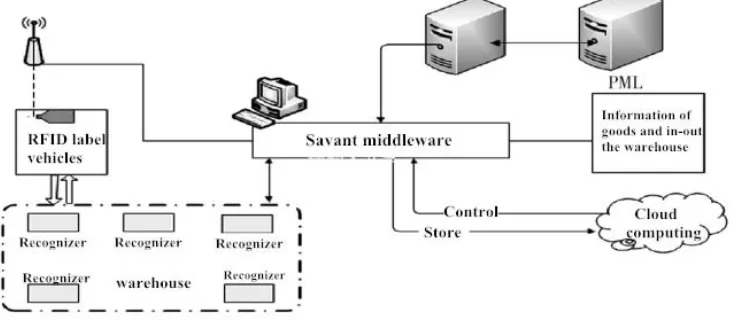
information, it stores production process data in the cloud computing platform, providing a physical support for cloud services.
Software architecture
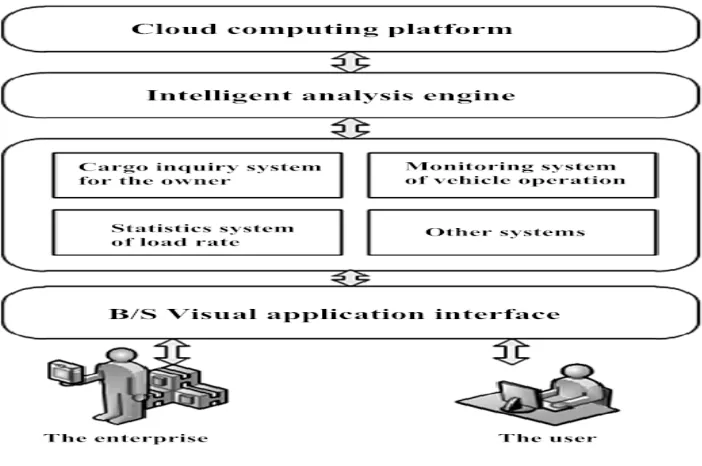
[image:4.612.135.501.460.620.2]The software system is responsible for the real-time handling of complex events to assist the IOT to accomplish intelligent tasks like scheduling and searching. In the process of logistics management, it process the mass data immediately relying on the advantages of cloud computing technology, that is, the data mining and reading operations are processed in real time. The architecture is divided into four layers. The first layer is the cloud computing platform. The platform is responsible for managing the hardware and providing the user with transparent virtual resources which are mainly soft resources such as cloud databases. The second layer is an intelligent analysis engine which is a kind of artificial intelligent application and a variety of knowledge bases are stored in its applications. The calculation and search methods of this engine program are mainly distributed and parallel, which can excavate and analyze the data to provide the basis for rapid decision making. The third layer is the business logic layer. This layer is made up of several system modules, which can accurately provide the data for the manager to analyze and collect all kinds of data. The data report generated by this way is detailed and the whole process is carried out automatically. The entire link from the collection of goods to the sale ensures the timely delivery of data information, and meanwhile, the information content is accurate and clear. The fourth layer is the browser/server (B/S) interface, which realizes the organic combination of cloud computing and network technology. Its interface is mainly man-machine interface by which the visual query and operation network interface can be directly supplied to users and administrators. With this visual interface, the user and administrator can use the cloud computing platform at the same time. Through the combination of the two, they exchange information with each other and send out requests to achieve the real-time scheduling of the logistics process for real-time. Real-time feedback of the logistics information will be also presented according to the decision-making of scheduling optimization.
Figure 2. Software architecture.
Functions that the software system should achieve mainly covers: getting cargo information from the PML IOT server, judging the priority level, automatically arranging the cargo type and logistics transport vehicles, offering prompting message about the goods loaded and unloaded by staff and analyzing the no-load rate and relevant reasons. The optimization decision can improve the operation efficiency of the whole logistics process and the real-time response to the logistics business provides the basis for the management decision in the data information.
As can be seen from the contents above, the cloud computing plays a central role in the cloud computing logistics network. The physical system collects and transfers and stores the mass data in the system structure, while the software system is responsible for querying and analyzing the data, providing the basis for logistics management decisions.
Key technologies of cloud computing logistics network system 1. Sensor technology
Sensor technology, together with computer and communication technology, constitutes a complete information technology system. It is a kind of technology that uses sensors and data acquisition technology to apperceive and recognize external information. This technology has the function of identifying object attributes, which are divided into two kinds of attributes: the dynamic attribute and static attribute. The sensor can reflect the dynamic attribute only in real-time detection, and store the information in real time after the location; the static attributes are stored directly in the label.
2. Cloud computing network technology
Embedded software technology
In the form of computer applications, the embedded system is an important form of microprocessors. Embedded software technology exists in this system. That is to say, only the software technology that can be used by this system is called embedded software technology. In simple terms, the application of this technology is embedded the dedicated functions in the chip. These functions are controlled by the internal computer to these functions to interact with the interface of the real environment, which is widely applied in the field of logistics.
APPLICATION OF CLOUD COMPUTING IN LOGISTICS
INFORMATIZATION PROCESS -- TAKING COLD CHAIN LOGISTICS OF FRESH FOOD AS AN EXAMPLE
Optimization of inventory
Quantity demanded and order quantity has important influence on inventory. The effective management of inventory can effectively control storage costs and orders, which enables the good operation of the business cycle. Based on the information system software developed relying on cloud computing, it inputs product information, which provides great convenience for enterprise query and modification, promoting online transactions. For logistics enterprises, the cloud platform processes the order according to the inventory data after they receive order information. The warehouse department will deliver the goods if the inventory is sufficient and the replenishment will be done in time if the inventory is insufficient, which ensures the quality of customer service. Cloud computing can also effectively monitor the storage environment conditions, so that the quality and safety of fresh products are guaranteed. At the same time, the timely update of inventory data and statistics of storage products also optimizes the inventory decision and reduces the management costs.
Optimization of vehicle scheduling
From the perspective of the informatization application in logistics enterprise, the actual level of vehicle scheduling is not high and distribution efficiency is also low. The optimization of vehicle scheduling is mainly based on two principles: One is the combination of optimization methods, the other is operational research. This problem can be understood as that different distribution object has a variety of options to the distribution site, so that the driving route can be optimized. Cloud computing can integrate the resources of the corporate headquarter and its subsidiary companies, which gives full play to the advantages of data analysis and thereby dispatches vehicles according to the principle of efficient scheduling.
CONCLUSION
informationalization process of cold chain logistics make cloud computing shine in the field of logistics. From the current development of China's logistics industry, an undeniable reality is the low informationalization and poor distribution efficiency, while the current logistics industry is rapidly developing with the promotion of market economy. Obviously, the level of informatization and the efficiency of distribution cannot keep up with the current development of the logistics industry. Therefore, in order to promote the efficient and coordinated development of the logistics industry, it is necessary to increase the penetration of cloud computing technology on the basis of improving the level of informationalization.
ACKNOWLEDGEMENTS
Special Research Project in Shaanxi Province Department of Education “Application of Cloud Computing Technology in the Cold Chain Logistics Informationization” (Serial number: 16JK2047)
REFERENCES
1. Cui Zhongfu. Logistics information: the Emerging Wisdom of Technology Speeds up the
Application [J]. Logistics & Material Handling, 2017, 22 (03): 57-58.
2. Li Hui. Application and Implementation of Cloud Computing model in Port Information System
[J]. Ship Science and Technology, 2016, 38 (14): 166-168.
3. Zhang Ling. Research on Chongqing Rural logistics Public Information Platform Construction