2017 2nd International Conference on Information Technology and Industrial Automation (ICITIA 2017) ISBN: 978-1-60595-469-1
A Comparative Analysis of the Economic
Performance of New Energy-saving
Wires Based on Life Cycle Cost
Min Gao, Bin Song and Yuchen He
ABSTRACT
Many types of new wires are rapidly emerging to address the increasingly wide gap between power supply and demand for both residential and industrial needs. Based on the characteristics of a transmission line construction project, this paper presents a comparative analysis of the economic performance of three new wire types (a new steel core aluminum strand wire with high electrical conductivity, a new aluminum alloy core aluminum stranded wire, and a new medium-strength aluminum alloy conductor) for a 500 kV transmission condition based on life cycle cost. The results of the analysis show that under the conditions of constant transmission capacity, annual loss hours, electricity price and recovery rate for the electric power project, the annual cost of the new steel core aluminum stranded high-conductivity wire is the highest, and the annual cost of the new medium-strength aluminum alloy wire is the lowest of all three wire types studied. The new medium-strength aluminum alloy wire is optimal from an economic perspective.
INTRODUCTION
of wire. Currently, China’s electric power construction industry uses a construction cost management model, which involves cost management of the entire process based on quota costing. To support China’s economic development, it is necessary to shift from construction cost management of the entire process to cost management of the entire life cycle [2].
In recent years, research on the economic performance of conductors has primarily focused on traditional wire types, such as steel-reinforced aluminum alloy stranded wire conductors [3], steel core aluminum stranded wire [4], expanded-diameter conductors [5] and others. Research involving new wire types has focused primarily on transmission capacity [6], transmission line applications [7], conductor selection methods [8], optimization design of the conductor section selection [9] and other aspects. However, few studies have
focused on the economic performance of new energy-saving,
capacity-increasing wire types.
In this paper, three new types of energy-saving, capacity-increasing wires (JL/GG1A4-630/45, new steel core aluminum strand wire with high electrical conductivity, JL/GQLHA4-600/75, new aluminum alloy core aluminum stranded wire and GQLHA4-675, new medium-strength aluminum alloy conductor) are investigated based on an economic comparison of the life cycle cost and the minimum annual cost for a typical 500-kV transmission line. The annual cost of three new types of wires are studied with varying transmission capacities, electricity prices, annual loss hours and power engineering recovery rates, and the results indicate the new medium-strength all aluminum alloy wire has an optimal annual cost.
ECONOMIC COMPARISON USING THE LIFECYCLE AND MINIMUM ANNUAL COST METHODS
Principle of Life Cycle Cost
Life cycle cost (LCC) comparisons involve analyzing all costs incurred during the life of a product or project from a comprehensive, long-term perspective rather than simply considering the cost of a certain stage. The life cycle cost should consider the inputs and losses of each phase, including design standards, engineering design, engineering construction, operation and maintenance, and the disposal cost of the product should be researched to ultimately minimize the total cost of the entire life cycle of the project [10-11]. The life cycle cost is expressed as
before it is placed in use. IC is expressed as
In Equation (2), C1 represents the pole and tower engineering costs, C2 represents basic engineering costs, C3 represents stringing engineering costs, C4 represents grounding and ancillary engineering costs, and C5 represents accessory engineering costs.
Because all the costs in Equation (1) occur over different years, the costs must be annualized for comparison purposes.
Minimum Annual Cost Method
The annual cost comparison method involves converting the net present value of each design to an equivalent annual cost (AC) for design comparison and selection through the calculation of the time value of capital. According to the previously selected base earnings ratio, the present value of all costs during the calculation period are converted into a yearly equivalent cost, which is referred to as the equivalent annual cost. The minimum annual cost method selects the design with the minimum equivalent annual cost. As a financial evaluation method, the minimum annual cost method can comprehensively reflect the appropriateness and economic efficiency of engineering investment [13]. Therefore, in this paper, the three wire types are compared using the minimum annual cost method.
According to the literature [14], the annual cost is calculated as
In Equation (3), NF represents the annual cost (average distribution over n years), Z represents the total investment converted to the mth year, μ represents the derated annual operational cost, m refers to years of construction, n refers to years of economic use, and r0 represents the recovery rate of the electric power engineering investment. Z (the total investment converted to the mth year) is calculated as
In Equation (5), ωt refers to the annual recovery rate of the electric power engineering investment in the tth year. IC is a one-time investment cost.
The formula for calculating μ (the derated annual operational cost) in Equation (3) is as follows:
μ = μ0h·a (6)
In Equation (6), μ0 refers to resistance and corona loss, h refers to annual loss hours, and a refers to the electricity price. According to the literature [15], the resistance loss of a wire is related to the aluminum alloy cross section, and the corona loss is related to the electric field intensity on the conductor surface, the conductor surface conditions, meteorological conditions, altitude and other factors. For simplicity, this paper considers only the relationship between the resistance and the corona loss with the transmission capacity and the annual loss hours while holding other influencing factors constant.
LIFECYCLE ANNUAL COST COMPUTATIONAL PROCEDURE
The life cycle cost of the conductor is embodied in the calculation and comparison of the annual cost. The minimum annual cost method can convert the costs input in different periods during operation into equivalent annual costs according to the previously described procedures. The conductor with the best economic performance is selected by comparing the annual cost of each conductor.
According to Equations (1)-(5), the one-time investment cost is the basic data for calculating the annual cost. When calculating the annual cost for the three types of wires, Equation (2) should first be applied to calculate the one-time cost of the three wire types. The results are then successively substituted into Equations (5), (4) and (3) to calculate the annual cost of the three wire types. Finally, the economic performance of the three wire types are analyzed based on the minimum annual cost method.
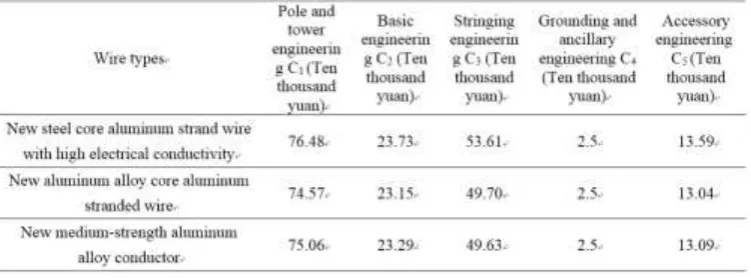
[image:4.595.104.480.586.725.2]C1, C2, C3, C4 and C5 for the three new types of energy-saving, capacity-increasing wires are obtained for a given project, as shown in Table I.
CALCULATION EXAMPLE
In this paper, a typical 500-kV transmission line is chosen as the line condition for calculation. Suppose that the economic service lives of the three new wire types are 30 years each, and the unit price is calculated to be 15.3 thousand yuan/ton. The construction period shall be assumed to be two years, with an investment in the first year of 60% of the total investment and an investment in the following year of 40% of the total investment. The transmission capacities are 1200, 1500, and 1800 MW for the steel core aluminum strand wire, aluminum alloy core stranded wire, and medium-strength aluminum alloy conductor, respectively, and the annual loss hours are calculated to be 2500, 3500, and 4500 h, respectively. The equipment operation and maintenance rate is assumed to be 1.4%. The recovery rate for the electric power project is calculated to be 8% and 10% of the project investment. Electricity prices are assumed to be 0.3, 0.40 and 0.5 yuan/kWh.
Calculation of the One-time Investment Cost, IC
Taking the new steel core aluminum strand wire with high electrical conductivity as an example, we first calculate the one-time investment cost and then use the results to calculate the annual cost. The specific calculation data and steps are discussed below.
Table 1 presents the pole and tower engineering cost C1, basic engineering cost C2, stringing engineering cost C3, grounding and ancillary engineering cost C4, and accessory engineering cost C5 for the new steel core aluminum strand wire with high electrical conductivity, which are 764.8 thousand yuan, 237.3 thousand yuan, 536.1 thousand yuan, 25 thousand yuan and 135.9 thousand yuan, respectively. Adding these values, the one-time investment cost IC is 1699.1 thousand yuan. We can calculate the one-time investment cost of the other two wire types in a similar manner, and these values are given in Table II.
Table II. One-time investment cost of the three wire types.
Wire types
One-time investment cost, IC (Ten thousand yuan)
New steel core aluminum strand wire with high electrical
conductivity 169.91
New aluminum alloy core aluminum stranded wire 162.96 New medium-strength aluminum alloy conductor 163.57
Calculation and Analysis of The Annual Cost, NF
the transmission capacity, electricity price, annual loss hours or electric power project recovery rate. The annual cost of three wire types are calculated, which enables us to determine which wire type has the best economic performance according to the minimum annual cost method.
[image:6.595.99.478.251.366.2]We calculate the annual cost of the new steel core aluminum strand wire with high electrical conductivity as an example. We perform the calculations according to Equations (3), (4) and (5) by considering the following parameter values: transmission capacity of 1200 MW, electricity price of 0.3 yuan/kWh, annual loss hours of 2500 h and electric power project recovery rate of 8%. The annual cost is shown in Table III.
Table III. Annual cost of new steel core aluminum stranded high-conductivity wire.
Table III shows the annual cost of a new steel core aluminum strand wire with high electrical conductivity calculated based on Equations (3), (4) and (5). The calculation process to determine the annual cost of the wire is the same for the other conditions.
ANNUAL COST OF THE THREE WIRE TYPES FOR DIFFERENT TRANSMISSION CAPACITIES
[image:6.595.102.479.578.720.2]The annual costs of the three types of aluminum stranded wires are shown in Table 4 and Figure 1, considering the following parameter values: an electricity price of 0.40 yuan/kWh, electric power project recovery rate of 8%, annual loss hours of 3500 h, and transmission capacities of 1200, 1500 and 1800 MW.
Figure I. Transmission capacity - annual cost chart.
As shown in Figure I and Table IV, in the case of constant values for the recovery rate for the electric power project, annual loss hours and electricity price, the transmission capacity changes from 1200 MW to 1800 MW. The annual cost of the new wire types increases with an increase in transmission capacity. The annual cost of the new steel core aluminum strand wire with high electrical conductivity is the highest, whereas the annual cost of the new medium-strength aluminum alloy conductor is the lowest of all three wire types studied.
ANNUAL COST OF THREE WIRE TYPES FOR DIFFERENT ELECTRICITY PRICES
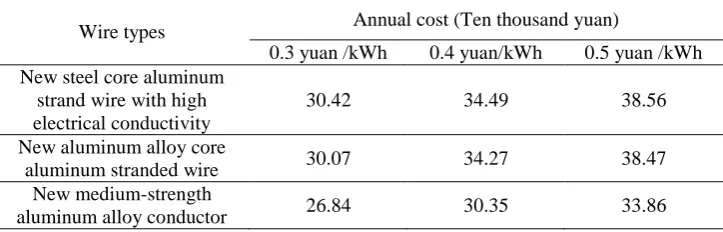
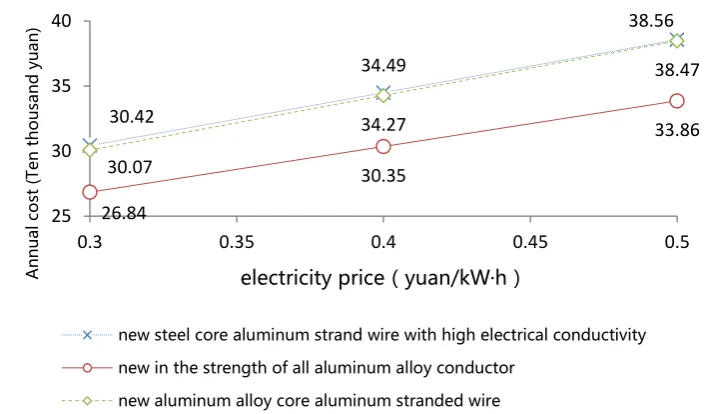
Consider an electric power project recovery rate of 8%, annual loss hours of 3500 h and a transmission capacity of 1500 MW, the electricity price is varied between 0.3, 0.4, and 0.5 yuan/kWh, yielding the annual costs for the three types of aluminum stranded wires shown in Table V and Figure II.
Table V. Electricity price—annual cost sheet.
Wire types Annual cost (Ten thousand yuan)
0.3 yuan /kWh 0.4 yuan/kWh 0.5 yuan /kWh New steel core aluminum
strand wire with high electrical conductivity
30.42 34.49 38.56
New aluminum alloy core
aluminum stranded wire 30.07 34.27 38.47 New medium-strength
aluminum alloy conductor 26.84 30.35 33.86 29.04
34.49
41.18
25.66
30.35
36.09
28.63
34.27
41
25 30 35 40 45
1200 1300 1400 1500 1600 1700 1800
An
nu
al
co
st
(
ten
th
ou
san
d
yu
an
)
Transmission(MW)
new steel core aluminum strand wire with high electrical conductivity new in the strength of all aluminum alloy conductor
[image:7.595.109.471.590.706.2]Figure II. Electricity price—annual cost chart.
As shown in Figure II and Table V, when the transmission capacity is 1500 MW, with the same loss hours, the annual cost for the new wire types increases with increases in the electricity price when the electricity price rises from 0.30 to 0.50 yuan/kWh. The annual cost of the new steel core aluminum strand wire with high electrical conductivity is the highest, whereas the annual cost of the new medium-strength aluminum alloy conductor is the lowest of all three wire types studied.
ANNUAL COST OF THE THREE WIRE TYPES FOR DIFFERENT ANNUAL LOSS HOURS
Considering a transmission capacity of 1500 MW, an electricity price of 0.40 yuan/kWh and an electric power project recovery rate of 8%, the annual loss hours vary, at 2500, 3500 and 4500 h. The annual cost of for the three types of aluminum stranded wires are shown in Table VI and Figure III.
Table VI. Annual loss hours—annual cost sheet. 30.42
34.49
38.56
26.84
30.35
33.86
30.07
34.27
38.47
25 30 35 40
0.3 0.35 0.4 0.45 0.5
An
nu
al
co
st
(T
en
tho
usan
d
yu
an
)
electricity price(yuan/kW·h)
new steel core aluminum strand wire with high electrical conductivity new in the strength of all aluminum alloy conductor
[image:8.595.102.480.611.727.2]Figure III. Annual loss hours—annual cost chart.
As shown in Figure III and Table VI, when the transmission capacity, electricity price and discount rate are fixed and the annual loss hours increase from 2500 to 4500 h, the annual cost of the new wire types increases with increases in the annual loss hours. The annual cost of the new steel core aluminum strand wire with high electrical conductivity is the highest, whereas the annual cost of the new medium-strength aluminum alloy conductor is the lowest of all three wire types studied.
ANNUAL COST OF THE THREE WIRE TYPES FOR DIFFERENT ELECTRIC POWER ENGINEERING RATES OF RECOVERY
Considering a transmission capacity of 1500 MW, an electricity price of 0.40 yuan/kWh and annual loss hours of 3500 h, the annual costs for the three types of aluminum wires for recovery rate for the electric power project of 8% and 10% are shown in Table VII and Figure IV.
Table VII. Power engineering recovery rate—annual cost.
Wire types Annual cost (Ten thousand yuan)
8% 10%
New steel core aluminum strand wire with high electrical conductivity
34.49 37.78
New aluminum alloy core
aluminum stranded wire 34.27 37.42
New medium-strength
aluminum alloy conductor 30.35 33.30
30.19
34.49
38.79
26.65
30.35
34.05 29.82
34.27
38.73
25 30 35 40
2500 3000 3500 4000 4500
An
nu
al
co
st(
Ten
th
ou
san
d
yu
an
)
Annual loss hours(h)
new steel core aluminum strand wire with high electrical conductivity new in the strength of all aluminum alloy conductor
[image:9.595.108.467.609.725.2]Figure IV. Recovery rate of the electric power project—annual cost chart.
As shown in Figure IV and Table VII, when the transmission capacity, electricity price and annual loss hours are fixed and the recovery rate of the electric power project is taken to be 8% and 10%, the annual cost of the new wire types increases with increases in the recovery rate of the electric power project. The annual cost of the new steel core aluminum strand wire with high electrical conductivity is the highest, whereas the annual cost of the new medium-strength aluminum alloy conductor is the lowest of all three wire types studied.
In summary, for a typical 500-kV transmission lines and using the transmission capacity, electricity price, annual loss hours and electric power project recovery rate as variables, changing only one variable at a time while holding the other variables constant, the results all show that the annual cost of the new steel core aluminum strand wire with high electrical conductivity is the highest and that of the new medium-strength aluminum alloy wire is the lowest of all three wire types studied. In the case of a constant transmission capacity, electricity price, annual loss hours and recovery rate for the electric power project, the annual cost of the new steel core aluminum stranded high conductivity is the highest, whereas the annual cost of the new medium-strength aluminum alloy conductor is the lowest.
CONCLUSION
In this paper, three new types of energy-saving wire are considered and compared economically using the principles of life cycle cost and the minimum annual cost method. The case study of a typical 500-kV transmission line
34.49
37.78
30.35 33.3
34.27
37.42
30 32 34 36 38 40
8% 9% 10%
An
nu
al
co
st(
Ten
th
ou
san
d
yu
an
)
Power engineering rate recovery
new steel core aluminum strand wire with high electrical conductivity new in the strength of all aluminum alloy conductor
project demonstrated that for the same transmission capacity, electricity price, annual loss rate and recovery rate, the annual cost of the new medium-strength aluminum alloy conductor is the lowest of all three wire types studied, making it the optimal choice. The economic performance analysis method used in this paper is equally applicable to 220-, 50-, 1000-kV and other types of transmission line projects.
REFERENCES
1. Peng Huang, Juan Mo, Jiancheng Wan, Xinyu Zhao. Economic Analysis of Energy-saving Wire Application Technology for Overhead Transmission Lines [J]. China Electric Power, Vol.46, No.7, 2013:153-157.[In Chinese]
2. Jie Ru, Lingchang Wen. Application of Life Cycle Analysis in Wire Type Selection of Transmission Line [J]. Shaanxi Electric Power, Vol.35, No.12, 2007:49-54.[In Chinese] 3. Xinkuan Wang, Yalong Li, Xinping Dong. 220kV Xintian Yangtze River Long Span
Transmission Line Wire Selection [J]. Shandong Electric Power, Vol.178, No.6,2010: 24-26[In Chinese]
4. Bo Zhang. Study on Equivalent Viscous Damping of Aeolian Vibration for Transmission Line by AACSR-400 Steel Core Aluminum Alloy Wire[J]. Key Engineering Materials, Vol.723, 2017:94-99.
5. Long Liu; Jian-cheng Wan; Jia-jun Si; Liang-hu Jiang. Experimental research on structure stability of expanded-diameter conductor[C]. Proceedings of the 2014 IMSS International Conference on Future Manufacturing Engineering (ICFME 2014), 2014.12.10.
6. Xiancan Wang, Jing Lin. Type Selection Application of New Heat-resisting Capacity-increasing Wire in 220kV Line Capacity-increasing Transformation [J]. Inner Mongolia Electric Power, Vol.29, No3, 2011:79-81+88.[In Chinese]
7. Tianquan Huang. Research on Key Points of Construction Technology of Wire Erection in 220kV High-voltage Transmission Line [J]. Low Carbon World, Vol.137, No.2, 2017:84-85.[In Chinese]
8. Qing Zhang. Comparison Analysis of New Energy-saving Wire Selection of Transmission Line and Technical Economy. [J] Chinese Foreign Investment,Vol.299,No.20, 2013:385.[In Chinese]
9. Yanrong Song, Hubiao Zeng. Optimization Design of the Conductor Section Selection in the Transmission Line[C]. Proceedings of 2011 Third Pacific-Asia Conference on Circuits, Communications and System (PACCS 2011 V2), 2011.07.17.
10. Lin Yang. Project Life Cycle Management Method and Analysis of 750kV Power Transmission Project [c]. Chinese Society for Electrical Engineering Transmission Five Academic Annual Conference, 2006.11.19. [In Chinese]
11. Yue Wu,Jun Biao Wan,Ke Yi Wang,Rui Ma. A Novel Framework of the Life Cycle Asset Management for Transmission and Transformation Equipment of Power System[J]. Applied Mechanics and Materials, Vols.241-244,2013:773-777.
12. Feng Guo, Kai Wen, Guangfu Li. Life Cycle Cost Design of Transmission Line [J]. Electric Power Construction, Vol.32, No.2, 2011:29-34.[In Chinese]
13. Rui Lin, Lichao Zhang, Peiyong Zhang, Yunqing Chen. Large-span Wire Selection of 1000kV EHV AC Transmission Line [J]. Electric Power Construction, Vol.36, No.5, 2015:91-98.[In Chinese]
14. Xiaolin Li. Wire Selection Analysis of East Huai—East China ±1100kV EHV DC Transmission Line Project Northern Part of Gansu Province [J]. Inner Mongolia Electric Power, Vol.34, No.1, 2016:25-31[In Chinese]