2016 International Conference on Artificial Intelligence and Computer Science (AICS 2016) ISBN: 978-1-60595-411-0
Proposal of Lateral Inhibition Real Time Map Updating Method for
Simultaneous Localization and Mapping by Using LRF
Manabu FUJIKI
1,*and Hideki TODA
11Dept. of Electric and Electronic Engineering, University of Toyama
Gofuku Campus, 3190 Gofuku, Toyama, 930-8555, Japan e-mail:[email protected]
*Corresponding author
Keywords: SLAM, Grid mapping, Natural environment, Laser range finder, Lateral inhibition.
Abstract. In this paper, a novel real time map updating algorithm using a concept of lateral inhibition was proposed and it was evaluated by simple 2D room mapping experiment. For long time and difficult map creation process of simultaneous localization and mapping (SLAM) algorithm, stable map updating is one of the important topics. By using the lateral inhibition process to the map updating process, it is able to reduce the complexity of the map updating process of the SLAM. It could reduce the noise around the wall and emphasize the border (such a wall). The experimental result of 6.0 x 3.5 m 2D room with many obstacles shows the x-y positional and the rotational estimation precision would be measured as Δx, y= 0±0 m (within laser range finder measurement error, ±S.D.) and the θ= - 3.3×10⁻⁴ ±1.4×10⁻³ rad (1 hour measurement), and the map was updated real
time when the laser range finder sensor was moving from a position to another room position with low speed.In addition, the environment map was created without deformation in the three trees environment which has a little wind (<1m/sec) and uneven shape.The long time stable position and rotation estimation could be realized by using the lateral inhibition mapping update algorithm.
Introduction
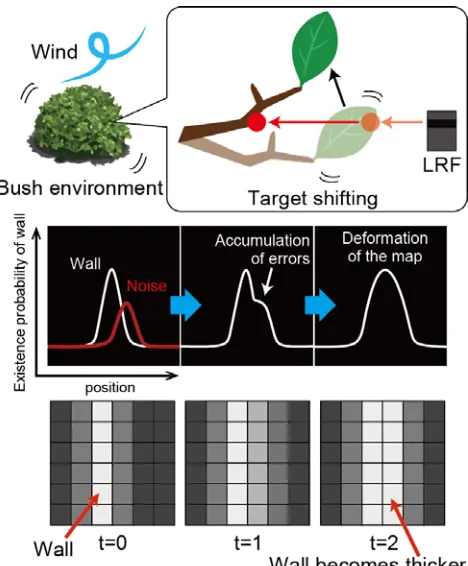
In this paper, a novel real time map updating algorithm using a concept of lateral inhibition was proposed and it was evaluated by simple 2D room mapping experiment. For long time and difficult map creation process of simultaneous localization and mapping (SLAM) algorithm, stable map updating is one of the important topics [1]. Especially, there is a large demand to use the SLAM algorithms in outdoor natural environment (such as inside forest) and the algorithms would be necessary to robust against not only the sensor noise itself, but the vibration (such as leaf, branch and tree) affected by unpredictable natural wind. Previously proposed method used a method of improving the scan matching method [2, 3] and stochastic estimation method that considers many error factors [1, 4]. Although above methods could create the map by short time period's sensor information, but it should be taken into account the all of small estimation errors in the case of a long time map creation process.
Figure 1. Deformation of the environmental map by noise, such as the vibration of the environment.
Figure 2. Lateral inhibition realtime map updating.
Method
Key point of the proposed method is lateral inhibition real time map updating. Generally, it is necessary to update the internal map by using the measured distance data and the estimated position in the SLAM algorithm. The updated map would take into account the noise of the LRF and estimation in long time map updating. As a result, the thickness of the updated map, especially, wall parts would be increasing and unstable.
In our method, the internal map would be updated by lateral inhibition filter L3 donated by Fig. 2.
L3 changes the original value depending on the surrounding value. As shown in Fig. 3 of
one-dimensional value, it could reduce the noise around the wall (red arrow) and emphasize the border (such a wall) by using L3 for all (x, y) positions of the map. Created blurring map is
parameters are adjusted at implementation. When the 3x3 lateral inhibition filter is L and the filtered existence probability of the wall in the map is map (x, y), the updated map is described as,
(1)
where the meaning of x, y is the position in the map. The center parameter of L is 1 and the lateral parameters of L are adjusted to -1/20 in experiment.
Lateral inhibition is a concept of neural system which emphasizes the contrast and boundary of the information such as vision [7]. Its essence is that the adjacent elements inhibit each other and the filtered value is changed by the ratio of the original value to the adjacent values.
Figure 3. Change in the existence probability of the wall which has a noise in the map by lateral inhibition filtering.
Experiment
The validity of the lateral inhibition is confirmed by 2D mapping process which uses a simple scan matching between the past map and current sensor data as localization method.
In the first experiment, the mapping process in the case of fixing the position and the direction of the sensor in the center of 6.0 x 3.5 m room during 30 seconds is confirmed. As distance sensor, the LRF was used (URG-04LX-UG01, max measurement distance about 5 m, range 240 degrees, 12 fps, Hokuyo Denki). The precision of the distance is about 3 cm (at 4 m distance) and the one division (1 pixel on the map) was taken as 4 cm. Walls of the environmental map are represented by gray pixels which mean existence probability of obstacles.
In the second experiment, a map of 6.0 x 3.5 m room and corridor environment is created by moving LRF and the mapping process is confirmed.
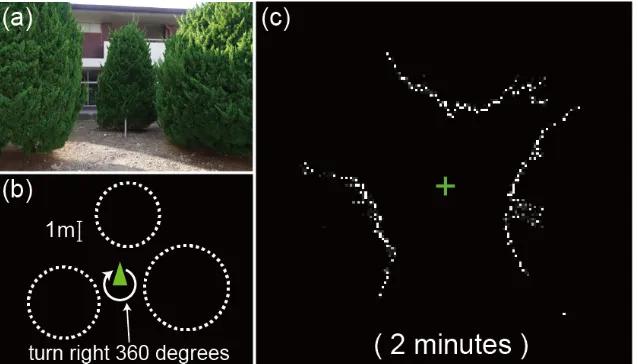
In the third experiment, a map of an outdoor environment which is surrounded by three trees covered with leaves is created and the mapping process is confirmed. In this experiment, the LRF is positioned at a center of the three trees in the direction upper side firstly and it is turned right 360 degrees by hand during 2 minutes.
Result
process while 1 hour experiment. Although the 1 hour long time mapping, the obtained map was cleared and the existence probability of the wall was not blurred. As basic performance, the x-y positional and the rotational estimation precision would be measured as Δ x,y = 0±0 m (within LRF measurement error (3 cm), ± S.D.) and the θ= - 3.3×10⁻⁴ ±1.4×10⁻³ rad when the LRF fixed at one
position in the room with 1 hour lateral inhibition filter case.
In the second experiment, Fig. 5(a) shows the outline of experimental environment and Fig. 5(b) shows the experimental result of the SLAM algorithm moving 6.0 x 3.5 m room through the door to the corridor. In this experiment, the LRF was positioned at A in the direction lower side (green triangle) firstly and it turned to the upper side (rotation angle is about 180 degrees), and it was moved by hand from position A to D via through the door. By using the proposed algorithm, the wall part would remain stably without the wall becomes thicker.
In the third experiment, Fig. 6(a)(b) shows the experimental environment and Fig. 6(c) shows the experimental result of the outdoor mapping. By using the proposed algorithm, the environment map was created without deformation in the three trees environment which has a little wind (<1m/sec) and uneven shape. The x-y positional estimation precision was measured as Δx = - 2.0×10⁻⁴ ±2.5×10⁻³ m
and Δy = 3.0×10⁻⁴±6.2×10⁻³ m when the LRF was turned 360 degrees at one position on the outdoor
[image:4.612.138.473.295.456.2]environment during 2 minutes.
Figure 4. Reduction of accumulated errors in the long time mapping by using the lateral inhibition filter (a) Created map without the lateral inhibition filter (b) Created map with the lateral inhibition filter.
[image:4.612.139.471.491.665.2]Figure 6. Rotation among the three trees experimental result of the SLAM.
Conclusions
In this paper, a novel real time map updating algorithm using a concept of lateral inhibition was proposed and it was evaluated by simple 2D room mapping experiment. The experimental result of 6.0 x 3.5 m 2D room with many obstacles shows the x-y positional and the rotational estimation precision would be measured as Δx, y= 0±0 m (within LRF measurement error, ±S.D.) and the θ= - 3.3×10⁻⁴ ±1.4×10⁻³ rad (1 hour measurement), and the map was updated real time when the LRF
sensor was moving from a position to another room position with low speed. In addition, the environment map was created without deformation in the three trees environment which has a little wind (<1m/sec) and uneven shape. By using the lateral inhibition mapping update algorithm, the long time stable position and rotation estimation could be realized.
Acknowledgement
This work was supported by JSPS KAKENHI Grant Number 15K12598.
References
[1] S. Thrun, W. Burgard, and D. Fox, Probabilistic robotics, The MIT Press, 2005.
[2] S. Rusinkiewicz and M. Levoy, Efficient Variants of the ICP Algorithm, 3-D Digital Imaging and Modeling, pp.145-152, 2001.
[3] S. Kohlbrecher, J. Meyer, O. von Stryk and U. Klingauf, A Flexible and Scalable SLAM System with Full 3D Motion Estimation, In Proc. 2011 IEEE International Symposium on Safety, Security and Rescue Robotics(SSRR), pp. 155-160, 2011.
[4] G. Grisetti, C. Stachniss, and W. Burgard, Improved Techniques for Grid Mapping with Rao-Blackwellized Particle Filters, IEEE Trans. on Robotics, vol. 23, no. 1, pp. 34-46, 2007.
[5] H.P. Moravec, Sensor fusion in certainty grids for mobile robots, AI Magazine, vol. 9, no. 2, pp. 61-74, 1988.
[6] C. Yu, V. Cherfaoui, P. Bonnifait, Evidential occupancy grid mapping with stereo-vision, 2015 IEEE Intelligent Vehicles Symposium (IV), IEEE, pp. 712-717, 2015.