2017 International Conference on Computer, Electronics and Communication Engineering (CECE 2017) ISBN: 978-1-60595-476-9
Prediction of the Software Security Defects Based
on the Complex Network
Xiao-lin ZHAO
*, Yi-man ZHANG, Jing-feng XUE,
Ji ZHANG
and Quan-bao CHEN
Software of School, Beijing Institute of Technology, Beijing
Keywords: Complex network, Software defects, Defects prediction, KeyNodeRank algorithm.
Abstract. The traditional software defects prediction methods just evaluate the software defects
based the unweighted undirected network, which do not reflect the real complex software system. Therefore, this paper proposes a software security defects prediction method based on the complex network. This method improves the PageRank algorithm and develops a KeyNodeRank algorithm based on the complex network. In this method, the software system is divided into different classes and these classes constitute a weighted directed network. In addition, the KeyNodeRank algorithm evaluates and ranks the importance of class nodes in the global network. In order to examine the validity of the software defects prediction method, this paper carries out an experiment. It is found that this method not only is accurate to predict and locate software defects and but also is very significant for improving software quality and maintaining software.
Introduction
Nowadays, the software system is larger and the interaction between the classes of the software is more complicated, which result in a series of software development problems, such as poor stability and poor quality [1]. Therefore, it is very urgent and important to improve the software quality and find out the software defects.
In the last decades, the development of information technology and biology is rapid, so the complex network has gradually become the common focus in many fields [2]. In the complex network, the nodes are huge and the relationship between nodes is very complicated [3]. Besides, the complex network is very different from the random network and the regular network [4]. At present, the complex network is being gradually applied to the software fields, which provides a new method to study the software [5]. Many studies have shown that there is a complex network in the large software systems. In addition, there are many units with different granularity and complex relationship in the large software systems, which can be modeled into a complex network [6].
In many previous studies, the statistical and metrics characteristics of the complex network have been used to predict the software defects. Now, there are mainly three methods based on the complex network [7]. The element level is to measure the degree, average distance and aggregation coefficient of the software [8]. The class level uses the modularity, cohesion and coupling methods to evaluate the software system [9,10]. The network level measures the software defects by degree distribution, average aggregation coefficient, average distance and correlation. However, there are several limits for this three methods [11]. One hand, these methods are based on the undirected network, but the real network is a weighted network. Therefore, these methods can not truly reflect the structure of the software. On the other hand, these methods only use a single indicator without considering the correlation of different indicators, which lost the difference between nodes and the recognition accuracy of the center nodes is also decreased.
Directed and Weighted Network Model of Software Unweighted Network Model
In object-oriented software, the basic unit of the program is a class, which contains member variables and member methods. The exchange of information between the two classes is through the reference of variables and the call of methods. Variables can be called by the methods, so variables and methods can be treated equally. The calls of methods between two classes is more, the relationship between two classes is closer and the weight of the corresponding edge is larger. The relationship between two classes is varied by the call way of the class and the weight can reflect the relationship between the two classes. However, the unweighted network model can not reflect the relationship information of two classes.
[image:2.612.201.417.351.528.2]Figure 1 indicates the interaction between the members inner the class. Figure 2 shows the dependency relationship between classes. In Figure2, C1, C2 and C3 are interconnected. If C3 has an error, it will be passed to C2 and C2 will pass the error to C1. However, it is not corresponded to the real situation. The details of classes are shown in Figure 1. For C2, if the variable c2 or the function C2F () is incorrect, it is passed to C1 through the call of function C1F1 () or C1F2 (). For C3, if the variable c3 is incorrect, the error is not passed to class C2 and C1. Obviously, the dependency between C1, C2and C3 are incomplete. The traditional software network model often exaggerates the wrong communication between classes ignoring the details of the interaction in the class. Therefore, the traditional software network model can not measure the software system completely and effectively. Therefore, it is very important to build a model that can truly reflect the dependency of the software [12].
Figure 1. Interaction between members in the class.
Figure 2. Dependency between the extract classes.
Definition of Weight
The directed weighted network model is defined as G=(V,E).V=(V1,V2,..., Vn) is a set of nodes in
the networkand E={e1,e2,…,em}V×V stands for the edges between the nodes in the network.
n=|V| is the number of the nodes and m=|E| is the number of the edges in the network. Besides, viV, (i=1,2,..n) indicates a node in the network, (vi,vj)E represents a edge from Vi to Vj and
ω(vi,vj) shows the weight of (vi,vj)E .
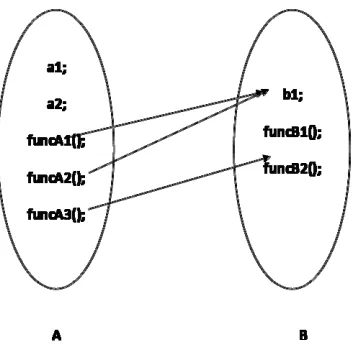
Figure 3. Weight definition model.
Figure 3 illustrates the weight definition model. In Figure 3, the member includes member variables and member methods and it is same to calculate the weights. It is found that there are three members in class A that depend on class B, funcA1 () and funcA2 are affected only by b1 and funcA3 () is only affected by funcB2 (). Therefore, if funcB1 () has an error and it is not passed to A. Therefore, this paper defines the weight function between two nodes (see function 1).
ij ji ij
j
f f
= .
f f
i
(1)
In function 1, fi is the member number of node i and fj is the the member number of node j. fij
represents the member number of node i depending on node j and fji represents the member number
of node j depending on node i. ωij indicates the weight from node i to node j. In general, ωij is
different from ωji. In Figure 3, fab = 3, fba =2, fa =5, fb = 3, therefore, ωAB = 3/52/5 =0.4
Evaluation of Software Key Nodes Based on KNR Algorithm KNR Algorithm
The PageRank algorithm is a tool for evaluating the importance of Web pages and is very important for Google search technology [13,14]. PageRank ranks the pages based on the value of the link. The link from other pages to this page is a vote to this page. The page is more important if has more votes from other pages and the rank value of this page is higher. In fact, in Google search system, the PageRank value of different pages is based on the number of votes, which measures the importance of the page. The PageRank is as follows:
1 21
1 2
( ) ( )
PR(T ) ( )
( ) 1- + ... (1 ) .
( ) ( ) ( ) ( )
n
n i
i
n i
PR T PR T
PR T PR A
C T C T C T C T
(2)PR (A) represents the PageRank value of page A and T1, T2, ..., Tn is the other page that links to
page A. PR (Ti) represents the PageRank value of page Ti, C (Ti) represents the number of pages
from page Ti, so the PageRank value of page Ti is passed to that pages that it points to. α represents
a random jump factor, which imitates the user behavior and represents the probability of browsing a page. The probability of staying on the current page is 1-α. In general, the value of α is 0.85.
KeyNodeRank algorithm improves the PageRank algorithm, which is applied to a weighted network. This algorithm not only considers the direction between nodes, but also takes into account the weight between nodes. Function 2 shows the KeyNodeRank algorithm.
In the directed weighted network, the number of nodes are n. Node v has the links form μ1,μ2,μn ,
1 2 1 2 1 2 1 1 2 1 1 1 ( ) ... ( ). n nv v nv iv
n i
m m m n
i izi
zj zj nzj
j
j j j
KNR v KNR KNR KNR KNR
N N
(3)α is the jump factor, generally, α is 0.85. KNR(μi) is the KeyNodeRank value of node μi that is
linked to v. ωμiv is the weight form node μi to node v.
mi
mizj j=1
is the sum of weight from node μi toother nodes. z1,z2…zn (including node v) is pointed by node μi. Therefore, the KeyNodeRank
proportion of node v form μi is mi miv
mizj j=1
.Steps of KNR Algorithm
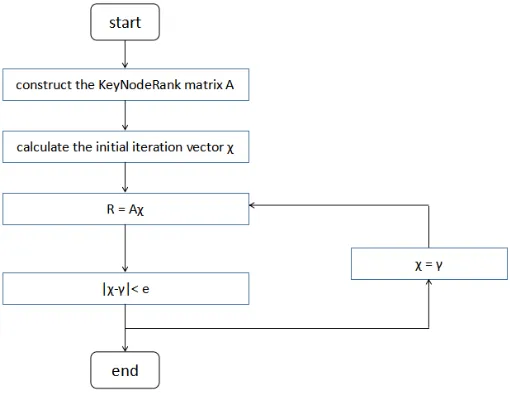
[image:4.612.182.437.341.543.2]KeyNodeRank algorithm takes the depth analysis of the network topology, which is based on the adjacency matrix of the network. KNR algorithm utilizes the power iteration to evaluate the software system [15]. In specifically, the KeyNodeRank value of each node in the network is calculated and the key nodes are selected according to the rank of KeyNodeRank value. However, the times of iteration is so huge when calculating the KeyNodeRank value. In order to reduce the time complexity, the initial vector of the iteration uses in-degree, which can combine the local attributes and the global network. The process of KNR algorithm is as follows (see Figure 4).
Figure 4. Process of KeyNodeRank algorithm.
(1) Construct the adjacency matrix H. The associated information of each node is stored in H and hij means the weight of the edge that is from node i to node j.
(2) Normalize the adjacency matrix H. For each element hij in H, the division operation should be
operated that hij is divided by the sum of all the elements in the same row of H. After the operation,
the matrix H is transferred to
j
ijn
i
j=1 n n
M = h h .
The element in matrix M corresponds to the jump probability of the node i and j. In matrix M, if
the values in a row are all 0, the node is called a dangling node and use the vector
1 Te
n to take
the place of this node. After that, M is transferred to the random matrix M'=M+η
1 eTn . In M’,
is a Boolean vector, 1 is the dangling node and 0 is a normal node.
(3) Transpose matrix M’. Matrix M’ transitions to matrix PM'T. The KeyNodeRank algorithm
(4) Calculate matrix A. Matrix A is an abstract of the KeyNodeRank algorithm.
1
.
T
A e e P
N
P is the probability transfer-matrix, α is a random jump factor and n is the total number of the nodes in the network. Each element of e eT is 1. The KNR value of all the nodes is the N-dimensional KNR vector, which is the smooth distribution of the A.
(5) Solve the smooth distribution of matrix A.tis the initial KNR value of a node, so the vector
is
0, ,1 2,...,
T
n . For Χ, the iterative operation is operated and the result is A. At the
same time, the limit value 8
e is used to judge the end of iteration. When the result between
two iterations is less than ε, the process is end up. Finally, the smooth matrix γ of the matrix A is obtained, which is the N-dimensional KNR vector in the network.
(6) Rank the nodes with the KNR value. The top 10% among the all nodes in the network is the key nodes.
KNR Initial Value
It is need to set the initial vector before the iteration using the algorithm KNR. The initial vector is related to the times of iteration, so it is important to set the proper value. In general, χ=(1/n,1/n,…,1/n) is the initial vector and n is the number of the nodes in the network, which shows that the importance of each node is the same. However, in this paper, the KNR value is more concerned the in-degree of the nodes. Therefore, the in-degree of nodes is used to initialize the vector χ. The specific steps are as follows.
(1) Calculate in-degree of each node in the adjacency matrix. The in-degree of each node is Si(in).
The in-degree of nodes corresponds to the sum of each column in the adjacency matrix.
(2) Calculate the sum of the nodes in-degree in the global network. ( )
1
n i ini
sum S
(3) Calculate each component of the initial vector. Each component is i Si in( )/sum
Design of the Experiment
In order to examine the validity and accuracy of the software key node measurement based on complex network, an object-oriented open source software JEdit is used. The network architecture diagram of software system is generated at the class level, and then the key nodes value is measured on the basis of the KNR. In addition, the defects of JEdit are collected. Therefore, the defect prediction is verified by calculating the hit ratio of the key nodes to the software defects. In this paper, JEdit5.2.0 and JEdit4.5.1 are used and the defects are collected in the website http://sourceforge.net/p/jedit/bugs/.
Only the software network is a complex network, can the method related to the complex network be used. Therefore, there are two steps in this experiment. On the one hand, whether the built software network is a complex network, which means to the software network has “small-world” and “free-scale” features. On the other hand, KNR algorithm in software defect prediction is examined. The figure 5 shows the specific process of this experiment.
(1) Software source code is preprocessed and xml file with dependency relationship is extracted. In this paper, Dependency Finder tool takes some file type as input, such as.jar, .class, .zip, so it is need to preprocess the source code.
(2) Extract useful dependency information from the xml file by programming. The xml file contains the dependency information of the package level, class level, and feature level. This paper only extracts the dependencies of the classes and features level.
(4) Calculate the KNR values of the nodes in the software network and rank them, choosing the top 10% as the key nodes.
[image:6.612.182.377.129.444.2](5) Software defects are predicted by the key nodes and the KNR algorithm in software defect prediction is verified.
Figure 5. Specific process of experiment.
Results and Analysis of the Experiment Experiment of Software Network Complexity
The source codes of JEdit5.2.0 and JEdit4.5.1 are extracted into complex networks. In the complex networks, classes correspond to the nodes and the interaction between classes corresponds to the edges. The classes that are developed by the developers are considered and the classes in the system are ignored. The results of software network statistics are shown in table 1.
The random network with the same numbers of nodes and edges as the experiment is built. The result shows that the average path length is similar and the average aggregation coefficient of the random network is very different form the experiment network, which indicates the experiment network has the feature of “small-world”. Besides, the power distribution index of the two versions is larger than 3, which shows the experiment network has the feature of “free-scale”. Therefore, the experiment software is a complex network and the method based on complex network is useful.
Table 1. Statistics of JEdit resource code.
Versi
on Total nodes numbers N edges Total numbers M
Average
degree k aggregation Average coefficient
C
Random network aggregation
coefficient CRand
Averag e path length
L
Random network Lrand
power distribut ion index
[image:6.612.79.530.667.748.2]Application of KeyNodeRank in Software Defects Prediction
For the prediction of defects using the KNR algorithm, this paper collects the defects of JEdit5.2.0. The defects are distinguished by the key nodes in this experiments, so if the recognition accuracy is relatively high, the KNR algorithm is valid.
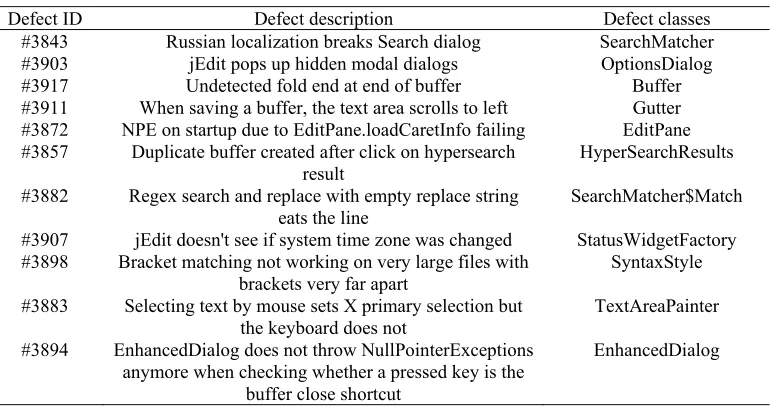
[image:7.612.117.502.223.429.2]Table 2 shows the found defects in this experiment. In the table 2, each defect has a unique id and a short description of the defect. Besides, the class where the defect is located is depicted to examine the accuracy of the KNR algorithm. These defects of JEdit5.2.0 are from the JEdit development site and have been confirmed and accepted. In this paper, the KNR algorithm is use to calculate the key nodes to predict the defects. If these key nodes can correspond the software defects, the algorithm is feasible in software defect prediction.
Table 2. Defects of Jedit5.2.0.
Defect ID Defect description Defect classes
#3843 Russian localization breaks Search dialog SearchMatcher
#3903 jEdit pops up hidden modal dialogs OptionsDialog
#3917 Undetected fold end at end of buffer Buffer
#3911 When saving a buffer, the text area scrolls to left Gutter #3872 NPE on startup due to EditPane.loadCaretInfo failing EditPane #3857 Duplicate buffer created after click on hypersearch
result
HyperSearchResults
#3882 Regex search and replace with empty replace string eats the line
SearchMatcher$Match
#3907 jEdit doesn't see if system time zone was changed StatusWidgetFactory #3898 Bracket matching not working on very large files with
brackets very far apart SyntaxStyle
#3883 Selecting text by mouse sets X primary selection but
the keyboard does not TextAreaPainter
#3894 EnhancedDialog does not throw NullPointerExceptions anymore when checking whether a pressed key is the
buffer close shortcut
EnhancedDialog
[image:7.612.103.507.556.693.2]Table 3 shows the defect evaluation of JEdit5.2.0 including the name, the KNR value, the ranking of the KNR value of the defect class and the evaluation. It is found that the KNR algorithm can evaluate the most of the defects. Besides, the accuracy of 72.7% illustrates that KNR algorithm is accurate to evaluate the software system. For example, org.gjt.sp.jedit.Buffer class operates when the files are opened in the memory. Form the complex network, this node can be referenced by many other nodes. Therefore, this class is important. In fact, the common functions such as opening files, editing files are related to this class. In addition, KNR algorithm also shows the importance of this class.
Table 3. Defects evaluation of JEdit5.2.0.
Defect classes KNR value Rank Evaluation
SearchMatcher 4.19E-04 94 Yes
OptionsDialog 3.34E-04 235 No
Buffer 5.92E-04 26 Yes
Gutter 3.62E-04 147 Yes
EditPane 4.87E-04 72 Yes
HyperSearchResults 3.87E-04 128 Yes
SearchMatcher$Match 3.43E-04 159 Yes
StatusWidgetFactory 3.05E-04 359 No
SyntaxStyle 2.97E-04 383 No
TextAreaPainter 3.91E-04 103 Yes
EnhancedDialog 4.53E-04 84 Yes
Comparison of KNR with Traditional Method
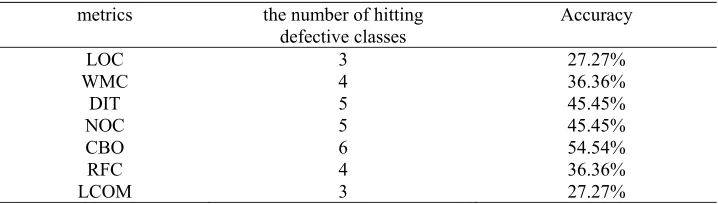
[image:8.612.127.486.200.302.2]In order to explain the advantages of the method based on the KNR, the traditional method is used to measure JEdit5.2.0 and calculate the hit rate of defect class. In traditional method, LOC is selected. Generally, for CK model, six metrics are selected. However, MOOD model measure the complexity of the software from the system level, which is not comparable with software security defect based on the complex network. For the selected metric, the value of node is calculated and ranked and the top 10% of nodes are selected as the key nodes. Table 4 shows the results of the defects of the software by traditional method.
Table 4. Prediction of traditional measurement method.
metrics the number of hitting
defective classes Accuracy
LOC 3 27.27%
WMC 4 36.36%
DIT 5 45.45%
NOC 5 45.45%
CBO 6 54.54%
RFC 4 36.36%
LCOM 3 27.27%
It is found that the result of traditional method is lower than the software security defect method based on complex network. For LOC, it is so simple to evaluate the software only by the number of codes. For CK, the index only concerns the local attributes. For example, NOC only considers the number of the sub-classes and DIT only concerns the depth of inheritance. Therefore, the traditional methods are not good and accurate to evaluate the software. By contrary, KNR measures the network in the global network, which is valid and accurate to evaluate the software.
Conclusion
Good and pleasing method has been still of great importance for measuring the software defects. Due to the limits of accuracy, there is a need to develop a new model to measure the software. What could be found is the software security defect method based on complex network, which is valid, accurate and reasonable.
In software security defect method based on complex network is introduced and KNR algorithm based on PageRank is developed. KeyNodeRank algorithm calculate the KeyNodeRank value of nodes and find the key nodes in the network. Compared to the traditional methods, this software security defect method not only utilizes the complex network, but also measures the software defects for the global not the local network. In order to examine the validity of the software security defect method based on the complex network, the experiment of JEdit5.2.0 and JEdit4.5.1 is carried. The results show the software security defect method based on the complex network and KNR algorithm can evaluate the software effectively and accurately.
Acknowledgement
This work was supported the National Key R&D Program of China (Grant No. 2016YFB0800700).
References
[1] Ozakinci R., Tarhan A. The Role of Process in Early Software Defect Prediction: Methods, Attributes and Metrics [C]// International Spice Conference. 2016.
[4] Albert R., Barabási A.L. Statistical mechanics of complex networks [J]. Reviews of modern physics, 2002, 74(1): 47-97.
[5] Li Bing, Ma Yutao, Liu Jing, et al. Advances in the studies on complex networks of software systems [J]. Advances in Mechanics, 2008, 38(6): 805-814.
[6] Zhaodong Xue. A Focus Measurement Based on Software Topology [D]. Nanjing University, 2012.
[7] Kayes I., Islam S., Chakareski J. The network of faults: a complex network approach to prioritize test cases for regression testing[ J]. Innovations in Systems and Software Engineering, 2015, 11(4): 1-15.
[8] Zhang F., Hassan A., Mcintosh S., et al. The Use of Summation to Aggregate Software Metrics Hinders the Performance of Defect Prediction Models [J]. IEEE Transactions on Software Engineering, 2017, PP(99): 476-491.
[9] Yang Y., Ai J., Li X., et al. MHCP Model for Quality Evaluation for Software Structure Based on Software Complex Network [C]// IEEE, International Symposium on Software Reliability Engineering. IEEE, 2016: 298-308.
[10] Wang J., Wang Q. Analyzing and predicting software integration bugs using network analysis on requirements dependency network [J]. Requirements Engineering, 2016, 21(2): 161-184.
[11] Looker N., Munro M., Xu J. A Comparison of Network Level Fault Injection with Code Insertion [C]// International Computer Software & Applications Conference. IEEE Computer Society, 2005: 479-484.
[12] Wang B., Wang L. Analysis of Defects Propagation in Software System Based on Weighted Software Networks [J]. Journal of Convergence Information Technology, 2012, 7(17): 63-77. [13] Ghosh R., Lerman K. Rethinking Centrality: The Role of Dynamical Processes in Social Network Analysis [J]. Discrete and Continuous Dynamical Systems - Series B (DCDS-B), 2017, 19(5): 1355-1372.
[14] Gleich D.F. PageRank beyond the Web [J]. Computer Science, 2015, 57(3).