2017 2nd International Conference on Computer Engineering, Information Science and Internet Technology (CII 2017) ISBN: 978-1-60595-504-9
An Approximate Algorithm for the Steiner Tree
Problem based on Ant Colony Algorithm
JINGWEI JIA and HAIMING LONG
ABSTRACT
Ant colony optimization (ACO) is a well-known heuristic intelligent method which is used to solve combinatorial optimization problem and can obtain high-quality results in a reasonable execution time. Steiner Tree Problem (STP) is a classic NP-complete problem. The computational complexity of the exact algorithm increases exponentially with the increment of the size of the problem. In this paper, we propose an ant colony optimization algorithm with data parallelism to solve the STP. The simulation results show that the algorithm has good performance in result quality.
INTRODUCTION
Steiner tree problem is a classical NP-complete problem [1], which can be described as giving an undirected graph 𝐺 = (𝑉, 𝐸, 𝑐) where 𝑉 is the set of nodes in the graph, 𝐸 is the edge, 𝑐 represents the non-negative weight of the graph, i.e., 𝑐: 𝐸 → 𝑅+. 𝐴 is the set of terminal nodes 𝑇, where 𝑇 ⊆ 𝑉. The minimum steiner tree problem (MSTP) in graph is to find a subtree that connects all the terminal nodes 𝑇 and make the sum of the weights of all edges in the subtree is minimal.
The ant colony algorithm is proposed by Dorigo M et al. in 1992 to solve the traveling salesman problem (TSP). It can effectively solve the various combinatorial optimization problems. Before 2006, Gutjahr W J [2], Yang W [3] et al. have made some research on the convergence of ACO, and explored the validity of the algorithm in theory.
The structure of this paper is as follows. Part II summarizes the application of ant colony optimization algorithm in steiner tree problem in recent years. Part III introduces the concrete realization of the ant colony optimization algorithm on the GPU. Part IV introduces the results and analysis of the algorithm in various tests. Part V sets out the conclusions and future work.
RELATED WORK
In recent years, many researchers have applied the ant colony optimization algorithm to the MSTP. XuHong, WangHua et al. [4] proposed an ant colony optimization algorithm based on forest growth to solve the STP. In this algorithm, each step of the ant only chose one edge from candidate edge set to make the current forest grow further until all of the forest is connected into a tree and contains all the terminal nodes. Prossegger M, Bouchachia A et al. [5] used the divide-and-conquer ________________________________________
strategy to solve the problem by dividing the original problem into several sub-problems. The algorithm combines the spectral clustering and ant colony optimization algorithms. For the larger problem, although the running time of the algorithm is significantly reduced when increases the number of clusters, but the solution will be worse. In the algorithm proposed by Prasad S et al. [6], the number of ants is set to be the same as the number of terminal nodes. Each ant starts from a terminal node and finds the shortest path from the terminal node to the source node, and finally merge into a steiner tree.
Although many researchers have done a lot of research on the study of GPU-based ant colony optimization algorithms, most of the problem models solved by the algorithm are travelling salesman problem (TSP). In this paper, we propose an ant colony optimization algorithm with data parallelism to solve steiner tree problem.
ANT COLONY OPTIMIZATION ALGORITHM
Procedure of Ant Colony Optimization Algorithm
This section will describe how the algorithm to construct a steiner tree. The procedure of algorithm is as follow:
Step 1: Initialization
At the beginning of the algorithm, a node of the terminal node 𝐴 will be randomly selected as the starting node, the set 𝑆 is the set of nodes that have been visited, and 𝑆
is initialized to the starting node. The amount of pheromone on each edge of the graph is initialized to 𝜏0.
Step 2: State Transition Rule
We add an unselected node 𝑗 adjacent to the node in 𝑆 to the set 𝑆, where 𝑗 is a node in the set of candidate node:
𝑗 = {𝑎𝑟𝑔𝑚𝑎𝑥𝑖∈𝑆,𝑘𝜖𝐶[𝜏𝑖,𝑘]𝛼[𝜂𝑖,𝑘]𝛽, 𝑞 ≤ 𝑞0
𝑜𝑡ℎ𝑒𝑟𝑤𝑖𝑠𝑒 (1)
𝜏𝑖,𝑘is the size of the pheromone value associated with this edge (𝑖, 𝑘). 𝜂𝑖,𝑘 is a heuristic function that shows the feasibility from the current node 𝑖 to the node 𝑘.
The parameters α, β determine the importance of 𝜏𝑖,𝑘 and 𝜂𝑖,𝑘.
𝑞 is a number randomly generated in [0,1], 𝑞0 is a parameter, and 0 ≤ 𝑞0 ≤ 1.
𝑝(𝑖,𝑗) =
[𝜏𝑖,𝑗]𝛼[𝜂𝑖,𝑗]𝛽
∑𝑘∈𝑐𝑎𝑛𝑑_𝑠𝑒𝑡[𝜏𝑖,𝑘]𝛼[𝜂𝑖,𝑘]𝛽, where 𝜂𝑖,𝑘 =
1
𝑐(𝑖,𝑘)+𝑑(𝑖,𝑧) (2)
Advance Filter
Figure 1. Gunrock's two steps to turn the current frontier into a new frontier. Step 3: Pheromone Update Rule
For the edges on the steiner tree, the pheromone update to form a positive feedback mechanism for useful information, the formula is as follows:
𝜏𝑖,𝑗 = (1 − 𝜌) ∙ 𝜏𝑖,𝑗+ 𝜌 ∙ ∆𝜏𝑖,𝑗, where ∆𝜏𝑖,𝑗 = 1 𝑄⁄ , (𝑖, 𝑗) (3)
Where 𝜌 denotes the pheromone attenuation coefficient for controlling the pheromone, and 0 < 𝜌 < 1. ∆𝜏𝑖,𝑗 represents the increment of pheromone at edge (𝑖, 𝑗)
in this cycle. In the global update, 𝑄 is the global optimal solution; in the local update,
𝑄 is the solution of current iteration. The algorithm repeats the process of Step 2 ~ 3 until the convergence condition is met.
The Detail of Data Parallelism
The implementation of ant colony algorithm parallelization is mainly in two aspects: (i) parallel selection of candidate node set 𝐶 (ii) selection of next node 𝑗.
SELECTION OF CANDIDATE NODE SET
For the selection of candidate set 𝐶, we use a programmable high-performance graphics processing library--Gunrock [7] [8]. When selecting candidate set 𝐶, we used Gunrock's two steps to do this, Advance and Filter.
Advance This step generates a new frontier by accessing the current frontier's adjacency. Frontier can be composed of adjacent edges or nodes, Advance can enter and output any form of frontier. In this article, we use the nodes frontier.
Filter The input of this step is the output of the step Advance, which compresses the nodes that have already been accessed by using the efficient segmentation node of the filter. Filtering the Frontier after Filter is the candidate node set 𝐶 we need.
SELECTION OF NEXT NODE
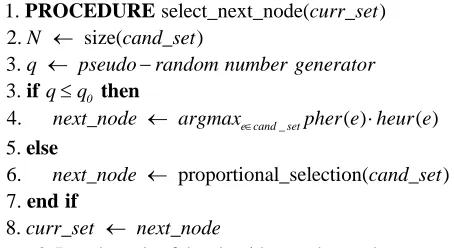
After the candidate set 𝐶 is selected, we will need to select the next node to be accessed by the transition probability formula. The random number 𝑞 is generated using the XORWOW pseudo-random number generator in the cuRand library.
_
1. select_next_node( ) 2. size( )
3. 3.
4. ( ) ( )
5.
6. proportio
0
e cand set
curr_set
N cand_set
q pseudo random number generator
q q
next_node argmax pher e heur e
next_node PROCEDURE
if then
else
nal_selection( ) 7.
8.
cand_set
curr_set next_node
[image:4.612.183.410.55.179.2]end if
Figure 2. Pseudo-code of the algorithm to choose the next node.
If 𝑞 > 𝑞0, we use the formula (2) to select the next node, this method is also called roulette select method. Skinderowicz R [9] based on the characteristics of the thread bundle proposed a reduction algorithm, the maximum size of the calculation is limited to 32. This is because, in the CUDA architecture, the number of threads in a thread bundle is 32. So, here we also use this reduction method, we only select the candidate nodes in the 32 elements of the probability of the calculation.
EXPERIMENT AND RESULT ANALYSIS
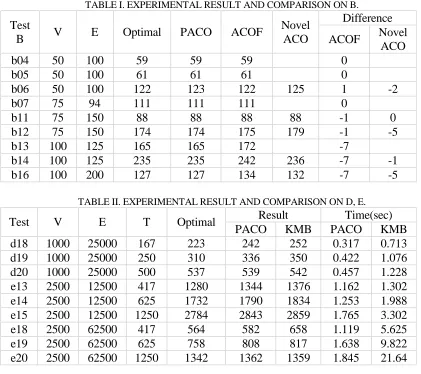
The proposed algorithm was implemented in C++ through a Intel(R) Core(TM) i3-2100 3.10GHz with 1GB RAM, GTX650 GPU, Ubuntu16.04 operating system. In order to verify the effectiveness of the algorithm, this paper uses the B, D, and E class graph in SteinLib Library as test cases. Koch T, Martin A et al. [10] summarize the known optimal solutions and the best solutions of various topological graphs.
The algorithm in this paper is compared with the ACOF algorithm [4] and the Novel-ACO algorithm [6] on the B class graph. In Table I, Optimal is the current or known optimal solution of the test case. The negative value in Difference indicates that the experimental results of this algorithm is better than other algorithms, Positive values in contrast. The blank part of the table indicates that the algorithm does not test the corresponding graph.
TABLE I. EXPERIMENTAL RESULT AND COMPARISON ON B.
Test
B V E Optimal PACO ACOF
Novel ACO
Difference
ACOF Novel
ACO
b04 50 100 59 59 59 0
b05 50 100 61 61 61 0
b06 50 100 122 123 122 125 1 -2
b07 75 94 111 111 111 0
b11 75 150 88 88 88 88 -1 0
b12 75 150 174 174 175 179 -1 -5
b13 100 125 165 165 172 -7
b14 100 125 235 235 242 236 -7 -1
b16 100 200 127 127 134 132 -7 -5
TABLE II. EXPERIMENTAL RESULT AND COMPARISON ON D, E.
Test V E T Optimal Result Time(sec)
PACO KMB PACO KMB
d18 1000 25000 167 223 242 252 0.317 0.713
d19 1000 25000 250 310 336 350 0.422 1.076
d20 1000 25000 500 537 539 542 0.457 1.228
e13 2500 12500 417 1280 1344 1376 1.162 1.302
e14 2500 12500 625 1732 1790 1834 1.253 1.988
e15 2500 12500 1250 2784 2843 2859 1.765 3.302
e18 2500 62500 417 564 582 658 1.119 5.625
e19 2500 62500 625 758 808 817 1.638 9.822
e20 2500 62500 1250 1342 1362 1359 1.845 21.64
CONCLUSION
This paper presents an ant colony optimization algorithm with data parallelism to solve STP. The algorithm uses the Gunrock graph processing library and the correlation function in CUDA to implement the data parallelism in the path search phase. In this paper, we test the topology of B, D, and E in SteinLib Library. The simulation results show that the proposed algorithm is better than the related ACOF, Novel-ACO and KMB algorithm. In future research, we can study the algorithm from multiple target nodes, and further increase the parallelism of the algorithm in order to achieve better performance.
REFERENCES
1. F. Hwang and D. Richards, “Steiner Tree Problems”, Networks, vol 22, pp 55-89, 1992.
2. Gutjahr W J. A Graph-based Ant System and its convergence.[J]. Future Generation Computer Systems, 2000, 16(8):873-888.
3. Yang W. An Ant Colony Optimization Algorithms for the Minimum Steiner Tree Problem and its Convergence Proof [J]. Acta Mathematicae Applicatae Sinica, 2006, 29(2):352-361.
4. Hong X U, Wang H, Shan-Wen Y I. Ant Colony Optimization Algorithm Based on Forest Growth for Steiner Tree Problem [J]. Journal of Chinese Computer Systems, 2010, 31(4):752-755.
6. Prasad S. A novel Ant Colony Algorithm for multicast routing in wireless ad hoc networks[C] International Conference on Computer Science, Engineering and Applications. 2012:309-317. 7. Harish P, Narayanan P J. Accelerating large graph algorithms on the GPU using CUDA[C] High
PERFORMANCE Computing - Hipc 2007, International Conference, Goa, India, December 18-21, 2007, Proceedings. DBLP, 2007:197-208.
8. Wang Y, Davidson A, Pan Y, et al. Gunrock: a high-performance graph processing library on the GPU[C] Acm Sigplan Symposium on Principles & Practice of Parallel Programming. arXiv, 2015:265-266.
9. Skinderowicz R. The GPU-based parallel Ant Colony System [J]. Journal of Parallel & Distributed Computing, 2016, 98:48-60.