Volume 4, No. 2, Jan-Feb 2013
International Journal of Advanced Research in Computer Science
RESEARCH PAPER
Available Online at www.ijarcs.info
Analysis of Crowding Population Based Ant Colony Optimization for Service Restoration
Problem in Distribution System
Rajneesh Kumar Karn* Research Scholar, Student Member IEEE Maulana Azad National Institute of Technology
Bhopal, India [email protected]
Yogendra Kumar Professor, Electrical Engineering Maulana Azad National Institute of Technology
Bhopal, India [email protected]
Gayatri Agnihotri
Former Professor, Electrical Engineering Maulana Azad National Institute of Technology
Bhopal, India [email protected]
Abstract: The crowding population based ant colony optimization algorithm (CP-ACO) uses a different pheromone update in comparison to other ACO algorithms. In this paper, crowding population based ant colony optimization algorithm is proposed to solve service restoration problem. The most notable achievement featured in this paper is run time reduction of algorithm to solve the service restoration task. The results on three test systems show the prominent efficiency of CP-ACO algorithm.
Keywords: Non dominated sorting; crowding population based ant colony optimization; priority customers; service restoration
I. INTRODUCTION
To maintain the customer satisfaction and the consequent revenue earned by the power distribution company, fast restoration of power supply to the healthy out-of-service area is of profound importance. However, in the course of service restoration, several related issues must also be considered as: (1)The power supply must be restored to the maximum possible healthy out-of-service area. (2) From economic point of view, there should be minimum loss in the system after the service restoration is accomplished. (3) Radial topology of the distribution systems should be maintained. (4) To maintain the safety and security of different power system components (such as transformers and lines etc.), it is important that the bus voltages and line currents should not cross their respective operational limits. (5) Number of switch operation should be minimum for service restoration to reduce time taken in the service restoration process. (6) In the event of partial service restoration, the supply must be restored to highest priority customers and this fact should be reflected in the final solution of service restoration problem. (7) The software run time required by the service restoration algorithm should be minimum for speedier solution. Because of the importance of the service restoration problem, there has been considerable interest in the past in developing suitable methods for service restoration in distribution systems.
To reduce the out of service area as efficiently as possible and the burden of operators, a computer aided decision supports assist the operators. The researchers have developed many methods to solve the service restoration
problem in distribution systems [1]-[10]. In recent years, modern intelligent calculation methods have been also applied in distribution network service restoration such as genetic algorithm (GA) and ant colony optimization (ACO). In conventional GA based techniques [11]-[16] proposed for service restoration, multi objective optimization problem is converted into a single objective function.
The improved technique using GA is Advanced NSGA-II [17] where for solving the service restoration problem, the multi objective nature of the problem is retained without the need for any tunable weights or parameters. But due to radial operation of distribution network, GA based on binary code generates a lot of infeasible solution in the evolutionary process and memory space required is very high. In standard ACO based techniques [22] for solving service restoration [18-21], the multi-objective nature of the problem is converted to a single objective by the use of weighting factors hence multiobjective nature of the problem is not retained finally.
pheromone update based on integer ranking of different fronts in the entire population of solutions of parents and offsprings, elitism is maintained and convergence is achieved in short time than NSGA-II and conventional GA. Multiobjective nature of the problem is also retained without the use of tunable weighting factors. As a result the proposed methodology is generalized enough to be applicable to any power distribution network. The applicability of proposed methodology has been demonstrated through detailed simulation studies on three different distribution test systems. The paper is organized as follows. In section II, the detailed mathematical description of the service restoration problem is described in detailed. In section III, the salient features of the CP-ACO algorithm is discussed. In section IV, the application of CP-ACO is described in detail and the main results of this work are discussed in section V. Finally section VI presents main conclusions of this paper.
II. PROBLEMFORMULATION
In this paper, the service restoration problem has been formulated as a multi-objective, multi-constrained combinatorial optimization problem. The various formulations for objective functions and constraints developed in this work are described as follows:
A. Objective Functions:
a. Minimization of Out of Service Area:
Min
1
1
1
( )
b
i i
i i B
f X
L
L
= ∈
=
∑ ∑
−
(1)X
is switch state vector of network under consideration for service restoration,i.e. [ 1, 2,... ]
S
N
X = SW SW SW
j
SW
=
Status ofj
th switch. A closed switch is represented by 1 and an open switch is represented by 0.S
N
=
Total number of switches in the network.1
b
= No. of energized buses in the network before fault.i
L
= load oni
th bus.B : Set of energized buses in the restored network. In eqn. (1), it is assumed that in a ‘n’ bus power system, the buses are numbered from 1 to n and in the pre-fault case, all the buses in the network are energized. Therefore ‘b1’ is equal to ‘n’. However, in the post fault scenario, all the buses would not be necessarily energized. Hence, ‘B’ would contain only the energized buses
b. Minimization of number of manually controlled
switch operation:
2
1
min ( )
m
N
j j
j
F X SWM SWMR
=
=
∑
− (2)Where,
N
m is number of manually controlled switches.j
SWM
= Status ofj
thmanually controlled switch in network just after fault.j
SWMR
= Status ofj
th manually controlled switch in the restored network.c. Minimization of number of remotely controlled
switch operation:
3
1
min
(
)
a
N
j j
j
F X
SWA
SWAR
=
=
∑
−
(3)Where, Na is number of remotely controlled switches.
j
SWA
= Status ofj
th remotely controlled switch in network just after fault.j
SWAR
= Status ofj
th remotely controlled switch in the restored network.d. Minimize the losses:
4
min
F X
( )
=
Power loss in the restored network whichcan be calculated with help of load flow. (4)
B. Constraints:
a. Radial network structure should be maintained.
b. Bus voltage limits should not be violated.
V
min<
V
j<
V
max …..(5)
V
min=
Minimum acceptable bus voltage.V
j=
Voltage atj
th bus.
V
max=
Maximum acceptable bus voltage. c. Feeder line current limits should not be violated.
I
min<
I
j<
I
max ……(6)min
I
=
minimum acceptable line current.I
j=
Current inj
th line.
I
max=
maximum acceptable line current.III. METHODOLOGY
A. Crowding Population Based Ant Colony Optimization:
The Crowding Population-based ACO algorithm (CPACO) was first defined and applied for TSP [26-28] and has slight improvement in population based and colony optimization developed by Guntsch and Middendorf [23-25] for dynamic combinatorial optimization problems. CPACO uses a crowding replacement scheme similar to restricted tournament selection. With this scheme a single population (P) of preset size is maintained, which is initialized with randomly generated solutions. All solutions in the population are assigned an integer rank according to the dominance ranking procedure used by the NSGA-II algorithm developed by Deb [30] All elements in the pheromone matrix are initialized to some initial value (τinit).
All solutions in the population increment their corresponding elements in the pheromone matrix according to the inverse of their rank, i.e. ∆ τsij=1/(Srank) and is
calculated in each iteration.
CPACO uses a single pheromone matrix [27] with individual heuristic matrices for different objective unlike PACO which uses individual pheromone and heuristic matrix for each objective.
CP-ACO assigns each ant a set of unique heuristic exponent correction factors (λ), similar to the procedure explained in [29] in place of average rank weight method used in P-ACO. This allows each ant to exploit heuristic matrices by different amounts while still using a common pheromone matrix. The transition probabilities are calculated using (7) where h defines the number of objectives.
B. CP-ACO Algorithm:
The step-by-step procedure of CP-ACO for is described here. The basic algorithm is as follows
a. Initially a random population P0 of size N is created
where N is the number of strings in the population. The length of each string is equal to the number of bits in each string. Each solution is assigned initial pheromone value τt= τinit(τinit>0)
b. Create offspring population Q0 of size N by applying
GA operators i.e. selection, crossover and mutation on P0. Here selection will be based on transition
probability principle of ant colony algorithm given by equation (7).
c. Assign Pt =P0 and Qt =Q0 where Pt and Qt denote the
parent and offspring population at any general “tth” generation respectively.
d. Create a combined population Rt=PtUQt. Thus the size
of Rt is 2N.
e. Perform nondominated sorting on Rt which divides the
population in various fronts. The solution in Rt, which
do not constrained dominate each other but constrained dominate other solutions of Rt, are kept in first front
and ranked one.. Among the remaining solutions not in rank one which do not constrained dominate each other but constrained dominate all other solutions are kept in second front and are ranked 2.In the similar way all remaining solutions are ranked by integer and is repeated until there is no solution in Rt.
f. To create parent population in next “(t+1)th” generation Pt+1 , the following procedure is opted. Initially the rank
one front is considered. If the no of solutions ranked one is less than N then all the solutions of rank one are included in Pt+1. The remaining solution in Pt+1 are
filled with the solutions from rank 2, 3,4 and more. This process is repeated until the total no of solutions (i.e n) in Pt+1 is greater than N. To make the size Pt+1
exactly equal to N, (n-N) solutions from the last included nondominated front are discarded from Pt+1.To
choose the solutions to be discarded, initially the solutions of the last included nondominated front are sorted according to their crowding distances and, subsequently, the solutions having least (n-N) crowding distances are discarded from Pt+1.
g. All solutions in the new population increment their corresponding elements in the pheromone matrix according to the inverse of their rank, i.e. ∆τst=1/(Srank)
τt+1=τt+∆τst (8)
h. Create the offspring population Qt+1 with the
application of crowded tournament selection based on Pheromone in each string, crossover and mutation operator on Pt+1.
i. Test for convergence. If the algorithm has converged, then stop and report the results. Else t→(t+1), Pt→Pt+1,
Qt→Qt+1 and go back to step 4.
Flowchart of CP-ACO Algorithm is shown in Appendix “A” at last page.
IV. IMPLEMENTATIONOFCP-ACOFORSERVICE RESTORATIONPROBLEM
In this work, before application of CP-ACO for solving service restoration problem, the original distribution network is mapped to a graph involving nodes and branches. Thus, the configuration of the original network is completely described by the status of the switches.
A. String Representation:
The entire switches in a particular distribution network are represented in terms of string of binary bits. The status of switches such as ‘closed’ and ‘open’ are shown ‘1’ and ‘0’ respectively. The length of the string (i.e. number of bits in string) is equal to number of switches in the system.
B. Generation of initial population:
Generally the initial population P0 is generated
randomly. If the prefault network is well behaved and well balanced, then the final service restoration plan is expected to be near to the original configuration and hence a string according to original configuration is incorporated in initial population replacing any one string in randomly generated
( )
[
]
[
]
( )
⋅
⋅
=
∑
∏
∏
∈ =
=
7 )
( ) (
1 1
i k N
l ij
d h
d ij
ij d h
d ij
k ij
d d
t t
t
p λβ
β λ
η
τ
population. The generation of the initial population is restricted to meet the following requirements.
a. Root switches are always connected i.e. kept always equal to “1” in all the possible binary strings of the expected newly reconfigured network as the opening the root switch will isolate the entire bus system. Root switch is one nearest to the substation connecting the entire bus system.
b. The faulted zone is always isolated by making the element in all strings, corresponding to switches around the faulted zone, “0”.
C. Radiality Checking:
To check the radiality of the system, a breadth-first-traversal of the network starts from the root switch and travels downwards of the distribution network. The root switch from where the traversal starts is called the first level switch. If any switch under consideration is closed, the reachable zones connected to downstream side and hence, is marked “visited”. On the other hand, the unreachable switches connected at the downstream side are marked “unvisited”. After consideration of all first level switches, zones marked “visited” are entered in a list “L”. The switches connected to “visited” zone downstream side are called second level switches. The same procedure just mentioned for first level switches is repeated and list “L” is updated. The switches connected to zones recently admitted in list “L” are third level switches and the procedure is repeated again and again till there is no switch left in the next level. The earlier mentioned procedure is illustrated as follows for the network shown in Fig.2, in which switch S1
is root switch. First level switch-S1
Zones “visited” connected with first level switch-Z1
Second level switches-S2, S3
Zones “visited” connected with second level switch-Z2, Z4
Third level switches-S4, S5, S7, S8
Zones “visited” connected with third level switch-Z3, Z5, Z7
Fourth level switches-S6, S9, S10
Zones “visited” connected with third level switch-Z6
Fifth level switches-nil, all zones are “visited”
The presence of loop is detected if any of the zones is “visited” more than once during the traversal. The switch currently under considered is made ‘OFF’ to maintain the radiality. After the completion of network traversal all the “visited” zones are put list “EZ” called “existing zones”. The “existing zones” are actually energized zones.
D. String evaluation:
After checking the radiality, all strings give a radial configuration and their corresponding existing zones are recorded through which existing buses and lines are found. With the knowledge of the existing buses all the objective functions are calculated for each string of population. AC load flow study is conducted to calculate system losses, bus voltage and line current violations.
E. Initialization of ACO parameters:
a. Number of ants
b. Initial pheromone value τt= τinit(τinit>0)
c. Pheromone parameter (α)
d. Heuristic parameter (β)
e. unique heuristic exponent correction factors (λ)
F. String Operation:
To generate the offspring population single point crossover method is used. GA operators i.e. selection, will be based on transition probability principle of ant colony algorithm given by equation (7).Moreover, the mutation operator is randomly applied in any string. After the off spring population is created, the radiality of all offspring population is checked and if any solution found non radial then is made radial according to the procedure mentioned in step C. Subsequently, with the help of crowded tournament selection operator based on pheromone matrix, the mating pool is created for next generation. This operator maintains the convergence as the solution from better front is selected and diversity as the solution having higher crowding distance within the same front is selected.
G. Partial Restoration:
During the restoration process, if no such string in search space is generated which can restore entire out of service area without violating any constraint, the string, which can restore maximum portion of out of service area without violating any constraint, is selected and kept in better front.
H. Front formation and ranking:
Following step 5 of section III, the combination of parent and offspring population having size 2N is divided in various ranked nondominated fronts. If no better solution is generated in offspring,the current best solution in the parent becomes a winner and in this elitism is maintained to improve the convergence.
I. Selection of new parent having N strings:
N strings for the parent population of the next generation from Rt (having 2N strings) of the current generation are
selected according to the procedure mentioned in step 6 of section III.
J. Pheromone update:
All solutions in the new population increment their corresponding elements in the pheromone matrix according to the inverse of their rank as described in step 7 of section III.
K. Convergence:
To check the convergence, at each generation, the candidate configurations in parent Pt and offspring Qt are
compared after they are made radial as mentioned in part C of this section. If both parent and child populations are same then convergence is achieved otherwise it is not.
L. Selection of Final solution:
After convergence is achieved, the best solution is in first front of Rt. If the first front has the only one solution
area will be considered string of better quality. If two or more strings have the same value of objective function of first priority, then objective of second priority is evaluated and the process is continued. In any stage only one solution is left then, it is considered the best solution.
M. Steps of Algorithm for Service Restoration:
a. The information available to the ACO algorithm are (a) system data; (b) prefault configuration and (c) post fault configuration.
b. Generate initial population P0 for ants following the
procedure described in part B of this section.
c. Check the radiality of the solutions in search space and modify them, if necessary, following the procedure described in part C of this section.
d. Evaluate the strings in P0 as described in part D of
this section and assign Pt=P0.
e. Initialize the parameters for ACO search as described in part E of this section.
f. The ants are dispatched and solutions are constructed based on the level of pheromone on edges i.e. string of binary bits to be selected for crossover to generate offspring. The number of ants will be less than or equal to the number of strings generated in search space.
g. Generate offspring population Qo as described in part
F of this section. In all strings of new offspring population, the faulted zone is isolated and the root switch is always made “closed” as described in part B of this section.
h. Check the radiality of the strings inoffspring population and modify them, if necessary as mentioned in part C of this section.
i. Follow steps 4 to 8 of section III to obtain Pt+1 and
Qt+1
j. In all solutions of Qt+1, the faulted zone is isolated
and root switch is always closed as described in step B of this section.
k. Check the radiality of the strings in Qt+1 and modify
them, if necessary as mentioned in part C of this section.
l. Check for convergence as described in part K of this section. If the algorithm has converged, find the final solution according to part L ,otherwise go to step XIII.
m. Evaluate the strings in Qt+1 +as described in part D of
this section
n. Update t→(t+1), Pt→Pt+1, Qt→Qt+1 and go back to
step IX.
V. RESULTSANDDISCUSSION
[image:5.612.309.556.66.154.2]The effectiveness of the Ant Colony System algorithm for service restoration has been studied on three different distribution systems. The details of these systems are given in Table I.
Table 1: Details Of Different Test Systems
SL. No.
Descripti on
No. of Buses
No. of Switche s
Systems nominal voltage (KV)
No. of load points
1 System-1 13 10 11 12
2 System-2 10 14 13.8 19
3 System-3 33 37 12.66 31
The performance of proposed CP-ACO algorithm has also been compared with Non-dominated Sorting of Genetic Algorithm NSGA-II developed by Deb [30] and conventional GA developed by Laun et al [13]
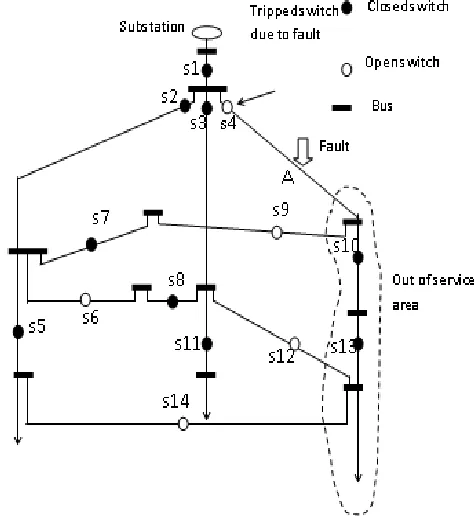
Here the results corresponding to 10 bus, 14 switches system (system-2) are only illustrated. Fig. 1 shows the schematic diagram of the 10-bus,14-switch system. In this system, it has been assumed that the fault has taken place at point A (also indicated in Fig.1) and due to this fault, the switch S4 trips for isolating the fault. As a result, the area
shown inside the closed curve is left without electric power. The supply to this “out-of-service” area can be restored either by closing switch S14 (let it be called option A) or by
closing switch S12 (let it be called option B). Now, switch
S12 is an automatic, remote controlled switch with a typical
operating time of 50 seconds whereas, switch S14 is a
manually controlled switch with operating time typically in the range of 1200-1500 seconds. It is to be noted that the operating time of a manually controlled switch depends on its distance from the nearest manned substation (from which an operator has to travel to operate the switch). Now, by both these options, the entire “out-of-service” area can be supplied. Therefore, from the considerations of the objective function kept at first
[image:5.612.313.550.451.711.2]Preference, both these options are equally preferable. However, as option B takes considerably less time as compared to option A to accomplish the service restoration task, this option is chosen.
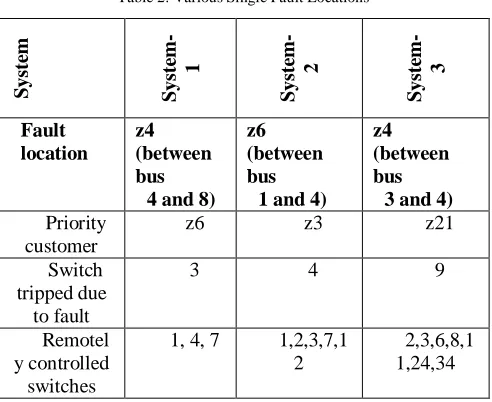
[image:6.612.308.560.69.471.2]Similar kind of studies for different single fault in all three systems under consideration is shown in TableII.
Table 2: Various Single Fault Locations
Sys
te
m
Sys
te
m
-1
Sys
te
m
-2
Sys
te
m
-3
Fault location
z4 (between bus
4 and 8) z6 (between bus
1 and 4) z4 (between bus
3 and 4) Priority
customer
z6 z3 z21
Switch tripped due
to fault
3 4 9
Remotel y controlled
switches
1, 4, 7 1,2,3,7,1 2
2,3,6,8,1 1,24,34
Various GA-ACO algorithm parameters are shown in Table III.
Table 3: Parameters Setting In Test Cases
Parameters Value
Size of Population 10
Number of Ants 10
Maximum no of iterations 100
Initial Pheromone on strings 0.1 Cross over rate (Single Point) 0.8 Mutation Rate per gene(bit) 0.05
[image:6.612.36.282.135.336.2]In the result tables, the entries corresponding to the “out-of-service” area has been given in terms of the total amount of load (in KW) left unsupplied. For example, from Table IV, it can be concluded that 600 KW of total load is always left unsupplied in system-1, irrespective of whichever solution methodology is used. Actually, in system-1, the load in the faulted zone is 600 KW and as this zone is isolated following a fault, this load cannot be restored by any technique. Similarly, the faulted zones in system-2 and system-3 contain 100 KW and 120 KW of load respectively and as a result, these loads can also not be restored by any of the methods. Moreover due to generation of lot of infeasible solution on the basis of probability in conventional GA, run time required for the algorithm is very high in comparison to proposed CP-ACO technique. NSGA-II developed by Deb [30] also require more time than CP-ACO. Conventional GA requires more manual switch operations than NSGA-II and CP-ACO. All the three methods are able to restore Priority customers. Based on results in Table IV, CP-ACO based technique is found to be the best technique among three.
Table 4: Single Fault Full Service Restoration
System System-1 System-2 System-3
Out
-of
-se
rv
ic
e A
rea
(K
W)
CPACO 600 100 120
NSGA-II 600 100 120
GA 600 100 120
N
o.
of
m
a
nu
al
Swi
tc
h
ope
ra
ti
o
n
CPACO 2 1 1
NSGA-II 2 1 1
GA 3 2 2
N
o.
of
A
ut
om
at
ic S
w
it
ch
O
pe
rat
io
n
CPACO 2 1 1
NSGA-II 2 1 1
GA 1 0 0
L
os
se
s(
KW
)
CPACO 104.50 582.40 210.00
NSGA-II 104.50 582.40 210.00
GA 106.86 579.0 216.0
Ru
n
-time
of
A
lg
ori
th
m
(s
ec
onds
) CPACO 14.113 17.534 41.313
NSGA-II 22.538 30.121 75.812
GA 43.807 64.910 195.311
S
ta
tus
of
P
ri
ori
ty
Cus
tom
e
rs
CPACO Yes Yes Yes
NSGA-II Yes Yes Yes
GA Yes Yes Yes
[image:6.612.36.282.388.477.2]Table 5: Single Fault Partial Service Restoration
System System-1 System-2 System-3
Ou
t-of
-ser
v
ic
e A
re
a
(K
W
)
CPACO
1344 260 240
NSGA-II
1344 260 240
GA
1344 650 240
N
o.
of
m
a
n
u
al
S
w
itc
h
o
pe
ra
ti
on
CPACO
3 3 3
NSGA-II
3 3 3
GA
4 2 3
N
o.
of
A
u
to
m
a
tic
S
w
itc
h
O
p
e
ra
tio
n CPACO 2 1 2
NSGA-II
2 1 2
GA
0 0 2
L
o
sse
s(
K
W
)
CPACO
99.834 578.37 191.4
NSGA-II
99.834 578.37 191.4
GA
98.797 533.14 199.3
Ru
n
-tim
e
of
A
lgor
it
hm
(s
e
co
n
d
s)
CPACO
13.193 15.273 39.117
NSGA-II
21.976 29.789 75.291
GA
43.782 65.117 195.64
S
ta
tu
s
o
f
P
rio
rity
Cu
st
o
m
e
rs
CPACO
Yes Yes Yes
NSGA-II
Yes Yes Yes
GA
No Yes No
VI. CONCLUSION
In this paper, CP-ACO based technique is developed and analyzed for solving the service restoration problem in the electric power distribution system. In this study, various practical issues of distribution system operation, such as presence of important key customers like hospitals, industries are considered. Moreover manually controlled switches and remotely controlled switches are considered separately as objective function which helps in applying restoration plan practically in short time as the operating time of manually controlled switches are significantly high in order of 1200-1500 seconds in comparison to remotely controlled switches having operating time of 50-60 seconds. The advantage of the proposed CP-ACO based technique is that it does not require weighting factors as needed in conventional optimization techniques. Moreover the proposed technique overcomes the demerits of GA and ACO both. Demerit of GA to produce infeasible solution is controlled by positive feedback mechanism based on pheromone of ACO and demerit of ACO to take large convergence time is controlled by controlling the no of ants and size of search space generated by GA. Based on larger number of simulation studies, it has been found that the CP
ACO based technique performs far better than conventional GA in all respects and significantly better than NSGA-II in respect of run time of algorithm. Number of iterations required to get best solution is also very less in comparison to NSGA-II and GA. It is therefore CP-ACO based technique is most suitable for real time implementation both in terms of accuracy and speed.
VII. REFERENCES
[1]. Akoi, H. Kuwabara T. Satoh M. Kanezashi, "Outage state optimal load allocation by automatic sectionalizing switches operation in distribution systems," IEEE trans. Power delivery. 1987,vol. 2, no.4, pp. 1177-1185
[2]. K.Akoi , H. Kuwabara T. Satoh M. Kanezashi, "Voltage drop constrained restoration of supply by switch operation in distribution system," IEEE trans. Power delivery. 1988 vol. 3, no. 3, pp. 1267-1279.
[3]. K. Akoi, H. Kuwabara T. Satoh M. Kanezashi, "A new algorithm for service restoration in distribution systems," IEEE trans. Power delivery. 1989 vol. 4, no. 3, pp.1832-1839.
[4]. C. C. liu S. J. Lee, S.S. Venkata "An expert system operational aid for restoration and loss reduction of distribution systems," IEEE trans.Power syst.1988 vol. 3, no. 2, pp. 619-626
[5]. C. E. Lin et al., "A distribution system outage dispatch by data base method with real time revision," IEEE trans. Power Delivery, vol. 4. Jan.1989.
[6]. Imamura et al., "An application of fuzzy reasoning for service restoration" (in Japanese) Trans. IEE Jpn., vol. 4, July 1989.
[7]. H. Mori et al., Parallel simulated annealing for power system decomposition," IEEE trans. Power system vol. 4, May 1994.
[8]. S. Toune, H. Fudo, T. Genji, Y. Fukuyama, Y. Nakanishi, "A reactive tabu search for service restoration in electric power distribution system," IEEE International conference on evolutionary computation," Anchorage Alaska, May 4-11 1998.
[9]. H.C.Kuo and Y.Y Hsu, “ Distribution system load estimation and service restoration using a fuzzy set approach”, IEEE Transactions on Power delivery, Vol-8, No-4, pp-1950-1957, Oct.1993
[10]. S.J.Lee, S.I.Lim, and B.S.Ahn, “ Service restoration of primary distribution system based on fuzzy evaluation of multi criteria”, IEEE Transactions on Power System, Vol-13, No-3, pp-1156-1163, Aug.1998
[11]. Y. Fukuyama and H. D. chaing, "A parallel genetic algorithm for service restoration in electric power systems," in proceeding IEEE FUZZ/FES Conference, Yokohama, Japan, Mar. 1995.
[12]. A. Augugliaro, L.Dusonchet, E.R. Sanseverino, "Service restoration in compensated distribution networks using a hybrid genetic algorithm," Electric power syst. Research, 1998, vol. 46, 59-66.
[14]. Yogendra Kumar, Biswarup Das, Jaydev Sharma, Genetic Algorithm for supply restoration in distribution system with priority customers 9th international Conference on Probabilistic Methods applied to power systems , Sweden, June 2006.
[15]. R. E. Brown, S. Gupta, R. D. Christie and S. S. Venkata, “A genetic algorithm for reliable distribution system design”, International Conference on Intelligent Systems Applications to Power Systems, ISAP '96., pp. 29-33, January 28 - February 2,1996.
[16]. S. Chavali, A. Pahwa and S. Das, “A genetic algorithm approach for optimal distribution feeder restoration during cold load pickup”, Proceedings of the Congress on Evolutionary Computation, CEC '02, vol. 2, pp. 1816-1819, May 12-17, 2002.
[17]. Y.Kumar, B.Das and J.Sharma, “ Multiobjective, multiconstraint service restoration of electric power distribution system with priority customers”, IEEE Transactions on Power delivery, Vol-23, No-1, pp-261-270, Jan.2008
[18]. Indira Mohanty,Jugal Kalita,Sanjoy Das,Anil Pahwa,Erik Buehler, “Ant Algorithm for the optimal restoration of Distribution feeders during cold load pickup’,IEEE Transactions on Power Delivery,pp.132-137,2003.
[19]. Isamu Watanabe, “An ACO Algorithm for service Restoration in Power Distribution Systems”, IEEE Transactions on Power delivery, pp.2864-2871,2005
[20]. Zhigang Lu, Ying wen, Lijun Yang, “An Improved ACO algorithm in Power Distribution Systems” IEEE transactions on Power Delivery,2009
[21]. H. Falaghi,M.RHaghifam, and Chanan Singh, “Ant Colony optimization-Based Method for placement of Sectionalizing Switches in Distribution Network Using a Fuzzy Multiobjective Approach’ IEEE transactions on Power Delivery, Vol.24, No.1, pp.268-276,2009
[22]. M.Dorigo and T.Stutzle, “Ant Colony
Optimization”,Cambridge,MA:MIT Press,2004
[23]. M.Guntusch and M.Middendorf, “A population based approach for ACO” In S. Cagnoni, J.Gottlieb, E.Hart, M.middendorf and G.r.Raidy editors, EvoWorkshop, PP-72-81, springer-Verlag, 2002
[24]. M.Guntusch and M.Middendorf, “Applying population based ACO for dynamic optimization problem”. In ANTS’02 Proceedings of the Third International workshop on Ant Algorithms, pp-111-122, London, UK, Springer-Verlag, 2002.
[25]. M.Guntusch and M.Middendorf, “ Solving multi-criteria optimization problem with population based ACO” In G. Goos, J. Hartmanis, and J. van Leeuwen, editors, Proceedings of the Second International Conference on Evolutionary Multi-Criterion Optimization (EMO 2003), volume 2632 of LNCS, pages 464– 478. Springer, April 2003.
[26]. D.Angus, “Niching for ant colony optimization” Technical Report, Faculty of Information and Communication Technology, Swinburne University of Technology, 2006.
[27]. D. Angus, “Crowding population based ant colony optimization for the multi-objective travelling salesman problem”, Proceedings
of the IEEE Syposium on Computational Intelligence in Multi-Criteria Decision making (MCDM 2007), pp-333-340, 2007.
[28]. D. Angus & C. Woodward, “Multiple Objective Ant Colony Optimization” Swarm Intelligence (2009) 3:pp-69-85
[29]. B. Baran and M. Schaerer. A multiobjective ant colony system for vehicle routing problem with time windows. In Proceedings of the 21st IASTED International Conference, Innsbruck, Austria, February 2003.
[30]. K.Deb, A.Pratap, S.Agrawal, and T.Meyarivan, “ A fast and elitist multi objective genetic algorithm:NSGA-II”,IEEE Tranns.Evol.Comput.,Vol.6, No.2,pp-182-197,Apr.2002
Short Bio Data for the Author
Rajneesh Kumar Karn born in 1978 in India. He received the M.Tech degree in Heavy Electrical Equipment from Maulana Azad National Institute of Technology, Bhopal in 2006.He is working towards the Ph.D. degree in Power System from Maulana Azad National Institute of Technology, Bhopal. Presently he is working as Associate Professor in Electrical Engineering Department in Radharaman Engineering College, Bhopal, India. His research interests are in area of optimization technique in Electrical Distribution Systems.
Yogendra Kumar born in 1965. He recieived the M.tech degree in Heavy Electrical Equipment from Maulana Azad College of Technology, Bhopal, India in 1998 and Ph.D. degree in Power System from IIT Roorkee, India in 2006.Presently he is working as Professor in Electrical Engineering Department in Maulana Azad National Institute of Technology, Bhopal, India. His areas of research interests are Distribution automation and Optimization.