BioMed Central
Page 1 of 19
(page number not for citation purposes)
BMC Psychiatry
Open Access
Study protocol
Folate Augmentation of Treatment – Evaluation for Depression
(FolATED): protocol of a randomised controlled trial
Seren Haf Roberts*
1, Emma Bedson
1, Dyfrig Hughes
2, Keith Lloyd
3,
Stuart Moat
4, Munir Pirmohamed
5, Gary Slegg
1, Richard Tranter
6,
Rhiannon Whitaker
7, Clare Wilkinson
8and Ian Russell
9Address: 1North Wales Section of Psychological Medicine, Institute of Medical and Social Care Research (IMSCaR), Bangor University, Academic Unit, Wrexham Technology Park, Wrexham, LL13 7YP, UK, 2Centre for Economics and Policy in Health, IMSCaR, Bangor University, Dean Street, Bangor, Gwynedd, LL57 1UT, UK, 3Psychological Medicine, Swansea University, Clinical School, Room 213, Grove Building, Swansea, SA2 8PP, UK, 4Department of Medical Biochemistry and Immunology, University Hospital of Wales, Health Park, Cardiff, CF14 4XW, UK, 5Department of Pharmacology and Therapeutics, University of Liverpool, Ashton Street, Liverpool, L69 3GE, UK, 6North West Wales NHS Trust, Ysbyty Gwynedd, Bangor, Gwynedd, LL57 2PW, UK, 7North Wales Organisation for Randomised Trials in Health (NWORTH), Institute of Medical and Social Care Research (IMSCaR), Bangor University, Ardudwy, Normal Site, Bangor, Gwynedd, LL57 2AS, UK, 8Department of General Practice, Cardiff University, Gwenfro Building, Wrexham Technology Park, Wrexham, LL13 7YP, UK and 9Institute of Medical and Social Care Research (IMSCaR), Bangor University, Brigantia Building, Bangor, Gwynedd, LL57 2AS, UK
Email: Seren Haf Roberts* - [email protected]; Emma Bedson - [email protected]; Dyfrig Hughes - [email protected]; Keith Lloyd - [email protected]; Stuart Moat - [email protected];
Munir Pirmohamed - [email protected]; Gary Slegg - [email protected]; Richard Tranter - [email protected]; Rhiannon Whitaker - [email protected]; Clare Wilkinson - [email protected]; Ian Russell - [email protected]
* Corresponding author
Abstract
Background: Clinical depression is common, debilitating and treatable; one in four people experience it during their lives. The majority of sufferers are treated in primary care and only half respond well to active treatment. Evidence suggests that folate may be a useful adjunct to antidepressant treatment: 1) patients with depression often have a functional folate deficiency; 2) the severity of such deficiency, indicated by elevated homocysteine, correlates with depression severity, 3) low folate is associated with poor antidepressant response, and 4) folate is required for the synthesis of neurotransmitters implicated in the pathogenesis and treatment of depression.
Methods/Design: The primary objective of this trial is to estimate the effect of folate augmentation in new or continuing treatment of depressive disorder in primary and secondary care. Secondary objectives are to evaluate the cost-effectiveness of folate augmentation of antidepressant treatment, investigate how the response to antidepressant treatment depends on genetic polymorphisms relevant to folate metabolism and antidepressant response, and explore whether baseline folate status can predict response to antidepressant treatment.
Seven hundred and thirty patients will be recruited from North East Wales, North West Wales and Swansea. Patients with moderate to severe depression will be referred to the trial by their GP or Psychiatrist. If patients consent they will be assessed for eligibility and baseline measures will be undertaken.
Published: 15 November 2007
BMC Psychiatry 2007, 7:65 doi:10.1186/1471-244X-7-65
Received: 1 May 2007 Accepted: 15 November 2007
This article is available from: http://www.biomedcentral.com/1471-244X/7/65
© 2007 Roberts et al; licensee BioMed Central Ltd.
Blood samples will be taken to exclude patients with folate and B12 deficiency. Some of the blood taken will be used to measure homocysteine levels and for genetic analysis (with additional consent). Eligible participants will be randomised to receive 5 mg of folic acid or placebo. Patients with B12 deficiency or folate deficiency will be given appropriate treatment and will be monitored in the 'comprehensive cohort study'. Assessments will be at screening, randomisation and 3 subsequent follow-ups.
Discussion: If folic acid is shown to improve the efficacy of antidepressants, then it will provide a safe, simple and cheap way of improving the treatment of depression in primary and secondary care.
Trial registration: Current controlled trials ISRCTN37558856
Background
Clinical depression is common, debilitating and treatable; one in four people experience it during their lives. By 2020, unipolar major depression is predicted to be the second leading cause of disability worldwide [1]. Impaired physical, social and occupational functioning are characteristic of depression, as is increased mortality via suicide, alcohol and drug misuse, and increased rates of cardiovascular disease [2]. Depression thus burdens individuals, families, the NHS, and the national economy [3]. Sub-optimal treatment of depressive disorders is therefore of great public health concern. Mental health is, like cardiovascular disease, the subject of a National Serv-ice Framework and thus reflects the priority given to the recognition and management of depression.
Despite a striking increase in the number of antidepres-sant options over the last 50 years their effectiveness remains largely unchanged. In line with National Institute of Clinical Excellence (NICE) guidance [4] the great majority of recognised sufferers are treated in primary care. However only half respond well to active treatment, while one-third respond to placebo [5]. According to NICE guidelines [4] selective serotonin reuptake inhibi-tors (SSRIs) are as effective in outpatient depression as tri-cyclic antidepressants (TCAs); since SSRIs generally have fewer side effects, they are recommended as first-line treat-ment in primary care.
The monoamine hypothesis of depression implicates a functional deficiency of noradrenaline (NA) or serotonin (5-hydroxytryptamine, 5-HT) in neurotransmission; vir-tually all antidepressants are thought to act by prolonging the activity of these neurotransmitters or by modulating receptor sensitivity [6]. Folate is an essential cofactor for the biosynthesis of both 5-HT and NA. Thus folate defi-ciency leads to impaired 5-HT synthesis in the human brain [7]. Moreover, studies demonstrate that up to one-third of patients with depressive illness have decreased plasma and red cell folate levels [8]. This may result from poor nutrition or socio-economic disadvantage, both
common in chronic mental illness. Patients with low folate respond less well to antidepressant therapy [9]. However, current clinical measures of folate status do not detect patients who may have functional rather than abso-lute deficiency.
Homocysteine, a toxic amino-acid metabolite elevated in functional folate deficiency, is a highly sensitive marker of folate status. A recent cohort study demonstrated that hyperhomocysteinaemia (plasma level >15 μmol/L), but not total serum folate or vitamin B12, is significantly related to depression severity (odds ratio = 1.90; 95% con-fidence interval = 1.11–3.25)[10]. Another study that examined 412 people aged between 60 and 64 years found that low folate and high homocysteine, but not low vitamin B12 levels, are correlated with depressive symp-toms [11]. Further evidence of a possible role of impaired folate metabolism in depression is suggested by a finding that patients homozygous for an abnormal variant of the methylenetetrahydrofolate reductase gene experience more severe depression (odds ratio = 1.69; 95% confi-dence interval = 1.09–2.62)[12]. This study has not been replicated, however, and was associated with a relatively modest odds ratio, less than expected with homocysteine. The use of genotyping to predict the effectiveness of folate supplementation of antidepressants thus needs further critical examination in appropriately powered studies that also take into account functional measures such as homo-cysteine level. Such a strategy should also acknowledge that folate metabolism in the human body is extraordi-narily complex; 27 enzymes are involved, many of which exhibit polymorphisms [13].
BMC Psychiatry 2007, 7:65 http://www.biomedcentral.com/1471-244X/7/65
Page 3 of 19
(page number not for citation purposes)
depression. Despite such suggestive evidence few attempts have been made to determine the effect of folic acid sup-plementation on drug treatment of depression. A Cochrane systematic review and meta-analysis identified only two randomised controlled trials (combined n = 151) examining the role of folate augmentation in depres-sion [14,15]. The trials differed substantially in recruit-ment criteria and provide little evidence for or against the routine use of folic acid in antidepressant treatment. In only one of the studies was folate given in its dietary form, in this case combined with fluoxetine [16]. Folic acid at only 0.5 mg per day was adequate to change serum homo-cysteine status, and to enhance antidepressant action, in females but not males. Thus the differential effect in men and women may have been due to the low dose of folic acid used in the study. In addition, abnormal clinical chemistry, (e.g. raised mean corpuscular volume as seen in folate deficiency) was used to exclude patients. The other study utilised a higher dose of methylfolate (15 mg) and selected patients with low red cell folate (<200 μg/L) but was of low power, with only 24 patients [17]. No study to date has used pharmacological doses of folic acid (i.e., 5 mg daily) to augment pragmatic antidepressant therapy. Hence there is a clear need for a trial with suffi-cient power to examine the effect of folic acid supplemen-tation in the treatment of clinical depression. The effects of folic acid supplementation may vary across different clinical populations encountered in primary and second-ary care; in particular, the clinical and cost effectiveness of folate augmentation for new cases may differ from that of cases with continuing but ineffective antidepressant pre-scription. In addition, the biological mechanism of folate augmentation may differ across different antidepressant treatments; accordingly, a comparison of SSRI versus other antidepressants is of interest.
The evidence, reviewed above, suggests that folic acid sup-plementation may augment antidepressant response. This is consistent with the finding that baseline levels of folate within the normal range predict antidepressant response [18]. In addition, there is evidence to suggest that folate deficiency, (e.g., as may be produced by inflammatory dis-orders or anticonvulsant drug treatment [19]), may aggra-vate depression or impair response to treatment.
Since dose-response relationship for folic acid as an adjunct to antidepressant treatment is not known, it is necessary to consider other evidence with regard to appro-priate dose choices for use with antidepressant. Based on known pharmacology of folate, including its penetration into the central nervous system and effects on neurotrans-mitter metabolism, there is little chance that 5 mg would be less effective than lower dose (e.g., 0.5 mg/day) folic acid, whereas it could well be more effective. This argu-ment is bolstered by findings [20,21] that 5 mg/day is
more effective than 0.4 mg/day with respect to both clini-cal and pre-cliniclini-cal outcomes in the human cardiovascu-lar system. There is little available information regarding the mechanism that may underlie a possible antidepres-sant-adjuvant effect, although suppression of homo-cysteine (Hcy) and clinical improvement were both more common in women than men treated with fluoxetine combined with folic acid [16]. This result suggests that higher doses of folic acid may be more effective, especially in men. Further evidence regarding potential mechanisms may be inferred from cardiovascular data. In this system there is growing evidence that Hcy elevation is a marker of functional folate deficiency, but suppression of Hcy by folic acid does not correlate with the latter's beneficial effects. For example, 0.4 mg/day folic acid is adequate to suppress elevated Hcy, but not to restore disturbed endothelial function measured using the technique of flow mediated dilatation of human forearm artery [22].
Furthermore, despite high doses (5 mg) of folic acid being substantially above the FDA's recommended daily dose (0.4 mg), there are few risks associated with such high doses other than for those with B12 deficiency, epilepsy or malignant disease. Even with lower doses of folic acid, consultant haematologists advise that vitamin B12 screen-ing, and exclusion of those found deficient, would be required. With the exception of patients with malignant disease and some patients with epilepsy, high dose folate is known to be safe in various clinical populations, includ-ing pregnant women and the elderly, provided B12 defi-ciency is screened and excluded [23]. Thus providing those patients with contraindicated conditions or treat-ments are excluded there is no experimental or clinical disadvantage to using 5 mg/day folic acid dose.
Thus consideration of the appropriate folic acid dose for trial participants with normal baseline serum folate is lim-ited by the lack of prior trials of folate augmentation of antidepressant treatment with essentially no information available on the nature of the dose-response relationship apart from the observation that women appear to respond better than men to low dose (0.5 mg/day) folic acid aug-mentation of fluoxetine [16]. Accordingly, the decision regarding folic acid dose depends on considerations of safety and possible effectiveness of various doses, ranging from 0.4 mg/day (as is used routinely pre-conception and in early pregnancy) to 5 mg/day (as is used routinely to treat folate deficiency). Of the two available tablet doses, we chose a pharmacological dose of 5 mg/day to improve our chances of detecting an effect of folate supplementa-tion in depression.
Methods/Design
depressive disorder in primary and secondary care. Sec-ondary objectives are to evaluate the cost-effectiveness of folate augmentation of antidepressant treatment, investi-gate how the response to antidepressant treatment depends on genetic polymorphisms relevant to folate metabolism and antidepressant response, and explore whether baseline folate status can predict response to anti-depressant treatment.
This is a multi-centred double blind, placebo-controlled, randomised trial of folic acid augmentation of pragmatic antidepressant treatment of moderate-to-severe depres-sion. The trial investigates the effect of folic acid augmen-tation on new and continuing antidepressant treatment over 3 months. Assessments will be at week -2 (baseline 1 – antidepressant initiation if required), week -1 (tele-phone contact for tolerability of antidepressant), week 0 (baseline 2 – randomisation to folate or placebo), and weeks 4, 12 and month 6 (outcome measures). Figure 1 shows the flow diagram of the trial.
Outcome measures
To estimate the effectiveness of folic acid in augmenting antidepressant treatment the trial will measure changes in depressive symptoms both from the participant's own experience and from the clinical perspective. The primary outcome measure is symptom severity as estimated by the self-rated Beck Depression Inventory (BDI). Clinician-rated Montgomery-Asberg Depression Rating Scale (MADRS) and the clinical global impression (CGI) of change will also measure symptom severity as secondary measures. Secondary outcome measures will include: health status (mental and physical aspects of quality of life) through the SF-12; recording and appropriately reporting of adverse events (e.g. psychiatric inpatient admission, attempted or completed suicide, and other mortality); and side effects as measured by the UKU side effects scale [24]. Cost-utility analysis will use the Euro-QoL (EQ-5D), a self complete resource use instrument and relevant medication history from GPs.
Blood samples at baseline and each follow-up will meas-ure folate and B12 status. Homocysteine levels will be determined from blood samples taken at baseline, week 12 and month 6. Pharmacogenetic analysis will be carried out on blood samples obtained at baseline only.
Compliance will be measured using the following four methods:
(1) The number of tablets remaining at each follow up will give a crude estimate of maximum compliance.
(2) Dispensing records for folic acid (or placebo) will be reviewed to measure persistence with therapy; and dates
on antidepressant medication containers to indicate delay in collecting repeat prescriptions.
(3) Patients will be asked to complete the Morisky ques-tionnaire [25], a validated tool for assessing compliance with tricyclic antidepressants [26] at the 12-week visit only.
(4) Red cell folate and homocysteine levels will be used as biochemical measures of compliance.
Referral and recruitment
Patients will be recruited from primary and secondary care in three NHS Trusts areas – North East Wales, North West Wales and Swansea, covering a population of about 800,000. A feasibility study in North West Wales estab-lished two ways of improving the recruitment of patients from primary care into antidepressant trials: (a) research-ers visited general practices to register, consent, randomise and follow-up patients; and (b) responsibility for pre-scribing shifted from general practitioners to trial
psychi-Flow diagram of trial
Figure 1
Flow diagram of trial.
Randomisation appointment
1. Treat as usual & count
2. Refer back to GP & count
No
Screening interview
Yes GP
appointment
No No
Yes
Patients with depression who either need 1st prescription, change or optimisation of
antidepressant treatment, or are not responding well to current antidepressant treatment are identified as suitable for trial
Yes No Does patient
meet inclusion criteria? Exclude2
No
Does thepatient consent? Exclude2
Blood & first baseline measures taken by researcher Randomisation appointment made within 2 weeks
Yes Does patient meet locally agreed B12 deficiency criterion?
B12 treatment and second baseline measures taken
Does patient meet locally agreed folate deficiency criterion?
Treat for folate deficiency and second baseline measures taken
RANDOMISATION stratified by centre, sex, new or continuing antidepressant, antidepressant type and counselling Second baseline measures taken
Receive placebo Receive folate
Repeat outcome measures at follow-ups
• 1 (4 weeks post randomisation appointment)
• 2 (12 weeks post randomisation appointment)
• 3 (6 months post randomisation appointment) Exclude1
Yes
GP or psychiatrist refers patient to trial via fax /email and provides an information sheet
Psychiatrist and researcher clarifies trial process, answers questions, assesses eligibility and obtains consent
Is patient willing to be screened?
Trial phase
Trial psychiatrist screens for depression, confirms patient meets ICD-10 criteria for moderate to severe depression, & takes appropriate clinical action. If necessary an antidepressant will be prescribed, changed or optimised
Researcher telephones patient to arrange screening appointment Trial
referral process
BMC Psychiatry 2007, 7:65 http://www.biomedcentral.com/1471-244X/7/65
Page 5 of 19
(page number not for citation purposes)
atrists. As a result the study recruited 155 patients in 18 months at a single centre with fewer resources than pro-posed for FolATED. Where appropriate this study will adopt a similar model in order to reach our recruitment target. In addition to minimising the barriers to recruit-ment we have developed two further strategies. First, GPs will be reimbursed for the administration costs for each patient recruited into the trial and second, patients will complete a depression rating scales (BDI, HADS or PHQ9) in accordance with GP preferences. These strate-gies will ensure the proposed sample size is achievable.
Research interested general practices will be identified in each of the three Trust areas, from the All-Wales Primary Care Research Database managed by the North Wales Department of General Practice. Inviting general practices with a proven interest in research to refer patients to the study can be an effective way of enhancing recruitment rates. The feasibility study in North West Wales demon-strated that research interested practices can recruit up to 20 patients each over a 2-year recruitment period. Thus 365 patients will be recruited from primary care.
The remaining 365 patients will be recruited from second-ary care. Although most cases of depression are managed in primary care across Wales, additional diagnostic and management support is available in somewhat different configurations in the three target regions. At North East Wales NHS Trust, patients with common mental health problems unable to be managed by the GP are referred to the First Access Mental Health Service; by contrast only patients with severe and enduring mental illness are referred to the Community Mental Health Teams (CMHTs). At North West Wales NHS Trust, patients with depression requiring referral are directed either to the practice counsellor, to research projects (e.g. the feasibility study previously mentioned), or to the local CMHT. Sim-ilarly, at Swansea NHS Trust patients with depression not managed effectively in primary care are seen by liaison psychiatric nurses and may be referred to the Psychiatrist within the local CMHT.
The Consultant Psychiatrists at each centre will ensure that their respective teams recruit 122 patients over the 18-month recruitment period, giving a total of 366 patients recruited from secondary care. It is anticipated that patients recruited from secondary care will predomi-nantly be continuing cases that have already been initi-ated on antidepressant treatment. To maximise recruitment the study will be adopted by the Mental Health Research Network Cymru (MHRN-Cymru).
Participating GPs will identify patients with depression and will give them a study booklet if they are interested in entering the trial. The study booklet will contain details of
the trial in the patient information leaflet and consent form. Patients willing to be screened will be referred to the trial using a standardised referral form which will be faxed to the regional research team. In addition to the patients' demographic details, the form will also ask the GPs to note their first and second choice antidepressant in each instance if they have not been prescribed an antidepres-sant. Patients not responding adequately to existing anti-depressant treatment will also be referred to the trial in a similar manner. Patients with moderate or severe depres-sion routinely referred to secondary care will also be recruited into the trial using the same referral process. The local research professional will contact referred patients within three days to discuss the study, answer any ques-tions and to arrange an appointment for a screening inter-view at the GP surgery or local research centre. Patients who do not wish to be screened or are ineligible for other reasons will be offered usual treatment by the GP. To avoid withholding treatment an appointment will be made within three working days for new patients who have yet to be prescribed an antidepressant. For patients already prescribed an antidepressant an appointment will be made as soon as possible.
Screening
At the screening interview the Psychiatrist explains what will happen and will ask the patient if they are happy to be assessed. Patients will be assessed for depression by the psychiatrist and asked to complete the BDI as part of the screening process. (If the GP requests HADS or PHQ9 patients will be asked to complete them in addition to the BDI.)
The Psychiatrist will take an appropriate clinical action based on the patients needs such as prescribing or opti-mising an antidepressant, or onward referral. If the patient meets ICD-10 criteria for moderate to severe depression the Psychiatrist will ask the patient if they are willing to be screened for eligibility. See planned inclusion and exclu-sion criteria.
Inclusion and exclusion criteria Inclusion
Only patients aged 18 or over with an ICD-10 diagnosis of moderate to severe depression [confirmed by the trial psy-chiatrists during the screening interview using BDI] will be included. Only patients able to give informed consent (not delirious, actively psychotic or with severe communi-cation or learning disability) and able to complete the research assessments will be included.
Exclusion
(a) are folate deficient: they cannot be randomised because they need to be treated with folic acid but can be included in the comprehensive cohort
(b) are B12 deficient: they cannot be randomised because they need to be treated with B12 injections but can be included in the comprehensive cohort
(c) have knowingly taken supplements containing folic acid within 2 months because this will mask any effects of folic acid given during the study
(d) suffer from psychosis because additional treatment for psychosis may mask any benefit of folic acid with antide-pressants. Plus people suffering from psychosis are less able to give informed consent and will require referral through to secondary services.
(e) are already participating in another research project
(f) are pregnant or planning to become pregnant as it is important for pregnant women to take folic acid so they cannot be randomised to placebo
(g) are taking anticonvulsants as in very rare circum-stances folic acid can react with certain anticonvulsants
(h) serious, advanced or terminal illness with a life expect-ancy of less than 1 year
(i) have recently started treatment for a medical condition which has not yet been stabilised
(j) are taking lithium
(k) have had a diagnosis or treatment for any malignant disease or any related condition such as intestinal polypo-sis
Informed consent
Once eligibility is determined the research professional and psychiatrist will provide information about the trial and the patient will be given the opportunity to ask any question regarding the trial. The patient is told that they can withdraw from the study at any time without their usual care being affected. The research team will check that the patient understands all aspects of the trial includ-ing the genetics part. The psychiatrist must be happy that the patient is willing to consent to the trial. Patients will then be asked to give informed consent to participate in the trial. If the patient agrees to enter the trial, the patient must complete two copies of the consent form indicating which parts of the study they are consenting to. Once the patient has completed the consent form the Psychiatrist must sign and date it. One copy of the study booklet with
completed consent form will be given to the patient and one copy will be kept by the research team. Patients who do not wish to enter the trial will be referred back to their GPs.
Baseline measures and blood samples
First baseline measures will be undertaken during this screening appointment. For new cases of depression, the GPs can initiate according to their usual practice or they can refer the patients to the study and the trial psychia-trists can initiate treatment. To be pragmatic, prescriptions will take account of preferences expressed by GPs. Where the GP does not state a preference one of two available generic SSRIs, namely citalopram or fluoxetine, will be prescribed. SSRIs will be prescribed according to NICE rec-ommendations. For depression not responding ade-quately to treatment, the trial psychiatrist will continue with the current prescription where appropriate and adjust dosage in accordance with the current British National Formulary [27]. If optimisation is required, patients will be given an optimal dose for 4 weeks before randomisation.
Note that two key exclusion criteria, namely B12 or folate deficiency, will be determined via a blood test. For this reason, blood samples will be taken at the screening inter-view to determine eligibility in the first instance.
Blood samples (40 ml in total) will be split into three, col-lected in EDTA tubes (plus a serum gel tube for haematol-ogy):
(1) Routine haematology. Full blood count, red cell folate, serum folate and B12, to be analysed in local NHS laboratories in Bangor, Wrexham and Swansea.
(2) Homocysteine. Samples will be centrifuged within 1 hour and plasma taken off red cells. The resulting plasma will be stored at -20°C and sent batch-wise to the Univer-sity Hospital of Wales, Cardiff.
(3) Genetic analysis (if consent is given). Samples will be sent, as and when taken, to the University of Liverpool.
A further research appointment will be arranged between the research professional and the patient within 14 days, in which time the folate and B12 results will be con-firmed. A copy of the results will be sent to the patient's GP, again using a standardised form.
BMC Psychiatry 2007, 7:65 http://www.biomedcentral.com/1471-244X/7/65
Page 7 of 19
(page number not for citation purposes)
appropriate clinical action will be taken. A standardised form will be used for referrals back to GPs.
Blood results and randomisation
Upon receipt of the blood results, the research profession-als will liaise with the trial psychiatrist to determine B12 and folate status based on locally determined values. The psychiatrist will then prescribe the appropriate action to be taken at the second appointment between the research professional and the participant. At this appointment the research professionals will inform the participant of their blood test results and their eligibility to continue in the trial. Patients whose blood results show B12 deficiency will be referred back to their GP for immediate treatment with B12 injections. GPs will be informed of the defi-ciency with a copy of the blood results. Those patients will be excluded from the principal trial but will continue in the 'comprehensive cohort study' of recruited patients. Thus antidepressant response will be monitored at each follow-up.
Patients whose serum folate results suggest folate defi-ciency will have their red cell folate levels reviewed to con-firm the deficiency. If red cell folate is also below the normal range for the local laboratory, then we shall exclude the participant from the trial, but include him or her in the 'comprehensive cohort study' for follow-up dur-ing (unblinded) folate supplementation. We shall then inform the GPs of the required treatment with copies of the blood results and continue to monitor treatment responses at each follow-up.
Randomisation, stratification and blinding
Following baseline observations, patients with B12 and folate levels within the normal range will be randomised and allocated to folic acid or matching placebo. Partici-pants will thus receive either a folic acid or placebo adjunct to their antidepressant treatment. Randomisation to FoLATED will be achieved by telephone to the remote randomisation centre at North Wales Organisation for Randomised Trials in Health (NWORTH) at Bangor Uni-versity. The randomisation will be performed by dynamic allocation to protect against subversion while ensuring that each arm of the trial is balanced for the stratification variables. Participants will be stratified by (1) centre (Swansea/Wrexham/Bangor); (2) sex (male/female); (3) patient type [new/continuing (i.e. having taken the same daily antidepressant for at least two months with a stable dose in the therapeutic range (BNF) for at least one month)] (4) the type of antidepressant prescribed (SSRI/ other) and (5) whether or not they have ever received counselling for depression.
For validation purposes, additional information is also requested including the participant's trial number, date of
birth, and the name of the person requesting the randomi-sation. The following questions will be asked during the randomisation process:
1. Has consent been given?
2. Does the patient meet ICD10 criteria?
3. Is the patient B12 deficient?
4. Is the patient folate deficient?
If a person requesting the randomisation responds 'Yes' to the first two questions and then 'No' to the second two questions the participant can be randomised.
Identically packaged folic acid and placebo will be coded randomly for each stratification group by NWORTH. Both folic acid and placebo tablets will appear identical. In this way the patient, doctor, researchers and pharmacists will be blind to the intervention. The research professionals at each centre will hold the trial drugs and distribute as nec-essary. Each patient's prescription will indicate his or her trial number and package serial number in addition to the randomisation code generated by NWORTH. This will determine the appropriate trial package to be dispensed. The allocated codes will be recorded in the research notes and the patient's clinical record. The key to the randomi-sation code will be held centrally by NWORTH and by the local pharmacies. A telephone number of the local phar-macy will also be available so that the code can be broken in an emergency.
Follow-Ups
effects whilst retaining sensitivity to clinical change. In addition non-response at this point allows for possible changes to the antidepressant treatment in accordance with the British National Formulary and NICE guidelines as stipulated below. Given this early follow-up, we pro-pose to undertake later follow-up at 12 weeks to measure late and continued responses to antidepressant treatment. It is important to monitor relapse rates during the main-tenance phase of treatment and to identify any effects of folate on late responders to antidepressants. Evidence sug-gests that SSRIs are associated with higher rates of relapse (tachyphylaxis) than other antidepressant classes includ-ing tricyclic antidepressants (TCAs) and selective noradrenaline reuptake inhibitors (SNRIs) [31]. Thus fol-low-up at 12 weeks monitors, not only the effects of folic acid on clinical outcomes, but also its effect on relapse rates.
For new patients or continuing patients undertaking opti-misation, additional telephone follow-ups in week -1 will gauge tolerability of treatment and suicidality. Where nec-essary, changes to antidepressant type or dose will be made. These changes will be the subject of regular sum-mary reports to the trial Data Monitoring and Ethics Com-mittee (DMEC).
There are two methodological reasons for follow-up after 4 weeks, 12 weeks and 6 months. First, one of these is dur-ing treatment with folate, one and the end of treatment and the final one after some time has lapsed post treat-ment. Second, the combination of short-, medium- and long-term measures yields better estimates of the cost-effectiveness of treatment.
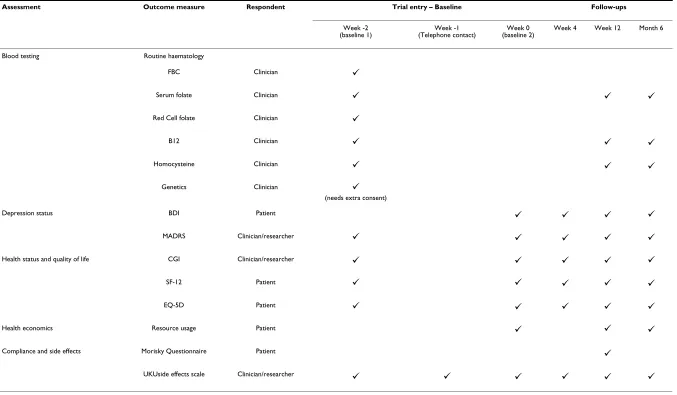
With consent, serum folate, homocysteine and B12 levels will be assessed at week 12 and at the final follow-up. A summary of the baseline and follow-up assessments can be seen in Table 1.
Withdrawal
A participant can withdraw or can be withdrawn from the treatment. Participants who withdraw from the trial treat-ment will be asked to attend all the follow-up appoint-ments. Local research ordinators will notify the trial co-ordinator in writing about all trial participants who wish to withdraw from all future follow-ups.
Pharmacogenetics Study
There is increasing realisation of the potential importance of pharmacogenetics in maximising the benefits of medi-cines and to this end, most commercial trials and an increasing number of non-commercial trials, now contain a pharmacogenetic arm. For this reason, a major strand of this trial is to characterise the role of genetically deter-mined variation in folate metabolism in clinical outcome.
Prior to the completion of the human genome project, the conventional strategy utilised for pharmacogenetics involved the analysis of single variants in single genes. This has been practiced since the 1960s and unfortunately has not led to major breakthroughs. Indeed the literature is littered with contradictory data on pharmacogenetics, which has made it impossible to translate any benefits into clinical practice. As stated earlier, folate metabolism is complex involving 27 different enzymes [13]. The com-plexity is exacerbated by the fact that folate requires active transport into cells, and the facilitated transporters show genetic polymorphisms [32]. To date, only the common functional genetic polymorphism (C677T) in methylene-tetrahydrofolate reductase (MTHFR) gene has been related to depression [12], although no study has yet related the occurrence of this polymorphism to the effec-tiveness of folate treatment. No other genes in the folate pathway have been investigated either in relation to the severity of depression, response to antidepressant treat-ment, or to folate supplementation.
Concentrating on just one gene (for example MTHFR, the most widely studied gene in the folate pathway) would be unnecessarily restrictive and would ignore the variance in the other pathways. On the other hand, in the timescale available in this study, it would not be possible to under-take an analysis of all 27 genes involved in folate metabo-lism because (a) the genetic variability has not been adequately characterised, (b) the functional effects of all genetic polymorphisms has not been investigated, and (c) the study has not been powered to look at this number of genes with an insufficient sample size.
Furthermore, this would also be prohibitively expensive at this stage. A practical strategy has been adopted, as fol-lows:
(a) analysis of the most important pathways based on pre-vious studies in other diseases areas, for example response to methotrexate;
(b) we will adopt a genetic strategy that involves using tag-ging SNPs to determine the overall genetic diversity of the chosen genes. The tagging SNPs will be determined from the data that are publicly available via the HapMap project;
BM
C Psychiatry
200
7,
7
:65
http://www.bi
omedcen
tra
l.co
m
/14
71-24
4X/7/6
5
Pa
ge 9 of
1
9
(page nu
mber not
for
cit
a
tion pur
[image:9.792.67.744.112.507.2]poses)
Table 1: FolATED Baseline and follow-up assessments
Assessment Outcome measure Respondent Trial entry – Baseline Follow-ups
Week -2
(baseline 1) (Telephone contact)Week -1 (baseline 2)Week 0 Week 4 Week 12 Month 6
Blood testing Routine haematology
FBC Clinician
Serum folate Clinician
Red Cell folate Clinician
B12 Clinician
Homocysteine Clinician
Genetics Clinician
(needs extra consent)
Depression status BDI Patient
MADRS Clinician/researcher
Health status and quality of life CGI Clinician/researcher
SF-12 Patient
EQ-5D Patient
Health economics Resource usage Patient
Compliance and side effects Morisky Questionnaire Patient
UKUside effects scale Clinician/researcher
9
9 9 9
9
9 9 9
9 9 9
9
9 9 9 9
9 9 9 9 9
9 9 9 9 9
9 9 9 9 9
9 9 9 9 9
9 9 9
9
(d) DNA will be stored for future analysis for other vari-ants in the same and other genes.
This strategy is currently being tested by Prof. Pirmo-hamed as part of 3 large projects funded through the Department of Health Pharmacogenetics Initiative. This strategy will provide the highest chance of identifying genetic predictors of responsiveness to folate whilst simul-taneously provide us with a resource, as knowledge of the genetics of these pathways increases, for future refinement and identification of other associations.
Thus, although this is a feasible strategy, it will neverthe-less be the most thorough investigation to date by allow-ing us to determine critically whether the interaction between any of the genetic polymorphisms in the folate pathway predicts the severity of depression, response to antidepressants per se, and the response to folate supple-mentation. Furthermore, this will allow us to determine whether such a strategy has an impact on patient out-come, and therefore whether it is clinically and cost-effec-tive in a real-world setting. With this in mind, the following 7 (out of the possible 27) genes in the folate pathway will be investigated in the first instance:
• methylenetetrahydrofolate reductase
• thymidylate synthase
• dihydrofolate reductase
• methionine synthase
• methionine synthase reductase
• gamma glutamyl hydrolase
• reduced folate carrier (SLC19A1).
The choice of genetic variant within each gene will be based on (a) literature review of the functionally impor-tant common polymorphisms; (b) a search of the publicly available databases including dbSNP http:// www.ncbi.nlm.nih.gov/SNP/; and (c) a search of the Hap-Map database.
DNA will be extracted according to standard procedure. Genotyping for polymorphisms will be undertaken using a medium throughput platform utilising TaqMan technol-ogy – available in the Department of Pharmacoltechnol-ogy, Uni-versity of Liverpool [33]. It is difficult to provide realistic power calculations in advance since little is known about the frequency of genetic variants in patients with depres-sion and the statistical methodology for the analysis of genetic association studies is still being developed. A key
variable in such studies is the frequency (among cases) of the SNP minor allele frequency. For rarer variants to be clinically important, their effect size (measured by the allelic odds ratio, OR) must be large. We therefore specify distinct benchmarks for the power analyses: we seek to have good power for (a) OR = 3 and a variant with a fre-quency of 10%; (b) OR = 2 for a common variant (>20%). Note that these effect sizes are for a single causal variant; we expect to realise much larger effect sizes via combina-tions of causal variants. The assumed type 1 error is 5%. Adjustment for multiple testing will be performed by per-mutation analysis [34]. As indicated above, multiple regression models will be used to evaluate the importance of genetic factors in determining clinical outcomes in patients.
Intervention
Given the increased efficacy of higher folic acid doses in other body systems and the very low risk of adverse effects, we have opted for a pharmacological 5 mg/day folic acid dose or matching placebo to supplement antide-pressant treatment, the same dose as is routinely used to treat folate deficiency. This dose is the treatment of choice for folate deficiency and well tolerated in various clinical populations, including the elderly and pregnant women [35,36]. There is no evidence that pharmacological folate will have a deleterious effect on either methylation status or mood, nor that it will lead to sub-acute combined degeneration of the spinal cord or other neurological complications, provided that B12 deficiency is excluded. Individuals identified with B12 or folate deficiency will be excluded from the folate/placebo trial, but will be treated appropriate and asked to continue to participate in the 'comprehensive cohort study'. People who have been diagnosed or treated for malignancy will not be able to receive folic acid. Although there is evidence that high folate intake lowers the risk of developing cancer if a per-son has already had a malignant disease there is some evi-dence that high folate intake may increase cancer growth. In summary,
• 5 mg/day folic acid is safe in working age adults and the elderly, provided B12 deficiency and diagnosed or treated malignancy is excluded.
• 5 mg/day folic acid is more likely than lower doses to be effective as an antidepressant adjuvant, based on limited trial data and folate's known effects in other body systems.
BMC Psychiatry 2007, 7:65 http://www.biomedcentral.com/1471-244X/7/65
Page 11 of 19
(page number not for citation purposes)
be treated with a 5 mg dose of folic acid. Patients with a B12 deficiency also continuing in the comprehensive cohort study, will be treated with B12 injections as neces-sary by the GP. Patients not wishing to continue will be referred back to their GP for appropriate treatment using the designated form.
Risks and anticipated benefits for trial participants and society, including how the benefits justify the risks
There is suggestive evidence that folate may enhance the effects of antidepressants for those suffering depression. Thus patients requiring antidepressant treatment may benefit from supplementing their treatment with folic acid. The associated risks with folic acid supplementation are very low. Folic acid is normally well tolerated but occa-sionally nausea, allergic reactions, anorexia and abdomi-nal distension can occur. However, there is a potential risk for patients with B12, folate deficiency or malignancy. Those patients with B12 deficiency must not receive folate and will be excluded from the trial. They will be asked to continue to participate as part of the 'comprehensive cohort study' and will be referred back to their GP for immediate treatment with B12 injections. Similarly, patients with folate deficiency must be treated with folic acid and it would be unethical to randomise these patients to receive placebo. For this reason, they will also be invited to continue to participate as part of the compre-hensive cohort in an unblinded folate group and moni-tored as appropriate.
Patients with mental health problems might be viewed as a vulnerable population and therefore appropriate meas-ures will be taken to ensure that they fully understand the nature of the trial and the risks and benefits of the treat-ment. We recognise that people suffering from moderate to severe depression may have reduced capacity to assim-ilate information and we will thus ensure that all informa-tion is clear, user friendly, honest, and precise. Information will be given verbally in addition to written information sheets and the research professionals will be available to answer any question. If folic acid augmenta-tion is shown to be beneficial, it would be a cheap, safe and simple method of improving treatment of a common, debilitating illness in primary care.
Informing potential trial participants of possible benefits and known risks of the intervention (or of no intervention or a placebo)
Information sheets will be given to patients to keep which will explain in detail all the benefits and risk of participat-ing in the trial. Research professionals will be available to answer any questions and respond to any difficulty expe-rienced during the trial. Patients will be given the oppor-tunity to nominate an advocate (e.g., family member) if they wish. Participants will be asked not to take folic acid
supplements (including multivitamin preparations con-taining folic acid) outside of the trial and any individual that becomes pregnant during the trial will be asked to inform the appropriate research professional. These patients will be followed-up as intention to treat. At each appointment participants will also be asked if they are tak-ing any additional supplements.
Safety monitoring and reporting
To ensure that the safety of folic acid is properly moni-tored and reported this protocol stipulates the definitions used to identify different types of adverse events (AE) and the associated reporting requirements (adapted from the EU Directive [37]). All adverse events will be assessed for causality, seriousness and expectedness. That is whether the AE is related to the drug; whether the AE is serious; and whether the AE was unexpected. Table 2 shows how these three features apply to the main types of AEs.
Causality
Causality is the degree to which an untoward medical occurrence can be attributed to the trial drug and can be classed as either unrelated, unlikely to be related, possibly related, probably related or definitely related. Only unto-ward medical occurrences that are considered to be either possibly, probably or definitely related to the trial drug will be reported as having a causal relationship.
If the untoward medical occurrence is not considered to have a causal relationship with the treatment at the time of the event (i.e. it is not believed to be a consequence of taking folic acid or placebo) this will be classified as an Adverse Event. However, if it is considered to have a causal relationship with folic acid or placebo at the time of the event it will be classified as an Adverse Reaction.
Seriousness
Any untoward medical occurrence will deemed serious if it:
• results in death
• is life-threatening
• requires hospitalisation or prolongation of existing hos-pitalisation
• results in persistent or significant disability or incapacity
• results in a congenital anomaly or birth defect
All serious events not considered to have a causal relation-ship with the treatment will be classified and reported as a Serious Adverse Event (SAE). All serious events that are considered to have a causal relationship with the treat-ment will be classified and reported as a Serious Adverse Reaction (SAR).
Expectedness
An untoward medical occurrence will be considered to be 'unexpected' if its nature and severity are not consistent with the information in the summary of product charac-teristics for that treatment. If an adverse event is consid-ered 1) to be related to the folic acid or placebo 2) is serious and 3) unexpected then is will be classed as a Sus-pected UnexSus-pected Serious Adverse Reaction (SUSAR).
Known undesirable effects reported in the summary of product characteristics include nausea, anorexia, abdomi-nal distension and allergic reaction.
Responsibility for reporting
The reporting requirements differ depending on the cau-sality, seriousness and expectedness of the medical occur-rence as summarised in the flow diagram of safety reporting (Figure 2).
All adverse events will be recorded on the trial database, evaluated by the principal investigator or other designated person responsible for the clinical aspect of the trial in each centre and included in the annual safety report to the MREC and MHRA.
However, for all events considered serious additional reporting is required. The trial co-ordinating centre must be informed within 24 hours of investigator's knowledge of the event. A Serious Adverse Event Form must be com-pleted and sent to the trial co-ordinating centre as soon as possible. The trial co-ordinator will immediately contact the clinical and methodological chief investigators who have been delegated the responsibility of reporting any serious adverse events on behalf of the sponsor (Bangor University). A decision must then be made by the investi-gator with the clinical responsibility for aspects of the patient's care which are relevant to the trial as to whether an adverse event is related to folic acid or placebo. The
investigator should decide the degree to which the event is caused by the trial drug. If a decision cannot be made, the investigator must contact the co-ordinating centre. Advice will be sought from the clinical chief investigator and other clinicians may be asked if a decision cannot be reached.
If it is decided that the adverse event is a serious adverse reaction then it must be determined whether the reaction is expected. If it is unexpected and thus considered a SUSAR then the SAE form will be completed and reported to the MHRA and MREC.
For fatal or life-threatening SUSARs the MHRA and MREC will be notified as soon as possible but no later than 7 cal-endar days after the sponsor has first knowledge of the event. In each case relevant follow-up information will be sought and a report completed as soon as possible. The follow-up information will be sent to the MHRA and the MREC within an additional eight calendar days.
Non-fatal and non life-threatening SUSARs will be reported to the MHRA and the MREC as soon as possible but no later than 15 calendar days after the sponsor has first knowledge of the event. Further relevant follow-up information will be given as soon as possible.
Serious but expected reactions or non-serious adverse reactions will be recorded in the database and reported in the usual way.
Statistics
[image:12.612.56.554.639.730.2]With national collaboration and adoption of the project by the Mental Health Research Network Cymru, it is esti-mated that 730 patients from 3 participating centres can be randomised to folic acid 5 mg daily or placebo over 1 to 2 years. We estimate that 5% will present with B12 defi-ciency and 10% with folate defidefi-ciency at baseline. These patients will not enter the main trial but will be treated appropriately and followed-up as part of the comprehen-sive cohort. Although up to 33% of patients with depres-sive illness have decreased plasma and red cell folate levels [8], not all will be considered folate deficient.
Table 2: Types of adverse events
Adverse Events (AE)
Adverse Reactions (AR)
Serious Adverse Events (SAE)
Serious Adverse Reactions (SAR)
Suspected Unexpected Serious Adverse Reactions (SUSAR)
Is the medical occurrence considered to be related to trial drug?
N Y N Y Y
Is the medical occurrence serious? N N Y Y Y
BMC Psychiatry 2007, 7:65 http://www.biomedcentral.com/1471-244X/7/65
Page 13 of 19
(page number not for citation purposes)
After allowing for 10% loss at each follow-up, and the exclusion of those with B12 and folate deficiency, a total of 730 patients recruited would yield 400 participants completing the trial. We estimate that this would yield 80% power, when using a 5% significance level, to detect a difference between the folic acid and placebo groups, of 3 points on the Beck Depression Inventory (BDI), gener-ally considered a meaningful difference (equivalent to an effect size of 0.3).
Analysis will be by intention to treat. We shall compare folic acid and placebo using analysis of covariance to take account of baseline differences, notably in folate levels. We shall use multi-level modelling to test for heterogene-ity across sites, and general linear modelling to assess rel-ative contributions to differences in clinical outcomes. These include stratification variables (sex, new or contin-uing patient, and type of anti-depressant); biochemical variables (especially baseline folate, functional folate defi-ciency, homocysteine and methylation status); demo-graphic variables [especially smoking, alcohol and drug consumption – all known to affect homocysteine levels [38]]; genetic variables (including interactions with bio-chemical variables); and pharmacological variables.
Before modelling we shall develop an explicit analysis plan exploiting previous studies, for example the finding that baseline folate predicts response to antidepressant better than homocysteine does [39].
Our pharmaco-economic analysis will evaluate folate aug-mentation through cost-utility analysis and estimated cost-effectiveness ratios. Post hoc analysis will also esti-mate the cost-utility of pharmacogenetic testing, if results suggest this has predictive value. We shall prospectively collect major direct costs to the NHS of the health care resources used by participants. These will include investi-gations, treatments, use of primary and secondary care services, trial drug therapy, management of adverse drug reactions and genotyping. To estimate cost-effectiveness ratios, we shall estimate treatment effectiveness through utility scores derived from the EQ-5D. We shall take account of uncertainty by 'bootstrapping'. We shall iden-tify potential predictors of response through regression analysis, and thus analyse the cost-effectiveness of genetic and biochemical testing post hoc. We shall compare the estimated incremental cost per QALY of folate augmenta-tion for new and continuing antidepressant users, and of laboratory testing, with the results of other economic assessments of antidepressant treatments.
Economic analysis
We will assess whether the use of folic acid supplementa-tion is effective by estimating the incremental cost-utility and cost-effectiveness ratios of antidepressant drug plus folic acid, relative to antidepressant drug alone. Fur-ther, a post-hoc analysis will be conducted to estimate the cost-utility and cost-effectiveness of pharmacogenetic test-ing, should the trial results suggest that genetic testing is of predictive value.
Healthcare resource utilisation
We shall use prospective self-complete questionnaires to assess patients' use of health and social services. These will be collected by the research professional at baseline, week 4 and week 12 of treatment. The questionnaire will include items on patients' use of general practice and community nursing services and social services. We shall supplement collection of healthcare resource utilisation data by reviewing patients' GP records after the final 12-week follow-up. This will allow for the collection of data on hospital clinic attendance, inpatient admission and home visits etc.
Cost analysis
The perspective of the NHS will be adopted with the major direct costs of health care resources used by patients in the trial being collected prospectively. These will include treatments and investigations, use of primary and secondary care clinic services, concomitant and trial drug
Flow diagram of safety reporting
Figure 2
Flow diagram of safety reporting.
Is the event assessed as serious?
All adverse events will be recorded and graded by causality and a summary of these will be sent to the DMEC every 6 months
No
Yes
Is it causally related to the trial medication?
It is a Serious Adverse Event
Complete the SAE form and report to co-ordinating centre within 24 hours. SAEs listed in the protocol that do not require immediate attention should be reported in the agreed time frame.
It is a Serious Adverse Drug Reaction
Report to co-ordinating centre within 24 hours CI will assess for expectedness according to the SmPC.
Is the event expected based on the SmPC? It is a suspected serious adverse reaction. Record on SAE form
It is a SUSAR
Is the event life threatening/fatal?
• Event must be reported to the CI within 24
hours
• CI reports to MHRA and MREC within 7
days using the SAE form
• Follow-up report within a further 8 days
with the SAE follow-up form
• Event must be reported
to the CI within 24 hours
• CI reports to MHRA and
MREC within 15 days using the SAE form
• Follow-up report as soon
as possible
No
Yes
Yes
Yes No
therapy, management of adverse drug reactions and geno-typing. Unit costs will be sought from appropriate sources [27,40,41].
Cost-utility analysis
For the purposes of estimating the cost-utility ratio, treat-ment effectiveness will be assessed by eliciting utility scores from trial participants. Patients will be asked to complete the EQ-5D questionnaire and Visual Analogue Scale at the time points specified. We shall also conduct a cost-effectiveness analysis by considering the incremental cost per depression-free week. The number of weeks free from depression will be calculated from analysis of the depression symptom rating scales, and by assuming linear interpolation between time points.
Uncertainty analysis
Sensitivity analyses will be conducted to test the robust-ness of our findings. We shall use such analyses based on the observed distributions of outcome and costs to test whether, and to what extent, the incremental cost-utility and cost-effectiveness ratios are sensitive to key assump-tions in the analysis. Uncertainty will also be addressed by means of probabilistic sensitivity analysis with results pre-sented as cost-effectiveness acceptability curves.
Subgroup analysis
Putative predictors of response, adverse reactions and high cost episodes will be tested by means of generalised linear regression models. These will be used to inform the post-hoc analysis of the cost-effectiveness of pharmacoge-netic testing.
Generalisability and policy implications
The findings of the economic evaluation will be compared with the results of other health economic assessments of antidepressant drug treatments, including the AHEAD trial, a randomised control trial to compare the cost-effec-tiveness of tricyclic antidepressants, selective serotonin re-uptake inhibitors and lofepramine, funded by the HTA programme [42]. The estimated cost per QALY (and cost per depression-free week) of folate supplementation, and of pharmocogenetic testing, will be compared with other health care interventions to place into context the value for money they may offer.
Direct access to source data/documents
Trial related monitoring, audits, Research Ethics Commit-tee reviews and regulatory inspections will be permitted, allowing access to data and documents where required.
Quality control and quality assurance
The conduct of this trial will follow the principles of good clinical practice outlined by the ICH-GCP and will com-ply with the EU directive 2001/20/EC. The research is
underpinned by the MRC guidelines for clinical trials [43-46] and the Research Governance Frameworks for Eng-land and Wales [47,48].
A Trial Steering Committee (TSC) will be established to oversee the running of the trial, and will meet annually, with the first meeting being in Month 3. A Data Monitor-ing and Ethics sub-Committee (DMEC) will also be estab-lished. This committee will meet independently of the TSC but will be responsible for reporting to it.
Two other related work groups will be established to man-age the project, a Trial Manman-agement Group (TMG) and a Research Team (RT). The lead applicant will chair the TMG which will meet every three months and consist of co-applicants, collaborators, the trial co-ordinator and service user and public involvement representatives. The TMG will report to the TSC, and oversee the work of the RT. The RT, chaired by the trial co-ordinator and consist-ing of the three research professionals, will be responsible for the day-to-day research activities. The RT will meet and obtain input from particular members of the TMG when relevant. Members of the TMG will also have the opportu-nity to comment on draft questionnaires, draft papers and any other trial material. The existing close working rela-tionship between members of the proposed TMG will ensure the aims and objectives of the project will be met within the time specified.
Full ethical approval has been sought from the Multi-cen-tre Research Ethics Committee (MREC) for Wales and from the Local Research Ethics Committees (LRECs) at each centre. An Eudract Number (2006-004647-37) and clinical trial authorisation (CTA) have been received via the Medicines and Healthcare products Regulatory Authority (MHRA). We have ensured that there is appro-priate insurance/indemnity to cover the liability of the investigators. In addition, we will ensure that we obtain written informed consent from all patients entering into the trial and monitor, record and report any serious unex-pected adverse reactions to the TSC and DMEC, the spon-sor, the MHRA and ethics committees as appropriate. An annual safety report will be provided.
Data Monitoring and Ethics Committee (DMEC)
The role of the DMEC is to consider the need for interim analyses of trial data, the implications of such analyses, and requests for release of interim data. It will report to the TSC about these issues and after each meeting. As this is a health technology assessment rather than a pharma-ceutical trial it is less likely that the DMEC will require interim analysis of trial data.
BMC Psychiatry 2007, 7:65 http://www.biomedcentral.com/1471-244X/7/65
Page 15 of 19
(page number not for citation purposes)
team will report this to the chair of the DMEC. The DMEC will examine the evidence, and if there is evidence of imbalance in SAEs between the treatment groups that requires further action, report this to the TSC.
If new evidence becomes available during the course of the trial, for example suggesting that folic acid is substan-tially better or worse than no supplement, it is the respon-sibility of the DMEC to consider such issues and make recommendations on the continuation of the trial to the TSC.
Ethics
MREC for Wales and appropriate LREC approval have been sought. All trial documentation, including patient information leaflet and consent form, referral forms and template GP letters have been submitted for approval. To conform to the data protection and freedom of informa-tion acts, all data will be anonymised and stored securely. No published material will contain patient identifying information.
Obtaining informed consent from participants
Only patients 18 years of age or over and giving informed consent will participate in the trial. Informed consent will be obtained during the screening interview where both a psychiatrist and research professional will be present to ensure that the patient fully understands the nature of the trial and answer any questions. Patients will also be informed that they can withdraw from the trial at any point and that doing so would not affect the care they received. Patients will be given a copy of their consent form to keep.
Patients unable to give informed consent will be excluded from the trial.
Ethical issues of DNA testing
All genetic studies to be undertaken in the trial will be subject to approval by a research ethics committee accred-ited to deal with multi-domain studies. It is also impor-tant to note that the studies will be conducted under a strict ethical framework that adheres to guidelines devel-oped by Department of Health, MRC and the Nuffield Council on Bioethics. The studies will also be in accord-ance with the Human Tissue Act [49]. The following are the key points of the study to be undertaken, as raised by the reviewers:
• The DNA samples will be transported from the site of patient recruitment to Liverpool in a coded form where they will be extracted and stored. The laboratory will only know the samples by code numbers, and will not be told of clinical details including the study arm into which the patient has been randomised, until after all the
genotyp-ing has been completed, and the results analysed. There-fore all genotyping will be blinded.
• The DNA will be stored in a coded form until the end of the study. When the DNA has been linked to the ano-nymised clinical details, the DNA sample will be irrevers-ibly anonymised and the original code destroyed.
• All patients will be asked to take part in the genetic study. In other genetic studies being undertaken in Liver-pool, no patient has yet refused on the basis of the fact that DNA was being collected. Furthermore the refusal rate in studies involving a single blood sample for DNA analysis is <1%. However, as the trial progresses, we will continue to monitor the situation, and if there are prob-lems associated with recruitment which can be related to the genetic testing, then steps will be undertaken to rectify the situation after consultation with the ethics committee.
All patients will be asked to give informed consent for the genetic study. Thus additional consent, separate from con-senting to the main study, will be required. Participants will be asked to give specific consent to allow us to use the participant's DNA samples to investigate the specific genes mentioned in the protocol and broad consent to allow us to use their anonymised samples for further genetic test-ing. Anonymised DNA samples will be used in the future to look at other genes relevant to responsiveness to folate, as and when these are identified. Participants who con-sent to the specific genetic testing will be invited to give broad additional consent to anonymise their DNA sam-ples for analysis conducted once the FolATED trial is com-plete. Where no additional consent is given, the DNA sample will be destroyed at the end of the study. The patient information leaflet will state that these DNA sam-ples will be considered to be a gift and will be stored under the custodianship of University of Liverpool. No information on the genetic analysis will be passed onto the patients individually or to their GPs.
Data handling and record keeping
monitor-ing. Since NWORTH will also be coordinating the ran-domisation procedures, the ranran-domisation codes will be kept on a separate database by NWORTH.
With regard to blood samples, they will be split for differ-ent analyses depending on the consdiffer-ent given by the par-ticipant. The first sample will be sent to the local pathology laboratory for routine haematology analysis (FBC, red cell folate, serum folate and B12), the samples will then be destroyed. A second sample will be sent to Cardiff for analysis of homocysteine levels, these samples will also be destroyed following analysis. A third sample, only taken with additional consent, will be used for DNA analysis at the University of Liverpool and will be viewed as a gift to the University. The samples will be stored at the Genetic laboratory within the University with no identify-ing information for the duration of the study. Blood sam-ples used for genetic analyses and homocysteine will be coded so that no patient identifying information will be available with the sample. Blood samples used for routine haematology will have patient details for clinical reasons so that results can be forwarded to appropriate GPs and to detect folate deficiency during the course of the trial. To safeguard the research team's blindness to treatment, a collaborating GP will monitor blood results for changes in folate levels during the trial. We shall keep an extra sample of the plasma at each research site as a back up for homocysteine analysis. This is to safeguard against loss of samples through unforeseen events like equipment fail-ure. We shall destroy these stored samples at the end of the study.
Anonymised electronic data will be stored by NWORTH following the trial completion. This allows future access to raw data. Consent forms will be stored securely at local sites according to local research governance procedures. All blood samples retained for genetic analysis will be destroyed after five years unless participants give broad consent to allow anonymised samples to be kept indefi-nitely for future analysis. The database linking subject identity to anonymisation codes will be stored securely at each local site for a period of five years following the com-pletion of the trial. This database will then be destroyed, ensuring trial data are permanently and irreversibly ano-nymised.
Discussion
FinanceThe FolATED trial is funded by a grant from the NHS Health Technology Assessment Programme to Bangor University. No drug manufacturing company is sponsor-ing the trial. Folic acid manufactures have had no involve-ment with the design nor will they be involved with the management or reporting of the trial. DHP Ltd are manu-facturing the study drugs folic acid 5 mg and matching
placebo specifically for the study on a commercial basis. This ensures that adequate objectivity with regard to the study findings.
Cost implications
FolATED has been designed to minimise costs for partici-pating hospitals, GPs and Community Mental Health Teams (CMHTs). The drugs are supplied to patients free-of-charge. Folic acid is a simple out-patient treatment and the follow-ups scheduled for the study are only margin-ally more than those that would be required with standard antidepressants treatment outside the trial. To reimburse the administration costs for GPs to refer patients to the trial a payment of £50 will be made to GPs for each patient recruited into the trial.
Indemnity
No special arrangements have been made for compensa-tion for non-negligent harm suffered by patients as a result of participating in the study. Folic acid 5 mg is licensed for use as a treatment for folate deficiency. A lower dose, folic acid 400 mcg is available over-the-coun-ter as a vitamin supplement and often used by pregnant women. The NHS indemnity liability arrangements will apply for negligence on the part of any healthcare profes-sional involved in the study.
Publication policy
A detailed publication strategy will be devised once the trial has started. We are committed to publishing in as wide afield as possible in peer reviewed journals and to ensuring that appropriate recognition is given to anyone who has worked on trial. We are also committed to mak-ing research findmak-ing accessible for secondary analysis.
Conclusion
If folic acid is shown to improve the efficacy of antidepres-sants, then it will provide a safe, simple and cheap way of improving the treatment of depression in primary and secondary care.
Abbreviations
AE: Adverse Event;
AR: Adverse Reactions;
BDI: Beck Depression Inventory;
BNF: British National Formulary;
BU: Bangor University;
CGI: Clinical Global Impression;