Abstract—A compound parabolic concentrator (CPC) is a well known non-imaging concentrator that will concentrate the solar radiation onto receiver (PV cell). This is also will lead to the decreases of concentration ratio but it will be negligible. In this paper, the flux distribution of untruncated and truncated 2-D hollow compound parabolic trough concentrator (hCPTC) design is presented. The untruncated design has initial height, H=193.4mm with concentration ratio, C_(2-D)=4. This paper presents the optical simulation of compound parabolic trough concentrator using ray-tracing software TracePro. Results showed that, after the truncation, the height of CPC reduced 45% from initial height with the geometrical concentration ratio only decrease 10%. Thus, the cost of reflector and material dielectric usage can be saved especially at manufacturing site.
Keywords—Compound parabolic trough concentrator, optical modelling, ray-tracing analysis.
I. INTRODUCTION
HEdemand for alternative energy is increasing in many countries around the world [1]. Power utility company, government agencies as well as academic institutions have put extensive efforts in exploring the potential of renewable energy for improved electric power generation [2], [3]. This issued can overcome by using solar energy since it offers unlimited potential as a clean renewable energy. Solar energy is one of the most popular energy resources that can be harvested through device such as photovoltaic (PV) cell and directly convert the solar irradiance into electricity [4], [5]. However, the cost of PV material is relatively expensive which requires high investment cost. Due to the high costs of PV modules, the use of a device called solar concentrator is highly desirable [2], [6]. It allows the collection of sunlight from a large area and focus onto a small area of the receiver which will harness the power from the sun to generate the electricity.
Concentrating photovoltaic (CPV) is a third generation in solar energy technology [5], [7], [8]. It used optical devices like mirrors or lens to concentrate solar radiation onto photovoltaic (PV) cell. The aims of CPV are reducing the
R. Abd-Rahman is with the Electrical and Electronic Engineering, UniversitiTun Hussein Onn, 86400 Parit Raja, BatuPahat, Johor, Malaysia (phone: 607-453-7938; fax: 607-453-6060;(e-mail: rahisham@ uthm.edu.my). M. M. Isa, was with the Electrical and Electronic Engineering, UniversitiTunHusseonOnn, 86400 Parit Raja, BatuPahat, Johor, Malaysia (e-mail: [email protected]).
H. H. Goh is with the Electrical and Electronic Engineering, UniversitiTun Hussein Onn, 86400 Parit Raja, BatuPahat, Johor, Malaysia (phone: 607-454-3933; fax: 607-4538387; (e-mail: hhgoh@ uthm.edu.my).
system cost in PV technology by replacing the number of expensive PV cell used with inexpensive optics and also performance improvement. There are many proposed types of solar concentrator based on their applications. A compound parabolic concentrator (CPC) is one of well-known non-imaging type’s solar concentrator [9], [10]. The theory of optics is related with the creation of image from an initial object. For non-imaging optical system is defined where the optical system has to take the light from the light source, instead of an object. Then, it concentrated to any point of receiver, instead of an image. CPC is composed by combining two parabolas either translation or rotation operation, premier invested by Prof. Winston [11]-[13]. It can be either symmetrical or asymmetrical design. However, the acceptance angle of CPC will be decrease when reaching higher concentration. To overcome this problem, truncation is a way to increase the acceptance angle but also lead decreasing geometrical concentration ratio. Truncation can be defined as removing the entry aperture which is the top part of CPC. Then, the cost of material usage and reflector can be saved especially at manufacturing site. Therefore, this research focuses on designing an optimized compound parabolic concentrator (CPC) by truncation and analysed using ray-tracing software.
II.DESIGN PRINCIPLE
In this work, TracePro ray-tracing software had been used to analyse the flux distribution of solar radiation onto the CPC surface [14]. The design of full and truncated 2D-CPC depending on the height and acceptance angles which relative to concentration ratio as shown in Fig.1. One of disadvantage of CPC is tall and narrow height compared to its diameter or collecting entry aperture area. Therefore, for the economic purpose, the initial height of CPC needs to be minimized and this will lead in saving the cost of reflector or dielectric material usage. This is can refer as truncation process where the entry aperture of CPC structure can be removed. Normally, 1/3 to ½ from the top of full height CPC can be truncated but also affect the concentration ratio value. Although the result will reduce the concentration ratio but it will be negligible. As previous explanation, the important of truncations refer to the results in the reduction of height of the CPC with small reduce in concentration value. The dimension of final 2D-CPC can be constructed with following equations (Equation 1 to Equation 4) below:
The height of full CPC
Design Optimisation of Compound Parabolic
Concentrator (CPC) for Improved Performance
R. Abd-Rahman, M. M. Isa, H. H. Goh
1 (1)
The height to aperture ratio of concentrator
1 cos (2)
The truncated height of CPC
! % ##$
% (3)
Half entry aperture for a truncated CPC
& #$ % #
% ' &( (4)
where:
[image:2.595.53.289.79.637.2]a': half side of exit aperture θ_a: full half acceptance angle ɸ_T: truncated half acceptance angle
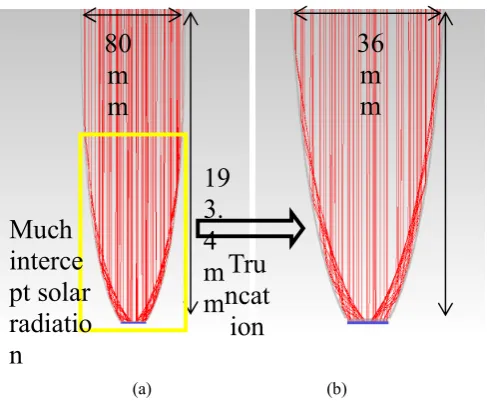
Fig. 1Comparison initial CPC and truncated 2D-CPC model
III. RESULTS AND ANALYSIS
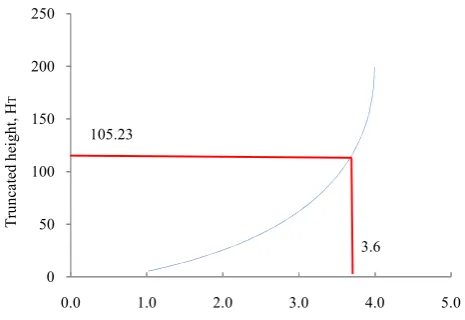
Fig.2 shows a graph of variation of the truncated height, HT
over the geometrical concentration ratio for a half acceptance angle, θa = 14.5° for 2-D CPC. In this case, the full height for initial CPC design is 193.4mm with the geometrical
[image:2.595.322.555.342.502.2]concentration ratio also will be decreases. Due to this, the truncation of height of CPC has significantly affected the geometrical concentration ratio. Based on the graph, at starting point geometrical concentration ratio equal to 4, the slope of truncated height decrease sharply curve in range from 193.4mm to 110mm height, resulting in large decrease of concentration ratio. When the concentration ratio equal to 3.6, the slope of the graph begins moderately curve in decreasing for each truncation height and consequential lower decrease in geometrical concentration ratio. Due to this, the truncated height, H_T of 2D-CPC is selected as 105.23mm after truncation and giving new concentration ratio equal to 3.6. Therefore, the geometrical concentration ratio only decreases 10% from initial value, 4 to 3.6 when the initial height truncated from 193.4mm to 105.23mm compared to larger decrease in concentration ratio with same amount truncation (88.17mm) of height/concentration variations below 3.6. For example, the truncated height of 105.23mm to 17.06mm gives the large decrease of concentration ratio by 50% from 3.6 to 1.64.
Fig.2 Variation truncated height over the geometrical concentration ratio for 2D-CPC
The ray trace diagram for untruncated and truncated CPC design are shown in Fig.3(a) and Fig.3(b) when the incident rays at normal incidence (0°) to the entry aperture of CPC. It can be seen that, the top surface of CPC did not much intercept solar radiation compared to the bottom surface (yellow box).
0 50 100 150 200 250
0.0 1.0 2.0 3.0 4.0 5.0
T
ru
n
ca
te
d
h
ei
g
h
t,
H
T
Truncated geometrical concentration ratio, CgT
[image:2.595.91.261.374.642.2](a) (b)
Fig. 3 Ray trace diagram at normal incidence angle (0°) (a) Initial CPC design (b) Truncated CPC design
At the incidence angle 0°, the flux distribution for overall reflector 1 (R1) and reflector 2 (R2) surface present in Fig.4 and Fig. 5 respectively. Based onFig. 4 (a) and Fig. 5(a), it illustrated the 2-D irradiance map while for Fig. 4 (b) and Fig. 5 (b) show it profile. The blue line indicates the incident flux on horizontal axis while green line for vertical axis and also the location of top (right side) and bottom (left side) of CPC surface. Those reflectors (R1 and R2) have an area of 21188.89mm² each and received 1000W/m² of power density from grid source. The incident flux on the overall surface is measured as 4.1384W, which is 50.05% of the source emitted. On this figure, when the incidence angle is 0°, both map clearly shows that the irradiance flux distribution of solar radiation more uniform at the bottom surface compare to the top surface (yellow box) entry aperture of CPC. This is because the top surface of CPC did not intercept much of solar radiation.
(a)
[image:3.595.309.547.85.291.2](b)
Fig. 4Flux distribution on overall surface for reflector 1 (R1) (a) 2-D irradiance map (b) Profile
-100 -60 -20 0
Ir
ra
d
ia
n
ce
(W
/m
²)
Receiver size (mm) 9
0 0 8 0 0 7 0 0 6 0 0 5 0 0
36
m
m
19
3.
4
m
m
80
m
m
Much
interce
pt solar
radiatio
n
Tru
ncat
(a)
[image:4.595.67.294.79.509.2](b)
Fig. 5Flux distribution on overall surface for reflector 2 (R2) (a) 2-D irradiance map (b) Profile
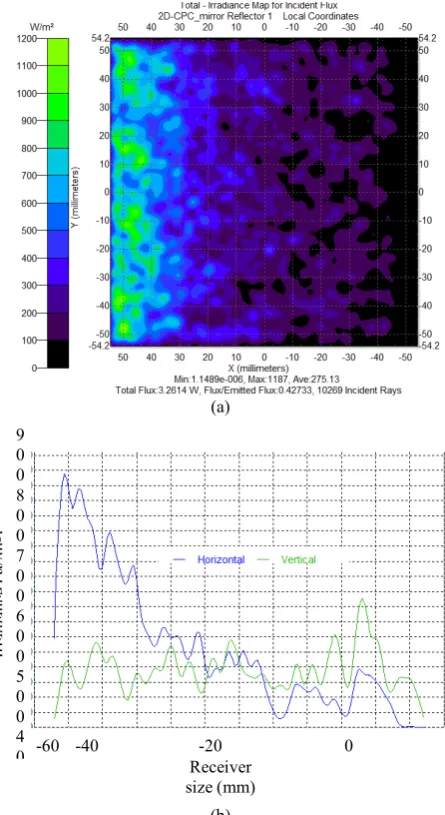
For the truncated design, flux distribution at the incidence angle 0° for overall reflector 1 (R1) and reflector 2 (R2) surface present in Fig.6 and Fig.7.
(a)
[image:4.595.317.540.84.492.2](b)
Fig. 6Flux distribution on overall surface for reflector 1 (R1) (a) 2-D irradiance map (b) Profile
Based on both figures, the Fig. 6 (a) and Fig. 7 (a) illustrated the 2-D irradiance map while the Fig. 6 (b) and Fig. 7 (b) show it profile. The blue line indicates the incident flux on horizontal axis while green line for vertical axis and also the location of top (right side) and bottom (left side) of CPC surface. This reflector has an area of 11721.4059mm² and received 1000W/m² of power density from grid source. The incident flux on the overall surface is measured as 3.2614W, which is 42.73% of the source emitted. It is clearly shows that the irradiance flux distribution of solar radiation more uniform; 90% from overall surface of CPC compared to previous analysis for initial design.
Ir
ra
d
ia
n
ce
(
W
/m
²)
-60 -40 -20 0 Receiver
size (mm) 9
0 0 8 0 0 7 0 0 6 0 0 5 0 0 4 0 10
00 90 0 80
0 70
0 60
0 50
0 40
0 30
0
Ir
ra
d
ia
n
ce
(W
/m
²)
-100 -60 -20 0
(a)
[image:5.595.66.289.81.486.2](b)
Fig. 7Flux distribution on overall surface for reflector 2 (R2) (a) 2-D irradiance map (b) Profile
IV. CONCLUSION
Untruncated and truncated 2-D hollow compound parabolic trough concentrators had been described and analyze using the ray-tracing software TracePro. The optimum design of truncated CPC is chosen depending on height, entry aperture and geometrical concentration ratio parameters. Irradiance flux distribution also had been analyzed for both cases (untruncated and truncated). It is clearly shows that the irradiance flux distribution of solar radiation more uniform at the bottom surface compares to the top surface entry aperture of CPC. This is because the top surface of CPC did not intercept much of solar radiation. Furthermore, after the truncation, the height of CPC reduced 45% from initial height with the geometrical concentration ratio only decrease 10%. Thus, the cost of reflector and material dielectric usage can be saved especially for manufacturing site.
ACKNOWLEDGMENT
The authors would like to thank to Ministry of Higher Education, Malaysia (KPT) and Research and Innovation Centre, UTHM for financially supporting this research under the Research Acculturation Grant Scheme (RAGS) grant Vot.No.R023.
REFERENCES
[1] Electricity Supply Application Handbook. 3rd ed. 2012:
TenagaNasionalBerhad.
[2 ] Muhammad-Sukki, F., et al., Solar concentrators. International Journal of Applied Sciences(IJAS), 2010. 1(1).
[3] Sukki, F.M., et al., Solar Concentrators In Malaysia: Towards The
Development Of Low Cost Solar Photovoltaic Systems.JurnalTeknologi, 2012. 55(1): p. 53–65.
[4] Jha, A.R., Solar Cell Technology and Application. 4th ed. 2010: CRC
Press.
[5] Renewable Energy Technologies: Cost Analysis Series, in Solar
Photovoltaic2012.
[6] Swanson, R.M., The promise of concentrators.Progress in Photovoltaics Research and Applications, 2000. 8(1): p. 93-111.
[7] Cameron, A., Tracking the CPV global market: Ready to fulfil its
potential, in Renewable Energy World Magazine2011.
[8] McConnell, R., V. Fthenakis, and V. Fthenakis, Concentrated
Photovoltaics.Third Generation Photovoltaics, 2012.
[9] Swanson, R.M., Photovoltaic concentrators. Handbook of photovoltaic
science and engineering. 2003. 449-503.
[10] Winston, R., J.C. Miñano, and P. Benitez, Nonimaging optics. 2005:
Elsevier Academic Press, pp. 1-217.
[11] Figari, A., Some features of the compound parabolic concentrator, 2011, FOTONICA.
[12] Mansi G. Sheth, D.P.K.S., Design and Development of Compound
Parabolic Concentrating Solar Collector with Flat Plate Absorber. International Journal of Innovative Research in Science,Engineering and Technology, 2013. Vol.2(8).
[13] MansiG.Sheth, P.A.T., Development of 2D Compound Parabolic
Concentrating Solar Collector for Its Different Surface Temperature Analysis. International Journal of Research in Advent Technology, January 2014. 2(1).
[14] Gregory, G.G. and R.J. Koshel. Modeling the operating conditions of
solar concentrator systems.inPhotonics Europe. 2006. International Society for Optics and Photonics.
9 0 0 8 0 0 7 0 0 6 0 0 5 0 0 4 0
Ir
ra
d
ia
n
ce
(
W
/m
²)
-60 -40 -20 0