Journal of Chemical and Pharmaceutical Research, 2014, 6(6):1136-1144
Research Article
CODEN(USA) : JCPRC5
ISSN : 0975-7384
A novel improved node localization algorithm of wireless sensor network
Tao Zhang
#and Nan Zhu
@#
Network Management Center, Xinxiang University, Henan Xinxiang, China
@
College of Computer and Information Engineering, Xinxiang University, Henan Xinxiang, China
_____________________________________________________________________________________________
ABSTRACT
DV-Hop positioning algorithm based on distance vector routing and GPS location was put forward. The paper presents a localization algorithm for sensor networks based on mobile beacon localization in wireless sensor networks. Wireless sensor network localization accuracy depends on the density of beacon node. In this paper, using the Monte Carlo localization algorithm to solve the problem of node localization in wireless sensor network node mobility, and was improved. The paper presents a novel improved node localization algorithm of wireless sensor network. The simulation results show that the improved algorithm can improve the positioning precision, reduce the amount of computation algorithm, and improve the positioning efficiency.
Keywords: Wireless sensor network, Node localization, Simulation.
_____________________________________________________________________________________________
INTRODUCTION
Network node localization method for wireless sensor is different, is divided into two types: positioning based on beacon nodes and not based on beacon nodes (also divided into no anchor node and anchor node positioning algorithm, beacon nodes can also be called anchor nodes). No localization method based on beacon node belongs to the relative orientation; absolute coordinate location algorithm can reach the unknown node beacon based on. Most current localization algorithms assume the existence of a small amount of beacon nodes are in the network, in order to achieve absolute positioning of the whole network.
In many wireless sensor network (WSN) applications, monitoring is not the position information of nodes is often meaningless. When the monitoring the occurrence of an event, an important concern is the event location, such as forest fire monitoring, natural gas pipeline leakage monitoring. These events, first need are its geographical location information to know. Location information in addition to report incidents, but also can be used for target tracking, the target trajectory prediction, to assist the routing and network topology management. Therefore, node localization problem has become a primary solution to the problem of wireless sensor network.
Beacon node localization strategy in wireless sensor networks typically use a small amount of position is known [1]. The information received from other ordinary nodes unknown position they estimate their location. Existing localization methods are mostly using the above strategies, typical Range-free positioning algorithm mainly includes: the centroid localization, A-morphous, SPA (self-positioning algorithm), convex programming, APS (adhoc positioning system, APIT etc.. However, these methods do not consider the node (including ordinary nodes and beacon nodes) with position mobile network scenario.
correlation calculation of position of the target node. Position Range-based algorithm by measuring the distance between neighboring nodes or range, the specific method of distance measurement with Time of Arrival (TOA), Time Difference of Arrival (TDOA), Radio Signal Strength (RSSI) and Angle of Arrival (AOA).
The Range-based algorithm can achieve accurate positioning, but due to the addition of GPS or other additional ranging in the node hardware equipment, required in practical applications due to the high cost of. While the Range-free localization algorithm by reducing the requirements of hardware has been attracting more and more attention, the typical algorithms are DV-Hop algorithm, DV-Hop algorithm based on RSSI, the localization algorithm based on connectivity. The paper presents a novel improved node localization algorithm of wireless sensor network.
2. Research of Node Localization Algorithm of Wireless Sensor Network
When deployed sensor network nodes are often uncontrollable, such as in large-scale wireless sensor network applications, usually sow the nodes in a wide area where most of the nodes in the network location is unknown, can not be determined in advance, but most applications of wireless sensor networks need to know the location information of nodes in the network, it may get to the location of the network events and information source location. Therefore, the positioning of wireless sensor networks is one of the main application areas, for most applications, but do not know the location of the node-aware data is meaningless. Only the correct positioning of the sensor node itself and it is to determine the sensor nodes to monitor the occurrence of events and information about the specific location.
In general, TOA positioning method is the direct path detection using the received signal arrival time, to measure the communication distance between nodes. Therefore, is crucial to the accurate estimation of the arrival time of the direct path signal. According to the node positioning method discussed in this article is a typical wireless sensor network. In general, by detecting the received signal amplitude is maximums to determine the direct signal arrival time, but this method in multipart conditions difficult to achieve high precision.
Location based mobile beacon algorithm is a hot research topic in recent years. Due to a network location algorithm mainly depends on the density of beacon node, Unicom network. Cost several times the beacon nodes even ten times to ordinary nodes, so the positioning of higher cost [2]. And the mobile beacon node through the introduction of a roaming mobile node in the network to broadcast their location information to form a virtual beacon, thereby reducing the positioning cost, improve the positioning efficiency.
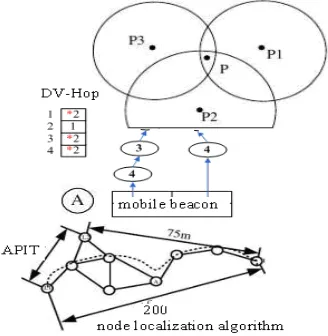
[image:2.595.227.391.526.694.2]So the mobile positioning algorithm beacon has recently become a new research focus, many domestic and foreign scholars have made many studies, the main research question localization algorithm based on mobile beacon is how to integrate the mobile beacon and locating algorithm now, dynamic selection algorithm and the mobile beacon path planning of virtual beacon of structure. Therefore, there are many domestic and foreign scholars to the mobile beacon with the centric localization algorithm, APIT algorithm and DV-Hop algorithm, combination to improve the location algorithm.
Fig. 1. Node Localization Algorithm of Wireless Sensor Network
its calculation each virtual beacon distance, finally calculate the unknown node location information using three edge measuring method, to achieve precise positioning of node. Dynamic selection algorithm to select and study the mobile beacon can obtain the mobile beacon node maximum accuracy for location calculation.
The research method and the mobile node localization algorithm based on Calculation of beacon nodes in the study focused on the mobile beacon selection, moving path, positioning. Due to the beacon nodes need to move, its role in the network is more important, research needs the application system design of mobile beacon node and wireless sensor networks according to the characteristics of sensor networks. Construction of wireless sensor network applications, need to consider the problems of cost, network in the application, the number of communication.
In order to avoid global positioning system energy consumption is in each sensor node equipment expensive (GPS) and it is but only as part of a joint assembly positioning system. We call these with a positioning system for the beacon node. That beacon node location is accurate, all the sensor nodes leaving through the beacon node location known to determine their position [3]. The commonly used positioning algorithm is independent of the location and distance positioning based on distance, the distance of the positioning algorithm based on TOA positioning, TDOA positioning, AOA positioning and RSSI positioning, range-free localization algorithms have the centroid algorithm, DV-Hop algorithm, Amorphous algorithm and APIT algorithm, as is shown by equation1.
( )
j tT
T t
t
T
x
e
X
ωπ
ω
−− =
∑
=
2
1
(1)
The mobile node localization system sensor network anchor node dynamic adjustment based on the study, the system can realize efficient localization of mobile nodes. This paper from the hardware design of embedded hardware platform, the mobile node localization algorithm, researches on the system design and implementation as well as the positioning system three. Based on the VWMC (Voronoi and Weight Monte Carlo Method) of the mobile sensor node localization algorithm, and it is the algorithm in MCL (Monte Carlo Localization) algorithm based on Voronoi diagram and weight analysis technique. Simulation results prove that, compared with MCL algorithm, the positioning of mobile sensor nodes in sensor networks based on the VWMC algorithm to improve the accuracy and efficiency of the location of the mobile node.
Combined with the mobile node localization sensor network VWMC algorithm and dynamic adjustment strategy based on anchor nodes, the mobile node localization sensor network anchor node dynamic adjustment algorithm based on the improved algorithm, ability to resist the interference of the.Node location beacon node algorithm relies on some known based on coordinate position. This algorithm requires pre-positioning beacon node, otherwise unable to normal operation, in order to reduce the positioning error, the number of beacon nodes should be enough. An important feature of beacon node algorithm based on positioning accuracy depends on the beacon point density. In order to solve the beacon node algorithm based on dependence on the density of beacon node, in recent years, many scholars have studied the mobile beacon node localization algorithm, through the mobile beacon node in the network according to a predetermined trajectory roaming and broadcast their position in the structure of packet virtual beacon node, can greatly reduce the investment of beacon nodes.
According to whether the localization process to measure the actual distance between nodes, and it is localization algorithm based on distance can be divided into: (Range-Based) independent positioning algorithm and distance (Range-Free) localization algorithm. The former requires measurement of the absolute distance between adjacent nodes or range, then the actual distance to determine the location of the unknown target node; the latter uses only the distance between nodes correlation calculation of position of the target node, as is shown by equation2.
X X
P
m
s
W
W
s
m
P
(η)(
,
)
=
* (η)(
,
)
(2)Ultra wideband (Ultra WideBanol, UWB) communication technology is a kind of NS impulse radio communication technology of high-speed data transmission in short distance. This communication technology has good concealment, strong penetrating ability, high precision and low power consumption, ranging, positioning in wireless sensor network, has the very important realistic function, and has been applied to the actual material supply in locating and tracking.
and then with the survival of the correction value in the network broadcast. The first unknown nodes will record the received correction value, forwarded to the neighbor node [4]. This strategy can ensure that the vast majority of nodes receive the average hop distance from the nearest beacon.
[
]
Tq
(
)
,
),
(
),
(
)
(
k
α
1k
α
2k
α
k
α
=
K
(3)
It is proposed a new localization algorithm (Amorphous Localization Algorithm). The algorithm uses the method similar to DV-Hop obtained from the beacon hops. The number of hops collect neighbor nodes, calculating the average value of a beacon of local hops, such as (3) type, type hi represents the hops between nodes and beacon I, HJ hops between neighbor nodes in J and the beacon, nabs (I) said the neighbor node set.
Accurate positioning distance positioning can be achieved based on nodes, but often the node hardware requirements higher. For the sake of hardware cost, energy consumption and other considerations, the use of distance (Range-free) is independent of the node localization technology does not need to measure the absolute distance between nodes or range, reduces the node hardware requirements, but the positioning error increased.
The first stage is to locate. Each beacon node transmits a signal that includes its own position; all sensor nodes in the transmission range can receive the signal and save the beacon node position. The second stage, the centroid it received all beacon nodes calculate simple location of each sensor node estimates its position. In the sensor network, using the transmission range is small (TR < FQ), the overlapping area of typical (e.g. A1, A3) on the formation of the. All sensor nodes in the region receive the same location beacon nodes and the centroid of the region as the estimated position of all sensor nodes in the area.
SDGPSN algorithm based on SPA algorithm is proposed based on the idea of clustering location. The basic idea: after network deployment, each sensor node to run a random timer, if compared with the neighbor nodes, node i timer first due and not received any neighbor node information, then I to upgrade the main node and neighbor node, to broadcast this message, all received the news of the suspension of its neighbor nodes timer and become the main node from the node [5]. These nodes constitute a main node i as the origin of coordinates of the node domain, and with the scan of A choice of two adjacent and I from the node for the auxiliary nodes to, build a local coordinate system.
The DV-Hop algorithm can calculate beacon far from the location of the unknown node. And it does not require additional information, however, error according to the bending degree of the different routing. Due to an unknown node only through a path hop count, so it needs to calculate its position by the average distance of each hop, which leads to calculate the location error in great quantity. Assuming a DV-Hop is model.
The test uses node density is relatively high in the network to simulate the mobile node point approximate triangle, to determine whether near or far from the beacon using the propagation characteristics of wireless signal, usually in a given direction, a node from another node farther, and received signal strength is weak. The neighbor nodes by exchanging their received signal strength to determine distance a beacon of distance, thus mimicking the nodes in mobile PIT.
The UWB signal has a very wide bandwidth, which is applied in the TOA positioning method helps to achieve high accuracy. However, in the practical application environment often multipart interference, the UWB direct signal is difficult to accurately detect. Therefore, this paper puts forward to get the direct signal arrival time through fuzzy logic techniques are weighted signal arrival time and the strongest signal first time, makes the application of the UWB in the node localization in wireless sensor networks [6].
{
Ψjkm(x,y),Ψjkm(x,y),Ψj3km(x,y)|j,k,m∈z}
, , 2
, , 1
,
, (4)
No localization algorithm range mainly centroid algorithm, DV-Hop algorithm, amorphous algorithm, APIT algorithm. No localization error is ranging algorithm to positioning range, but can meet most of the requirements engineering application, is positioning mechanism is generally focus on. There are also many scholars in a number of ways to improve the accuracy of range-free algorithm, but also resulted in the increase of range-free algorithm complexity and energy costs. In view of this situation, these papers presents a localization algorithm for sensor networks based on mobile beacon localization in wireless sensor networks, reduce the cost and complexity, and improves the positioning accuracy.
}
0
)
(
,
0
)
(
:
)
,
0
(
{
∈
'=
''<
=
Λ
ω
π
S
xω
S
xω
(5)(1) Initialization. Nodes initially did not have any of their own N position of a priori knowledge, needs to be initialized its operation (N sampling number to maintain the process of implementation.). N possible position] L0=[node deployment area of random selection;
(2) Circulation calculation. According to the position sequence of Lt-1, a period of time, nodes and the new observation Ot to calculate the likely location of new Lt node.
DV-Hop localization algorithm does not need to measure the distance between nodes, this algorithm has the advantages of simple method, high position accuracy, and it is one of a series of distributed positioning methods distance vector routing and GPS localization idea. The basic idea of the algorithm is that between the unknown nodes and beacon nodes with the distance of the nodes in the network average distance of each hop to hop and product beacon nodes to calculate, and then use the three edge measuring method to derive the location information of the nodes.
From the above analysis, in order to improve the positioning accuracy and it is the need to increase the beacon nodes, but the high cost of beacon nodes. In order to improve the positioning precision, reduce network complexity, this paper presents a positioning method based on mobile beacon. The beacon node with the positioning device mounted on mobile platforms or mobile robots, we construct a mobile beacon, mobile beacon in certain laws in the process of moving, can obtain its position in real time, and location information periodically broadcast their location, to help the unknown node.
3. Improved Node Localization Algorithm of WSN
DV-Hop is a range-free localization algorithm is a classic, has simple positioning algorithm, the advantages of high precision, but its accuracy depends on the network connectivity status, for isotropic networks, positioning accuracy can be gained more appropriate, while for the network location of irregular topology error is larger.
Through the mobile beacon, or mobile beacons to unknown nodes to the network location method is a new method of the years, the node load in a mobile robot or node broadcast aircraft, and the node with GPS or other positioning device, so as to construct a mobile beacon. It can be in the process of moving to obtain its current location information. The main idea of positioning by mobile beacon is: mobile beacon moves in "within the region of interest, packet continuous broadcast containing its current location information of the nodes in the communication radius; it will receive the broadcast packet.
The mobility of nodes will lead to localization process even more difficult and complex. In this paper, using the Monte Carlo localization (MCL) algorithm to solve the problem of node localization in wireless sensor network node mobility, and was improved. Some applications of is constrained MCL algorithm [7].
This algorithm obviously reduce the energy consumption of nodes not the maximum, the sensor network node strict demands on energy, will need more node path planning algorithm for mobile path optimization and suitable for the current network can do little to reduce the communication, reduce the consumption of network nodes broadcast information. According to the existing path planning method, path planning can be divided into static and dynamic programming, has nothing to do with the connectivity of the path planning and network static, according to the ROI zone requires localization, path planning in the shortest possible coverage area as the target, the static path to random mobility model, Gauss Markov mobility model, spiral moving model and SCAN model.
direct path signal using maximum likelihood.
Fig. 2. The design of improved node localization algorithm of WSN
Three edge measuring method by RSSI is unknown node to the 3 beacon distance; calculate the unknown node position through the 3 distance value. As shown in Figure 2, when P1, P2, P3 positioning signal of unknown nodes from the P, according to the RSSI value, can be P1 to P,to P from D1, D2, D3; P2, respectively by P1, P3 as the center of the circle, D1, D2, D3 circle as the radius, through the 3 round the region of intersection set the location of the unknown node.
At present, many localization algorithms are implemented using RSSI technology. At present, the wireless communication chip WSN networks are mainly of two types: CC1000 and CC2420. CC1000 working frequency band is 915MHz, and data transfer rate up to 72.8Kbit/s, suitable for frequency hopping protocol. The CC2420 operating frequency in modulation is adopted, the data rate in the 250kbit/s, it has high anti-interference ability. For CC1000 communication chip, RSSI value is a 10 bit register values, and for CC2420, the value is 8 bit register value. It is through A/D converter, chip, RSSI transformations are different.
{
}
(
(
)
(
)
)
(
)
}
)
(
{
M
)
(
|
)
(
2 ) ( 0 1
) ( T 1 -|
σ
α
β
µ
ε
k k
k
k
k
k
k
k
s a
s
s
a
a
s
E
+
−
Σ
=
=
−
(6)
Wireless sensor network localization accuracy depends on the density of beacon node, but the high cost of beacon nodes, is about 200 times more than ordinary nodes, in order to reduce the cost of location, put forward a kind of wireless sensor network node localization algorithm based on mobile beacon and DV-Hop (MBWDV-Hop). Based on the DV-Hop algorithm this algorithm, using a mobile beacon node in the network by moving a predetermined path and broadcast their location information, forming a plurality of virtual beacon, the unknown node records to the hop count each virtual beacon, by adopting the method of weighted average hop distance and their calculation virtual beacon distance, finally calculate the unknown node location information using three edge measuring method, to achieve precise positioning of node.
The first stage: the unknown nodes and beacon nodes first calculates the minimum hop count. The beacon node to the packet broadcast neighbor node location information, including the number of hops field, initialized to 1. The receiving node to record each beacon node with minimum hops, and it is the packet to ignore larger hop from one beacon nodes. Then hop value plus 1, and forwarded to the neighbor node. Through this method, all nodes in the network can record to the minimum hop each beacon node number.
The second stage: calculate the unknown nodes and beacon nodes of the actual hop distance. Each beacon node according to the first stage of the other beacon nodes record the position information and the distance of hop, using type (9) the actual distance to estimate the average of each jump.
The beacon node will calculate the average distance of each hop with survival field packet broadcast to the network, the first average hop distance of unknown nodes only records the received, and forwarded to the neighbor node. The unknown node receives the average distance of each hop, according to records, the calculation to the hop distance of each beacon node. The third stage: unknown node uses to hop each beacon node distance record of second stage, estimation method in its coordinates using three edge measuring method or maximum likelihood.
MCL positioning accuracy of the algorithm in the initial stage will change over time to upgrade quickly and entered a stable stage, in the stable stage, new observation node value (filter) effects due to node mobility and uncertainty on the positioning accuracy of certain equilibrium, a position estimation error will eventually stabilize at a minimum fluctuation. It can be seen that the positioning accuracy and the centered localization algorithm MCL algorithm has a considerable advantage.
The mobile beacon node adopt what mobile can as far as possible to traverse the entire network, this itself is a research hotspot, sensor nodes in the network itself is random distribution, node position information itself is unknown, in order to make these nodes are fixed, we need to design a motion model, the motion trajectory the mobile beacon can traverse network in less time, location information is sent enough to unknown nodes to complete the positioning algorithm. Mobile model currently used in wireless sensor networks are S, RWP (Random Way Point) model and Gauss-Markov model. These models are self-organizing networks widely used model, RWP model for beacon hardware requirements, path is random, and along with the movement velocity decreases, trajectory appeared in the probabilistic network center area is too large.
4. Simulation and Analysis
DV-Hop algorithm in the calculation of average distance of each hop in the process of communication between nodes, the amount is too large, will consider the network as a whole, all nodes use the same average hop distance in calculating the distance himself and reference node, resulting in an average positioning error. DV-Hop algorithm in average network connectivity is 10; the proportion of 10% reference nodes for localization of the isotropic network precision is about 85%. The shortcomings of the algorithm are only in the isotropic in dense networks, can reasonably estimate the average hop distance. In view of this situation, put forward a kind of improved DV-Hop localization algorithm based on mobile beacon dynamic selection (DSB-DV-Hop), through the introduction of the mobile beacon in a predetermined trajectory roaming in the network, and in each virtual beacon node position is calculated separately for each part of the network average hop distance after the broadcast their location to the packet, the unknown node records to hop each virtual beacon.
The communication overhead and configuration of hardware conditions, an important criterion of evaluating a node positioning method is the location estimation accuracy. Through the simulation of is MCL algorithm, the improved MCL, localization algorithm and centroid localization (Centroid) algorithms were compared. The simulation process, relevant parameters of wireless sensor networks, node and the algorithm are changing. Nodes are randomly deployed in a rectangular area of 500 m × 500 m. Wireless transmission distance and that beacon nodes and ordinary nodes to a constant value R (r=50 m), between the position information broadcast node intervals to a fixed value of Tu and mobile in each time period Tu to node distance r said node movement speed.
∑
∑
=
i i
i
y
x
d
w
y
x
I
y
x
d
w
y
x
F
))
,
(
(
)
,
(
))
,
(
(
)
,
(
(7)
The beacon node with the positioning device mounted on mobile platforms or mobile robots, we construct a mobile beacon, mobile beacon in certain laws in the process of moving, can obtain its position in real time, and location information periodically broadcast their location, to help the unknown node. When unknown nodes obtain virtual beacon enough information, we need a virtual beacon optimal dynamic participation three side position calculation to improve the calculation accuracy, the paper then moves from the model of beacon node selection algorithm, dynamic virtual beacon to analyze how to choose in the improved DV-Hop localization algorithm based on mobile beacon dynamic selection.
Step1: mobile beacon to obtain the current position information in the first place, packaging position information broadcast packet {LIDi, Xi, Yi, HOPs}, LIDi denotes the current position is the number of broadcast packets, Xi, Yi represents the current position coordinates, HOPs experience, the initial 0;
information packet, node receiving the packet to compare them with the data packet itself, and a smaller number of hops, and discard the larger, will add 1 hop count, recorded the one hop value, waiting for the next location information package.
∑
∑
= =
−
−
=
=
ni
i i n
i
i
y
ax
b
b
a
F
0
2 0
2
)
(
)
,
(
ε
(8)
At the receiving end were recorded the first arrival time of Tf signal, amplitude of the strongest signal arrival time Ts, first arrived in the amplitude of the Es signal amplitude Ef and the strongest signal amplitude. To calculate fuzzy logic input values of Er, Ts, according to membership function, can be a. The Tf, Ts, a substitution (3) type can be obtained by the direct signal arrival time of T, and then combined with the (4) formula to calculate the distance between two points. Suppose there are three reference nodes (0, 0), (20, 10), (103, 102), the blind node to the actual distance of the reference node is respectively 5.36, 9.25, 8.41, the nodes can use the three edge measurement position.
DV-Hop localization algorithm first run the mobile beacon of the steps mentioned above, the unknown nodes obtain virtual beacon positioning information list, position information of N virtual beacon node virtual beacon packet list assumes the unknown node N, as previously shown in figure 1. The unknown node N identifies first received virtual beacon node A3 as standard. And the A3 broadcast average hop distance DA3 calculated as their location value. The unknown node from the virtual beacon positioning information list other node except A3 of arbitrary is choice of P virtual beacon to calculate.
In order to make the simulation results closer to the actual situation, the simulation results is the result of 850 independent simulation results mean values obtained. In order to verify the proposed a mobile beacon dynamic selection algorithm influence on the positioning accuracy of the simulation, we use OMNeT++ platform for localization process, and analyze the experimental data of the auxiliary MATLAB, in the OMNeT++ platform, the 800 sensor nodes are randomly distributed in a 952 set of experimental conditions, the simulation, in order to effect dynamic selection algorithm the ratio of beacon nodes under different verification, we in the experimental process according to the different localization accuracy setting 2 virtual beacon ratio, as is shown by equation3.
Fig. 3. Comparison results of improved node localization algorithm of wireless sensor network DV-Hop with MCL
In the simulation the definition of node localization is error for the real position and the position estimation of the Euclidean distance between nodes. As can be seen from the table, the node localization, application based on UWB ranging technology can greatly enhance the localization accuracy.
CONCLUSION
This paper analyses the location dynamic mobile beacon selection algorithm for wireless sensor networks based on mobile beacon. The paper presents a novel improved node localization algorithm of wireless sensor network. It will be introduced to DV-Hop algorithm, and by weighted processing and dynamic selection algorithm to calculate the average hop distance of refinement, improve the positioning accuracy of the algorithm, the final performance by simulation from the positioning accuracy and the coverage rate of positioning analysis positioning the algorithm and the superiority, and analyzed the influence of positioning the broadcast cycle performance of mobile beacon moves.
REFERENCES
[1]Savvides A; Han C; Srivastava M B. Dynamic fine-grained localization in ad-Hoe networks of sensors.
Proceedings of ACM MobiCom, 2001.
[2]Shuang Tian; Xinming Zhang; Pengxi Liu.A RSSI-Based DV-Hop Algorithm for Wireless Sensor Networks.Wireless Communications. Networking and Mobile Computing, 2007, WiCom 2007.International
Conference on. 21-25 Sept, 2007:2555-2558.
[3]Changhui Yang. Journal of Chemical and Pharmaceutical Research, 2013,5(12), 243-247.
[4]Bin Xiao; Hekang Chen; Shuigeng Zhou. A walking beacon-assisted localization in wireless sensor networks. In
Proc. 2007 IEEE International Conference on Communications (ICC 2007), Glasgow UK, June 2007,3070-3075.
[5]Rajagopal Iyengar; Biplab Sikdar. Scalable and Distributed GPS free Positioning for Sensor Networks. In Proc.
of IEEE Int'I Conf. on Communications 2003. Vol.l, Anchorage: IEEE Communications Society, 2003, 338-342.
[6]Min Yin; Jian Shu. The Infltmenee of Beacon On DV-hop in Wireless Sensor Networks. Hunan: Proceedings of
the Fifth International Conference on Grid and Cooperative Computing Workshops, 2006, 118-122.
[7]Shuangde Zhang. Journal of Chemical and Pharmaceutical Research, 2014, 6(1), 459-464.