ARTIFICIAL IMMUNE SYSTEM BASED ON REAL VALUED NEGATIVE SELECTION ALGORITHMS FOR ANOMALY DETECTION
RIHAB SALAH KHAIRI
A dissertation submitted in Partial
fulfillment of the requirement for the award of the Degree of Master of Computer Science (Soft Computing)
Faculty of Computer Science Universiti Tun Hussein Onn Malaysia
v
ABSTRACT
ABSTRAK
vii
TABLE OF CONTENTS
DECLARATION ii
DEDICATION iii
ACKNOWLEDGEMENT iv
ABSTRACT v
ABSTRAK vi
TABLE OF CONTENTS vii
LIST OF TABLES x
LIST OF FIGURES xi
LIST OF SYMBOLS AND ABBREVIATIONS xiii
CHAPTER 1 INTRODUCTION 1
1.1 Overview 1
1.2 Problem Statements 2
1.3 Aim of study 4
1.4 Objectives of the Study 4
1.5 Scope of Study 5
1.6 Significance of the Study 5
1.7 Thesis Organization 5
1.8 Chapter Summary 6
CHAPTER 2 LITERATURE REVIEW 7
2.2 Transition from Biological Immune System to
Artificial Immune System 8
2.3 Anomaly Detection 11
2.4 Anomaly Detection Technique 12
2.4.1 Negative Selection Algorithm (NSA) 13 2.4.1.1 String (or Binary)-based Negative Selection Algorithm 13 2.4.1.2 Real Value Negative Selection
Algorithm (RNSA) 15 2.4.1.3 V- Detector Negative Selection
Algorithm 17
2.4.2 Support Vector Machine (SVM) 19
2.4.3 K- nearest neighbor (KNN) 21 2.5 Application of AIS in Anomaly Detection 22
2.6 Chapter Summary 26
CHAPTER 3 RESEARCH METHODOLOGY 27
3.1 Introduction 27
3.2 Data Selection 28
3.2.1 Iris Dataset 28
3.2.2 Balance-Scale Dataset 29
3.2.3 Lenses Dataset 30
3.2.4 Hayes-Roth Dataset 31
3.3 Data Pre-processing 32
3.4 Data partition 33
3.5 Training and Testing Data with the Detector 34
3.6 AIS Algorithm 35
3.6.1 Real Valued Negative Selection Algorithm
(RNSA) 36
3.6.2 V-Detector Real –Valued Negative Selection
Algorithm 36
ix 3.6.3.3 Value Kernel Cache Size 38 3.6.4 KNN Algorithm Parameter Description 38
3.7 Pereformance Evaluation 39
3.8 Chapter Summary 40
CHAPTER 4 SIMULATION RESULTS AND ANALYSIS 41
4.1 Introduction 41
4.2 Experimental Design 41
4.3 The Performance of Real-Valued Negative Selection
Algorithms 42
4.4 The Experimental Assessment 42
4.5 Experimental Assessment 47
4.6 The Experimental Assessment of SVM 47 4.7 The Experimental Assessment of KNN 49 4.8 Performance Comparison between All Algorithms 52
4.9 Chapter Summary 54
CHAPTER 5 CONCLUSIONS AND FUTURE WORKS 55
5.1 Introduction 55
5.2 Research Contribution 55
5.2.1 The Construction Model of AIS 56 5.2.2 Anomaly Detection by using the AIS Model
with RNSA and V-Detector 56
5.2.3 Performance Evalution of the RNSA and V-Detector Models and Benhmarked
Algorithms 57
5.3 Recommendation and Future Works 58
5.4 Chapter Summary 58
REFERENCES 59
LIST OF TABLES
2.1 A time-line of AIS (1986 to 1999) 22
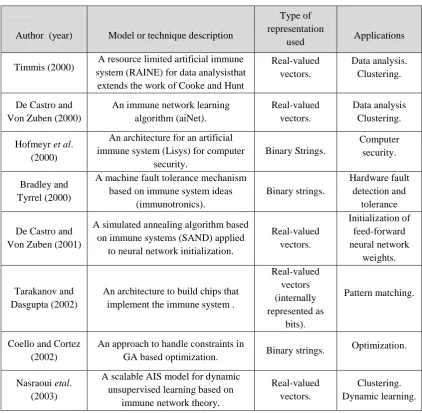
2.2 A time-line of AIS (2000 to 2003) 23
3.1 Summary of the Iris Dataset 28
3.2 Iris Dataset’s Description 29
3.3 Class Information of Iris Dataset 29
3.4 Summary of the Balance-Scale Dataset 29 3.5 Balance-Scale Dataset’s Description 30 3.6 Class Information of Balance-Scale Dataset 30
3.7 Summary of the Lenses Dataset 30
3.8 Lenses Dataset’s Description 31
3.9 Class Information of Lenses Dataset 31
3.10 Summary of the Hayes-Roth Dataset 31
3.11 Hayes-Roth Dataset’s Description 32
3.12 Class Information of Hayes-Roth Dataset 32
3.13 Parameter value for RNSA 36
3.14 Parameter value for V-Detector 37
3.15 Parameter value for SVM 38
3.16 Parameter value for KNN 39
3.17 Confusion Matrix Defines Four Possible
Scenarios when Classifying Class “AB” 40 4.1 The Performance of Four Dataset on NSA on
Different of Number Radius 46
4.2 The Performance of SVM with Complexity
Factor on Four Dataset 49
4.3 The Performance of Four Dataset on KNN on
xi
LIST OF FIGURES
2.1 Partitioning an Antigen and the Proliferation
of the B-Cell into a Plasma Cell 8
2.2 Multi-layer Structure of the Immune System 9
2.3 Censoring Stage 14
2.4 Monitoring Stage 15
2.5 RNSA Pseudo-code 16
2.6 The Iterative Process of Real-Valued Negative
Selection Algorithm 17
2.7 Comparison of Detector Coverage for
Different Detector Schemes 18
2.8 Real-Valued Negative Selection V-Detector
Algorithm Pseudo-code 19
2.9 Linear Support Vector Machine 20
3.1 Research Framework 27
3.2 A model How to Construct a Detector Model 34 3.3 Unknown Data is Classified Using a
Pre-generated Detector Model 35
4.1 The effect of radius on the Detection Rate for
V-Detector 43
4.2 The effect of radius on the Detection Rate
for RNSA 43
4.3 The effect of radius on the false alarm rate for
V-Detector 44
4.4 The effect of radius on the False Alarm
Rate for RNSA 44
4.5 The effect of radius on the CPU time
4.6 The effect of radius on the CPU time
for RNSA 45
4.7 The effect of complexity of factor on the
Detection Rate for SVM algorithm 47 4.8 The effect of complexity factor on the False
Alarm Rate for SVM algorithm 48
4.9 The effect of complexity factor on the CPU time
for SVM algorithm 48
4.10 The effect of number folder option K on the
Detection Rate for KNN algorithm 50 4.11 The effect of number folder option K on the
False Alarm Rate (FR) for KNN algorithm 50 4.12 The Effect of number folder option K on the
CPU time (T) for KNN algorithm 51
4.13 The Detection Rate of Different Algorithms
on Four Datasets 52
4.14 The (FR) of Different Algorithms on
Four Datasets 53
4.15 The CPU time of Different Algorithms
xiii
LIST OF SYMBOLS AND ABBREVIATIONS
AIS - Artificial Immune Systems
ALC - Artificial lymphocytes
RNSA - real-valued negative selection algorithm with fixed
detector
Detector
-V - real-valued negative selection with variable detector
HIS - Human Immune System
SVM - Support Vector Machine
KNN - K-Nearest Neighbours
NIS - Natural Immune System
NSA - Negative Selection Algorithm
S - Self
R0 - set of competent detectors
L - length strings
R - set of competent detectors
RNS - Real-Valued Negative Selection
r - radius of detection
η - adaptation rate
t - once a detector reaches this age it will be considered to be mature
τ - decay rate
d - Detector
rs - self radius
c0 - estimated coverage
Dmax - maximum number of detectors
rd - variable radius
Mmax - limit of the counter
F(x) - Margin
y - Output
x - training or test pattern
w - weight vector
b - Bias
wixi. - vector components
UCI - Machine Learning Repository
KEEL - Knowledge Extraction based on Evolutionary Learning
xi - initial value of vector
Zi - normalized data
SOM - Sequential Minimal Optimization
C - complexity factor
WEKA - Waikato Environment for Knowledge
k - Number folder MI option
NNge - Non--Nested generalized exemplars
DR - Detection Rate
FAR - False Alarm Rate
A - Actual normal class
TP - True Positives
FN - False Negatives
FP - False Positives
TN - True Negatives
AB - Actual anomalies class
CPU - Central Processing
MATLAB - Matrix Laboratory
1CHAPTER 1
INTRODUCTION
1.1 Overview
A record is said to be anomalous or outlying if its behavior does not conform to the behavior of the majority of the dataset. There has been an increasing interest because its presence could indicate unauthorized usage of the system, a failure in part of the system or a diagnosis of a disease. Many domains require anomaly detection systems. One of them is anomaly detection, in which a user can try to gain extra privileges of the system or an unauthorized user can try to gain access to the system (Amer, 2011).
Additionally, anomaly detection is essentially a rare event problem that has been called and used interchangeably with various terms such as deviation detection, outlier analysis, fraud detection, exception mining, mining rare classes, and others. Similarly, a very minute fraction of the total transaction constitutes the anomalilent activities executed (Tuo et al., 2004).
Thus, anomaly detection can be applied in many applications, where there are different costs for false positives and false negatives that are similar to different datasets for anomaly detection. There are biased and unsatisfactory results, especially with different costs of false positives and false negatives. Under these conditions, it is important to train the classification model under a cost sensitive procedure and also to evaluate the classifier performance more accurately (Gadi et al., 2008).
such as noise tolerance, robustness, diversity, reinforcement learning memory, dynamic, distributed, multilayered and adaptive. These features give the immune system a great advantage in detecting lots of different types of pathogens, both known and unknown, and also destroying pathogens. The techniques inspired by the immune system have already been useful in solving some computational problems (Dasgupta et al., 2011).
AIS can be seen as a pattern recognition system and consists of artificial lymphocytes (ALC) that can classify any pattern either as part of a predetermined set of patterns or otherwise, and in training, only positive examples are required. As such, AIS lends itself to application of fraud detection problems (Graaff et al., 2011). The definition of AIS by Sridevi et al. (2012) as adaptive systems is inspired by theoretical immunology and observed immune functions, principles and models, which are applied for problem solving, which certifies its suitability for application in this study.
AIS with two types of Negative Selection Algorithms using real-valued coordinates, namely Real-Valued Negative Selection Algorithm (RNSA) with fixed detector and Real-Valued Negative Selection with variable detector (V-Detector) are the focus of this study. The immune system metaphors relevant to AIS are described in detail in Chapter 2. Furthermore, there is a comparison with other classification algorithms such as Support Vector Machine (SVM) and K-Nearest Neighbors (KNN). The real-valued Negative Selection Algorithms and the benchmarked algorithms are tested and applied to various dataset, with the step by step algorithm walk-through is revealed.
1.2 Problem Statement
3 proposed in handling issues related with keeping the integrity of data, and have been applied to fault tolerance, robotic control, network intrusion detection, and bioinformatics.
In general, the problem of anomaly detection can be seen as a two or more class classification problem. Given an element from a given problem space, the system should classify it as normal or abnormal. However, this is a very general characterization since it can correspond to very different problems depending on the specific context where it is interpreted. Therefore, from a statistical point of view, the problem can be seen as that of outlier detection, which is referred to as an observation deviating from other observations and triggering uncertainty as to how it was generated (Gonzalez & Dasgupta, 2003).
Since the 19th century, various attempts have been made to resolve the problems of anomalies. Many modern techniques exist in literature that are based on Artificial Intelligence, Neural Network, Bayesian Network, Fuzzy logic, K-Nearest Neighbor Algorithm, Support Vector Machine, Decision Tree, Fuzzy Logic Based System, Machine learning, Sequence Alignment, Genetic Programming and others, which have evolved in detecting various anomaly (Tripathi et al., 2013).
The Negative Selection Algorithm is equipped with properties that make it suitable for use in detecting anomalies. The properties are as follows: (1) No prior knowledge of intrusions is necessary, (2) Detection is probabilistic but tunable, meaning a complete repertoire of detectors will not be generated (i.e. a set of detectors that covers all possible non-self strings). Instead, it is contented with matching all but a small fraction of non-self strings in exchange for a smaller set of detectors, (3) The detection scheme is inherently distributable, (4) The set of detectors at each site can be unique. This means that if one site is compromised, others would still be protected, and (5) The set of self strings and the detector set are mutually protective, meaning that the detector set protects the self set against change and vice versa (D’haeseleer et al., 1997).
They were inspired by the Human Immune System (HIS) which is robust, decentralized, error tolerant, and adaptive in nature. Also, the Artificial Immune System appears to be precisely tuned to the problem of detecting and eliminating infections (Tuo et al., 2004). There are a number of AIS models used in pattern recognition, fault detection, computer security, and a variety of other applications in the field of science and engineering. Most existing AIS algorithms imitate one of the following mechanisms of the immune system: negative selection, dendritic cell, immune network, or clonal selection. These models emphasize on designing and applying computational algorithms and techniques using simplified models of various immunological processes and functionalities (Aziz et al., 2012). Negative Selection-based Algorithm (Dasgupta et al., 2011) has potential applications in various areas, in particular anomaly detection.
Considering all the above advantages of AIS, this work attempts to classify different datasets by using AIS with Negative Selection Algorithms, namely the RNSA and V-Detector, which are data-driven models to alleviate the difficulty in anomaly detection in various datasets.
1.3 Aim of the Study
The aim of this study is to apply AIS with Real-Valued Negative Selection Algorithms for anomaly detection problem through classification of four datasets.
1.4 Objectives of the Study
In order to achieve the above mentioned research aim, several objectives have been set, which are listed below:
i. To apply a detector model based on Artificial Immune System (AIS) with Negative Selection Algorithms; the RNSA and V-Detector.
ii. To classify the datasets using the algorithmic models in (i).
5
1.5 Scope of the Study
This research focuses on the use of two kinds of Real-Valued Negative Selection Algorithms, namely the RNSA and V-Detector. For benchmarked purpose, two popularly known classification algorithms; Support Vector Machine and K-Nearest Neighbors have been adopted in this study. Three datasets were retrieved from the UCI Machine Learning Repository, which are the Iris data consisting of three classes of Iris Setosa, Iris Versicolour and Iris Virginica instances; and the Balance-Scale data constituting three classes of Left, Balance and Right; and the Lenses constituting three classes, which are the patient that should be fitted with hard contact, soft contact, and no contact lenses. Also, one dataset was retrieved from KEEL Knowledge Extraction based on Evolutionary Learning, which is Hayes-Roth consisting of three classes (1, 2, 3). As a measure of performance for comparison between the RNSA algorithms and benchmarked algorithms, three (3) evaluation metrics were considered, namely Detection Rate, False Alarm Rate, and time.
1.6 Significance of the Study
The importance of this research is to ascertain the accuracy rates of the Real-Valued Negative Selection Algorithms of RNSA and V-Detector when tested and applied on different datasets. The benchmark with other classification algorithms will give an insight on their performances for anomaly detection analysis. Therefore, it becomes essential to maintain the viability of the system using Negative Selection Algorithms, which significantly reduces false alarms.
1.7 Thesis Organization
highlights the virtues and limitations of the existing algorithms, and arguments are brought forward for alternative methods that can be used for classifying datasets.
In Chapter 3, brief description on the steps of applying the RNSA algorithms of RNSA and V-Detector and benchmarked algorithms of SVM and KNN to datasets, rationale of selecting parameters for each algorithm, as well as evaluation method on the algorithms based on Detection Rate, False Alarm Rate, and CPU time are presented.
Comprehensive experimental evaluations of the algorithms used are presented in Chapter 4. The classification results of each algorithm with graphical representation constitute the fourth chapter. Lastly, Chapter 5 summarizes the work done, contributions, and several recommendations are suggested in order to improve the performance of the algorithms used.
1.8 Chapter Summary
2CHAPTER 2
LITERATURE REVIEW
2.1 Introduction
This chapter introduces and discusses the idea behind anomaly detection, its definition and also different techniques in alleviating its harm. One of those techniques is Artificial Immune System (AIS) algorithms. Focus is directed at AIS algorithms that are based on the Biological Immune System of two types of negative selection, namely Real-Valued Negative Selection Algorithm (RNSA) and Variable-Detector Negative Selection Algorithm (V-Variable-Detector). Details of their working processes are elaborated upon. Also, exploration of the classifier algorithms of SVM and KNN are discussed.
AIS algorithms are machine-learning algorithms that embody some of the principles and attempts to take advantages of the benefits of natural immune systems in tackling complex problem domains (Brownlee, 2005). AIS is a branch of biologically inspired computation focusing on many aspects of immune systems. AIS development can be seen as having two target domains; the provision of solutions to engineering problems through the adoption of immune system inspired concepts and the provision of models and simulations to study immune system theories (Read et al., 2012).
Anomaly detection provides an alternate approach than that of traditional intrusion detection systems and suggests modelling both normal and malicious behavior (Jung et al., 2004). It should be noted that not all anomalies are malicious in nature (Muda & Shamsuddin, 2005), and anomalies also have potentials to translate into significant critical and actionable information (Chandola et al., 2009). Some of the uses of anomaly detection are detecting precedent attack behavior, zero day attack detection, intrusion detection, insider threat detection, situational awareness, and the validation and assisting with signature data. The targeted aim is the thoughtful process is differentiating what is normal from abnormal.
2.2 Transition from Biological Immune System to Artificial Immune System
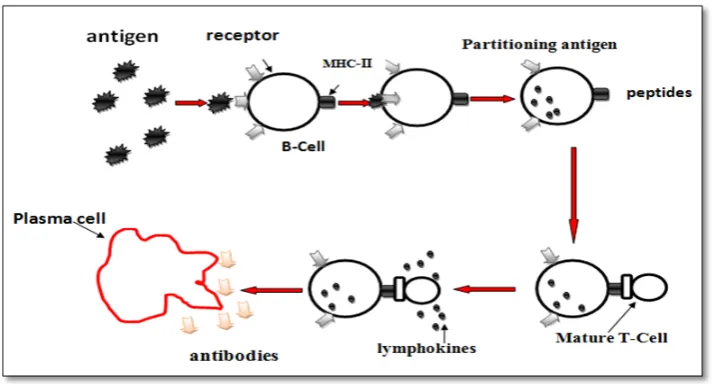
[image:19.595.140.497.500.692.2]The concept and theory of the Artificial Immune System will be incomplete without mentioning its source of inspiration in bringing its algorithms to the Biological Immune System. The body has different mechanisms to protect itself (self cells) from harmful foreign materials. One of these mechanisms is the natural immune system, and its main purpose is to detect and destroy any unwanted foreign cells (non-self cells) that could be harmful to the body. These non-self cells are known as antigens, and the natural immune system produces antibodies (as explained below) to bind to these antigens.
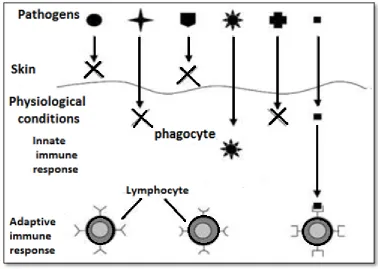
9 Natural Immune System (NIS) mainly consists of lymphoid organs that create lymphocytes. The two most familiar lymphocytes are the T-Cell and B-Cell, in which both are formed in bone marrows as shown in Figure 2.1. Both T-Cell and B-Cell have receptors on their surfaces to bind with an antigen (Graaff et al., 2011; Andrews, 2008). The immune system is a natural resistance to diseases using sophisticated adaptive mechanisms intended either to destroy the invaders or to neutralize their effects. As illustrated in Figure 2.2, the Biological Immune System can be classified according to functionality into four different layers of defence, which are physical, physiological, innate and adaptive. Depending on the invaders type and behavior, the immune system responds to very basic infections, and the skin serves as a physical barrier and a first line of defence. When pathogens elude the skin barrier, there are physiological barriers that provide a non-survival environment for pathogens (Elhaj et al., 2013).
Figure 2.2: Multi-layer Structure of Immune System
are to employ adaptive immune system mechanisms, then it is argued that they also need to incorporate innate immune system mechanisms, which control the adaptive immune system in biological organisms (Twycross & Aickelin, 2007).
Meanwhile, the artificial immune systems, techniques that are new to the scene of biologically inspired computation and artificial intelligence, are based on metaphor and abstraction from theoretical and empirical knowledge of the mammalian immune system. A robust biological process critical to the combating of disease in the body, the immune system is known to be distributed in terms of control, parallel in terms of operation, and adaptive in terms of function, all of which are features desirable for solving complex or intractable problems faced in the field of artificial intelligence (Brownlee, 2005).
There are a number of AIS models used in pattern recognition, fault detection, computer security, and a variety of other applications in the field of science and engineering (Aziz et al., 2012). Most of these models emphasize on designing and applying computational algorithms and techniques using simplified models of various immunological processes and functionalities (De Castro & Timmis, 2002; Dasgupta, 2006). Also, AIS has gained increasing interest among researchers in the development of immune-based models and techniques to solve diverse complex computational or engineering problems (Al-Enezi, 2012).
11 as highlighted by Negative Selection Algorithm (Greensmith & Aickelin, 2007). Based on the above mentioned application areas of the AIS approaches, and in line with the objective of detecting fraud for this study, the Negative Selection Algorithm and Dendritic Cell Algorithm fall perfectly within the research confines.
Several definitions of AIS exist in literature but only three have gained popularity among AIS researchers.
• AIS is a new technique for solving combinatorial optimization problems. AIS are computational systems that explore, describe and apply different mechanisms inspired by Biological Immune Systems in order to solve problems in different domains (Guezouri & Houacine, 2012).
• AIS is a technique new to the scene of biologically inspired computation and artificial intelligence, based on metaphor and abstraction from theoretical and empirical knowledge of the mammalian immune system (Brownlee, 2005).
• The field of AIS is one of the recent biologically inspired approaches to emerge from computer science (Muda & Shamsuddin, 2005).
2.3 Anomaly Detection
anomalies in data translate into significant, and often critical, actionable information in a wide variety of application domains. For example, an anomalous traffic pattern in a computer network could mean that a hacked computer is sending out sensitive data to an unauthorized destination (Kumar, 2005). An anomalous MRI image may indicate the presence of malignant tumours (Spence et al., 2001). Anomalies in credit card transaction data could indicate credit card or identity theft (Aleskerov et al., 1997), or anomalous readings from a spacecraft sensor could signify a fault in some components of the spacecraft (Fujimaki et al., 2005). Detecting outliers or anomalies in data has been studied in the statistics community as early as the 19th century (Edgeworth, 1887). Over time, a variety of anomaly detection techniques has been developed in several research communities. Many of these techniques have been specifically developed for certain application domains, while others are more generic.
2.4 Anomaly Detection Technique
Many modern techniques based on Artificial Intelligence, Data Mining, Neural Network, Bayesian Network, Fuzzy logic, Artificial Immune System, K- Nearest Neighbour Algorithm, Support Vector Machine, Decision Tree, Fuzzy Logic Based System, Machine Learning, Sequence Alignment, Genetic Programming and others have evolved in detecting various anomaly (Tripathi & Pavaskar, 2012; Singh & Narayan, 2012).
13
2.4.1 Negative Selection Algorithm (NSA)
Negative Selection Algorithm provides a mechanism to protect the self cells of the host, and also destroy unknown antigens (non-self cells). Within the highly-impregnable barrier of thymus, thymocytes (immature T-cells) mature by a pseudo-random genetic rearrangement of its receptors. Next (still in the thymus), these mature T-cells are exposed to self-peptides, and those that react strongly with the peptides are eliminated through a process called apoptosis. The rest of the mature T-cells that do not react with the self-peptides are subsequently released outside the thymus and into the body to fight against non-self antigens. The result of such a mechanism is that while on the one hand the (released) matured T-cells kill the non-self antigens; they are, on the other hand, non-reactive to the non-self (body) cells. Thus, Negative Selection Algorithm (NSA) may be viewed as a mechanism to discriminate the self from non-self cells (Dasgupta & Nino, 2008). There exist two types of NSA based on the data representation, which are the string (or binary) Negative Selection Algorithm, and the Real-Valued Negative Selection Algorithm. Detailed descriptions of the NSA types are reflected in the next section.
2.4.1.1 String (or Binary)-based Negative Selection Algorithm
NSA is one of the first immune-inspired change detection algorithms that was proposed (Balachandran et al.,2007). The process of keeping a computer away from intrusion can be regarded as distinguishing self and non-self. In the illumination of this idea, the research group led by Stephanie Forrest in the New Mexico University proposed the immune negative selection algorithm (Forrest et al., 1994). This first implementation initially used a binary representation for the elements in the self/non-self space.
generated in the censoring stage (Forrest et al., 1994). The algorithm constructs a set of competent detectors in the following steps:
Step 1: Define a set of self S. The data being protected is viewed as a string. The string is split into several L-length substrings. The set of self consists of several substrings.
Step 2: Generate a set of random candidate detectors R0. They are also L -length strings and are generated in some probability analytical ways.
Step 3: Generate a set of competent detectors R .Strings from R0 that match self are eliminated. Strings that do not match any of the strings in S become members of the detector collection R. This step is called censoring.
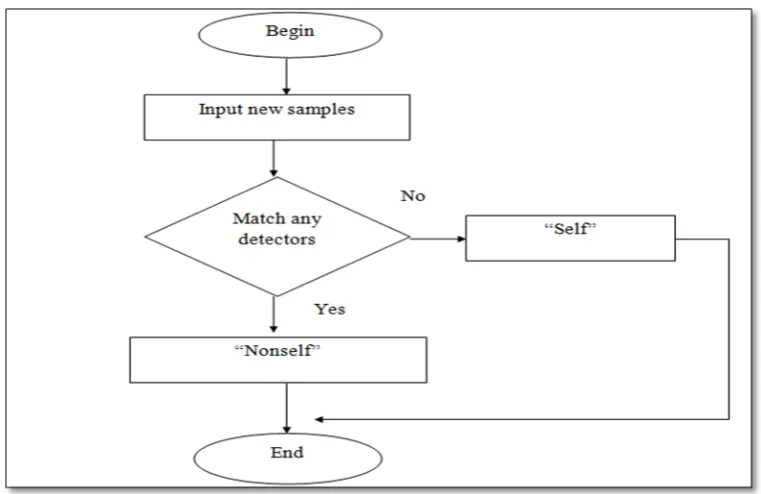
[image:25.595.127.508.390.637.2]Step 4: Monitor the changes of self. This is achieved by continually choosing one detector in R and testing to see if it matches with strings in S. If the self string matches one of the detector strings, a change would happen in S. Those changes are caused probably by intrusion, virus or misuse. This step is called monitoring.
15
Figure 2.4: Monitoring Stage
2.4.1.2 Real-Valued Negative Selection Algorithm (RNSA)
The Negative Selection Algorithm proposition as shown in Figure 2.4 (Forrest et al., 1994) suffers greatly from time complexity as it is exponential to the size of the matching window (the number of bits used to compare two binary strings). In order to tackle these problems, Gonzalez et al. (2002) proposed a Negative Selection Algorithm that uses real-valued representation of the self/non-self space. This algorithm, called Real-Valued Negative Selection (RNSA), tries to alleviate the scaling issues of binary negative selection algorithms while it uses various schemes to speed up the detector generation process. Different RNS algorithms used different geometric shapes such as hyper-rectangles, hyper-spheres and hyper-ellipses for covering the non-self space (Ji & Dasgupta, 2006).
Real-Valued Negative Selection (r,η,t,τ, # of Detectors) r: radius of detection
η: adaptation rate
t: once a detector reaches this, age it will be considered to be mature
τ: decay rate
Generate a random population of detectors based on # of Detectors While stopping criteria is not satisfied
For each detector di,
Calculate the shortest distance to any self point, dist_min, and store the nearest
point ci
While (dist_min < r)
If age > t
Generate a new Detector di,
Else
Calculate direction (dir) using ci,
Calculate ηi,
Move detector by: d(i+1) = di + ηi *dir
Increase age + 1,
Recalculate dist_min and ci
End If
End While
If (Not the first detector),
Calculate the shortest distance to all previous detectors and self points,
dist_min2, and store the nearest point ci,
While (dist_min2 < r) If age > t
Generate a new Detector di,
Else
Calculate direction (dir) using ci,
Calculate ηi,
Move detector by: d(i+1) = di + ηi *dir
Increase age + 1,
Recalculate dist_min2 and ci
End If
End While
Store detector as di
Else
Store detector, End
Figure 2.5: RNSA Pseudo-code
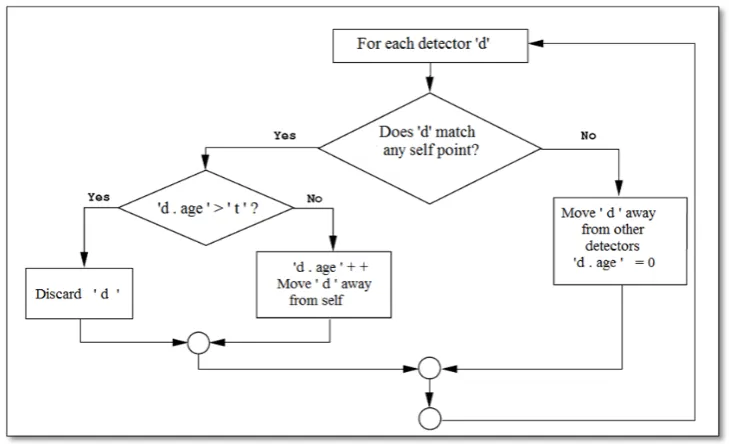
The input to the algorithm is a set of self samples represented by n-dimensional points (vectors). The algorithm tries to evolve a complement set of points called antibodies or detectors that cover the non-self space. This is accomplished by an iterative process that updates the position of the detector driven by two goals:
17 ii. Keep the detectors separated in order to maximize the covering of the
[image:28.595.135.500.134.356.2]non-self space.
Figure 2.6: The Iterative Process of Real-Valued Negative Selection Algorithm
2.4.1.3 V-Detector Negative Selection Algorithm
The first implementation of the real-valued negative selection algorithm generated detectors, in which the distance threshold (or radius) was constant throughout the entire detector set. However, the detector features can reasonably be extended to overcome this limitation. Zhou and Dasgupta proposed a new scheme of detector generation and matching mechanisms for negative selection algorithms which introduced detectors with variable properties (Ji & Dasgupta, 2007).
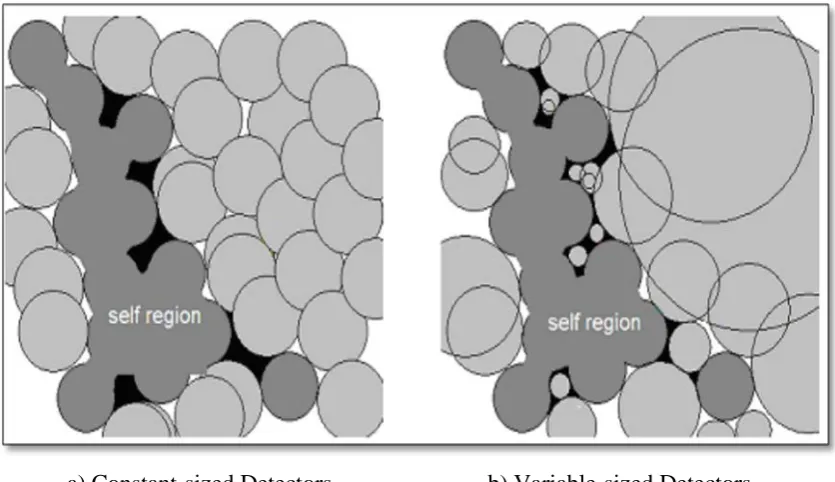
a) Constant-sized Detectors b) Variable-sized Detectors Figure 2.7: Comparison of Detector Coverage for Different Detector Schemes
Figure 2.7 illustrates several core advantages to the method of implementing variable-sized detectors. The first apparent advantage is that a larger area of non-self space is covered with fewer detectors. The issue of “holes” is a well-known problem with Real-Valued Negative Selection Algorithms. Tiny spaces between detectors and self points cannot be filled by constant-sized detectors as illustrated in black in Figure 2.7 (a). However, by using variable-sized detectors as shown in Figure 2.7 (b), smaller detectors can be generated to cover small holes while larger detectors cover the wider non-self space.
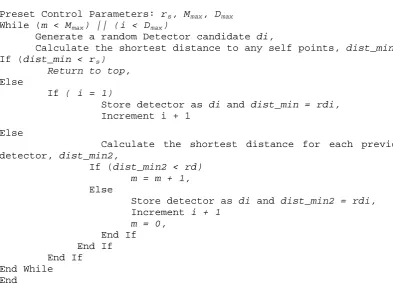
19 Real-Valued Negative Selection with Variable Detection Radius (rs, Mmax, Dmax) Preset Control Parameters: rs, Mmax, Dmax
While (m < Mmax) || (i < Dmax)
Generate a random Detector candidate di,
Calculate the shortest distance to any self points, dist_min, If (dist_min < rs)
Return to top, Else
If ( i = 1)
Store detector as di and dist_min = rdi, Increment i + 1
Else
Calculate the shortest distance for each previous detector, dist_min2,
If (dist_min2 < rd) m = m + 1, Else
Store detector as di and dist_min2 = rdi, Increment i + 1
[image:30.595.114.508.88.377.2]m = 0, End If End If End If End While End
Figure 2.8: Real-Valued Negative Selection V-Detector Algorithm Pseudo-code
2.4.2 Support Vector Machine (SVM)
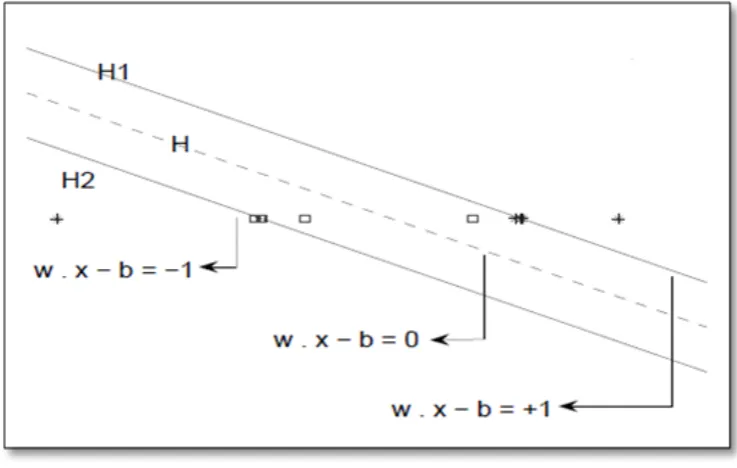
lies closest to it. An example of such hyperplane is illustrated in Figure 2.9. As it can be seen in the drawing, there can be many hyperplanes that can separate two classes, but with regard to optimal choice.
Figure 2.9: Linear Support Vector Machine
The margin F(x) and the hyperplanes as reflected in Figure 2.9 are depicted in Equations 2.2 through 2.5. H refers to hyperplanes, y refers to the output, x refers to a training or test pattern, w refers to the weight vector and the value b is the bias term. The term (w. x) refers to the dot product (liner) product, scalar product), which calculates the sum of the products of vector components wixi.
1. Optimal hyperplane.
H : y = w. x- b = 0 (2.1)
2. Supporting hyperplanes - parallel and equidistant to optimal hyperplane.
H1 : y = w . x - b = +1 (2.2)
21 3. Margin - distance between optimal hyperplane and a vector that lies
closest to it.
F(x) = w. x + b (2.4)
where F(x) is a margin.
2.4.3 K-Nearest Neighbour (KNN)
K-Nearest Neighbour (KNN), originally proposed by Fix and Hodges, is a very simple instance-based learning algorithm (Fix & Hodges, 1951), and one of the most popular algorithms for text categorization. The idea behind K-Nearest Neighbour algorithm is quite straightforward. To classify a new dataset, the system finds the k nearest neighbours among the training dataset and uses the categories of the k nearest neighbours to weight the category candidates. One of the drawbacks of KNN algorithm is its efficiency, as it needs to compare a test dataset with all samples in the training set. In addition, the performance of this algorithm depends greatly on two factors, which are a suitable similarity function and an appropriate value for the parameter k ( Li & Lu , 2003).
However, the k-nearest neighbour algorithm, which is most often used for classification, can also be used for estimation and prediction. The k-nearest neighbour is an example of instance-based learning, in which the training dataset is stored so that a classification for a new unclassified record may be found simply by comparing it to the most similar records in the training set (Marcoulides, 2005). The traditional KNN classification has three limitations:
2. Dependency on the training set: The classifier is generated only with the training samples and it does not use any additional data. This makes the algorithm depend on the training set excessively; it needs recalculation even if there is a small change on the training set.
3. No weight difference between samples: All the training samples are treated equally; there is no difference between the samples with a small number of data and a huge number of data. Therefore, it does not match the actual phenomenon where the samples have uneven distribution commonly (Suguna & Thanushkodi, 2010).
2.5 Application of AIS in Anomaly Detection
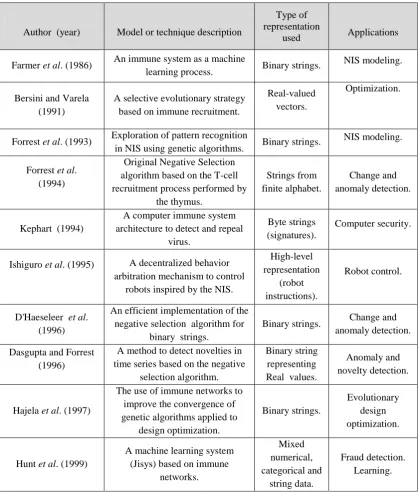
23 Table 2.1: A timeline of AIS (1986 to 1999)
Author (year) Model or technique description
Type of representation
used Applications
Farmer et al. (1986) An immune system as a machine
learning process. Binary strings.
NIS modeling.
Bersini and Varela (1991)
A selective evolutionary strategy based on immune recruitment.
Real-valued vectors.
Optimization.
Forrest et al. (1993) Exploration of pattern recognition
in NIS using genetic algorithms. Binary strings.
NIS modeling.
Forrest et al. (1994)
Original Negative Selection algorithm based on the T-cell recruitment process performed by
the thymus.
Strings from finite alphabet.
Change and anomaly detection.
Kephart (1994)
A computer immune system architecture to detect and repeal
virus.
Byte strings (signatures).
Computer security.
Ishiguro et al. (1995) A decentralized behavior arbitration mechanism to control
robots inspired by the NIS.
High-level representation
(robot instructions).
Robot control.
D'Haeseleer et al. (1996)
An efficient implementation of the negative selection algorithm for
binary strings.
Binary strings. Change and anomaly detection.
Dasgupta and Forrest (1996)
A method to detect novelties in time series based on the negative
selection algorithm.
Binary string representing Real values.
Anomaly and novelty detection.
Hajela et al. (1997)
The use of immune networks to improve the convergence of genetic algorithms applied to
design optimization.
Binary strings.
Evolutionary design optimization.
Hunt et al. (1999)
A machine learning system (Jisys) based on immune
networks. Mixed numerical, categorical and string data. Fraud detection. Learning.
Table 2.2: A timeline of AIS (2000 to 2003)
Author (year) Model or technique description
Type of representation
used Applications
Timmis (2000) A resource limited artificial immune system (RAINE) for data analysisthat extends the work of Cooke and Hunt
Real-valued vectors.
Data analysis. Clustering.
De Castro and Von Zuben (2000)
An immune network learning algorithm (aiNet).
Real-valued vectors.
Data analysis Clustering.
Hofmeyr et al. (2000)
An architecture for an artificial immune system (Lisys) for computer
security. Binary Strings. Computer security. Bradley and Tyrrel (2000)
A machine fault tolerance mechanism based on immune system ideas
(immunotronics).
Binary strings.
Hardware fault detection and
tolerance
De Castro and Von Zuben (2001)
A simulated annealing algorithm based on immune systems (SAND) applied
to neural network initialization.
Real-valued vectors. Initialization of feed-forward neural network weights. Tarakanov and Dasgupta (2002)
An architecture to build chips that implement the immune system .
Real-valued vectors (internally represented as bits). Pattern matching.
Coello and Cortez (2002)
An approach to handle constraints in
GA based optimization. Binary strings.
Optimization.
Nasraoui etal. (2003)
A scalable AIS model for dynamic unsupervised learning based on
immune network theory.
Real-valued vectors.
Clustering. Dynamic learning.
REFERENCES
Alcalá-Fdez, J., Sánchez, L., García, S., del Jesús, M. J., Ventura, S., Garrell, J. M., Otero, J., Romero, C., Bacardit, J., Rivas, V.M., Fernández, J.C., & Herrera, F. (2009). KEEL: a software tool to assess evolutionary algorithms for data mining problems. Soft Computing, 13(3),pp. 307-318.
Al-Enezi, J. (2012). Artificial immune systems based committee machine for classification application.
Al-Enezi, J. R., Abbod, M. F., & Al-Sharhan, S. (2009). Advancement in artificial immune systems: a perspective of models, algorithms and applications. In GCC Conference & Exhibition, 2009 5th IEEE (pp. 1-6). IEEE.
Aleskerov, E., Freisleben, B., & Rao, B. (1997). Cardwatch: A neural network based database mining system for credit card fraud detection. In Computational Intelligence for Financial Engineering (CIFEr), Proceedings of the IEEE/IAFE 1997 (pp. 220-226). IEEE.
Amer, M., & Abdennadher, S. (2011). Comparison of unsupervised anomaly detection techniques (Doctoral dissertation, Bachelor’s Thesis 2011).
Andrews, P. S. (2008). An Investigation of a Methodology for the Development of Artificial Immune Systems: A Case-Study in Immune Receptor Degeneracy. University of York, Department of Computer Science.
Aziz, A. S. A., Salama, M. A., Hassanien, A. E., & Hanafi, S. E. O. (2012). Artificial Immune System Inspired Intrusion Detection System Using Genetic Algorithm. Informatica (Slovenia), 36(4), 347-357.
Balachandran, S., Dasgupta, D., Nino, F., & Garrett, D. (2007). A general framework for evolving multi-shaped detectors in negative selection. In IEEE Symposium on Foundations of Computational Intelligence (FOCI'07), IEEE Computer Society (pp. 401-408).
Bennett, C. C. K. P. (2001). A linear programming approach to novelty detection. In Advances in Neural Information Processing Systems 13: Proceedings of the 2000 Conference 13, p. 395. MIT Press.
Bersini, H., Varela, F., Belew, R. K., & Booker, L. B. (1991). The immune recruitment mechanism: A selective evolutionary strategy. In Proceedings of the 4th International Conference on Genetic Algorithms (pp. 520-526). Mogan Kaufman.
Blake, C. L., & Merz, C. J. (1998). UCI Repository of machine learning databases [http://www. ics. uci. edu/~ mlearn/MLRepository. html]. Irvine, CA: University of California. Department of Information and Computer Science, 55.
Bradley, D. W., & Tyrrell, A. M. (2000). Immunotronics: Hardware fault tolerance inspired by the immune system. In Evolvable Systems: From Biology to Hardware (pp. 11-20). Springer Berlin Heidelberg.
Brownlee, J. (2005). Artificial immune recognition system (airs): a review and analysis. Swinburne University of Technology, Melbourne, Australia, Tech. Rep, (1-02).
Chandola, V., Banerjee, A., & Kumar, V. (2009). Anomaly detection: A survey. ACM Computing Surveys (CSUR), 41(3), 15.
Coello, C. C., & Cortés, N. C. (2002). A parallel implementation of an artificial immune system to handle constraints in genetic algorithms: Preliminary results. In Computational Intelligence, Proceedings of the World on Congress on 1, pp. 819-824. IEEE.
Cooke, D. E., & Hunt, J. E. (1995). Recognising promoter sequences using an artificial immune system. In Proceedings of the Intelligent Systems in Molecular Biology Conference ISMB (pp. 89-97), AAA1 Press.
61
1
D’haeseleer, P., Forrest, S., & Helman, P. (1997). A distributed approach to anomaly detection. Submitted to ACM Transactions on Information System Security. Dasgupta, D. (1999). Immunity-based intrusion detection system: a general
framework. In Proceedings of the 22nd national information systems security conference NISSC 1, pp. 147-160.
Dasgupta, D. (2006). Advances in artificial immune systems. Computational Intelligence Magazine, IEEE, 1(4), 40-49.
Dasgupta, D., & Forrest, S. (1996). Novelty detection in time series data using ideas from immunology. In Proceedings of the international conference on intelligent systems (pp. 82-87).
Dasgupta, D., & Nino, F. (2008). Immunological computation: theory and applications. CRC Press.
Dasgupta, D., Yu, S., & Nino, F. (2011). Recent advances in artificial immune systems: models and applications. Applied Soft Computing, 11(2), 1574-1587. De Castro, L. N., & Von Zuben, F. J. (2000). The clonal selection algorithm with
engineering applications. In Proceedings of GECCO 2000, pp. 36-39.
De Castro, L. N., & Von Zuben, F. J. (2001). An immunological approach to initialize feedforward neural network weights. In Artificial Neural Nets and Genetic Algorithms (pp. 126-129). Springer Vienna.
De Castro,L. N., & Timmis, J. (2002). Artificial immune systems: a new computational intelligence approach. Springer-Verlag, London. UK.
De Pádua Moreira, R., & Nascimento, C. L. (2012). Prognostics of aircraft bleed valves using a SVM classification algorithm. In Aerospace Conference, 2012 IEEE (pp. 1-8). IEEE.
Desforges, M. J., Jacob, P. J. and Cooper, J.E.(1998). Applications of probability density estimation to the detection of abnormal conditions in engineering. Proceedings of the Institution of Mechanical Engineers, Part C— Mechanical engineering science, 212:687–703.
Dixon, S. E. (2010). Studies on Real-Valued Negative Selection Algorithms for Self-nonself Discrimination: A Thesis (Master dissertation, California Polytechnic State University).
Elhaj, M. M., Hamrawi, H., & Suliman, M. (2013). A multi-layer network defense system using artificial immune system. In Computing, Electrical and Electronics Engineering (ICCEEE), 2013 International Conference on (pp. 232-236). IEEE.
Fan, W., Miller, M., Stolfo, S. J., Lee, W. and Chan, P. K.( 2001). Using artificial anomalies to detect unknown and known network intrusions. In IEEE International Conference on Data Mining (ICDM’01),pages 123–130. IEEE Computer Society.
Farmer, J. D., Packard, N. H., & Perelson, A. S. (1986). The immune system, adaptation, and machine learning. Physica D: Nonlinear Phenomena, 22(1), 187-204.
Fix, E., & Hodges Jr, J. L. (1951). Discriminatory analysis-nonparametric discrimination: consistency properties. California Univ Berkeley.
Forrest, S., Javornik, B., Smith, R. E., & Perelson, A. S. (1993). Using genetic algorithms to explore pattern recognition in the immune system. Evolutionary computation, 1(3), 191-211.
Forrest, S., Perelson, A. S., Allen, L., & Cherukuri, R. (1994). Self-nonself discrimination in a computer. In 1994 IEEE Symposium on Security and Privacy (pp. 202-202). IEEE Computer Society.
Fujimaki, R., Yairi, T., & Machida, K. (2005). An approach to spacecraft anomaly detection problem using kernel feature space. In Proceedings of the eleventh ACM SIGKDD international conference on Knowledge discovery in data mining (pp. 401-410). ACM.
Gadi, M. F. A., Wang, X., & do Lago, A. P. (2008). Comparison with parametric optimization in credit card fraud detection. In Machine Learning and Applications, 2008. ICMLA'08. Seventh International Conference on (pp. 279-285). IEEE.
Garrett, S. M. (2005). How do we evaluate artificial immune systems? Evolutionary Computation, 13(2), 145-177.
63
1
Gonzalez, F., Dasgupta, D., & Kozma, R. (2002). Combining negative selection and classification techniques for anomaly detection. In Evolutionary
Computation, 2002. CEC'02. Proceedings of the 2002 Congress on 1, pp. 705-710. IEEE.
Graaff, A. J., & Engelbrecht, A. P. (2011). The Artificial Immune System for Fraud Detection in the Telecommunications Environment.
Greensmith, J., & Aickelin, U. (2007). The dendritic cell algorithm (Doctoral dissertation, Nottingham Trent University).
Guezouri, M., & Houacine, A. (2012). Hybrid Flow Shop Scheduling Problem Using Artificial Immune System. International Journal of Intelligent Systems and Applications (IJISA), 4(10), 82.
Hajela, P., Yoo, J., & Lee, J. (1997). GA based simulation of immune networks applications in structural optimization. Engineering Optimization, 29(1-4), 131-149.
Hayton, P., Scholkopf, B., Tarassenko, L. and P.(2001). Anuzis. Support vector novelty detection applied to jet engine vibration spectra. In T. K. Leen, T. G. Dietterich, and V. Tresp, editors, Advances in Neural Information Processing Systems 13, pages 946–952. MIT Press.
Hofmeyr, S. A., & Forrest, S. (2000). Architecture for an artificial immune system. Evolutionary computation, 8(4), 443-473.
Hunt, J., Timmis, J., Cooke, E., Neal, M., & King, C. (1999). Jisys: The Envelopment of an Artificial Immune System for Real World Applications. InArtificial Immune Systems and their Applications (pp. 157-186). Springer Berlin Heidelberg.
Ishiguro, A., Kondo, T., Watanabe, Y., & Uchikawa, Y. (1995). Dynamic behavior arbitration of autonomous mobile robots using immune networks. In Evolutionary Computation, 1995., IEEE International Conference on 2, pp. 722-727. IEEE.
2
Ji, Z., & Dasgupta, D. (2006). Applicability issues of the real-valued negative selection algorithms. In Proceedings of the 8th annual conference on
Genetic and evolutionary computation (pp. 111-118). ACM.
Ji, Z., & Dasgupta, D. (2007). Revisiting negative selection algorithms. Evolutionary Computation, 15(2), 223-251.
Jung, J., Paxson, V., Berger, A.W., and Balakrishman, H. (2004). Fast Portscan Detection Using Sequential Hypothesis Testing, Security and Privacy. In Proceedings 2004 IEEE Symposium (pp. 211-225).IEEE.
Kephart, J. O. (1994). A biologically inspired immune system for computers. In Artificial Life IV: proceedings of the fourth international workshop on the synthesis and simulation of living systems (pp. 130-139).
King, S. P., King, D. M., Astley, K., Tarassenko, L., Hayton, P., & Utete, S. (2002). The use of novelty detection techniques for monitoring high-integrity plant. In Control Applications, 2002. Proceedings of the 2002 International Conference on 1, pp. 221-226. IEEE.
Kumar, V. (2005). Parallel and distributed computing for cybersecurity. IEEE Distributed Systems Online, 6(10).
Lasisi, A., Ghazali, R., & Herawan, T. (2014). Comparative Performance Analysis of Negative Selection Algorithm with Immune and Classification Algorithms. In Recent Advances on Soft Computing and Data Mining (pp. 441-452). Springer International Publishing.
Li, B., Yu, S., & Lu, Q. (2003). An improved k-nearest neighbor algorithm for text categorization. In Proceedings of the 20th international conference on computer processing of oriental languages (CPOL), Shenyang, pp. 12-19. Manikopoulos, C., & Papavassiliou, S. (2002). Network intrusion and fault detection:
a statistical anomaly approach. Communications Magazine, IEEE,40(10), 76-82.
Marcoulides, G. A. (2005). Discovering Knowledge in Data: an Introduction to Data Mining. Journal of the American Statistical Association, 100(472), 1465-1465.
65
1
Nairac, A., Corbett-Clark, T. A., Ripley, R., Townsend, N. W., & Tarassenko, L. (1997). Choosing an appropriate model for novelty detection. In Artificial
Neural Networks, Fifth International Conference on Conf. Publ. No. 440 pp. 117-122. IET.
Nasaroui, O., Gonzalez, F., & Dasgupta, D. (2002). The fuzzy artificial immune system: Motivations, basic concepts, and application to clustering and web profiling. In Fuzzy Systems, 2002. FUZZ-IEEE'02. Proceedings of the 2002 IEEE International Conference on 1, pp. 711-716. IEEE.
Nasraoui, O., Gonzalez, F., Cardona, C., Rojas, C., & Dasgupta, D. (2003). A scalable artificial immune system model for dynamic unsupervised learning. In Genetic and Evolutionary Computation—GECCO 2003 pp. 219-230. Springer Berlin Heidelberg.
Read, M., Andrews, P. S., & Timmis, J. (2012). An Introduction to Artificial Immune Systems. In Handbook of Natural Computing (pp. 1575-1597). Springer Berlin Heidelberg.
Shevade, S. K., Keerthi, S. S., Bhattacharyya, C., & Murthy, K. R. K. (2000). Improvements to the SMO algorithm for SVM regression. Neural Networks, IEEE Transactions on, 11(5), 1188-1193.
Singh, A., & Narayan, D. (2012). A Survey on Hidden Markov Model for Credit Card Fraud Detection. International Journal of Engineering and Advanced Technology (IJEAT), 1, 49-52.
Singh, K., & Upadhyaya, S. (2012). Outlier detection: applications and techniques. IJCSI International Journal of Computer Science Issues, 9(1). Spence, C., Parra, L., & Sajda, P. (2001). Detection, synthesis and compression in
mammographic image analysis with a hierarchical image probability model. In Mathematical Methods in Biomedical Image Analysis, 2001. MMBIA 2001. IEEE Workshop on pp. 3-10. IEEE.
Sridevi, R., & Chattemvelli, R. (2012). Genetic algorithm and artificial immune systems: A combinational approach for network intrusion detection. InAdvances in Engineering, Science and Management (ICAESM), 2012 International Conference on pp. 494-498. IEEE.
Tarakanov, A., & Dasgupta, D. (1999). A formal model of an artificial immune system. In Third International Workshop on Information Processing in Cells and Tissues (IPCAT), 55(1), 151-158.
Tarakanov, A., & Dasgupta, D. (2002). An immunochip architecture and its emulation. In Evolvable Hardware, NASA/DoD Conference on (pp. 261-261). IEEE Computer Society.
Tarassenko, L., Hayton, P., Cerneaz, N. and Brady, M. (1995). Novelty detection for the identification of masses in mammograms. In 4th International Conference on Artificial Neural Networks, PP 442–447.
Timmis, J. (2000). Artificial immune systems: a novel data analysis technique inspired by the immune network theory. Doctoral thesis, University of Wales.
Tripathi, K. K., & Pavaskar, M. A. (2012). Survey on Credit Card Fraud Detection Methods. International Journal of Emerging Technology and Advanced Engineering, 2, Issue 11,pp. 2250-2459.
Tripathi, K. K., & Ragha, L. (2013). Hybrid Approach for Credit Card Fraud Detection. International Journal of Soft Computing and Engineering (IJSCE), 3, Issue 4, pp. 2231-2307.
Tuo, J., Ren, S., Liu, W., Li, X., Li, B., & Lei, L. (2004). Artificial immune system for fraud detection. In Systems, Man and Cybernetics, 2004 IEEE International Conference on 2, pp. 1407-1411. IEEE.
Twycross, J., & Aickelin, U. (2007). Biological inspiration for artificial immune systems. In Artificial immune systems pp. 300-311. Springer Berlin Heidelberg.
Vapnik, V.,& Cortes, C. (1995). Support vector networks, Machine Learning, 20, (3). 273-297.