EFFECT OF RECONSTITUTED METHOD ON SHEAR STRENGTH PROPERTIES OF PEAT
NORHALIZA BINTI WAHAB
A thesis submitted in partial fulfilment of the requirement for the award of the Degree of Master of Civil Engineering
Faculty of Civil and Environmental Engineering Universiti Tun Hussein Onn Malaysia
iii
“Special dedicated with much love and affection to my beloved parents, Haji Wahab bin Ngah and Hajjah Munah binti Mohd Nor,
and beloved siblings,
Norhayati, Shaifudin, Noraizam, Azizudin, Nasarudin and Norhashima Also my booster energy (nieces)
Arissya, Adam, Haziq, Irfan, Auni Camellia and Nafis In addition, person who’s always support me
Tok, Tokki, Cik Ngoh, Ayah De, Mok Teh Ani, Mok yah, Abang Ri, Kak Ti, Umi, My ex- supervisor Emeritus Prof Dato’ Dr. Ismail bin Hj. Bakar
Also my current supervisor Dr. Mohd Khaidir bin Abu Talib
and also to all my fellow friends who always helped me and encourage myself to complete my study in Master of Civil Engineering”
ACKNOWLEDGEMENT
In the name of Allah, Most Gracious, Most Merciful
Alhamdulillah, all the praise for Allah S.W.T. the most graceful and merciful; who give me the courage and faith for me along the period to accomplish this postgraduate project. Praise is to Allah for, without His will, I would have not able to complete this project.
Firstly, I would like to express my deepest appreciation to my ex- supervisor, Emeritus Prof Dato’ Dr. Ismail bin Hj. Bakar for his generous time and patience to meet all my queries and providing revision materials related during this study.
Special gratitude to my supervisor Dr Mohd Khaidir bin Abu Talib for his endless support, guidance, supervision, advices, patience, ideas and unlimited encouragement through my research.
I would like to extend my appreciation to those who indirectly helped me; lecturers, laboratory technical assistants; Puan Salina Sani and all the staff at Research Centre for Soft Soil (RECESS) and Faculty of Civil and Environmental Engineering (FKAAS), Universiti Tun Hussein Onn Malaysia.
v
ABSTRACT
Peat is an organic soil contains more than 75% organic content. Shear strength of the soil is one of the most important parameters in engineering design, especially during the pre-construction and post-construction periods, since used to evaluate the foundation and slope stability of soil. Peat normally known as a soil that has very low shear strength and to determine and understand the shear strength of the peat is difficult in geotechnical engineering because of a few factors such as the origin of the soil, water content, organic matter and the degree of humification. The aim of this study was to determine the effective undrained shear strength properties of reconstituted peat. All the reconstituted peat samples were of the size that passing opening sieve 0.425mm, 1.000mm, 2.360mm and 3.350mm and were pre- consolidated at pressures of 50 kPa, 80 kPa and 100 kPa. The relationship deviator stress- strain, σdmax and excess pore water pressure, ∆u, shows that in both of
reconstituted and undisturbed peat gradually increased when confining pressure, σ’ and pre- consolidation pressure, σc increased. As a conclusion, the undrained shear
ABSTRAK
Gambut adalah tanah organik mengandungi lebih daripada 75% kandungan organik. Kekuatan ricih tanah adalah satu parameter yang paling penting dalam rekabentuk kejuruteraan, terutamanya semasa tempoh pra-pembinaan dan selepas pembinaan, digunakan bagi menilai asas dan cerun kestabilan tanah. Gambut biasanya dikenali sebagai tanah yang mempunyai kekuatan ricih yang sangat rendah dan untuk menentukan dan memahami kekuatan ricih tanah gambut adalah sukar dalam bidang kejuruteraan geoteknikal disebabkan beberapa faktor seperti asal-usul tanah, kandungan air, bahan organik dan tahap penguraian gambut. Tujuan kajian ini adalah untuk menentukan ciri-ciri berkesan kekuatan ricih taktersalir penstrukturan semula gambut. Semua sampel penstrukturan semula gambut melepasi saiz bukaan ayak 0.425mm, 1.000mm, 2.360mm dan 3.350mm dan dikenakan tekanan pra- penyatuan 50 kPa, 80 kPa dan 100 kPa. Hubungan tegasan terikan sisih, σdmax dan lebihan
tekanan air liang, Δu, menunjukkan bahawa kedua- dua tanah penstrukturan semula gambut dan gambut takterganggu secara beransur-ansur meningkat apabila tekanan terkurung, σ’ dan tekanan pra- penyatuan, σc meningkat. Kesimpulannya, keputusan
vii
TABLE OF CONTENTS
TITLE i
DECLARATION ii
DEDICATION iii
ACKNOWLEDGEMENT iv
ABSTRACT v
ABSTRAK vi
TABLE OF CONTENT vii
LIST OF TABLE xii
LIST OF FIGURE xiv
LIST OF SYMBOL AND ABBREVIATION xviii
CHAPTER 1 INTRODUCTION
1.1 Background study 1
1.2 Problem statements 4
1.3 Research objectives 6
1.4 Scopes of research 6
1.5 Significance of research 7
1.6 Structure of thesis 8
CHAPTER 2 LITERATURE REVIEW
2.1 Introduction 10
2.2 Peat 11
2.3 Classification of peat 17
2.4 Particle size distribution 21
2.4.1 Distribution of peat size 22
2.6 Soil specimen 29
2.6.1 Disturbed 30
2.6.2 Undisturbed 30
2.6.3 Reconstituted 30
2.6.3.1 Reconstituted method 31
2.6.3.1.1 Wet sieve 31
2.6.3.1.2 Pre- consolidation 32 method
2.7 Shear strength 33
2.7.1 Shear strength of soil 34
2.7.2 Shear strength of peat 35
2.7.2.1 Effect of pre- consolidation 38 pressure (σc) on the shear strength
parameter of the reconstituted peat soil
2.7.2.2 Effect of fiber and organic content 40 on the shear strength
2.7.2.3 Effect of degree of humification 41 on shear strength properties
2.8 Triaxial compression test 42
2.8.1 Consolidated undrained (CU) triaxial test 43 2.8.1.1 Stress –strain and excess pore 45
water pressure curve
2.8.1.2 Mohr- coulomb failure criterion 48
2.9 Summary 50
CHAPTER 3 METHODOLOGY
3.1 Introduction 53
3.2 Peat samples 55
3.2.1 Disturbed peat samples 55
3.2.2 Undisturbed peat samples 56
ix
3.4.1 Wet sieve 60
3.4.2 Pre- consolidation 61
3.5 Laboratory test 66
3.6 Physical properties test 67
3.6.1 Moisture content of peat (BS 1377: Part 2: 67 1990, Clause 3.0)
3.6.2 Liquid limit (BS 1377: Part 2: 1990, 68 Clause 4.3)
3.6.3 Specific gravity (BS 1377: Part 2: 1990, 69 Clause 8.3)
3.6.4 Organic content- loss on ignition (LOI) 71 method (BS 1377: Part 3: 1990, Clause 4.0) 3.6.5 Fiber content (ASTM, D 1997 – 91 (2001)) 72
3.7 Engineering properties test 76
3.7.1 Calibration on triaxial machine 76 3.7.2 Process of specimen testing on triaxial 78
machine
3.8 Summary 80
CHAPTER 4 RESULTS AND DISCUSSIONS
4.1 Introduction 81
4.2 Von Post classification 81
4.3 Particle size distribution 83
4.4 Physical properties 84
4.4.1 Water content 84
4.4.2 Liquid limit 86
4.4.3 Specific gravity 88
4.4.4 Organic content 90
4.4.5 Fiber content 91
4.5 Summarise of physical properties 93 4.6 Consolidated undrained identification tag of 96
reconstituted peat
water pressure- strain
4.7.1 Stress- strain relationships for undisturbed 96 and reconstituted Parit Nipah peat
4.7.1.1 Stress- strain relationships at 97 pre- consolidation 50kPa on
deviator stress, σdmax (kPa)
4.7.1.2 Stress- strain relationships at 99 pre- consolidation 80kPa on
deviator stress, σdmax (kPa)
4.7.1.3 Stress- strain relationships at 101 pre- consolidation 100kPa on
deviator stress, σdmax (kPa)
4.7.2 Excess pore water pressure- strain 104 relationships for undisturbed and
reconstituted Parit Nipah peat
4.7.2.1 Excess pore water pressure- 104 strain relationships of undisturbed and reconstituted peat at pre- consolidation 50kPa
4.7.2.2 Excess pore water pressure- 107 strain relationships of undisturbed and reconstituted peat at pre- consolidation 80kPa
4.7.2.3 Excess pore water pressure- 109 strain relationships of undisturbed and reconstituted peat at pre- consolidation 100kPa
4.8 Shear strength properties 114
4.9 Effect of reconstituted peat samples on shear 119 strength properties
xi
CHAPTER 5 CONCLUSIONS
5.1 Introduction 125
5.2 Conclusions 125
5.3 Recommendation 130
REFERENCES 131
LIST OF TABLES
1.1 Proportionate distribution of peat in Malaysia 2 (Wetlands International Malaysia, 2010; and CREAM, 2015)
1.2 Thesis outline 9
2.1 Distribution area of peat in Malaysia (CREAM, 2015) 12 2.2 Summary description and determination of peat soil 17
2.3 General purpose definition of peat 17
2.4 Peat classification according to degree of humification 19 (Von, 1992 and Adon et. al, 2012)
2.5 Organic soil classification based on the organic content 20 Jarret (1995)
2.6 Classification based on the fiber content of peat (Jarret, 1995) 20
2.7 Definition and significance of the test 20
2.8 Classification of soil chart (ASTM D2487-06) 23 2.9 The physical properties of peat soil in Malaysia 27
2.10 Soil specimen description 29
2.11 Factors control the shear strength (Poulos, 1989) 35
2.12 Undrained shear strength of fine soils 37
(BS EN ISO 14688-2:2004)
2.13 Undrained shear strength of peat 38
2.14 Shear strength parameter and pre- consolidation pressure of 39 the reconstituted soil (Rabbee et al., 2012)
2.15 Shear strength under pre- consolidation pressure of the 40 reconstituted peat (Anggraini, 2006)
2.16 Method to strengthen and toughen peat soil 51
3.1 Total reconstituted peat samples 66
3.2 Experimental method based on standard 66
xiii
reconstituted peat
4.2 Water content for undisturbed and reconstituted peat 85 4.3 Liquid limit for undisturbed and reconstituted peat 87 4.4 Specific gravity for undisturbed and reconstituted peat 89 4.5 Organic content for undisturbed and reconstituted peat 91 4.6 Classification of reconstituted soil from organic content range 91 4.7 Fiber content for undisturbed and reconstituted peat 92 4.8 Classification of reconstituted soil from fiber content range 93 4.9 Summary of physical properties on Parit Nipah peat soil 95 4.10 Summary of deviator stress at pre- consolidation 98
pressure 50kPa
4.11 Summary of deviator stress at pre- consolidation 100 pressure 80kPa
4.12 Summary of deviator stress at pre- consolidation 102 pressure 100kPa
4.13 Summary of excess pore water pressure at pre- consolidation 105 pressure 50kPa
4.14 Summary of excess pore water pressure at pre- consolidation 108 pressure 80kPa
4.15 Summary of excess pore water pressure at pre- consolidation 110 pressure 100kPa
4.16 Summary of ɛa, σd max and ∆umax for undisturbed and 111
reconstituted peat
4.17 Effective undrained triaxial summary results 117 5.1 Summary of physical properties of Parit Nipah peat soil 127 5.2 Summary of shear strength properties analysis 128 5.3 Classification of shear strength properties based on fiber 130
LIST OF FIGURES
1.1 Peat land in Malaysia (Wetlands International-Malaysia, 2010) 3 2.1 Peat distribution in the world (Trumper et al., 2009) 12 2.2 General distribution of quarternary deposits including 13
peat and soft soils in Peninsular Malaysia (modified after geological map of Peninsular Malaysia, 9th. edition, 2014; CREAM, 2015)
2.3 General distribution of quarternary deposits including 13 peat and soft soils in Sabah and Sarawak (modified after
geological map Sabah and Sarawak, geological survey of Malaysia, 1992; CREAM, 2015)
2.4 Profile morphology of drained organic soil (Mutalib et al., 14 1992; Rahman and Chan, 2013)
2.5 Texture of tropical peat (Wust et al., 2002) 15 2.6 Subsidence rate versus groundwater level relationships 26
for different areas in the world (Wösten et al., 1997; Al- Ani, 2015)
2.7 General arrangement of slurry consolidometer (Barnes, 2015) 33 2.8 Variation of cohesion with pre-consolidation pressure 39
(Rabbee et al., 2012)
2.9 Variation of ϕ with pre-consolidation pressure 40 (Rabbee et al., 2012)
2.10 Effect of degree of humification on shear strength properties 42
2.11 Triaxial compression test apparatus (Teferi, 2011) 43 2.12 Results of stress- strain and excess pore water pressure on 46
xv
2.13 Variation of stress strain and pore water pressure relationship 47 Das (2007)
(a) deviator stress against axial strain for loose soil, (b) deviator stress against axial strain for dense soil, (c) pore water pressure against axial strain for loose soil, (d) pore water pressure against axial strain for dense soil
2.14 Pore pressure pattern for undrained peat 48 (Gosling and Keeton, 2006)
2.15 Shear strength parameter of total and effective stress failure 49 envelopes for consolidated undrained triaxial tests (Das, 2007) 2.16 Failure envelope for undisturbed peat (Mohamad, 2015) 50
3.1 Methodology flow 54
3.2 Process of removing top soil 55
3.3 Illustration of the tube sampler setup condition 56 3.4 Process to collect undisturbed peat sample 58
3.5 Drying peat samples retained on sieve 59
3.6 Peat retained on varied sizes of sieve 59
3.7 Wet sieving process to obtain reconstituted peat sample 61 3.8 Placed slurry sample into the remolded sampler 62 3.9 Remolded sampler preparation equipment (one dimensional 63
consolidation)
3.10 The main steps of the slurry deposition process (Barnes, 2015) 63 a) Check the holes and tube does not stuffy,
b) Pouring the slurry sample slowly on flexible tube, c) Raise the flexible tube while pouring the slurry sample, d) Fill the slurry sample until full,
e) Load the slurry sample with pre- consolidation pressure
3.11 Reconstituted peat sampler 65
3.12 Peat sample for consolidated undrained test 65
3.13 Moisture content samples 67
3.14 Cone penetration equipment 68
3.15 Specific gravity test 70
3.17 Sodium hexametaphosphate 73 3.18 Peat was submerged into hydrochloric acid solution 74
3.19 Process of fiber content test 75
3.20 GDS triaxial compression test 76
3.21 The piston touch the top cap during shearing stage 80
4.1 Von Post squeezing method 82
4.2 Particle size distribution of disturbed sample Parit Nipah peat 84
4.3 Water content versus type of sample 85
4.4 Liquid limit versus type of sample 87
4.5 The differences between the usage of kerosene and water 89
4.6 Specif gravity versus type of sample 89
4.7 Organic content versus type of sample 90
4.8 Fiber content versus type of sample 92
4.9 Typical curve for deviator stress versus axial strain for 98 undisturbed and reconstituted peat at pre- consolidation
pressure 50kPa
4.10 Comparison of undisturbed and reconstituted peat at 99 pre- consolidation pressure 50kPa on deviator stress
4.11 Typical curve for deviator stress versus axial strain for 100 undisturbed and reconstituted peat at pre- consolidation
pressure 80kPa
4.12 Comparison of undisturbed and reconstituted peat at 101 pre- consolidation pressure 80kPa on deviator stress
4.13 Typical curve for deviator stress versus axial strain for 103 undisturbed and reconstituted peat at pre- consolidation
pressure 100kPa
4.14 Comparison of undisturbed and reconstituted peat at 103 pre- consolidation pressure 100kPa on deviator stress
4.15 Excess pore water pressure- strain relationship for 106 undisturbed and reconstituted peat at pre- consolidation
pressure 50kPa
xvii
water pressure
4.17 Excess pore water pressure- strain relationship for 108 undisturbed and reconstituted peat at pre- consolidation
pressure 80kPa
4.18 Comparison of undisturbed and reconstituted peat at 109 pre- consolidation pressure 80kPa on excess pore
water pressure
4.19 Excess pore water pressure- strain relationship for 110 undisturbed and reconstituted peat at pre- consolidation
pressure 100kPa
4.20 Comparison of undisturbed and reconstituted peat at 111 pre- consolidation pressure 100kPa on excess pore
water pressure
4.21 Shear stress at failure (Τf) against normal stress (σn) for 115
undisturbed sample
4.22 Shear stress at failure (Τf) against normal stress (σn) for 115
RS0.425
4.23 Shear stress at failure (Τf) against normal stress (σn) for 116
RS1.00
4.24 Shear stress at failure (Τf) against normal stress (σn) for 116
RS2.36
4.25 Shear stress at failure (Τf) against normal stress (σn) for 117
RS3.35
4.26 Effect of peat size at pre- consolidation pressure 50kPa on 119 effective cohesion and effective angle of friction
4.27 Effect of peat size at pre- consolidation pressure 80kPa on 120 effective cohesion and effective angle of friction
4.28 Effect of peat size at pre- consolidation pressure 100kPa on 120 effective cohesion and effective angle of friction
4.29 Reconstituted sample (passing peat size) against cohesion and 121 angle of friction
LIST OF SYMBOL AND ABBREVIATION
ASTM - American Society for Testing and Materials
BS - Bristish Standard
c - Cohesion value of soil
c’ - Apparent cohesion in term of effective stress Cc - gradation coefficient
Cu - uniformity coefficient
Cu - Undrained shear strength CD - Consolidated drained test CU - Consolidated undrained test D10 - Effective size at 10%
D30 - Effective size at 30%
D60 - Effective size at 60%
eo - Void ratio
g - gram
Gs - Specific gravity
Ha - Hectare
HCI - Hydrochloric acid
kN/ m2 - KiloNewton per meter square
kPa - Kilopascal
LL - Liquid limit
LOI - Loss on Ignition
M - Mass
m - meter
ml - mililitre
mm - millimeter
xix
O - Organic
Pt - Peat
PVC - Polyvinyl Chloride
RECESS - Research Centre for Soft Soils
RS - Reconstituted peat
Su - Undrained shear strength
UCS - Unconfined Compressive Strength Test
UD - Undisturbed peat
USCS - Unified Soil Classification System
USDA - United States Department of Agriculture UTHM - Universiti Tun Hussein Onn Malaysia UU - Unconsolidated undrained test
μm - Micrometer
ɛa - Axial strain
σdmax - Maximum deviator stress
w - Water content
% - Percentage
ϕ - Angle of internal friction
ϕ’ - Angle of internal friction based on effective stress - Shear stress
τf - Shear strength at failure
f’ - Effective shear strength at failure
Δu - Excess pore water pressure σc - Pre- consolidation pressure
σ’ - Normal stress on the failure plane based on effective stress
σn - Normal stress
µm - Micrometer
° - Degree
CHAPTER 1
INTRODUCTION
1.1 Background Study
Peat soil is formed when a decay process of plants is produced and it is divided into three categories namely hemic peat, fibric peat and sapric peat. The difference between peat and inorganic soil leads to difference in the physical and mechanical properties such as high compressibility. During the sampling process and specimen test, the peat soil sample preparation undergoes a careful process. This is because of the structure of fibrous peat has a high compressibility, especially when dealing with low peat decomposition. Physical properties of peat can represent the structure and engineering properties (MacFarlane and Radforth, 1965; and Zainorabidin and Bakar, 2003). Peat is a problematic soil in terms of stability and long term settlement.
Generally, peat soil can be described as soil that is formed by the dead wetland materials that cannot decay in a normal way because of the presence of high water table. When the organic matter decomposed, it turns into a sort of glue called humus, which is strong enough to bind several smaller particles together, making them into larger multi- particles, which can alter the behavior of the soil (Paikowsky
2 i. Fresh plant and animal residues (decomposable)
ii. Humus (resistant)
iii. Inert forms of nearly elemental carbon (charcoal, coal or graphite)
Table 1.1 shows the proportionate distribution of peat across the states in Malaysia. There are about 2.5 million hectares of peatland in Malaysia including 0.7 million hectares of peat soil in Peninsular Malaysia, 1.7 million hectares in Sarawak and 0.2 million hectares in Sabah (Wetlands International Malaysia, 2010 and CREAM 2015). The state of Sarawak has the largest areas of peat soils that amounted to 1, 697, 847 hectares, followed by Peninsular Malaysia with 642, 918 hectares; then followed by Sabah which recorded 116, 965 hectares, with the percentage of total peatland area are 69.08%, 26.16% and 4.76% respectively.
[image:20.595.211.429.636.710.2]Figure 1.1 shows the locations where peat located in Malaysia. The shaded area shows the distribution of peat in Malaysia. Based on Figure 1.1, the largest peatland in Malaysia is located in Sarawak with 16,500 km2. In Peninsular Malaysia, the peat areas are found in the east and west coast areas, especially in the coastal areas of West Johore, Kuantan and Pekan district, Rompin-Endau area, Northwest Selangor and the Perak (Hilir Perak district and Perak Tengah district). In Sarawak, peat occurs mainly between the lower stretches of the poorly drained interior valleys (valley peat) and the main river course (basin peat). Peat is found in the administrative division of Sri Aman, Sibu, Sarikei, Bintulu, Miri, Kuching, Samarahan and Limbang. In Sabah, the organic soils are found around the coastal areas of the Klias peninsula, Krah swamps in Sugut, Kota Belud and Labuk estruaries and Kinabatangan floodplains (Phillips, 1998).
Table 1.1: Proportionate distribution of peat in Malaysia (Wetlands International Malaysia, 2010; and CREAM, 2015)
Regions Total peat area (ha)
Percentage of total peatland area (%) Peninsular 642, 918 26.16
Sabah 116, 965 4.76
Figure 1.1: Peat Land in Malaysia (Wetlands International-Malaysia, 2010)
Peat soils have higher moisture content and wet density values that are approximately equal to the water density value. Classification of the decomposition proposed by Von Post (1922) was divided into ten groups, H1 to H10. The values represent the degree of decomposition are increasing as the number of classification increase. According to this system, test samples are classified into H3 and H6 with an average organic content of 75% and 30%, respectively. H3 refers to very slightly
Peninsular Malaysia
Sabah Sarawak
Legend:
4 decomposed peat, which releases very muddy brown water when being squeezed but no peat passes through the fingers. The remaining plants are still identifiable and no amorphous material is present. H6 refers to moderately decomposed peat with a very indistinct plant structure. When it is squeezed, about one-third of the peat escapes between the fingers and the structure is more distinct compared to before squeezing. The symbol of Peat is ‘Pt’ and grouped into the soil at the rate of two high organic (organic soil). Based on Mankinen and Gelfer (1982), peat is a soil with organic content greater than 50%, but according to Landva et al., (1983); Kearns and Davison (1983); and ASTM D4427 (2013), peat is a soil with organic content more than 75%. Whitlow (2001) and Jelisic and Leppanen (2003) stated that peat has a low bearing capacity in the range 5kPa – 20 kPa which is lower than the soft clay, so the result can cause a slide / collapse (bearing capacity failure) due to low shear strength and high settlement due to high compressibility characteristic of peat. Hence, construction over peat deposit may cause excessive settlement and bearing capacity failure.
1.2 Problem Statement
In construction, there is problem rises on peat soil since it lacks of strength which contributes to ground failure. In order to overcome this problem, ground improvement and alternative methods need to be executed and these certainly gain added costs for development. Nevertheless, the challenge on the peats is the difficulty to collect undisturbed peat samples that truly represent site conditions due to the soil condition and its properties (Munro, 2004). Whitlow (2001) stated that is actually it most impossible to gain a totally undisturbed sample of soft soil because of the process of boring, driving the coring tool, raising and withdrawing the coring tool and extruding the sample from the coring tool which caused some disturbance in the structure of the soft soil. Hence, the knowledge and deeper understanding on forming reconstituted samples and engineering parameters of peat soil is needed to overcome this study.
recommended in construction by some developers (Gofar and Sutejo, 2007). Construction on peat soil nowadays increasing rapidly because of the lack space on the suitable land. Due to this rapid urban development the land owner and developers are forced to open a new space area. Due to this phenomenon the construction of infrastructure likes building, highway and other construction have to be constructed on the organic soil. There are various construction techniques that have been carried out to support embankments over peat deposits without risking bearing failures but settlement of these embankments remains excessively large and continues for many years. Thus, the active and effective research has to be conducted to find and understand the best solution on this phenomenon to overcome this problem.
Generally, peat commonly occur as extremely soft, wet, unconsolidated surficial deposits that are an integral part of wetland systems. These types of soils contribute to geotechnical problems in the area of sampling, settlement, stability, in situ testing, stabilization and construction. Formation of peat significantly takes time to fully decompose. It will decompose from fibrous (least decomposed) to hemic (intermediate decomposed) and then settle down as sapric (most decomposed). The degree of peat decomposition will contribute to the changing of peat fiber, thus it affects to the changing of engineering properties such as shear strength properties. The different sizing of peat fiber will result in different shear strength properties. Hebib (2001) has revealed that least decomposed peat has higher shear strength rather than most decomposed peat due to the presence of large fiber in the peat acts as reinforcement.
6 Triaxial Test (UU- Test). The result of shear strength properties (cohesion and angle of friction) of reconstituted peat increased, due to the increase of the pre- consolidation pressure. Differ from this thesis, the author conducted the reconstituted peat on Parit Nipah peat that classified as hemic peat. The reconstituted peat sample through segregation peat size via wet sieving and consolidated with the 50kPa, 80kPa and 100kPa pre- consolidation pressure to test the specimen on the Consolidated Undrained Triaxial Test (CU- Test).
1.3 Research Objectives
The aim of this study was to determine the effective undrained shear strength properties of reconstituted peat. Therefore, the shear strength properties (c' and ϕ') need to investigate to correlate with the effect of the reconstituted method (peat size and pre- consolidation pressure). To achieve the outcomes, the objective was highlighted
The specific objectives of this thesis are:
1) To determine the physical properties of undisturbed and reconstituted peat. 2) To investigate the shear strength parameters of undisturbed and reconstituted
peat of different sizes of peat and in different pre- consolidation pressure. 3) To correlate the shear strength properties with the effect of passing peat size
and pre- consolidation pressure.
1.4 Scope of Research
tests were conducted according to British Standard Institution (BS 1377: 1990), Manual of Soil Laboratory Testing by Head and Annual Book of ASTM Standards.
All the peat samples were brought to the RECESS, UTHM to proceed with the physical and mechanical test. The disturbed peat samples were sieved through wet sieves with different sizes of sieve opening to obtain the reconstituted samples. In this project the reconstituted peat samples were prepared through four different sizes that are 0.425mm, 1.000mm, 2.360mm and 3.350mm. Reconstituted peat samples were formed by using a pre-consolidation pressure of 50kPa, 80kPa and 100kPa that represent the pressure at the site that can be exerted on a soil without irrecoverable volume change. Johari et al. (2014) stated the value for pre- consolidation pressure for Parit Nipah peat is 26kPa at the depth 0.3m to 1.0m.
In this study, the Consolidated Undrained Trixial Compression Shear Test (CU-Test) was applied on the specimens of diameter 50mm and 100mm height and was subjected to confining pressure of 25 kPa, 50 kPa and 100 kPa. This pressure was performed to represent peat depth layers where average stress has been carried by the soil and simulate as the real site pressure condition (Mohamad, 2015). The results that obtained from the triaxial test were analyzed to understand the shear strength properties by determining the effective cohesion (c’) and effective angle of friction (ϕ’). The standard for triaxial compression test (BS 1377-8: 1990) was used to determine the shear strength properties (effective stress). Subsequently, the shear strength properties results that obtained for both undisturbed and reconstituted samples were correlated with the sizes of peat and pre- consolidation pressure.
1.5 Significance of Research
in-8 depth knowledge regarding the shear strength parameters is necessary because it is very useful to engineers to design safe structures.
This research is very useful to geotechnical engineering and who is involved in the development of peat lands. In the future, the developers and contractors can determine the soil shear strength properties in a variety of peat size, degree of decomposition, fiber content, organic content and others data that offers in this study by referring the data value obtained and thus can be used in preliminary work in construction. This study may also help researchers in the shear strength determination at certain of peat size with the classification of peat. For example, when the researchers go to the construction areas and determine the type of peat whether fibric, hemic and sapric by using the Von Post method, thus the researchers can evaluate and relate the range value of shear strength from the data that were obtained in this study. Apart from that, this data will also help the peat researchers in the future who work on with the distribution of soil, where to refer directly to the shear strength data on different sizes obtained from this study without having to make consolidated- undrained test and maybe can proceed with the other test experiment.
Hopefully, in the future, more peat researchers study about shear strength peat in term of the peat size passing through a wet sieve to obtain more shear strength data.
1.6 Structure of Thesis
last chapter summarised all the results and recommendation for future work based on current study experience and literature review.
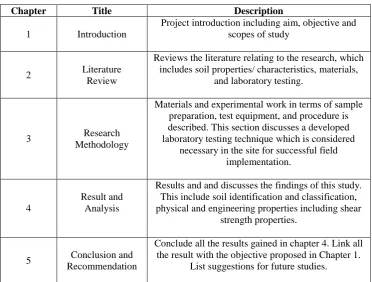
Table 1.2: Thesis outline
Chapter Title Description
1 Introduction
Project introduction including aim, objective and scopes of study
2 Literature Review
Reviews the literature relating to the research, which includes soil properties/ characteristics, materials,
and laboratory testing.
3 Research
Methodology
Materials and experimental work in terms of sample preparation, test equipment, and procedure is described. This section discusses a developed laboratory testing technique which is considered
necessary in the site for successful field implementation.
4
Result and Analysis
Results and and discusses the findings of this study. This include soil identification and classification, physical and engineering properties including shear
strength properties.
5 Conclusion and Recommendation
Conclude all the results gained in chapter 4. Link all the result with the objective proposed in Chapter 1.
10
CHAPTER 2
LITERATURE REVIEW
2.1 Introduction
Nowadays, the construction development over peat soil is increasing due to the lack of space and suitable land for building infrastructure, highway construction and other development. The problems of peat in foundation construction generally is because of its own characteristics such as low shear strength, very high natural moisture content, high compressibility and water holding capacity, low specific gravity and low bearing capacity (Kazemian et al.,2011).
uniformity and repeatability specimens that can simulate the study area ground strength.
In this chapter, the literature review and the information on properties peat soil samples and obtaining the shear strength parameter are discussed according to the objectives of this research. The information gathered is obtained from journals, books, proceedings and reports.
2.2 Peat
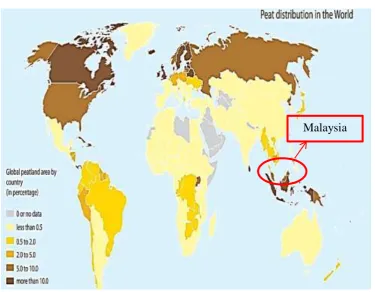
There is about thirty million hectares of peat soil coverage around the world with Canada and Russia having the largest distribution of peat (Zainorabidin, 2010). More than sixty percent of the world‟s tropical peat lands are found in South-East Asia (Lette, 2006). Most notable are the large peat land on the islands of Borneo belonging to Indonesia, Malaysia, Brunei and Indonesia. However, there are also significant occurrences in other parts of Indonesia, Malaysia, Vietnam, Thailand and the Philippines (Adon et al., 2012). Figure 2.1 shows the picture of peat distribution around the world which shows that the percentage distribution of peat is in the range 0% to more than 10%. Malaysia is in the range 5% to more than 10% as shown in the red circle areas. Figure 2.2 and Figure 2.3 displays the distribution of quaternary soil around Peninsular Malaysia, Sabah and Sarawak areas. The yellow color areas show the distribution of peat, soft soils, clay, silt, sand and gravel in both figures.
12 Table 2.1: Distribution area of peat in Malaysia (CREAM, 2015)
State Total Area of Peat (Ha)
Johor 143,974
Pahang 164,113
Selangor 164,708
Perak 69,597
Terengganu 84,693
Kelantan 9,146
Negeri Sembilan 6,245 Federal Territory 381
Sabah 116, 965
Sarawak 1, 697, 847
Total 2, 457, 730
[image:30.595.132.508.297.589.2]Figure 2.2: General Distribution of Quaternary Deposits including Peat and Soft Soils in Peninsular Malaysia (modified after Geological Map of Peninsular
Malaysia, 9th. Edition, 2014; CREAM, 2015)
Figure 2.3: General Distribution of Quaternary Deposits including Peat and Soft Soils in Sabah and Sarawak (modified after Geological Map Sabah and
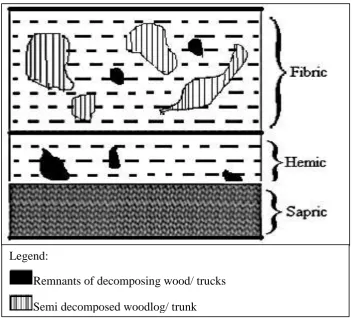
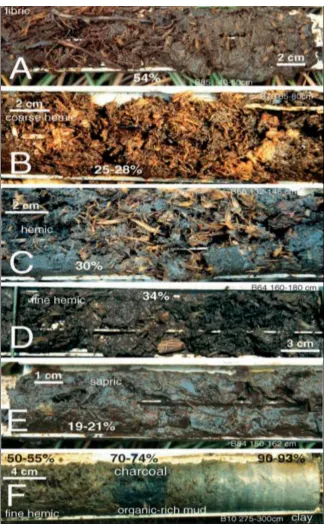
[image:31.595.138.497.432.702.2]14 Figure 2.4 illustrate the profile morphology of peat structure. The arrangement of particle seen loose in fibric peat compared to the sapric peat because of the presence of woody plant. Figure 2.5 shows the texture of tropical peat. As can be seen, the colour of peat soil in Malaysia is generally dark reddish brown to black. It consists of loose, branches, partly decomposed leaves, twigs and tree trunks with a low mineral content (Wust et al., 2002). The formation of peat is mainly controlled by the combination of water and temperature. On earth, temporal and spatial changes of water and temperature depend upon climatic conditions, and geological, geomorphologic, and hydrological factors. These factors directly and indirectly influence peat formation, development, and its characteristics.
Figure 2.4: Profile Morphology of drained organic soil (Mutalib et al., 1992; Rahman and Chan, 2013)
Legend:
Figure 2.5: Texture of Tropical Peat (Wust et al., 2002)
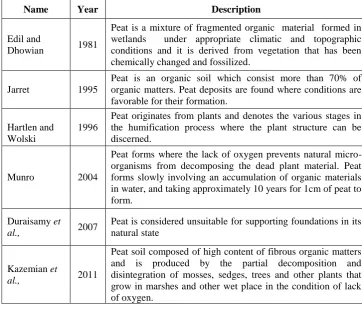
16 fibrous organic matters and was produced by the partial decomposition and disintegration of mosses, sedges, trees and other plants that grow in marshes and other wet place in the condition of lack of oxygen. At the same time, peat is a mixture of fragmented organic material formed in wetlands under appropriate climatic and topographic conditions and it is derived from vegetation that has been chemically changed and fossilized (Edil and Dhowian, 1981; Mesri and Ajlouni, 2007). Decomposition or humification involves the loss of organic matter either in gas or in solution, the disappearance of the physical structure and the change in the chemical state (Huat etal., 2009).
In natural state, peat consists of water and decomposed plant fragment with virtually no measurable strength (Munro, 2005). Table 2.2 shows the description and determination of peat from peat researchers. As concluded, peat is a mixture of fragmented organic material forms where the lack of oxygen prevents natural micro- organisms from decomposing the dead plant material. Thus, peat is considered unsuitable for supporting foundations in its natural state.
Table 2.2: Summary description and determination of peat soil
Name Year Description
Edil and
Dhowian 1981
Peat is a mixture of fragmented organic material formed in wetlands under appropriate climatic and topographic conditions and it is derived from vegetation that has been chemically changed and fossilized.
Jarret 1995
Peat is an organic soil which consist more than 70% of organic matters. Peat deposits are found where conditions are favorable for their formation.
Hartlen and Wolski
1996
Peat originates from plants and denotes the various stages in the humification process where the plant structure can be discerned.
Munro 2004
Peat forms where the lack of oxygen prevents natural micro- organisms from decomposing the dead plant material. Peat forms slowly involving an accumulation of organic materials in water, and taking approximately 10 years for 1cm of peat to form.
Duraisamy et
al., 2007
Peat is considered unsuitable for supporting foundations in its natural state
Kazemian et
al., 2011
Peat soil composed of high content of fibrous organic matters and is produced by the partial decomposition and disintegration of mosses, sedges, trees and other plants that grow in marshes and other wet place in the condition of lack of oxygen.
Table 2.3: General purpose definition of peat
Purpose of
application Definition From reference
Geotechnical engineering
Organic content < 75% = organic soil
Organic content > 75% = peat ASTM D4427- 92
Agriculture Organic content > 20% = peat USDA (Soil Taxonomy)
Soil science Organic content > 35% = peat USDA (Soil Taxonomy)
2.3 Classification of Peat
[image:35.595.136.502.478.574.2]18 of peat is developed based on the decomposition of fiber, the vegetation forming the organic content, and fiber content.
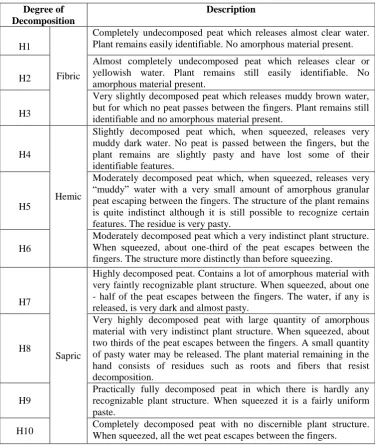
Table 2.4 shows the classification of peat according to degree of humification. The classification of peat soils have been classified into 10 groups (H1-H10) by Von Post based on water content, fibre properties, and degree of decomposition (Von, 1922). The test was conducted by pressing the peat soil in the hand and it gives off marked muddy water. The pressed residue material remaining in the hand has fibrous structure and it is some-what thick. Based on (Hartlen and Wolski, 1996), the fibrous peat with more than 60% fiber content is usually in the range of H1 to H4.
To a geotechnical engineer, all soils with organic content of greater than 20% is known as organic soil. Peat soil is an organic soil with organic content of more than 75% (Huat, 2004). This classification is partly the same as ASTM D 2487- 06 classifications; a soil with organic content less than 75% (or ash content more than 25%) as muck or organic soil, while a soil with organic content higher than 75% (or ash content less than 25%) as a peat. For geotechnical purposes, degree of peat decomposition or humification system of Von Post is often divided into 3 classes that are (Magnan, 1980; ASTM Standard D 5715- 00):
a) Fibric or fibrous (least decomposed) tentatively ranging from H1 to H3 b) Hemic or semi-fibrous (intermediate decomposed) tentatively ranging
from H4 to H6
c) Sapric or amorphous (most decomposed) tentatively ranging from H7 to H10
Davis (1997) said that peat is classified as woody, fibrous, sedimentary, and granular peat in terms of texture. In Malaysia, Malaysian Soil Classification System (MSCS) also had been introduced to classify organic soil and peat. The MSCS is developed based on British Soil Classification (BS 5930: 1981) and improved by Public Work Malaysia. MSCS used the degree of humidification as another parameter to classify the state of decay of organic soil after organic content.
Malaysia (Zainorabidin et al, 2007). Generally, the classification of peat is developed based on the decomposition of fiber, the vegetation forming the organic content, and fiber content. Based on Jarret (1995), the soil classification of organic soil can be determined as shown in Table 2.5 and Table 2.6. The features of the physical properties determination with the definitions and significance of the tests is summarised in Table 2.7. The physical properties accommodate the valuable information in determining the peat classification.
Table 2.4: Peat classification according to degree of humification (Von, 1992 and Adon et al., 2012)
Degree of Decomposition
Description
H1
Fibric
Completely undecomposed peat which releases almost clear water. Plant remains easily identifiable. No amorphous material present.
H2
Almost completely undecomposed peat which releases clear or yellowish water. Plant remains still easily identifiable. No amorphous material present.
H3
Very slightly decomposed peat which releases muddy brown water, but for which no peat passes between the fingers. Plant remains still identifiable and no amorphous material present.
H4
Hemic
Slightly decomposed peat which, when squeezed, releases very muddy dark water. No peat is passed between the fingers, but the plant remains are slightly pasty and have lost some of their identifiable features.
H5
Moderately decomposed peat which, when squeezed, releases very “muddy” water with a very small amount of amorphous granular peat escaping between the fingers. The structure of the plant remains is quite indistinct although it is still possible to recognize certain features. The residue is very pasty.
H6
Moderately decomposed peat which a very indistinct plant structure. When squeezed, about one-third of the peat escapes between the fingers. The structure more distinctly than before squeezing.
H7
Sapric
Highly decomposed peat. Contains a lot of amorphous material with very faintly recognizable plant structure. When squeezed, about one - half of the peat escapes between the fingers. The water, if any is released, is very dark and almost pasty.
H8
Very highly decomposed peat with large quantity of amorphous material with very indistinct plant structure. When squeezed, about two thirds of the peat escapes between the fingers. A small quantity of pasty water may be released. The plant material remaining in the hand consists of residues such as roots and fibers that resist decomposition.
H9
Practically fully decomposed peat in which there is hardly any recognizable plant structure. When squeezed it is a fairly uniform paste.
20 Table 2.5: Organic soil classification based on the organic content
(Jarret, 1995)
Soil Types Description Symbol Organic Content (%) Clay or silt or sand Some Organic O 2-20
Organic Soil - O 25-75
[image:38.595.149.494.230.280.2]Peat - Pt >75
Table 2.6: Classification based on the fiber content of peat (Jarret, 1995)
Soil Types Fiber Content Degree of Humification
Fibric Peat >66% H1-H3
Hemic Peat 33%-66% H4-H6
[image:38.595.140.500.339.678.2]Sapric Peat <33% H7-H10
Table 2.7: Definition and significance of the test
Test Definition Significant
Degree of Humification
The physical appearance of
soil was described based on
the Von Post classification.
A detail description on
classification of soil by refer H1-
H10 classification of peat
Particle Size Distribution
The list of values that defines as the relative amount, typically by mass, of particles present according to size.
To determine the percentage of various sized soil particles in a soil mass. The findings of the results allow the particle size distribution curve is plotted
Moisture Content
The ratio of the mass of water in a specimen to the mass of solid in the specimen.
The percentage of moisture content can be related to the settlement, shear strength and compressibility of the soil.
Liquid Limit The water content at which soil passes from the plastic to the liquid state.
The limit is expressed as a percentage of the dry weight of the soil.
Specific Gravity Specify is the ratio of the weight of a given volume of the material to the mass of an equal volume of water.
It is related to the degree of decomposition and mineral content of peat.
Organic Content The organic content is the percentage of the organic matter present in a soil.
Important parameter whereby the percentage of peat and organic soils can be indistinguishable
Fiber Content Determined typically from dry weight of fiber retained on 0.15 mm as a percentage of oven-dried mass
2.4 Particle Size Distribution
The Unified Soil Classification System (USCS) is the most widely used soil classification system practice in the geotechnical engineering. The purpose of this system is for classifying mineral and organic soil based on the particle size and limit (liquid and plastic) determination. The grain size distribution of a soil determines the governing particle- level forces, inter- particle packing and the ensuing macro scale behavior, while grain shape was established at three different scales: the global form, the scale of major surface features and the scale of surface roughness (Tang, 2011). Santamarina and Cho (2004) reported that each scale reflects the features of the formation history and particles in deciding the global behaviour of the soil mass, from particle packing to mechanical response.
Boelter (1968) has stated that the physical properties of peat are highly affected by the distribution of the pore size and the porosity. These two parameters are related to the distribution of peat size. The degree of decomposition affects the porosity of peat and the porosity is affected by both the particle size and structure of peat. With an increment in the degree of decomposition, the particle size of organic matters decreases Boelter (1968).
In particle size distribution, the uniformity coefficient (Cu) and gradation
coefficient (Cc) are taken into account to determine and verify the grade of soil. A
well graded known as a soil that has a broad distribution of particle size, while poorly graded or uniform soils are composed of a narrow size particle distribution only. Cu> 5 accounted as a well-graded soil, Cu<3 demonstrate a uniform soil, Cc
22 2.4.1 Distribution of Peat Size
ASTM (D2487-06) classified the soil in three major soil divisions: coarse- grained, fine grained and highly organic soil as tabulated in Table 2.8. The peat soil was described and categorized in highly organic soils with the symbol „Pt‟. Peat is different with other types of soils because the identification of this type of soil is identified through organic matter, colour and odour.
Based on Levesque and Dinel (1977), particle- size distribution of peat fiber was determined according to the wet sieving method. For the case of organic soils, particles size distribution is not necessarily used in characterization and it is highly influenced by its botanic nature. As for mineral soil, the theory of particle composed of single grain unit is not able to be visualized in an organic area. Therefore, it could be practical to use particle size as the comparison for fibrous and non-fibrous peat materials which denote their decomposition level. Wet sieving is chosen to separate fine grains from the coarse grains and it is carried out onto the disturbed or undisturbed soil by using tap water with the arrangement of a stack of aperture sizes which chosen. Said and Taib (2009) has specified their opinion that to obtain the particle size distribution result precisely, the wet sieving analysis must be done on the soil in order to further break the soil particles into a smaller size. Kalantari and Prasad (2014) stated that, tropical peat soils are normally having sizes between 0.006mm to 5.000mm.
Tang (2011) revealed the wet method for coarse peat soil is more effective to practice and the soil fraction finer than 63 µm was analyzed with diffraction laser method (CILAS test). Mohamad (2015) stated the coefficient of curvature (Cc) for
peat soil at Parit Nipah Johor is 1.07 and coefficient of uniformity (Cu) is 9.6. In
Table 2.8: Classification of soil chart (ASTM D2487-06)
Major Divisions Group
Symbol Typical Names
Course-Grained Soils More than 50% retained on the 0.075 mm (No. 200) sieve
Gravels 50% or more of course fraction retained on the 4.75 mm (No. 4) sieve
Clean Gravels GW
Well-graded gravels and gravel-sand mixtures, little or no fines
GP
Poorly graded gravels and gravel-sand mixtures, little or no fines
Gravels with Fines
GM Silty gravels, gravel-sand-silt mixtures
GC Clayey gravels, gravel-sand-clay mixtures
Sands
50% or more of course
fraction passes the 4.75 (No. 4) sieve
Clean Sands
SW
Well-graded sands and gravelly sands, little or no fines
SP
Poorly graded sands and gravelly sands, little or no fines
Sands with Fines
SM Silty sands, sand-silt mixtures
SC Clayey sands, sand-clay mixtures
Fine-Grained Soils More than 50% passes the 0.075 mm (No. 200) sieve
Silts and Clays
Liquid Limit 50% or less
ML
Inorganic silts, very fine sands, rock four, silty or clayey fine sands
CL
Inorganic clays of low to medium plasticity,
gravelly/sandy/silty/lean clays
OL Organic silts and organic silty clays of low plasticity
Silts and Clays
Liquid Limit greater than 50%
MH
Inorganic silts, micaceous or diatomaceous fine sands or silts, elastic silts
CH Inorganic clays or high plasticity, fat clays
OH Organic clays of medium to high plasticity
Highly Organic Soils Pt Peat, muck, and other highly organic soils
Keyword:
Prefix: G= Gravel, S= Sand, M= Silt, C=Clay, O= Organic
Suffix: W= Well Graded, P= Poorly Graded, M= Silty, L= Clay, LL < 50%, H=
24 2.5 Physical Properties of Peat
There are a few unique physical properties of peat which should be paid attention in discussion. Hobbs (1986) stated that the physical characteristics such as color, degree of humification, water content and organic contents should be included in a full description of peat. They are influenced by main component of the formation such as mineral content, organic content, moisture and air. When one of these components changes, it will result in the changes of the whole physical properties of peat. Table 2.9 shows the all the physical properties peat data that were recorded from the past researchers in Malaysia.
Boelter (1968) reported that the physical properties of peat are highly affected by the porosity and the distribution of the pore size. Both of these parameters are related in the distribution of peat size. Rahman (2015) stated the degree of decomposition affects the porosity of peat and the porosity is influenced by the particle size and structure of peat. With an increase of the decomposition level, thus it tends to the particle size of organic matters decreases. Past researchers have reported that the degree of decomposition for Parit Nipah peat is H5 (moderately decomposed peat) with the organic and fiber content is in the range between 78 - 93% and 40 - 67% respectively, as tabulated in Table 2.9.
The water content is the most important criteria properties for peat soil. The value of water content depends on the origin, degree of decomposition and the chemical composition of peat (Rahman and Chan, 2014). Generally, peat has very high natural water content due its ability to holding water capacity. Mesri and Ajlouni (2007) emphasized that the water content of peat may range from 200 to 2000% which is quite different from that for clay and silt deposits which rarely exceed 200%. Water content of fibrous peat generally is very high. It is because fibrous peat holds a considerable amount of water as its organic coarse particles are generally very loose and the organic particles itself are hollow and largely full of water (Rahman and Chan, 2014). In Parit Nipah Johor, the water content ranges from 330 to 650% (Azhar et al., 2016, Saedon and Zainorabidin 2012, Johari et al., 2016, Zainorabidin and Mohamad 2015; Yusoff et al., 2015).
REFERENCES
Abdullah, M., Huat, B. B. K., Kamaruddin, R., Ali, A. K. and Duraisamy, Y. (2007). Design and performance of eps footing for lightweight farm structure on peat soil. American Journal of Applied Sciences 4 (7): 484-490.
Adon, R., Bakar, I., Wijeyesekera, D. C., and Adnan. (2012). Overview of the sustainable uses of peat soil in Malaysia. Int. Journal of Integrated Engineering – Special Issue on ICONCEES. Vol. 4 No. 3. pp. 38-46.
Ajlouni, M.A. (2000) Geotechnical Properties of Peat and Related Engineering Problems. University of Illinois at Urbana-Champaign: PhD Thesis.
Al-Ani, H. and Oh, E. and Chai, G. (2013). Engineering properties of peat in estuarine environment. Foundation and Soft Ground Engineering Conference. Thu Dau Mot University.
Al- Ani, H. A. H. (2015). Digital geotechnical maps and classification of soil engineering properties by using GIS. Griffith School of Engineering, Griffith University, Gold Coast Campus: PhD. Thesis
Al- Raziqi, A. A., Huat, B. B. K. and Munzir, H. A. (2003). Potential usage of hyperbolic method for prediction of organic soil settlement. Proc. 2nd International Conference on Advances in Soft Soil Engineering and Technology Putrajaya, Malaysia, pp.439- 45.
Ali, A. W. M., Sabarudin, M., Mohd, I. M. M., Saiful, A. A. T., Ismail, B., Adnan, Z., Azrul, Z. K. and Ling, J. H. (2016). Construction of buildings on peat: Case Studies and Lessons Learned, MATEC Web of Conferences, 47 03013. American Society for Testing and Materials (2000). Standard Test Methods for
Moisture, Ash, and Organic Matter of Peat and Other Organic Soils, ASTM D2974- 00, Vol. 04.08.
132
Mass, ASTM D1997- 91, Vol. 04.08.
American Society for Testing and Materials (2002). Standard Classification of Peat Samples by Laboratory Testing. ASTM D4427- 92, Vol. 04.08.
American Society for Testing and Materials (2005). Standard Test Methods for Liquid Limit, Plastic Limit, and Plasticity Index of Soils, ASTM D4318- 05, Vol. 04.08.
American Society for Testing and Materials (2006). Standard Terminology Relating to Soil, Rock, and Contained Fluids. ASTM D653- 06, Vol. 04.08.
American Society for Testing and Materials (2006). Standard Test Methods for Specific Gravity of Soil Soilds by Water Pycnometer, ASTM D854- 06, Vol. 04.08.
American Society for Testing and Materials (2006). Standard Practice For Classification of Soils For Engineering Purposes (Unified Soil Classification System). ASTM D2487- 06, Vol. 04.08.
American Society for Testing and Materials (2006). Standard Test Method For Estimating the Degree of Humification of Peat and Other Organic Soils (Visual/ Manual Method). ASTM D5715- 00 (2006) , Vol. 04.08.
Aminur M. R., Kolay P. K., Taib S. N. L., Mohd Zain, M. I. S. and Kamal, A. A. (2011). Physical, geotechnical and morphological characteristics of peat soils from sarawak. Journal - The Institution of Engineers, Malaysia. Vol. 72, No. 4, December 2011.
Anggraini, V. (2006). Shear Strength Improvement of Peat Soil Due To Consolidation. Universiti Teknologi Malaysia: Degree of Master.
Axelsson, K., Johansson, S. and Anderson, R. (2002). Stabilization of organic soil by cement and pozzaolanic reaction- feasibility study. Swedish Deep Stabilization Research Centre, Report 3, 1- 51.
Barnes, D.M (2015). Monotonic and cyclic shear response of reconstituted natural silt. The University of British Columbia: Degree of Master
Bashar, M. A. (2002). Stress-deformation characteristics of selected coastal soils of Bangladesh and their sampling effects. Dept. of Civil Eng., BUET: PhD Thesis.
Boso, M. (2005). Shear Strength Behaviuor of A Reconstituted Partially Saturated Clayey Silt. University of Trento: PhD Thesis.
Bradshaw, A.S. and Baxter, C.D.P. (2007). Sample preparation of silts for liquefaction testing. Geotechnical Testing Journal. 30(4), Paper ID GTJ100206, 9 pages.
British Standard Institution (1990). Classification test. British Standards Institution, London. UK: BS 1377 Part 2.
British Standard Institution (1990). Methods of test for soils for civil engineering purposes, chemical and electrochemical tests, London. UK: BS 1377 Part 3. British Standard Institution (1990). Shear strength tests (effective stress): British
Standards Institution, London. UK: BS1377 Part 8.
Boylan N., Jennings P. and Long M. (2008). Peat slope failure in Ireland. Quarterly Journal of Engineering Geology and Hydrogeology 2008; v. 41; p. 93-108 doi:10.1144/1470- 9236/06-028.
Burland, J. B., (1990). The Thirtieth Rankine Lecture: On the Compressibility and Shear Strength of Natural Soils, Geotechnique 40, No.3, pp. 329-378.
Coulomb, C. A. (1776). Sur une application des regles maximis et minimis a quelques problems de statique, relatives a l’architecture. Acad Sci Paris Mem Math Phys 7:343–382.
Cola, S. and Cortellazo, G., (2005). The shear strength behaviour of two peaty soils,
Geotechnical and Geological Engineering, pp. 679-695.
Cortellazzo, G. and Cola, S. (1999). Geotechnical characteristics of two Italian peats stabilized with binders. In: Bredenberg H, Holm G, Broms BB (eds) Dry mix methods for deep soil stabilization. AA Balkema, Rotterdam, pp 93–100 Craig, R.F. (1993). Mekanik Tanah. Terjemahan Soil Mechanics oleh Aminaton
Marto, Fatimah Mohd Noor, dan Fauziah Kasim. Edisi ke-4. Unit Penerbitan Akademik Universiti Teknologi Malaysia.
CREAM (2015). Guidelines for Construction on Peat and Organic Soils in Malaysia. Kuala Lumpur, Malaysia: Construction Research Institute of Malaysia (CREAM).
134 Das, B. M. (2007). Principles of Foundation Engineering. 7th Ed. United States of
America: Christopher M. Shortt.
Das, B.M. (2008). Fundamentals of Geotechnical Engineering. 4th Ed. Canada: Christopher M. Shortt.
Das, B. M., (2010). Principles of Geotechnical Engineering. 7th Edition. Stamford, USA: Cengage Learning.
Das, B. M., (2011). Principles of Foundation Engineering. 7th Ed. Stamford, USA: Christopher M. Shortt
Davis, J. H. (1997). The Peat Deposits of Florida their Occurrence, Development and Uses. Florida Geological Survey. Geological Bulletin, 3.
Deboucha, S. and Hashim, R. (2009). Durability and swelling of tropical stabilized peat soils. Journal of Applied Sciences. 9 (13): 2480- 2484.
Dehghanbanadaki, A.,Arefnia, A., Keshtkarbanaeemoghadam, A., Kamarudin, A., Motamedi, S. and Hashim, R. (2016). Evaluating the compression index of fibrous peat treated with different binders. Bull Eng Geol Environ. DOI 10.1007/s10064-016-0890-6
Duraisamy, Y., Huat, B, B, K., Aziz A.A. (2007). Engineering Properties and Compressibility Behaviour of Tropical Peat Soil. American Journal of Applied Sciences, 4(10): 768-773.
Edil, T. B. (1997). Construction Over Peats and Organic Soil. Proc. Conf. On Recent Advances in Soft Soil Engineering, Kuching. Referred by Abedin
Edil, T.B. and A. W. Dhowian. (1981). At-rest Lateral Pressure of Peat Soils. Conf. On Sedimentation and Consolidation Model, ASCE, San Fransisco, 411 – 424.
Edil T. B. and Wang, X. (2000). Shear strength and ko of peats and organic soils
geotechnics of high water content materials, ASTM STP 1374, West Conshohocken, PA.
Farrell E.R. (2012). Organics/peat soils. In ICE Manual of Geotechnical Engineering. Burland J, Chapman T, Skinner H and Brown M (eds). ICE Publishing, London, vol. 1, pp. 463– 479.
Gofar N. and Sutejo Y., (2007). Long term compression behavior of fibrous peat.
Malaysian Journal Civil Engineering 19.
Peat Seminar. Edinburgh, 11 March 2008.
Hanzawa, H., Kishida, T., Fukusawa, T. and Asada, H. (1994). A case study of the application of direct shear and cone penetration tests to soil investigation, design and quality control for peaty soils. Soils and Foundations, Jap. Soc.
Soil Mechan. Found. Eng., 4: 13-22.
Hartlen, J. and Wolski, W. (1996). Embankments on Organic Soils, 1st Edn., B.V. Elsevier Science, Amsterdam, ISBN: 0-444-88273-1, pp: 456.
Hashim, R. and Islam, S. (2008). Engineering Properties of Peat Soil in Peninsular Malaysia. J. Appl. Sci., 8(22). pp. 4215-4219.
Head, K. H. (1998). Manual of soil laboratory testing: Effective stress tests. 1st edition . Pentech Press. London Ltd. Vol 2.
Hebib, S. (2001). Experimental Investigation on The Stabilisation of Irish Peat. Ph.D. thesis, University of Dublin, Trinity College, Dublin, Ireland.
Hobbs, N. B. (1986). Mire Morphology and the Properties and Behaviour of Some British and Foreign Peats. Q. I Eng. Geol., London, 19(1): 7-80.
Huat, B. B. K. (2004) Organic and Peat Soil Engineering. Publisher Serdang : Universiti Putra Malaysia Press, 2004.
Huat, B, B.K., (2006). Deformation and Shear Strength Characteristics of Some Tropical Peat and Organic Soils. Petanika J. Sci. and Technol. 14 (1 and 2), pp. 61- 74.
Huat, B. B., Asadi, A. and Kazemian, S. (2009). Experimental investigation on geomechanical properties of tropicanal organic soil and peat. American Journal of Engineering and Applied Sciences, 2 (1), 184- 188
Huat, B. B., Kazemian, S., Prasad, A. and Barghchi, M. (2011). State of an art review of peat: General prespective. International Journal of the Physic Sciences, 6 (8), 1988- 1996.
Huat, B. B., Prasad, A., Asadi, A. and Kazemian, S. (2014). Geotechnics of Organic Soils and Peat. London, UK: Taylor and Francis Group.
Hyde, A.F.L., Higuchi, T. and Yasuhara, K. (2006). Liquefaction, Cyclic Mobility, and Failure of Silt. Journal of Geotechnical and Geoenvironmental Engineering, 132(6) p. 716-735.
136 Jelisic N. and Leppanen M. (2003). Mass stabilization of organic soils and soft clay [M]. Reston, VA, USA: Geotechnical Special Publication (120 I) : 552−561. Johari. N. N., Bakar, I. and Razali, S. N. M., (2014). Oedometer Testing on
Undisturbed and Reconstituted Peat. Proceedings of Soft Soils 2014.
Bandung, Indonesia: Universiti Tun Hussein Onn.
Johari, N. N., Bakar, I., Razali, S. N. M. and Wahab, N. (2016). Fiber effects on compressibility of peat. Soft Soil Engineering International Conference 2015 (SEIC2015).
Kalantari, B. and Huat, B. B. K. (2009). Load-Bearing Capacity Improvement for Peat Soil. European Journal of Scientific Research. 32.2 (2009): 252-259 Kalantari, B. and Prasad, A. (2014). A study of the effect of various curing
techniques on the strength of stabilized peat. Transp Geotech, 1:119–128 Kazemian S., Asadi A. and Huat B. B. K. (2009). Settlement Problems in Peat Due
to Their High Compressibility and Possible Solution Using Cement Columns. In: Shen-en C, de Leon AD, Dolhon AM, Drerup MJ, Parfitt K, Forensic engineering 2009: Pathology of the built.
Kazemian, S., Huat, B.B.K., Prasad, A. and Barghchi, M. (2011). A state of art review of peat: Geotechnical engineering perspective. International Journal of the Physical Sciences. Vol. 6(8), pp. 1974-1981.
Kazemian, S., and Moayedi, H. (2012). Effect of Cement-Sodium Silicate Grout on the Compressibility Parameters of Fibrous Peat. Advanced Materials Research. Vol. 629, pp 461-465.
Kazemian, S., Huat, B. B. K. and Moayedi, H. (2012). Undrained Shear Characteristics of Tropical Peat Reinforced with Cement Stabilized Soil Column. Geotechnical and Geological Engineering, 30:753–759
Khalid, N., Mukri, M., Kamarudin, F., Sidek, N., and Arshad, M.F., (2013). Experimental Studies on Fibrous Peat Stabilized Using Waste Paper Sludge Ash (WPSA). Electronic Journal of Geotechnical Engineering. Vol. 13, Bundle B.