Journal of Chemical and Pharmaceutical Research, 2014, 6(3):560-565
Research Article
CODEN(USA) : JCPRC5
ISSN : 0975-7384
Characteristics and metabolic pathways of fluorene (FLU) degradation by
strain Rhodococcus sp. USTB-C isolated from crude oil
Chan Yu, Jun Yao*
and Jingnan Jin
School of Civil and Environmental Engineering, and National “International Cooperation Based on Environment and Energy”, and Key Laboratory of “Metal and Mine Efficiently Exploiting and Safety” Ministry of Education,
University of Science and Technology Beijing, Beijing, PR China
_____________________________________________________________________________________________
ABSTRACT
A fluorene-degrading strain named USTB-C was isolated from crude oil of production well in Dagang oil field, southeast of Tianjin, northeast China. The 16S rDNA sequence of USTB-C showed 100% similarity with that of Rhodococcus erythropolis PR4, it was belonged to Rhodococcus. The strain USTB-C could remove 55.8% of fluorene with an initial concentration of 100 mg L-1 in 23 days without other substrates. It implied that the strain USTB-C showed the potential to degrading efficient of fluorene. Based on the intermediate metabolites analyzed by gas chromatography-mass spectrometry (GC-MS), we deduced the possible metabolic pathway of strain USTB-C for fluorene biodegradation. Fluorene was initially oxidized at C-9 positions finally resulting 9-fluorenone. Through hydrolysis reaction, 9-fluorene subject to form phthalic acid. Furthermore, phthalic acid was further degraded to1 -hydroxybenzene. USTB-C evidently possesses efficient, high effective degrader and potential for further application on the enhanced bioremediation technologies for treating fluorene-contaminated soil.
Keywords: Fluorene, Biodegradation, Rhodococcussp. USTB-C, Metabolic Pathway.
_____________________________________________________________________________________________
INTRODUCTION
Polycyclic aromatic hydrocarbons (PAHs) easily recognize by the presence of two or more fused aromatic rings in liner, angular, or cluster structural arrangements [1]. They are persistent environmental contaminates that are widespread in soils, sediments, groundwater as well as in the atmosphere [2]. PAHs are primarily formed during incomplete combustion of organic materials and are emitted into the environment by forest fires or/and anthropogenic activities such as refining processes and coal combustion as well as contamination associated with the transport and use of fossil fuels and derivatives [3]. Due to their high hydrophobicity, low water solubility and complex chemical structure, PAHs tend to accumulate along the food chains and food web. A variety of PAHs have been demonstrated to be toxic, mutagenic, teratogenic and carcinogenic [4]. Their presence in the environment is of great concern [5]. Sixteen PAHs are listed as priority pollutants by the US Environmental Protection Agency (USEPA) [6] and as persistent organic pollutants (POP) by United Nations Environment Programme (UNEP), and seven of them have been placed on the black list of priority pollutants in China.
Biodegradation is a viable, inexpensive and ecological-friendly technology for both ex situ and in situ remediation of fluorene-contaminated sites. Microorganisms play an important role in the degradation of fluorene during the process. Many researches have been attempted on microbial degradation of PAHs, microbial metabolism of lower-molecular-weight naphthalene [13,14], tricyclic compounds phenanthrene and anthracene[15,16] and even the degradation of acenapthene[17]and fluoranthrene[18-21]. But, it is rare about the research on the degradation of fluorene. Nowadays, the microbial transformation and degradations of toxic PAHs are considered to be the most promising methods, however the screening of novel fluorene-transforming microorganisms and the study of metabolic system involved in fluorene transformation has been wanted. Research on this would be important provide the basis for future research on the degradation mechanism of hydrocarbons.
The present study aimed to describe the isolation, identification, characterization and metabolic pathway of a fluorene-degrading bacterium from the crude oil. The isolated strain was found to belong to the Rhodococcus genus and designated as USTB-C. Its growth characteristics, fluorene degradation pathway were studied and reported.
EXPERIMENTAL SECTION
Reagent and culture media
Crude oil was collected from Dagang oil field (southeast of Tianjin, northeast China).
Fluorene and all other reagents used in the experiments were of analytical grade. The inorganic salt medium used as the following composition (g L-1) : 3 (NH4)2SO4; 0.5 KH2PO4; 1.26 Na2HPO4·12H2O; 0.54 MgSO4·7H2O; 0.05 FeCl3·6H2O; 0.03 FeSO4·7H2O; 0.015 MnSO4·H2O; 0.024 ZnSO4·7H2O; 0.366 CoCl2·6H2O with NaOH to the pH of 7.0. Luria Bertani (LB) medium containing (g L-1) Tryptone (10.0, Oxoid , Basingstoke, Hampshire UK), Yeast Extract (5.0, Oxoid , Basingstoke, Hampshire UK) and NaCl(10.0, Beijing, China). Tris-HCl buffer was added to maintain the pH at 7.0. In addition, 2% agarose was added to media and sterilized at 121 °C for 30min.
Isolation of fluorene degrading bacteria
An enrichment technique was employed to obtain the desired microbial consortia. Briefly, 1 g crude oil was inoculated into 50 mL of sterilized inorganic salt medium with 10 mg fluorene and incubated aerobically at 28 °C at 180 rpm. Two weeks later, 500 μL enriched aqueous culture was transferred to another flask with 50 mL of inorganic salt medium containing the same amount of fluorene as sole carbon and energy source. This consecutive enrichment process was repeated three times until microbial consortia develop in the medium. Finally each 200 μL culture was spread on the fluorene solid inorganic salt medium plates. After about two weeks, developed colonies on fluorene plates were isolated as bacteria with a potential to degrade fluorene.
Identification
To identify the bacteria, genomic DNA was extracted from the isolated strain, and 16S rDNA fragments were amplified by PCR with the following set of primers: 27F (5-AGAGTTTGATCCTGGCTCAG-3) and 1492R (5-GGTTACCTTGTTACGACTT-3). The reaction mixture consisted of 2xTaq MasterMix 10 μL, DNA 0.5 μL, each primer 0.5 μL and ddH2O 8.5 μL. The PCR conditions were the following: 5min of denaturing at 94°C, followed by 35 cycles consisting of 30s at 94°C, 1min at 54 °C, and 90s at 72°C, and finally 10min of extension at 72°C. Use TIANgel Midi Purification Kit (TIANGEN, Beijing, China) to purify the PCR products. The cloned PCR fragments were sequenced by BGI company (Shenzhen, P.R. China). The obtained sequences were compared with the GenBank database using the Basic Local Alignment Search Tool (BLAST). The calculation of sequence similarity and phylogenetic tree inference were carried out using the MEGA4 program.
Characterization of growth
Growth of the isolated strain USTB-C was test in inorganic salt medium containing 100 mg L-1 fluorene. The stock solution was prepared by dissolving fluorene in acetone and transferred respective volume into the sterilized flask and allowed to evaporate acetone. After evaporate totally, 25 mL of inorganic salt medium was added into each flask. Then each flask was incubated at 28 °C on a shaker with the speed of 180 rpm. Cell growth was measured by measuring OD600 using spectrophotometer (UV-1800, Shimaszu). Each experiment was replicated for three times.
Fluorene degradation
The requirement of GS-MS: injector and detector were retained at the temperature of 250 °C and 300°C respectively. The temperature in the oven was programmed to keep at 60°C for 1 min and rise to 150 °C at a rate of 15 °C min-1 and after that rise to 320°C at the rate of 6 °C min-1 and finally maintained at 320 °C for 10 min. Each experiment was replicated for three times and fluorene supplemented medium without inoculating test strain was used as the controls. The produced intermediate metabolites during the biodegradation of fluorene were identified.
RESULTS AND DISCUSSION
Isolation and identification
Fluorene degrading bacterial strain USTB-C was isolated from crude oil. The isolate was rod-shaped, creamy color, circular in shape, entire, convex and wet colonies with smooth surface.
The 16S rDNA sequence of USTB-C showed 100% similarity with that of Rhodococcus erythropolis strain PR4. The phylogenetic analysis confirmed that the strain USTB-C belongs to genus Rhodococcus. The relationship of USTB-C with the nearest phylogenetic relatives are described in Fig.1.
Fig.1. Phylogenetic tree of Rhodococcus strain USTB-C. The scale bar, 0.005Knuc unit
Numbers at the branch points indicate bootstrap values (%) based on a neighbor-joiningnalysis of 1000 replicate datasets
Degradation of fluorene during its growth
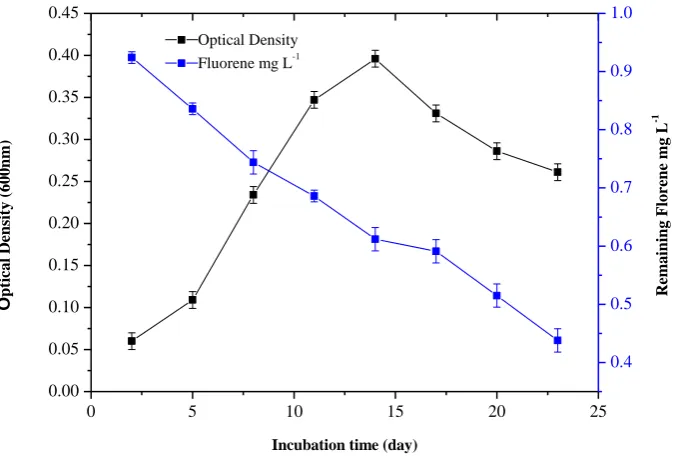
Biodegradation of fluorene by strain USTB-C was studied (Fig.2). The strain USTB-C has four stages: delay, log, stationary and decline during its growth supplement fluorene as sole carbon and energy source. The value of OD600 obtained the maxiumat 14 days and it is 0.396. This value is lower than strain cultured in LB at the same time, it may due to the inorganic salt medium belong to a deficient medium and the strains grow not so well as LB.
The results of GC-MS analysis showed nearly 55.8% decrease of fluorene out of total amount within 23 days. The observed downward trend in substrate in the medium when the biomass increased is typical as biomass one of the critical factor which determine the rate of the degradation. This result implied that the strain USTB-C has a potential to degrade fluorene efficiently.
Metabolites of fluorene
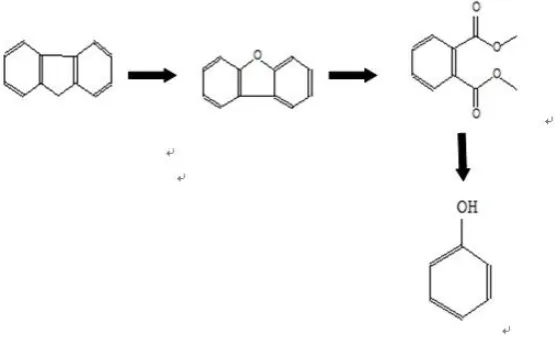
In order to determine the degradation products and pathway of fluorene, the GC-MS analysis was carried out. Three metabolites of fluorene were detected under GC-MS (Fig. 3). These three metabolites were 9-fluorenone, phthalic acid, and 1-hydroxybenzene respectively. As a result, a pathway for fluorene transformation by USTB-C was proposed (Fig.4).
Rhodococcus sp. An6
Rhodococcus sp. YL-7
Rhodococcus sp. 15-3
Rhodococcus sp. MN9-3
USTB-C
Rhodococcuserythropolis strain HS8
RhodococcuserythropolisPR4
Rhodococcuserythropolis strain BZ4
Rhodococcus sp. BEN
Rhodococcus sp. wp20 100
67
0 5 10 15 20 25 0.00 0.05 0.10 0.15 0.20 0.25 0.30 0.35 0.40 0.45 Optical Density Fluorene mg L-1
Incubation time (day)
[image:4.595.141.480.96.325.2]O pt ica l D ensi ty ( 6 0 0 nm) 0.4 0.5 0.6 0.7 0.8 0.9 1.0 R em a ini ng Fl o re ne mg L -1
Fig.2. The growth and FLU biodegradation of USTB-C with the incubationtime at concentration 100 mg L-1
[image:4.595.105.503.370.657.2]Error bars represent the standard deviation ofthree independent measurements
Fig.3. GC chromatogram of fluorene metabolites produced by USTB-C
As detailed in Table 1, the metabolites showed three main peaks with retention time of 10.713, 9.714and 4.453 min (m/z 168, 163 and 94).
Table 1 GC retention time and electron impact mass spectral properties of metabolites formed from fluorene utilization by USTB-C
Metabolite Retention time (min) m/z of fragmentions(% relative intensity) Identification
50 100 150 200 250 300 350 400 450 500
0.00 0.25 0.50 0.75
1.00(x10,000) 168
139 84
63 113
O
50 100 150 200 250 300 350 400 450 500
0.00 0.25 0.50 0.75
1.00(x10,000) 163
77 50 164 135 194 104 O O O O
50 100 150 200 250 300 350 400 450 500
0.00 0.25 0.50 0.75
1.00(x10,000)94
66
96
[image:4.595.107.504.719.763.2]The degradation pathways of fluorene were proposed as follows. It is possible that the strain USTB-C utilized the ligninolytic system to transform fluorene to 9-fluorenone. 9-fluorene undergoes hydrolysis reaction, which then subject to form phthalic acid. Furthermore, phthalic acid was further degraded to1 -hydroxybenzene.
Fig. 4. Proposed pathway of fluorene metabolism by USTB-C
CONCLUSION
In this study, we describe isolation and characterization of a FLU degrading bacterium from crude oil. An enrichment technique was employed in the isolation and the strain USTB-C was characterized belonging to the genus Rhodococcus. The strain USTB-C could remove 55.8% of fluorene with an initial concentration of 100 mg L-1 in 23 days without other substrates. Based on the intermediate metabolites analyzed by GC-MS, we deduced the possible metabolic pathway of strain USTB-C for fluorene biodegradation. USTB-C evidently posses efficient, high effective degrader and potential for further application on the enhanced bioremediation technologies for treating fluorene-contaminated soil.
Acknowledgments
This work was supported in part by grants from the International Joint Key Project from Chinese Ministry of Science and Technology(2010DFB23160), International Joint Key Project from National Natural Science Foundation of China (40920134003), National Natural Science Foundation of China (41273092) and National Outstanding Youth Research Foundation of China (40925010).
REFERENCES
[1] Bamforth S.M., Singleton I.. Journal of Chemical Technology and Biotechnology,v.80, n.7, pp.723-736, 22 April,2005.
[2] Cerniglia C.E.. Current Opinion in Biotechnology, v.4, n.3, pp.331-338, June, 1992.
[3] Y.Zhong, T.G.Luan , L.Lin, H.Liu, N.F.Y Tam.Bioresource Technology, v.102, n.3, pp. 2965-2972.February,
2011.
[4] Grifoll M., Solanas A.M., and Bayona J.M.. 1992. Archives of Environmental Contamination and Toxicology, v.23, n.1, pp. 19-25. July, 1992.
[5] Haritash A.K., Kaushik C.P.. Journal of Hazardous Materials, v.169, n. 1-3, pp. 1-15. September, 2009. [6] Patel V., Jain S., Madamwar D.. Bioresource Technology, v.107, pp. 122-130. March, 2012.
[7] StephenA.W., Bruce A.B., Gary D.B., Stephen N.C., Richard E.R., Michele M.S.. Analytical Chemistry, v.60, n.9, pp. 887-894. May, 1988.
[8] Casellas M., Fernandez P., BayonaJ. M., and SolanasA. M.. Chemosphere,v.30, n.4, pp.725-740. February, 1995. [9] Fernandez P., GrifollM., SolanasA. M., BayonaJ. M., and AlbaigesJ.. Environmental Science and Technololy, v.26, n.4, pp. 817-829. April, 1992.
[10] Danz M., Müller D., and RätheH.. Experimental and Toxicologic Pathology, v.44, n.5, pp. 259-261. 1992. [11] Rivas F.J.. Journal of Hazardous Materials, v.138, n.2, pp.234-251. November, 2006.
[12] Semple K.T., Doick K.J., Wick L.Y., Harms H.. Environtal Pollution, v.150, n.1, pp.166-176. November, 2007. [13] Cerniglia, C. E.. Advance and Application Microbiology, v.30, pp.31-71. 1984.
[14] Gibson D. T. and Subramanian V.. Microbial degradation of organic compounds: microbiology series, v. 13. Marcel Dekker, Inc., New York.1984.
[16] Guerin W. F., and Zones G. E.. Application and Environmental Microbiology,v.54, pp.937-944.1988.
[17] Schocken M. J., and Gibson D. T.. Application and Environmental Microbiology,v.48, pp.10-16.1984.
[18] Mueller J. G., Chapman P. J., BlattmannB. O., and Pritchard P. H.. Application and Environmental Microbiology,v.56, n.4, pp. 1079-1086. April, 1990.
[19] Weissenfels W. D., Beyer M., and Klein J.. Application and Environmental Microbiology,v.32, n.4, pp.479-484. January, 1990.
[20] Weissenfels W. D., Beyer M., Klein J., and RehmH. J.. Application and Environmental Microbiology,v.34, n.4, pp.528-535. January, 1991.
[21] Kelley I., and CernigliaC. E.. Joural of Industrial Microbiology. v.7, pp.19-26. 1991..
[22] H.P. Zhao, L. Wang, J.R. Ren, Z. Li, M. Li, H.W. Gao. Journal of Hazardous Materials, v.152, n.3, pp.1293-1300. April, 2008.
[23] J.L. Ling, G.Y. Zhang, H.B. Sun, Y.Y. Fan, J.H. Ju, C.K. Zhang. Science of The Total Environment,v.409, n.10, pp.1994-2000. April, 2011.