301
Acceptance of Computerized Payroll System among SMEs’
Managers using Technology Acceptance Model
Nor Hazana Abdulah, Eta Wahab, Alina Shamsuddin, Nor Aziati Abdul Hamid
Faculty of Technology Management, Business and Entrepreneurship Universiti Tun Hussein Onn Malaysia
Abstract
Technology is transforming human resource (HR) practices and activities by improving their effectiveness in managing organizational resources. The use of relevant technology in HR would increase organizational ability to meet new business challenges such as globalization and increase of diversity in workplaces. Computerized payroll system is one of the technologies commonly used in HR and considered as the heart of HR activities. However, the use of computerized payroll system among SMEs is not well researched on especially in Malaysia. Thus, the objective of this study is to identify the use of computerized payroll system among SMEs and the relationship between SMEs managers’ characteristics with Perceived Usefulness and Perceived Ease of Use based on Technology Acceptance Model (TAM). Thisstudy used cross sectional survey research strategy with questionnaire as major data collection method. Data collected was analyzed using descriptive statistics, Spearman correlation coefficient and chi square. It is found that only 58.1% of SMEs surveyed had used the computerized payroll system which is regarded as a matured technology. None of the SMEs’ managers’ characteristics are significantly correlated with Perceived Usefulness and Perceived Ease of Use. This finding show contradictory results when compared to previous studies.
302
Introduction
Small and Medium Enterprises are important contributor to the Malaysian economic growth and future sustainability. The recent Economic SME Census (2011) indicates an increase of 17.7% in the number of SMEs from the period 2003 to 2010. As the share of business establishments categorized as SMEs becomes larger than before (current statistics is 97%), SMEs’ development has become a focal national agenda.
SMEs cumulative impact on national economic growth is very much linked to how the individual SME would sustain their business growth. Measures to be taken usually involve mechanisms to increase organizational effectiveness and efficiency. One of the factors commonly claimed as critical to SME efficiency is adoption of relevant technology. However, recent SME Census indicates that 73% of SMEs across all economic sectors does not utilize ICT and for those who used ICT, only 67% used it for business purposes. Similarly, Prodromos et al.(2010) claimed that Small and Medium Enterprises (SMEs) has been claimed to be laggards in technology adoption. Their inability to incorporate new technology changes compared to larger organizations can be partially attributed to the barriers they face in the adoption of technology (Prodromos et al., 2010). Many SMEs still have basic problems with the utilization of technologies such as poor software quality, lack of sufficient training, and failure to relate technology investments to business value. Similar issues are also found in public sector departments as claimed by Batool et al. (2012). Among these problems, SMEs manager’s characteristics could be seen as one of the most important hindrance that could affect technology adoption among SMEs which in congruence with the Upper Echelon Theory.
Thus, this research is aimed to identify the use of payroll system among SMEs and to determine the influence of SMEs manager’s characteristics on Perceived Ease of Use and Perceived Usefulness which are the basis of technology acceptance.
Literature Review
Human Resource Information System (HRIS)
303
Payroll System and Computerized Payroll
According to United States Department of Agriculture (2013), payroll system or sometimes known as personnel system is a full-service integrated system offering a full range of personnel and payroll processing using a database which linkedmany modular subsystems. The database consists of current and prior salary payment information, personnel actions, name and address information, and time and attendance data.These records are maintained so that information can be accessed when needed. The system also interfaces with accounting systems and various other administrative systems, which facilitates reporting processes.
There are various benefits associated with the payroll system. It could compute pay for employees who are under many different pay plans (e.g. executives and shop floors) or various deductions such as EPF and SOCSO (Steven, 2004). The use of this system would also reduce processing times and downtime. In addition, it is easier to use, thus helping to improve staff efficiency. Furthermore, payroll system can help SMEs to reduced HR workload which payroll system can focus on core business, improved productivity (Mark et al, 2008). Payroll system can eliminate errors associated with manual payroll processing and has higher reliability.
Computerized payroll, on the other hand, is a standalone Windows-based system which has limited integrative functions. Since the use of payroll system among SMEs in Malaysia has limited empirical evidence, this study focuses on the most basic technology available for human resource management which is computerized payroll.
Technology Acceptance Model (TAM)
Technology Acceptance Model (TAM) introduced by Davis in 1989 has been one of the most popular models in explaining individual technology acceptance. As this study utilized the Upper Echelon Theory which postulates that SME owner-managers have significant influence on the use of computerized payroll system among SMEs, the use of TAM as a structural theory is deemed as appropriate. TAM assumes that PU (perceived usefulness), and perceived ease of use (PEU) are instrumental elements which influence technology acceptance.“Usefulness” is defined as the individual’s perception that using the new technology will enhance or improve her/his performance (Davis, 1989). In the context of this research, usefulness refers to the effectiveness and performance of computerized payroll system to provide detailed attendance reports to be used for salary payment. “Ease of use” is defined as the individual’s perception that using the new technology free of effort (Davis, 1989). The easier and more effortless a technology is, the more likely consumers intend to use this technology. In the context of this research, Perceived Ease of Use refers how easy the computerized Payroll system to be used.
The Relationships between SMEs Managers’ Characteristics with PU and PEU
304
adoption of technology. Gray (2006) concurs that higher educational background of SME’s managers correspond to higher levels of management development activities which contributes higher absorptive capacity. Lu (2006) found that age moderated the effect of PU and PEUs. Older workers are more reluctant to adopt technologies compared to younger ones.
Methodology
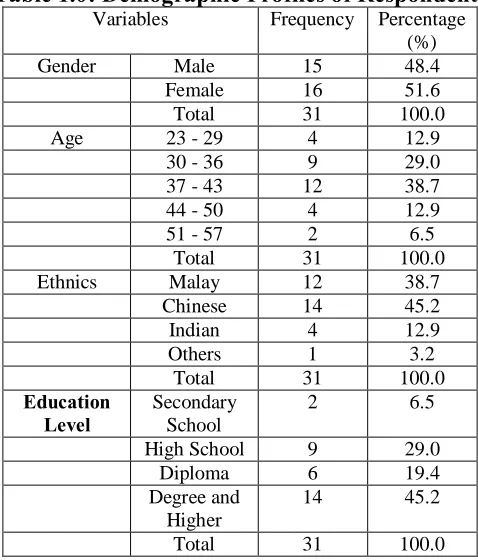
[image:4.612.186.425.356.636.2]Using a quantitative approach of descriptive research, with questionnaire as data collection method, this study intends to survey forty SMEs’ owner-managers at Pasir Gudang Industrial Park. However, only 31 owner-managers responded to yield a return rate of 77.5%. The questionnaires consists of two parts, A and B. Part A contains questions relating to the background of the respondents while Part B contains question relating to Perceived Ease of Use and Perceived Usefulness. Prior to actual data collection, a pilot study was conducted and initial reliability of 0.907 was obtained. After completion of actual data collection, an Alpha Cronbach was computed again which was 0.968. This figure exceeds the cut-off point of 0.7, indicating high internal consistency (Nunnaly, 1978). Descriptive statistics were performed using SPSS Version 19.0 to describe the demographic profiles of the respondents as shown in Table 1.0.
Table 1.0: Demographic Profiles of Respondents
Variables Frequency Percentage (%) Gender Male 15 48.4 Female 16 51.6 Total 31 100.0 Age 23 - 29 4 12.9
30 - 36 9 29.0 37 - 43 12 38.7 44 - 50 4 12.9 51 - 57 2 6.5
Total 31 100.0 Ethnics Malay 12 38.7
Chinese 14 45.2 Indian 4 12.9 Others 1 3.2
Total 31 100.0
Education
Level Secondary School
2 6.5
High School 9 29.0 Diploma 6 19.4 Degree and
Higher
14 45.2
Total 31 100.0
305
Results
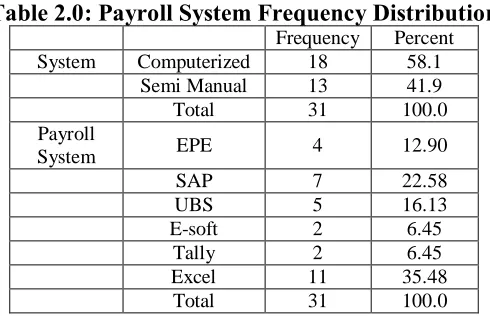
[image:5.612.184.429.319.477.2]The frequency distribution of the data in Table 2.0 shows that the use of payroll system among the respondents is only 58.1%, with the rest used both semi-manual and computerized standalone system. This indicates that the use of payroll system although encouraging has not sufficiently diffused among SMEs. Among the system commonly used by the SMEs were Microsoft Excel with 35.48% followed by SAP with 22.58% ,and E-Soft and Tally with both 6.45% respectively. It is evident from these figures that SMEs use software commonly available without additional cost. There are several reasons for the use of less sophisticated softwares. One reason is number of employees working with the SMEs. Since most SMEs have less than 150 employees, payroll calculations are simpler with less integration needed. Thus, the use of spreadsheet like Microsoft Excel is sufficient to fulfill their payroll needs. It is interesting to observe that the use of integrated and sophisticated system such as SAP is gaining acceptance among SMEs despite its high costing. These findings are consistent with those from Ball (2001).
Table 2.0: Payroll System Frequency Distribution
Frequency Percent System Computerized 18 58.1
Semi Manual 13 41.9 Total 31 100.0 Payroll
System EPE 4 12.90 SAP 7 22.58 UBS 5 16.13 E-soft 2 6.45
Tally 2 6.45 Excel 11 35.48
Total 31 100.0
Usefulness of Payroll System had a mean of 3.69 and standard deviation 0.631, which mean that the owner manager of SMEs have high agreement with the usefulness of Payroll System. The overall of Ease of Use of Payroll System had mean 3.71 and standard deviation of 0.560, which means that the owner manager of SMEs had acceptable level of agreement that the payroll system they use are easy to use.
Chi-square tests of independence were performed to examine the relation between gender, age, education with PU and PEU. The relation between gender and PU was not significant with χ2(2) = 8.477, p > .001, similar with age and PU with χ2(8) 3.086, p > .001, and education and PU with
χ2(6) 2.655, p > .001.
The relationships between gender, age and education PEU were insignificant; gender with χ2(2) = 4.306, p > .001, age with χ2(8) = 5.103, p > .001, and education with χ2(6) = 6.634, p > .001.
Discussion And Conclusion
306
differences in the determinants of technology use. However, it should be noted that the descriptive findings are consistent with the Ball’s (2001) where smaller firms are less likely to use sophisticated HR system.
307
References
Alam S.S (2009), Adoption of internet in Malaysian SMEs, Journal of Small Business and Enterprise Development Vol. 16 No. 2, 2009, ms. 240-255.
Andrew B.J, Geoffrey S.H (2006), The mediation of external variables in the technology acceptance model, A. Burton-Jones, G.S. Hubona / Information & Management 43 (2006) pp 706–717.
Ball, K.S. (2001), The Use of Human Resource Information System s: A Survey, Personnel Review, 30(6), pp. 677-693
Batool, Syeda Qudsia, Sajid, M.A, Raza, Syed Hassan (2012), Benefits and Barriers of Human Resource Information System In Accounts Office &Azad Jammu &Kashmir Community Development Program, International Journal of Humanities and Social Science, 2(30), pp. 211-217
Davis F.D (1989), Perceived Usefulness, Perceived Ease of Use, and User Acceptance of Information Technology, MIS QuatterlylSeptember 1989.
Gray, G. (2006), Absorptive Capacity, Knowledge Management and Innovation in Entrepreneurial Small Firms, International Journal of Entrepreneurial Behavior and Research, 12(6), pp. 345-360
Kinnie, N. J., and Arthurs, A. J. (1996). Personnel Specialists’ Advanced Use of Information Technology. Personnel cited in Ball, K.S. (2001), The Use of Human Resource Information System s: A Survey, Personnel Review, 30(6), pp. 677-693
Lu, J., Yu, C., Liu, C. (2006). "Gender and Age Differences in Individual Decisions about Wireless Mobile Data Services: A Report from China," Proceedings of Helsinki Mobility Roundtable . Sprouts: Working Papers on Information Systems, 6(34).
Nunnally, J. C. (1978). Psychometric theory (2nd ed.). New York: McGraw-Hill.
Mark, S, and Todd, L. (2008), Achieving Electronic Pay for all Employees, First Data Corporation
Manon.B, S.Bouchard (2008), Applying The Technology Acceptance Model to VR With People who are Favorable to its Use, Journal of CyberTherapy & Rehabilitation Summer 2008, Volume 1, Issue 2 © Virtual Reality Medical Institute, pp 200-210.
Mondy and Mondy (2012), Human Resource Management 12th Ed., Upper Saddle, NJ; Pearson
Payroll/Personnel System Overview (PPSO) (2013), National Finance Center OfficeU.S. Department of Agriculture Prodromos D. Chatzoglou, Eftichia Vraimaki, Anastasios Diamantidis, Lazaros Sarigiannidis, (2010) "Computer acceptance in Greek SMEs", Journal of Small Business and Enterprise Development, 17 (1), pp.78 - 101
SME Cencus 20122, Economic Census 2011, Department of Statistics, Malaysia (DOSM) Economics & Policy Planning Division
Sullivan, A.J. (2002), Gender, Household Composition, and Adoption of Soil Fertility Technologies: A Study of Women Rice Farmers in Southern Senegal, African Studies Quarterly, 6(1&2)
Steven, M.B (2004), Accounting for Payroll: A Comprehensive Guide, New Jersey: John Wiley and Sons