Meeting basic needs? Exploring the
survival strategies of displaced migrants
Dwyer, PJ
Title
Meeting basic needs? Exploring the survival strategies of displaced
migrants
Authors
Dwyer, PJ
Type
Monograph
URL
This version is available at: http://usir.salford.ac.uk/12815/
Published Date
2005
USIR is a digital collection of the research output of the University of Salford. Where copyright
permits, full text material held in the repository is made freely available online and can be read,
downloaded and copied for noncommercial private study or research purposes. Please check the
manuscript for any further copyright restrictions.
End of Award Report
Meeting basic needs - Exploring the survival strategies of
forced
1migrants.
Background
Given the growing body of research into asylum seeking and forced migration some may question the value of yet another study. This study differs from many that have preceded it in three important respects. First, it explores and compares the welfare rights, needs and strategies of four closely linked, but different, socio-legal categories of forced migrants, that is, refugees, asylum seekers, those granted humanitarian leave to remain, and failed asylum seekers/‘overstayers’ (see ‘tiering of entitlement’ below). Some previous work has tended to deal with issues about the support and welfare options of particular groups, usually asylum seekers or refugees, in isolation (see for example Hurstfield et al, 2004). The socio-legal comparative element of this study, therefore, adds an important additional dimension. Second, with some notable exceptions (e.g. Charlaff et al 2004; Craig et al 2004; Robinson et al, 2003; Wilson 2001), a lot of research into forced migration focuses on London and the South East of England (e.g. Bloch 2000; Carey-Wood, 1997). The introduction of a policy to disperse asylum seekers across the UK makes this regionally based (Leeds, UK) study increasingly relevant. Third, in the past various studies have tended to be centred around the insights of key informants (e.g. professionals working in relevant NGOs) rather than migrants themselves (e.g. Penrose 2002). It is intended that this research prioritises the voices, experiences and expectations of forced migrants whilst simultaneously acknowledging the valuable role and opinions of key informants.
An outline of national policy
As the number of forced migrants entering the UK has risen throughout the last decade, increasingly restrictive immigration and asylum legislation been introduced (Sales, 2002; Mynott, 2002, 2000). Since 1993 five piece of legislation have widened the gulf between the social rights enjoyed by UK citizens and forced migrants who enter Britain. Stringent efforts to keep forced migrants out have been combined with systematic attempts to reduce the welfare entitlements of those who enter to seek asylum (Bloch and Schuster, 2002; Cohen, 2002; CPAG, 2002; Morris, 2002).
Consolidating the approach of their Conservative predecessors the New Labour government introduced the Immigration and Asylum Act (1999). This legislation saw the creation of the National Asylum Support Service (NASS) to which asylum seekers have to apply for basic housing and social security benefits. Following an induction
1
In the original proposal the phrase ‘displaced migrants’ was used. However, as the work progressed a decision to replace this with ‘forced migrants’ was made as this was considered to be more appropriate. This change has been approved by the case officer and changes made to the Regard database.
period spent in emergency accommodation, individuals can choose between accommodation and subsistence or subsistence only support. Access to NASS support is, however, highly conditional. Individuals must be destitute and accommodation is offered on a ‘no choice’ basis with migrants dispersed to regions across the UK. CPAG, 2002; Finch, 2001; Zetter and Pearl, 2000).
The subsequent Nationality, Immigration and Asylum Act (2002) retained the basic framework of NASS support but also initiated important changes in the provision of basic welfare to asylum seekers. Most controversially Section 55 of the 2002 Act stated that individuals must apply for asylum status ‘as soon as is reasonably practicable’ (currently within 72 hours of entering the UK), in order to retain eligibility for NASS provisions. The Act also gave the Home Secretary the power to withdraw or deny NASS support from in country applicants who fail to co-operate with the authorities’ further enquiries. Section 55 which pushed 1000s of forced migrants into extreme poverty or destitution, has been widely condemned and subject to challenge in the courts (see GLA, 2004; IAP, 2004;Refugee Council, 2004a; Shelter, 2003).
As a result of defeat for the government in the Court of Appeal, the Home Office suspended the use of Section 55 in May 2004. The policy is now under review and the government intends to appeal to the House of Lords (Home Office 2004b). However, the substantial number of failed asylum seekers/‘overstayers’ whose claims have been turned down but who remain in the UK will not effected by any changes to Section 55 and continue to run the risk of destitution (Refugee Council, 2004b; Travis, 2004). A small number (e.g. those in poor health, those who cannot be returned to their country of origin, individuals with a claim under Judicial Review), may be eligible for temporary support from NASS under strictly administered ‘hard cases’ rules (Refugee Council, 2002b). The number of destitute forced migrants resident in Britain is unknown as many failed asylum seekers choose to ‘disappear’ and fend for themselves but the extent of the problem in the capital is highlighted by Brangwyn (2004) who notes that the London boroughs currently support 34,818 destitute asylum seekers.
Since June 4th 2004 the government has removed the right of NASS supported asylum seekers to apply for the Single Additional Payment (SAP) of £50. A SAP payment was previously available every six months to help meet the cost of replacing clothing, shoes and other worn out items (CAB, 2004). Most recently, the Asylum and Immigration (Treatment of Claimants etc.) Act (2004) further reduced the welfare rights of forced migrants. New restrictions on eligibility to NASS support for failed asylum seekers/‘overstayers’ with dependant children have been introduced. The Act effectively places an obligation on adult asylum seekers with young families to accept voluntary repatriation or face the possibility of destitution and their children being taken into care (Home Office, 2003; RCC, 2003; Refugee Council, 2003). Also regulations which previously allowed those granted refugee status to apply for the 30% of Income Support they were denied under NASS rules (back dated from the start of their asylum appeal), have been rescinded.
Forced migrants and the tiering of welfare entitlement
within the general population of forced migrants resident within the UK (Bloch, 2004a, 2000; CPAG, 2002; Morris, 2002; Sales, 2002). Four basic socio-legal categories of forced migrant, each with varying social rights that are derived from differing formal immigration statuses, can be identified.
• Refugees – welfare rights on the same basis as citizens. They enjoy rights to
work and family reunion
• Asylum seekers – those making a claim for refugee status. Welfare rights
vary considerably depending on date of entry; those lodging ‘in country claims’ more than 72 hours after entry’ effectively have no right to public support; they are not allowed to work (since July 2002); no rights to family reunion.
• Humanitarian protection/discretionary leave status – (previously known
as exceptional leave to remain i.e. ELR), granted for periods of up to 3 years; the same welfare rights as citizens, they may work, but lack rights to family reunion.
• Failed asylum seekers/‘overstayers’ – asylum seekers whose claims have
been turned down and who have no right to remain and thus no recourse to social welfare or (legal) paid work.
The combined effect of this tiering of entitlement and successive changes in the law is that different socio-legal categories of forced migrants in the UK have diverse rights to social benefits and housing. It has been noted previously that individuals do not always fit neatly into prescribed socio-legal categories (rf Ackers and Dwyer, 2004). Nonetheless, such categorisations remain justifiable in the context of this study as they continue to define the rights and responsibilities of the majority of forced migrants under consideration.
Objectives
Against the backdrop of the legislative changes that have been noted above the overall objective of the research was to explore the ways in which dispersed forced migrants attempt to meet their day to day financial and housing needs. More specific aims were,
1. To consider the extent to which the basic financial and housing needs of forced migrants are being adequately met.
2. To explore the strategies used by forced migrants in order to meet their needs in relation to social security and housing.
3. To explore the role of formal and informal welfare agencies and actors in meeting such needs.
4. To engage in some preliminary scoping of the appropriateness of a policy that would allow asylum seekers to engage in paid work in order to meet their needs.
5. To explore how formal immigration status effects the options and strategies of forced migrants.
Two points need to be noted in relation to the specific aims highlighted in the original research proposal. First, aim number 5, above was implicit in the original research proposal but its importance has become apparent in conducting the study. Second, where appropriate the term forced migrant has replaced the words ‘asylum seekers and refugees’ in the five aims listed.
aims and objectives of the research (see questioning frames 1 and 2 in the annex). The fieldwork interviews generated rich grounded data of respondents’ perceptions, experiences and expectations vis a vis the housing and basic day to day needs and rights and options of forced migrants. Reviews of relevant national policy developments, of policy and provision in relation to forced migrants in Leeds, and an analysis of the legal status of different groups of forced migrants (and the implications this has for their welfare), inform this report (see background section above) and other outputs disseminated to international academic and user audiences. (Refer to appropriate sections of the end of award report form and results, activities and output sections below). For a fuller discussion of relevant findings and how the qualitative data generated in the field addressed the five stated objectives see the results section below.
Methods
The study focused on the welfare of dispersed forced migrants in the city of Leeds (UK). The fieldwork that was an integral part of the research used qualitative techniques (Ritchie and Lewis, 2003; Mason, 2002) to explore the role of formal and informal welfare agencies and the welfare strategies of forced migrants themselves in meeting basic housing and financial needs. Questioning frames (see annex, frames 1 and 2) were designed for the two sets of semi-structured qualitative interviews with forced migrants and key respondents. These were piloted and refined in initial interviews with respondents.
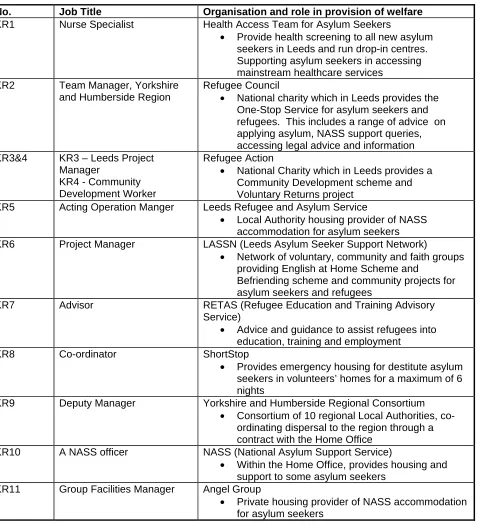
It was originally envisaged that six interviews with key informants would be carried out alongside 20 with forced migrants (5 respondents from each of the four socio-legal categories identified above). However, two important sampling decisions were taken during the fieldwork. First, given the complex nature of housing and financial provision for forced migrants, (rf. Figs. 1 and 2 annex) and the number of agencies involved, a decision to increase the number of interviews conducted with key informants to 11 was taken early in the study. Second, in order to access forced migrants who were active in providing informal welfare services in RCOs a mini focus group was convened. This decision was taken following advice from a Community Development Officer who worked with RCOs in Leeds. He believed that a group interview had two distinct advantages. First, it would enable a larger number of RCOs to take part in the research. Second, the informality of a group discussion would be beneficial in encouraging the respondents, many of whom were likely to be forced migrants themselves, to speak. Seven of the 19 RCOs operating in Leeds (rf. annex table 3) were invited to send a representative but on the day only three respondents attended; two were asylum seekers and the other had ELR status. This increased the number of forced migrants interviewed in the study to 23.
The focus group lasted for approximately 2½ hours and was divided into two parts. Part one focused discussions on the respondents’ role within RCOs and part two centred on their experiences as forced migrants in relation to housing and financial assistance. An appropriate questioning frame was developed from those used in individual interviews.
The sample
were referred to us by key respondents, others replied to leaflets that we distributed at various drop in centres across the city and others responded to personal requests from the researcher who regularly visited appropriate locations.
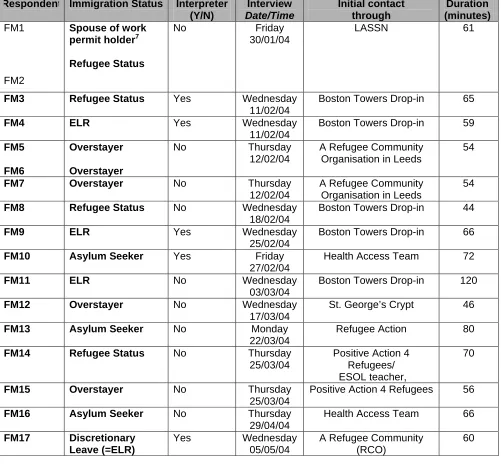
In total thirty four respondents (23 forced migrants and 11 key informants) took part in the fieldwork which consisted of 29 semi-structured, qualitative interviews2 plus the mini focus group (see tables 1 and 2 annex). Thirteen of the forced migrants were male and ten were female and the ages of the eighteen respondents who divulged their age ranged between 21 and 57 years. Respondents identified 9 countries of origin i.e. Afghanistan, Democratic Republic of Congo, Iran, Iraq, Iraqi Kurdistan, Kosovo, Pakistan, Somalia, and Zimbabwe.
Ethical considerations
Two basic ethical principles underpinned the fieldwork; informed consent and confidentiality. Access to, and building trust with, vulnerable respondents such as forced migrants can be a major problem (Robinson and Segrott (2002). We endeavoured to overcome such problems in a number of linked ways. First, the researcher employed for the project had previous experience of working with forced migrants and was aware of the ethical dilemmas involved and the need for sensitivity. Second, to overcome any apprehensions on the part of respondents the interviewer fully explained the nature of the research and answered any questions. Third, when migrants asked for specific help or advice we directed them to appropriate support services.
Protecting the anonymity of respondents was an important issue within the research. Many forced migrant were willing to take part in the field work provided that they could not subsequently be identified in outputs. This was particularly the case when failed asylum seekers/‘overstayers’ who had no legal right to work or residence in the UK were interviewed. To protect the anonymity of respondents all interviews with forced migrants were conducted on first/false name terms. All subsequent transcripts have been assigned by a code number (FM1, FM2 etc.) and anonymised. Personal characteristics such as country of origin, age and location within Leeds have been removed and such characteristics are not attributed to specific individuals in data or research outputs. In order to avoid compromising the level of anonymity requested by certain forced migrant respondents a decision was taken not to forward copies of transcripts to forced migrants who took part in the research.3
Generating, handling and analysing the data
The interviews were conducted in the city of Leeds between 30/1/2004 and 21/6/2004 and lasted between 44 minutes and two hours with an average duration being 60 minutes. A range of locations were used including migrants’ own homes, cafes and key respondents’ offices. Forced migrants who took part in the research each received a £20 supermarket voucher. All forced migrants were offered the use of an appropriate interpreter. In the event the majority (18) opted to be interviewed in English. Interpreters were arranged for the remaining five. Respondents were also asked whether the interview could be recorded on audiotape. One migrant did not want to be recorded and field notes were taken instead. All other interviews were transcribed verbatim and analysed using grid analysis and thematic coding
2
In addition to the focus group where three forced migrants were involved, two key informants were interviewed simultaneously at the Leeds office of Refugee Action. On two other occasions respondents who were forced migrants preferred to be interviewed in pairs rather than individually.
3
techniques (Ritchie et al, 2003; Mason, 2002). A Nudist 6 computer software package was used to assist this process.
Results
A review of current national policy and provision and an analysis of the effects of socio-legal status on the welfare rights of forced migrants promised in the research proposal have been produced. (Refer to background section above). A brief outline of relevant policy and provision in Leeds is detailed below. Figures 1 and 2 (see annex) also map how the welfare options and services available to dispersed forced migrants resident in Leeds differ according to specific socio-legal status.
Forced migrants and welfare: an outline of Leeds
Leeds (population 700,000), is the biggest city in the Yorkshire and Humberside region of England; an area which has the highest regional population (20% of the UK total), of dispersed NASS accommodated asylum seekers. The biggest population within the region is resident in Leeds (Home Office, 2004a). Statistics show 2,574 asylum seekers living in Leeds on 1/9/04. This figure does not include ‘failed asylum seekers’, those opting for ‘subsistence only’ support, nor those denied provision under Section 55. It does include unaccompanied minors cared for by the social services (LRAS, 2004).
The Yorkshire and Humberside Consortium for Asylum Seekers and Refugees (established in 2000), consists of ten local authorities. As a member of the consortium Leeds City Council is contracted to NASS to provide 336 properties until October 2005. In June 2003 the council also negotiated a separate contract to provide 65 spaces in the ‘Hillside’ induction centre for newly dispersed asylum seekers (LCC, 2004). Three other agencies, the Angel Group, Clearsprings, (private companies) and Safehaven Yorkshire (a not for profit organisation), are also contracted to supply accommodation for dispersed asylum seekers. These landlords provide the bulk of asylum seekers’4 accommodation in Leeds some of which they procure through sub letting arrangements with other local private landlords (Wilson, 2001).
A range of informal welfare services are also provided by various non governmental charitable and voluntary agencies across the city. Many of these are supplied by the key respondents interviewed as part of the study (see table 2 of annex). In addition there are a growing number of Refugee Community Organisations (RCOs) which offer differing levels of advice, companionship and support (see table 3 of annex). Twice yearly multi-agency meetings for organisations working with refugees and asylum seekers are arranged by the Leeds Refugee and Asylum Service. These aim to promote best practice, enhance information sharing between agencies and discuss relevant issues.
The following key findings which relate closely to the stated aims and objectives of the research have been generated by the study.
Key findings
• The basic housing and social security needs of many forced migrants are not being adequately met. The NASS social security benefits available to
4
asylum seekers are set at levels that promote poverty and social exclusion.
• Destitution remains a real but largely hidden problem among those who are denied access to public welfare under ‘Section 55’ rules, or because their asylum claim has failed.
• Homelessness is a problem for many forced migrants. For those who receive a positive asylum decision this is due to the short transition period allowed for the move from NASS accommodation into mainstream social housing. Failed asylum seekers, many of whom remain in the UK, may become homeless on leaving NASS accommodation.
• Respondents reported that some of the housing provided through NASS contracts is of a very poor standard.
• Respondents reported that on occasions when forced migrants face hostility and abuse from neighbours it can be difficult to secure moves to other locations.
• The basic accommodation and day to day needs of those forced migrants who are denied access to public welfare are increasingly being met by other forced migrants, charities and refugee community organisation (RCOs)
• Forced migrants would prefer to be able to work so that they can take responsibility for their own well-being and contribute to wider society. Our sample contained forced migrants with skills that could be used in sectors of the UK’s paid labour market currently experiencing labour shortages. • Evidence suggests that those forced migrants who have no rights to
public welfare and who are denied the right to work are forced to engage in illegal paid work in order to survive.
• The specific immigration status assigned to a forced migrant is important in defining their right to access public welfare. Many forced migrants are confused and demoralised by the complexities of an asylum system which they do not understand.
• As formal rights to welfare for some forced migrants are reduced or removed the informal support of other forced migrants and strategies of mutual self help are assuming a greater importance.
A full explanation and contextualisation of these findings is impracticable within the limits of this report. However, qualitative data and further analysis to support these key findings are reported in detail in the research outputs generated by the study. A brief illustrative discussion of the issue of destitution serves to show the wider context of key findings presented in bullet point format here. Recent research (GLA 2004; IAP, 2004) highlights destitution among those deemed ineligible for NASS support under section 55 or because they are failed asylum seekers/‘overstayers’ as a significant problem. In our study, however, we struggled to find ‘section 55’ forced migrants to interview. This was probably due to two factors. First, as KR2 (a representative of the Refugee Council) pointed out, in country asylum applicants resident in Yorkshire are routinely directed to Liverpool as the facility to apply for asylum is not available in Leeds. Second, we were advised that any section 55 migrants who lived in Leeds were unlikely to want to be interviewed for fear that it would interfere with their ongoing asylum claim. It may be then that destitution related to section 55 rulings among forced migrants in Leeds is both hidden and displaced to other locations in the UK.
are known to have been removed from the UK. The whereabouts and means of support of the others are not known. (LCC, 2004). In addition a respondent (FM1), who is involved with a Leeds based RCO, also stated that their organisation had a list of 40 forced migrants who were destitute in Leeds. Furthermore, the section 55 respondent and three of the five5 failed asylum seekers/‘overstayers’ we managed to interview spoke at length of their own destitution. Many other interviewees, both migrants and key respondents, also outlined how those without rights to public welfare relied increasingly on fellow forced migrants and/or charity for their day to day survival.
Activities
The following papers reporting interim findings of the study have been presented at three academic conferences of international importance.
1. Dwyer, P. and Brown, D. (2004) ‘Meeting basic needs? The survival strategies of forced migrants’, paper presented to the Annual Conference of
the Social Policy Association, University of Nottingham, 13-15th July 2004. 2. Dwyer, P. and Brown, D. (2004) ‘Welfare rights, governance and forced
migration’, paper presented to Annual ESPAnet Conference on European
Social Policy, St Antony’s College, University of Oxford, 9-11th September, 2004.
3. Dwyer, P. (2004) ‘Delivering welfare and dispersed forced migrants in Leeds (UK)’, paper presented to the ESRC supported EurPolCom ‘Asylum Today
in Britain and Europe an Institutional, Public and Lived Issue’ Conference, University of Leeds, 29th October 2004.
Outputs
The outputs produced have exceeded those envisaged in the original proposal. A total of four articles for publication in journals of international standing have been/will be produced. Papers have also been delivered to three conferences (see activities above). Outputs generated by the study are detailed below.
Refereed academic journal articles
Two academic papers are currently being refereed by leading international policy journals.
Dwyer, P. (forthcoming) ‘Governance, welfare and forced migration’ to Journal of
Social Policy
Dwyer, P. and Brown, D. (forthcoming) ‘Meeting basic needs? Forced migrants and welfare’ to Social Policy and Society
In addition two further papers are currently under construction.
Dwyer, P. and Brown, D. (forthcoming) ‘Work and welfare: the rights and responsibilities of forced migration’
Dwyer, P. and Brown, D. (forthcoming) ‘Accommodating others? Dispersed forced migrants and housing’
These will be will be submitted to Housing Studies, Social Policy and
Administration in February 2005.
Short articles in journals and professional magazines
5
Short articles outlining the main findings etc of the study have been sent to a number international/national and regional journals :
Benefits (submitted Dec 2004).
Asylum: Newsletter of Yorkshire and Humberside Regional Consortium for Asylum Seekers and Refugees (submitted Dec 2004).
Poverty: Journal of the Child Poverty Action Group (to be submitted Feb 2005) The Yorkshire and Humber Regional Review (to be submitted Jan 2005)
The Reporter: Newsletter of the University of Leeds (to be submitted Jan 2005).
Press dissemination
A press release has been written. This will be issued on 8th Jan 2005 and will be managed by the ESRC press dissemination team. Subsequent press and media interest is expected following its release.
Web based dissemination
Electronic copies of the research summary, the academic papers generated by the study and the free text from this ESRC end of award report are available via the award holder’s research interests web link on the University of Leeds, School of Sociology and Social Policy web page. Free copies can be accessed and downloaded at:
http://www.leeds.ac.uk/sociology/people/pddocs
Further dissemination
The award holder has been invited to present research findings at two seminars. 1. 15/12/04 Keynote presentation to the Citizenship, Migration and Belonging
Research Group, School of Geography, University of Leeds.
2. 17/2/05 Paper to the Department of Applied Social Science Seminar Series at the University of Lancaster.
Anonymised electronic copies of the two sets of interview transcripts generated in the study have been offered to the ESRC Data Archive.
Impacts
The welfare rights and mechanisms of support afforded to forced migrants resident in the UK remain a contentious element of policy and wider public debate. This study which investigated the extent to which the basic financial and housing needs of forced migrants are currently being met (and the roles of formal and informal welfare agencies and strategies in meeting such needs), has highlighted a range of issues that need to be addressed. The policy recommendations listed below are of interest to a wide range of influential research users including local, national, and international policy makers and welfare providers.
Policy recommendations
• The government should take the opportunity presented by the current review of ‘Section 55’ which promotes destitution among forced migrants to terminate its operation.
from NASS should receive benefits equivalent to 100% of income support. This would help to offset any additional accommodation costs that they incur. • NASS needs to take steps to ensure that all contractors supply and maintain
accommodation that is fit for human habitation.
• NASS needs to ensure that all housing contractors routinely record and respond effectively to incidents of harassment suffered by asylum seekers. This needs to include a system of rapid rehousing for asylum seekers who face physical violence and/or repeated abuse.
• It may be appropriate for Local Authorities to take a lead role in the management of provision for dispersed forced migrants in future. This may help to ensure a more co-ordinated approach to the provision of services for dispersed asylum seekers and also ensure that such services are open to public scrutiny.
• A longer transition period and enhanced personal support should be made available to asylum seekers who receive a positive decision and are faced with the switch from NASS accommodation to the mainstream welfare system. This would help to combat homelessness.
• Asylum seekers should be granted permission to undertake paid work whilst their asylum claim is being assessed and/or undergoing appeal within the legal system.
• Non returnable asylum seekers (i.e. failed asylum seekers/‘overstayers’) who are not returned by the government due to the human rights situation in their country of origin), should be allowed to engage in paid work or be provided with adequate support through the public welfare system as long as they remain in the UK. This is in line with recommendations made by the House of Commons Home Affairs Committee in 2004.
• The government’s ‘one off exercise to allow families who have been here for at least three years to stay’ (announced October 2003) should be extended to include single forced migrants.
In response to requests at the time of interview, copies of the research summary have been sent to all the key respondents who took part in the study. In addition several key respondents requested copies of any significant research outputs generated. Copies of journal papers will be forwarded in due course. Please refer to section 2B of the End of Award report form for a full list of non academic users who have received a summary of the research findings. Prudent use has been made of available resources (including an enhanced dissemination strategy targeted at both academic and user audiences), in order to maximise the potential impact of the study and increase the value for money provided by this relatively small research grant award.
Future Research Priorities
Table 1. Forced migrant respondents6
Respondent Immigration Status Interpreter (Y/N) Interview Date/Time Initial contact through Duration (minutes) FM1 FM2
Spouse of work permit holder7
Refugee Status
No Friday
30/01/04
LASSN 61
FM3 Refugee Status Yes Wednesday 11/02/04
Boston Towers Drop-in 65
FM4 ELR Yes Wednesday
11/02/04
Boston Towers Drop-in 59
FM5
FM6
Overstayer
Overstayer
No Thursday
12/02/04
A Refugee Community Organisation in Leeds
54
FM7 Overstayer No Thursday 12/02/04
A Refugee Community Organisation in Leeds
54
FM8 Refugee Status No Wednesday 18/02/04
Boston Towers Drop-in 44
FM9 ELR Yes Wednesday
25/02/04
Boston Towers Drop-in 66
FM10 Asylum Seeker Yes Friday 27/02/04
Health Access Team 72
FM11 ELR No Wednesday
03/03/04
Boston Towers Drop-in 120
FM12 Overstayer No Wednesday 17/03/04
St. George’s Crypt 46
FM13 Asylum Seeker No Monday 22/03/04
Refugee Action 80
FM14 Refugee Status No Thursday 25/03/04
Positive Action 4 Refugees/ ESOL teacher,
70
FM15 Overstayer No Thursday 25/03/04
Positive Action 4 Refugees 56
FM16 Asylum Seeker No Thursday 29/04/04
Health Access Team 66
FM17 Discretionary Leave (=ELR)
Yes Wednesday
05/05/04
A Refugee Community (RCO)
60
6
Additional information including country of origin, age, gender, marital status/family situation was also collected in the study. This information has been removed from table 1 in order to protect the anonymity of individual respondents (see ethics section of research report for a fuller discussion).
7
Respondent Immigration Status Interpreter (Y/N)
Interview
Date/Time
Contacted through Duration (minutes) FM18 Asylum Seeker
(s.55)
No Thursday
06/05/04
Health Access Team 83
FM19 Asylum seeker No Tuesday 11/05/04
Positive Action 4 Refugees 96
FM20 Refugee Status No Thursday 10/06/04
Positive Action 4 Refugees 65
FM21 ELR No Monday
21/06/04
ESOL teacher, A Leeds FE college
49
FM22 FM23 FM24
Asylum seeker Asylum seeker
ELR
No Thursday
1/04/04
Table 2. Key Respondents and Organisations
Table 3. Refugee Community Organisations in Leeds (July 2004)
1. CONGO LINK
2. Leeds Sudanese Community Association
No. Job Title Organisation and role in provision of welfare
KR1 Nurse Specialist Health Access Team for Asylum Seekers
• Provide health screening to all new asylum seekers in Leeds and run drop-in centres. Supporting asylum seekers in accessing mainstream healthcare services
KR2 Team Manager, Yorkshire and Humberside Region
Refugee Council
• National charity which in Leeds provides the One-Stop Service for asylum seekers and refugees. This includes a range of advice on applying asylum, NASS support queries, accessing legal advice and information KR3&4 KR3 – Leeds Project
Manager
KR4 - Community Development Worker
Refugee Action
• National Charity which in Leeds provides a Community Development scheme and Voluntary Returns project
KR5 Acting Operation Manger Leeds Refugee and Asylum Service
• Local Authority housing provider of NASS accommodation for asylum seekers KR6 Project Manager LASSN (Leeds Asylum Seeker Support Network)
• Network of voluntary, community and faith groups providing English at Home Scheme and
Befriending scheme and community projects for asylum seekers and refugees
KR7 Advisor RETAS (Refugee Education and Training Advisory Service)
• Advice and guidance to assist refugees into education, training and employment
KR8 Co-ordinator ShortStop
• Provides emergency housing for destitute asylum seekers in volunteers’ homes for a maximum of 6 nights
KR9 Deputy Manager Yorkshire and Humberside Regional Consortium • Consortium of 10 regional Local Authorities,
co-ordinating dispersal to the region through a contract with the Home Office
KR10 A NASS officer NASS (National Asylum Support Service)
• Within the Home Office, provides housing and support to some asylum seekers
KR11 Group Facilities Manager Angel Group
3. Leeds Somali Community Association
4. Leeds Ethiopian Community
5. Leeds Afghan Community
6. African Communities Trust (ACT)
7. Leeds Iranian Organisation
8. Zimbabwe Refugee Community in Leeds
9. Yorkshire Association of Kurds
10. Yorkshire African Refugees Community Organisation
11. Leeds Great Lakes Community
12. African Community Support Association
13. Somali Women’s Group
14. Leeds Central African Women’s Health & Education
15. Nuba Mountains Welfare Association
16. Church Christ Roi
17. South Sudanese Women’s Group
18. Black Integration Group Advice Services (BIGAS)
QUESTIONING FRAME - FORCED MIGRANTS
Introduction
Full explanation of what we’re doing Independent academic work
Outline and emphasise informed consent and confidentiality/anonymity Anonymous, confidential first /false name terms etc.
Recording ok? Assurances Payment
Background
Can we start by asking your name? How old are you?
What is your current status?
Prompts: Asylum seeker, refugee, ELR/ discretionary leave/ humanitarian protection, failed/‘overstayer’
Are you awaiting a decision about your application? How long have you been in the process? What stage?
How long have you been in the UK?
Prompt: When did you arrive in Leeds?
Could you tell us about your experiences both when you first arrived in this country and up until now in Leeds?
Prompt: As we’ve already said we’re particularly interested in your day to day life in Leeds
Housing
We now want to talk to you about housing
Can you tell us about your experiences concerning housing here in Leeds?
Prompts: Where are you living now? How long have you lived there? Where did you live before? Do you live alone?
Who provides the housing?
Prompts: Is it the Council, Angel, Clearsprings, Safehaven, friends, family, community
What do you think of the standard of your current accommodation/ housing?
Prompts: Adequate/ inadequate?
Furniture, heating, general repair. What sort of condition is in?
What about the area about the area in which you now live?
Friendly? Supportive? Hostile?
Have you got any particular issues or concerns about your housing that we haven’t covered?
Meeting basic needs?
We want to move on and talk about how you meet your day to day living expenses
How do you support yourself here in Leeds?
Prompts: Do you receive NASS benefits? How much? Do you make your own arrangements?
How do you manage in terms of food, clothing, transport and other necessities?
Is the money you receive enough to meet these basic needs?
Are there places that you go to get help with day to day necessities?
Prompts: Who do you turn to if you have a problem in meeting your basic needs?
Voluntary organisations, refugee communities? friends, family, other migrants?
Are there any other ways you can help yourself/manage to get by?
Coping strategies
We want to move on to talk about how you spend your time
Could you describe what you do during a typical day?
Prompts: Education, training, English Do you work? (Paid/voluntary) Do you do any social activities?
Do you have any friends that you spend time with?
Work
We want to talk a little more about the issue of work.
Can we start by asking what you work you did before arriving in the UK?
Prompts: Qualifications, training, recognition
Have you any experience of working in this country?
Prompts: Yes: What do (did) you do? Paid? voluntary? Full-time/ part-time? Helping people on a casual basis?
Paid work in the home?
Legal or illegal? Were you legally permitted to work?
No; not at all?
What about helping people on a casual basis away from the home? Work in the home?
Voluntary work?
What is stopping you from working?
Informal care work?
Did you have any hopes or expectation about finding paid employment when you came to this country?
Would you like to be able to work?
Ways forward
What would you identify as the biggest problem in terms of your day to day life in Leeds?
Are you able to take any action that would improve your present situation?
Prompts: In relation to Housing? Financial wellbeing? Something else?
If you could change one thing to improve your day to day life in the UK what would it be?
Prompt: Why is this particularly important to you?
Is there anything we’ve not mentioned in relation to your day to day life that you want to bring to our attention/discuss?
Thank you for taking the time to talk to me. It is appreciated.
Do you want to ask me any questions?
QUESTIONING FRAME FOR KEY INFORMANT INTERVIEWS
INTRODUCTION
Who we are, what were interested in. ESRC funded independent academic work.
Outline and emphasise informed consent and confidentiality/anonymity ask if required
Do you want your org. identified? OK to record for transcription?
PART 1 BACKGROUND
Brief outline of position with org and their orgs role
Prompts: Could you outline your position within XXXXX? How would you describe this organisations role? Outline the sort of work your org does?
Who funds the org? Any conditions attached to your funding, any time limits?
To get at Leeds background info/statistics
Prompts: How many asylum seekers are there in Leeds? Where are they located?
Nationalities?
PART 2 WELFARE ISSUES: CURRENT PROVISION (PARTICULARLY IN RELATION TO SS AND HOUSING).
What would you identify as the key issues in relation to the welfare of forced migrants in Leeds?
Key issues in relation to meeting day to day necessities and costs?
Prompts: Food, transport, clothing etc.
How adequate are current welfare benefits? Are needs being met? Which ones?
Everybody’s needs, some groups and individuals?
Key issues re housing provision?
Prompts: How adequate is current housing provision? Are needs being met?
Everybody’s needs some groups and individuals?
Does formal immigration status effect the welfare of forced migrants?
Prompts: To what extent does an individual’s immigration status constrain their ability to meet their needs?
In your opinion how are the housing and social security rights of different categories of displaced migrants enhanced or limited by the acquisition of a particular immigration status?
Are there any other issues in relation to the welfare of your clients that you would like to raise?
PART 3 COPING STRATEGIES OF FORCED MIGRANTS
Prompts: How important is formal welfare provision to forced migrants?
Do they rely solely on their welfare entitlements/welfare rights, access to housing and social security from NASS etc?
Are their other places they can go to get support?
What role does more informal welfare play in providing accommodation and social security for forced migrants needs?
Prompts e.g. charitable/voluntary organisations, RCOs, familial support, friends or community?
Have you come across any other things they do to support themselves?
Prompts: Informally supporting each other? (positive) Beg? Steal, Shoplift, Prostitution?(negative)
Is there anything that forced migrants themselves can do to improve their financial position or housing situation?
Prompts: How do they manage?
What strategies are open to asylum seekers and refugees in order to try meet their housing and financial needs?
Do options and possibilities vary across different groups? Why? enhancers and constraints?
Do any forced migrants you come into contact with engage in paid employment?
Prompts: What types of work?
Legal employment? illegal employment? Voluntary work?
Do you have any views on allowing asylum seekers to take paid work while their claim is being assessed?
Part 4: WAYS FORWARD
How might the welfare of forced migrants be improved in the future?
Prompts: Which policy option(s) should be prioritised?
Extending the right to paid employment to all asylum seekers? Improving social security benefits and quality of accommodation? Would it be more effective/appropriate to increase funding to informal non state providers of welfare?
Would you like to add anything else before we finish? Thanks
Bibliography for End of Award Report
Ackers, H. L. and Dwyer, P. (2002) Senior citizens? Retirement, migration and
welfare in the EU, Bristol, Policy Press.
Ager, A. and Strang, (2004) Indicators of integration: final report, Home Office Development and Practice Report 28, London, Research Development and Statistics Directorate, Home Office.
Bloch, A. (2004a) Making it work: refugee employment in the UK, asylum and
migration working paper 2, London, IPPR.
Bloch, A. (2004b) ‘Survey research with refugees: a methodological perspective’,
Policy Studies, 25(2) :139-151.
Bloch, A. (2000) ‘Refugee settlement in Britain: the impact of policy on participation’,
Journal of Ethnic and Migration Studies, 26(1) :75-88.
Bloch, A. (1999) ‘Carrying out a survey of refugees’, Journal of Refugee Studies, 12(4) :367-383.
Bloch, A. and Schuster L. (2002) ‘Asylum and welfare: contemporary debates’,
Critical Social Policy, 22(3) :393-413.
Brangwyn, M. (2004) Leaders committee report: refugees and asylum seekers, London, Association of London Government.
CAB (2004) Asylum Support (Amendment) (No 2) Regulations 2004, Briefing, May, London, Citizens Advice Bureau.
Carey-Wood, J. (1997) Meeting refugees needs in Britain: the role of refugee-specific
initiatives, London, Research Development and Statistics Directorate,
Home Office.
Castles, S. (2003) ‘Towards a sociology of forced migration and social transformation’, Sociology, 37(1) :13-34.
Charlaff, L., Ibrani, K., Lowe, M., Marsden, R. and Turney, L. (2004) Refugees and
asylum seekers in Scotland: a skills and aspirations audit, Edinburgh,
Scottish Executive.
Cohen, S, (2002) ‘Dining with the devil: the 1999 Immigration and Asylum Act and the voluntary sector’, :141- 156 in Cohen, S., Humphries, B. and Mynott,. E. [eds.] (2002) From immigration controls to welfare controls, London, Routledge.
CPAG (2002) Migration and social security handbook, London, Child Poverty Action Group.
Craig, G., Dawson, A., Hutton, S., Roberts, N. and Wilkinson, M. (2004) Local
impacts of international migration: the information base, social policy
working paper, Hull, University of Hull.
Eagle, A., Duff, L., Tah, C. and Smith, N. (2002) Asylum Seekers’ experience of the
voucher scheme in the UK- field work report, London, Home Office.
Finch, N. (2001) ‘The support and dispersal of asylum seekers’, :17-25 in Asylum
seekers a guide to recent legislation, London, ILPA.
GLA (2004) Destitution by design: withdrawal of support from in-country asylum applicants: an impact assessment for London, London, Greater London Authority.
Home Office (2004a) Asylum Statistics 1st Quarter 2004, London, Home Office. Home Office (2004b) Asylum Statistics 3rd Quarter 2004, London, Home Office.
Home Office (2003) ‘Final phase of asylum reform will build on progress in halving claims’, Press Release 326/2003, 27/11/03, London, Home Office.
Hurstfield, J., Pearson, R., Hooker, H., Ritchie, H. and Sinclair, A. (2004) Employing
refugees: some organisations’ experiences, London, Institute for
Employment Studies.
IAP (2004) The impact of section 55 on the Inter-Agency Partnership and the asylum
LCC (2004) Report of scrutiny board (neighbourhoods and housing): Asylum
Seekers, May 2004, Leeds, Leeds City Council.
Mason, J. (2002) Qualitative researching, London, Sage.
Morris, L. (2002) ‘Britain’s asylum and immigration regime: the shifting contours of rights’, Journal of Ethnic and Migration Studies, 28(3) :409-425.
Mynott, E. (2000) ‘Analysing the creation of apartheid for asylum seekers’,
Community, Work and Family, 3(3) :311-331.
Mynott, E. (2002) ‘From a shambles to a new apartheid: local authorities, dispersal and the struggle to defend asylum seekers, :106-125 in Cohen, S. et al [eds.] op cit
Penrose, J. (2002) Poverty and asylum in the UK, London, Oxfam/Refugee Council. RCC (2004) ‘Clause 8, failed asylum seekers withdrawal of support, London,
Refugee Children’s Consortium.
Refugee Council (2004a) Refugee Council Briefing on the common European asylum
system, London, Refugee Council.
Refugee Council (2004b), Hungry and homeless: the impact of the withdrawal of
state support on asylum seekers, refugee communities and the voluntary sector, London, Refugee Council.
Refugee Council (2003) The Refugee Council’s response to new legislative
proposals on asylum reform, London, Refugee Council.
Refugee Council (2002a) Government announcement and proposals since its White
Paper on asylum: a summary, Briefing July 2002, London, Refugee
Council.
Refugee Council (2002b) Help and support: hard cases support, Briefing November 2002, London.
Refugee Council (2002c) The nationality Immigration and Asylum Act 2002: changes
to the asylum system in the UK, Briefing December 2002, London,
Refugee Council.
Ritchie, J. and Lewis. J. [eds] Qualitative research practice, London, Sage.
Ritchie, J., Spencer, L. and O’Connor, W. (2003) ‘Carrying out qualitative analysis’, in Ritchie, J. and Lewis. J. [eds] op cit.
Robinson, V., Andersson, R. and Musterd, S. (2003) Spreading the burden? A review
of policies to disperse asylum seekers and refugees, Bristol, Policy Press.
Robinson, V. (2002) ‘Doing research with refugees and asylum seekers’, Swansea
Geographer, 37 :61-67.
Robinson, V. and Segrott, J. (2002) Understanding the decision making of asylum
seekers, Home Office Research Study 243, London, Home Office.
Sales, R. (2002) ‘The deserving and the undeserving? Refugees, asylum seekers and welfare in Britain, Critical Social Policy, 22(3) :456-478.
Shelter (2003) ‘Voluntary sector unites against new asylum law’, London, Shelter. Travis, A. (2004) ‘Blunkett backs down on aid for asylum seekers’, The Guardian,
June 26 2004.
Wilson, R. (2001) Dispersed: a study of services for asylum seekers in West