Numerical Study of Flow Past a Solid Sphere at Moderate Reynolds
Number
Azmahani Sadikin
1,a, Nurul Akma Mohd Yunus
1,b, Kamil Abdullah
1,cand Akmal Nizam Mohammed
1,d1
Centre for Energy and Industrial Environement Studies (CEIES), Faculty of Mechanical Engineering and Manufacturing, Universiti Tun Hussein Onn Malaysia, 86400 Parit Raja, Malaysia
a
[email protected] [email protected] [email protected]
d
Keywords: Flow separation, vortex shedding, separation angle, CFD
Abstract. The unsteady three dimensional flow simulation around sphere using numerical simulation computational fluid dynamic for moderate Reynolds Number between 20 ≤ Re ≤ 500 is presented. The aim of this work is to analyze the flow regimes around sphere and flow separation. Extensive comparisons were made between the present predicted results and available experimental and numerical investigations, and showed that they are in close agreement. The results show that the vortex shedding increases with the Reynolds number. The flow separates early when Reynolds number increases, therefore the separation angle is found to be smaller when high Reynolds number is present.
Introduction
A flow separation around rigid spherical is an undesirable flow feature in many engineering application. The separation angle is important because they control the size of the form loss and drag force created by the wakes at the rear of the tubes. This flow causes increase of drag, loss of lift, diminished pressure recovery which gives hurdles to such application. As drag estimates to a large amount, the running costs of transport of fluids, drag reduction is a crucial design issue in engineering. Therefore, a lot of attention is given by researchers to control the flow separation.
Special attention is given to unsteady phenomena in aerodynamic and hydrodynamic. The flows around the sphere, the stability of the wake, the possible flow separation or boundary layer separation that occur behind the sphere, affect significantly the mass, momentum and energy transfer and determine the values of the transport coefficient. The visualization studies by [1] have shown that the fluid flow is attached to the sphere and there is no visible recirculation behind itat (0 ≤ Re ≤ 20). This is called attached flow region.Both theoretical arguments [2] and experimental velocity measurement demonstrate that there is a velocity defect region behind the sphere, which is the characteristic of a weak and stable wake. In this flow regime, the flow is attached on the surface of the sphere and separation does not occur. The presence and characteristics of the wake are noticeable in the asymmetry of the vortices field and to a lesser extent, the asymmetry of the streamline contours.
planar symmetric wake occurs. The flow becomes unsteady flow (270≤Re≤1000) as the Reynolds number increases. The unsteadiness first appears as waviness in the double threaded wake [4]. The shedding of vortices started to become irregular near Re= 420 and was completely random at Re = 480 [4]. Many had investigated the flow regimes, flow separation and drag coefficient because these parameters affect the design to such application. Therefore, the objective of this paper is to investigate the flow phenomenon around sphere using a CFD in a moderate Reynolds number from 20 to 500.
Computational Fluid Dynamics
The flow is simulated over a rigid sphere in the flow direction in a 500 x 180 x 200 mm to ensure fully developed flow is achieved. The tube bundle was created in DesignModeler. Two dimensional model for the sphere were produced in CFX-PRE. The computer model and the boundary conditions are shown in Fig. 1. Two mesh configurations of 46 000 and 84,000 cells were conducted for the grid independency test. The pressure coefficient around the sphere was analyzed. The results show there is no significant difference between the two mesh configurations as all lines of both configurations are almost overlapped. These indicate that using finer mesh does not improve the model prediction. Thus, meshing with lower number of mesh cells does not sacrifice the solution accuracy. Since the Central Processing Unit (CPU) time increases exponentially with the number of grids, the lower mesh cells, 46 000 were chosen. Less mesh cells reduce CPU time during CFD simulation which permits a significant number of cases to be run.
The model was constructed with a grid 0.5 mm in length. The meshing gave a total of 11,000 nodes and had 46,000 elements that consisted of prisms. The sphere was set to solid surfaces with no slip. The opening boundary condition at the outlet was set to atmospheric pressure and the inlet boundary was set to a normal velocity of 0.00769 – 0.19 m/s to give a range of Reynolds number from 20 to 500 which is laminar flow. An inflation layer of 1.0 mm thickness and containing 20 layers with an expansion factor of 1.2 was inserted between the tube walls and the bulk fluid to capture the effects near the wall. The transient simulation was set and SIMPLE was chosen for the pressure correction method. The simulation was run until the residual of the pressure and velocities were less than 0.00001.
Fig. 1: (a) The model and the boundary conditons; (b) inlet (c) outlet (d) wall
(a) (b)
Results and Discussion
Flow regimes around solid sphere
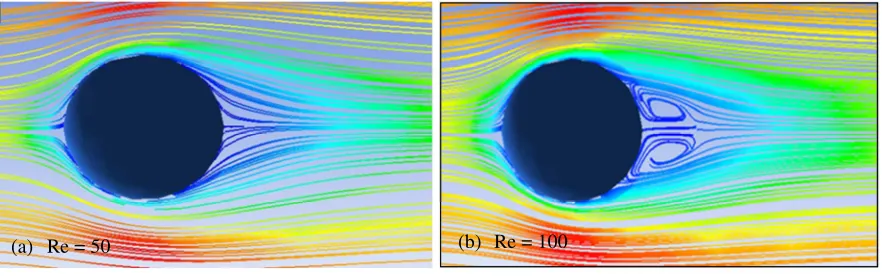
[image:3.595.79.520.279.417.2]Fig. 2(a) shows the streamlines for flow past a sphere at low Reynolds number, 50, where this flow region is called steady-state wake [5]. As the fluid flows past the tubes, which was set to no slip at the wall, the fluid decelerates near the tube surface and creates a thin layer, called the boundary layer, due to viscous effects. The flow is attached to the tube surface until the formation of a wake, evident to the rear of the tube, where some of the fluid is flowing backward against the main flow. The maximum velocity occurs at
θ
= 90°. Nearθ
= 180°, the velocity is at a minimum or zero. This is where the circulation happens, see Fig. 2(b). A very weak recirculation region that is attached to the aft of the sphere has been observed at this Reynolds number. As the value of Reynolds number is increases, the wake becomes, wider and longer, and its point of attachment on the sphere moves forward.Fig. 2: The streamlines around a rigid sphere for (a) Re = 50 (b) Re = 100
[image:3.595.75.525.604.730.2]There is an onset of instability for the wake at the aft of a rigid sphere occurs in the range of 130 < Re < 150 suggested by [5]. This region is called unsteady wake in laminar flow. As seen from Fig. 3(a) there is appearance of a weak, long period of oscillation increases with Reynolds number, but the wake remain attached to the sphere. The flow outside the wake is laminar throughout this range and remains laminar up to appriximately Re = 270. Starting with this flow pattern, the viscous effects, or viscous drag play a small role in the value of the drag coeffecient. Pressure effects begin to dominate. Fig. 3(b) shows that vorticity generation at the surface of the sphere exceeds significantly the diffusion and advection dowstream. Pockets of vorticity begin to shed from the tip of the sphere and to influence the average and fluctuations of the velocity at the far field.
Fig. 3: The streamlines around a rigid sphere for (a) Re = 200 (b) Re = 375
Vortex shedding became faster at higher Reynolds number, see Fig. 4(a), but pulsations from the shedding of the vortices on the sphere were not observed until Re > 800. Then, the vortex shedding
(a) Re = 50 (b) Re = 100
becomes regular and that vortices are shed from alternate sides of the sphere when Reynolds number exceeds 400, as seen in Fig. 4(b). This observations is similar to the finding in [5].
Fig. 4: The streamlines around a rigid sphere for (a) Re = 400 (b) Re = 450
Separation angles, θs
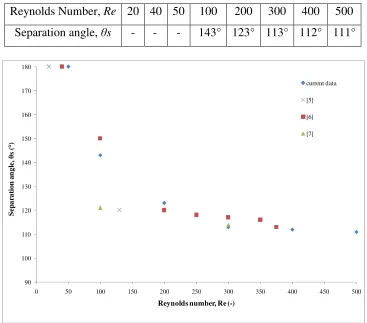
[image:4.595.115.482.446.769.2]Flow separation occurs when the shear stress is zero. Table 1 shows the separation angle,θs at various Reynolds number. It showed that as the Reynolds number is increases, the flow separation occurs earlier. It is due to the fact that the flow has difficulty to attached more longer to the sphere as the velocity increases. This is because the inertia effects more dominant than the viscous effect as the Reynolds number increases, so that the boundary layer separates from its wall more quickly. The predicted separation angles,θs from the simulation is agree well with [6,7] as shown in the Fig. 5.
Table 1: The separation angle at various Reynolds number
Reynolds Number, Re 20 40 50 100 200 300 400 500
Separation angle,θs - - - 143° 123° 113° 112° 111°
Fig. 5: The separation angle, θs with various Reynolds number
90 100 110 120 130 140 150 160 170 180
0 50 100 150 200 250 300 350 400 450 500
S
ep
a
ra
ti
o
n
a
n
g
le
,
θ
s
(
°
)
Reynolds number, Re (-)
current data
[5]
[6]
[7]
Conclusion
The flow behaviour around sphere is changing as the Reynolds number is increases. The flow is found to be in steady state wake in 20<Re< 130, unsteady wake in laminar flow in 130 <Re< 270 and vortex shedding in 270 < Re < 6000. The flow separates early as the Reynolds number increases. This finding is found to be in close agreement with the past researchers [5,6,7]. These predictions are ought to help engineers to improve the aerodynamic and hydronamic design application.
Acknowledgement
This work is supported by Research Acculturation Grant Scheme (RAGS) (No. R028).
References
[1] S. Taneda, Experimental Investigation Of The Wake Behind A Sphere At Low Reynold Number, Journal of the Physics Society of Japan, vol.11, No.10 (1956)1104-1108.
[2] E.J. Hinch, The Approach To Stady State In Oseen Flow, Journal Fluid Mechanics., 256 (1993) 601-605.
[3] R.H. Margavey, R.I. Bishop, Transition Ranges for Three-Dimention Wakes, Can.J.Phys., 39 (1961) 1418-1422.
[4] D.A. Jones, D.B. Clarke, Simulation of Flow Past a Sphere Using the Fluent Code, Maritime Platform Division DSTO, 2008.
[5] E.E. Michaelides, Particles, Bubbles and Drop, their motion, heat and mass transfer, World Scientific Publishing Co. Pte. Ltd, 2006, 107-116.
[6] Sungsu Lee, A Numerical Study of the Unsteady Wake Behind a Sphere in a Uniform Flow at Moderate Reynolds Number, Journal Computers and Fluid 29 (2000) 639-667.