*Corresponding Author: 1Dr. Goh Teik Lim ([email protected]) 2Dr. Nor Azizi Yussof ([email protected])
Press-in Piling: Challenges and Solution to Piling in Soft Soil
Goh Teik Lim
1*, Nor Azizi Yusoff
2*1Atsunew Giken Pte. Ltd. (www.atsunewgiken.com) 2Universiti Tun Hussein Onn Malaysia (www.uthm.edu.my)
1.
Introduction
Piling works using heavy construction machineries in some cases has to be carried out over soft soil. Carrying out piling operation in such cases may involve works over swampy ground and muddy soil underlain by soft marine clay deposit. If the weak ground is not stabilized and congealed properly, it will pose great danger and risk to the base stability of the construction machinery. Preventing heavy construction machinery from tipping over can be of great challenge to piling contractor in order to ensure safe execution of piling operation. Accident involving heavy construction machinery including toppling of crane can cause casualty and huge damage to adjacent properties. This is especially true when piling work along river bank, shore line and lakes has to be carried out on soft ground and marine condition. On 16 March 1991, in Akebono Town, Tachikawa City, Tokyo, at the construction site, a large pile driver machine (weight about 100ton and height about 30m) fell down and a total of seven buildings including private houses and apartments were damaged due to the toppling of heavy construction machinery (Fig. 1). Two university students were killed in the accident. The tragedy, so called “The Construction Accident” was reported in all major newspaper in Japan, Nihon Keizai Simbun, Asahi Simbun, Mainichi Simbun, Yomiuri Simbun and an article was also published in Nikkei Construction Edition 2000 [1]. What can we learn from such devastating tragedy?
[image:1.595.305.521.367.715.2]Considering the high frequency of occurrence for similar kind of accident happening worldwide due to soft foundation, it has brought great alertness and initiative for machine inventers to develop safer piling machineries based on innovative construction concept and principle.
Fig. 1: “The Construction Accident” in Japan (1991)
2.
Challenges using Conventional Piling
Abstract: Press-in Piling technology has been introduced to solve the challenges faced by piling contractors during pile driving operation in soft soil. Press-in Piling machine, so called the “Silent Piler” operates based on reaction principle where the machine grips on previous installed piles during piling operation. This allows the press-in machine to work and travel firmly along the pile top, eliminating the risk of machine overturning due to soft machine base. In 1982, Giken Reaction Base (GRB) System has been introduced, allowing more supporting machineries such as the “Power Pack” of Silent Piler, the „Clamp Crane‟ and the „Pile Runner‟ to sit firmly and work on top of installed piles. With such arrangement of equipment, the entire piling procedures such as pile transportation, pile pitching and press-in piling work can be synchronized systematically. This changes the construction approach, making non-staging piling work possible in sensitive areas, difficult slope embankment, soft soil and marine condition, resulting in faster, easier and safer construction.
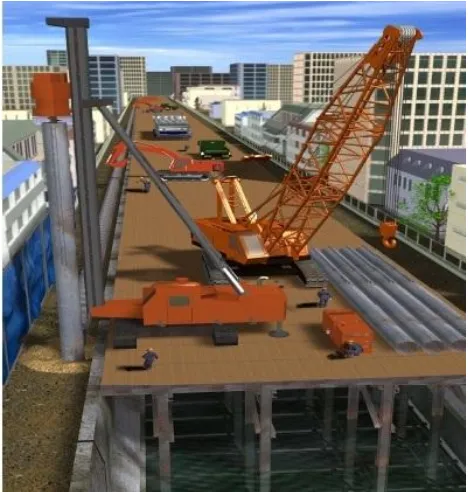
The rapid development in robotics technology and machine automation has led to revolutionary change in conventional design, function and capability of construction piling machinery as shown in Figure 2 and 3. Advanced machinery has been designed to improve the work safety with less human dependent and more environmental friendly. However, one area that has not fully benefited from the technological wave of automation is the construction method adopted for piling works in soft soil and marine condition. Ironically, there are still many challenges faced by piling contractor during the execution of construction works in such condition especially when the base stability of piling machinery is questionable, which may pose great danger during the execution of piling operation. The necessity to erect temporary deck in most cases will prolong the project schedule and increase the construction cost.
[image:2.595.57.291.486.732.2]Fig. 2: Challenges by using Conventional Piling Method
Fig. 3: Requirement of Temporary Deck for Piling Operation in Soft Soil & Marine Conditions
3.
Concepts of Press-in Piling Method
[image:2.595.307.536.555.741.2]A) Jack-in Piling based on Counter Weight System
The idea of jacking-in piles into the ground by static force is not a new concept, but it has taken some time to develop a machine that is capable of consummating this idea. One of the earliest jack-in piling machines was developed in China. The machine relies on own self-weight to derive its reaction force (Fig. 4), allowing square or circular pre-cast reinforced or pre-stressed concrete piles and H steel piles to be jacked-in into the ground. This type of machine is usually used for driving of pile foundation. The jack-in piling machine is normally massive and it requires a large flat working space on ground surface for set-up.Fig. 4: Jack-in Piling based on Counter Weight System
B) Press-in Piling based on Reaction Principle
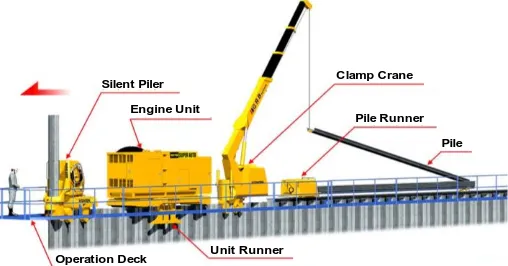
The size of press-in piling machine has to be massive if the reaction force is obtained solely from the machine weight [2]. To develop a relatively small and compact lightweight machine which has the sufficient penetration force, shaft friction of previously installed piles is used. By gripping on installed piles (Fig. 5), the machine size can be significantly reduced while it still has similar capability to press-in piles into the ground.Silent Piler Engine Unit
Operation Deck Unit Runner
Clamp Crane
Pile Runner Pile
4.
Solution using the Silent Piler
A) Self-Walking Mechanism of Silent Piler
The Silent Piler consists of three distinct parts linked together by a sliding rail and mast (Fig. 6). The upper and lower parts of the machine slide horizontally on the rail of the lower body. The lower body normally has three or four clamping claws to hold the body on the piles by gripping the previously installed piles tightly. The part attached to the upper body that grips the pile is referred to as the “chuck”. It moves vertically up and down along the mast of the upper body.
This moving function allows the static pile driving to be carried out, which eliminate the noise and vibration. Half-way through the press-in piling operation, the clamping claws of the lower body release the piles. The body of the Silent Piler is lifted up by the hydraulic jack. The whole body is then held by the chuck on the pile. The lower body finally moves forward along the rail and sits on the piles back, in which the process is called the self-walking.
Fig. 6: Silent Piler Self-Walks on Installed Piles
B) GRB Non-Staging Press-in Piling System
[image:3.595.305.559.222.355.2]In 1982, Giken Reaction Base (GRB) System has been developed in conjunction with the Press-in Piling Method to allow non-staging piling activities to proceed in sensitive areas, where access and spatial concerns are an issue [3][4]. The GRB System comprises of the press-in pilpress-ing equipment (Silent Piler) with power pack, a crane with reaction clamping mechanism (Clamp Crane), and a pile transport unit (Pile Runner). The piles are loaded onto the pile transport unit, which runs on top of the installed pile wall, towards the crane and subsequently being pitched and placed into the chuck of the Silent Piler for pile installation (Fig. 7).
Fig. 7: Giken Reaction Base (GRB) Equipment
[image:3.595.46.288.338.512.2]This systemized arrangement allows non-staging press-in piling to continue over water without the need for barges (Fig. 8), along sloped embankments without the need for temporary deck (Fig. 9) and in tight confined working space where the conventional approach could not gain access [2].
Fig. 8: Non-staging Press-in Piling in Marine Condition
Fig. 9: Press-in Piling on Sloping Ground & Tight Access GRB System
5.
Silent Piler Applications in Soft Soil
A) Soft Soil Condition: Flood Mitigation Project
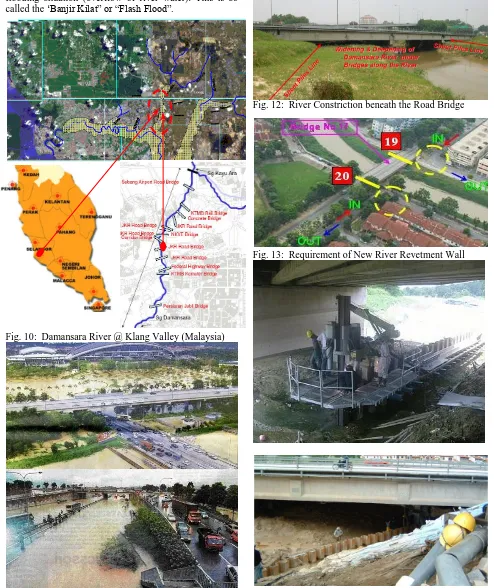
Upgrading works on existing river revetment under road & highway bridges becomes crucial in Klang Valley area, Malaysia. After several hours of heavy rain, water level from the existing river rises rapidly, causing flooding situation (overflow of river water). This is so called the „Banjir Kilat” or “Flash Flood”.Fig. 10: Damansara River @ Klang Valley (Malaysia)
Fig. 11: Flooding so called the “Banjir Kilat”
The investigation discovers that soil sedimentation and trapped rubbish at cross junctions between the river and bridge piers has caused the river to choke, severely affecting the flow capacity of the river. The river constriction problem has to be solved by constructing new revetment using sheet piles wall at both sides of river (involving excavation & earthwork), a process to widen and deepen the water pathway.
Fig. 12: River Constriction beneath the Road Bridge
Fig. 13: Requirement of New River Revetment Wall
[image:4.595.52.546.168.756.2]B) Shoring Work for Drainage Improvement
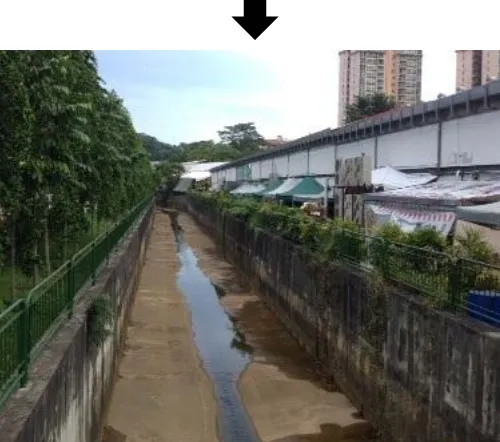
Upgrading works on existing outlet drains to wider and deeper water pathway are important and critical in the urban development of Southeast Asia. Flooding after a heavy downpour has become a major concern to residents and commercial areas adjacent to drains.In Singapore, Public Utilities Board (PUB) has been actively upgrading some of the existing outlet drains prone to flooding. Nevertheless, the major difficulty to carry out these upgrading works is the tight working space available considering that both sides of the outlet drain have been fully developed for residential and commercial purposes.
Fig. 15: Outlet Drain Condition @ Joan Rd [S‟pore]
Fig. 16: Sheet Pile Installation Work to Widen & Deepen For the Improvement of existing Outlet Drain
Fig. 17: After Installation of Sheet Piles at Both Sides
Fig. 18: Strutting Work for Construction of New Drain
[image:5.595.305.556.70.247.2] [image:5.595.56.291.222.544.2] [image:5.595.305.557.281.490.2] [image:5.595.305.555.525.746.2] [image:5.595.58.293.569.736.2]C) Cofferdam for Pipe Laying Work @ Reservoir
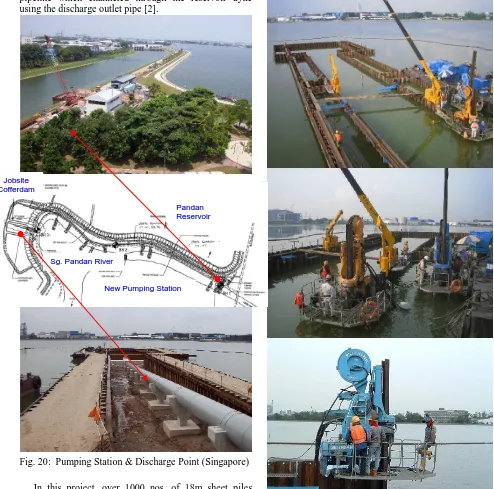
The New Pandan Pumping Station and Pipelines Upgrading Works in Singapore have been initiated by the Public Utilities Board (PUB) as part of the Singapore Government Master Plan to increase the capacity of water storage at existing reservoirs for water supply (Fig. 20). The upgrading work involves the construction of a new pumping station next to the existing Pandan Pumping Station and laying a new pipe parallel to the existing one. The water from Sungei Pandan River will be pumped at intervals into Pandan Reservoir using a 1.4m diameter pipeline which channeled through the reservoir dyke using the discharge outlet pipe [2].Fig. 20: Pumping Station & Discharge Point (Singapore)
In this project, over 1000 nos. of 18m sheet piles (Type FSP-IIIA) has been installed using the GRB Non-Staging Press-in Piling System. 2 nos. of Silent Piler (ECO100-4C and SA150), 2 nos. of Clamp Crane (CB1A and CB1-7) and a pile transporter (TB3) has been
employed (Fig. 21). Based on the soil investigation report, soft clayey material is found for the first 12m below the water level. At greater depth of 15m, the soil becomes stiffer with SPT N value ranging from 30 to 50. The deepest water level is about 6m, which is located towards the centre of the reservoir. The penetration of sheet piles is assisted by the water jetting system. Average productivity is about 8-12 pieces per day with one vertical joint. The project began on 20th June 2006 and sheet pile installation was completed within 3 months (15th September 2006)[2].
Fig. 21: Non-Staging Piling Work using GRB System
J
Joobbssiittee
C
Cooffffeerrddaamm
S
Sgg..PPaannddaannRRiivveerr
P
Paannddaann R
Reesseerrvvooiirr
N
[image:6.595.38.532.219.708.2] [image:6.595.299.530.222.751.2]6.
Acceptance of Silent Piling Technology in
Malaysia
[image:7.595.315.551.76.276.2]A qualitative review had been conducted in order to investigate the acceptance of silent piling technology among designers in Malaysia [6]. For this reason, set of questionnaires were distributed to 43 companies from civil engineering consultant registered with Association Consultancy Engineering Malaysia (ACEM). These respondents were given 4 weeks to return the questionnaires. In theory, response rate from respondents vary considerably to as much as 30%. 20% response can be considered adequate and 80% can be considered to be high. For this study, the sample size for data analysis was 52%. Therefore, the data set was adequate and can be considered as valid.
Fig. 22: Gender of the Respondents [6]
Fig. 22 shows that 68% are male respondents and 32% are female. In terms of the age of the respondents, 36% of the respondents are in the range of 31 to 40 years old. On the other hand, 32% respondents in the range of 20 to 30 years old and 40 years old and above respectively.
In terms of design experience obtained from the respondents, 50% of the respondents have less than 5 years experience in this sector. The respondents with 5 to 10 years experience represent 14% of the respondents & those with more than 10 years experience are about 36%. The distribution is as shown in Fig. 23.
Fig. 23: Respondent‟s Experience in Particular Engineering Design [6]
Fig. 24: Preference of Pile Driving Method & Site Problems Faced by Designers [6]
Fig. 24 shows the preference of pile driving method by the respondents. They had been given several scenarios such as conducting piling work in a sensitive area, which method produce lowest noise and vibration, extension of a railway track without halting the train operation, narrow access site and development above water. The findings show that they are in favors with press-in piling method as compared to other approaches. These show that the respondents agreed that this technology may have a great potential in dealing with a related problems on site.
In addition, the majority of the respondents agreed that this technology is suitable to be applied for foundation engineering construction in an urban area. The result is as shown in Fig. 25. By considering this technology, respondents are able to observe that the technology may provide a smaller machine, less dusty site, minimize the noise and vibration during pile installation and overcome the human disturbance.
[image:7.595.59.274.274.387.2] [image:7.595.318.507.541.726.2] [image:7.595.74.271.577.719.2]Even though it was observed that most of the respondent is able to recognize the benefits of applying this technology, they have been given a question on how far they can apply this technology in the real condition. As shown in Fig. 26, it was found that 82% of respondents are not familiar and have never used the press-in piling method before. In addition, 14% of the respondents are familiar but never used it, while only 5% are very familiar and often use it. Therefore, it can be concluded that the press-in piling method provides a very positive future for foundation engineering construction but this new technology has not yet widely used in Malaysia.
Fig. 26: Implementation of Press-in Method in Malaysia
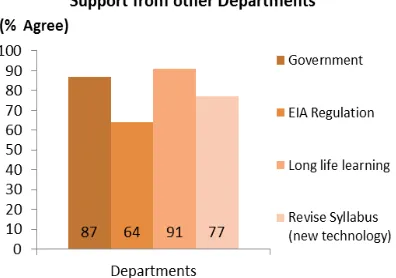
In order to accelerate the application of this sustainable technology, the respondents advised that some technical support should be provided to the designers. Their recommendation is as shown in Fig. 27.
In summary, they believed that the designer should emphasized more on their time towards lifelong learning. Majority of them also believed that the government will play a very important role in promoting this kind of technology. At the university level, it was recommended that the current engineering syllabus should be revisited in order to make room for this latest technology.
Fig. 27: Recommendations by the Respondents [6]
7.
Conclusions
Conventional piling methods are easily applicable to areas that have no environmental restraints, but in a
restricted environment, many simple projects become feasibly impossible. The introduction of press-in piling method has redefined impossible, simplifying these projects and making them possible. Obvious advantages can be seen as there is no perceived vibration and the noise levels are often quieter than ambient traffic levels.
Through its ability to self-walk over installed pile heads with crane support, it enables sheet piling works to proceed in narrow access areas, on slopes and soft soil condition. Without innovation, in this case the ability to eliminate the time consuming temporary works (i.e. staging), it would have been impossible for the above projects to complete within the targeted schedule. This is a clear example on how a proper evaluation of construction methods by both the designer and authority can bring about great success to a project.
From a simple hydraulic pile jacking system that relies on the reaction principle, the press-in piling technology has provided the construction solution to problems encountered during the installation of sheet piles wall in soft soil. Continuous research and development in Japan and experiences gained worldwide would allow more capable press-in machines to be released to construction industry in the near future.
Acknowledgement
1. Giken Seisakusho Asia Pte., Ltd.
2. Main Contractors & Consultants in Malaysia & Singapore.
References
[1] Article on “The Construction Accident”, published in Nikkei Construction Edition 2000 and local major newspapers, (2000), (Nihon Keizai Simbun, Asahi Simbun, Mainichi Simbun, Yomiuri Simbun). [2] Goh, T. L., Katami, M. & Motoyama, M. “Press-in
Piling Technology for Sustainable Construction in Southeast Asia”. Proc. of 16th South-East Asian Geotech. Conference, Kuala Lumpur, (2007). [3] Goh, T. L., Nishimura, H., Nozaki, Ikeda, T. &
Motoyama, M.. The Use of Environmental Friendly Press-in Piling Technology in the Construction of Transportation Infrastructures. Proc. of 3rd Asia Pacific Conference on Transportation and the Environment, S‟pore, (2004).
[4] Goh, T. L., Shiomi, T., Yamamoto, M., Ikeda, T. & Motoyama, M. Press-in Piling: A Solution for Road Construction. 6th Malaysian Road Conference, Kuala Lumpur, (2004).
[5] Goh, T.L., Shinoda, Y., Hino, I. & Carlito, M. C. (2004), Press-in Piling: A Solution for General Batangas Cargo Berth Construction. Int. Conf. on Coastal Infrastructure Development, Hong Kong, (2004).
[image:8.595.65.272.238.383.2] [image:8.595.74.272.552.691.2]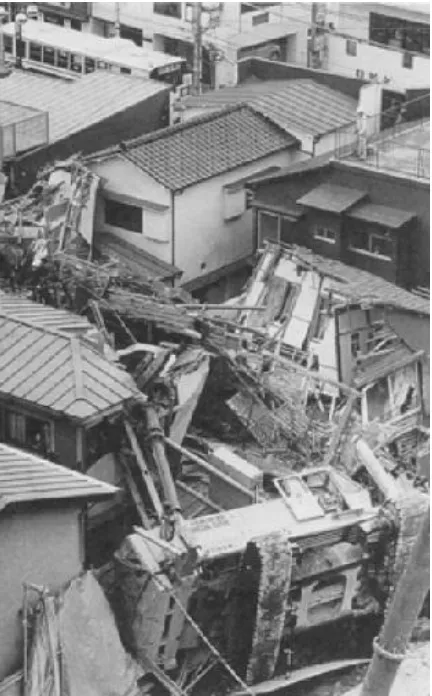
![Fig. 24: Preference of Pile Driving Method & Site Problems Faced by Designers [6]](https://thumb-us.123doks.com/thumbv2/123dok_us/8772611.899695/7.595.315.551.76.276/preference-pile-driving-method-site-problems-faced-designers.webp)