Journal of Chemical and Pharmaceutical Research, 2014, 6(5):1592-1596
Research Article
CODEN(USA) : JCPRC5
ISSN : 0975-7384
1592
How to define general purpose technologies in the cluster: Based on the view of industrial chain
Zheng Jianzhuang and Jin Yuhan*
Zhejiang University City College, Hangzhou, China
ABSTRACT
The paper defines industrial cluster general purpose technologies (or generic technologies) according to the literature review regarding generic technology. Based on its definition and cluster perspectives, three methodologies of choosing industrial cluster generic technologies from industrial chain dimension are proposed, that is, horizontal analysis, vertical analysis, and cross analysis. Jiande hardware and electronic appliances industry, Anji chair industry, and Hangzhou equipment manufacturing industry are empirically analyzed via these methods, which leads to the conclusions: (a) choosing cluster generic technology should be underpinned by industrial chain analysis; (b) the common technology utilized by cluster may not be public goods, which implies that it can be levied on enterprises within the cluster; (c) supply and organization of generic technology may differ depending on the industrial chain structural distinctiveness.
Keywords: general purpose technologies; industrial clusters; definition and choosing
INTRODUCTION
Since 1920s, the field of generic technology has been studies from theoretical and practical dimension, which results in the rising recognition of the field in China. On the other hand, industrial cluster has been the mainstream economic development in China’s coastal area (Yu, 2006) [1]. Those two reasons set the background of increasing studies in general purpose technologies within clusters in Zhejiang. Yet, as majority of clusters start from imitative enterprising, they capture profit and market share by low price and cost, which no more becomes the competitive advantage in the background of shrinking market overseas and fierce competition within the country. Although progressive achievements can been seen in the pilot plan of “Modern Industrial Clusters Demonstration Zone in Provincial Aspect” judging from the report, issues around generic technology are still been questioned. In comparison, Finland’s way of modern technology industrial clusters through OSKE, SHOK and FINNODE plans since 1990s has led the country to an above average economic development country among OECD countries (Lu et al., 2010) [2].
Presently, researches regarding generic technology seem to just begin. We searched related database
(SCI-EXPANDED,SSCI,A&HCI,CPCI-S,CPCI-SSH,CCR-EXPANDED,IC)with the key word
______________________________________________________________________________
Table. 1 Results of SSCI search
Year 1980-1989 1990-2004 2005-2009 2010-2013
No. 0 11 12 22
Gregory Tassey (2003) pointed out after long time of studies in policies of US R&D; it is suitable for the government rather to intervene technology infrastructure than intervene commercialized technologies [3].
Literature Review
General purpose technologies have drawn increasing attention in studies of technologies per se, the ‘double
failure’ of general purpose technologies and technology policies. In terms of the first realm, majorities of the technological competitions take place in national and industrial dimension, and increasingly numbers of technologies turn to fields of pre-competition and complementary innovation, which provides promising researches in general purpose technologies as technological platform. In the light of double failure, there is a market failure resulted from blurring copyright and indefinable ownership of returns. Meanwhile, the restricted individual capabilities cannot satisfy the needs of R&D in general purpose technology, and there are difficulties in diffusion. From government’s viewpoint, the failures offer potent reasons in its interference in such technologies; according to some scholars, the key task of government in general purpose technologies is
not solve those technologies per se, but to provide the conditions of the emergence and diffusion of such
technologies, in other words, it aims to resolve the formation mode of general purpose technologies.
The concept of generic technology was first identified by Anders Granberg in, which was then clarified by US ATP in 1988. in 1997 Gregory Tassey carried out the technology developing model based the definition and classified technology into basic technology, generic technology and specialized technology, and further proposed the concept of industrial generic technology (Ma, 2005) [4]. Li (2004) argued that generic technology refers to such technology that has been or will be widely adopted in many realms, and the respective R&D findings can be shared to influence one or more industries. Except for clarity in definition, Chinese government carried out ‘Key industrial generic technology development guide in 2011’ [5]. Therefore, the characteristics of generic technology can be concluded as multi-use, multi-user, enabling and precompetitive.
Compared with other sub-classifications, generic technology within industrial clusters is featured as universality, importance, originality and foresight and quasi-public goods. On the national level, it is based on micro level and emphasizes practicability. It resolves applied technology which affects and leads cluster on economic progress. In other words it involves independent and integrated innovation.
The selection and definition of industrial cluster generic technology contributes greatly to industrial upgrading. Three aspects, technological realm, R&D and applied subjects, and comprehensive effectiveness, have been researched on macro level (Xu, R. & Xu, F., 2010) [6]. Based on Zhejiang’s development Yu (2006) implemented the ‘three-chain analysis method’, ‘three-combinations’ and‘marketization selection method’ By Delphi method and sampling research [1], Lu and Zhao (2010), Lu (2010) analyzed the degree of attention, selection of R&D organizing model on generic technology of equipment manufacturing companies as well as
top ten industrial technologies that required breakthroughs in Zhejiang province during the 12th Five-year Plan
period [7,8].
Selection of Generic Technology within Industrial Clusters Based on Industrial Chain
The special properties of the industrial cluster add difficulties in direct employment in cluster generic technology. The article aims to explore three new methods of selection generic technology within clusters with the underlying geological and specializing systematic characteristics of industrial clusters. The methods are vertical industrial chain analysis, horizontal analysis and cross analysis.
______________________________________________________________________________
[image:3.595.81.535.67.181.2]1594
Figure. 1 Generic technology: hardware industrial cluster in Jiande
Vertical analysis: Vertical analysis happens when the main industrial chain is vertical. Taking the hardware electrical appliance industrial cluster in Jiande as an example, the industry becomes the pillar contributor in Jiande City’s economy after three decades of development. The cluster is formed by hardware screwdrivers industry in Qiantan County and low voltage apparatus industry in Meicheng County. The former accounts for 60% in international market while the latter’s enormous production make Jiande the national headquarter of universal sockets manufacturing. Screwdrivers industry emerged from the self-employment business of intensive labor force in agriculture sector. With 46 large scale firms of the total 100 firms and 8000 staff, the industry is a typical collective initiatives and traditional cluster. Most of the enterprises manufacture all parts of the screwdriver and assembling process, while there are few specialized in complementary part. The mold manufacturing, heat treatment and electroplating technologies are bottlenecks as well as key generic technologies (Figure. 1).
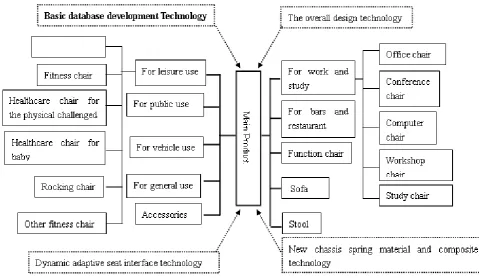
Horizontal analysis: Horizontal analysis happens when the clusters involves more products and requires horizontal cooperation. Taking Anji chair industrial cluster as an example, from the first swiveling chair was produced in the area in 1982, the cluster has experienced high pace of expansion in product mix (Figure. 2).
Figure. 2 Generic technology: Anji chair industrial cluster
[image:3.595.71.551.400.678.2]______________________________________________________________________________
technology, auto-adaptive interface technology; new chassis spring material and composite technology and relevant detection technology.
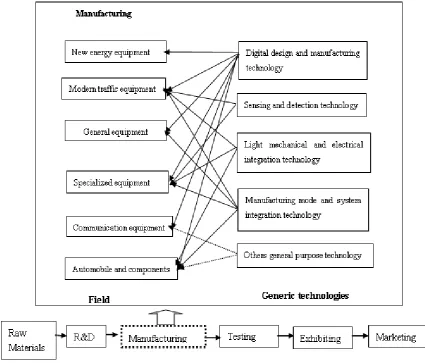
Cross analysis: Cross analysis happens when the industry cluster combines both horizontal and vertical chains. For instance, equipment manufacturing cluster in Hangzhou includes seven types of products. In 2011, its
industrial sales income reached 514.86 billion yuan, while it achieved 66.79 billion yuan in export delivery
value with profits of 33.46 billion yuan. Generally speaking, industrial value chain within the cluster takes a
[image:4.595.88.514.188.551.2]network structure with the properties of long industrial chain, complicated relatedness, more effects of prime generic technology and more profitability in R&D and marketing (Figure. 3).
Figure 3. General purpose technologies selection: towards machinery manufacturing industry
Hence, the overall industrial network needs to be considered when analyzing generic technology within equipment manufacturing industry cluster. For manufacturing sector, development and applications in digital design and manufacturing technology, sensing and detection technology, light mechanical and electronic integration and system integration technologies accelerate upgrading in the industry.
CONCLUSION
Three findings can be concluded according to the above research.
______________________________________________________________________________
1596
Secondly, industrial cluster generic technology is not necessarily quasi-public goods. As has been mentioned in the Jiande’s case, some technologies can be undertaken by companies. However, as the industrial chain becomes complicated, the attributes are predominant.
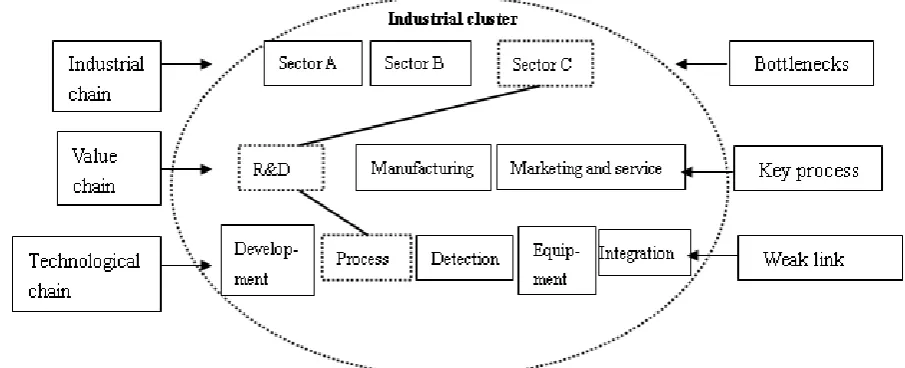
[image:5.595.100.553.178.362.2]Lastly, supply in and organizing of generic technology differ in response to the forms of industrial chain within the cluster, which includes mechanism in information share and expansion as well as the role of local government, core or leading firms and institutions.
Figure. 4 Three-chain analysis model
Acknowledgements
This research is funded by National Science Foundation of China (71173188), Hangzhou Science and Technology Development Plan Soft Science Project ‘Research on Intellectual Property Protection Mechanism in Hangzhou: Combination of Industrial Self-discipline and Government Interference’ (20130834M46) and the construct program of the key laboratory in Hangzhou.
REFERENCES
[1] Yan, X.. Science Research Management. 2006, 1, 80-84.
[2] Lu, L., Qu, C., Zhang, X. & Wang, X. East China Science & Technology. 2010, 7, 25-26.
[3] Tassey, G. [OL] from http:// www.nist.gov/ public-affairs/budget.htm. reviewed April 20, 2013.
[4] Ma, M. Manufacture Information Engineering of China, 2005, 7, 14-16.
[5] Li, J. Industrial general purpose technologies supply system. Beijing: China Financial Publishing House,2004.
[6] Xu, R. & Xu, F. China Soft Science.2010, 4, 73-79.