Journal of Chemical and Pharmaceutical Research, 2016, 8(7):515-519
Research Article
CODEN(USA) : JCPRC5
ISSN : 0975-7384
515
Study of liver function abnormalities during statin therapy in a
tertiary care center
Sowmya P.
1*, Muthiah N. S.
2, Susshmitha R.
3and Arvinth A.
41
Post Graduate, Department of Pharmacology, Sree Balaji Medical College, Chennai 2Professor and HOD, Department of Pharmacology, Sree Balaji Medical College, Chennai
3Post Graduate, Department of Pharmacology,S ree Balaji Medical College, Chennai 4Post Graduate, Department of Pharmacology, Sree Balaji Medical College, Chennai
ABSTACT
The statins are the most effective and best-tolerated agents for treating dyslipidemia. They can reduce all elevated lipids and also modestly raises High density lipoprotein -Cholesterol levels. They can reduce fatal and nonfatal coronary heart disease events, stroke, and total mortality. An open labelled cross sectioned study was conducted in the Department of General Medicine Sree Balaji medical college and hospital , Chrompet during the period of August 2015 to January 2016 .In our study ,patients on Atorvastatin had incidence of 4% abnormal elevation of liver enzymes, and patients on Rosuvastatin had incidence of 2% abnormal elevation of liver enzymes. p value was not significant (p=1).Hence this study shows that statins do not cause significant liver dysfunction and can be safely prescribed for all cases of dyslipidemia.
Keywords: Statins, Dyslipidemia, Coronary heart disease, Liver enzymes.
INTRODUCTION
Statins play a beneficial role in primary and secondary prevention of coronary heart diseases (CHD). Statins reduce the incidence of CHD by 21% to 43%. CHD is one of the major cause of morbidity and mortality world wide. CHD is the result of coronary atheroscelorosis by the accumulation of cholesterol in the arterial walls . Hence to prevent atherosclerosis cholesterol levels must be reduced appropriately (1) (2).
Statins are HMG-CoA reductase inhibitors, that inhibit the enzyme HMG-CoA reductase which has a primary role in the production of cholesterol. Life style modifications should be recommended to the patients before using statin therapy. Statins are considered as a major first line treatment of Dyslipidemia . Dyslipidemias are disorders of lipoprotein metabolism often due to high carbohydrate , calorie-rich diet, alcohol consumption, high fat, tobacco use, and sedentary life style. Primary dyslipidemia is due to defect in the genetic metabolism and secondary dyslipidemia is due to underlying cause that influences lipid levels in the blood circulation . Statins reduce the incidence of peripheral vascular diseases, myocardial infarction and stroke.
516
Objective:
To assess the risk and severity of liver dysfunction with the use of statins for the treatment of dyslipidemia.
EXPERIMENTAL SECTION
An open labelled cross sectioned study was conducted in the Department of General Medicine, Sree Balaji medical college and hospital, Chrompet during the period of August 2015 to January 2016. The study was approved by institutional ethics committee and patients voluntary informed written consent obtained after explaining the risk and benefits to the patient. 100 patients on statin therapy for dyslipidemia were selected randomly. Information regarding personal history, educational level, and history of chronic illnesses, smoking and tobacco intake were recorded. The inclusion criteria was Patients (Age 18 to 60 years, both sexes) with only dyslipidemia or dyslipidemia associated with metabolic syndrome. Dyslipidemia is defined by National Cholesterol Education Program Guidelines (5).
Total cholesterol >200mg/dl; Triglycerides >150mg/dl LDL cholesterol >130mg/dl
HDL cholesterol <40 in men and <50 in women TOTAL CHOLESTEROL: HDL RATIO- 3.5:1
The exclusion criteria was pregnant women, history of smoking, alcohol, liver dysfunction, patients not able to give informed consent, any other health or mental condition that in the investigator’s opinion may adversely affect the subject’s ability to complete the study .
Procedure:
3 ml of venous blood samples was collected after overnight 9 hours of fasting for estimating liver function tests in patients by enzymatic kinetic method in a fully automated biochemistey analyzer done during the start of statin therapy and 6 months post treatment with statins. All patients enrolled in this study were treated with either atorvastatin or rosuvastatin (6).
Statistical analysis:
Data analysis was performed by means of the SPSS statistical software package for Windows (version 9.0; SPSS Inc.,Chicago, USA). Results were expressed as the mean ± SD. Variables were analyzed by independent students “t” test.
The P – values less than 0.05(P<0.05) were treated as statistically significant in two tailed test
RESULTS
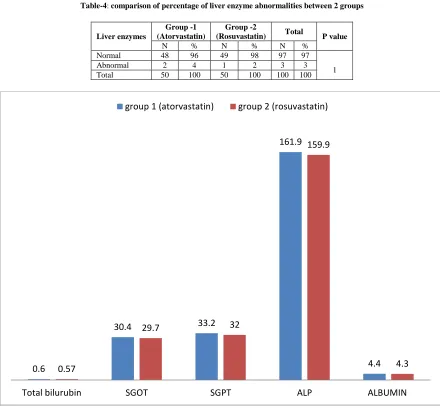
TABLE 1 : Matching of the two groups according to their baseline values of liver enzymes
Liver enzymes Atorvastatin (n=50) Rosuvastatin (n=50)
Mean ± S.D Mean ±S.D
Total Bilurubin 0.60 ± 0.36 0.57 ± 0.27
SGOT 30.4 ± 7.5 29.7 ± 7.7
SGPT 33.2 ± 6.5 32 ± 7.0
ALP 161.9 ± 47.8 159.9 ± 48.8
Albumin 4.4 ±0.48 4.3 ± 0.5
The baseline values of the liver enzymes of Atorvastatin and Rosuvastatin were matched in the above table -1.
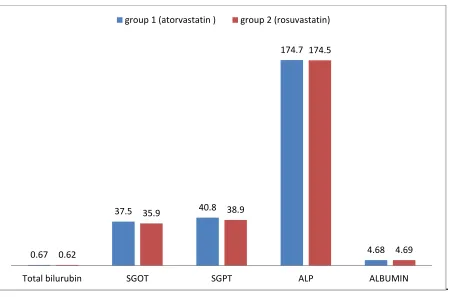
Table-2: Comparison of percentages of improvements of Liver enzyme values of Atorvastatin and Rosuvastatin after 6 months treatment with statins
Liver enzymes Atorvastatin (n=50) Rosuvastatin (n=50) P Valve
Mean ± S.D Mean ±S.D
Total Bilurubin 0.67 ± 0.34 0.62 ± 0.29 0.479 SGOT 37.5 ± 19.3 35.9 ± 17.4 0.657 SGPT 40.8 ± 23.8 38.9 ± 18.3 0.65 ALP 174.7 ± 49.1 174.5 ± 51.7 0.984 Albumin 4.6 ± 0.4 4.6 ± 0.5 0.888
517
[image:3.595.182.428.113.173.2]The liver enzymes values of Atorvastatin and Rosuvastatin after 6 months treatment were matched in the above table -2
Table-3: Matching of the two groups according to their sex
Sex Group -1
(Atorvastatin ) Group -2 (Rosuvastatin ) Total
N % N % N %
Male 24 48 25 50 49 49
Female 26 52 25 50 51 51
Total 50 100 50 100 100 100
[image:3.595.84.524.205.613.2]The number of males and females of the two groups were matched
Table-4: comparison of percentage of liver enzyme abnormalities between 2 groups
Liver enzymes
Group -1 (Atorvastatin)
Group -2
(Rosuvastatin) Total P value
N % N % N %
Normal 48 96 49 98 97 97
1
Abnormal 2 4 1 2 3 3
Total 50 100 50 100 100 100
.
Fig. 1 Bar diagram shows liver function tests of Atorvastatin vs Rosuvastatin groups before treatment with statins
0.6
30.4 33.2
161.9
4.4 0.57
29.7 32
159.9
4.3
Total bilurubin SGOT SGPT ALP ALBUMIN
518
[image:4.595.83.532.67.364.2].
Fig 2 Bar diagram shows liver function tests of Atorvastatin vs Rosuvastatin groups 6 months after treatment with statins
Table 1 and 2 , Chart 1 and 2 shows that both groups had similar liver function parameters at induction of statin therapy and after 6 months of treatment. Atorvastatin group had incidence of 4% elevation of liver enzymes(SGOT/SGPT) and Rosuvastatin group had 2% elevation. Alkaline phosphatase ,serum bilirubin and albumin showed no significant changes
DISCUSSION
Our study shows the comparative analysis of Atorvastatin and Rosuvastain effect on liver function .The incidence was 4% elevation of liver enzymes in the Atorvastatin group, and 2% elevation of liver enzymes in the Rosuvastatin group which was not statistically significant.
Statins are the first line management of dyslipidemia. The other treatment options of dyslipidemias include fibrates, nicotinic acid, and bile acid sequestrants. Atorvastatin is a potent, orally available inhibitor of HMG-CoA reductase. It will reduce serum total cholesterol and low density lipoprotein (LDL).Atorvastatin therapy is associated with mild transient elevations of serum aminotransferase levels. Hepatotoxicity was defined as abnormal liver biochemistry with either a serum bilirubin ≥40 µmol/l, serum aspartate aminotransferase [AST] or alanine aminotransferase
[ALT] ≥ 120 U/l [3 x ULN] or serum alkaline phosphatase [ALP] > 2 x ULN or ≥ 600 U/l. (7) A comparative analysis of 49 safety trials of Atorvastatin effect on adverse events showed incidence of any ALT or
AST elevations greater than 3 times the upper limit of normal was 0.6% in the Atorvastatin 10 mg group,0.6% in the placebo group and 3.3% in the Atorvastatin 80 mg group (8). In retrospective analyses, hepatic enzyme elevations are the most common forms of hepatic side effects associated with Atorvastatin, but the incidence of elevations of serum transaminases is 0.5% in the Atorvastatin-treated population (9). Atorvastatin is associated with several forms of side effects including hepatocellular injury, cholestatic injury, autoimmune-type reaction and fulminant liver failure (10). Rosuvastatin was found to have higher potency as an inhibitor of cholesterol synthesis .It was found to be the most effective statin at reducing LDL-C and triglycerides and increasing HDL-C. Clinical trials have reported a 0.5–3.0% occurrence of elevations in aminotransferases among patients receiving rosuvastatins and few episodes of severe liver injury (11). The frequency of liver-related adverse effects was low (1.1%) and did not differ from rates reported in patients not treated with statins (0.4%); p = 0.2 (12).Our study showed comparable mild liver dysfunction in both atorvastatin and rosuvastatin groups.
Drugs that elevate the statin level in the blood include Cyclosporine, macrolide antibiotics, azole antifungal agents, and other cytochrome P450 inhibitors may potentially increase the risk for toxicity and may warrant more cautious monitoring of liver enzymes. Statins play a role as an anti-inflammatory, anti-oxidant and anti-thrombotic effects
0.67
37.5 40.8
174.7
4.68 0.62
35.9 38.9
174.5
4.69
Total bilurubin SGOT SGPT ALP ALBUMIN
519
that are independent of their lipid-lowering activity (13) statins combined with several other lipid lowering drugs such as Gemfibrosil and Niacin elevates the risk of liver toxicity.
CONCLUSION
Statins cause low incidence of mild elevation of liver enzymes .No significant difference was observed in liver functions after 6 months of treatment. Both groups of atorvastatin and rosuvastatin had similar incidence of liver dysfunction. Low dose of statin therapy appears to be safer than high dose to avoid the risk of liver toxicity.
Limitations of the study
Small sample size. Patients included in study were treated with low dose statins and results studied after 6 months. Long term effect of statins on liver dysfunction were not assessed
Acknowledgement
I am very thankful to the Department of Medicine and Pharmacology for giving support.
REFERENCES
[1]Rossana M. Calderon, MD, Luigi X. Cubeddu, MD, Ronald B. Goldberg, MD, and Eugene R. Schiff, MD. 4, s.l. : mayo clinical proceedings, April 2010, Vol. 85, pp. 349–356.
[2]Grundy SM, Cleeman JI, Bairey CN, et al. s.l. : Circulation., 2004, Vol. 110, pp. 227-239.
[3]Pasternal RC, Smith SC, Bairez-Merz C, Grundy SM, Cleeman JI, Lenfant C. s.l. : Circulation, 2002, Vol. 106,
pp. 1024–1028.
[4]Horsman Y, Desager JP, Harvengt C. . 4, s.l. : Pharmacolgyand Toxicoogyl, October 1990, Vol. 67, pp. 336– 339.
[5]Fauci As, Kasper DL, Braunwald E,Hauser SL,Longo DL, Jameson JL, Loscal zo. Harrisons principles of
internal medicine. 17. United states if Ameerica : McGraw- Hill Edition.
[6]Aguilar-Salinas, C. A., G. Olaiz, V. Valles, J. M. mexico. s.l. : Journal of lipid research, 2001, Vol. 42, pp. 1298–1307.
[7]Clarke AT, Johnson PCD, Hall GC, Ford I,Mills PR. 3, s.l. : PLoS ONE, March 2016, Vol. 11.
[8]Newman C, Tsai J, Szarek M, Luo D, Gibson E. 1, s.l. : American journal of cardiology, Jan 2006, Vol. 97, pp.
61–67.
[9]Newman CB, Palmer G, Silbershatz H, et al. 6, s.l. : American journal of cardiology, Sep 2003, Vol. 92, pp. 670–676.
[10] Bhardwaj SS, Chalasani N. 3, s.l. : Clinical Liver Diseases., Aug 2007, Vol. 11, pp. 597–613.
[11] Lolwa Barakat, 1 Amin Jayyousi,2 Abdulbari Bener,3,4,5 Bilal Zuby,6 and Mahmoud Zirie2. s.l. : ISRN
Pharmacology, 2013, Vol. 2013, p. 7.
[12] Athyros VG1, Tziomalos K, Gossios TD, Griva T, Anagnostis P, Kargiotis K, Pagourelias ED, Theocharidou E, Karagiannis A, Mikhailidis DP. s.l. : Lancet, Dec 2010, Vol. 376, pp. 1916-1922.