International Journal of Emerging Technology and Advanced Engineering
Website: www.ijetae.com (ISSN 2250-2459, Volume 1, Issue 2, December 2011)78
Analysis of Data mining Algorithm in Intrusion
Detection
Mr. Hemant H. Patel
1, Prof. Ketan J. Sarvakar
21M.Tech. Scholar , IT Department, U.V.Patel College of Engg., Ganpat University, Gujarat (INDIA)
2Assistant Professor, CE Department, U.V.Patel College of Engg., Ganpat University, Gujarat (INDIA)
[email protected] [email protected]
Abstract— In this paper, we have presented a survey on the different data mining technique of intrusion detection which is basically used for the intrusion detection purpose in the field of data mining. Today intrusion detection in data mining has gain more interest to the researches, there are many intrusion detection issues in data mining like dos attacks, R2L, U2R and probing etc. There are many algorithms like Decision Tree, Naive Bayes, Naive Bayes (CFSGSW), NBTree and Improved Self Adaptive NBTree for intrusion detection.
Keywords—Data mining, Intrusion Detection, Decision Tree, Naive Bayes, NBTree.
I.
I
NTRODUCTIONWith the development of the Internet, network security
has become the essential elements of computer
technology. The concept of Intrusion Detection System (IDS) proposed by Denning (1987) is useful to detect, identify and track the intruders [1].
It should provide a secure data confidentiality, data integrity and data availability. Invasion is an action, trying to destroy data confidentiality, data integrity and availability of network information.
The proposed intrusion detection system (IDS) is used to detect over an insecure network attacks on computer systems is the case, detection of an attempt to legitimate users abusing their privileges or exploit security includes computer. In fact, intrusion detection is a knowledge
which is collected during the invasion of the
monitoring and analysis of data to conclude whether the system is not as invasive or user activities occurring in the system, system logs, etc. The possible intrusion detection, IDS sound the alarm to the network administrator, good protective treatment position.
Typically, IDS can be divided into three systems based on such misuse based system, anomaly based systems, and hybrid systems. Misuse based IDS simple pattern matching techniques to match the attack pattern, and a database of known attack patterns are consistent, and produce very low false positive (FP). It requires the signature of the rules or to see, not so well-known attacks regularly updated. Anomaly based of the IDS to determine the normal behaviour by examining the abnormal behaviour of the new attack [2], both well-known and achieve a high detection rate (DR) unwell-known attacks, but makes many false positives (FP). Anomaly based IDS, the development of IDS audit data collected by observing the rules. Developed by the operating system audit data record of the activities is logged to a file in chronological order. On the other hand, a combination of a hybrid IDS based on misuse and corruption of the detection system technology. The current adaptive intrusion detection is designed to address large amounts of data in the analysis of audit, inspection rules for performance optimization.
International Journal of Emerging Technology and Advanced Engineering
Website: www.ijetae.com (ISSN 2250-2459, Volume 1, Issue 2, December 2011)79
Most IDS detects malicious activity, whether this is at the transaction level or OS or both of the transaction and the standard OS [5-6]. The ID has some disadvantages: 1). A data overload. In fact, there are many attacks on the emergence of the privilege. To test these attacks, it is necessary to collect large Amount of information, including system logs, Transaction records, etc., to analyse. However, it is Difficult to understand and traditional IDS Analysis of data collected, due to extensive Data source intrusion detection.
2). False positives. Another disadvantage of the traditional IDS is a false positive occurs when the amount of Ordinary attack wrongly classified.
3). False negative. This is the IDS system does not alarm when there is a real Attack the system.
The rest of this paper is organized as follows:
Section II we describe the types of Intrusion in KDD99 dataset. Section III we briefly review the concept of data mining. Section IV presents the detailed insight of the various data mining algorithms used in this paper. Section V describes the Pros and Cons of dataset and algorithm. Finally, Section VI presents conclusions.
II.
T
YPESO
FI
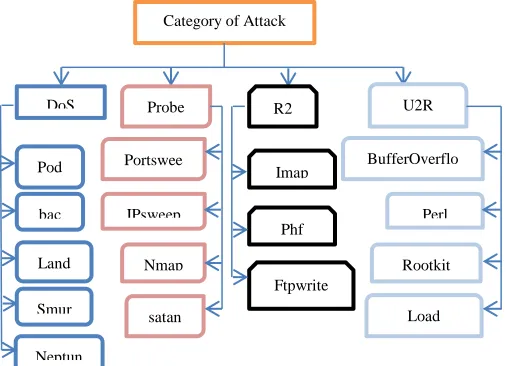
NTRUSION [image:2.612.44.297.473.656.2]The classes in KDD99 dataset can be categorized into five main classes (one normal class and four main intrusion classes: probe, DOS, U2R, and R2L).
Fig 1. Category Of Attack
1) Normal connections are generated by simulated daily user behaviour such as downloading files, visiting web pages.
2) Denial of Service (DoS) attack causes the computing power or memory of a victim machine too busy or too full to handle legitimate requests. DoS attacks are classified based on the services that an attacker renders unavailable to legitimate users like apache2, land, mail bomb, back, etc.
3) Remote to User (R2L) is an attack that a remote user gains access of a local user/account by sending packets to a machine over a network communication, which include send-mail, and Xlock.
4) User to Root (U2R) is an attack that an intruder begins with the access of a normal user account and then becomes a root-user by exploiting various vulnerabilities of the system. Most common exploits of U2R attacks are regular buffer-overflows, load-module, Fd-format, and fb-config.
5) Probing (Probe) is an attack that scans a network to gather information or find known Vulnerabilities. An intruder with a map of machines and services that are available on a network can use the information to look for exploits.
III.
C
ONCEPTO
FD
ATAM
ININGData Mining (DM), also known as Knowledge Discovery and data mining, automatic search, analysis, and the process of extracting useful information from a large-scale use association rules [7-8], which is noisy, fuzzy, random data. In general, mining technology to the company's business development, the value of the data warehouse. Data mining goal is to predict and describe, predict to predict unknown or future interest in the value of pre-choose data and found that patterns can be interpreted the data and description of human purpose.
Data mining techniques can be divided into three categories, according to a different view: classification, association and sequence rules. Classification, the data is mapped to one or more predefined categories. In the general classification rules to distinguish between the use of decision trees and the data is "not normal" or "normal." Association rule mining techniques, we found the data did not expect the relationship between dependence and find the rules with minimum confidence. Thus, the association rules main challenge is how to effectively search for those who rely on. Sequence rules analysis, found that more than one data stream based on the chronological order of events model.
Category of Attack
U2R
Rootkit Perl
Load
Module
BufferOverflo w R2
L Probe
Imap
Ftpwrite Portswee
p
Nmap IPsweep
Phf
satan DoS
bac
International Journal of Emerging Technology and Advanced Engineering
Website: www.ijetae.com (ISSN 2250-2459, Volume 1, Issue 2, December 2011)80
IV.
C
LASSIFICATIONA
LGORITHMSSystem construction of the classification is commonly used data mining tools. Such a system as input is collected, each belonging to a fixed property settings, and output a classification described in a small class numbers, can accurately predict a new case belongs to [9] class. In this paper, based on Decision Tree, Naive Bayes, Naive Bayes (CFSGSW), NBTree and Improved Self Adaptive NBTree.
A. Decision Tree
Decision trees are well known machine learning techniques. A decision tree is composed of three basic elements:
A decision node specifying a test attributes.
An edge or a branch corresponding to the one of the possible attribute values this means one of the test attribute outcomes.
A leaf which is also named an answer node, contains
the class to which the object belongs.
In decision trees, two major phases should be ensured: Building the tree. Based on a given training set, is to build a decision tree. It consists of each decision node, select the "appropriate" test properties, and define the class label of each leaf.
Classification. Order to classify a new instance; we began to determine the root of the tree, then we test the node specified property. The test results, allowing moving down the tree relative to a given instance of the attribute value. This process is repeated until it encounters a leaf. The instance is then classified in the same class characteristics to leaves.
Several algorithms have been developed to ensure that the construction and use of decision tree classification task. Quinlan developed ID3 and C4.5 algorithm [10] is probably the most popular. Most of these algorithms use the strategy of future generations, from the root to the leaves. To ensure this process, the following generic parameters are required:
The attribute selection measure taking into account the discriminative power of each attribute over classes in order to choose the „best‟ one as the root of the (sub) decision tree. In other words, this measure should consider the ability of each attribute Ak to determine
training objects‟ classes. In the literature many attribute selection measures are proposed [11-12].
We mention the gain ratio, used within the C4.5algorithm [12] and based on the Shannon entropy, where for an attribute Ak and a set of objects T, it is
defined as follows:
( ,
k)
( )
Ak( )
Gain T A
Info T
Info
T where
1
( , )
( , )
( )
log 2
|
|
|
|
i i
n
i
freq c T
freq c T
Info T
T
T
( )
|
|
( )
(
)
|
|
k
k k
k
k
k
k D
A
A
A
A
a
a
a
Info
T
Info
T
T
T
And freq (ci, T) denotes the number of objects in the set T belonging to the class ci and TAKak is the subset of
objects for which the attribute Ak has the value ak
(belonging to the domain of Ak denoted D (Ak)).Then,
Split Info (Ak) is defined as the information content of the
attribute Ak itself [12]:
( )
|
|
|
|
( ,
)
log 2
|
|
|
|
k k
k k
k
k
k
D
A A
A
a
a
a
Split Info T A
T
T
T
T
So, the gain ratio is the information gain calibrated by Split Info:
( ,
)
( ,
)
(
)
k k
k
Gain T A
Gain ratio T A
Split Info A
The partitioning strategy having as objective to divide the current training set by taking into account the selected test attribute.
The stopping criteria dealing with the condition(s) of stopping the growth of a part of the decision tree (or even all the decision tree). In other words, they determine whether or not a training subset will be further divided.
B. Naive Bayes
International Journal of Emerging Technology and Advanced Engineering
Website: www.ijetae.com (ISSN 2250-2459, Volume 1, Issue 2, December 2011)81
It assumes conditional independence of class, is based on Bayes theorem. Bayesian network is one of the most
widely used graphics Model representation and
processing of uncertain information [13-14]. Bayesian network is specified by two elements:
A graphical component composed of a directed
acyclic graph (DAG) where vertices represent events and edges are relations between events.
A numerical component consisting in a quantification
of different links in the DAG by a conditional probability distribution of each node in the context of its parents.
Naive Bayes is a very simple Bayesian network, which is the root from the same DAG node (called mother) that node is ignored, and several children, the node corresponding to the observed and the strong assumption of independence between in the context of their parent child nodes.
The classification is by considering the parent node is a hidden variable, that of which should be set for each test object class and sub-nodes represent different attributes of the specified object.
Thus, in the presence of a training set, we have to calculate the conditional probability, because the structure is unique. Once the network is quantified, it is possible to provide the classification of any new object of their properties' value using the Gulf rules. Expressed as:
( |
). ( )
( | )
( )
i i
i
P A
P
P
A
P A
c
c
c
Where ci is a possible value in the session class and A is the total evidence on attributes nodes. The evidence A can be dispatched into pieces of evidence, say a1, a2... an relative to the attributes A1, A2,...,An, respectively. Since naive Bayes work under the assumption that these attributes are independent (giving the parent node C), their combined Probability is obtained as follows:
1 2
(
|
). (
|
),..., (
|
). ( )
( | )
( )
i i i i
i
n
P
P
P
P
P
A
P A
c
c
c
c
c
a
a
a
Note that there is no need to explicitly compute the denominate or P (A) since it is determined by the normalization condition.
C. NBTree
Algorithm NBTree decision tree is a cross between Naive Bayes classifier and classification. NBTree model Best described as a decision tree with nodes and branches Leaf nodes of the Bayesian classification. As with other tree-based Classification, NBTree through, with branches and nodes. Given the A set of instances of the algorithm evaluation node "Practice" for each division of the property. If the greatest value the property is significantly better than the practices Instance, based on the current node, will be divided into Property. If you do not divide, providing an important to better the effectiveness of a naive Bayesian classifier to create the current node. The effectiveness of compute nodes discrete data and five times the cross-validation performed Using Bayesian estimation accuracy [15].
D. Naïve Bayes (CFSGSW)
Naïve Bayes algorithm has already discusses in above step and hears discuss the CFSGSW techniques.
According to R.Kohavi and G.H.John (1997) feature selection keeps the original features as such and selects subset of features that predicts the target class variable with maximum classification accuracy [16]. M.Hall (1999) proposed the Correlation Feature Selection measure (CFS) which computes heuristic measure of the “merit” of a feature subset from pair-wise feature correlations and a formula adapted from test theory [17]. Mark A. Hall, Lloyd A. Smith (1998) compared CFS with wrapper approach. The results showed that CFS is comparable or better than Wrapper [18]. Zhiwei Ni et al., (2007) proposed CFS method based on Genetic algorithm to select the optimal subset of attributes. The proposed method was capable of identifying the most related subset for classification and prediction but decreasing the classification precision [19].
International Journal of Emerging Technology and Advanced Engineering
Website: www.ijetae.com (ISSN 2250-2459, Volume 1, Issue 2, December 2011)82
F. Improved Self Adaptive Naive Bayesian TreeNaïve Bayesian Tree algorithm that has already discusses in above step and hears discuss the Improved Self Adaptive Naive Bayesian Tree. In a given training data, D = {A1, A2,…,An} of attributes, where each attribute Ai = {Ai1, Ai2,…,Aik} contains attribute values and a set of classes C = {C1, C2,…,Cn}, where each class Cj = {Cj1, Cj2,…,Cjk} has some values. Each example in the training data contains weight, W = {W1, W2…, Wn}. Initially, all the weights for examples of training data have equal unit value that set to Wi = 1/n. Where n is the total number of the training examples. Estimates the prior probability P (Cj) for each class by summing the weights and how often each class occurs in the training data. For each attribute, Ai, the number of occurrences of each attribute value Aij can be counted by summing the weights to determine P (Aij). Similarly, the conditional probability P (Aij | Cj) can be estimated by summing the weights how often each attribute value occurs in the class Cj in the training data. The conditional probabilities P (Aij | Cj) are estimated for all values of attributes. The algorithm then uses the prior and conditional probabilities to update the weights. This is done by multiplying the probabilities of the different attribute values from the examples. Suppose the training example ei has independent attribute values {Ai1,Ai2,..., Aip}. We already know the prior probabilities P (Cj) and conditional probabilities P (Aik | Cj), for each class Cj and attribute Aik. We then estimate P (ei | Cj) by
P ei C
(
|
j)
P C
(
j)
k
1
pP A
(
ij|
C
j)
To update the weight of training example ei, we can estimate the likelihood of ei for each class. The probability that ei is in a class is the product of the conditional probabilities for each attributes value. The posterior probability P (Cj | ei) is then found for each class. Then the weight of the example is updated with the highest posterior probability for that example and also the class value is updated according to the highest posterior probability. Now, for each attribute Ai, evaluate the utility, u (Ai), of a spilt on attribute Ai. Let j = argmaxi (ui), i.e., the attribute with the highest utility. If uj is not significantly better than the utility of the current node, create a NB classifier for the current node. Partition the training data D according to the test on attribute Ai. If Ai is continuous, a threshold split issued; if Ai is discrete, a
multi-way split is made for all possible values. For each child, call the algorithm recursively on the portion of D that matches the test leading to the child. The main procedure of proposed improved self adaptive naive Bayesian algorithm is described [20].
V.
P
ROSA
NDC
ONSO
FA
LGORITHMA
NDD
ATASETTABLEI
PROS AND CONS: DATA SOURCE FILE
Data Source Pros Cons
Pcap files Ubiquitous Large, requires feature extraction tools (e.g. tcptrace) for classification Connection
log files
There are many academic examples to draw from for this data
Not always available
IDS alerts Well-structured data
May capture rela-tively few features for algorithms to learn from
Firewall log files
Well-structured data May require some parsing for intrusion detection
TABLEII
PROS AND CONS:DECISION TREE CLASSIFIERS
Decision Tree Classifiers
Pros Cons
Best First Tree Creates simpler, less complicated trees for some datasets
A newer technique evaluated for subset of decision tree situations
C4.5 Tree Classifies data with missing attributes
Slower to classify Than other techniques. ID3 Extensively tested
and used across many Different applications
International Journal of Emerging Technology and Advanced Engineering
Website: www.ijetae.com (ISSN 2250-2459, Volume 1, Issue 2, December 2011)83
TABLEIII
PROS AND CONS:NAIVE BAYES NBTREE (ISA)NBTREE
PROS CONS
Naive Bayes
Naive Bayes tend to be attack specific and build a decision tree based on Special characteristics of individual attacks.
The result of Bayesian inference depends strongly on Prior probabilities.
NB Tree (ISA)
Analyses the large volume of network data and considers the complex properties of attack behaviours to scaling up detection rates and reducing false positives in intrusion detection.
Not use in real computer network.
NB Tree
NBTree spans out with branches and nodes. Given a node with a set of instances the algorithm evaluates the „utility‟ of a split for each attribute.
high time complexity
VI.
C
ONCLUSIONThis paper gives the basic ideas about the different intrusion detection algorithm in data mining. we have present the comparative review on the different algorithm
Like Decision Tree, Naive Bayes, Naive Bayes (CFSGSW),
NBTree for intrusion detection, we have find the Pros and Cons for each. Naive Bayes tend to build a decision tree based on Special characteristics of individual attacks where in opposite the result of Bayesian inference depends strongly on Prior probabilities. A NB Tree (ISA) analyzes the large volume of network data and considers the complex properties of attack behaviours where in opposite it is not use in real computer network and in simple NB Tree it spans out with branches and nodes.
References
[1] D. E. Denning, “An Intrusion-Detection Model”, IEEE Transa-ctions on Software Engineering, vol. SE-13,no. 2,pp.222-232, 1987.
[2] Lazarevic, A., Ertoz, L., Kumar, V., Ozgur,. A., Srivastava, and J., “A comparative study of anomaly detection schemes in network intrusion detection,” In Proc. of the SIAM Conference on Data Mining, 2003.
[3] T.H. Ptacek and T.N. Newsham. lnsertion, Evasion and Denial of Service: Eluding Network lntrusion Detection. Technical report, Secure Networks, January 1998
[4] J.P. Anderson. Computer Security Threat Monitoring and Surveillance. Technical report, James P. Anderson Co., Fort Washington, PA, April 1980.
[5] Peng Liu et al .The Design and Implementation of a Self-Healing Database System Database System. School of info Sciences and Technology Department of Information Systems, Pennsylvania State University UMBC, University Park, PA 16802 Baltimore,MD 21250.
[6] Pramote Luenam, Peng Liu, .ODAM An On-the-tly Damage Assessment and Repair System for Commercial Database Applications., Dept. of Info. Systems, UMBC Baltimore, MD21250.
[7] Fayyad, D, Piatetsky-Shapiro, G., and Smyth, P. From Data Mining to Knowledge Discovery in Databases. Al magazine, 17(3):37.1 54.1 996a.
[8] Han, J. and Kamber, M. Data Mining: Concepts and Techniques. Morgan Kaufmann Publisher.2000
[9] Daniel T, Larase, Discovering Knowledge in Data: An Introduction to Data Mining, John Wiley & Sons, Inc, 2005.
[10]Quinlan, J. R.: C4.5, Programs for machine learning. Morgan Kaufmann San Mateo Ca, 1993.
[11]Breiman, L., Friedman, J. H., Olshen, R. A., Stone, C.J.: Classification and regression trees. Monterey, CA Wadsworth & Brooks, 1984.
[12]Quinlan, J. R.: C4.5, Programs for machine learning. Morgan Kaufmann San Mateo Ca, 1993.
[13]Jensen, F. V.: Introduction to Bayesien networks. UCL Press, 1996.
[14]Pearl J.: Probabilistic Reasoning in intelligent systems: networks of plausible inference. Morgan Kaufmman , Los Altos, CA, 1988.
[15]R. Kohavi, “Scaling Up the Accuracy of Naïve-Bayes Classifiers: A Decision-tree Hybrid”, Proc. of the 2th International Conference on Knowledge Discovery and Data Mining, pp.202-207, 1996.
[16]R.Kohavi, G.H.John, “Wrappers for feature subset selection”, Artificial Intelligence, vol.1, no.2, pp.273-324, 1997
[17]M. Hall, Correlation Based Feature Selection for Machine Learning, Doctoral Dissertation, University of Waikato, Department of Computer Science, 1999.
[18]Mark A. Hall, Lloyd A. Smith, “Feature Selection for Machine Learning: Comparing a Correlation based Filter approach to the Wrapper”, American association for Artificial Intelligence, 1998
[19]Zhiwei Ni, Fenggang Li, Shanling Yang, Xiao Liu,Weili Zhang, QinLuo, “Attributes Reduction based on GA-CFS method”, Proc. of the joint 9th Asia-Pacific web and 8th Intl. Conf on Web-age information management on Advances in data & web management, Springer- Verlag,2007.