A NEW APPROACH TO DESIGN
AN ATTRACTIVE GAME BASED LEARNING IN VARIOUS
DOMAINS
1LAMYAE BENNIS, 2SAID BENHLIMA
1, 2
University Moulay Ismail, Faculty of Science, Meknes, Morocco
E-mail: [email protected], 2 [email protected]
ABSTRACT
Serious Games has been extensively utilized in diverse domains such as the military, education, marketing and advertising. In this article, we are particularly interested in Serious Games (SG) for education, called Learning Game (LG). Currently Learning Games consumers still suffer from the high prices and complications of emerging and designing an effective learning game without being a developer or an informatics designer. In addition there is a huge lack of authoring tool which allows the generation of LG linked to various culture, ethnicity, and language for example (our Moroccan culture, ethnicity and our native language). Therefore the main aim of this research work is to develop and design an authoring tool entitled (Serious Game Generator) “S.G.G” which addresses all the problems above using the generic model DICE to ease the conception of Game Based Learning (GBL) generated by this tool.
Keywords: Serious Games, Learning Games, Design, Method DICE, Authoring Tool, Game Based
Learning.
1. INTRODUCTION
A play is “a physical competition or mental which has particular rules, with the goal of amusing or rewarding the players game” (Zyda, 2005) [1]. The current search plans that a game can be used in the apprenticeship and the formation as an interactive tool of apprenticeship which have an effect of persuasion or educational and that’s what we named Learning Games (LGS) [2]. There are many LGS approaches “A Game Based Learning is an IT application which uses playful competencies to stimulate the learner’s attention and to ease their apprenticeship. It has a clear educational goals and can be used within the framework of the training at every level” (Iza Marfisi, 2012) [3]. Besides, recent works in this domain bring back that Game Based Learning (GBL) has numerous benefits: permitting the learner to learn of their errors by the possibility to replay, without consequence in the real world, on the other hands the main problems to the diffusion of SG are the high costs of development and the design of GBL trouble using the current solutions without being a game designer, a thorough lack of the learner adaptability to the cultural diversity, ethnic and the language for example (our
Moroccan culture, the ethnicity and our mother tongue) [4][5]. The aim of our project is to develop and design an authoring tool “S.G.G” responds to the problems above which facilitate software development and make it possible for novices to use it based on the generic model DICE [6]. To address these issues, we discuss and present the following:
1) Comparative analysis of Game Based Learning design models, 2) the generic model DICE Overview and its application on the LG generated by our authoring tool “S.G.G”, 3) Conclusion and perspectives.
2. RELATED WORK
already mentioned in this article Serious Game is willingly conceived to attend a serious goal; the designer does not have to concentrate only on the creation of a funny set, but also make sure so that the play proposes a utilitarian vocation given. We can then suppose that the process of the creation of “Serious Game” is differenced to the creation “of an entertainment video games”. Making a game can take minimum 3 years (for ten hours of learning), the learning game overall cost is around 15000€ per hour [13]. To minimize the time and the charges of the conception of a SG we have to return their design quicker and more operational, this question arises visibly for the companies who produce SG, but also for the researchers in the domain. In this purpose, we are going to make an analytic and synthetic study of five model of
conception of LG (Marfisi-Schottman,
DODDEL, EMERGO, KTM Advance, and DICE) to select the one which responds better to our objectives.
The design model of Marfisi Schottman
More exactly, these researchers (Marfisi-Schottman, George and Tarpin-Bernard, on 2010), recommend a model destined to Game Based Learning Design process this model concentrates only on the stages of the conception of GBL which pass on an educational contents, to simplify the collaboration enter the teacher, game designer and designer of screen. It permits to design GBL in 6 phases: Determines the educational objectives, Defines the model of game scenario, Looks for software components, Overview of the GBL, Thorough description of the GBL, Control of the learning value, and Specifications for the manufacture team [3]. This methodology permits to identify visibly the roles of the actors, it increases the efficiency of the production by programming the phases of pre-validation before the development to verify the conventionality with the initial goals.
The design model DODDEL
DODDEL the abbreviation of Acronym Document-Oriented Design and Development of Experiential Learning and the development of the apprenticeship experiential, invented by McMahon (2009), the model is founded on the generic model ADDIE, which improves by introducing iterative buckles for certain stages of the process. McMahon utilized this model to guide the student’s novices in the design of GBL [14]. This experiences on the ground show that
the model DODDEL seems capable to aid novice on two sides: at first, it defines a conjoint base to simplify the communication within every pupils of the group. But especially, this theoretical model offers a complete series of stages for the creation of GBL. It allows to direct the process of creation of people which has never made a GBL before. This model was used to form the novices wanting to become upcoming expert designers what seems to us particularly exciting in this methodology the fact that it gives a central role for the specification of the instructive objectives.
The design model of KTM Advance
KTM Advance is a society which conceives and develops the formation e-learning and GBL. Among their GBL, the Starbank set of training to BNP Paribas was conceived in particular in collaboration with researchers of the laboratory research LIP6. It is in this context and based on the abstract frame of Yusoff (2010), Ibanez and al. (2009) Suggest a methodology to design LG in 7 stages: creation of a domain knowledge, by defining the list of the information, To bind the structuring of the education with the playful direction, Creation of a cognitive model, Deduction of the activities and the objects of the play, Definition of the type of the game, the combination of the knowledge in the game [15].
Method of creation EMERGO
The methodology EMERGO was formed through a project implying three universities in the Netherlands work for more than 10 years on the GBL (Nadolski and al., on 2008). It concerns the conception of GBL in the higher training. Methodology commends 5 stages: case ideas, scenarios, development case, the distribution case, and evaluation case [16].
The design model DICE
Damien Djaouti created a general design model DICE focused on the design of a Game Based Learning (GBL) by examining and synthesizing the sequence of stages suggested by the other design models of the Serious Game. This general
design model contains four Phases: Define, Imagine, Create, and Evaluate [6]. In order to have a more clear vision about this method we are going detailed its architecture in the next section of this article.
3. RESULTS AND DISCUSSION
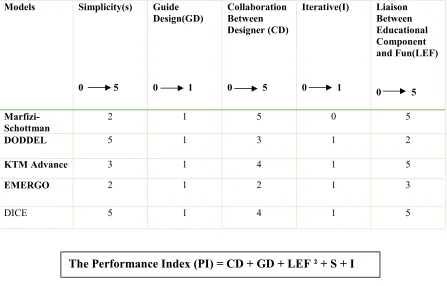
[image:3.612.86.533.305.591.2]These GBL conception methodologies allows us to define important measure for the design of an operative GBL. The method must be simple to use, to assure a good collaboration between the Designers, to promote the designers guide in the design stage and a good connection between educational components and playful.
Table 1: Comparative and Synthetic Study of GBL Models Design
Models Simplicity(s)
0 5
Guide Design(GD)
0 1
Collaboration Between Designer (CD)
0 5
Iterative(I)
0 1
Liaison Between Educational Component and Fun(LEF)
0 5
Marfizi-Schottman
2 1 5 0 5
DODDEL 5 1 3 1 2
KTM Advance 3 1 4 1 5
EMERGO 2 1 2 1 3
DICE 5 1 4 1 5
Table 1: The Performance Index of Five GBL Models Design
Model
Marfisi-Schottman
DODDEL KTM Advance EMERGO DICE
PI 33 14 34 15 36
Figure 1: Comparative Study of the Five Design Methodologies for GBL through the Performance Index
Crossways the tables above the methodologies
that have demonstrated efficiency (good
collaboration between designer, good liaison between the educational element and fun) such as Marfisi-Schottman, KTM Advance, EMERGO. Suggest obviously definite stages to aid designers to establish their responsibilities through the guide design, they proposal primary phase through which the designers delineate learning goals. Some similar to the methodology DODDEL and DICE also offer justification phases to confirm that teacher meets the purposes firstly identified through the iterative phase. By dint of this discussion we have chosen to design our generated GBL with design model DICE.
4. THE GENERAL DESIGN MODEL DICE
OVERVIEW AND ITS APPLICATION ON
THE GENERATED GBL BY OUR
AUTHORING TOOL “S.G.G”
4.1 Overview
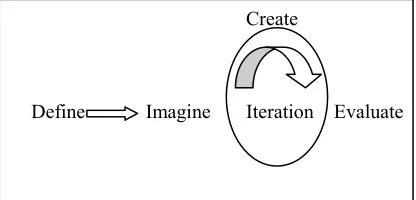
This model produced by Damien Djaouti is founded on an iterative series. More precisely, the first stage of this model happens only once throughout the design process while the succeeding three steps are part of an iterative sequence that initiates with stage “Imagine” to finish after the stage “evaluate” as shows the diagram below [6]:
Create
Define Imagine Iteration Evaluate
Figure 2: The Design Model DICE
It contains as already mentioned in this article four steps:
Define: description of serious contented that will be transferred through the play (education objectives,
lists of knowledge to be transferred,
announcement...).
Imagine: This phase permits the designer to
imagine a play idea from the serious contented. It will be used at the same time with the use of theoretical tools.
Create: A model is planned to test the
appropriateness of this play concept. This step is commonly sustained by the usage of technical tools.
Evaluate: the pattern is assessed with a target audience. Assessment norms vary depending on the project, but for the common Serious Games, the effective transmission of the contented definite in the principal phase is frequently measured.
4.2 Application of the Design Model DICE on
the GBL Generated by our Authoring Tool “S.G.G” Overview
4.2.2 Define
[image:4.612.87.295.607.707.2]drag and drop, Dissemination of our generate LGS on the usual user platforms (PCs, Smartphone’s, tablets) [7].
•Evaluation: There are two types of evaluation: formative assessment and summative
assessment. The trainer defines the different analysis areas on which the learner will be assessed and the feedback that attest to his current skill level.
4.2.2 Imagine a) Material safety data sheet MSDS:
At this stage, we define the basic concept of our generate LGS. Type of our generate LGS [8]:
• Action: this type depends on the
coordination between hands and eyes more than the game content.
• Strategy: This one puts point on the
importance of reflection.
• Adventure: It takes place around the
exploration and problem solving
What is the broadcast medium and Control mode of our generate LGS?
• We distribute our generate LGS in various
media by such as: Mac, Android, PS3, Iphone/Ipad, and PC.
• Our generate LGS will be controlled by
several mode: mouse, keyboard and screen.
b) Game play bricks
This test provides information on the "fun" aspect by providing information on the type of structure used to create the game [6]. The Game Play used is two types: Goals and means:
i.Goals:
A goal is a desired result a user envisions; here we describe the three goals Reach, Avoid, Destroy.
• Reach: the player must "reach" a value or a given position.
• Avoid: the player is penalized if he
touches an element.
• Destroy: the player must destroy an item.
ii.Means:
Here we describe different ways that will be used allowing to user to achieve the goal.
• Move: the player can move an item.
• Select: the player can choose an item.
• Shoot: the player can shoot items.
• Create: the player can create new
elements.
• Random: the player receives a random
value.
c) Universe
At this stage, we describe the universe in
which our generate LG will take place.
d) Personage
Personage are game elements, at this phase we describe each personage and his interactions with other personages and elements of the generate LG.
e) Overview
Here, we must ask the important issues that determine the nature and background of LGS generate by our authoring tool.
• Where LGS is going on?
• What do I control?
• How many characters do I
control?
• What is the purpose of this
generating LGS?
• What makes my LGS different?
f) Artistic choices
We describe here in a few lines, the artistic choices we have choose.
• Graphisme : 3D or 2D
• Music: we have to choose the
type of music we want during the playing of our generate LGS.
g) Level Design
“Level Designer” dedicated to the creation of different “levels” of our generate LG; the work of “Level Designer” is based on a specific software tool, called "level editor"[6].
• Level diagram
The level diagram allows us to determine the levels order.
Figure 3: The Level Diagram
Level 2
Level 3
Level 1
• Critical Level path
Here we describe the actions necessary to complete a game level and thus to continue the game.
• Final goal
Here we have to define the ultimate goal of our generate GBL.
h) “S.G.G” Screenshots
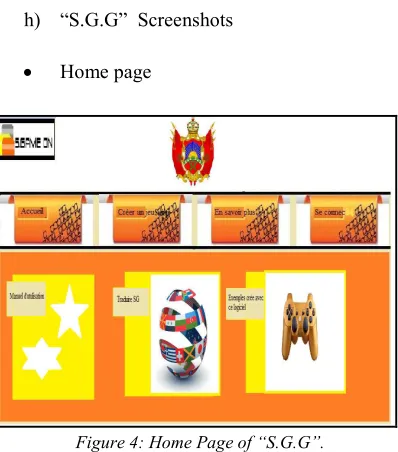
[image:6.612.96.295.183.409.2]• Home page
Figure 4: Home Page of “S.G.G”.
The “S.G.G” is divided into four main menus and three Tabs (See Figure 4).
All of these menu (Home Page, Create Game, Contact Us, and Connect) structures will be now described in the following subsections:
Menu “Home Page”: The first button on the left of the main menu screen is Home Page (see Figure 4). In Home Page user will be presented with the Manual software. Additionally users can explore Examples already created with this software.
Menu “Create a Learning Game (LG)”: The next menu on the main menu screen is to create a LG (see Figure 4). Create a LG is a place when user can create new project, save it or delete it.
Menu “Contact Us”: The following menu
is Contact Us, this is a place where users can find the information on how to contact the researcher if they need to.
Menu “Connect”: The last section in the “S.G.G” is Connect (see Figure 4). This is a place where user can create his own account, to connect to “S.G.G” user must enter their username and password. Every one of these three Tabs (User Manual, Translate LG, example created by our authoring
tool) structures will be now described in the following subsections:
Tab “User Manual”: The first Tab is “User Manual” (see Figure 4). Is a guide, which presents the overview of our software, it explains overall operation and the role of each part of our product. To ease the use of this one by novice users.
Tab “Translate LG”: The following Tab
is “Translate LG” (see Figure 4). This one allows us to translate our generate Learning games into different language for example : (Arabic, French, English, the
language spoken at Moroccan home)based
on the studies made by pimpa(2011) who claimed that linguistic background affects the learners willingness, so language is one of the potential factor that may
prevent the learning process[9].
Additionally, there are many studies shows that learners are more motivated to learn when the narrative in the LG environment is in their mother tongue [4].
Tab “example created by “S.G.G” ”: The last tab is “example created by our authoring tool”, this is a place where user can download many LG already generated by our authoring tool for inspiration, he can also analyze and play with our examples on line by using the “S.G.G” project.
• CREATE A LEARNING GAME:
To create a LG user should pursue the following steps:
Window edition Scene: The window
edition scene allows you to create different replicas of the stage, the sound associated with it, and the specific activities of the different actors (See Figure5).
Figure 5: Window Edition Scene.
Window edition decoration: The window
[image:6.612.327.518.552.672.2]takes place. A preview window is
available and shows the selected
[image:7.612.172.524.59.375.2]characters and the setting selected linked for example to our Moroccan culture and ethnicity (See Figure 6).
Figure 6: Window Edition Decoration.
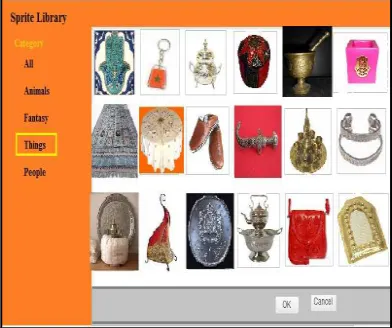
Window edition sprite: The Widows
edition Sprite allows you to add new sprite to you LG, you can choose your own sprite from the Sprite library or paint it. Sprite Category we have Animals, Fantasy, Things.
Figure 7: Window Edition Sprite
Avatar management: Once the setting is selected, you must select the different protagonists who are present in the simulation. The characters or avatars chosen are two types: non-player or player. A player character is the virtual avatar can be controlled by the learner. On the other hand a non-player character is an avatar controlled by the system. An avatar is defined as a representative character of the user [10] (See Figure 8 and 9).
[image:7.612.104.300.394.558.2]Figure 8: Choice of Avatar
Figure 9: The Window Definition Avatars
4.2.3 Create
Programation:We will program our platform with
oriented object language, since this one ease the LG webcast on usual users’ platforms
(smartphones, tablets ...).
4.2.4 Evaluate
This tool is used to evaluate the generate LG by asking those question. What did you like in this generate LG? What did you find unpleasant in this generate LG? Have you had fun? Did you learn something? If so what? What do you think of the graphics? What is the message of this generate LG?
5. CONCLUSION AND PERSPECTIVES
adapt the generate GBL conferring to his level in the purposes to offer an effective learning [11].
REFRENCES:
[1] Zyda, M. (2005).From visual simulation to
virtual reality to games. IEEE Computer.
[2] The Value of Serious Games and Virtual
Worlds, Serious Games Discussion SCOPE 4th – 24th April, 2007.
[3] (Iza Marfisi, 2012).Marfisi-Schottman
Methodology, models and tools for the design of Learning Games. PhD in IT., INSA de Lyon, 35p.
[4] Mazeyanti Mohd Ariffin*, Alan Oxley, Suziah
Sulaiman “Evaluating Game-based Learning Effectiveness in Higher Education”.
[5] BertrandMARNE September 2010 Evaluation
of authoring tools for serious games without programming Memory Master thesis under the supervision of Professor Jean-Marc Labat 3.4 p.
[6] Damien DJAOUTI (2011), Serious Game
Design: Theoretical and technical study of the creation of games aimed to serve serious purposes.
[7] Eugenio J. Marchiori, Javier Torrente, Ángel
del Blanco, Iván Martínez-Ortiz, Baltasar
Fernández-Manjón “Extending a game
authoring tool for ubiquitous education”.
[8] Alvarez, J., & Michaud, L. (2008). Serious
Games: Advergaming, edugaming, training... IDATE.
[9] Pimpa, N (2011), 'Engaging international
business students in the online environment', The International Journal of Management Education, vol.9, no. 3, pp. 77-89.
[10]MAZLAN, MOHAMMAD, and NUR,
AZHAR 2012” Students’ Perception of Motivation to Learn: Does an Avatar Motivate?” Ph.D. Thesis.
[11]L. Bennis and S. Benhlima (2015), Evaluation
of five Educational Game Authoring Tools: Literature Review and Case Study.
[12]Salen, K., & Zimmerman, E. (2003). Rules of
play. MIT Press.
[13] Iza Marfisi-Schottman, Aymen Sghaier,
Sébastien George, Patrick Prévôt, Franck Tarpin-Bernard Vers une industrialisation de la conception et de la production de Serious Game.
[14]McMahon, M. (2009). Using the DODDEL
model to teach serious game design to novice designers. Presented at the ASCILITE 2009, Auckland, New Zealand.
[15]IBANEZ B.C., BOUDIER V. & LABAT J.-M.
(2009). Knowledge Management Approach to Support a Serious Game Development. Advanced Learning Technologies, ICALT, p. 420-422
[16]NADOLSKI R.J., HUMMEL H.G.K., VAN
DEN BRINK H.J., HOEFAKKER R.E., SLOOTMAKER A., KURVERS H.J. & STORM J. (2008). EMERGO: A methodology and toolkit for developing serious games in
higher education. Simulation & Gaming, vol.