ISSN: www.jatit.org E-ISSN:
REAL TIME VIDEO SEGMENTATION BASED ON
MODIFIED MULTISCALE MORPHOLOGICAL
RECONSTRUCTION
1
NITHYA. A, 2KAYALVIZHI R.
1
Research Scholar, Department of E&I, Annamalai University,Chidambaram, India.
2
Professor, Department of E&I, Annamalai University,Chidambaram, India.
1
E-mail: [email protected]
ABSTRACT
Video Segmentation is used in many practical applications such as medical imaging, computer-guided surgery, machine vision, object recognition, digital entertainment, surveillance, content-based browsing and augmented reality applications. In the proposed technique video segmentation is performed using modified
gradient based multiscale morphological operation. Both gradient and grey scale method used to segment
the object from the frame. Also K-Mean Clustering algorithm is applied to segment object by removing the background in each frame. Segmented object will be obtained by refining the combined gradient k-means segmented frame and the gray-scale k-means segmented frame. Accuracy of the segmentation is evaluated by comparing proposed algorithm and existing algorithm with different threshold value.
Keywords: Video Segmentation, Multiscale Morphological Operation, Gradient, K-Means Clustering, Accuracy.
1. INTRODUCTION
Video Segmentation decomposes a video into many frames throughout the sequence. Video segmentation applications are used in the field of robotics, video surveillance, traffic monitoring, video indexing etc. A group of pixels follow analogous motion segmentation. Video is a series of frames (pictures) displayed sequentially at fixed rate. All the pictures (frames) in a video files have equal size. Video contains continues series of 25 frames per second. And all the processing techniques are applied to frames.
Video segmentation technique accepts video as an input and the processed output will be a data extraction from input video or a new video. It is a technique used for detecting changing frame in video. Video segmentation is classified into following types: Shape based video segmentation, edge based video segmentation, color based video segmentation and texture based video segmentation. This work is based on shape based video segmentation. In [1][2] mathematical morphological technique is used in image processing. Different mathematical operations such as dilation, erosion, opening, closing etc. are used. Set theoretic, shape
oriented approach treat image as a set and kernel of operation called as structuring element. Several multiscale and multiresolution techniques are proposed for processing image based on size or scale. In [3] an Efficient Video Segmentation Algorithm is proposed. In this segmentation mask for image examining and editing mask can be used. Next the Panorama is used for virtual reality system and mask to appear the virtual 3D environment.
This algorithm is divided into four steps namely motion estimator, panorama composing and removal of moving foreground object from the panorama and finally determine the segmentation mask. In [4] Face Detection Algorithm is proposed. In this integrated differential algorithm and mosaic rules for video is used. The object is acquired and tracked by using comprehensive algorithm with temporal and background difference. In this target region face is detected by using mosaic images. Thus face is detected accurately using mosaic grey rules.
ISSN: www.jatit.org E-ISSN: segmentation algorithm is proposed based on
spatio temporal integration. Result is obtained in temporal domain by change detection algorithm. In [8] Block based scheme is proposed using likelihood ratio comparison and feature sensitive to movement of camera and object. In [8] refinement of object is done using mean shift algorithm whereas in the proposed method refinement of object is done using K-means clustering algorithm. In [9] modified gradient based morphology is applied only for images.
2. PROPOSED TECHNIQUE
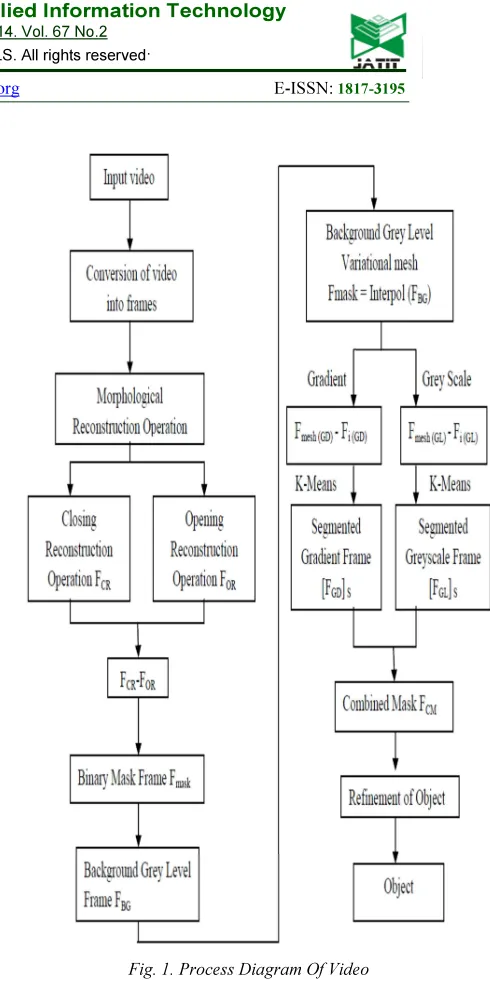
Video segmentation is considered as a vital issue in the image coding filed. A large number of previous methods try to solve the segmentation problem from a certain perspective, e.g., threshold, template matching, region growing, edge detection and clustering. These methods have been proven to be successful in many applications, but none of them are generally applicable to all images and moving objects. This section, describe how the proposed method is used to segment the object from video. Proposed method G-SEGON provides segmentation more accurately than the existing method. The process diagram of video segmentation was shown in Fig. 1.
First Step: Identify the background region
roughly using morphological operation; over that region a mesh was constructed.
Second
Step
: From the first step, frame with background grey level variational mesh is obtained over that gradient operation is applied. Third step: On both the gradient applied frame and gray-scale frame, K-Mean Clustering algorithm is applied to segment object by removing the background (BG). [image:2.595.305.550.71.562.2]Fourth Step: Output of the previous step is two segmented frame, then the gradient segmented frame and the gray-scale segmented frame are combined, then the combined result is refined to get object.
Fig. 1. Process Diagram Of Video Segmentation
2.1. Pre-processing phase
Pre-Processing is required to remove noise present in an image since the image cannot be directly applied. To make it suitable for further operation several process such as RGB to grey level conversion, Image adjustment, and Region expansion had performed.
• RGB to grey level conversion: Input
image or frame Fi is first converted into
ISSN: www.jatit.org E-ISSN:
• Image adjustment: Image adjustment
is used to improve the quality of the frame for image enhancement.
•
Region expansion: Performed to get accurate position of object in the frame.Morphological reconstruction operation
Multi-scale morphological operations are used to extract the features in the image Ii. Dual
multi-scale reconstruction operation was performed to segment object in that image. Reconstruction operation (opening and closing) is used and performed until the original shape was recovered.
Opening: In Opening operation the intensity of bright regions in the input image is decreased. This is based on the structural element size compared to the bright regions. It entails both the erosion and dilation process the binary image value is shown in Eq. (1)
(1)
Closing: Reverse operation of Opening. The Intensity of the background remained unchanged when processing the dark features. The binary frame of the closing operation is given by Eq. (2)
(2)
2.2. Back ground grey level variation
Background grey level variation is obtained by subtracting the output image obtained from close operation with the open reconstruction operation. To get stable outcome the reconstructed operations are not iterated completely so that the convex (concave) grey level variation of the image is used. So the back ground variation of frame is given by Eq. (3)
FBG = FCR (i,j) - FOR (i,j)
(3)
By using the different morphological operations we can get the image and these image is shown in Fig.2.
(A)Original Frame Fi (B) Closing Reconstruction
(C) Opening Reconstruction (D) Closing-Opening Reconstruction Operation
Fig.2. The image obtained by using various levels of morphological operation
2.3. Object region segmentation phase
Background grey level variation is extended over the frame using structural elements that used in the Reconstruction operation. Based on the Reconstruction operation the object in the frame can be segmented by following three steps.
2.3.1. Initialization of object region
Binary frame mask Fmask is the initial process for
video segmentation. Role of binary Mask is to partition the grey level frame into object and background regions using top hat or bottom hat operation which provides an outline of the object in the frame. The binary mask of the frame is shown in the fig.3.
( A) Original Frame Fi (B) The Binary Mask Of The Frame Fmask
Fig.3. Binary Frame Mask Of InitializationOf Object
Top hat operation:Top hat operation identifies the brightest region present in the frames by subtracting the original frame from the resultant frame of opening operation.
ISSN: www.jatit.org E-ISSN:
2.3.2. BG grey level variational mesh
A background grey level mesh was constructed across the boundary region between the object and background in the frame since when the background region and the object regions are closely present in the frame then the structural element cannot differentiate both the regions. Grey level variational mesh was constructed by making use of isolated data points in the frame by using Lagrangian interpolant algorithm and the Fmesh value is given by Eq. (4)
Fmesh = interp(FBG) (4)
For efficient segmentation k-means clustering is utilized over the constructed mesh, to segment
the object for gradient and grey scale frames.
2.3.3 Gradient Frame segmentation using k-means clustering
Both gradient and k-means operation are performed to segment object from the frame. Here, gradient operation is performed on Fmesh
and original frame Fi to extract visual
information. A gradient magnitude operator detects the amplitude edges at which pixel change their grey levels suddenly. The mathematical representation of gradient frame is given in Eq. (5)
y
y
f
x
x
f
f
ˆ
ˆ
∂
∂
+
∂
∂
=
∇
(5)Subsequently, FGD gradient frame is obtained by
taking the gradient of the input frame and then subtracting it with gradient of the BG grey level variational mesh and this resultant gradiant frame is given in Eq. (6)
FGD = || Fmesh(GD) – Fi(GD) ||
(6)
K-mean clustering is applied for FGD and then
segmented [FGD]S is obtained.
The K-means segmentation algorithm is follows:
Step 1: Place K points into the space represented by the objects that are being clustered. These points represent initial group centroids.
Step 2: Assign each object to the group that has the closest centroid by following objective function 2 1 ) (
∑∑
= =−
=
k j n i j j iv
x
J
(7)Step 3: When all objects have been assigned, recalculate the positions of the K centroids.
Step 4: Repeat Steps 2 and 3 until the centroids no longer move. This produces a separation of the objects into groups from which the metric to be minimized can be calculated.
2
.3.4. Gray level frame segmentation using k means clusteringP
arallely K-mean segmentation is applied directly on Gray level image FGL. The resultantgrey scale frame FGL is obtained by subtracting
the input grey scale image with the background (BG) grey level mesh and we have obtain an resultant gray scale frame which is given in Eq. (8
FGL = || Fmesh (GL) – Fi (GL) ||
(8)
2.4. Majority selection and Refinement phase
After object region segmentation [FGD]S and
[FGL]S, the combined mask FCM is obtained by
majority selection process. In majority selection process if both the pixel has same value i.e. 0 or 1 then no change. For different value, the majority value in the neighbourhood pixels of particular pixel is taken and the pixel value is replaced by the majority value.
Majority selection procedure is carried out by following steps,
1. Start
2. Compare both segmented gradient
frame [FGD]S and Grey scale frame
[FGL]S
3. Consider every pixel HC in both frames
4. If [ FGD(HC)]s – [FGL(HC)]s (9)
5. No change
6. Else
7. Replace the pixel with majority of the
neighbourhood pixel.
ISSN: www.jatit.org E-ISSN:
2.4.1. Refinement of object and boundary region:
In Refinement phase, coherent region justification procedure was performed to avoid poor matching between the obtained frame and the original frame then the final object was extracted from the frame F0. The overall
G-SEGON procedure is given in the fig.4. and the value of the F0. Is given in Eq.(10)
ISSN: www.jatit.org E-ISSN:
3. RESULTS AND DISCUSSIONS
3.1 Experimental Setup & Dataset Description
For this proposed technique Matlab version (7.12) in a windows machine with configuration Intel ® core i5 processor, 3.20 GHz, 4 GB RAM, and the Microsoft Window7 professional operating system.
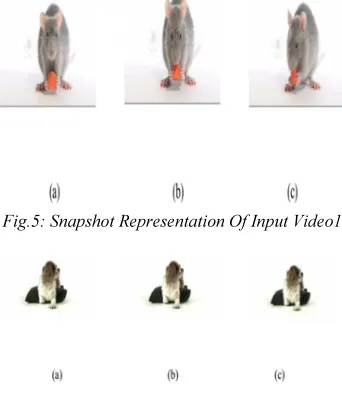
[image:6.595.98.269.317.514.2]Dataset description: For this proposed technique 2 videos are considered. Each image is about 512×512 pixel resolution. Fig.5. shows different frames of input video 1 and the different frames of input video2 are shown in fig.6. In video 1 first 25 frames are considered and in video 2 first 15 frames are considered.
Fig.5: Snapshot Representation Of Input Video1
Fig.6: Snapshot Representation Of Input Video2
3.2 Evaluation Metrics
In this the accuracy of the image segmentation is calculation by taking the ratio of manually segmented image region to the proposed image region. The formulae to calculate accuracy is given in Eq.(11)
(
)
(
)
A
B
Accuracy
AUB
∩
=
(11) Where
A
is the manually segmented regionB
is the proposed image region3.3 Experimental Results
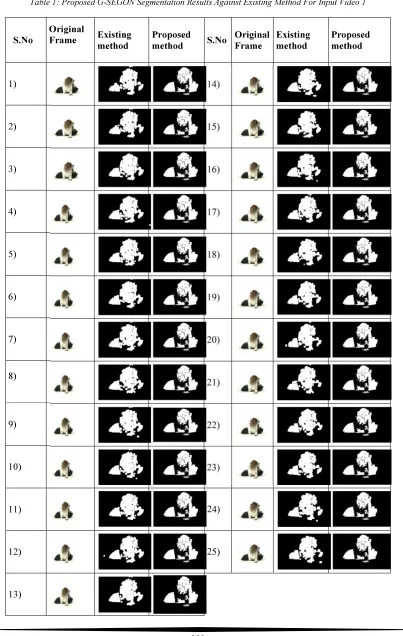
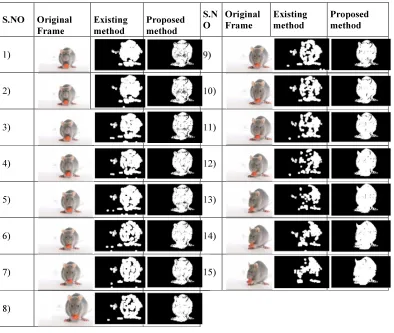
The Experimental output obtained from the proposed technique is discussed in this section. The Table.1 and2 describes the segmentation of
videos by both existing and proposed method, which is given below references.
3.4 . Comparative Analysis
[image:6.595.309.514.380.691.2]Proposed G-SEGON technique is compared against region growing algorithm (existing). Plot in Fig.7. and Fig.8. includes the threshold and the segmentation accuracy. The graph is drawn by varying the threshold value in open and close reconstruction operation. The corresponding accuracy is calculated for different threshold value. From the figure it is clear that in existing method, for small threshold value the accuracy is very low, when compared to the G-SEGON proposed method. In G-SEGON the accuracy remain high for all the threshold value from 1 to 5. Table 3 represents the threshold and accuracy of video1 and video2, which is given below table .
Table 3.Accuracy Of Existing Method And Proposed Method
Video
Thresh old Value
Segmentation Accuracy
Existing method
Proposed method
Video 1 1 0.72 0.91
Video 1 2 0.55 0.9
Video 1 3 0.59 0.89
Video 1 4 0.64 0.88
Video 1 5 0.68 0.87
Video 2 1 0.58 0.95
Video 2 2 0.59 0.94
Video 2 3 0.64 0.92
Video 2 4 0.70 0.90
ISSN: www.jatit.org E-ISSN:
4. CONCLUSION
In this paper an object segmentation algorithm G-SEGON is used to improve the accuracy of object in video segmentation. Both gradient and grey scale method used to segment the object from the frame. To find the efficiency of the proposed technique, accuracy is calculated. From the comparison of two videos it is clear that the accuracy of existing method is far behind the proposed method. This method is entirely based on shape based Object segmentation from the background of frames in videos. We know that, no method is completely perfect. Our proposed technique also has some limitations that is segmentation of video with very complex background is difficult. Future work can be done to overcome the drawbacks like object segmentation in videos with complex background.
REFERENCES:
[1] Jiann-Jone Chen, Chun-Rong Su, W. Eric L. Grimson, Jun-Lin Liu, and De-HuShiue,”Object Segmentation of Database Images by Dual Multiscale Morphological Reconstructions and Retrieval Applications”, IEEE Transactions On Image
Processing, Vol. 21, No. 2,February 2012.
[2] P. T. Jackway, “Morphological scale space”, in Proc. 11th IAPR Int. Conf. Pattern Recognition, The Hague, The Netherlands, September 1992.
[3] ZHAO Xin-bo “An efficient Video
Segmentation Algorithm” IEEE International
Conference on Industrial and Information Systems, 2010,pp. 317-319.
[4] MENG Fanwen and WV Peimin “A Fast
Face Detection for Video Sequences” IEEE
International Conference on Intelligent
Human-machine System and
Cybernetics,2010,pp. 117-120.
[5] Zheng Cao and Ming Zhu “An Efficient
Video Similarity Search Algorithm” IEEE
Transactions on Consumer Electronics, Vol. 56, No. 2, May 2010.
[6] Gang Zhang, Luming Yu and Wenlong Wang
“Video Stabilization Algorithm Based on
Video Object Segmentation” IEEE
International Conference on Future Computer and Communication,vol.2,2010 [7] Shiping Zhu Xi Xia Qingrong Zhang ” A
Novel Spatio-Temporal Video Object
Segmentation Algorithm” IEEE.,2008.
[8] Nanmozhi.R and Mirunalini.P “Segmentation
Using Multiscale Morphological
Reconstruction” International journal of
Engineering Science and Technology Vol. 5 No. 04S Apr 2013
[9] Nithya.A and Kayakvizhi.R “Segmentation of Database Images Using Gradient Based
Multiscale Morphological Reconstruction”
ISSN: www.jatit.org E-ISSN:
Table 1: Proposed G-SEGON Segmentation Results Against Existing Method For Input Video 1
S.No
Original
Frame Existing
method
Proposed
method S.No
Original Frame
Existing method
Proposed method
1) 14)
2) 15)
3) 16)
4) 17)
5) 18)
6) 19)
7) 20)
8)
21)
9) 22)
10) 23)
11) 24)
12) 25)
ISSN: www.jatit.org E-ISSN:
Table 2: Proposed G-SEGON Segmentation Results Against Existing Method For Input Video 2
S.NO Original Frame
Existing method
Proposed method
S.N O
Original Frame
Existing method
Proposed method
1) 9)
2) 10)
3) 11)
4) 12)
5) 13)
6) 14)
7) 15)
ISSN: www.jatit.org E-ISSN:
3.5. Comparative Analysis Of Videos
Fig.7. Output Of Video1
Fig.8. Output Of Video2
1 1.5 2 2.5 3 3.5 4 4.5 5
0.55 0.6 0.65 0.7 0.75 0.8 0.85 0.9 0.95
threshold
s
e
g
m
e
n
ta
ti
o
n
a
c
c
u
ra
c
y
Average value of video images
proposed existing
1 1.5 2 2.5 3 3.5 4 4.5 5
0.5 0.55 0.6 0.65 0.7 0.75 0.8 0.85 0.9 0.95
threshold
s
e
g
m
e
n
ta
ti
o
n
a
c
c
u
ra
c
y
Average value of video images