CBIR BASED ON SINGULAR VALUE DECOMPOSITION
FOR NON-OVERLAPPING BLOCKS
1,2
A.RAHMAN M.ALAMIN , 1SITI MARIYAM SHAMSUDDIN 1
UTM Big Data Centre ,Faculty of Computing , Universiti Teknologi Malaysia, 81310,Skudai,Johor
2Sudan University of Sciences &Technology
E-mail: 1,[email protected] , [email protected]
ABSTRACT
Image retrieval techniques are useful in many image processing applications. Conventionally, the content based image retrieval systems work with whole images and searching is based on comparison of the query and database images. The retrieval of the images is commonly based on the color, shape, texture and others. However, the color only or texture only or shape only cannot enough to discriminate the image. Therefore, in this paper, we present a proposed scheme based on the color and texture information using the Singular Value Decomposition feature to achieve better results. The proposed scheme consists the process of converting an image to HSV color space and each color plane is partitioned into 4, 16, 64 non-overlapping blocks. Later, a one to one matching procedure is implemented to compare the query and target images by using the Euclidean distance for retrieving the similar images. Experimental results demonstrate that the proposed method has higher retrieval precision than other conventional methods color moments, Dominant color, Dominant color and GLCM texture methods. Also shows that SVD features represent the color and texture features of the image.
Keywords: Singular Value Decomposition (SVD), Content Based Image Retrieval (CBIR),Non-Overlapping Blocks,Rank Matrix Approximation,HSV Color Space.
1. INTRODUCTION
In this digital era, almost every field is using image data in one form or another. A large collection of still visual data is called image database. These databases are producing promising results in a number of domain including commerce, government, academics, hospitals, crime prevention, surveillance, engineering, architecture, journalism, fashion and graphic design, and historical research etc..[1]. In criminal image database, police keep images of criminals, related crime scenes, and in some cases stolen items [2, 3]. In medical field the image database keeps MRI, CT scan, and other scanned image for diagnosis of disease, monitoring of current status of critical patients, and to do research toadvance the human understandings [4].Similarly, the image database plays an important role in the designing of new projects, manufacturing of new products, record track of finished project and so many others in the field of architectural and engineering. In order to
preserve the heritage image
databases are
created for archives in areas that include art and sociology. An image retrieval problem is the problem encountered when searching and retrieving images that are relevant to a user’s request from a database of tens of thousands images. In order to solve this problem, two techniques are developed:.-Text-Based Image Retrieval (TBIR)[5]. Which it has some drawbacks it is not standardized technique, incomplete, require humans actions to annotate every image in the database; this is takes longer time for large databases. To overcome the shortcoming of TBIR, Content Based Image Retrieval was developed [1, 6-12]
generated image features based on similarity matrices [13].
2. RELATED WORKS ON COLOR IMAGE RETRIEVAL
Color is one of the important and fundamental descriptor that is sensitive to human eyes. Human can easily distinguish images based color as compare to other descriptors. This feature can somtime provides more powerful information about the image and also play a vital role in image identification and retrieval. A number of techniques was used to describe the color feature ; In [7] color histogram , also in [6] color histogram for K-mean (CHKM) was used as color feature, [14] used color correlation, color moments was used by [12], dominant color descriptor(DCD ) [8] , micro structure descriptor method in HSV color space was adopted by [15] , color difference histograms(CDH) presented by [11] ,Zernike chromaticity distribution moments was presented by [12] after convert image to the chromaticity space, [10] was used color co-occurrence matrix to extract the texture features, their obtained features are also represents the color information.
Most of color techniques mentioned above have weakness in representing an image, for example histogram has high dimensional feature vector and not include spatial information. DCD similarity matching does not fit human perception very well, and it will cause incorrect ranks for images with the similar color distribution.
3. THE PROPOSED SCHEME OF SVD-BASED FEATURE EXTRACTION FOR COLOR IMAGES
A key component of the CBIR system is feature extraction. A feature is a characteristic that can capture a certain visual property of the image. CBIR differs from classical information retrieval in that the image databases are essentially unstructured, since digitized images consist purely of arrays of pixel intensities, with no inherent meaning. One of the key issues with any kind ofimage processing is the need to extract useful information from the raw data before any kind of reasoning about the image’s contents is possible.
In this paper we propose a method to improve the retrieval precision and solve the spatial information problem by dividing image into
non-overlapping blocks and choose color space that is more fit to human perception.
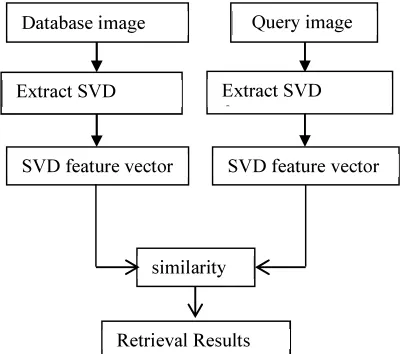
[image:2.595.301.503.209.386.2]Figure 1 shows the proposed scheme which consists Image Acquisition, SVD feature extraction, and Similarity Measurement. Each of this process is given in the next sub-section.
Figure 1: The Proposed Framework for Image Retrieval
using Singular Value Decomposition
3.1 Singular Value Decomposition (SVD) Technique
Singular Value Decomposition (SVD) is a matrix factorization and has three characteristics: stability, scaling property, and rotation invariance which represent algebraic and geometric invariant features of an image [16, 17]. SVD was used in several fields such as image processing, pattern recognition and data compression.
Using SVD, the proposed approach achieves extract singular feature vectors of image blocks and decreases the dimension of blocks feature vector. The basic theory of SVD is as follows:
Let A be N×M image matrix AϵRNxM its rank is equal to r, theorem singular value decomposition [18] . There exist an orthogonal matrices UϵRN×N and VϵRM×M such that A is factored in the form of equation (1).
ƩV
(1) Where Ʃ belong to RNxM is a diagonal matrix with NxM dimension, which is divided in the form of equation (2)
Ʃ
Ʃ
(2)
Σ is a diagonal in the field R r×r. Query image imagimage
Extract SVD features
SVD feature vector Database image
Extract SVD features
SVD feature vector
similarity
With positive elements ranked in as follows:
⋯
.
The two matrices U and V are orthogonal and not unique to the matrix A, Equation (1) written as Equation(3):
∑
⋯
(3)The sub matrices have dimensions
∈
,
∈
3.1.1 Rank Matrix Approximation
Let Ak reduced-rank matrix, which it
kept the first k elements from (3):
∑
⋯
(4)
k=1,2,…,r
k is the rank of Ak, when k=r, we have Ar=A. which it is original Full SVD of A, then we can write Ak in form (5)
Ʃ
(5)
Where
Ʃ
diag(⋯
, belong to R rxrTherefore, A and Ak matrices are similar in
their first k singular values
⋯
, but the remaining( r−k) values of A, be zeroes in the matrix Ak . The matrix Ak is constructing anapproximation reduced-rank of A.
The approximation reduced-rank theorem [18] states that there exist a matrix B , which is approximates A in
the Euclidean norm is the matrix Ak
.
The distance between A and B (||A−B||)is minimized when B = Ak
.
The minimum distancebetween matrix A and Ak
is
‖
‖
and
‖
‖
⋯
..
In this study the matrix A was clustered into two groups, one group contain the element of large SVs which are more discriminant:
And another group contains the remaining SVs which is representing the noise
The way to separate the SVs into two groups is determined by choosing the value of k , we choose it by trials and errors.
The approximation matrix Ak tends to enhance
the desired signal, reduce dimensionality and decrease the noise effects. The important parameter k value is chosen to satisfy equation (6):
where σ i represent the singular values of the original matrix A, ε is the reduced-rank approximation threshold of matrix A.
3.2 Features extraction
To extract the color features from the content of an image, we need to select a color space and use its properties in the extraction. In common, colors are defined in three-dimensional color space. In digital image purposes, RGB color space is the most prevalent choice. The main drawback of the RGB color space is that it is perceptually non-uniform and device-dependent system. The HSV color space is an intuitive system, which describes a specific color by its hue, saturation, and brightness values [19]. This color system is very useful in interactive color
selection and manipulation [20] .
We divide the image into L non-overlapping blocks and from each one of L blocks, we extract from each color channel the Singular Value of the color distribution and store the point numbers in the index of the image. Relevant images are retrieved by computing the similarity between the query vector and image vectors.
The feature vector of Singular Values for HSV channel planes denoted as:
ାଵ ାଶ⋯
ଵ ଶ⋯
= 1- ε (6)
ୀୀଵ ୀ
,
,
, … . ,
,
,
,
, … ,
,
,
,
, … . . ,
Where
(1<=i<=L)represent the singularvalue of block i in the channel H, (1<=i<=L) represent the singular value of block i in the channel S and (1<=i<=L) represent the singular value of block i in the channel V.Algorithm:
The purpose of the algorithm is to extract singular value decomposition features of an image.
Input: Query RGB image, the number SVD is equal k.
Output: SVD vector feature. Method:
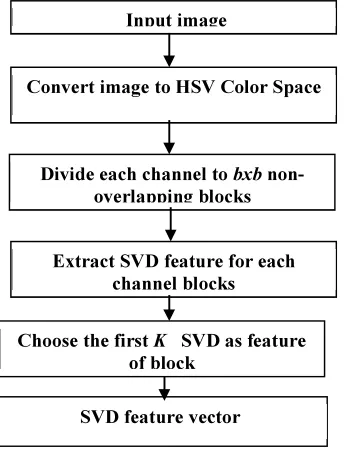
Step 1: Convert the Query image from RGB color space to HSV color space.
Step 2: Divide each channel to L non-overlapping blocks of size bxb.
Step 3: find the SVD features for each block in the color channel (H, S and V).
Step 4: choose the first k value of SVD as a feature vector of the block.
[image:4.595.95.267.446.674.2]Step 5: combine blocks feature vector into one vector to represent the image.
Figure 2: Singular Value Decomposition Feature Extraction
Figure 2 shows the steps of Singular Values feature extraction from each block for each channel plane;
the extracted features are representing texture and color information
.
3.3 Similarity Measurement
The Euclidean distance is the most of similarity metric that used when regions or objects are represented by u and v vectors feature of n-dimensional space, where the feature vector
,
, … . ,
and feature vector
,
, … . ,
, the Euclidean distance between u and v is defined in the form (7)!", # $" #
" #%
/&∑ "
!#
(7)
To determine the similarity of two images at query time, we measure the similarity between their indices. Let Q be a query image and I be a database image. Then their Singular Values feature vectors
are
'
"#$ And'
"#% , respectively.'
"#$
&
,
&
,
&
, … ,
&
,
&
,
&
,
&
, … ,
&
,
&
,
&
,
&
, … ,
&
'
"#%'
,
',
', … ,
',
',
',
', … ,
',
',
',
', … ,
'The Euclidian distance between two corresponding blocks in image Q and image I can be defined as:
()
&, )
'
$*
&
'
+
*
&
'
+
*
&
'
+
%
.(8)
To compute the total distance similarity of the two images Q and I, we define the total distance similarity as:(,, - ∑ ()
&, )
'(9)
Then Similarity between Q and I is denoted as:
.
,, - (
&
,
'
(10)
Input imageConvert image to HSV Color Space
Divide each channel to bxb
non-overlapping blocks
Extract SVD feature for each channel blocks
Choose the first K SVD as feature
of block
4. PERFORMANCE EVALUATION AND DATASET PREPARATION
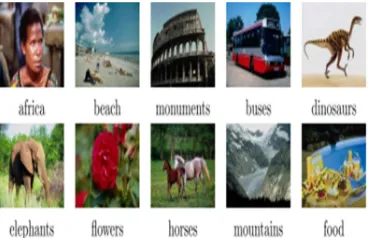
The WANG database is a subset of the Corel database; the images are of size 384 × 256 or 256 × 384 pixels. It composes of 1000 images which have been manually selected to be a database of 10 classes, each contains 100 images. The images are subdivided into 10 classes such that it is almost sure that a user wants to find the other images from a class if the query is from one of these 10 classes. This is a major advantage of this database because due to the given classification it is possible to evaluate retrieval results. One example of each class can be seen in Figure 3 This database was also used for classification experiments.
Figure 3: One example image from each of the 10 classes of the WANG database.
To evaluate CBIR, several performance evaluation measures have been proposed[4][18][ 16]. The widely used is the precision. The retrieval precision Pq for a given query q is the ratio between the number of relevant images found by the system and the total number of images retrieved.
(11)
As you can see from Equation (11), measures,
the capability of correct retrieval of the system for query image q. The average precision on the total number Q of queries is:
/
&
∑
/0
&(
(12)
The mean average precision (MAP) is the mean of the average precision over all queries for all classes:MAP
∑ P
(13)
Where C is the number of classes and
/
Is the precision of class I.5. EXPERIMENTAL RESULTS AND ANALYSIS
For each class of the dataset, we choose randomly 5 images as queries, and calculate the Average Precision for each class. We examine Singular Value Decomposition and image division with 4, 16 and 64 non-overlapping blocks, Table 1 shows the retrieval precision of different image blocks, the optimum result is (0.63) was obtained when the image is divided into 4 non-overlapping blocks. When the image is divided into 16 non-overlapping blocks, the precision is (0.464) which it is less than the precision of division image into 64 blocks (0.544).
From above result, we conclude that the division into small blocks not always increasing retrieval precision, if we look at the result of beaches, building, dinosaurs, elephants, flowers and horses the result is best when we divide into small blocks, while other classes like African, buses, dinosaurs, mountains and foods give the best result when an image is divided into large blocks.
[image:5.595.88.273.325.444.2]We could not say that the division of image into non-overlapping blocks will increase the retrieval precision result. The result it depends on the image contents and its background
.
Table 1: The Retrieval Precision Of Different Image
Blocks Using SVD
The Singular Value Decomposition (SVD) was extracted from each block after dividing each color channel plane (H, S, and V) into 4 non-overlapping blocks; the extracted feature vector provided good image retrieval result.
Class name 4 blocks
16 blocks
64 blocks
Africans 0.58 0.2 0.18
Beaches 0.62 0.56 0.80
Buildings 0.24 0.24 0.30
Buses 0.50 0.3 0.30
Dinosaurs 1.00 0.94 1.00 Elephants 0.58 0.46 0.66
Flowers 0.70 0.64 0.76
Horses 0.86 0.74 0.98
Mountains 0.50 0.38 0.38
Foods 0.72 0.18 0.08
MAP(Mean
Average Precision) 0.63
0.464
Table 2 shows the average precision for each class and compare it with color standard moment, Dominant color and Dominant color and GLCM Texture Methods, the result shows the proposed method is better than other mentioned techniques in most classes and it is better in overall mean average precision and has low variation than other mentioned methods.
Table 2: Comparison Average Precision Between SVD And Some Other Techniques
C
la
ss
na
m
e
P
ro
pos
ed
M
e
th
o
d
S
ta
nd
ar
d
m
om
ent
s
col
o
r
D
om
ina
nt
C
ol
or
D
om
ina
nt
C
ol
or
a
nd
G
L
C
M
T
ext
u
re
Africans 0.58 0.48 0.21 0.27
Beaches 0.62 0.30 0.35 0.36
Buildings 0.24 0.24 0.50 0.25
Buses 0.50 0.42 0.22 0.52
Dinosaurs 1.00 1.00 0.29 0.91
Elephants 0.58 0.50 0.24 0.38
Flowers 0.70 0.66 0.73 0.89
Horses 0.86 0.76 0.25 0.47
Mountains 0.50 0.44 0.18 0.30
Foods 0.72 0.66 0.29 0.32
MAP 0.63 0.546 0.326 0.467
Standard Deviation
0.209178 0.227459
0.1686
02 0.243221
Covariance factor
0.332029 0.416592
0.5171
84 0.520817
The class building gets better results by the dominant color method, while buses and flower classes get best results by the Dominant Color and GLCM Texture method.
The proposed color similarity method gives the best result in the remaining seven classes out of ten classes, compare with other color similarity retrieval. Also the mean average precision of the proposed method is higher than other mentioned methods, and covariance factor is smaller than other methods.
Figure 4 shows the Average Precision for Proposed method,Standard moments, Dominant Color , Dominant Color and GLCM texture Methods, the result shows the proposed method has high Average Precision than mentioned methods in most of image classes.
Figure 4: Ccomparison Methods
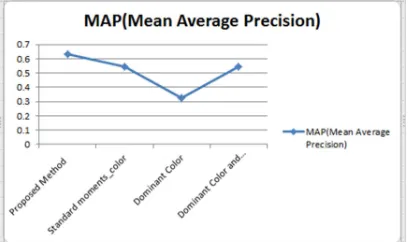
[image:6.595.307.511.420.541.2]Figure 5 shows the Mean Average Precision for each Method, the result shows the proposed method (0.63) is better than other mentioned methods.
Figure 5: Mean Average Precision For Different Methods
6. CONCLUSIONS
than other conventional methods color moments, Dominant color and Dominant color and GLCM texture methods. The experiment also shows that SVD features represent the color and texture features of the image.
Therefore, this research has contributed a successful Content Based Image Retrieval System based on Singular Value Decomposition for non-overlapping blocks that increases the retrieval precision,future studies concerns a retrieval system based on color and shape descriptor using improved invariant moments.
ACKNOWLEDGMENT
The authors would like to thank UTM Big Data Centre and Soft Computing Research Group(SCRG) Universiti Teknologi Malaysia (UTM) for their support and inspiration in making this study a success. Under FRGS Grant R.J130000.7828.4F347 - NEW ROTATIONAL MOMENT INVARIANTS.
REFRENCES:
[1] R.Salamah, "Efficient Content Based Image Retrieval," Master dissertation, Computer Engineering Department, Islamic University of Gaza, Palestine, 2010.
[2] H. Kekre and S. D.Thepade, "Color Based Image Retrieval using Amendment of Block Truncation Coding with YCbCr Color Space," International Journal of Imaging and Robotics, vol. 2, 2009, pp. 2-14.
[3] D. H. Kekre, S. D.Thepade, and A. Maloo, "Query by Image Content Using Colour Averaging Techniques," Engineering journals, International Journal of Engineering, Science and Technology (IJEST), vol. 2, 2010, pp. 1612-1622. [4] H. Müller, W. Müller, D. M. Squire, S.
Marchand-Maillet, and T. Pun, "Performance evaluation in content-based image retrieval: Overview and proposals," Pattern Recognition Letters, vol. 22, 2001, pp. 593-601.
[5] R. Datta, D. Joshi, J. Li, and J. Z. Wang, "Image retrieval: Ideas, influences, and trends of the new age," ACM Computing Surveys (CSUR), vol. 40, 2008, p. 5. [6] C.-H. Lin, R.-T. Chen, and Y.-K. Chan,
"A smart content-based image retrieval system based on color and texture feature,"
Image and Vision Computing, vol. 27, 2009, pp. 658-665.
[7] G. Duan, J. Yang, and Y. Yang, "Content-Based Image Retrieval Research," Physics Procedia, vol. 22, 2011, pp. 471-477. [8] X.-Y. Wang, Y.-J. Yu, and H.-Y. Yang,
"An effective image retrieval scheme using color, texture and shape features," Computer Standards & Interfaces, vol. 33, 2011, pp. 59-68.
[9] J. Yue, Z. Li, L. Liu, and Z. Fu, "Content-based image retrieval using color and texture fused features," Mathematical and Computer Modelling, vol. 54, 2011, pp. 1121-1127.
[10] X.-y. Wang, Z.-f. Chen, and J.-j. Yun, "An effective method for color image retrieval based on texture," Computer Standards & Interfaces, 2012. 34(1): p. 31-35.
[11] G.-H. Liu and J.-Y. Yang, "Content-based image retrieval using color difference histogram," Pattern Recognition, vol. 46, 2013, pp. 188-198.
[12] X.-Y. Wang, H.-Y. Yang, and D.-M. Li, "A new content-based image retrieval technique using color and texture information," Computers & Electrical Engineering, vol. 39, 2013, pp. 746-761. [13] F. Long, H. Zhang, and D. D. Feng,
"Fundamentals of content-based image retrieval," in Multimedia Information Retrieval and Management,ed: Springer, 2003, pp. 1-26.
[14] J. Huang, S. R. Kumar, M. Mitra, W.-J. Zhu, and R. Zabih, "Image indexing using color correlograms," in Computer Vision and Pattern Recognition, 1997. Proceedings., 1997 IEEE Computer Society Conference on, 1997, pp. 762-768. [15] G.-H. Liu, et al, "Image retrieval based on micro-structure descriptor, " Pattern Recognition, 2011. 44(9): p. 2123-2133. [16] V. Klema, and A.J. Laub, "The singular
value decomposition: Its computation and some applications, " Automatic Control, IEEE Transactions on, 1980. 25(2): p. 164-176.
[17] Z. Ting and W. Rang-ding, "Copy-move forgery detection based on SVD in digital image," in Image and Signal Processing, 2009. CISP'09. 2nd International Congress on, 2009, pp. 1-5.
[19] T. K.Shih, J.-Y. Huang, C.-S. Wang, J. C. Hung, and C.-H. Kao, "An intelligent content-based image retrieval system based on color, shape and spatial relations," Proceedings-National science council Republic of China Part A physical Science and engineering," vol. 25, 2001, pp. 232-243.