JAN-FEB, 2013, Vol. – I, Issue-IV www.srjis.com Page 785
A STUDY ON THE EXTENT TO WHICH RISK BASED AUDIT FACTORS
HAVE BEEN APPLIED IN INTERNAL AUDIT IN THE PUBLIC SECTOR:
CASE OF SOUTH-RIFT REGION, KENYA
Fredrick M. Kalui Egerton University
P. O. Box 535 Njoro, Kenya
Received: 11 January 2013
Reviewed & Received: 14 Feb 2013 Accepted: 14 February2013
Internal Audit departments that have adopted Risk Based Audit (RBA) have been envisaged as
key in achieving proper management of financial and non-financial resources in public sector.
Nevertheless, not much is known on how Risk Based Audit factors have contributed towards the
performance of Internal Audit departments. This study sought to establish the extent in which the
listed RBA factors have been applied in Internal Audit in public sector. The study employed a
census of all the 36 district Internal Audit units in central government and 20 internal audits in
local authorities in South Rift, Rift Valley province. Primary data was collected from the study
respondents using structured questionnaires administered by the researcher. Data was analyzed
with the help of the Statistical Package for Social Sciences (SPSS) computer software.
Descriptive statistics such as mean, median, mode and percentages were used to analyze and
present the data. The study found out that Risk Based Audit factors have been moderately
applied in internal audit in public sector within South Rift region. This study recommended the
need to strengthen particular aspects of RBA in the internal audit in public sector and the
effective application of RBA factors in order to achieve measurable improvement in the internal
audit performance.
Key Words: Internal Audit, Risk Based Audit Factors
JAN-FEB, 2013, Vol. – I, Issue-IV www.srjis.com Page 786 Introduction
For most of its history, internal audit served as a simple administrative procedure comprised mainly of checking documents, counting assets, and reporting on past events to various types of management. It began as a one person clerical function that consisted primarily of performing independent verification of bills before payment (Walter & William, 1991). These approaches to internal auditing are the so-called “type”, compliance-based and control-based approaches. These approaches are the old, traditional ways of auditing, usually long and time-consuming, using an extremely high number of samples (if not 100 percent), based on gut-feel or intuition of the auditor, which often lead to adverse and counterproductive relationships with the auditees (or audit customers), (Walter & William, 1991).
Over the years, internal auditing has evolved into a highly professional activity that extended to the appraisal of the efficiency and effectiveness of all phases of an organization’s both financial and non-financial. In recent times, a combination of forces has led to a quiet revolution in the profession (Walter & William, 1991). The issues of globalization, transparency, integrity and improvement of government service delivery increase the need for governance and accountability. Consequently, this phenomenon leads the interest to internal audit function in organizations. Dittenhofer, (2001) and Goodwin, (2004) argued that internal auditing is emerging as an important component of management and a governance mechanism both in private and public sectors. Internal audit helps an organization accomplish its objectives by bringing a systematic, disciplined approach to evaluate and improve the effectiveness of risk management, control and governance processes” (IIA, 2001)
The Risk-Based Audit (RBA) is the latest “best practice” in the evolution of internal auditing, aimed at maximizing the impact of audit by focusing on the major strategic, regulatory, reputational, financial and operational risks factors that confront an organization (Griffith, 2006). This approach targets high risk areas and helps the auditors achieve maximum value for the organization from their efforts. It involves challenging existing structures and processes to identify areas for improvement and propose value-adding changes to the organizations, (Riverback, 2000). This approach is not an option; rather, RBA is mandated by the Institute of Internal Auditors’ (IIA) International Professional Practice Framework (IPPF), which covers the
JAN-FEB, 2013, Vol. – I, Issue-IV www.srjis.com Page 787 Standards.
Statement of the Problem
A study on the extent to which risk based audit factors have been applied in internal audit in the public sector: case of south-rift region, Kenya.
Research Objectives
The broad objective of this study was to the extent to which risk based audit factors have been applied in internal audit in the public sector in the south-rift region, Kenya. The specific objectives were:
1. To establish the extent to which the following RBA factors have been applied in internal audit in the public sector.
a) Business focus b) Stakeholders focus
c) Continuous risk assessment d) Process improvement e) Strategic Planning f) Goal focus
g) Continuous process monitoring
h) Continuous risk management measures 2. To find out the level of the application of RBA factors
Significance of the Study
JAN-FEB, 2013, Vol. – I, Issue-IV www.srjis.com Page 788 Scope of the Study
The study focused on the Central and Local Government Departments as part of the vast public sector. The study was further limited to examination of Risk-Based Audit factors in Internal Audit function in Central and Local Government departments located in South Rift region of Rift Valley Province, Kenya. The study was limited on the following risk based audit factors; Business focus , Stakeholders Focus, Continual Risk Assessment Coverage, Process Improvement, Participates in strategic planning, Goal focus, continual process monitoring and Continual risk management measures (IIA, 1998).
Limitations of the Study
A variety of issues impacted on the study. Some internal auditors were unwilling to fill in the questionnaires without giving any reasons. The researcher, therefore, took the necessary steps and measures to ensure that clear communication was made on the purpose of the study and assured the respondents of confidentiality of the use of information provided. Time was a challenge given that most of the target respondents had very busy schedules, and did not have time to complete the questionnaires.
Assumptions of the Study
It was assumed that the respondents would give their frank feelings to the questions posed to them. The researcher assumed that environmental factors such as locality of the internal audit, category and size of the size of internal audit department, and type of the auditee had no significant influence on the performance of internal audit in public sector.
Research Methodology
This study was conducted through a cross-sectional survey. The study was carried out in South Rift, Rift Valley Province Kenya. According to Kenya National Audit Office (KENAO) Records (2009) South Rift region had a total of 36 internal audit units in central government and 20 internal audit units in Local government. The target population of this study was all internal auditors in charge of internal audit departments in South Rift because they are typically the most knowledgeable people regarding risk based audit and its implementation in public sector. It had a population of 56 internal auditors. The study employed a census survey of all the internal auditors (56) within south rift. The study targeted internal auditors in charge of internal audit departments as respondents for data collection because they are typically the most knowledgeable people regarding risk based audit and its implications in public sector. This study was aimed at evaluating risk-based audit factors affecting performance of internal audit in public sector. In order to get these data, the researcher used questionnaires.
In this study, ensuring validity of the data collection instrument involved going through
JAN-FEB, 2013, Vol. – I, Issue-IV www.srjis.com Page 789 information that could enable answer these objectives. This was accomplished with the help of
experts and examiners in Faculty of commerce at Egerton University. The instruments were piloted in internal audit units from some of local authorities and districts in the regions that were not included in the actual study that is, North Rift, Central Province and Nairobi. The results of the piloted instruments were used to calculate the reliability coefficient. This was calculated using the Cronbach formula and reliability of 0.7 and above was acceptable, (Selltiz, Wrightsman & Cook, cited in Githua, 2000). Mcmillan and Schumacher, (1993) viewed Cronbach alpha as the most appropriate type of reliability for survey research. Therefore, the Cronbach alpha test for reliability was used because it is superior to all others and can be used for both dichotomous-type and large-scale data. The reliability coefficient from the piloted instruments was 0.86. Descriptive statistical tools such as the mean, median, mode and percentage were used to analyze the data.
Findings
Extent of Application of RBA Factors by Internal Audit in Public Sector
a) Extent of Application of Business Focus in Internal Audit
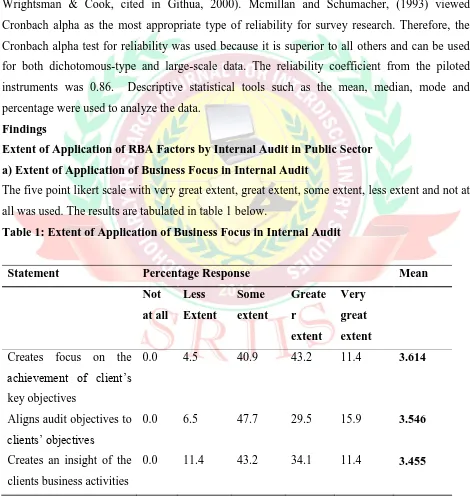
[image:5.612.70.540.199.698.2]The five point likert scale with very great extent, great extent, some extent, less extent and not at all was used. The results are tabulated in table 1 below.
Table 1: Extent of Application of Business Focus in Internal Audit
Statement Percentage Response Mean
Not
at all
Less
Extent
Some
extent
Greate
r
extent
Very
great
extent
Creates focus on the achievement of client’s
key objectives
0.0 4.5 40.9 43.2 11.4 3.614
Aligns audit objectives to clients’ objectives
0.0 6.5 47.7 29.5 15.9 3.546
Creates an insight of the clients business activities
JAN-FEB, 2013, Vol. – I, Issue-IV www.srjis.com Page 790 The study findings revealed that 95.5% of the respondents agreed that RBA creates focus to the
achievement of clients’ key objectives. Of these 40.9% was to some extent, 43.2% was to a greater extent, while 11.4% was to a very great extent. Therefore, Internal Audit in public sector has created focus on the achievement of the clients’ key objectives. In addition, 93.1% of the
respondents agreed that RBA aligns audit objectives to client objectives, (that is 47.7% to some extent, 29.5% to a greater extent while 15.9% to a very greater extent). Therefore, there is need for internal audit in Public Sector to improve their attitude towards business focus so that audit objectives can be aligned with the clients’ objectives. Further 88.7% of the respondents agreed that RBA creates an insight of the clients business activities, (that is 43.2% to some extent, 34.1% to a greater extent while 11.4% to a very greater extent). This implies that there is need for internal audit in Public Sector to improve their attitude towards business focus since this would create an insight of the client’s business activities.
Comparing statistical mean on the extent to which business focus had been applied in internal audit in public sector in order of magnitude: Creates focus on the achievement of clients key objectives (M=3.614), aligns audit objectives to clients objectives (M=3.546) and that business focus creates an insight of the clients business activities (M=3.455).
JAN-FEB, 2013, Vol. – I, Issue-IV www.srjis.com Page 791 Figure 2: Extent to which business focus was applied by internal auditors
b) Extent of Application of Stakeholders Focus in Internal Audit
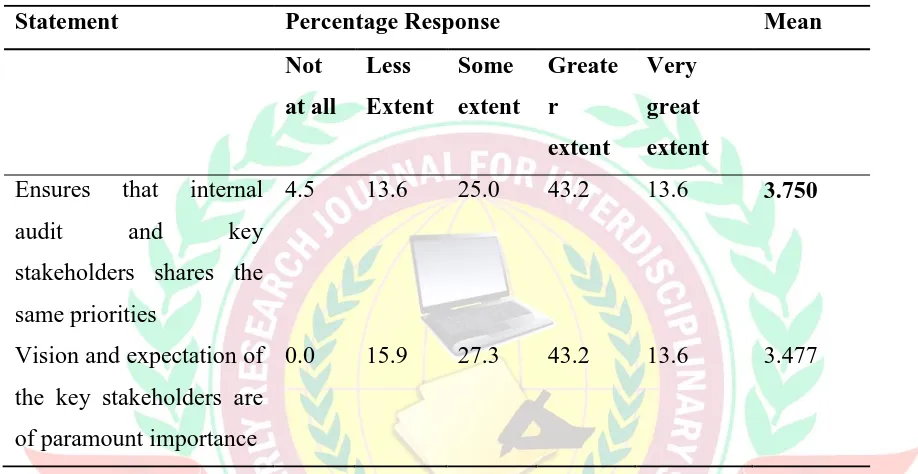
[image:7.612.70.529.186.423.2]The five point likert scale with very great extent, great extent, some extent, less extent and not at all was used. The results are tabulated in the table 2.
Table 2: Extent of Application of Stakeholders Focus in Internal Audit
This study revealed that 81.8% of the respondents agreed that internal audit in public sector and key stakeholders shares the same priorities, (that is 25.0% to some extent, 43.2% to a greater extent while 13.6% to a very greater extent). Therefore, internal audit in public sector should ensure their priorities align with those of key stakeholders in public sector. This would lead to increased performance of internal audit departments in public sector.
In addition 84.1% of the respondents agreed that RBA ensures vision and expectation of the key stakeholders are of paramount importance, (that is 27.3% to some extent, 43.2% to a greater extent while 13.6% to a very greater extent). Therefore, there is need for IA in Public Sector to improve their attitude towards business focus since this would ensure vision and expectation of the key stakeholders are of paramount importance.
Comparing statistical mean on the extent to which stakeholders focus had been applied in IA in public sector in order of magnitude: Ensures that Internal Audit and key stakeholders shares same priorities (M=3.75) and vision and expectations of the key stakeholders are of paramount importance (M=3.477)
Statement Percentage Response Mean
Not
at all
Less
Extent
Some
extent
Greate
r
extent
Very
great
extent
Ensures that internal
audit and key
stakeholders shares the same priorities
4.5 13.6 25.0 43.2 13.6 3.750
Vision and expectation of the key stakeholders are of paramount importance
JAN-FEB, 2013, Vol. – I, Issue-IV www.srjis.com Page 792 On the extent to which the stakeholders focus were applied in by internal audit in public
sector, survey data (Figure 2) shows that 13.6% of the respondents reported to a high extent, 65.9% to a moderate extent while only 20.5% reported to low extent. It is evident from the findings that stakeholders focus was applied generally to a moderate extent within the IA in the study area.
[image:8.612.69.540.196.734.2]
Figure 2: Overall Application of Stakeholders Focus
c) Extent of Application of Continual Risk Assessment Coverage in Internal Audit
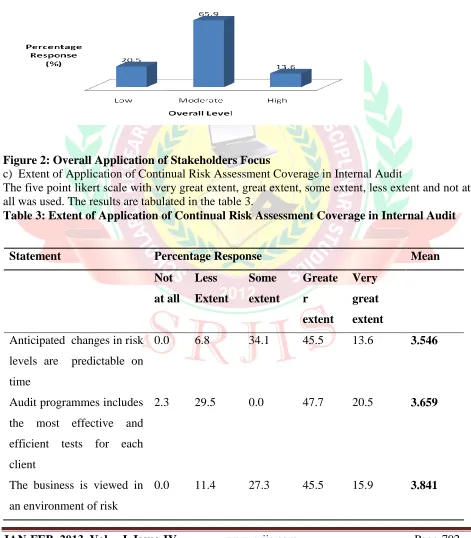
The five point likert scale with very great extent, great extent, some extent, less extent and not at all was used. The results are tabulated in the table 3.
Table 3: Extent of Application of Continual Risk Assessment Coverage in Internal Audit
Statement Percentage Response Mean
Not
at all
Less
Extent
Some
extent
Greate
r
extent
Very
great
extent
Anticipated changes in risk levels are predictable on time
0.0 6.8 34.1 45.5 13.6 3.546
Audit programmes includes the most effective and efficient tests for each client
2.3 29.5 0.0 47.7 20.5 3.659
The business is viewed in an environment of risk
JAN-FEB, 2013, Vol. – I, Issue-IV www.srjis.com Page 793 The study findings revealed that 93.2% of the respondents agreed that continual risk
assessment coverage ensures anticipated changes are predicted on time. Of these 34.1% was to some extent, 45.5% was to a greater extent, while 13.6% was to a very great extent. This implies that, anticipated changes in risk levels are predicted on time and hence appropriate actions are taken to ensure internal audit achieves its set level of performance. In addition 68.2% of the respondents agreed that continual risk assessment coverage ensures audit programs includes the most effective and efficient tests for each client. Of this 0% was to some extent, 47.7% was to a greater extent, while 20.5% was to a very great extent. This implies that Internal Audit departments in public sector have put systems in place to ensure that audit programs contain appropriate tests for each client environment to help organizations achieve success.
Further 88.7% of the respondents agreed that continual risk assessment coverage ensures the business is viewed in an environment of risk. Of these 27.3% was to some extent, 45.5% was to a greater extent, while 15.9% was to a very great extent. This implies, systems should be put in places to ensure that various clients are classified according to their risk factors. The research findings also revealed that 84.1% of the respondents agreed that continual risk assessment coverage ensures audit plans are developed based on risky areas and organizational goals. Of these 25% was to some extent, 45.5% was to a greater extent, while 13.6% was to a very great extent. This implies that there is deliberate positioning of audit plans based on risky areas and organizations goals to optimize performance. Further 81.8% of the respondents agreed that continual risk assessment coverage ensures audit judgment of inherent risk and control risk have become more accurate and consistent. Of these 29.5% was to some extent, 40.9% was to a greater extent, while 11.4% was to a very great extent. Therefore, audit judgment of inherent risk and control risk have become more accurate and consistent, this is turn could result into improved performance.
Audit plans are developed based on risky areas and organizational goals
0.0 15.9 25.0 45.5 13.6 3.659
Audit judgment of inherent risk and control risk have become more accurate and consistent
JAN-FEB, 2013, Vol. – I, Issue-IV www.srjis.com Page 794 Comparing statistical mean on the extent to which continual risk assessment coverage
had been applied in internal audit in public sector in order of magnitude: the business is viewed in an environment of risk (M=3.841), audit programs includes the most effective and efficient tests for each client (M=3.659), audit plans are developed based on risky areas and organizational goals (M=3.659), audit judgment of inherent risk and control risk have become more accurate and consistent (3.568) and anticipated changes are predicted on time (M=3.546).
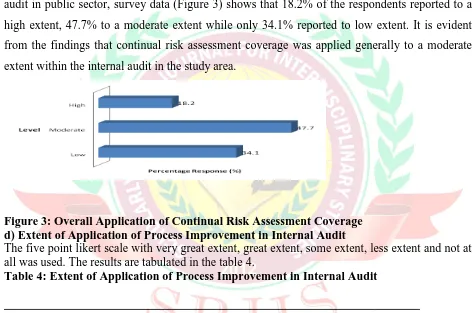
[image:10.612.68.540.220.533.2]On the extent to which the continual risk assessment coverage were applied in by internal audit in public sector, survey data (Figure 3) shows that 18.2% of the respondents reported to a high extent, 47.7% to a moderate extent while only 34.1% reported to low extent. It is evident from the findings that continual risk assessment coverage was applied generally to a moderate extent within the internal audit in the study area.
Figure 3: Overall Application of Continual Risk Assessment Coverage d) Extent of Application of Process Improvement in Internal Audit
The five point likert scale with very great extent, great extent, some extent, less extent and not at all was used. The results are tabulated in the table 4.
Table 4: Extent of Application of Process Improvement in Internal Audit
Statement Percentage Response Mean
No
t
at
all
Less
Exte
nt
Some
exten
t
Great
er
extent
Very
great
extent
Improves financial statements assurance and reporting process
0.0 2.3 40.9 38.6 18.2 3.455
The higher the risk area, the more audit time and client
JAN-FEB, 2013, Vol. – I, Issue-IV www.srjis.com Page 795 The study findings revealed that 93.2% of the respondents agreed that process
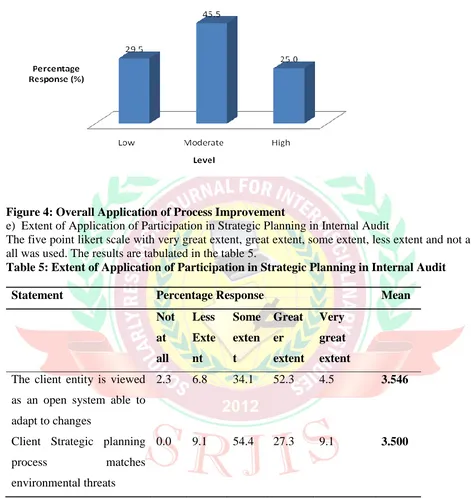
improvement ensures financial statements assurance and reporting process are improved. Of these 40.9% was to some extent, 38.6% was to a greater extent, while 18.2% was to a very great extent. This implies that financial statements assurance and reporting process were improved. Through improved process; this could result to high rating of performance of Internal Audit departments in public sector. In addition 93.2% of the respondents agreed that process improvement ensures the higher the risk area, the more audit time and client controls are required. Of these 20.5% was to some extent, 43.2% was to a greater extent, while 29.5% was to a very great extent. Therefore, the internal audit in public sector has given more priority to the high risky areas in terms of time and controls. This could imply that the risky areas have been considered and there is high chance when more attention is given on risky areas this could lead to improved performance.
Further 88.7% of the respondents agreed that process improvement assures the organization have focused on emerging risks that may not yet be well managed. Of these 34.1% was to some extent, 43.2% was to a greater extent, while 11.4% was to a very great extent. Therefore, this could imply that internal audit in public sector has put in place measures to focus on emerging risks that could have not been well managed to propel internal audit performance forward.
Comparing statistical mean on the extent to which process improvement had been applied in internal audit in public sector in order of magnitude: Assures the organization have focused on emerging risks that may not yet be well managed (M=3.945), the higher the risk area, the more audit time and client controls are required (M=3.727) and the process improvement improves financial statements assurance and reporting process (M=3.455).
On the extent to which the process improvement were applied in by internal audit in public sector, survey data (Figure 4) shows that 25% of the respondents reported to a high extent, 45.5% to a moderate extent while only 29.5% reported to low extent. It is evident from the findings that a process improvement was applied generally to a moderate extent within the internal audit in the study area.
controls are required
Assure the organization have focused on emerging risks that may not yet be well managed
JAN-FEB, 2013, Vol. – I, Issue-IV www.srjis.com Page 796 Figure 4: Overall Application of Process Improvement
e) Extent of Application of Participation in Strategic Planning in Internal Audit
The five point likert scale with very great extent, great extent, some extent, less extent and not at all was used. The results are tabulated in the table 5.
Table 5: Extent of Application of Participation in Strategic Planning in Internal Audit
The study findings revealed that 90.9% of the respondents agreed that participation in strategic planning ensures the client entity is viewed as an open system able to adapt to changes. Of these 34.1% was to some extent, 52.3% was to a greater extent, while 4.5% was to a very great extent. Based on the results, the client is viewed as an open system and is capable to adapt to changes which could be implemented to enhance internal audit performance. This implies that the client has adopted mechanisms for adoption of new technologies to meet new emerging
Statement Percentage Response Mean
Not
at
all
Less
Exte
nt
Some
exten
t
Great
er
extent
Very
great
extent
The client entity is viewed as an open system able to adapt to changes
2.3 6.8 34.1 52.3 4.5 3.546
Client Strategic planning
process matches
environmental threats
JAN-FEB, 2013, Vol. – I, Issue-IV www.srjis.com Page 797 issues. In addition 90.8% of the respondents agreed that participation in strategic planning
ensures the client strategic planning process matches environmental threats. Of these 54.4% was to some extent, 27.3% was to a greater extent, while 9.1% was to a very great extent. This Implies that strategic planning process considers environmental threats. By considering environmental threats they are able to capitalize on their strengths to create competitive edge. Comparing statistical mean on the extent to which strategic planning had been applied in internal audit in public sector in order of magnitude: The client entity is viewed as an open system able to adapt to changes (M=3.546) and clients strategic planning process matches environmental threats (M=3.500).
[image:13.612.66.535.608.723.2]On the extent to which the participation in strategic planning were applied in by internal audit in public sector, survey data (Figure 5) shows that 4.5% of the respondents reported to a high extent, 79.5% to a moderate extent while only 15.9% reported to low extent. It is evident from the findings that a participation in strategic planning was applied generally to a moderate extent within the internal audit in the study area.
Figure 5: Overall Application of Participation in Strategic Planning e) Extent of Application of Goal Focus in Internal Audit
The five point likert scale with very great extent, great extent, some extent, less extent and not at all was used. The results are tabulated in the table 6.
Table 6: Extent of Application of Goal Focus in Internal Audit
Statement Percentage Response Mean
Not
at
all
Less
Exte
nt
Some
exten
t
Greate
r
extent
Very
great
extent
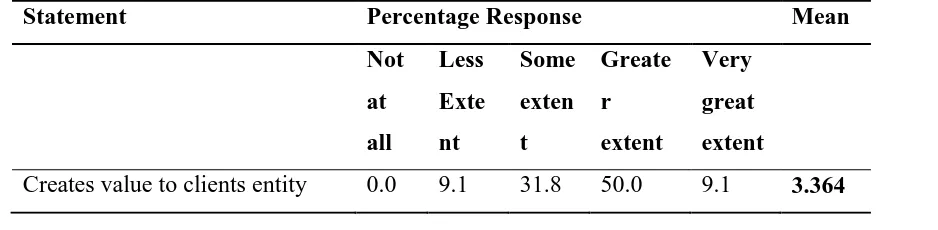
JAN-FEB, 2013, Vol. – I, Issue-IV www.srjis.com Page 798 The study findings revealed that 90.9% of the respondents agreed that goal focus creates
value to client’s entity. Of these 31.8% was to some extent, 50% was to a greater extent, while 9.1% was to a very great extent. This implies that internal audit by actualizing the clients’ goals it added value to the organization hence by achieving clients’ goals this improves the performance of the internal audit. In addition 90.9% of the respondents agreed that goal focus enhances good governance in public sector. Of these 34.1% was to some extent, 47.7% was to a greater extent, while 9.1% was to a very great extent. Therefore, Internal Audit departments in public sector should have RBA which promotes good governance.
Comparing statistical mean on the extent to which strategic planning had been applied in internal audit in public sector in order of magnitude: Organizational recognition in the market place (M=3.591) and creates value to clients entity (M=3.364).
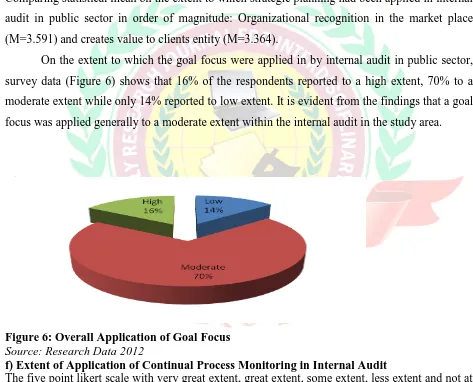
On the extent to which the goal focus were applied in by internal audit in public sector, survey data (Figure 6) shows that 16% of the respondents reported to a high extent, 70% to a moderate extent while only 14% reported to low extent. It is evident from the findings that a goal focus was applied generally to a moderate extent within the internal audit in the study area.
[image:14.612.67.540.233.615.2]
Figure 6: Overall Application of Goal Focus
Source: Research Data 2012
f) Extent of Application of Continual Process Monitoring in Internal Audit
[image:14.612.69.520.661.721.2]The five point likert scale with very great extent, great extent, some extent, less extent and not at all was used. The results are tabulated in the Table 7;
Table 7: Extent of Application of Continual Process Monitoring in Internal Audit Enhances organizational
recognition in the market place
4.5 4.5 34.1 47.7 9.1 3.591
Statement Percentage Response Mean
Not
at
Less
Exte
Some
exten
Greate
r
Very
JAN-FEB, 2013, Vol. – I, Issue-IV www.srjis.com Page 799 The study findings revealed that 99.8% of the respondents agreed that continual process
monitoring identifies significant internal control weaknesses and designs ways to address them. Of these 27.3% was to some extent, 54.5% was to a greater extent, while 18.2% was to a very great extent. This implies that mechanisms have been put in place to continually identify and update significant internal controls weaknesses and designing ways of addressing them. In addition 90.8% of the respondents agreed that continual process monitoring monitors progress in addressing previously identified risks. Of these 29.5% was to some extent, 45.5% was to a greater extent, while 15.8% was to a very great extent. This implies that mechanisms have been put in place to continually monitor the progress of previously identified risks and ensure identified loopholes are sealed. Further 90.9% of the respondents agreed that continual process monitoring identifies good practices and improvement opportunities. Of these 22.7% was to some extent, 52.3% was to a greater extent, while 15.9% was to a very great extent. This implies that RBA promotes learning process which leads to development of best practices which leads to enhanced performance.
Comparing statistical mean on the extent to which continual process monitoring had been applied in IA in public sector in order of magnitude: Monitors progress in closing previously identified risks (M=3.909) identifies good practices and improvement opportunities (M=3.605) and continual process monitoring identifies significant internal control weaknesses and designs ways to address them (M=3.523),
On the extent to which the continual process monitoring were applied in by internal audit in public sector, survey data (Figure 7) shows that 27.3% of the respondents reported to a high extent, 47.7% to a moderate extent while only 25% reported to low extent. It is evident from the findings that a continual process monitoring was applied generally to a moderate extent within the internal audit in the study area.
all nt t extent extent
Identifies significant internal control weaknesses and designs ways to address them
0.0 0.0 27.3 54.5 18.2 3.523
Monitors progress in closing previously identified risks
4.5 4.5 29.5 45.5 15.8 3.909
Identifies good practices and improvement opportunities
JAN-FEB, 2013, Vol. – I, Issue-IV www.srjis.com Page 800 Figure 7: Overall Application of Continual Process Monitoring
g) Extent of Application of Continual Risk Management Measures
The five point likert scale with very great extent, great extent, some extent, less extent and not at all was used. The results are tabulated in the table 8.
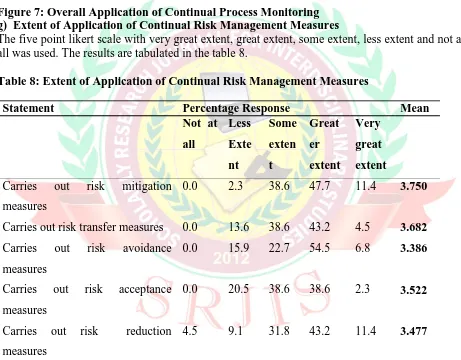
Table 8: Extent of Application of Continual Risk Management Measures
The study findings revealed that 97.7% of the respondents agreed that continual risk management measures ensure risk mitigation measures are carried out. Of these 38.6% was to some extent, 47.7% was to a greater extent, while 11.4% was to a very great extent. Therefore, based on the study findings risk mitigations measures could prevent occurrence of adverse event or transactions being carried out. This in turn could result to good internal audit performance. In addition 86.3% of the respondents agreed that continual risk management measures ensure risk
Statement Percentage Response Mean
Not at
all
Less
Exte
nt
Some
exten
t
Great
er
extent
Very
great
extent
Carries out risk mitigation measures
0.0 2.3 38.6 47.7 11.4 3.750
Carries out risk transfer measures 0.0 13.6 38.6 43.2 4.5 3.682 Carries out risk avoidance
measures
0.0 15.9 22.7 54.5 6.8 3.386
Carries out risk acceptance measures
0.0 20.5 38.6 38.6 2.3 3.522
Carries out risk reduction measures
JAN-FEB, 2013, Vol. – I, Issue-IV www.srjis.com Page 801 transfer measures are carried out. Of these 38.6% was to some extent, 43.2% was to a greater
extent, while 4.5% was to a very great extent. This implies that the client is able to engage the expertise in dealing with the risky areas hence save on time and cost.
Further 84% of the respondents agreed that continual risk management measures ensure risk avoidance measures are carried out. Of these 22.7% was to some extent, 54.5% was to a greater extent, while 6.8% was to a very great extent. This implies that, there are measures to ensure that risks the client could not be able to handle were avoided. The study findings also revealed that 79.5% of the respondents agreed that continual risk management measures ensure risk acceptance measures are carried out. Of these 38.6% was to some extent, 38.6% was to a greater extent, while 2.3% was to a very great extent. This implies there were measures to ensure that risks the client could be able to manage were being accepted. This implies that the client is able to determine the merits and demerits of a certain level of risk acceptance. Based on the study findings 86.4% of the respondents agreed that continual risk management measures ensure risk reduction measures are carried out. Of these 31.8% was to some extent, 43.2% was to a greater extent, while 11.4% was to a very great extent. This implies that systems have been put in place to minimize the risk levels.
Comparing statistical mean on the extent to which continual risk management measures had been applied in internal audit in public sector in order of magnitude: Carries out risk mitigation measure (M=3.750), Carries out risk transfer measures (M=3.682), Carries out risk acceptance measures (M=3.522), Carries out risk reduction measures (M=3.477) and continual risk management measures carries out risk avoidance measures (M=3.386).
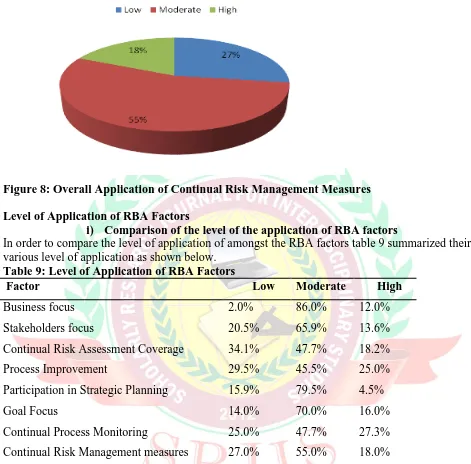
JAN-FEB, 2013, Vol. – I, Issue-IV www.srjis.com Page 802 Figure 8: Overall Application of Continual Risk Management Measures
Level of Application of RBA Factors
i) Comparison of the level of the application of RBA factors
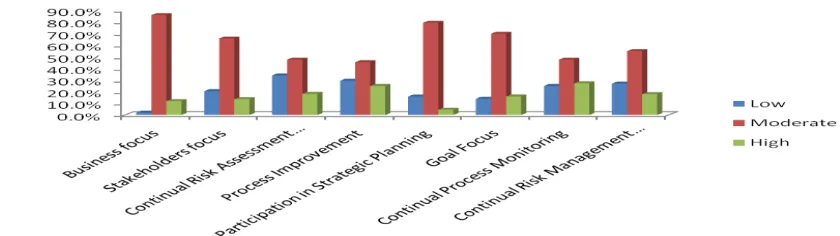
In order to compare the level of application of amongst the RBA factors table 9 summarized their various level of application as shown below.
Table 9: Level of Application of RBA Factors
Factor Low Moderate High
Business focus 2.0% 86.0% 12.0%
Stakeholders focus 20.5% 65.9% 13.6%
Continual Risk Assessment Coverage 34.1% 47.7% 18.2%
Process Improvement 29.5% 45.5% 25.0%
Participation in Strategic Planning 15.9% 79.5% 4.5%
Goal Focus 14.0% 70.0% 16.0%
Continual Process Monitoring 25.0% 47.7% 27.3%
Continual Risk Management measures 27.0% 55.0% 18.0%
JAN-FEB, 2013, Vol. – I, Issue-IV www.srjis.com Page 803 Figure 9: Comparison on the Level of Application of Risk Based Audit Factors
ii) Overall Application of RBA Factors
In order to get the overall effect of all the risk based audit factors, the computed index for all the individual respondents were computed and summarized as shown on the table 10 below.
Table 10: Overall application of RBA factors
Level Frequency Percent
Low 8 18.2
Moderate 21 47.7
High 15 34.1
Total 44 100.0
On the extent to which the overall risk based audit factors were applied in by internal audit in public sector, survey data (Figure 13) shows that 18.2% of the respondents reported to a low application, 47.7% to a moderate application and 34.1% reported to high application. It is evident from the findings that a risk based audit factors were applied generally to a moderate extent within the internal audit in public sector.
JAN-FEB, 2013, Vol. – I, Issue-IV www.srjis.com Page 804 Conclusion
This study evaluated RBA factors in the internal audit in public sector in South Rift. It also highlighted on the level of application of the factors. The study findings may be useful in providing clear understanding of the subject of RBA and its application by internal audit in public sector. Based on the survey findings, the study concluded that RBA factors have been moderately applied in internal audit in public sector in South Rift.
Recommendations
It is evident from the study findings that RBA factors have only been moderately applied by the internal audit in public sector. This study recommends the need to higher application of RBA factors as well as other elements of RBA in the internal audit in public sector.
Suggestions for Further Research
This study provided relevant insight on the evaluation of RBA factors and the effect on internal audit performance in public sector within south rift. It is important that further research is carried out to assess the impact of RBA factors on internal audit performance through assessment of internal operations and process changes rather than from individual internal auditors. The same research should be conducted in the same areas but more focus should be on qualitative measures of performance. Further research should be conducted in a different area like private sector and parastals to establish whether the same results would be obtained. REFERENCES
Frigo, M.L. (2002). A Balanced Scorecard Framework For Internal Auditing Departments. Altamonte Springs, FL: The Institute Of Internal Auditors Research Foundation.
Fuente, L. And Vega, G. (2003), “Risk Management In Non-Financial Companies”, Double Entry, December, 54-60.
Funston, R. (2003), “Creating A Risk-Intelligent Organization”, The Internal Auditor, Vol. 60
(2), 59-63.
Government Of Kenya (2005). Internal Audit Manual, Government Printers, Nairobi, Kenya Goodwin, J. (2004), “A Comparison Of Internal Audit In The Private And Public Sectors”,
Managerial Auditing Journal, Vol. 19 (5), 640-50.
Gramling, A.A., Maletta, M.J., Schneider, A. And Church, B.K. (2004), “The Role Of The Internal Audit Function In Corporate Governance: A Synthesis Of The Extant Internal Auditing Literature And Directions For Future Research”, Journal Of Accounting
Literature, Vol.23 194-244.
Gramling, A. And Myers, P. (2006), “Internal Auditing’s Role In ERM”, The Internal Auditor,
Vol. 62 (2), 52-8.
Griffiths, D. (2006). Risk Based Internal Auditing: An Introdution, Available At: Www.Internalaudit. Biz.
Grobstein M, Loeb S, Neary R, (1985). Auditing: A Risk Analysis Approach, Richard D. Irwin, Inc Millichamp A (2002) Auditing, 8th Edition,
IIA – UK And Ireland (2003). Risk Based Internal Auditing, Institute Of Internal Auditors, Altamonte Springs, FL, Available At: Www.Iia.Org.Uk
IIA – UK And Ireland (2005), Internal Audit 2005. A Survey Of Current Practice In Ireland, Institute Of Internal Auditors, Altamonte Springs, FL, Available At: Www.Iia.Org.Uk IIA (2001). Practice Advisory 2100-4: Internal Auditing’s Role In Organization Without A Risk
JAN-FEB, 2013, Vol. – I, Issue-IV www.srjis.com Page 805 IIA (2004a). International Standards For The Professional Practice Of Internal Auditing,
Institute Of Internal Auditors, Altamonte Springs, FL.
IIA (2004b), “Definition Of Internal Auditing”, Available At: Www.Theiia.
IIA (2009). IIA Position Paper: The Role Of IA In ERM, Institute Of Internal Auditors, Altamonte Springs, FL, Available At: Www.Theiia.Org/Download.Cfm?File¼62465 Mcmillan, J. J And Schumacher, S., S (1993). Research In Education: A Conceptual
Introduction 3rd Ed. New York: Harper Collins