PERFORMANCE INVESTIGATION OF WIMAX 802.16M IN
MOBILE HIGH ALTITUDE PLATFORMS
1MARWA IBRAHIM, 2M.M. ZAHARA, ²SAMEH NOAMAN, ²RAGAB AL SAGHIER
1
, Department of communications, TELECOM EGYPT
2
Assoc. Prof., Department of Communications Engineering, AL AZHAR UNIVESITY
2Assoc. Prof., Department of Communications Engineering, MSA UNIVESITY 2Assoc. Prof., Department of Communications Engineering, AL AZHAR UNIVESITY
ABSTRACT
Providing WiMax broadband services via high altitude platforms (HAPs) is still an open research issue. One of the major problems affecting the system performance on the link level is Doppler Effect caused by the mobility of the served users. This paper investigates the Doppler effects on the bit error rate of mobile users in the downlink of the WiMax802.16m standard. The system key parameters that affect the error bit rate performance are also studied. These parameters include the channel propagation model. The Bit Error Probability (BEP) is the performance metric used to evaluate the downlink performance. Numerical results provided through simulations show that providing WiMax through high altitude platforms enhances the BER performance over that expected from conventional terrestrial systems.
Keywords: WiMax; HAPs; Doppler effect; IEEE802.16m; mobility
1. INTRODUCTION
The last decade has experienced an acute competition in the field of wireless communications developments either by extending the capability of existing systems or by developing new systems. Nowadays most of the broad band wireless services are provided through terrestrial systems or via satellites .The height of the communication platform appears to be quantized to either a near ground heights of about 50m or Satellite heights of about 36,000km for geosynchronous orbits .Intermediate height was not allowed due to the limitations of the existence of a suitable flying plat form that carries the communications equipment. Terrestrial systems are still the best alternative to satellites. Nowadays, communications plat forms at intermediate heights began to appear. These plat forms may be a helicopter or a balloon, standing still at height of about 17km up to 30km.The exact mechanism of hanging the platform is a left as a problem to aerodynamics engineers and is thus beyond the scope of this paper. HAPs can act as base-stations or relay nodes, which may be effectively regarded as a very tall antenna mast or a very Low-Earth-Orbit (LEO) satellite [1]. This modern communication solution has advantages of both terrestrial and satellite communications [1, 2, and 3]. It is a good technique for serving the
increasing demand of broadband wireless access (BWA) by using higher frequency allocations especially in mm-wavelength and high-speed data capacity. HAPs are also proposed to provide other communication services, i.e. 3G services, WiMax broadband services below 11 GHz. The International Telecommunication Union (ITU) allocated a frequency band around 2 GHz for IMT-2000 HAP service [4]. One of the problems limiting the system performance in terrestrial systems in a multi cell coverage environment the mobility of the users and while lacking a Line of Sight communications link between the user and his serving base station. A HAPs dependent coverage system may be considered as a promising solution for it always has a LOS link with the users it serves. As a consequence the
advantage of being independent of the path loss exponent that differs according to the environment in which the system is set up. Another advantage of this model is that it is semi deterministic as it depends on the exact user location and is capable of statistically predicting the attenuation of the transmitted signal in the downlink and assuming the general large scale Log normal fading distribution as will be seen in section (II).The rest of the paper is organized as follows. In section (II) a novel description of the system model is introduced along with expressions for the transmitted signal, channel model, the antenna model and the received signal model. Simulation results for both channel types are provided in section (III) with the Bit Error Probability as the performance metric of interest. Finally, the whole paper is concluded in section (IV).
2. MODELING THE HAP SYSTEM
2.1 System Overview
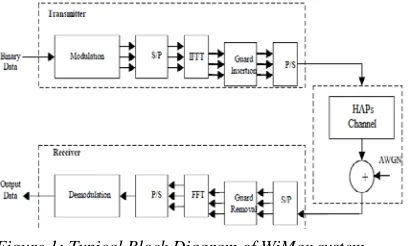
A typical block diagram of the WiMax system is shown in Fig (1).The user feeds information in the form of a stream of bits to a Forward Error Correction (FEC) scheme which is a Convolutional encoder. Convolution Coded bits are punctured and then interleaved. The resulted data are then mapped to one of the constellations (QPSK, 16QAM, and 64 QAM). Then the modulated data is then ODM modulated and transmitted over multi path channel. At the receiver after OFDM demodulation (guard time removal, FFT, zero de-padding) the user's assigned pilot and data subcarriers are extracted. Then the extracted data is soft bit de-mapped to compute the reliability of the constituent bits of the received constellation symbol. Hard decision is then performed to estimate the value of the transmitted bit stream.
2.2 The HAP Antenna Model
Usually, an aperture antenna is assumed for HAPs applications to deliver a narrow beam with a
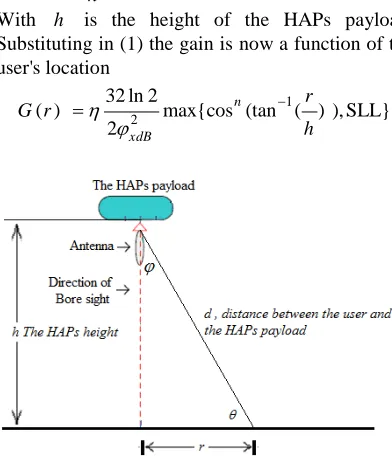
high suppression of side lobes. The main lobe of aperture antennas of medium and high directivity can be approximated by the cosine function raised to a power of n The peak directivity of circularly symmetric beams can be also approximated by a function of n While, the fluctuation in the power level within the side lobes can be substituted by a constant value that equals the average value of the leakage power through the minor lobes. This average value is called the Side Lobe Level (SLL).The normalized power gain is expressed in dB is equal to
2
2
| ( ) | 10 log
max{| ( ) | } G
GdB
G
ϕ ϕ
=
(1)
Whereϕis the angle measured from the bore sight
direction of the antenna as illustrated in Fig (2). Recalling that the antenna gain is related to its directivity as Gain = ×η Directivity
With ηis the efficiency of the antenna. A value of
0.7 is a typical one for the antenna efficiency .The directivity represented as a raised cosine function is thus
cos ( )o n
D =D ϕ
(2)
2
32 ln 2
2
o
xdB
D
ϕ
=
(3)
WithϕxdBis the beam width defined as the angle at which the gain falls xdBbelow its maximum value. In practical system, the beam width and the roll off factor are selected such that the beam width coincides with the cell boundaries whose radius is known priori. The beam width and the roll off factor are related as
0.1
cos( ) 10
2
n xdB
xdB
θ −
=
(4)
Solving for n, the roll off factor can be calculated by
cos( )
2 0.1
log xdB
xdB
n θ
−
=
(5)
The total antenna gain can be expressed as
2
32 ln 2
( ) max{cos ( ), SLL} 2 xdB
n
G ϕ η ϕ
ϕ
=
(6)
[image:2.612.92.297.558.681.2]The angleϕ that a user that makes with the bore sight direction of its serving antenna and the distance r from the origin of its serving cell are related as
1
tan ( ) r h
ϕ = −
(7)
With h is the height of the HAPs payload. Substituting in (1) the gain is now a function of the user's location
1 2
32 ln 2
( ) max{cos (tan ( ) ), SLL}
2
n
xdB
r G r
h
η ϕ
− =
2.3 Propagation Channel Model
Currently, most of the literature on broadband communications delivered via the HAPs systems assumes a free space path loss (FSPL) for modeling the propagation channel in the downlink. The FSPL is given by
2
4 PL( ,x y) ( πd)
λ
=
(8)
Whered =
r
2+h2 is the distance between the location of the desired user and the HAPs payload,ris the separation of the desired user from the origin that lies at the center of the coverage area and λ is the operating wavelength of the RF carrier. The elevation angleθrelated to the height of the HAPs payload,h and the radius of coverage
cov
R as
1 cov
tan (R ) h
θ = −
(9)
Typically the elevation angle of the HAPs ranges from 10º up to 90º and the HAPs heighth =17km : 30km.Until 2008, no specific propagation model has been established for HAPs at 3.5GHz, and therefore FSPL has been widely used in current research. It should also be noted that directional user antennas are likely to be installed at a fixed location with this scenario. High elevation angles owing to the relatively small radius of HAP
coverage also mean that the LOS propagation to the HAP is a reasonable assumption. Therefore, FSPL is used in this article, and diffraction and shadowing are not explicitly considered without loss of general validity. Several propagation models have been developed for HAPs in mm-wave band at 47/48 GHz, but they are not applicable in the 3.5GHz frequency band. A simple FSL propagation model is unsuitable for system simulations of mobile systems provided via HAPs in urban areas [6] in which communications through HAPs is an ideal solution. In this paper we investigate the effect of an experimentally verified model that is suitable for the 2-6GHz broadband communications using the HAPs band for .The model is elevation angle dependent and assumes that the FSL can take place via a Line Of Sight (LOS) path or a Non Line of Sight path (NLOS) .This both propagation scenarios will be investigated in this paper. According to [6].The model is suitable for four different types of environment were selected for the scenarios presented here and a measurement campaign demonstrated the applicability of the new propagation model.
1) Suburban area. 2) Urban area. 3) Dense urban area. 4) Urban high-rise area.
Based on the measurement results presented in [6], the path loss in built-up areas can be expressed in dB as
FSL LOS
FSL S NLOS
L L
L L
ζ
ζ + =
+ +
(10)
WithLFSLis the free space path loss in dB LS is the shadowing loss and ζLOS,ζNLOSare correction factors responsible for the shadowing phenomenon that takes place in a dense urban environment and are represented as a Log normally distributed random variable that is
20 log( ) 20 log( ) 92.4
FSL km GHz
L = d + f +
(0, ) , 3 5 dB LOS
LOS X dB N
ζ = : σ ≤σ ≤
(0, ) , 8 12 dB NLOS
NLOS X dB N
ζ = : σ ≤ ≤σ
(11)
[image:3.612.92.288.121.349.2]Withdkmis the distance between the HAPs payload and the ground receiver in km and fGHz frequency in GHz. The shadowing loss LS (expressed in dB) as a function of the elevation angle θ is represented by a random variable (RV) that follows
a normal distribution parameterized by (11).The standard deviation of this normal distribution ranges from3to5dB for LOS connections and from 8 to 12 dB for NLOS connections. Because of the need for realistic system-level modeling of mobile systems, random components and in dB are added as a location variability utilizing the log-normal distribution with a zero mean.
2.4 Modeling the User's Mobility
WiMax is a type of OFDM based system that depends on multi carrier .In a multi carrier system, no unique carrier is used to convey the information bearing signal, rather, the user data is divided into several parallel streams of symbols of equal rate and each stream modulates a different carrier. The set of carriers' frequencies are selected such that the carrier sinusoids are orthogonal and the parallel modulated streams are then summed up. The orthogonality property of the carrier set is then utilized at the receiver for purpose of accurate recovery of the information signal. One major problem of the OFDM based systems is the mobility of one of the communicating parties; usually the communications link is established between a fixed Base station and a mobile unit. In the present system the HAPs is fixed and the desired user is allowed to move through the coverage area. Since the carriers are orthogonal, the relative orthogonality between carriers must be kept along the channel. Any frequency offset in one or more of the carriers may disturb the carriers' orthogonality and hence the parallel streams are overlapped in the frequency domain in such a way that the information they bear is essentially destroyed. The use of a High Altitude Platform as an equivalent communications regulation center may be a promising solution for this problem as the user in the downlink depends always on a line of sight path
2.5 The received Signal Model
From the above analysis the channel model affecting the user's BER performance can be divided into two parts. The first part is the attenuation in the HAPs channel through which the transmitted signal will pass and can be modeled as
αwhere
0.1L( )
10
dBα
=
(12)
Secondly, the Doppler shift caused by the user's mobility is responsible for a frequency offset that depends on the user's velocity and can be modeled as [6]exp( 2 )
Doppler d
h = j πf t
(13)
As the system is simulated in the discrete time form, the continuous time t should be substituted byits discrete time versiont =nT Ts, s =1 /Rs, Rsis
the symbol rate and n∈{0,1, ...}.Thus;
exp( 2 / ), {0,1, ...}
Doppler d s
h = j πnf R n∈
(14)
The channel effect is the product of (12) and (13) and can be written as
0.1L( )
[n]
10
dB exp( 2 d / s)h
=
- j πnf R (15)The above equation grasps the effect of both the HAPs channel model provided by [6] and the Doppler Effect provided by [7] and as a result, more accurate conclusions can be drawn from system levels simulations. The received signal is thus the result of convolution between the transmitted signal and the channel, however, in the case of LOS environment, the convolution process is simplified to a multiplication process and the received signal [n]r is thus;
1 2 0.1L( )
1 2
)
[n] = [ ] [n] + N [n]
2 ( /
10 exp( ) + N [n]
fft
fft
OFDM
N L dB
OFDM k
N fft
k
s d
r s n h
k f R n
E s j
N π
−+
−
− =−
+
=
∑
[image:4.612.334.510.484.635.2]With N[n] is a realization of an Additive White Gaussian Noise with zero mean and unit variance.
3. CONCLUSION
The aim of this study was to introduce the High Altitude Platform systems as a superior to the conventional terrestrial systems in providing
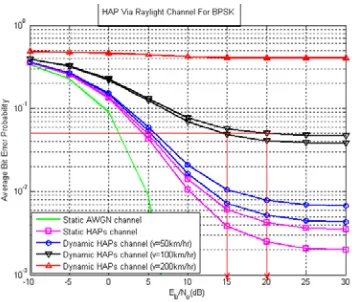
WiMax services, especially in high mobility environment. Although the Bit Error Rate performance of a HAPs system degrades with increasing the user mobility as in terrestrial systems, the gain in SNR for a HAPs system is higher for the same BER, for Example at fig (3) we note that, at the same value for BER we find SNR for HAP= 15 dB, where for terrestrial system= 20 dB. Then, this idea reduces SNR by more than 5 dB. In other words, a HAPs system achieves always a better BER performance at different user velocities if the received SNR is the same as for a user in a terrestrial system, making it promising alternative in future 4G communications services.
REFRENCES:
[1] A. Mohammed, S. Arnon, D. Grace, M. Mondin, and R. Miura,"Advanced communications techniques and applications for high-altitude platforms," Editorial for a special issue inEURASIP Journal on Wireless Communications andNetworking, vol. 2008, [2] G. M. Djuknic, J. Freidenfelds, and Y. Okunev,
"Establishing wireless communications services via high-altitude aeronautical platforms: A concept whose time has come?," IEEECommunications Magazine, vol. 35, pp. 128-135, 1997.
[3] R. Steele, "Guest Editorial: An update on personal communications," IEEE Communications Magazine, pp. 30-31,1992. [4] D. Grace, N. E. Daly, T. C. Tozer, A. G. Burr,
and D. A. J. Pearce, "Providing multimedia communications from high altitude platforms," International Journal of Satellite Communications, pp. 559-580, 2001.
[5] Jaroslav Holis, and Pavel Pechac," Elevation Dependent Shadowing Model for Mobile Communications via High Altitude Platforms in Built-Up Areas" ,IEEE TRANS. on Antennas and Propagation, vol. 56, No. 4, pp.1078-1083, 2008.
[image:5.612.94.289.75.252.2][6] H. A. Mohammed, M. J. N. Sibley and P. Mather"Investigation of Doppler Effects On High Mobility OFDM-MIMO Systems", School of Computing and Engineering Researchers’ Conference, University of Huddersfield, Dec 2010.
[image:5.612.101.282.293.439.2]Figure 4: BER Performance of a mobile HAPs WiMax system for QPSK modulation
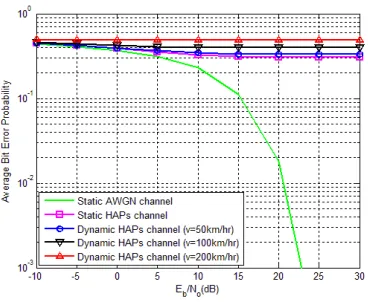
Figure 5: BER Performance of a mobile HAPs WiMax system for 16QAM modulation
[image:5.612.99.283.479.630.2]