ISSN: 1992-8645 www.jatit.org E-ISSN: 1817-3195
A GREY DATA ENVELOPMENT ANALYSIS MODEL
1,2HUAFENG XU, 2SHUKE ZHOU
1College of Economics and Management, Nanjing University of Aeronautics and Astronautics, Nanjing
210016,Jiangsu, China
2Henan University of Urban Construction, Pingdingshan 467036, Henan, China
ABSTRACT
In this paper, grey system theory and DEA are combined to establish a grey DEA model. In traditional DEA model, Input and output values of decision-making groups are all real numbers and real variables. They are replaced by grey numbers and grey variables in grey DEA model respectively. Using positioning solution method of grey linear programming, we prove the necessary condition for grey effective of decision making unit. As a practical application, we evaluate the performance of eight listed companies in Qingdao City, Shandong Province, China. Listed companies are seen as decision-making unit, we analyze DEA effective of their performance.
Keywords: Grey System, Data Envelopment Analysis, Grey Linear Programming, Grey Dea Effective
1. INTRODUCTION
Grey system theory is a new method that studies problem of little research data and poor information with uncertainties. Its experimental observation data has no any special requirements and limitations, and therefore it is a very broad application area. Professor Deng Julong puts forward the grey linear programming (LPGP) theory. In GLP model, grey number was introduced to represent uncertainty information, and the grey information bring the grey solution.[1-3] After nearly three decades of
development, taking “small sample”, “poor
information” uncertain system as the research objects, the comparatively perfect theoretical framework, method groups and model groups have been gradually included in grey systems theory, and great superiority and vigorous vitality are shown when they are applied in various fields such as society, economy, life, production, etc. [4-10]
Data envelopment analysis (DEA) is a crossover study field in operations research, management science and mathematical economics. Based on the relative efficiency concept and multiple indicator inputs and multi-objective indicator of output data, data envelopment analysis evaluates the relative effectiveness of the decision-making unit. The significant advantage of DEA is that we can calculate the input-output efficiency of the decision-making unit without considering the functional relationship between inputs and outputs, no requiring pre-estimate parameters and assuming any weights, avoiding subjective factors. Especially DEA effectiveness is equivalent to Pareto effectiveness. Because of this unique advantage, in
the past 30 years DEA has made great progress and a large number of theoretical studies and practical applications. DEA has become a mathematical analysis tools in management science and systems engineering. [11-16]
Data envelopment analysis (DEA) theory, taking efficiency analysis as the research starting point, nonparametric methods as characteristics, programming models as research tools, is a common system analysis method in management science research. When used for efficiency evaluation in uncertain systems, the traditional DEA models appear "stranded". DEA models with imprecise data which have been made some achievements but still not perfected need further in-depth study. There are the same application fields of grey system theory and data envelopment analysis from different research perspectives, and combined models with the advantages of the both theories have yet to be established and tested in practice.
2. PRELIMINARIES
determine whether a decision making unit j0 is DEA efficient. 0 0 1 1 1 min . (r=1, s)
(i=1, m) (1) 1 (j=1, n)
n
j rj rj j
n
j ij ij j n j j E st y y x Ex λ λ λ = = = ≥ ≥ ≥
∑
∑
∑
When E <1, the j0 decision making unit is non-DEA effective, otherwise it is non-DEA effective. Suppose there are n decision making units, each decision making unit has m types of inputs and s types of outputs ( j=1, 2,,n ).The integrated DEA model is as follow.
( )
( )
30 1 0
1 0
0
1 2 0
max
0, 1, 2, ,
0
0, 0, 1 0
T PI T T j j I T Y V
X Y j n
P
X
δ
µ δ µ ω µ δ µ
ω
ω µ δ δ µ
− = − + ≥ = = ≥ ≥ − ≥ (2)
( )
( )
30 1
0 1
1 2 1
1 min
1
0, 1, 2, , , 1
i D n j j j n I j j j n j n j j V X X Y Y D
j n n
δ
θ
λ θ
λ
δ λ δ λ δ
λ = = + = = ≤ ≥ + − = ≥ = +
∑
∑
∑
(3)Where Xj =
(
x1j,x2j,,xmj)
T are input vector and Yj =(
y1j,y2j,,ysj)
T are output vector. Thecorresponding production possibility set is as follow.
3
1 1
1 2 1 1
{( , ) | , , ( ( 1) ) ,
0, 1, 2, , , 1} (4)
n n
j j j j
j j
n
j n
j j
T X Y X X Y Y
j n n
δ
λ λ
δ λ δ λ δ
λ = = + = ≤ ≥ + − = ≥ = +
∑
∑
∑
Where the value of parameterδ1,δ2,δ3 is 0 or 1.
3. GREY DATA ENVELOPMENT NALYSIS MODEL
In the traditional DEA model, Input and output values of decision-making groups are all real numbers. However, in many practical problems, evaluators often do not know their true value. The evaluation variables are indicated by grey number more appropriately.
Suppose there are n decision making units, each decision making unit has m types of inputs and s types of outputs ( j=1, 2,,n).The integrated grey DEA model is as follow.
(
)
( )
( )
( )
( )
30 1 0
1 0
0
1 2 0
max
0,
1, 2, , 0
0, 0, 1 0
T PI T T j j I T
Y G V
X Y
G P j n
X
δ
µ δ µ ω µ δ µ
ω
ω µ δ δ µ
⊗ − = − ⊗ − ⊗ + ≥ − = = ≥ ≥ − ≥
(5)
(
)
( )
( )
( )
( )
( )
30 1
0 1
1 2 1
1 min
1
0, 1, 2, , , 1
i D n j j j n I j j j n j n j j G V X X Y Y D P
j n n
δ
θ
λ θ
λ
δ λ δ λ δ
λ = = + = = − ⊗ ≤ ⊗ ⊗ ≥ ⊗ − + − = ≥ = +
∑
∑
∑
(6)Where Xj
( )
⊗ are input vector and Yj( )
⊗ are output vector.( )
(
1( )
, 2( )
, ,( )
)
T j j j mj
X ⊗ = x ⊗ x ⊗ x ⊗
( )
(
1( )
, 2( )
, ,( )
)
T j j j sj
Y ⊗ = y ⊗ y ⊗ y ⊗
The numbers xij
( )
⊗ and yrj( )
⊗ are grey numbers.i=1, 2,,m,j=1, 2,,n,r=1, 2,,s.T he corresponding production possibility set are as follow.( )
( ) ( )
( )
( )
( )
( )
31
1 2 1
1
1
{( , ) | , , ( ( 1) ) , 0, 1, 2, , , 1} (7)
n
j j j
n n
j j j n
j j
j
T X Y X X
Y Y
j n n
δ
λ
λ δ λ δ λ
δ λ = + = ⊗ = ⊗ ⊗ ⊗ ≤ ⊗ ⊗ ≥ ⊗ + − = ≥ = +
∑
∑
∑
Where the value of parameterδ1,δ2,δ3 is 0 or 1.
When δ =1 0 ,
(
G−PI)
is grey input modelISSN: 1992-8645 www.jatit.org E-ISSN: 1817-3195
input model named 2
BC .When δ =1 1 , δ =2 1 ,
3 0
δ = ,
(
G−PI)
is grey input model namedFG.
Whenδ =1 1,δ =2 1 andδ =3 1,
(
G−PI)
is greyinput model namedST.
Definition 1 When the optimal value of
(
I)
G−P and
(
D−PI)
areG V− PI = −G VDI =1,we call 0
j
DMU is weakly grey efficient.
Definition 2 If grey linear programming
(
I)
G−P has optimal solution as follow,
( )
( )
( )
0 0 0
0
, ,
ω ⊗ µ ⊗ µ ⊗
Which satisfy ω0
( )
⊗ >0,µ0( )
⊗ >0 and( )
0 0
0 1 0 1
T
Y
µ ⊗ −δ µ = , we call
0
j
DMU is grey
efficient decision making unit of DEA. Theorem 1 If
0
j
DMU is (weakly) grey efficient
decision making unit of grey input model
named FG , it must be (weakly) grey efficient
decision making unit of grey input BC2 model.
Proof In integrated DEA model,
whenδ1=1,δ2 =1,δ3=0 ,
(
G−PI)
is grey inputFG model. If
0
j
DMU is (weakly) grey efficient
decision making unit of grey input FG model,
there must be 0
( )
0( )
0( )
0
, ,
ω ⊗ µ ⊗ µ ⊗ , which satisfy
( ) ( )
( )
0 0
0 1 0 1
T
Y
µ ⊗ ⊗ −δ µ ⊗ =
and
( )
( )
( )
0 0 0
0
0, 0, 0
ω ⊗ ≥ µ ⊗ ≥ µ ⊗ ≥
In integrated DEA model, when δ =1 1 ,
2 0
δ = ,δ =3 0,
(
G−PI)
is grey input BC2 model. For grey input BC2 model, if there is a solution( )
0,( )
0, 0( )
t t t
ω ⊗ ≥ µ ⊗ ≥ µ ⊗ which satisfies the
formula tT
( ) ( )
0 1 0t( )
1Y
µ ⊗ ⊗ −δ µ ⊗ = , then it is
efficient.
Obviously, when
( )
( )
( )
( )
( )
( )
0
0
0
0 0
,
,
t t t
ω ω µ µ µ µ
⊗ = ⊗
⊗ = ⊗
⊗ = ⊗
For grey input BC2 model, we have
( ) ( )
( )
0 0
0 1 0 1
T
Y
µ ⊗ ⊗ −δ µ ⊗ =
Then when 0
j
DMU is (weakly) grey efficient
decision making unit of grey input FG model, it must be (weakly) grey efficient decision making unit of grey input BC2 model.
Theorem 2 If 0
j
DMU is (weakly) grey efficient
decision making unit of grey input FG model, and
(
I)
FG
G−P has optimal solution which form is
( )
( )
( )
0 0 0
0
, ,
ω ⊗ µ ⊗ µ ⊗ , and 0
( )
0 0
µ ⊗ = , then
0
j
DMU must be (weakly) grey efficient decision
making unit of grey input C R2 model. Proof Suppose
0
j
DMU is (weakly) grey efficient
decision making unit of grey input FG model, and
(
I)
FG
G−P has optimal solution which form is
( )
( )
( )
0 0 0
0
, ,
ω ⊗ µ ⊗ µ ⊗ , and
( )
0
0 0
µ ⊗ =
Then
( ) ( )
( ) ( )
( ) ( )
( ) ( )
( )
0 0
0 0 0
0
0
T T
j j
T T
j j
X Y
X Y
ω µ
ω µ µ
⊗ ⊗ − ⊗ ⊗
= ⊗ ⊗ − ⊗ ⊗ + ⊗ ≥
1, 2, ,
j= n
( ) ( )
0
0 1
T
X
ω ⊗ ⊗ =
( ) ( )
( ) ( )
( )
0 0 0
0 0 0 1
T T
Y Y
µ ⊗ ⊗ =µ ⊗ ⊗ −µ ⊗ =
Thus ω0
( )
⊗ ,µ0( )
⊗ is optimal solution of(
2)
I C R
G−P model.
As ω0
( )
⊗ >0,µ0( )
⊗ >0 and 0( )
0 1
T
Y
µ ⊗ = ,
0
j
DMU is grey efficient decision making unit of
2
C Rmodel.
When 0
j
DMU is (weakly) grey efficient decision
making unit of grey input FG model, and
(
I)
FG
G−P has optimal solution which form are
( )
( )
( )
0 0 0
0
, ,
ω ⊗ µ ⊗ µ ⊗ , and 0
( )
0 0
µ ⊗ = , by similar method we wan have
0
j
DMU must be
(weakly) grey efficient decision making unit of grey input C R2 model.
Theorem 3 If 0
j
DMU is (weakly) grey efficient
decision making unit of grey input ST model, and
(
I)
ST
G−P has optimal solution which form is
( )
( )
( )
0 0 0
0
, ,
ω ⊗ µ ⊗ µ ⊗ , and 0
( )
0 0
µ ⊗ = , then
0
j
DMU must be (weakly) grey efficient decision
4. SOLVING PROCESS OF GREY DATA ENVELOPMENT ANALYSIS MODEL
For grey linear programming
( )
( )
( )
max ( )f x C T X
A b
B d
= ⊗ ⊗ ≤ ⊗ ≤
(7)
1 2
[ , , , ]T
n
X = x x x
( )
[ 1( ) ( )
, 2 , ,( )
]T n
C ⊗ = c ⊗ c ⊗ c ⊗
( )
[ , ] i i ic ⊗ ∈ c c ,i=1, 2,,n
( )
[ j( )
]m n, j( )
[ j, j]A ⊗ = aµ ⊗ × aµ ⊗ ∈ aµ aµ
( )
[ j( )
]p n, j( )
[ j, j]B ⊗ = bν ⊗ × bν ⊗ ∈ bν bν
1 2 1 2
=[ , , , m] , =[ ,T , , p]T
b b b b d d d d
Set
( )
( )
( )
+1
= + ( - ) = + ( - )
= + ( - ) =
i i i i j j j j
j j j j n
c c c c
a a a a
b b b b
x
µ µ µ µ
ν ν ν ν
θ θ θ θ ⊗ ⊗ ⊗
Using the above equation we can transform grey linear programming into ordinary linear programming as follow.
+1 =1
+1 =1
+1 =1
+1
max ( )= [ + ( - )]
. .
[ + ( - )]
-[ + ( - )] - (8)
0 1
=1,2, , ; =1,2, , ;
n
i n i i i i
n
j n j j i j
n
j n j j i j
n
f x c x c c x
s t
a x a a x b
b x b b x d
x
m p p n
µ µ µ µ
ν ν ν ν
θ
θ
µ ν
≤
≤
≤ ≤
≤
∑
∑
∑
5. CASE STUDY
By the above grey DEA model, we evaluate the performance of listed companies. First of all listed companies are seen as different decision-making unit, we analyze DEA effective of their performance. The two more representative input factors, circulation Unit number and total assets are input variables. The output variables are main business income, net profit, operating activities cash flows and inventory turnover rate. We select eight listed companies in Qingdao as our object. The corresponding data are obtained from the Securities Star website and they are grey numbers. As input and output indicators have different dimensions, and there is negative number in raw data, the solution of the linear programming problem is difficult to get. It is normalized to a certain dimensionless interval by a certain functional relationship. Dimensionless input and output of DMU are shown in Table1.
Table 1 Nondimensional Data
DMU company inputX1 inputX2 outputY1 outputY2 outputY3 outputY4
1 Jiante Biological [0.12,0.13] [0.11,0.12] [0.10,0.13] [0.13,0.14] [0.10,0.12] [0.44,0.45] 2 Tsingtao Eastern [0.11,0.04] [0.11,0.13] [0.10,0.15] [0.11,0.16] [0.10,0.15] [0.12,0.17] 3 Tsingtao Brewery [0.41,0.45] 1 [0.46,0.48] [0.28,0.31] [0.59,0.68] [0.19,0.23] 4 Hisense Electric [0.42,0.48] [0.45,0.48] [0.34,0.36] [0.21,0.22] [0.31,0.35] [0.13,0.15] 5 Tsingtao Double Star [0.17,0.19] [0.10,0.13] [0.12,0.16] [0.15,0.21] [0.16,0.17] [0.10,0.11] 6 Tsingtao Haier 1 [0.75,0.84] 1 1 1 1 7 Tsingtao Soda [0.16,0.20] [0.23,0.25] [0.16,0.18] [0.17,0.20] [0.16,0.18] [0.28,0.34] 8 Aucma [0.16,0.17] [0.34,0.38] [0.15,0.18] [0.19,0.25] [0.52,0.56] [0.15,0.18]
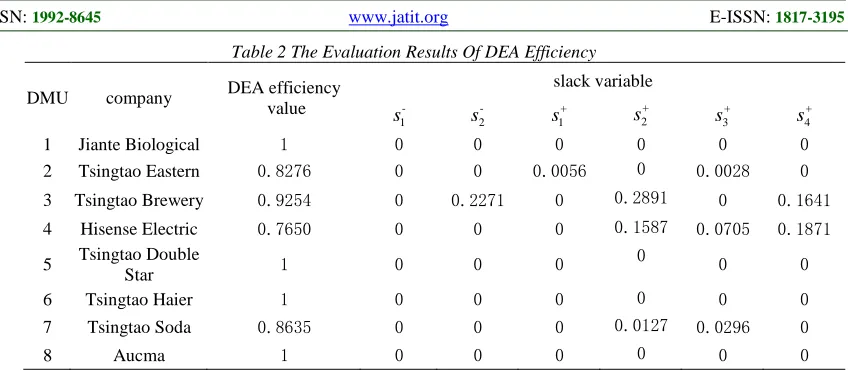
ISSN: 1992-8645 www.jatit.org E-ISSN: 1817-3195 Table 2 The Evaluation Results Of DEA Efficiency
DMU company DEA efficiency value slack variable
-1
s
-2
s +
1
s s2+ +
3
s +
4
s
1 Jiante Biological 1 0 0 0 0 0 0
2 Tsingtao Eastern 0.8276 0 0 0.0056 0 0.0028 0 3 Tsingtao Brewery 0.9254 0 0.2271 0 0.2891 0 0.1641 4 Hisense Electric 0.7650 0 0 0 0.1587 0.0705 0.1871
5 Tsingtao Double Star 1 0 0 0 0 0 0
6 Tsingtao Haier 1 0 0 0 0 0 0
7 Tsingtao Soda 0.8635 0 0 0 0.0127 0.0296 0
8 Aucma 1 0 0 0 0 0 0
Table 3 shows that DEA efficiency values of Jiante Biological, Tsingtao Double Star, Tsingtao Haier and Aucma are all equal to 1. At least they are DEA grey weakly efficient. Furthermore, the slack variable s- and +
s are equal to 0. It indicates that the production and operation of the four listed companies are relative grey efficiency. The DEA efficiency values of other listed companies are all less than 1. It indicates that the other companies are DEA grey not weakly effective, less DEA grey effective.
6. CONCLUSION
In this paper, the grey system theory and DEA are combined to establish a new grey DEA model. The intersection of two different theories contributes to the development of the two disciplines theory. It provides a new perspective and an integrated approach to solve practical problems. We explore the deficiencies of grey system theory and DEA and integrate the advantages of the two theories. At last, we create a combination model. Our method has a more widely
applications. It not only improves grey
comprehensive evaluation method, but also enhances the grey comprehensive evaluation method holistic and systematic evaluation. It provides effective ideas and approaches. The study of this problem will improve the further integration and development of the grey comprehensive evaluation method and DEA method. It can provide more effective information for decision-makers. But it is just an attempt to form a new model by combining the two theories. There are more research need to further develop for inspection, correction and additional in practical applications. The problems need to be further studied are as follow. When the variable is a grey number, what is
the path of decision-making unit promoted to DEA efficient from a non-DEA effective? If it is scale effective when it is effective technology? How to achieve scale effective? Solving these problems will procure DEA model to explain the reality more effective.
ACKNOWLEDGEMENTS
This work was supported in part by the National Natural Science Foundation (70701017) and Natural Science Research Project of Henan Province Department of Education (2011A110002).
REFERENCES:
[1] ChangYung Kung, KunLi Wen.
“
ApplyingGrey Relational Analysis and Grey Decision-Making to evaluate the relationship between company attributes and its financial performance---A case study of venture capital
enterprises in Taiwan
”,
Decision SupportSystems, Vol. 43, No. 3, 2007, pp. 842-852. [2] YiChung Hu.
“
Grey relational analysis andradial basis function network for determining
costs in learning sequences
”,
AppliedMathematics and Computation, Vol. 184, No. 2, 2007, pp. 291-299.
[4] A.J.C. Trappey, T.A. Chiang.
“
A DEA bench marking methodology for project planning and Management of new product development under decentralized profit-center business model”
, Advanced Engineering Informations, Vol. 22, No. 4, 2008, pp. 1-7.[5] Alex M.Andrew, “Grey Game Theory and Its Applications in Economic Decision-Making”,
Kybernetics, Vol. 39, No. 7, 2010, pp. 1205-1207.
[6] Li Qiaoxing, Liu Sifeng.
“
The GreyInput-Occupancy-Output Analysis
”,
Kybernetics, Vol. 38, No. 4, 2009, pp. 306-313.[7] QiaoXing Li.
“
Grey dynamic input-outputanalysis
”,
Journal of Mathematical Analysis and Applications, Vol. 359, No. 2, 2009, pp. 514-526.[8] Zhijie Chen, Qile Chen, Weizhen Chen, etc.
“
Grey linear programming”,
Kybernetes, Vol. 33, No. 2, 2004, pp. 238-246.[9] Li Qiaoxing.
“
The Covered Solution of GreyLinear Programming
”,
The Journal of greysystem, Vol. 19, No. 4, 2007, pp. 309-320. [10] Lizhi Wang.
“
Cutting plane algorithms for theinverse mixed integer linear programming problem
”,
Operations Research Letters, Vol. 37, No. 2, 2009, pp. 114-116.[11] Jianzhong Zhang, Chengxian Xu.
“
Inverse optimization for linearly constrained convexseparable programming problems
”,
European Journal of Operational Research,
Vol. 200, No.3, 2010, pp. 671-679.
[12] C.Yang, J.Zhang.
“
Two general methods forinverse optimization problems
”,
AppliedMathematics Letters, Vol. 112, No. 2, 1999, pp. 69-72.
[13] Andras Farago,Aron Szentesi, Balazs
Szviatovszki.
“
Inverse optimization inhigh-speed networks
”,
Discrete AppliedMathematics, Vol. 129, No.1, 2003, pp. 83-98.
[14] Ravindra K.Ahuja, James B.Orlin.
“
A Faster Algorithm for the Inverse Spanning Tree Problem”,
Journal of Algorithms, Vol. 34, No. 1, 2000, pp. 177-193.[15] L.M.Zerafat Angiz, A.Emrouznejad,
A.Mustafa, etal.
“
Selecting the mostpreferable alternatives in a group decision
making problem using DEA
”,
Expert Systemswith Applications, Vol. 36, No. 5, 2009, pp. 9599-9602.
[16] R.Anderson, T.U.Daim, J.Kim.T
“
echnologyforecasting for wireless communication
” ,
Technovation, Vol. 28, No. 9, 2008, pp. 602-614.