RELIABLE REAL-TIME DATA TRANSMISSION IN MANET
USING CONNECTION POSSIBILITY
1P.SIVAKUMAR, 2K.DURAI SWAMY
1Assistant Professor, Department of Information Technology
Manakula Vinayagar Institute of Technology, Puducherry, India 2Dean, Department of Computer Science and Engineering
K.S.R College of Technology, Tiruchengode, Tamil Nadu, India E-mail: [email protected]
ABSTRACT
In Mobile Ad hoc Networks (MANET), reliability in real time data transmission can be assured by confirming the connectivity of the network. Since, MANETs are characterized by dynamic topology changes; the established connection must be monitored for its consistency. In order to provide and maintain connectivity, in this paper, we propose a reliable real time data transmission technique in MANET using connection possibility. In this technique, a path with high connection possibility is elected as the main path using transmission path discovery mechanism. In addition to this, connectivity maintenance phase is initiated during link failures and delayed replies. In this phase, the path with long link expiration time is chosen for data transmission. By simulation, we show the performance of our technique. It provides reliable connectivity for real time data transmission.
Keywords: Mobile Adhoc Networks (MANET), Data Transmission, Connection Possibility
.
1. INTRODUCTION
1.1 Real Time Services in MANET
Mobile Ad Hoc Networks (MANETs) comprise of self-configuring and self-organizing mobile nodes, where they are connected by wireless links. It offers multihop connectivity. Due to dynamic topology, the network topology may change quickly and unpredictably. The mobile nodes are equipped with limited resources such as power and bandwidth. [1]
Multimedia has achieved favorable recognition for real time data transmission. The prominent role is played by wireless multimedia networks for its wide applications. Tourist information, e-learning units, virtual museums and advertisement are some of the applications of multimedia network. Since, the wireless communication offers large bandwidth, it can be utilized for multimedia applications. [2] In view of the fact that MANET offers multihop connectivity, the source node should depend on intermediate nodes to reach the destination. Hence, achieving reliable data transmission through intermediate nodes is a daunting task in ad hoc networks. [3]
The completion of real time process initiates the real time data delivery process. The process begins execution at time PT with deadline time DT1 on
intermediate node. It completes the execution at time DT2 and the processed data has to be delivered to another intermediate node before DT1. The real time data delivery time is T, which is obtained by DT1-DT2. The size of delivered data and execution time are computed using application-profiling techniques. [4]
In MANET, to deliver the data packets, the source depend on series of intermediate nodes to reach the destination. Consequently, reliability of the network relies on the robustness of link between the intermediate nodes. Since, MANET consists of wireless mobile nodes, the link must be provided with link repair and route reestablishment techniques before a link breakage occurs. [5]
ISSN: 1992-8645 www.jatit.org E-ISSN: 1817-3195
1.2 Issues of Reliable Data Forwarding in MANET
All Mobile ad hoc networks lead to significant challenges in transmission of multimedia streaming. Some challenges are described below,
• Because of infrastructure less and mobility nature of MANET, malicious nodes can act as intermediate nodes to affect the reliable link. [3]
• MANET characteristics such as dynamic topology, multihop transmission, and restricted transmission range introduce more complication in real time data transmission. [8]
• It is very difficult to obtain good quality in real time data delivery due to contention, mobility of nodes and the interference between transmitting nodes. [4]
• In MANET, wireless link characteristics such as inadequate transmission range, hidden terminal problem data transmission errors and mobility induced packet losses introduce reliability problems. [9]
• In addition to characteristics of MANET, the network congestion rigorously influences the reliability. [10]
1.3 Problem Identification
In MANET, real time data packets are more vulnerable to link failures and link breakages. In literature, there are some works for reliable real time data delivery in MANET. In addition to this, most of the work does not provide any mechanism for connectivity maintenance.
In paper, [4] and [11] the authors have considered multipath routing as a solution to provide reliable data delivery. However, one cannot assure perfect reliable path through multipath routing.
To provide the foremost solution for reliable real time data delivery, we propose a reliable real time data transmission technique using connection possibility.
2. RELATED WORKS
Kai Han et al. [4] have presented a mechanism called “Real-Time and Reliable Data Delivery” (RTRD) for real-time data delivery in ad-hoc networks. Their, mechanism makes use of a proactive wireless routing protocol (DSDV) for path finding and maintenance and timely delivers data through a priori bandwidth reservation. While a task is executing, their RTRD reserves enough
bandwidth between the source and destination nodes. After the task completes, their RTRD executes real time data delivery within the required time ST. Further, to be robust to network failures, or to deliver large data chunks, their mechanism delivers data simultaneously in multiple paths.
Meng-Yen Hsieh et al. [8] have presented a model with a cluster-based multimedia service. They have also proposed a probability measure for predicting stable and reliable transmission of multimedia streaming. They have also proposed a routing method called as PLCBRP, which combines the cluster-based routing protocol with the prediction scheme. Their method has found the optimum cluster based route for time-consuming multimedia service with forward and backward connectivity maintenance. Their model considers link expiry and probability measures and uses the ARC leader maintenance method.
M.Renuka et al. [11] have presented the security framework called, Reliable Data Security Architecture (RDSA) for multi path multimedia streaming over wireless network. They have proposed their approach to improve multipath routing efficiency in frequent communication failures due to channel interferences. Further, they use multiple disjoint paths for different packets and tolerating the burst of packet losses in the case of route breakage due to channel interferences. In the context of mobility, their RDSA requires that the route discovery take place simultaneously with reliable data path selection. The original message to be secured is split into parts that are transmitted in reliable multiple paths.
Bernhard Hohmann et al. [12] have proposed a new scheme for cooperative transmission in ad-hoc networks, which achieves full diversity. Their scheme is a time slotted distributed protocol; they have utilized this protocol to enhance transmissions in ad-hoc networks. They have achieved their objective by employing the well-known cooperative virtual multiple input multiple output (MIMO) technique. Further, their protocol is evaluated by considering bit error rate (BER), signal to noise ratio (SNR) and delay as target metrics.
for the minimum delay, but reliable, candidate. Further, they have also proposed a simple credit based mechanism (RTCP+) to improve the communication reliability.
3. RELIABLE REAL TIME DATA
TRANSMISSION USING CONNECTIVITY PROBABILITY
3.1 Overview
In this paper, we put forward a reliable real time data transmission technique in MANET using connection possibility. Initially, each node measures overlapping area with its adjacent node. During real time data transmission, the source transmits query request to all its neighbors. Each intermediate node updates the query request packet with its connection possibility value and forward towards the destination. At long last, the destination computes the connection possibility value for each path and chooses the one with highest connection possibility value. When the link fails, the corresponding node initiates the connectivity maintenance process. Thereby, it sends connectivity maintenance message to all its two hop neighbors. Each neighbor node estimates the link expiration time and reply back to the initiator. Among available paths, the initiator elects the path with long link expiration time.
3.2 Computation of Metrics
3.2.1 Node Overlap Region Prediction
Let S and D be the source and destination respectively. Consider the source at point S (Si, Sj) and the destination at D (Di, Dj). Assume that the transmission range of nodes takes the shape of a circle with radius R. The overlap region of two adjacent nodes are represented by O and it is obtained as, [14]
O =
2
D S
d
R
−
− (1)Where dS-D is the Euclidean distance between source and destination.
D S
d
− =(
S
i−
S
j) (
2−
D
i−
D
j)
2 (2)3.2.2 Link Expiration Time (LET) Estimation
Let N1 and N2 be the two nodes and they are at position (Ai, Bi) and (Aj, Bj)respectively. Consider that both nodes are moving with velocities vi and vj
in directions
θ
iand
θ
j. The Link Expiration Time(LET) of a link L1 and L2 between nodes N1 and N2 can be computes as below, [15]
( ) ( ) 2 2
2 2
2
) ( ) ( 2
, 1
r p
qr ps R r p rs pq L L LET
+
− − + + + −
= (3)
Whereas,
p
=
v
i∗
cos
θ
i−
v
j∗
cos
θ
j,j
i
A
A
q
=
−
,r
=
v
i∗
sin
θ
i−
v
j∗
sin
θ
jandj
i
B
B
s
=
−
3.3 Reliable Real Time Data Transmission Technique
Our technique provides reliability in two phases as,
• Transmission Path Discovery • Connectivity Maintenance
3.3.1 Transmission Path Discovery
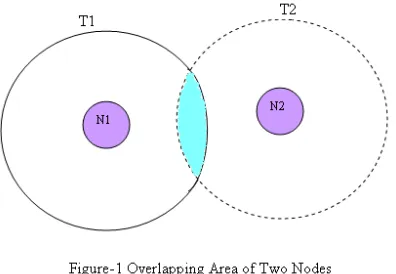
Initially, each node computes its overlap region with adjacent neighbor. (As we discussed in section-3.2) This overlap region of two adjacent nodes is known as connection possibility (CP), where it is formed by the intersection of transmission zone of neighboring nodes. Consider N1 and N2 as two nodes and their transmission ranges are T1 and T2 respectively. Their overlapping area is picturized in figure-1.
[image:3.612.319.517.392.529.2]Every node keeps CP value in neighbor table (N). The neighbor table (N) encompasses of node id, neighboring node id, hop count and connection possibility (CP). The neighbor table is portrayed in table-1.
Table 1: Neighbor Table
Node ID
Neighboring node ID
Hop Count
Connection Possibility
(CP)
ISSN: 1992-8645 www.jatit.org E-ISSN: 1817-3195
[image:4.612.320.514.342.399.2]nodes. Otherwise, it simply hands out the packet to other nodes. By crossing the intermediate nodes, the QUERY-REQ packet finally reaches the destination. The format of QUERY-REQ packet is shown below in Table-2.
Table 2: Format Of QUERY-REQ Packet
Node ID Sequence Number
Connection Possibility
(CP)
As soon as receiving the QUERY-REQ packet, the destination node estimates the CP value for every path. The path value is attained by aggregating the CP value of nodes along that path. That is,
Pi (CP) =
∑
= ni 1
CP
(
N
i)
(4)Where, Pi (CP) denotes the connection possibility (CP) value of path i, Ni represents node by the side of the corresponding path.
After calculating the CP value for all paths, the destination selects the path with maximum connection probability. Thenceforth, the destination sends QUERY-REP to the source in the chosen path.
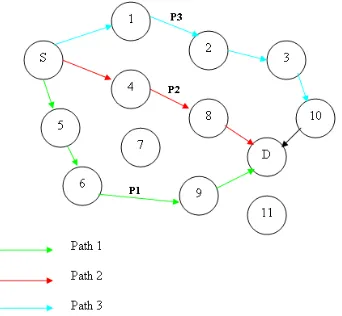
For instance, in figure-2, the circles 1, 2... 10 are nodes, S and D represents any source and destination pair. P1, P2 and P3 are path 1, 2, 3 respectively. As soon as estimating the cumulative value of CP for P1, P2 and P3, the destination (D) selects P2 as the chosen path. Further, the destination transmits QUERY-REP message to the source.
On receiving the QUERY-REP message, the source transmits the real time data in that optimal
chosen path. Connection possibility value differs significantly from a node to another. The path that has maximum CP value is less prone to link and path failures. Moreover, it provides reliable transmission for real time data.
3.3.2 Connectivity Maintenance
Since, MANETs are characterized by dynamic topology changes; the established connection must be monitored for its consistency. Connectivity ensures the reliability of paths. Connectivity maintenance is performed in the following way,
When a node does not obtain data packets from its previous node or the link between the nodes unexpectedly breaks, then a special connectivity message (CMESS) is flooded within the two hop neighbors, by that node. Node that initiates the maintenance phase is known as initiator. The CMESS encompasses of node id, destination id, neighbor list, and minimum link expiration time. The CMESS have the following format, (Table-3)
Table 3: Format Of CMESS
Node Id
Destination Id
Neighbor List
Minimum Link Expiration
Time
While receiving the CMESS, two hop neighbors computes their LET with adjacent node as per section-3.2.2 and sends reply to the initiator node. The reply message includes node id and its LET value. Node that initiates the connectivity maintenance phase, updates its routing table from the upcoming reply messages. From the replies of CMESS, the node gets additional path to the destination and updates them in the routing table. Among the available paths, it chooses the path with long link expiration time and transmits real time data steam in that path.
The overall process is described below in two algorithms. Algorithm-1 illustrates the process of path selection and Algorithm-2 portrays connectivity maintenance process.
Algorithm-1
Step-1
Source transmits QUERY-REQ packet to all neighbors
Source Node
QUERY
−
REQ
→
All Neighbors Step-2 [image:4.612.106.277.520.678.2]Intermediate Node
→
CP Destination Step-3Intermediate nodes forwards the QUERY-REQ packet to the destination
Step-4
Destination computes the aggregate CP value for each path as (equation-4)
Step-5
Selects the path that has higher CP value and send back QUERY-REP message to the source node
Step-6
The source transmits real time data through the chosen optimal path
Algorithm-2 Step-1
During the time of link failure and delayed reply, the node initiates the connectivity maintenance phase
Step-2
The initiator floods CMESS to the two hop neighbors
The initiator
CMESS →
Two-hop neighborsStep-3
The two-hop neighbors estimate LET according to equation (3)
Step-4
The two-hop neighbors send reply to CMESS with LET value
Step-5
The initiator updates new paths in its routing table
Step-6
Chooses the path that has long LET value
4. SIMULATION RESULTS
4.1 Simulation Model and Parameters
We use NS2 [16] to simulate our proposed Reliable Real-time Data Transmission using Connection Probability (RRDT-CP) protocol. In our simulation, the channel capacity of mobile hosts is set to the same value: 2 Mbps. We use the distributed coordination function (DCF) of IEEE 802.11 for wireless LANs as the MAC layer protocol. It has the functionality to notify the network layer about link breakage. In our simulation, 50 mobile nodes move in a 1000 meter x 1000 meter region for 50 seconds simulation time. Initial locations and movements of the nodes are obtained using the random waypoint (RWP) model of NS2. We assume each node moves
independently with the same average speed. All nodes have the same transmission range of 250 meters. In our simulation, the speed of the mobile node is varied as 5,10,15,20 and 25 and pause time is 5 seconds. The simulated traffic is Constant Bit Rate (CBR) and Video. For each scenario, ten runs with different random seeds were conducted and the results were averaged.
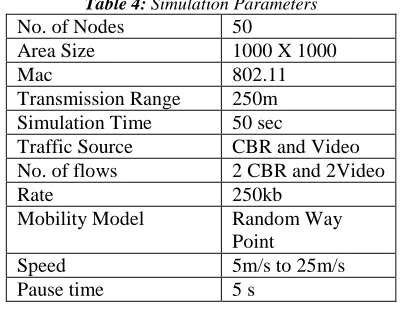
[image:5.612.317.517.224.382.2]Our simulation settings and parameters are summarized in table 4
Table 4: Simulation Parameters
No. of Nodes 50
Area Size 1000 X 1000
Mac 802.11
Transmission Range 250m Simulation Time 50 sec
Traffic Source CBR and Video
No. of flows 2 CBR and 2Video
Rate 250kb
Mobility Model Random Way
Point
Speed 5m/s to 25m/s
Pause time 5 s
4.2 Performance Metrics
We compare our proposed Reliable Realtime Data Transmission by Connection Probability (RRDT-CP) technique with RTRD [4] protocol. We mainly evaluate the performance according to the following metrics:
Aggregated Bandwidth: We measure the received bandwidth for all traffic flows
Packet Delivery Ratio: It is the ratio of the number of packets received successfully and the total number of packets sent
Throughput: It is the number of packets received successfully.
Packet Drop: It is the average number of packets dropped at each receiver.
4.3 Results
Effect of Varying Speed
ISSN: 1992-8645 www.jatit.org E-ISSN: 1817-3195
Speed Vs Received Bandwidth
0 0.1 0.2 0.3 0.4 0.5
5 10 15 20 25
Spe ed(m /s)
M
b
/s RRDT-CP
RTRD
Figure 3: Speed Vs Bandwidth
Speed Vs Delivery Ratio
0 0.2 0.4 0.6
5 10 15 20 25
Speed(m /s)
D
e
li
v
e
ry
R
a
ti
o
RRDT-CP
RTRD
Figure 4: Speed Vs Packet Delivery Ratio
Speed Vs Packet Drop
0 2000 4000 6000
5 10 15 20 25
Speed(m /s)
P
a
c
k
e
ts RRDT-CP
RTRD
Figure 5: Speed Vs Packet Drop
Speed Vs Throughput
0 2000 4000 6000 8000 10000
5 10 15 20 25
Speed(m /s)
P
a
c
k
e
ts RRDT-CP
RTRD
Fig 6: Speed Vs Throughput
Table 5: Percentage Of Improvement Of RRDT-CP
Over RTRD For Varying Speed
Parameters average % of
improvement Speed Vs Bandwidth 77
Speed Vs Drop 61
Speed Vs Delivery ratio 41
Speed Vs Throughput 53
Since RRDT-CP routing preserves connectivity, the aggregated bandwidth, throughput and packet delivery ratio are high, when the mobility is increased. As we can see from Figure 3, Figure 4 and Figure 6, RRDT-CP has high aggregated bandwidth, delivery ratio and throughput, respectively, when compared with RTRD.
Similarly in figure 5, we can see that the packet drop is less for RRDT-CP than RTRD.
Table 5 presents the average percentage of improvement of RRDT-CP over RTRD for all parameters, when the speed is varied.
5. CONCLUSION
In this paper, we have proposed a reliable real time data transmission technique in MANET through connection possibility. Before forwarding real time data, the source disseminates request message to all neighbors. The request message collects the connection possibility (CP) information from all intermediate nodes and then reaches the destination. The connection possibility of a node is computed by deriving overlapping area of two adjacent nodes. By aggregating the CP values, the destination measures the cumulative value of CP for each path and elects the path with high CP value. Subsequently, during link failures and delayed replies connectivity maintenance phase is triggered. Node that initiates the triggering process became the initiator. It gathers the link expiration time from neighboring nodes and chooses the path with long link expiration time. By simulation, we have shown the performance of our technique. It provides reliable connectivity for real time data transmission.
REFERENCES
[1] Hwee Xian Tan and Winston K. G. Seah, “Dynamic Topology Control to Reduce Interference in MANETs”, Proceedings of second International Conference on Mobile Computing and Ubiquitous Networking, 2005 [2] Priyanka Sharma, Yakuta Karkhanawala and K
Kotecha, “Bandwidth Constrained Routing of Multimedia Traffic over Hybrid MANETs using Ant Colony Optimization”, International Journal of Machine Learning and Computing, 2011.
MANETs”, Proceedings of the Third ACM Workshop on Security of Ad Hoc and Sensor Networks (SASN), pp-1-10, 2005.
[4] Kai Han, Guanhong Pei, Hyeonjoong Cho, Binoy Ravindran and E. D.Jensenz, “RTRD: Real-Time and Reliable Data Delivery in Ad
Hoc Networks”, IEEE Wireless
Communications and Networking Conference, (WCNC), 2008.
[5] Juki Wirawan Tantra, Chuan Heng Foh and Dongyu Qiu, “On Link Reliability in Wireless Mobile Ad Hoc Networks”, IEEE 64th Vehicular Technology Conference, (VTC-2006), pp-1-5, 2006
[6] Simon Heimlicher, Rainer Baumann, Martin May and Bernhard Plattner, “A Reliable Transport Protocol for Unreliable Networks”, TIK Report Nr. 239, ETH Zürich, 2005
[7] Oscar F. Gonzalez, Michael Howarth and George Pavlou, “Detection of Packet Forwarding Misbehavior in Mobile Ad-Hoc Networks”, Wired Wireless Internet Communications, pp- 302-314, 2007.
[8] Meng-Yen Hsieh, Yueh-Min Huang and You-Sheng Liu, “Reliable Transmission of Multimedia Streaming In Cluster-Based Ad Hoc Networks”, ACM Journal of Computer Communication, 2007.
[9] Priyanka Goyal, Vinti Parmar and Rahul Rishi, “MANET: Vulnerabilities, Challenges, Attacks, Application”, International Journal of Computational Engineering & Management, 2011.
[10] Heesook Choi, William Enck, Jaesheung Shin, Patrick McDaniel, Thomas F. La Porta, “Secure Reporting of Traffic Forwarding Activity in Mobile Ad Hoc Networks”, IEEE The Second Annual International Conference
on Mobile and Ubiquitous Systems:
Networking and Services, (MobiQuitous), pp- 12 – 21, 2005.
[11] M.Renuka and Dr. P.Thangaraj, “Reliable Data Security Architecture for Multi-Path Multimedia Streaming in MANET”,
International Journal of Electronics &
Communication Technology, 2012
[12] Bernhard Hohmann, M´erouane Debbah and Andreas Kr¨opfl, “Reliable Multimedia Transmission in Wireless Ad-Hoc Networks for Tele health Systems”, IEEE Second
International Conference on Pervasive
Computing Technologies for Healthcare, 2008. Pervasive Health, 2008
[13] Sergio Cabrero, Xabiel García Pañeda, Thomas Plagemann, David Melendi and Roberto García, “Towards reliable video transmission over sparse MANETs in
emergencies”, INFORMÁTICA NA
EDUCAÇÃO: Teoria & Prática, 2011
[14] Michael Pascoe-Chalke, Javier Gomez, Victor Rangel and Miguel Lopez-Guerrero, “Route duration modeling for mobile ad-hoc networks”, Springer, Wireless Networks, 2009 [15] Natarajan Meghanathan, “A Unicast Stable
Path Routing Protocol for Mobile Ad hoc Networks based on the Inverse of Link Expiration Time”, Network Protocols and Algorithms, ISSN 1943-3581, Vol-3, No-3, 2011.
[16] Network simulator,