UGC Approved Sr. No.49366, JAN-FEB 2018, VOL- 5/43
Copyright © 2017, Scholarly Research Journal for Interdisciplinary Studies
SELF PERCEPTION AMONG THE NINTH STANDARD STUDENTS IN
KALLAKURICHI EDUCATIONAL DISTRICT
O. SenthilKumar1 & S. Devasahayam Selvakumar2, Ph. D.
1
Ph. D. Scholar Assistant Professor, A. K. T . Memorial College of Education, Kallakurichi.
2
Research Supervisor, Principal, Meston College of Education, Chennai -14.
Self perception is hypothesized to have an impact on the choices of activities, effort expenditure, perseverance in the face of difficulties and expectations of eventual success .In this research work carried out among IX standard students, the samples are 1066 from the different schools, Normative survey method and Stratified random sampling technique was used, The investigator designed Self Perception Inventory had 29 Statements, administered and discussed level, significance difference of the self perception .The finding of this study indicates that IX Standard girls students can organize and implement actions in a specific situation better than male IX Standard students.
Keywords: Self perception, Personality, Emotions, Behavior
INTRODUCTION
Self perception is defined as the individual’s judgment of how will one can organize
and implement actions in a specific situation, which may contain ambiguous, unpredictable
,and stressful elements (Bandura,1977). Wig field and Karpathian (1991) also explained
self perception as knowledge structures about the self that organize the individuals
interpretations of their experiences and guide their behaviors.
Self perception is hypothesized to have an impact on the choices of activities, effort
expenditure, perseverance in the face of difficulties and expectations of eventual success
(Bandura, 1977b; Bandura &Schunk, 1981).For instance, individuals tend to determine
their ability to performin a given situation and then form expectations of their success or
failure. This, in turn, affects their future achievement-oriented behavior (Weiner et al.,
1971). When individuals have low assurance that they will actually be able to accomplish a
task, they tend to become fearful and stressed, and attempt to avoid the task they believe
exceeds their coping capacity. In contrast, when individuals judge that they are capable of
handling a situation, they become highly involved in the activities and apply strategies to help
them trouble shoot the potential problems in performing the task.
Copyright © 2017, Scholarly Research Journal for Interdisciplinary Studies OBJECTIVES OF THE STUDY
✓
To find the level of Self Perception of IX Standard students.
✓
To study the significant differences between the self perception of IX Standard
students based on the select sub samples gender, locality, medium of instruction, and
type of management schools.
HYPOTHESES OF THE STUDY ✓
The level of Self Perception of IX Standard students is average in nature.
✓
There is no significant difference between the self perception by IX Standard students
based on the select sub samples gender, locality, medium of instruction, and type of
management schools.
OPERATIONAL DEFINITIONS
SELF PERCEPTION
It refers to the way in which people come to understand their own attitudes and
believes based their behavior in given situation. It is effectively a model of oneself from the
perspective ofan outside observer. In the present study, it is measured by Self Perception
Inventory, constructed and validated by the investigator and Dr.S.Devasahayam
Selvakumar (2016).
SAMPLE AND METHOD
Normative survey method was adopted for the study. Stratified random sampling
technique was employed, 1066 students from 22 schools studying in Government,
Government Aided, and Self finance School in villupuram district have been selected for the
study.
TOOL
The investigator designed a separate tool for measuring the self perception of the
students.
The draft Self Perception Inventory had 29 Statements.
STATISTICAL TECHNIQUES USED
The collected data were analyzed by using statistical technique like percentage
analysis, t - test and F - test.
HYPOTHESIS
Copyright © 2017, Scholarly Research Journal for Interdisciplinary Studies
Table-1 Showing the Distribution of Low, Average and High Self Perception Groups In
the Sample
LOW AVERAGE HIGH
VARIABLE
N % N % N %
Self Perception 273 25.6 486 45.6 307 28.8
From the above table, it is found that 45.6% of secondary students have average level
of Self Perception; the high and low Self Perception groups are almost of equal size,
suggesting that the scores in the sample are more or less normally distributed.
HYPOTHESIS
There is no significant difference between the self perception by IX Standard students
based on the select sub samples gender, locality, medium of instruction, and type of
management of schools.
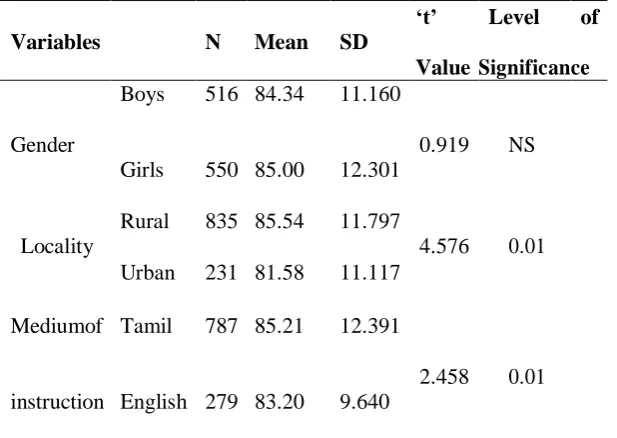
Table – 2 Showing the Mean Differences in Self Perception of Ix Standard Students
Based On the Demographic Variables
Variables N Mean SD
‘t’ Level of
Value Significance
Gender
Boys 516 84.34 11.160
0.919 NS
Girls 550 85.00 12.301
Locality
Rural 835 85.54 11.797
4.576 0.01
Urban 231 81.58 11.117
Mediumof Tamil 787 85.21 12.391
2.458 0.01
instruction English 279 83.20 9.640
From the above table , we infer the following
a) IX Standard male and female students do not differ in their self perception.
b) IX Standard rural and urban students do differ in their self perception
Copyright © 2017, Scholarly Research Journal for Interdisciplinary Studies
Table – 3 Showing The Mean Differences In Self – Perception Of Ix Standard Students Based On Type Of Management Of Schools
VARIABLES SOURCES Mean SSb SSw
‘F’ Level of
Value significance
Types of Government 85.13
School Government Aided 81.71 2397.688 144941.9 8.792 0.01
Self –Finance 85.99
From the above table, it is observed that IX Standard students studying in various
type of management of schools do differ in their self perception.
MAJOR FINDINGS
The following are the major finding of the study
1. The level of self perception of IX standard students in average in nature.
2. Gender does not influence self perception in a students.
3. IX Standard rural students have higher self perception than the urban
students.
4. IX Standard Tamil medium students have significantly higher self
perception than the English medium students.
5. IX Standard students studying in self finance schools have higher self
perception Government and Government Aided school students.
DISCUSSION
Influence of gender of secondary students on Self Perception
The findings obtained in the present study concluded that gender did not have
significant influence on their self-perception. The secondary school boys and girls are found
to be similar in their self-perception. The result contradicts the study conducted by Aysegul
Ozdemir Topaloglu (2015) that showed a statistically significant difference between the
mean scores of self perception of university students with respect to gender and the study
showed that the girl
students’ Self Perception is higher than boys. However the study of Mihaela Chraif, Mihai
Aniei (2013) on gender differences in measuring ‘positive emotions self-perception’ and
self-Copyright © 2017, Scholarly Research Journal for Interdisciplinary Studies
perception and school girl’s ‘negative emotions self-perception’ was also statistically significant higher than high school boy’s self-perception.
Influence of locality on Self Perception
Rural school social environment and community relationships promote the self –
acceptance and self-perception of secondary students. Rural community is a small, closely –
knitted community where every member knows each other and they had the chance of
growing together. They emphasized the importance of relationships and relatedness. Thus,
the secondary students enjoy the belongingness of peers, teachers and the community as they
live in the same location and the teacher knew his/her students and all the students knew each
other. They have lots of opportunities to involve actively in community activities (Herzog,
Mary Jean Ronan; Pittman, Robert B., 1995). Thus the self- perception of secondary
students living in rural area is constructed by the social acceptance and social relationship
they perceive in the environment leading to significantly higher self –perception than students
from urban areas.
Influence of Medium of Instruction of secondary students on Self Perception
The present study reveals a significant influence of medium of instruction on the
self-perception of secondary students. The secondary students studying in Tamil medium have
higher self-perception than secondary students studying in English medium. The inference of
the present study is supported by many previous research findings. Medium of instruction has
a very vital role in imparting education and it makes learning easy or difficult for a student.
More recent research findings indicate the ineffectiveness of using English as the medium of
instruction and the difficulties encountered by the students. The studies conducted in Hong
Kong indicate that English as a medium of instruction for secondary students has had a
significant negative effect on the size of academic vocabulary students (Lin & Morrison,
2010). Marsh, Hau and Kong (2006) concluded that instruction in English had sizeable
negative effects onboth academic self-concept and academic achievement.
Influence of types of School Management on Self Perception
The present study reveals that the secondary students studying in self-financing
schools are found to be higher in their Self- Perception than the students studying in
government and government aided schools .This may be due to the superior institutional
climate of self-financing school than government and government aided schools. Students
Copyright © 2017, Scholarly Research Journal for Interdisciplinary Studies
quality education. The Probe Report (1999) notes that “In a private school, the teachers are
accountable for providing quality education and for taking individual care to students.
CONCLUSION
The secondary student’s self perception have been researched on, and researchers have
acknowledged that the school related factors such as weighty academic assignments,
competitive learning environment, failures and poor relationships, social comparison in
classroom, poor social environment heavy academic workload and inadequate physical
classroom environments lead to poor self perception. To boost the self perception level of
secondary students from low and moderate to high, the impact of above – mentioned factors
need to be reduced by taking adequate rational and remedial measures.
REFERENCES
Bandura,A&Simon,K.M.(1977). The role of proximal intensions in self-regulation of refractory behaviour .Congitive Therapy and Reseach,1,177-193
Wigfield, A. & Karpathian, M. (1991). Who am I and what can I do? Children' s self - concepts and motivation in achievement situations. Educational Psychologist, 26(3&4), 233-261
Bandura, A. (1981). Self-referent thought: A develop-mental analysis of self-efficacy. In J. H. Flavell& L Ross (Eds.), Social cognitive development; Frontiers and possible futures. Cambridge; Cambridge University Press.
Schunk, D. H. (1981). Modeling and attributional effects on children's achievement; A self-efficacy analysis. Journal of Educational Psychology, 73, 93-105.
Weiner, B., Frieze, I., Kukla, A., Reed, L., Rest, S. & Rosenbaum, R. (1971). Perceiving the causes of success and failure. NY: General Learning Press.
AysegulOzdemir Topaloglu.,(2015) The Relationship between University Students’ Self Perception, Life Satisfaction and Various Variables, 6th World conference on Psychology Counseling and Guidance, 14 – 16, Procedia - Social and Behavioral Sciences 205 (2015) 349–355,doi: 10.1016/j.sbspro.2015.09.096.
MihaelaChraif, MihaiAniei.,(2013) Gender differences in measuring positive and negative emotions self-perception among Romanian high school students-a pilot study.5th International Conference EDUWORLD 2012 Education Facing Contemporary World Issues, Procedia -Social and Behavioral Sciences 76 ( 2013 ) 181 – 185, doi: 10.1016/j.sbspro.2013.04.095 Lin, l. H. F.,& Morrison, B. (2010).The impact of the medium of instruction in Hong Kong secondary
schools on tertiary students’ vocabulary. Journal of English for Academic Purposes,9 (4), 255-266. doi: 10.1016
Marsh, H. W, Hau, K. T & Kong, C. K. (2006). Multilevel causal ordering of academic self-concept and achievement: Influence of language, of instruction (English Compared with Chinese) for Hong Kong Students. American Educational Research Journal, 39(3) 727-763. doi: 10.3102/00028312005004437