Optimization of Process Parameters of Belt
Conveyor for Transferring Bajra
Settu S1, Manikandan S2, Murali T3
1Assistant Professor, Department of Mechanical Engineering, SVS College of Engineering
2Assistant Professor, Department of Mechanical Engineering, Sri Shakthi Institute of Engineering and Technology
3Assistant Professor, Department of Mechanical Engineering, Annai Mathammal Sheela Engineering College
Abstract: In this automation world transfer of material from one place to another at faster rate without any damage to or by product plays a important role in reducing the cycle time of a product. To achieve this different equipment’s such as conveyors, robots, AGV’s, fork trucks etc. are used. From these conveyors are the cheapest material handling equipment especially for commercial products. There are different types of conveyors available such as screw conveyor, belt conveyor, bucket elevators, chain conveyor. Based on the requirement suitable type is selected. In this research a belt conveyor is designed and fabricated as a model with 1HP electric motor in which various variable factors related to the transformation (speed, feed rate, type of product) are experimented and their results are analyzed in the Minitab analysis software to determine the optimum value of variable factor for each component. Experiments using Bajra, is carried at different belt speed 0.55, 0.91 and 0.94 m/s at different hopper position (1, 2 & 3) and observed that the hopper position is plays a major role for minimum loss of the product while transferring. The Speed is exerted the greatest effect on the transfer of materials with lesser time.
Keywords: Belt conveyor, Bajra, optimization, Taguchi
I. INTRODUCTION
The conveyor systems are commonly used in many industries, including the automotive, agricultural, computer, electronic, food processing, aerospace, pharmaceutical, chemical, bottling and canning, print finishing and packaging. In that the Belt conveyors are commonly used equipment for continuous transport, as it has a high efficiency, large conveying capacity, simpler construction, small amount of maintenance.
Although a wide variety of materials can be conveyed, some of the most common include food items such as beans and nuts, bottles and cans, automotive components, scrap metal, pills and powders, wood and furniture and grain and animal feed.
Belt conveyors are the most commonly used powered conveyors because they are the most versatile and the least expensive. Product is conveyed directly on the belt so both regular and irregular shaped objects, large or small, light and heavy, can be transported successfully. These conveyors should use only the highest quality premium belting products, which reduces belt stretch and results in less maintenance for tension adjustments.
The following are the conveyors are used for general material handling purpose
A. Belt conveyor
B. Screw conveyor
C. Bucket conveyor
D. Elevators
E. Chain conveyor
A screw conveyor or auger conveyor is a mechanism that uses a rotating helical screw blade, called a "flighting", usually within a tube, to move liquid or granular materials. A bucket elevator can elevate a variety of bulk materials from light to heavy and from fine to large lumps. a chain conveyor is a type of conveyor system for moving material through production lines. Chain conveyors utilize a powered continuous chain arrangement, carrying a series of single pendants. Belt conveyor is constantly operating transporting equipment which is mainly used to convey mass bulk material like mineral, coal, sand, etc.
II. MATERIALSANDMETHODS
The essential elements required for fabricating the conveyor are pulley, idler, belt, variable auto transformer, hopper and prime mover. The parts are bought from the leading industries and assembled with some advanced features to overcome the problems in the existing conveyor system. The following are the drawbacks in the existing system.
A. Adjustment of the speed of the belt for different working condition is not possible.
B. It is difficult to control the feed rate.
C. The height of the belt frame is fixed.
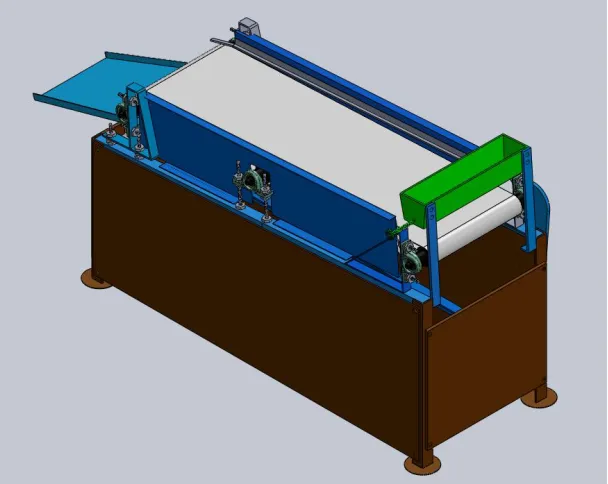
[image:3.612.162.466.207.449.2]In the present work the above problems are rectified. By considering the above restriction in the current method of material transfer a concept has been developed to control the feed, position of belt frame and speed of the system as shown in the Fig.1
Fig.1. Conceptual Design of belt conveyor
The feed rate of the material is controlled by developing a hopper which can be positioned at required position as shown in the Fig.2
Fig. 2.Variable feed hopper
[image:3.612.193.449.502.688.2]belt speed of the conveyor.
A simple lock nut mechanism is used to vary the belt frame length as shown in the Fig.3
Fig.3. Adjustable height stands
The basic procedure for belt selection is taken from the catalogue of the Dunlop Co (India) Ltd. The load correction factor for belt conveyor is 1.2 is taken from the design data book.
Table.1 The Specifications of the belt conveyor
Particulars Values
Length 1.5 meter
Width 0.5 meter
Height 1 meter
Motor power 0.75 KW
Hopper capacity 4 Kg
III.CONVEYORTEST
The conveyor was tested with various speed, feed, and grains using the specially designed part. The variation in the speed is archived by connecting the variable autotransformer to the output of the motor. The speed of the belt conveyor is varied by varying the input voltage of the supply to the motor. The speed reduction takes place due to the step down of the voltage. Variation in feed is obtained by specially designed hopper with screw mechanism to obtain varies opening position.
As the screw is moved the size of the opening can be increased or decreased. Provisions also available to adjust the height of the belt frame to the required level. The above three test were conducted to define the optimum speed, feed, angle of inclination to convey different agriculture product. The tests are carried out on the belt conveyor given below in the fig.4
IV.EXERIMENTALDESIGN
The experiments were carried out to analyse the influence of various parameters on transferring material at high speed with less percentage of loss. The levels of control parameters were shown in Table 2.
Table.2 Details of the test conditions used in this study
Input voltage(volts) 60,80,220
Belt speed(m/s) 0.55,0.91,0.94
Hopper position (no.) 1,2,3
Input quantity (kg) 3 kg
This table shows that the experimental plan had three levels. A standard Taguchi experimental plan with notation L9 was chosen. In the Taguchi method, the experimental results are transformed into a signal-to-noise (S/N) ratio.
This method recommends the use of S/N ratio to measure the quality characteristics deviating from the desired values. There are three categories of quality characteristic in the analysis of the S/N ratio. Those are the lower- the-better, the higher-the-better, and the-nominal-the better. To obtain the optimal parameters, lower-the better quality characteristic for loss of materials and lesser time taken. The S/N ratio for each level of testing parameters was computed based on the S/N analysis.
V. RESULTSANDDISCUSSION
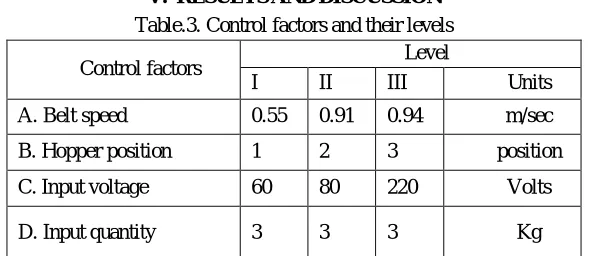
Table.3. Control factors and their levels
Control factors Level
I II III Units
A. Belt speed 0.55 0.91 0.94 m/sec
B. Hopper position 1 2 3 position
C. Input voltage 60 80 220 Volts
[image:5.612.159.454.344.472.2]D. Input quantity 3 3 3 Kg
Table.4 Experimental lay out and results with calculated S/N ratios for transfer Bajra in Less loss of product with less time.
A. Analysis of control factors
Table 4 shows experimental layout and results with the calculated S/N ratios for weight loss and time taken of the Bajra transfer through belt conveyor. Analysis of the influence of each control factor on the time taken and percentage of product loss was performed with S/N response table, using a Minitab 16.0 computer package.
Material transferred through conveyor Input Voltage (volts) Speed (m/s) Hopper Position (no.) Time taken (sec) Product loss In (%) Bajra
60 0.55 1 27.80 0.67
80 0.91 1 25.61 0.89
220 0.94 1 23.60 0.44
60 0.55 2 23.88 0.44
80 0.91 2 21.64 6.22
220 0.94 2 20.45 6.22
60 0.55 3 17.51 1.45
80 0.91 3 15.06 8.67
Fig.5. main effect plot for means (Lesser time taken)
Fig.6.main effect plot for S/N ratio (Lesser time taken)
The control factor with the strongest influence was determined by difference values. The higher the difference, the more influential was the control factor or an interaction of two controls. The strongest influence was found out by Hopper Position (B) and speed (A) respectively. The main effects for S/N ratio and main effects for means are shown in Fig. 5 and 6.
Optimal testing conditions of these control factors can be easily determined from this graph. The Fig.5 shows the speed and hopper position are plays a major role for lesser time taken. The graphs (fig. 5 and 6) shows the A3,B3 combination shows the lesser time taken for to transfer a Bajra. But at the same time, percentage (%) of loss of Bajra was high in the A3,B3 combination. In that case the optimum process parameter for transferring the Bajra was A1,B3 combination.
VI.CONCLUSION
REFERENCES
[1] M. A. Alspaugh, “Latest developments in belt conveyor technology”, First Edition, Mini expo Publication, 2004, pp.25-150. [2] V. B. Bhandari, “Design of Machine Elements”, Third Edition, Tata McGraw-Hill Education Publication, 2007, pp.449-542.
[3] H. Brink., W. Niemand and W. Sullivan, “An overview of the use of flywheels on troughed conveyors”, International Journal of Scientific Engineering and Technology Research, Vol.04, 2011, pp.6707-6710.
[4] Conveyor Equipment Manufacturers Association (CEMA), “Belt Conveyors for Bulk Materials”, Sixth Edition, CEMA Publication, 2007, pp.25-48.
[5] Gerard, Bruce and O Rourke, L, “Optimization of overland conveyor performance”, International Journal of Scientific Engineering and Technology research, Vol.02, 2009, pp.254-312.
[6] Graham Short, “The Design and Operation of Belt Conveyors”, Second Edition Published by Conveyor Manufacturers Association, pp.158-289. [7] Harrison, A, “Non-linear Belt Transient Analysis”, International Journal of Innovative Science, Engineering & Technology, Vol. 1,2008, pp.524-584. [8] Lill, Allan, “Conveyor pulley design”, Third Edition, IMHC Publication, 2007, pp.421-520.
[9] Lodewijks, G., Schott, D. L. and Pang, Y. “Energy saving at belt conveyors by speed control”, International Journal of Engineering, Vol. 4, 2011. pp.1-25. [10] ] Markus Mueller , "Electrical Drives” Second Edition, Woodhead Publishing Company, 2013, pp.152-185
[11] Nel, Paul. “Conveyor idler configuration”, First Edition, LINDEL Publication, 2011, pp.48-74 [12] Philli