An Efficient Service Allocation & Deallocation in
Cloud Environment
Komal Parashar1, Mr. Vinod Saroha2, Dr. Sanjeev Rana3
1
M. Tech CSE, BPSMV, (Main Author)
2
Asstt Professor, Department of CSE and IT, BPSMV.
3
Professor, CSE, MMU, Mullana
Abstract: Cloud computing has become one of the most talked about technologies in recent times and has got lots of attention from media as well as analysts because of the opportunities it is offering. Resource allocation is process of assigning the available resources in an economic, efficient and effective way. Resource assignment is the scheduling of the available resources and available activities required by those activities while taking into consideration both the resource availability and the project time. The efficient allocation of resources by cloud environment solves the problem of scarce resources & provides services to large numbers of clients. In this paper we provide an efficient technique for service allocation and deallocation of cloud resources.
Keywords: Resource Scheduling & Allocation, Resource, Virtual Machines, Cloud Services
I. INTRODUCTION
Cloud computing is combination of two terms [1]: Cloud & Computing. Cloud is the Network. A network is a bulk of thousands of users. The cloud also consists of Server & a Database. Server is also known as Cloud-Provider; while Database is a collection of user-details and applications to be worked upon by users. Computing is the term used for services of cloud.
The US National Institute of Standards and Technology (NIST) has developed a working definition that covers the commonly agreed aspects of cloud computing. NIST definition of cloud computing is described below:
“The process of obtaining resources from the pool of shared resources such as storage servers, network servers and application servers at anytime and anywhere with little cost is called cloud computing”.
Cloud computing means different to different people, its benefits are different to different people. To IT managers, it means to minimize capital-expenditure by outsourcing most of the hardware and software resources. To Cloud Service Providers, it means to reach out to more users by offering a SaaS solution. To end users, it means to access an application from anywhere using any device [3]. Resource allocation [4] is process of assigning the available resources in an economic, efficient and effective way. Resource assignment is the scheduling of the available resources and available activities required by those activities while taking into consideration both the resource availability and the project time. Resource provisioning and allocation solves that problem by allowing the service providers to manage the resources for each individual request of resource. In this paper we provide an efficient technique for service allocation and deallocation of cloud resources.
II. CLOUDCOMPUTINGSERVICEMODELS
There are three fundamental Service models in Cloud computing. Three service models are presented below.
A. Software as a Service
Cloud Applications or Software as a Service (SaaS) refers to software delivered over a browser. SaaS eliminates the need to install and run applications on the customer's own computers/servers and simplifies maintenance, upgrades and support.
B. Platform as a Service
Cloud platform services or Platform as a Service (PaaS) refers to an environment for software development, storage and hosting delivered as-a-service over the Internet.
C. Infrastructure as a Service
Figure 1 below shows the service models.
Figure 1: Cloud Computing Service model
III. CLOUDCOMPUTINGDEPLOYMENTMODELS
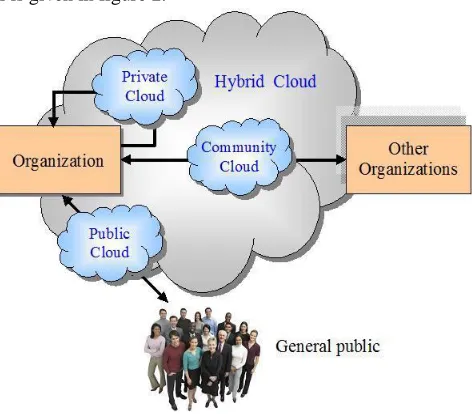
[image:3.612.189.425.366.573.2]Cloud Computing Deployment model is given in figure 2.
Figure 2: Cloud Computing Deployment model
Each company chooses a deployment model for a cloud computing solution based on their specific business, operational, and technical requirements. Four primary cloud deployment models are private cloud, community cloud, public cloud, and hybrid cloud [1][3].
A. Public Cloud
Public cloud refers to Cloud Computing in the traditional mainstream sense, whereby resources are dynamically provisioned on a fine-grained, self-service basis over the Internet. These resources are provisioned via web applications/web services, from an off-site third-party provider who shares resources and bills the customer on a fine-grained utility computing basis.
B. Community Cloud
C. Private Cloud
A term that is similar to, and derived from, the concept of Virtual Private Network (VPN), is applied to Cloud Computing. The Private Cloud delivers the benefits of Cloud Computing with the option to optimize on data security, corporate governance and reliability.
D. Hybrid Cloud
The cloud infrastructure is shared by several organizations with common concerns (eg, mission, security requirements, policy, and compliance considerations).
IV.PROPOSEDMODEL
Resource allocation [4] is process of assigning the available resources in an economic, efficient and effective way. Resource assignment is the scheduling of the available resources and available activities required by those activities while taking into consideration both the resource availability and the project time. Resource provisioning and allocation solves that problem by allowing the service providers to manage the resources for each individual request of resource [5][6].
From the perspective of a cloud provider, predicting the dynamic nature of users [7], user demands, and application demands are impractical. For the cloud users, the number of tasks of job needs to be completed on time with minimal cost. Hence due to limited resources, resource heterogeneity, environmental necessities, locality restrictions and dynamic nature of resource demand, we need an efficient resource allocation system that suits cloud environments. The software and hardware resources are allocated & de-allocated to the cloud applications on-demand basis.
The presented work is focused on the concept of effective resource allocation and de-allocation in a cloud environment. To present the concept, we have taken a cloud environment with multiple clouds along with multiple virtual machines. All the machines are homogenous. These all clouds are assigned by a specific priority. Now as the user request arrive, it performs the request to the priority cloud under its requirements in terms of number of processors required. As the particular cloud will get the request, it will search for the number of requested processors. If the numbers of processors are available with the current cloud, the resources will be allocated to that particular client [8][9].
When the client stops the task then the service allocated to the client is released & same can be reallocated to another client in the waiting. Hence the work provides efficient allocation and de-allocation of cloud services [10].
V. PROPOSEDALGORITHM
The following steps will illustrate the working of resource allocation and deallocation concept of cloud computing:
To present the concept, we have taken a cloud environment with multiple clouds along with multiple virtual machines. All the machines are homogenous. These all clouds are assigned by a specific priority.
Now as the user request arrive, it performs the request to the priority cloud under its requirements in terms of memory & processor capabilities.
As the particular cloud will get the request, it will search for the number of requested processors. If the numbers of processors are available with the current cloud, the resources will be allocated to that particular client.
If the sufficient numbers of processors are not available then the search will be performed for the next particular cloud to perform the resource allocation.
When the client stops the task then the service allocated to the client is released & same can be reallocated to another client in the waiting.
We can also some transfer work so that if a cloud is poorly utilized then its services are moved to nearest cloud having sufficient utilization.
Hence the work provides efficient allocation and de-allocation of cloud services.
A. Allocation Algorithm
of the server. We also update the client status with the server id. If current server is capable for allocating resources then next server in list is started and checks whether it can fulfil the requirement. This process continues until the maximum limit is exhausted. If no server is capable for fulfil the request then display appropriate message.
B. Deallocation Algorit
In this algorithm we deallocate the resources from the servers which are previously allocated to the clients. Deallocation is performed by releasing the resources from the specified server. Update the remaining capacity and utilization value of the server. Update the client status by setting allocation status to false. If numbers of CPUs to be deallocated are more than the allocated then display the appropriate message.
[image:5.612.167.408.235.442.2]VI.IMPLEMENTATIONRESULTS
Figure 3 shows the start screen of efficient service allocation and de-allocation.
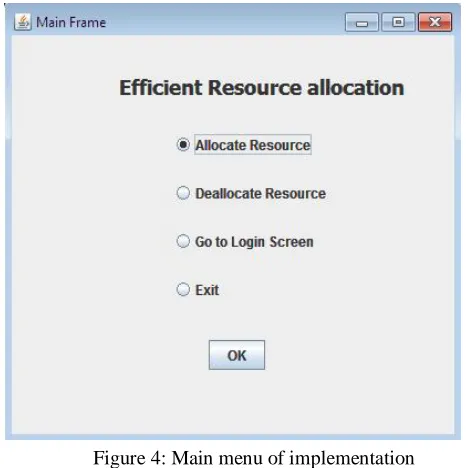
[image:5.612.179.412.472.706.2]Figure 3: The start screen of efficient service allocation and deallocation Enter the client id 1 and press start button. Figure 4 shows the main menu of our implementation.
Figure 4: Main menu of implementation
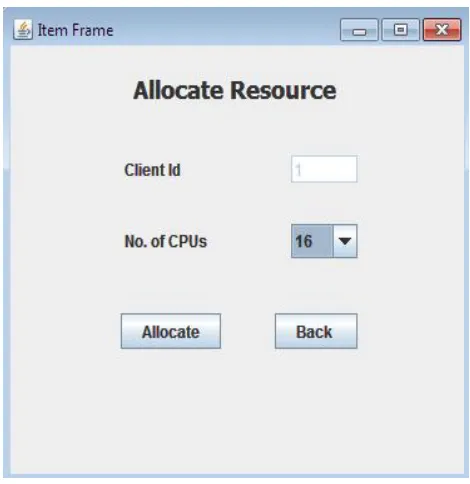
Figure 5: Allocation of resources for client id 1
Figure 6 shows the effect after allocation of resources.
Figure 6: Effect after resource allocation
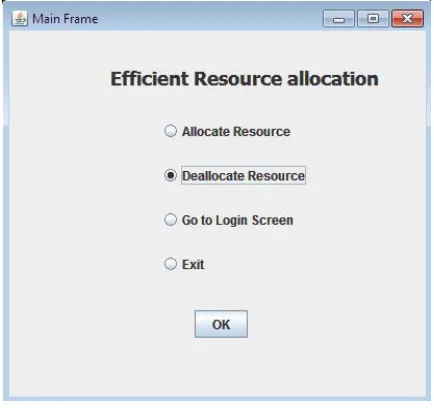
In main menu options now select the option 2 for de-allocation of resources. It will ask for client id and numbers of CPUs to be deallocated. If client id is not correct or numbers CPUs to be deallocated are more than the allocation then appropriate error message is displayed. If everything is OK then deallocation is performed. The remaining capacity and utilization value are updated for the server on which deallocation are performed as shown in figure 7 & 8.
[image:6.612.154.417.557.720.2]Figure 8: Deallocation process for client id 1
VII. ANALYSISOFRESULTS
We compare the result of our proposed algorithm with the work of other previous/ existing researchers. The metric used for comparison is the number of servers started with respect to number of virtual machines requested.
Figure 9 below shows the comparatve chart of existing techniques and proposed algorithm for efficient service allocation and deallocation on cloud computing.
Figure 9: The comparative chart
VIII. CONCLUSION
Cloud computing allows consumers and businesses to use applications without installation and access their personal files at any computer with internet access. Resource allocation is process of assigning the available resources in an economic, efficient and effective way. Resource de allocation is the process of de allocating i.e., releasing the existing resources from authorized user after completion of work. In this paper we provide an efficient technique for service allocation and deallocation of cloud resources.
REFERENCES
[1] Hayes, “Cloud Computing,” Commun. ACM, vol. 51, no. 7, pp. 9–11, Jul. 2008.
[2] P. Mell and T. Grance, “The NIST definition of cloud computing (draft),” NIST special publication, vol. 800, no. 145, p. 7, 2011. [3] Anthony T.Velte, Toby J.Velte, Robert Elsenpeter, “Cloud Computing, A Practical approach”
[image:7.612.196.417.384.555.2][5] V. Vinothina, Dr. R. Sridaran, Dr. Padmavathi Ganapathi, “Resource Allocation Strategies in Cloud Computing”, International Journal of Advanced Computer Science and Applications [IJACSA], Vol. 3, No.6, 2012. ISSN: 2158-107X (Print), DOI: 10.14569/issn.2156-5570.
[6] Sowmya Koneru, V N Rajesh Uddandi, Satheesh Kavuri, ”Resource Allocation Method using Scheduling methods for Parallel Data Processing in Cloud”, International Journal of Computer Science and Information Technologies[IJCSIT], Vol. 3(4), 2012, pp 4625 - 4628 4625, ISSN: 0975-9646.
[7] Pratik P. Pandya, Hitesh A. Bheda, “Dynamic Resource Allocation Techniques in Cloud Computing”, International Journal of Advance Research in Computer Science and Management Studies Volume 2, Issue 1, January 2014.
[8] Li, Bo, Jianxin Li, Jinpeng Huai, Tianyu Wo, Qin Li, and Liang Zhong. "Enacloud: An energy-saving application live placement approach for cloud computing environments." In Cloud Computing, 2009. CLOUD'09. IEEE International Conference on, pp. 17-24. IEEE, 2009.
[9] B. Rajasekar, S. K. Manigandan, “An Efficient Resource Allocation Strategies in Cloud Computing”, International Journal of Innovative Research in Computer and Communication Engineering Vol. 3, Issue 2, February 2015.]