Development, Standardization and Nutrient
Evaluation of the Functional Food Supplement
Ithayamalar. S1, Kowsalya. S2
1 Assistant Professor, Department of Nutrition and Dietetics, Seethalakshmi Ramaswami College, Trichy
2 Professor and Registrar, Department of Food Science and Nutrition, Avinashilingam Institute for Home Science and Higher Education for Women, Coimbatore
Abstract: A functional food supplement was developed; standardized and nutrient evaluation was carried out for the same. The ingredients such as Oats, defatted soy flour, wheat bran, flaxseed, foxtail millet and horse gram dhal were used in various proportions. For standardizing, the proportion of ingredient used was varied and three variations were prepared and compared with the standard. Nutrient analysis was also carried out. Results revealed that variation I scored high in the organoleptic attributes. The energy content was found to be 336.37 Kcal and the protein content was found to be 17.47g. The crude fiber content was estimated as 14.02g. The synergistic effects rendered by a combination of bioactive compounds present in source materials and the complementary nature of phyto chemicals from different sources are important factors to consider in the formulation of functional foods and in the choice of a healthy diet. Good nutrition, physical activity, and a healthy body weight are essential parts of a person’s overall health and well-being.
Keywords: Functional foods, oats, flaxseed, wheat bran, foxtail millet
I. INTRODUCTION
In India, urbanization is caused by urban expansion into peripheral areas and internal migration from rural to urban areas, largely for economic reasons. Urbanization increases the risk of obesity and diabetes among people who have had divergent early life experiences, particularly in developing countries1. World are becoming more affluent and able to afford more food and more
commercially prepared foods, which tend to have a higher energy density. Ease of access to food has increased with more restaurants, especially fast food restaurants that have quite inexpensive, high-fat, high-calorie foods as their staples. Portion sizes have increased since the 1980s. With more leisure-time activity, especially watching TV, food intake increases. Excessive calorie intake above daily energy requirements is necessary for the development of obesity, but it is incorrect to assume that simple overeating is responsible for all obesity and there is evidence that the quality of the foods ingested also is important in producing obesity2.A change in the diet structure is needed to keep up with the on-going nutrition transition and also to combat the ever rising
incidence of coronary heart disease, diabetes and obesity. Healthy eating may be best achieved with a plant-based diet, which encourages whole plant based foods and discourages meats, dairy products and eggs as well as all refined and processed food3.
Taking this trend of nutrition transition towards the functional food concepts requires huge momentum and dissemination of the same in relation to their health benefits. Functional foods can be considered to be those whole, fortified, enriched or enhanced foods that provide health benefits beyond the provision of essential nutrients (e.g., vitamins and minerals), when they are consumed at efficacious levels as part of a varied diet on a regular basis4 . Functional foods have the potential to be an increasingly important
component of healthy life style and to be beneficial for public health as well as provide insight for wider product range for the food industry.
II. METHODS AND MATERIALS
A. Formulation of the Food Supplement
15 15 20 20 20 10 Variation I 10 15 20 20 25 10 Standard 20 15 20 20 15 10 Variation II
were kept in ziplock covers and placed in air tight containers to retain shelf life and to prevent quality deterioration of the product. The details of proportions of various ingredients included for preparation of the supplement are given below
B. Standardization of the Food Supplement
Fig1 Standardization the Functional Food Supplement
25
15
20
20
10
10
Variation - III
Flax seed Powder
Defatted Soy flour
Foxtail Millet
Wheat bran
Oats
The developed food supplement was standardised. The ingredients were mixed in varied proportion to achieve three variations apart from the standard preparation. The proportion of flax seed added was different in all the variations from over that of the standard. The variation I, II and III had 15, 25, 30 per cent flax seed respectively while the standard formulation had 5 per cent flax seed. The addition of flax seed contributed to the change in taste hence based upon the palatability of the product, the proportion of flax seed added were adjusted. The various ingredients used and its proportion are given Fig 1.
The ingredients were mixed in the above proportion viz standard, variation I, II and III respectively. 10 per cent of jaggery syrup was prepared (single thread stage) in batches and used for the preparation of the supplement. 50g of the supplement was weighed and placed in a mould and pressed firmly to get a definite shape. Each portion of supplement was checked for weight with a deviation restricting to 5g so that it contributed one serving of the supplement. The developed supplement was further subjected to organoleptic evaluation.
C. Organoleptic Evaluation of the Food Supplement
Organoleptic evaluation was conducted to assess the organoleptic property of the prepared functional mix. The total of 50 semi trained panel members was included in the study for sensory evaluation. 9 point Hedonic rating scale was used for the same. The supplement was freshly prepared and displayed to thesemiskilledpanelists. A glass of water was also kept for the panelist to avoid bias in taste. They were requested not to take any other strongly flavoured food at least 1 hour before the test to minimize taste interaction that would influence the decision in evaluation. The variations were labelled as A, B, C and standard. The ingredients used, the proportion and nature of variation were not revealed to the panelists to minimize any kind of anticipation that would arise with regard to taste. Separate sheets with instructions were given to all panelists to evaluate the product. The variation with highest overall score was considered as the best accepted variation and the nutrients were analysed
D. Nutrient Analysis of the Food Supplement
The best accepted variation based on sensory evaluation was further subjected to nutrient analysis. Proximate analysis such as energy, protein, fat, fibre were analysed by standard AOAC5 procedures. Iron, folic acid, calcium, magnesium, sodium was also
assessed. Natural antioxidant vitamins such as vitamin A, E and C were analysed using standard procedures.
III. RESULTS AND DISCUSSION
The results of the standardization, development and evaluation of functional food supplement is discussed
A. Organoleptic evaluation of the functional food supplement
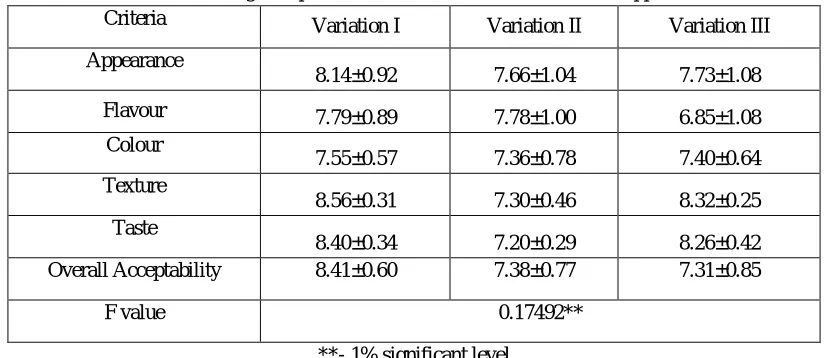
[image:5.612.99.511.498.677.2]Table I gives the organoleptic evaluation of the functional food supplement in terms of appearance, flavor, taste, texture, taste and overall acceptability of all the variations viz Variation I,II and III.
Table I Organoleptic Evaluation of the Functional Food Supplement
Criteria Variation I Variation II Variation III
Appearance
8.14±0.92 7.66±1.04 7.73±1.08
Flavour 7.79±0.89 7.78±1.00 6.85±1.08
Colour
7.55±0.57 7.36±0.78 7.40±0.64
Texture
8.56±0.31 7.30±0.46 8.32±0.25
Taste
8.40±0.34 7.20±0.29 8.26±0.42
Overall Acceptability 8.41±0.60 7.38±0.77 7.31±0.85
F value 0.17492**
**- 1% significant level
B. Nutrient content of functional food supplement
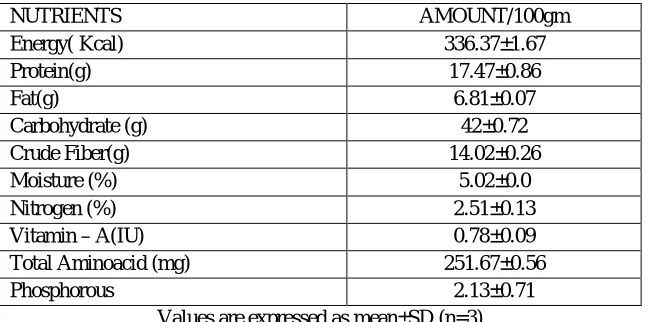
Table II Nutrient content of functional food supplement
NUTRIENTS AMOUNT/100gm
Energy( Kcal) 336.37±1.67
Protein(g) 17.47±0.86
Fat(g) 6.81±0.07
Carbohydrate (g) 42±0.72
Crude Fiber(g) 14.02±0.26
Moisture (%) 5.02±0.0
Nitrogen (%) 2.51±0.13
Vitamin – A(IU) 0.78±0.09
Total Aminoacid (mg) 251.67±0.56
Phosphorous 2.13±0.71
Values are expressed as mean±SD (n=3)
The developed functional food mix was found to be rich in macro and micronutrients. The energy content was found to be 336.37 Kcal. While, its protein content was found to be 17.47g and fat content was found to be 6.81g. The carbohydrate content was found to be 42.02g. The crude fiber content was estimated as 14.02g .It was also rich in iron, vitamin C, Vitamin A and phosphorous. The prepared functional food was found to be nutritionally superior to the snacks that were consumed by the target population.
IV. CONCLUSION
The developed functional food mix is found to be rich in macro and micronutrients. It is also rich in fiber. The synergistic effects rendered by a combination of bioactive compounds present in selcted ingredients in the formulation of functional food are the choice of a healthy diet. Good nutrition, physical activity, and a healthy body weight are essential parts of a person’s overall health and well-being.
REFERENCES
[1] McKay L, Macintyre S, Ellaway A. Migration and health: a review of the international literature occasional paper No 12. Glasgow: Medical Research Council, Social & Public Health Sciences Unit, University of Glasgow; 2003
[2] David J. Goldstein(2005) The Management of Eating Disorders and Obesity, 2nd edition, Humana Press, P.110
[3] Tuso, P. J., Ismail, M. H., Ha, B. P., &Bartolotto, C. (2013). Nutritional Update for Physicians: Plant-Based Diets. The Permanente Journal, 17(2), 61–66. [4] Clare M. Hasler(2002 ),Functional Foods: Benefits, Concerns and challenges—A Position Paper from the American Council on Science and Health, J. Nutr.
vol. 132 No. 12 , Pp:3772-3781