An Experimental Study on Partial
Replacement of Natural Coarse Aggregate
With Fly Ash Coarse Aggregate (FACA)
V.R.Prasath Kumar1, K.S.Anandh2, Midhun Kumar. V3
1,2- Asst Professor, 3- student
Department of Civil Engineering, SRM University, Chennai
Abstract: A construction industry plays vital role in India which leads into the economic developments. The materials like a cement, fine aggregate & natural coarse aggregate which is used to prepare concrete where once easily available in our country, but now there is high demand in materials which has gone to a high scenario. In this project an experimental investigation is done on the partial replacement of coarse aggregate with fly ash aggregate. The quantity of fly ash produced from thermal power plants in India is approximately 80 million tons each year, and its percentage utilization is less than 10%. Majority of fly ash produced is of Class F type. During the last few years, some cement companies have started using fly ash in manufacturing cement, known as ‘pozzolana Portland cement, but the overall percentage utilization remains very low, and most of the fly ash is dumped at landfills. Many researchers have been carried out in the area of fly ash utilization in the past. It mainly concentrated on replacement of cement with fly ash but production of artificial aggregates with fly ash helps in utilizing large volume of ash in concrete. The world is much interested in this part recently due to this large scale utilization which also reduces environmental pollution and dwindling of natural resources. This paper mainly focuses on manufacturing process of light weight aggregates.The production of fly ash aggregate is produced in ratio of 10:90, 15:85 and 20:80.Based upon the above mix ratio, fly ash aggregates are produced and used for casting the concrete cubes and cylinder for comparing the strength with conventional aggregate concrete at 7 and 28 days curing period.
Keywords: FACA, compressive strength, fl
1. INTRODUCTION
In conventional concrete, weight of concrete is one of the parameters to compare with weight of fly ash aggregate concrete. Normally density of concrete is in the order of 2200 to 2600 kg/m3. This heavy self weight makes an uneconomical structural material compared to low self weight of fly ash aggregate concrete. In order to produce concrete of desired density to suit the required application, the self weight of structural and non-structural members are to be reduced. Hence economy is achieved in the design of supporting structural elements which lead to the development of light weight concrete. Lightweight concrete is defined as a concrete that has been made lighter than the conventional concrete by changing material composition or production method. Lightweight aggregate concrete is the concrete made by replacing the usual material aggregate by lightweight
aggregates. Though lightweight concrete can’t always
substitute normal concrete for its strength potential, it has its own advantages like reduced dead load, and thus economic structures and enhanced seismic resistance, high sound
absorption and good fire resistance. Because of the above reasons the study on fly ash aggregate concrete is taken in this project work. A mix design was done for M30 grade of concrete by IS method. Ordinary Portland cement of 43 grade was selected and fly ash aggregates were prepared by mixing fly ash with cement and water. The properties of fly ash coarse aggregates were studied. The aggregate crushing value, abrasion value and aggregate impact value of fly ash coarse aggregates were also studied. The concrete cubes, cylinders and beams were cast with the fly ash aggregates obtained from the above six cement fly ash proportions. Then the compressive strength, split tensile strength and flexural strength were tested and compared with control concrete.
2. PREVIOUS STUDY
Selection of mortar for light weight aggregate concrete made with fly ash based aggregate
and are found to be light weight in nature. They found fly ash aggregate concrete up to 20Mpa can be used for production of concrete blocks for masonry construction in structures. They also suggested selecting mortar which can produce fly ash aggregate concrete of strength up to40Mpa. However concrete strengths more than 40Mpa can also be produced using less content of fly ash aggregates.
Light weight concrete with sintered fly ash aggregates
Dr.J.P.Behera, Dr.H.S.Ray, Dr.B.D.Nayak and Dr. B. Sarangi.(2004) Examined the use of sintered fly ash aggregate in concrete as a partial replacement of granite aggregate. A study on partial replacement to normal granite aggregate. Institution of Engineers, India (IE(I)) Journal –CV
Vol 85 August’2004, PP 84 to 87. They concluded that in
addition to light weight characteristics, the sintered fly ash concrete possesses strength and deformation characteristics similar to concrete with natural granite aggregate.
Effect of fine aggregate replacement with class F fly ash on the mechanical properties of concrete
RafatSiddique Cement and Concrete Research 33 (2003) 539–547 Department of Civil Engineering, Thapar Institute of Engineering and Technology, Deemed University, Patiala 147004, India. Experimental investigation carried out to evaluate the mechanical properties of concrete mixtures in which fine aggregate (sand) was partially replaced with Class F fly ash. Fine aggregate (sand) was replaced with five percentages (10%, 20%, 30%, 40%, and 50%) of Class F fly ash by weight. Tests were performed for properties of fresh concrete. Compressive strength, splitting tensile strength, flexural strength, and modulus of elasticity were determined at 7, 14, 28, 56, 91, and 365 days. Test results indicate significant improvement in the strength properties of plain concrete by the inclusion of fly ash as partial replacement of fine aggregate (sand), and can be effectively used in structural concrete.
3. PROPERTIES OF FLY ASH PHYSICAL PROPERTIES
Fly ash consists of fine, powdery particles that are predominantly spherical in shape, either solid or hollow, and mostly glassy (amorphous) in nature. The carbonaceous material in fly ash is composed of angular particles. The particle size distribution of most bituminous coal fly ashes is generally similar to that of silt (less than a 0.075 mm or No. 200 sieve). Although sub bituminous coal fly ashes are also silt-sized, they are generally slightly coarser than bituminous coal fly ashes. The specific gravity of fly ash usually ranges from 2.1 to 3.0, while its specific surface area (measured by the Blaine air permeability method) may range from 170 to 1000 m2/kg.
The colour of fly ash can vary from tan to gray to black, depending on the amount of unburned carbon in the ash. The lighter the colour, the lower the carbon content. Lignite or sub bituminous fly ashes are usually light tan to buff in colour, indicating relatively low amounts of carbon as well as the presence of some lime or calcium. Bituminous fly ashes are usually some shade of gray, with the lighter shades of gray generally indicating a higher quality of ash.
The burning of harder, older anthracite and bituminous coal typically produces Class F fly ash. This fly ash is pozzolanic in nature, and contains less than 10% lime (CaO). Possessing pozzolanic properties, the glassy silica and alumina of Class F fly ash requires a cementing agent, such as Portland cement, quicklime, or hydrated lime, with the presence of water in order to react and produce cementitious compounds.
Table 1 Physical requirements for fly ash (IS 3812-2003)
Characteristics
Siliceous PFA
(Class F)
Calcareous PFA (Class C)
Fineness, specific
surface area in m2/kg determined by the Blaine apparatus, min
320 320
Particles retained on
45µm IS sieve (wet
sieving), % max
34 34
Lime reactivity,
average compressive strength in N/mm2, min
4.5 4.5
Compressive strength at 28 days, N/mm2, min
80% of the
strength of
corresponding
plain cement
mortar works
80% of the
strength of
corresponding
plain cement
mortar works
Soundness, autoclave
expansion or
contraction, % max
CHEMICAL PROPERTIES
Fly ash material solidifies while suspended in the exhaust gases and is collected by electrostatic precipitators or filter bags. Since the particles solidify while suspended in the exhaust gases, fly ash particles are generally
spherical in shape and range in size from 0.5 µm to 100 µm.
They consist mostly of silicon dioxide (SiO2), which is present
in two forms: amorphous, which is rounded and smooth, and crystalline, which is sharp, pointed and hazardous; aluminium oxide (Al2O3) and iron oxide (Fe2O3). Fly ashes are generally
highly heterogeneous, consisting of a mixture of glassy particles with various identifiable crystalline phases such as quartz, mullite, and various iron oxides.
Two classes of fly ash are defined by ASTM C618: Class F fly ash and Class C fly ash. The chief difference between these classes is the amount of calcium, silica, alumina, and iron content in the ash. The chemical properties of the fly ash are largely influenced by the chemical content of the coal burned (i.e., anthracite, bituminous, and lignite).Not all fly ashes meet ASTM C618 requirements, although depending on the application, this may not be necessary. Ash used as a cement replacement must meet strict construction standards, but no standard environmental standards have been established in the United States. 75% of the ash must have a
fineness of 45 µm or less, and have a carbon content,
measured by the loss on ignition (LOI), of less than 4%. In the U.S., LOI needs to be under 6%. The particle size distribution of raw fly ash is very often fluctuating constantly, due to changing performance of the coal mills and the boiler performance. Especially important is the ongoing quality verification. This is mainly expressed by quality control seals like the Indian ISI mark or the DCL mark of the Dubai Municipality
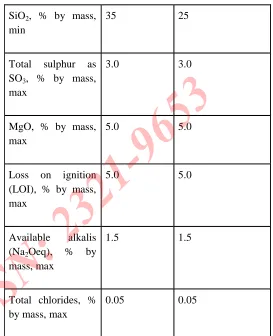
Table 2 Chemical requirements for fly ash (IS 3812-2003)
characteristics Siliceous PFA
(~ ASTM
Class F)
Calcareous PFA
(~ ASTM Class C)
SiO2+ Al2O3 +
Fe2O3, % by mass,
min
70 50
SiO2, % by mass,
min
35 25
Total sulphur as SO3, % by mass,
max
3.0 3.0
MgO, % by mass, max
5.0 5.0
Loss on ignition (LOI), % by mass, max
5.0 5.0
Available alkalis
(Na2Oeq), % by
mass, max
1.5 1.5
Total chlorides, % by mass, max
[image:4.612.303.576.111.447.2]0.05 0.05
Table 3 AASHTO M 295 (ASTM C 618) - Class F and C
Chemical Components Range % Class F Class C
SiO2+ Al2O3+ Fe2O3 min 70
1
50
SiO3 Max 5 5
Moisture Content Max 3 3
Loss on ignition (LOI) Max 51 51
Optional Chemical
Requirements Range% Class F Class C
Physical Requirements Range% Class F Class C
Fineness (+325 Mesh) Max 34 34
Pozzolanic
activity/cement (7 days) Min 75 75
Pozzolanic
activity/cement (28 days) Min 75 75
Water requirement Max 105 105
Autoclave expansion Max 0.8 0.8
Uniform requirements2:
density Max 5 5
Uniform requirements2:
Fineness max 5 5
Table 4 Influence of type of fly ash on its properties
Properties Class C fly ash Class F fly ash
Early strengths (< 28 days)
Very effective;
Can replace
cement 1:1
Effective; May replace cement as high as 1:2
Reduce Permeability
Effective Very effective
Resistance to ASR Effective but may
require higher
amounts
Very effective
even at lower amounts
Resistance to
sulphate attack
Less effective Very effective
4. CLASSIFICATION OF FLY ASH ASTM C618 Defines two classes of fly ash:
Class C
Class F
Primary difference between Class C and Class F fly ash is the amount of the amount of calcium, silica, alumina, and iron content in the ash.
Class F fly ash
Produced from burning harder, older anthracite and
bituminous coal.
Contains less than 20% lime
Requires cementing agent like PC, quick lime,
hydrated lime
Used in high sulfate exposure conditions
Addition of air entrained needed
Used for structural concretes, HP concretes, high
sulfate exposure concretes.
Useful in high fly ash content concrete mixes.
Class C fly ash
Produced from burning younger lignite and sub
bituminous coal
Higher concentration of alkali and sulfate
Contains more than 20% lime
Self-cementing properties
Does not require activator
Not for use in high sulfate conditions
Primarily residential construction
Limited to low fly ash content concrete mixes
5. CURRENT MANAGEMENT OPTIONS
The quantity of fly ash produced from thermal power plants in India is approximately 80 million tons each year, and its percentage utilization is less than 10%. Majority of fly ash produced is of Class F type
Recycling and disposal
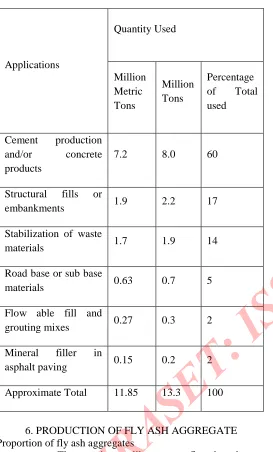
In 1996, approximately 14.6 million metric tons (16.2 million tons) of fly ash were used. Of this total, 11.85 million metric tons (13.3 million tons), or approximately 22 percent of the total quantity of fly ash produced, were used in construction-related applications. Table lists the leading construction applications in which fly ash were used during 1996. Approximately 70 to 75 percent of fly ash generated is still disposed of in landfills or storage lagoons.
Applications
Quantity Used
Million Metric Tons
Million Tons
Percentage
of Total
used
Cement production
and/or concrete
products
7.2 8.0 60
Structural fills or
embankments 1.9 2.2 17
Stabilization of waste
materials 1.7 1.9 14
Road base or sub base
materials 0.63 0.7 5
Flow able fill and
grouting mixes 0.27 0.3 2
Mineral filler in
asphalt paving 0.15 0.2 2
Approximate Total 11.85 13.3 100
6. PRODUCTION OF FLY ASH AGGREGATE Proportion of fly ash aggregates
[image:6.612.22.295.107.559.2]The constituents like cement, fly ash and water produce the fly ash aggregates. Water is the binding material that paves way for the formation of the aggregate with good bond property. The production of FAA is the theme of this project. It is detailed below.
Table 6 Proportions for cement and fly ash
Ratio Cement (%) Fly Ash (%)
R1 10 90
R2 15 85
R3 20 80
Preparation of FAA
Cement and fly ash were mixed in above six proportions in a concrete mixer. Water was added to the mix by adopting the water cement ratio of 0.3. The contents were thoroughly mixed in the drum until the complete formation of fly ash aggregates. This method of formation of fly ash aggregates is called pelletisation.
Pelletisation
It is a process of agglomeration of
moisturized fines in a rotating drum or disc, to produce ‘fresh pellet’ having strength enough for further handling. Formation
of pellets is based on the mechanism involved in balling phenomenon of powdery materials. When a fine-grained material is moisturized, a thin liquid film develops on the surface of each grain and bridges are formed at points where the moisturized particles contact each other. The particles are rotated into balls bonding forces develop gradually. The initial bonding between particles is due to a water bridge or meniscus. When more liquid is added, the liquid film on the particle surface began to coalesce, but closed and air-filled cavities remain between the grains. The ball grows as more moisturized particles are coated onto the nucleus. Mechanical forces, produced by the balls bumping against each other and against the walls of the rotating device, expel the air enveloped in the balls. At this capillary stage, the liquid fills the free space between the particles. The filled pores become bridged over, and the capillary forces affect the particle coherence throughout the whole ball. The concave membrane on the surface of the liquid seals surface pores. Under uneven or excessive moisturizing, particle clusters are enveloped in the droplets that tend to produce large, irregular entities. Grain size distribution and surface texture of the material influence the efficiency of pelletisation process.In the present study green pellets were produced from a mixture of fly ash, ordinary Portland cement and water as binder in the concrete mixer, which performed as a pelletiser.
Processing and curing of fly ash aggregate
The prepared ‘Green Pellets’ is allowed to dry for a
Figure 1 Formations of fly ash aggregates
Figure 2 Prepared sample of FAA
Figure 3 Curing of FAA
Segregation of fly ash aggregates
The cured aggregates are allowed to dry completely for segregating fine and coarse aggregates based on particle size. Sieving is adopted for the separation of aggregates.
Fly ash coarse aggregates have a size above 4.75mm to 20mm and fly ash fine aggregates have a size of less than 4.75mm. Fly ash aggregates of size 20mm are separated and used as coarse aggregate.
7. TESTING THE STRENGTH OF CONCRETE Sieve analysis of fly ash aggregate
The blow graph shown the sieve analysis of fly ash aggregate
Figure 4 Sieve analysis of fly ash aggregate
specific gravity of fly ash aggregate
The specific gravity of fly ash aggregate can be obtain by using the formula given below
Dry weight of aggregate Specific gravity =____________________________
Weight of equal volume of water
Table 7 Specific gravity of FAA
Ratio Specific
gravity Limits
Water
absorption Limits %
10:90 1.72 2.5 to 3.0 22.47% 0.1 to 2.0
15:85 1.83 2.5 to 3.0 20.41% 0.1 to 2.0
20:80 1.97 2.5 to 3.0 19.90% 0.1 to 2.0
Impact value of fly ash aggregate
[image:7.612.19.291.325.692.2]Weight of passing through 2.36mm sieve Aggregate Impact value = _____________________x 100
Weight of sample
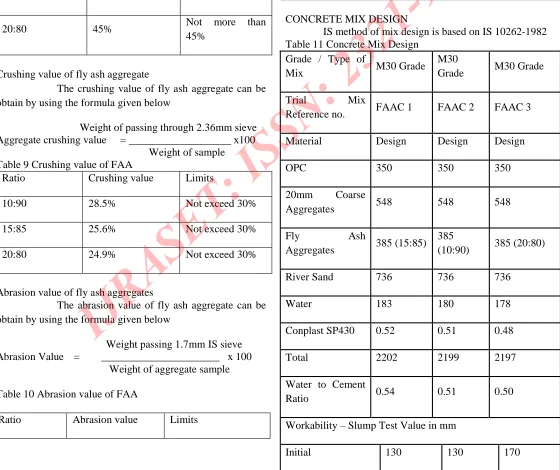
Table 8 Impact value of FAA
Ratio Impact value Limits
10:90 53.6% Not more than
45%
15:85 47.9% Not more than
45%
20:80 45% Not more than
45%
Crushing value of fly ash aggregate
The crushing value of fly ash aggregate can be obtain by using the formula given below
Weight of passing through 2.36mm sieve
[image:8.612.22.582.267.737.2]Aggregate crushing value = ___________________ x100 Weight of sample
Table 9 Crushing value of FAA
Ratio Crushing value Limits
10:90 28.5% Not exceed 30%
15:85 25.6% Not exceed 30%
20:80 24.9% Not exceed 30%
Abrasion value of fly ash aggregates
The abrasion value of fly ash aggregate can be obtain by using the formula given below
Weight passing 1.7mm IS sieve
Abrasion Value = ______________________ x 100
Weight of aggregate sample
Table 10 Abrasion value of FAA
Ratio Abrasion value Limits
10:90 52.43%
vary from 30.0
to 50.0 percent
15:85 49.76%
vary from 30.0
to 50.0 percent
20:80 48.34%
vary from 30.0
to 50.0 percent
CONCRETE MIX DESIGN
IS method of mix design is based on IS 10262-1982 Table 11 Concrete Mix Design
Grade / Type of
Mix M30 Grade
M30
Grade M30 Grade
Trial Mix
Reference no. FAAC 1 FAAC 2 FAAC 3
Material Design Design Design
OPC 350 350 350
20mm Coarse
Aggregates 548 548 548
Fly Ash
Aggregates 385 (15:85)
385
(10:90) 385 (20:80)
River Sand 736 736 736
Water 183 180 178
Conplast SP430 0.52 0.51 0.48
Total 2202 2199 2197
Water to Cement
Ratio 0.54 0.51 0.50
Workability –Slump Test Value in mm
@ 45min 80 110 70
COMPRESSIVE STRENGTH OF CONCRETE (CUBES) 15cm x 15cm x 15cm concrete cubes were tested as per IS 516-1959. The test was conducted in 120Tcompression testing machine. The load was applied at the rate approximately 140kg/cm2/min until the failure of the specimen. The maximum load applied to the specimen until failure was recorded.
Strength Result of FAAC and CCAC
The compressive strength of concrete gives an idea about the overall quality of a concrete.
Table 12 Compressive strength of FAAC and CCAC Sl. No. Structure Concrete d Grade of Concret e Age in days Actua l weigh t kg Dial Reading/ max load (kN) Comp. Strengt h (N/mm 2 ) Avera ge Comp. Streng th (N/m m2)
1 conventio nal concrete M30 7
8.26 590 26.1
26.3
8.30 595 26.5
28
8.38 850 37.9
38.2
8.34 860 38.5
2 M30 FAAC (Ratio 10:90) M30 7
7.97 500 22.2
22.7
8.05 520 23.2
28
8.10 750 33.2
33.4
8.21 755 33.6
3 M30 FAAC(R atio 15:85) M30 7
7.95 520 23.0
24
7.98 560 25.0
28
8.13 815 36.2
37.3
8.10 860 38.4
4 M30 FAAC(R atio 20:80) M30 7
8.08 590 26.1
25.2
8.10 545 24.3
28
8.13 770 34.2
35.1
[image:9.612.23.577.78.730.2]8.17 810 36.0
Figure 5
Compressive
strength of
FAAC (Ratio 10:90) and CCAC
0 5 10 15 20 25 30 35 40
7 days 28 days
FAAC( Ratio 20:80) CCAC
Figure 6 compressive strength of FAAC(Ratio 20:80) CCAC
Age of concrete in days
0
10
20
30
40
7 days
14 days
[image:10.612.60.571.101.640.2]FAAC(Ratio 10:90) FAAC(Ratio 15:85) FAAC(Ratio 20:80)
Figure 7 Compressive strength of FAAC
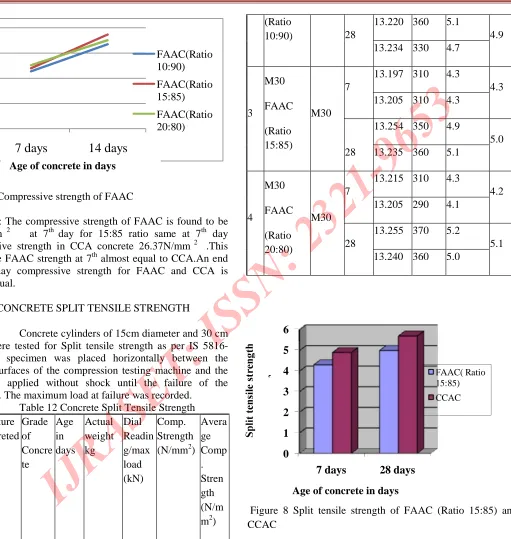
Inference: The compressive strength of FAAC is found to be 24 N/mm 2 at 7th day for 15:85 ratio same at 7th day
compressive strength in CCA concrete 26.37N/mm 2 .This
shows the FAAC strength at 7thalmost equal to CCA.An end
of 28th day compressive strength for FAAC and CCA is
almost equal.
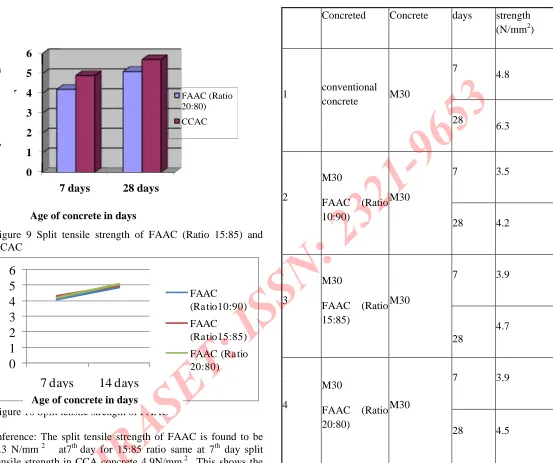
CONCRETE SPLIT TENSILE STRENGTH
[image:10.612.24.290.117.275.2]Concrete cylinders of 15cm diameter and 30 cm height were tested for Split tensile strength as per IS 5816-1976.The specimen was placed horizontally between the loading surfaces of the compression testing machine and the load was applied without shock until the failure of the specimen. The maximum load at failure was recorded.
Table 12 Concrete Split Tensile Strength Sl. No. Structure Concreted Grade of Concre te Age in days Actual weight kg Dial Readin g/max load (kN) Comp. Strength (N/mm2)
Avera ge Comp . Stren gth (N/m m2)
1
conventio nal concrete
M30
7 13.528 340 4.8
4.9
13.523 355 5.0
28 13.485 400 5.6
5.7
13.541 420 5.9
2 M30
FAAC
M30 7
13.170 280 4.0
4.1
13.187 300 4.2
(Ratio
10:90) 28
13.220 360 5.1
4.9
13.234 330 4.7
3 M30 FAAC (Ratio 15:85) M30 7
13.197 310 4.3
4.3
13.205 310 4.3
28
13.254 350 4.9
5.0
13.235 360 5.1
4 M30 FAAC (Ratio 20:80) M30 7
13.215 310 4.3
4.2
13.205 290 4.1
28
13.255 370 5.2
5.1
13.240 360 5.0
0 1 2 3 4 5 6
7 days 28 days
FAAC( Ratio 15:85) CCAC
Figure 8 Split tensile strength of FAAC (Ratio 15:85) and CCAC
[image:10.612.18.290.507.750.2]0 1 2 3 4 5 6
7 days 28 days
FAAC (Ratio 20:80)
CCAC
Figure 9 Split tensile strength of FAAC (Ratio 15:85) and CCAC
0
1
2
3
4
5
6
7 days
14 days
FAAC (Ra tio10:90)
FAAC (Ra tio15:85)
FAAC (Ra tio 20:80)
Figure 10 Split tensile strength of FAAC
Inference: The split tensile strength of FAAC is found to be 4.3 N/mm2 at7th day for 15:85 ratio same at 7th day split tensile strength in CCA concrete 4.9N/mm2 .This shows the
FAAC strength at 7thalmost equal to CCA. An end of 28thday
split tensile strength for FAAC and CCA is almost equal.
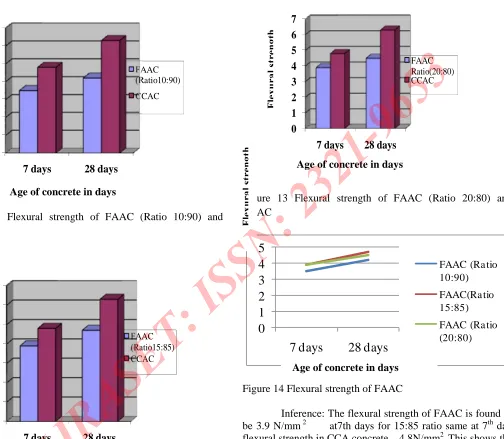
FLEXURAL STRENGTH
The concrete beams of size 10cm x 10cm x 50cm were tested as per IS 516-1959. The load was applied through two similar rollers mounted at one third points of the supporting span. The load was applied without shock until the failure occurs. The maximum load at failure was recorded. Table 13 Flexural strength of FAAC &CCAC
Sl. No. Structure Grade of Age in Average
Flexural
Concreted Concrete days strength
(N/mm2)
1 conventional
concrete M30
7
4.8
28
6.3
2
M30
FAAC (Ratio 10:90)
M30
7 3.5
28 4.2
3
M30
FAAC (Ratio 15:85)
M30
7 3.9
28
4.7
4
M30
FAAC (Ratio 20:80)
M30
7 3.9
28 4.5
Age of concrete in days
[image:11.612.25.578.108.571.2]0 1 2 3 4 5 6 7
7 days 28 days
FAAC (Ratio10:90)
CCAC
Figure 11 Flexural strength of FAAC (Ratio 10:90) and CCAC
0 1 2 3 4 5 6 7
7 days 28 days
FAAC (Ratio15:85) CCAC
Figure 12 Flexural strength of FAAC (Ratio 15:85) and CCAC
0 1 2 3 4 5 6 7
7 days 28 days
FAAC Ratio(20:80) CCAC
Figure 13 Flexural strength of FAAC (Ratio 20:80) and CCAC
0
1
2
3
4
5
7 days
28 days
FAAC (Ra tio 10:90)
FAAC(Ra tio 15:85)
[image:12.612.65.569.135.574.2]FAAC (Ra tio (20:80)
Figure 14 Flexural strength of FAAC
Inference: The flexural strength of FAAC is found to be 3.9 N/mm2 at7th days for 15:85 ratio same at 7th day flexural strength in CCA concrete 4.8N/mm2 .This shows the FAAC strength at 7th almost equal to CCA.An end of 28th day flexural strength for FAAC and CCA is almost equal.
7. CONCLUSION
Based upon the test carried out on compressive strength, Flexural strength and Split tensile strength test for conventional aggregate concrete and fly ash aggregate concrete.
On comparing the test result for CCAC & FAAC it is founded that the value is almost same for both concretes. This shows fly ash aggregate concrete has an equal strength while comparing to CCAC.
Age of concrete in days
Age of concrete in days
Age of concrete in days
[image:12.612.34.257.152.335.2]Therefore FAA can be recommended as coarse aggregate for preparing of concrete which will reduce the usage of natural aggregate.
REFERENCES
[1]. The Indian Concrete Journel,November 2004,Vol.78.. [2]. RafatSiddique Cement and Concrete Research 33 (2003)
539–547 Effect of fine aggregate replacement with
Class F fly ash on the mechanical properties of concrete. Department of Civil Engineering, Thapar Institute of Engineering and Technology, Deemed University, Patiala 147004, India.
[3]. ACI committee 211.2 (1991) standard practices for selecting proportions for structural light weight concrete.ACI Material Journel,87,638-651.
[4]. N.P.Rajamani and P.S. Ambily, scientist, SERC, Chennai
carried out the research work on “Selection of mortar for light weight aggregate concrete made with fly ash based
aggregate”.
[5]. www.sustainabledevelopment.in [6]. www.sciencedirect.com
[7]. www.flyash.com
[8]. www.FACprojectindia.com [9]. www.cement.org
[10]. M.S.Shetty,Concrete Technology Theory and practical Reprint-2005 Publishers S.Chand and Company Ltd., New Delhi
[11]. Neville, A.M and Brooks J.J “concrete
technology”,ELBS,1987
[12]. IS 10262-1982 recommended guidelines for concrete
“Mix Design”, BIS,New Delhi.