A Novel FLC Based
Street Lighting
Using NI Lab VIEW
Shefali Thakral1, Dr. S. Chatterji2, Shimi S.L3 1
M.E Student, 2Professor and Head, 3Assistant Professor, Electrical Engineering Department, NITTTR, Chandigarh, India
Abstract — This paper presents a novel concept of energy management software for developing energy efficient street lighting system by using solar as well as grid supply. The investigator studied and thought deeply regarding this problem. Being Electrical Engineer, the investigator has tried to develop energy management software package, which consists of two application and which are very practical and easy to use.
Energy efficient street lighting gives 33.33% energy saving by proper scheduling and 33.33% energy is saved by using solar supply .So total 66.66% of electrical energy is saved by using this software. This special software developed in Lab VIEW, which can automatically control the street lights and can save energy approximately 66.66%.
Keywords —NI Lab VIEW, Solar Cell, Energy management software, Energy saving.
I. INTRODUCTION
In India 50% energy is consumed in industries and left 50% in non commercial buildings and houses. But till now the conservation of energy and its proper utilization has not been implemented by the most of the area. Providing street lighting is one the most important – and expensive – responsibilities of a city: Lighting can account for 10–38% of the total energy bill in typical cities worldwide (NYCGP 2009). Street lighting is a particularly critical concern for public authorities in developing countries because of its strategic importance for economic and social stability. Inefficient lighting wastes significant financial resources each year, and poor lighting creates unsafe conditions. Energy efficient technologies and design can cut street lighting costs dramatically (often by 25-60%); these savings can eliminate or reduce the need for new generating plants and provide the capital for alternative energy solutions for populations in
remote Areas .These cost savings can also enable municipalities to expand street lighting to additional areas, increasing access to lighting in low-income and other underserved areas. By proper implementation of energy efficient technologies in industries and homes, lot of electrical energy can be saved in the country. Hence there is a huge scope of energy management in both commercial and non commercial areas in India [1] [2]. This software helps in development of efficient energy system.
II GLOBEL NEED TO CONSERVE ENERGY
It is very important to minimize the part of an empire on the fossil fuels that are becoming increasingly limited in supply.
If energy will not be preserved and manage properly a huge problem of energy crisis will take place and collapse condition may reach.
III LIGHTING HAS AN IMPORTANT ROLE TO PLAY
Reducing risks of night time accidents
Assisting in the protection of property
Discouraging crime and vandalism
Making residents feel secure
Enhancing the appearance of the area after dark.
IV BENEFITS OF ENERGY MANAGEMENT SOFTWARE
Using software for energy management has tremendous benefit over traditional one. Main need for using this software based street lights
are-It will immediately give proper direction so that electricity bill will reduce.
Speed up the process of energy auditing and energy management recommendation outcome.
Environmentally friendly – 100% powered by the sun, solar panels reduce fossil fuel consumption, eliminating pollution
Self-contained solution – Light on/off controlled by automatic daylight sensing or hour preset, low running or maintenance cost
Better light source –LED lamps feature cool white light without flickering and higher brightness than sodium lamps. It also does not decrease the power quality
Battery backup for cloudy or rainy days
Distributed light and power - no single point of failure for enhanced security
Easy to install with quick connect plugs - less than 1 hour
Less scheduled maintenance for up to 5 years
Less monthly electric bills
V ENERGY EFFICIENT SOFTWARE
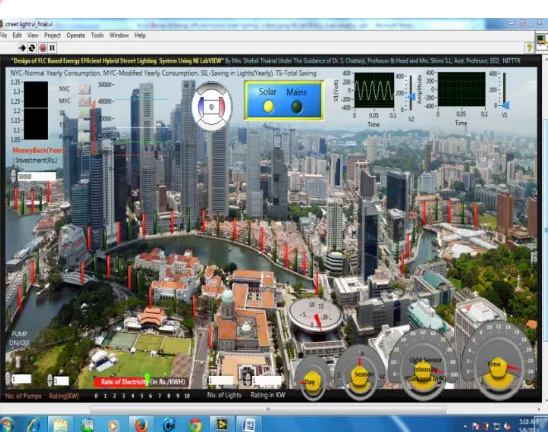
The energy efficient street lighting software applications are shown in Fig.1 to 4.
The concept behind this street lighting is to divide the street lights into four parts. In general practice it is found that almost all street lights are ON during the whole night. The investigator in the present work has used Lab VIEW software to switch OFF alternate street lights after 10 pm. As the traffic gets reduced to quite an extent in the night hours, therefore the requirement to keep all the street lights ON is not so essential for whole night. The front panel is shown in Fig 1 to 4.
All the lights are put off during day time. From 6 pm to 10 pm mains power is used and after 10 pm till morning solar power is used.
In the front panel, there are following controls:
Time - According to time the street lights will get on or off. Automatically by using fuzzy logic, according to our requirement, it will get on or off.
Light intensity - Light intensity will control the intensity of street lights. As the darkness will increase, the light intensity will increase.
Season - According to the season, the on/off timing of street light will be controlled.
Day - Day is used to schedule the street lights. On alternate day, half the street lights will get on/off.
The Input Output Variables has been shown in Fig. 1. The input variables based system, also known as the linguistic variables of the fuzzy logic, are as follows:
(i) Time (ii) Day
The output variables of the fuzzy logic are in the form of voltage which are given to the following devices:
(i) Street Light 1 (ii) Street Light 2
VI WORKING PRINCIPLE
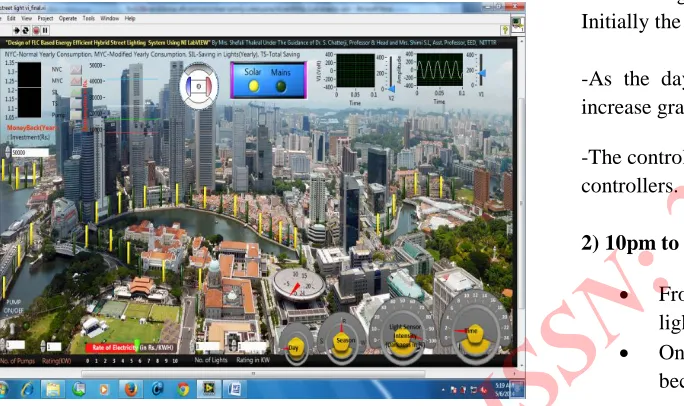
[image:4.612.314.578.113.313.2]Fig.2. shows the evening time when all the lights get ON simultaneously. All the lights get ON during 6pm to 10 pm. At this time the Mains supply will on. As this is the peak hrs, therefore there is a requirement to keep all the street lights ON from 6pm to 10 pm.
Fig. 2 All Lights are ON During 6 pm to 10 pm
It continues up to 10 pm. After 10 pm, half of the lights (Alternate ones) get turned OFF and only scheduled lights get ON. At this time period the Solar supply is ON as shown in Fig.3.
[image:4.612.132.581.346.628.2] [image:4.612.317.591.406.622.2]This continues up to 12am. After 12am, the half street lights which were turned OFF, gets turned ON and the ones which were ON get turned OFF, as shown in Fig.4. This scheduling of turning ON half the number of street lights at a time saves 33.33 % of electrical energy and 33.33% energy is saved by not using mains supply. So total 66.66% of electrical energy is saved by using this software.
Fig. 4 Next Half Lights are ON During 12 am to 6 am
This special software developed in Lab VIEW, which can automatically control the street lights and can save energy approximately 66.66%
To understand the working of the system lets divide the entire day into four parts. Let’s assume we switch on the street lights at 6pm. So, the four parts of the day are:
1) 6pm to 10pm
2) 10pm to 12am
3) 12am to 6am
4) 6am to 6pm.
- At 6pm the street lights are switched on.
-All the street lights are turned on at this time.
-The source of energy at this time for all the street lights will be the ac mains supply.
-Controlling of the intensity of light is required at this time. Initially the intensity of light is kept low.
-As the day light goes low, the intensity of street light will increase gradually.
-The controlling of the light intensity is done with the help of FL controllers.
2) 10pm to 12am:
From 10pm to 12am the source of energy for the street lights will be the solar energy stored during the day.
Only half of the street lights will be working at this time because at late night traffic on road is very low.
3) 12am to 6am:
From 12am to 6am also the source of energy for the street lights will be the solar energy stored during the day.
The other half of the street lights will be working at this time.
4) 6am to 6pm:
From 6am to 6pm all the lights will remain switched off.
Switching off of the street lights will be automatic.
At this time period the solar power is being utilized for water pumping/ Agriculture use.
VII ENERGY MANAGEMENT USING THE STREET LIGHTING SYSTEM
Normal street lights waste a huge amount of energy. 1) Normal street lights are sometimes left switched on the
entire day. Our proposed street lighting system automatically switches off the street lights.
2) Normal Street lights work on full intensity the entire night. Our proposed street lights have a control system
Which automatically control the intensity of light according to the requirement and the light outside. 3) Let’s say for a continuous working of 10 normal street
lights from 6pm to 6am, 30 units of energy is consumed per day,
therefore,
(i) 6pm to 10pm: 33.33 units (ii) 10pm to 12am: 16.66 units (iii) 12am to 6am: 50 units
4) Now let’stake a view on our proposed street light (i) From 6pm to 10pm ac mains supply is used therefore 33.33 units (neglecting the light intensity control)
(ii)10pm to 12am: zero units (because only solar energy is consumed)
(iii) 12am to 6am: zero units (because again only solar energy is used)So, therefore hybrid street lighting saves up to
66.66%of energy daily (neglecting the energy saved by automatic light intensity control).
VIII CONCLUSION
[1] This complete energy management software package is highly useful and capable of saving huge amount of electrical energy and provides an efficient way to use electrical energy. 2. Street lights are one of the major sources of huge
electrical energy consumption.
3. By using the software for controlling street lights, more than 66% energy can be saved with little investment only. 4. If .exe of energy management software is distributed free
of cost using website, then whole world can get proper idea of energy management and can save electrical energy themselves.
5. This software may be boon for engineers, energy managers and auditors, scientists, industries etc. as well as for normal people.
REFERENCES
1. Prudenzi, M. Di Lillo, A. Silvestri, M.C.Falvo “Software
s.n
o time mode fig
No. of lights ON Power Consumed Traditi on method Propos ed method Propos ed method 1. 6am to 6pm All lights OFF Fig.
1 0 0 0 0
2. 6pm to 10 pm All lights ON Fig.
2 10 10
1 0 10 3. 10p m to12 am Half the numb er of lights ON Fig.
3 10 5
1 0 2.5 ( Solar Energy) = ZERO 4. 12a m to 6am Next half lights ON Fig.
4 10 5
Tool for Energy Audit Activities in Building”, IEEE International Symposium on Power Electronics, Electrical Drives, Automation and Motion, August 6, 2008.
2. Peng Fang and Pu Wang, “The Research of Photovoltaic Street Ligh Control System with MPPT”, IEEE 3rd International Workshop, Intelligent and Applications (ISA), China, pp: 01-08, April, 2011.
3. Tao hen and Jin Ming Ang, “Research on Energy
Management for Wind/PV Hybrid Power System”, 3rd International Conference on Power Electronics Systems and Applications, China, pp: 1402-1406, September, 2009.
4. Ranjan, R. Agnihotri, S.K. Sangal and S.K. Shill, “ Village Electrification - Salojipally Project”,IEEE Twentieth Photovoltaic Specialists Conference, Sahibabad India, pp: 1211-1215, July, 1988.
5. Steve R. Harrington and Thomas D. Hund, “Photovoltaic Lighting System Performance”, IEEE Twenty Fifth Photovoltaic Specialists Conference, Washington, pp: 1307-1310, 13-17 May, 1996.
6. www.ni.com
7. Orion Zavalani, “Reducing energy in buildings by using energy management system and alternative energy saving system”, 8th
international conference on the Europian energy market, 25-27 May 2011.
8. Ana Rossell Busquet, Jose Soker, Lars Dittmann, novel home energy management system architecture”, UKSim 13th international conference on modelling and simulation, 2011.
9. Riccardo de Asmundis, “LabVIEW- Modeling,