An Experimental Investigation on the Mechanical
and Durability Properties of M
30
Concrete with
Partial Replacement of Coarse Aggregate by Steel
Slag and Fine Aggregate by Copper Slag
A. Jayanthi 1, Dr.S.M.V.Narayana2, T. Naresh Kumar 3
1
P.G. Scholar, Civil Engineering Department, Annamacharya Institute of Technology and Sciences-Rajampet
2
Principal, Annamacharya Institute of Technology and Sciences-Rajampet
3
Assistant Professor, Civil Engineering Department, Annamacharya Institute of Technology and Sciences-Rajampet
Abstract: The waste products that are produced from industries cause harmful effects to the environment if they are not properly utilized. About 12 million tones of steel slag and about 24.6 million tons of copper slag are generated annually worldwide. In order to utilize these waste products effectively, are attempt in made to study the mechanical and durability properties of M30
concrete using steel slag produced by local steel plant as CA and copper slag as FA. By varying the proportions of steel slag and copper slag replacements from 10% to 40% at an increment of 10%,Concrete specimens were prepared and tested for mechanical properties viz compressive strength and split tensile strength. The durability tests namely water permeability test and (RCPT) Rapid Chloride permeability tests were conducted. The results are compared with conventional OPC concrete. It is observed that both the steel slag and copper slag enhance the mechanical and durability properties. The waste products that are produced from industries cause harmful effects to the environment if they are not properly utilized. About 12 million tones of steel slag and about 24.6 million tons of copper slag are generated annually worldwide. In order to utilize these waste products effectively, are attempt in made to study the mechanical and durability properties of M30 concrete using steel slag produced by
local steel plant as CA and copper slag as FA. By varying the proportions of steel slag and copper slag replacements from 10% to 40% at an increment of 10%,Concrete specimens were prepared and tested for mechanical properties viz compressive strength and split tensile strength. The durability tests namely water permeability test and (RCPT) Rapid Chloride permeability tests were conducted. The results are compared with conventional OPC concrete. It is observed that both the steel slag and copper slag enhance the mechanical and durability properties.
Key words: Steel slag, Copper slag, Mix design, Mechanical Properties, Rapid chloride permeability test, water permeability test.
I. INTRODUCTION
It is a known fact that the natural materials (raw materials) used for the production of cement are depleting at a greater pace worldwide and there is no replenishment for these material. On the other hand many industries are generating waste material whose safe, effective and economical use is yet to be explored fully. Sustainable development of construction industry needs the usage of non conventional material, innovative and recycled material (Aggarwal and Siddique- 2014 ;) in order to compensate the depleting natural material and at the same time to conserve environment. The production of steel slag in India is 12 million tones per year(V.subathra Devi & B.K.Granavel-2014) and the production of copper slag is 24.6 million tones per year (KhalifaS. Al.Jabri et al-2011). In order to add value to these materials and for sustainability, there is a need to search for alternative uses of these materials, which not only consume these wastes at larger scale but also enhance the value of these waste products.
It is a proven fact that concrete has much scope for the usage of these waste materials as it is the largely consumed material after water. In the present study an attempt is made to use these by-products/waste materials as partial replacement to natural aggregate in concrete and evaluated the mechanical and durability properties of concrete.
II. EXPERIMENTALPROGRAM A. Materials
©IJRASET (UGC Approved Journal): All Rights are Reserve
1708
Cement is the most important material in concrete and it acts as a binding material. The cement of 53 gradeOPC manufacturedby Zuari Cement Company confirming to IS 12269-1987 is used in the present investigation.TABLE 2.1
PROPERTIES OF CEMENT S.No Property Test results 1 Normalconsistency 29% 2 Specific gravity 3.15 3 Initial settingtime 30minutes 4 Finalsettingtime 600minutes 2) Fine aggregate
In this investigation, natural sand is used as fine aggregate. The specific gravity of sand is found to be 2.62. Sand was obtained from Cheyyeru River near Nandalur in Kadapa district.
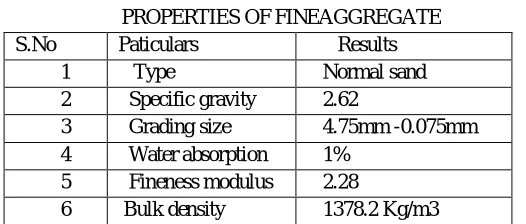
TABLE2.2
PROPERTIES OF FINEAGGREGATE S.No Paticulars Results 1 Type Normal sand 2 Specific gravity 2.62
3 Grading size 4.75mm -0.075mm 4 Water absorption 1%
5 Fineness modulus 2.28
6 Bulk density 1378.2 Kg/m3
[image:3.612.177.440.259.371.2]3) Coarse Aggregate: In the present investigation, crushed granite aggregate of 20mm size is used. The specific gravity of coarse aggregate is 2.64.
TABLE 2.3
PHYSICALPROPERTIES OF COARSEAGGREGATE
S.No Paticulars Results
1 Type Crushed stone
2 Specific gravity 2.64
3 Maximum size 20 mm
4 Water absorption 0.5% 5 Fineness modulus 4.30
6 Bulk density 1388 Kg/m3
4) Water: Water is used for mixing and curing of concrete. In the present investigation, tap water available in the campus was used for both mixing and curing of concrete.
TABLE 2. 4
PHYSICALPROPERTIES OFWATER
S.No Property Value
1 PH 7.1
2 Taste Agreeable
3 Appearance Clear
4 Turbidity(NTunits) 1.75
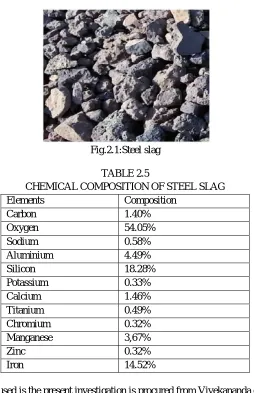
[image:3.612.197.420.620.697.2]Fig.2.1:Steel slag
TABLE 2.5
CHEMICAL COMPOSITION OF STEEL SLAG
Elements Composition
Carbon 1.40%
Oxygen 54.05%
Sodium 0.58%
Aluminium 4.49%
Silicon 18.28%
Potassium 0.33%
Calcium 1.46%
Titanium 0.49%
Chromium 0.32%
Manganese 3,67%
Zinc 0.32%
Iron 14.52%
6) Copper Slag:The copper slag used is the present investigation is procured from Vivekananda chemicals, Hyderabad. The slag is a black glassy and granular in nature and has a similar particle size range of sand which indicates that it could be tried as replacement with sand in cementations mixture. The other main advantage of using Copper slag (a waste material) is to reduce the cost of construction. (Al-Jabri et al 2009).copper slag has a number of favorable mechanical properties for aggregate use such as excellent soundness characteristics, good abrasion resistance and good stability conditions (Gorai 2002). In the present investigation, copper slag aggregate sieved through 4.75 to 150 micronsieves and conforming to zone II (of sand) size was used. The specific gravity of copper slag is 2.82.
©IJRASET (UGC Approved Journal): All Rights are Reserve
1710
TABLE 2.6CHEMICAL COMPOSITION OF COPPER SLAG Elements Composition Silicon oxide (SiO2) 97.01 Aluminum oxide (Al2O3) 0.095 Iron oxide (Fe2O3) 1.05 Calcium oxide (CaO) 1.064 Magnesium oxide (MgO) 0.118 Sulfur trioxide (SO3) 0.008 Potassium oxide (K2O) 0.028 Sodium oxide (Na2O) 0.118 Titanium oxide (TiO2) 0.120 Manganese oxide (Mn2O3) 0.002 Copper oxide (CuO) 0.183 SulphideSulphur 0.082
B. Concrete Mix design
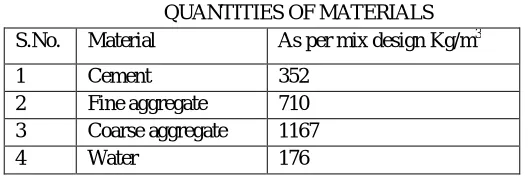
[image:5.612.175.441.364.453.2]Concrete mix design can be defined as the process of selecting suitable ingredients of concrete and determining their relative proportions with the objectives of producing concrete of certain minimum strength and durability as economically as possible. The concrete mix was designed using the guide lines given in IS 10262 -2009 and IS 456-2000 codes. The details of mix proportions (1:2:3.26) and the proportions of various ingredients of concrete are given below.
TABLE 2.7
QUANTITIES OF MATERIALS S.No. Material As per mix design Kg/m3
1 Cement 352
2 Fine aggregate 710 3 Coarse aggregate 1167
4 Water 176
[image:5.612.50.568.568.727.2]Control concrete mixture of M30was designated as A1. The other concrete mix proportions by replacing CA with steel slag at 10%,20%,30% and 40% were designated as A1, A2, A3, A4 and A5 and the concrete mixes made by replacing FA with copper Slag 10%, 20%, 30%, 40% were designated as A1,A6,A7,A8 AND A9. Mix proportions of A1 to A9 concrete mixtures are given in table 2.8
TABLE 2.8
MIXTURE PROPORTIONS
Material A1 A2 A3 A4 A5 A6 A7 A8 A9
Cement, Kg/m3 352 352 352 352 352 352 352 352 352
Steel slag % 0 10 20 30 40 0 0 0 0
Steel slag, Kg/m3 0 152.51 305.02 457.53 610.04 0 0 0 0 Coarse aggregate,
Kg/m3
1167 1034.42 919.4 804.5 689.61 0 0 0 0
Copper slag % 0 0 0 0 0 10 20 30 40
Copper slag, Kg/m3 0 0 0 0 0 86.70 173.40 260.10 346.80
Fine aggregate, Kg/m3 710 0 0 0 0 617.7 567.89 496.9 425.91
Water Kg/m3 176 176 176 176 176 176 176 176 176
C. Testing procedures
1) Compressive Strength Test: The compressive strength of concrete(150 mm × 150 mm × 150 mm) was tested using compression testing machine according to IS 516-1959.The concrete cubes were tested at7days, 14 days and 28 days and 60 days curing period. The cube compressive strength is calculated. The ratio of failure load to the area of cross section.
If fc is the cube compressive strength,
Then fc= N/mm2,
Where P is an ultimate load in Newtons. A is a cross sectional area of cube in mm2.
2) Split Tensile Strength Test: Split tensile strength test on concrete cylinder is a method to determine the tensile strength of concrete. Spilt
Tensile strength of concrete found by the procedure prescribed by IS 5816 – 1999. Specimens of 150mm diameter × 300mm height were used for this test. The specimens were tested for 7, 14, 28 and 60days strength. The
cylindrical specimen was placed in horizontal direction on the testing machine. The load was applied uniformly at a constant rate of 1.5 N/mm2until the failure by splitting along the vertical axis took place. Loads at which specimen failed were recorded and tabulated. Then split tensile strength was calculated. The following relation is
Used to find out the spilt tensile strength of cylinder, Ft = Where Ft is split tensile strength
P= Ultimate load in Newton. L = Length of the cylinder in mm. D = Diameter of the cylinder in mm.
3) Rapid Chloride ion permeability test: In the chloride permeability test, a water-saturated, 50 mm thick, 100 mm diameter concrete specimen is subjected to a 60v applied DC voltage for 6 hours using the RCPT apparatus. In one reservoir 3.0% NaCl solution and in the other reservoir is a 0.3 M NaOH solution was filled. The test was conducted as per the procedure prescribed in ASTMC 1202. The total charge passed is determined using the formula
I=900(I0+2(I30+I60+---I330)+I360)
4) Water permeability test: In the present investigation the water permeability of concrete was tested by using depth of penetration
test. The
Permeability is measured by using Darcy’s law.
K=
d= depth of penetration in (m) v= volume of water occupied by pores h= hydraulic head in m
t= time in seconds v=
m=gain in mass (grams) A= c/s area of sample (mm2) d= depth of penetration in mm
III. EXPERIMENTALRESULTSANDDISCUSSIONS A. Compressive Strength of concrete with steel slag
TABLE 3.1
COMPRESSIVE STRENGTH TEST RESULTS FOR CONCRETE WITH STEEL SLAG Mix
Designatio n
Proportions of coarse aggregate Compressive strength N/mm2
7-days 14-days 28-days
©IJRASET (UGC Approved Journal): All Rights are Reserve
1712
A2 90 % CA + 10% steel slag 24.323 35.11 39.20A3 80% CA + 20 % steel slag 27.52 36.26 42.25 A4 70% CA + 30% steel slag 26.84 27.74 36.70 A5 60% CA + 40 % steel slag 25.37 26.69 31.77
[image:7.612.181.472.168.395.2]At 7 days curing age, it was observed that the compressive strength showed an increase as the steel slag content increased up to20%.
Fig 3.1:Compressive strength Vs percentage of CA and steel slag
At 7 days ,it is observed that the Compressive strength of M30 grade concrete with steel slag coarse aggregate increased with increase in percentage of steel slag. The increase in compressive strength is 6%,20%,17% and 10.6% more than the conventional concrete. The M30 concrete with 20% steel slag has yield highest compressive strength at 7 days. At 14 days ,it is observed that the compressive strength of M30 grade concrete with steel slag coarse aggregate increased with increase in percentage of steel slag. The increase in compressive strength is 3%,6%,18.4% and 21.5% more than the conventional concrete. The M30 Concrete with 20% steel slag has yield highest compressive strength at 14 days. At 28 days ,it is observed that the compressive strength of M30 grade concrete with steel slag coarse aggregate increased with increase in percentage of steel slag. The increase in compressive strength is 4.3%,12.5%,22.6% and 15.3% more than the conventional concrete. The M30 concrete with 20% steel slag has yield highest compressive strength at 28 days.
B. Compressive Strength of concrete with copper slag
TABLE 3.2
COMPRESSIVE STRENGTH TEST RESULTS FOR CONCRETE WITH COPPER SLAG 0
5 10 15 20 25 30 35 40 45
A1 A2 A3 A4 A5
C
o
m
p
r
e
ss
iv
e
s
tr
e
n
gth
N
/M
M
2
% of Replacement CA with steel slag Compressive strength of concrete with steel slag CA
7 DAYS
14 DAYS
28 DAYS
Mix Designation Proportions of fine aggregate Compressive strength N/mm2
7-days 14-days
28-days
A1 100 % FA 22.93 34.0 37.55
Fig 3.2:Compressive strength Vs percentage of F.S and copper slag
At 7 days ,it is observed that the Compressive strength of M30 grade concrete with copper slag fine aggregate increased with increase in percentage of copper slag. The increase in compressive strength is 22%,26.4%,36.2% and 16.6% more than the conventional concrete. The M30 concrete with 30% copper slag has yield highest compressive strength at 7 days. At 14 days ,it is observed that the compressive strength of M30 grade concrete with copper slag fine aggregate increased with increase in percentage of copper slag. The increase in compressive strength is 4.2%,6.2%,13% and 6.6% more than the conventional concrete. TheM30 Concrete with 30% copper slag has yield highest compressive strength at 14 days. At 28 days, it is observed that the compressive strength of M30 grade concrete with copper slag fine aggregate increased with increase in percentage of copper slag. The increase in compressive strength is 2.9%,10%,16.9% and 3.8% more than the conventional concrete. The M30 concrete with 30% copper slag has yield highest compressive strength at 28 days.
[image:8.612.161.453.73.398.2]C. Split Tensile Strength of concrete with steel slag
TABLE 3.3
SPLIT TENSILE STRENGTH TEST RESULTS FOR STEEL SLAG Mix
Designatio n
Percentages of natural CA and Steel slag
Split Tensile Strength N/mm2
7-days 14-days 28-days
A1 100% CA 2.16 3.11 3.42
A2 90 % CA+10 % steel slag 2.43 3.69 4.18 A3 80 % CA+20 % steel slag 2.55 3.90 4.32 A4 70 % CA+30 % steel slag 2.50 3.20 3.64 A5 60 % CA+40 % steel slag 2.44 2.84 3.07
0 5 10 15 20 25 30 35 40 45 50
A1 A6 A7 A8 A9
C
o
m
p
r
e
ss
iv
e
s
tr
e
n
gth
N
/M
M
2
concrete with copper slag
Compressive strenth of concrete with copper slag FA
7 DAYS
14 DAYS
©IJRASET (UGC Approved Journal): All Rights are Reserve
1714
Fig 3.3:Split tensile strength Vs percentage of CA and steel slagAt 7 days ,itis observed that the split tensile strength of M30 grade concrete with steel slag coarse aggregate increased with increase in percentage of steel slag. The increase in splittensile strength is 12.5%,18%,15.7% and 12.7% more than the conventional concrete. The M30 concrete with 20% steel slag has yield highest split tensile strength at 7 days. At 14 days, it is observed that the split tensile strength of M30 grade concrete with steel slag coarse aggregate increased with increase in percentage of steel slag. The increase in split tensile strength is 18.6%,25.4%,2.8% and 8.6% more than the conventional concrete. The M30 Concrete with 20% steel slag has yield highest split tensile strength at 14 days. At 28 days ,it is observed that the split strength of M30 grade concrete with steel slag coarse aggregate increased with increase in percentage of steel slag. The increase in split tensile strength is 22.2%,26.3%,6.4% and 10.2% more than the conventional concrete. The M30 concrete with 20% steel slag has yield highest split tensile strength at 28 days.
D. Split Tensile Strength of concrete with copper slag
TABLE 3.4
SPLIT TENSILE STRENGTH TEST RESULTS FOR USING COPPER SLAG Mix
Designati on
Percentages of natural FA and copper slag
Split Tensile Strength N/mm2
7-days 14-days 28-days
A1 100% FA 2.16 3.11 3.42
A6 90% FA+10% copper slag 2.41 3.25 3.67
A7 80 % FA+20 % copper slag 2.64 3.72 4.10 A8 70% FA+30 % copper slag 2.80 3.98 4.42
A9 60 % FA+40% copper slag 2.43 3.12 3.51
Fig3.4: Split tensile strength Vs percentage of FA and CS 0 1 2 3 4 5
A1 A6 A7 A8 A9
S p li t te n si le s tr e n gth N /M M 2
% of replacement FA with steel slag split tensile strength of concrete specimens by
replacing of CA with steel slag
7 DAYS 14 DAYS 28 DAYS 0 2 4 6
A1 A6 A7 A8 A9
S p li t te n si le s tr e n gth N /M M 2
% of Replacement FA with copper slag split tensile strength of concrete specimens by
replacing of FA with copper slag
7 DAYS
14 DAYS
At 7 days ,it is observed that the split strength of M30 grade concrete with copper slag fine aggregate increased with increase in percentage of copper slag. The increase in split tensile strength is 11.5%,22.2%,29.6% and 12.5% more than the conventional concrete. The M30 concrete with 30% copper slag has yield highest split tensile strength at 7 days. At 14 days ,it is observed that the split tensile strength of M30 grade concrete with copper slag fine aggregate increased with increase in percentage of copperslag. The increase in split tensile strength is 4.5%,19.6%,27.9% and 0.3% more than the conventional concrete. The M30 Concrete with 30% copper slag has yield highest split tensile strength at 14 days. At 28 days ,it is observed that the split tensile strength of M30 grade concrete with copper slag fine aggregate increased with increase in percentage of copper slag. The increase in split tensile strength is 7.3%,19.8%,29.2% and 2.6% more than the conventional concrete. The M30 concrete with 30% copper slag has yield highest split tensile strength at 28 days.
E. Rapid chloride permeability test:
[image:10.612.127.488.286.647.2]The Rapid chloride permeability test was conducted on M30 grade concrete mixes replacing CA by steel slag at 10%, 20%, 30% and 40%. The results of rapid chloride permeability test of A1, A2, A3, A4 and A5 concrete mixtures tested at 28 days and 60 days are represented in table 3.5.
TABLE 3.5
CHLORIDE ION PERMEABILITY RATING FOR STEEL SLAG Designatio
n of mix
Proportion of coarse aggregate
Charge passed in columns
28 days 60 days
A1 Conventional mix 1150.50 1030.50
A2 90% CA+10% steel slag 1174.60 1080.90 A3 80 % CA+20 % steel slag 1258.20 1145.40 A4 70% CA+30 % steel slag 1390.50 1250.60 A5 60 % CA+40% steel slag 1480.70 1348.30
Fig. 3.5: chloride Vs percentage of CA and Steel slag penetration
The above figure shows the chloride diffusion in terms of the total charge passed through the specimen. it is observed that the total charge passed through the concrete specimen with replacement of coarse aggregate with steel slag increased with increase in percentage of slag .The chloride permeability decrease with age. The total charge passed through the M30 Concrete specimen with steel slag coarse aggregate up to 40% indicate that the concrete has low chloride ion permeability.
0 200 400 600 800 1000 1200 1400 1600
A1 A2 A3 A4 A5
c
h
ar
ge
p
as
se
d
i
n
c
o
u
lu
m
n
s
% of replacing by CA with steel slag
RCPT on replacing by CA with steel slag
28 days
©IJRASET (UGC Approved Journal): All Rights are Reserve
1716
F. Rapid chloride permeability test for copper slag :The Rapid chloride penetration test of M30 grade concrete mixes replacing FA by copper slag at 10%, 20%, 30% and 40%. The results of rapid chloride permeability test of A1, A6, A7, A8 and A9 concrete mixtures tested at 28 days and 60 days are represented in table 3.6.
TABLE 3.6
CHLORIDE ION PERMEABILITY RATING FOR COPPER SLAG Mix
designation
Proportion of fine aggregate Charge passed in columns
28 days 60 days
A1 Conventional mix 1150.5 1045.60
[image:11.612.116.499.156.448.2]A6 90% FA+10% copper slag 1150.0 1060.30 A7 80 % FA+20 % copper slag 1224.3 1020.40 A8 70% FA+30 % copper slag 1405.60 1142.40 A9 60 % FA+40% copper slag 1586.30 1244.50
Fig. 3.6: chloride penetration Vs percentage of FA and copper slag
The above figure shows the chloride diffusion in terms of the total charge passed through the specimen. It is observed that the total charge passed through the concrete specimen with replacement of fine aggregate with copper slag increased with increase in percentage of slag .The chloride permeability decrease with age. The total charge passed through the M30 Concrete specimen with copper slag fine aggregate up to 40% indicate that the concrete has low chloride ion permeability.
G. Water penetration of concrete with steel slag as coarse aggregate
[image:11.612.101.512.604.732.2]The test results for 60 days of water penetration with various percentages replacement of Coarse aggregate with steel slag are presented in table 3.7
TABLE 3.7
WATER PENETRATION TEST RESULTS OF CONCRETE WITH STEEL SLAG AS CA. Mix no. Proportion of coarse
aggregate
Depth of water penetration in
mm
Weigth of water penetrated in
grms
Coefficient of Water Permeability,m/
sec for 60 days
A1 Conventional mix 21 50 9.02×10⁻¹³
A2 90% CA+10% steel slag 13.1 50 5.91×10⁻¹³
A3 80 % CA+20 % steel slag 15.3 50 6.90×10⁻¹³
A4 70% CA+30 % steel slag 14.6 50 6.59×10⁻¹³
A5 60 % CA+40% steel slag 15.8 50 7.13×10⁻¹³ 0
500 1000 1500 2000
A1 A6 A7 A8 A9
c
h
ar
ge
p
as
se
d
i
n
c
o
u
lu
m
n
s
% of replacing by FA with copper slag
RCPT on replacing by FA with copper slag
28 days
Fig. 3.7:water penetration Vs percentage of CA and SS
H. Water penetration of concrete with copper slag as fine aggregate:
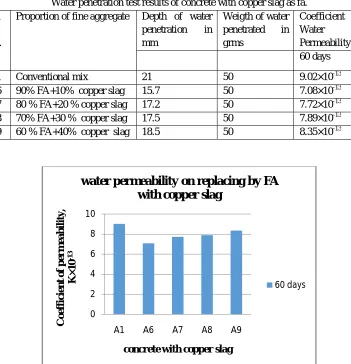
[image:12.612.127.478.355.719.2]The test results for 60 days of water penetration with various percentages replacement of fine aggregate with copper slag are presented in table 3.8.
TABLE 3.8
Water penetration test results of concrete with copper slag as fa. Mi
x no.
Proportion of fine aggregate Depth of water penetration in mm
Weigth of water penetrated in grms
Coefficient of Water
Permeability 60 days
A1 Conventional mix 21 50 9.02×10⁻¹³
A6 90% FA+10% copper slag 15.7 50 7.08×10⁻¹³ A7 80 % FA+20 % copper slag 17.2 50 7.72×10⁻¹³ A8 70% FA+30 % copper slag 17.5 50 7.89×10⁻¹³ A9 60 % FA+40% copper slag 18.5 50 8.35×10⁻¹³
Fig. 3.8:water penetration Vs percentage of FA and CS 0 2 4 6 8 10
A1 A2 A3 A4 A5
c o e ffi c ie n t o f p e r m e ab il ity, K × 10 -13
concrete with steel slag
water permeability of concrete on replacing by CA with steel slag
60 Days 0 2 4 6 8 10
A1 A6 A7 A8 A9
C o e ffi c ie n t o f p e r m e ab il ity, K × 10 -13
concrete with copper slag
water permeability on replacing by FA
with copper slag
[image:12.612.110.503.366.496.2]©IJRASET (UGC Approved Journal): All Rights are Reserve
1718
IV.CONCLUSIONS
A. The compressive strength of M30 concrete increases with increase in the replacement of CA with steel slag CA. Maximum
compressive strength is obtained for 20% replacement of CA. The increase in compressive strength at 28 days is about 15% when compared to the concrete with natural CA.
B. The compressive strength of M30 concrete increases with increase in the replacement of FA with copper slag FA. Maximum
compressive strength is obtained for 30% replacement of FA. The increase in compressive strength at 28 days is about 16.9% when compared to the concrete with natural FA.
C. The split tensile strength of M30 concrete with steel slag as CA increases with increase in percentage of slag aggregate up to
20% of replacement. The maximum tensile strength obtained is about 26% when compared to conventional concrete.
D. The split tensile strength of M30 concrete with copper slag as FA increases with increase in percentage of slag aggregate up to
30% of replacement. The maximum tensile strength obtained is about 29% when compared to conventional concrete.
E. The chloride resistance of M30 concrete slightly decreases with increase in replacement of CA by steel slag aggregate. There is
an increase in chloride resistance with age. i.e the concrete with 20% steel slag aggregate showed highest resistance at 60 days. F. The chloride permeability of M30 concrete slightly increases with increase in replacement of FA with copper slag aggregate.
There is reduction in chloride permeability of slag concrete with age. The lowest passage of charge is obtained for the concrete with 20% of copper slag fine aggregate.
G. The water permeability of concrete decreases with replacement of steel slag as coarse aggregate. The concrete with 30% of steel slag showed least water permeability when compared to conventional concrete.
H. The water permeability of concrete increases with increase in replacement of FA with copper slag aggregate. The concrete with 30% of copper slag showed least water permeability when compared to conventional concrete the percentages of copper slag is less water absorption.
REFERENCES
[1] Aggarwal, Y., Siddique, R., 2014. Microstructure and properties of concrete using bottom ash and waste foundry sand as partial replacement of fine aggregates. Constr. Build. Mater. 54, 210–223.
[2] V.Subathradevi&B.K.Granavel –(2014) Steel slag as a partial replacement of coarse aggregate in concrete,volume 97-2014
[3] Khalifa S. Al-Jabri, Abdullah H. Al-Saidy, RamziTaha(2011), Effect of copper slag as a fine aggregate on the properties of cement mortars and concrete , Construction and Building Materials ,25 pp.933–938.
[4] Jin Liu,Dongmin Wang-(2017).,-Influence of steel slag-silica fume composite mineral admixture on the propertiesof concrete.
[5] R.PadmaPriya,V.K.Bupesh Raja-(2015) study on replacement of coarse aggregate by steel slag &fine aggregate by manufacturing sand in concrete.volume 8,2015.
[6] Chinnaraju.K, et al., “Study on concrete using steel slag as coarse aggregate replacement and eco sandas fine aggregate” International journal of research in engineering and advanced technology,2013, 1,1-6.
[7] Al-Jabri K S, Al-Oraimi S K, Al-Saidy A H and Hisada M (2009) Copper slag as sand replacement for high performance concrete. CemConcr Compos 31:483– 88.
[8] Deepika K P(2016) -Utilization of copper slag as a partial replacement of fine aggregate in concrete-issue 10,volume 3,October 2016
[9] Khanzadi M and Behnood A (2009) Mechanical properties of high-strength concrete incorporating copper slag as coarse aggregate. Constr Build Mater23(6):2183–88.
[10] Gorai, B. and Jana, R.K. Premchand (2002) Characteristics and utilization of copper slag, Resources Conservation a
[11] V.K.Bupesh Raja-(2015) study on replacement of coarse aggregate by steel slag &fine aggregate by manufacturing sand in concrete.volume 8.
[12] Manso, J.M., J.J. Gonzalez and J.A. Polanco, 2004. Electric arc furnace slag in concrete. J. Mater. Civil Eng. DOI: 10.1061/(ASCE)0899- 1561(2004)16:6(639) [13] Anastasioue and Papayiannil(2006), “Criteria for the Use of Steel Slag Aggregates in Concrete", Measuring Book of Monitoring and Modeling Concrete
Properties.
[14] Song HW, Saraswathy V. Studies on the corrosion resistance of reinforced steel in concrete with ground granulated blast-furnace slag – an overview. J Hazard Mater 2006;138:226–33.
[15] İ.Yüksel,R.Siddique,Ö.Özkan,Influence of hightemperature on the proper- ties of concretes made with industrial by-products as fine aggregate replace- ment, Constr. Build.Mater. 25(2) (2011)967–972.
[16] R. R. Chavan& D .B .Kulkarni (July-Sept., 2013.), Performance of Copper Slag on strength properties as partial replace of fine aggregate in concrete mix design, International Journal of Advanced Engineering Research and Studies/II/IV/ pp.95-98.
[17] Shoya M, Nagataki S, Tomosawa F, Sugita S, Tsukinaga Y. Freezing and thawing
[18] resistance of concrete with excessive bleeding and its improvement. In Proceedings of the fourth CANMET/ACI international conference on durability of concrete, vol. 170(45), 1997. p. 879–98 [special publication].