Study on the Use of Renewable Fuels in a CI
Engine
Amrik Singh1, Amit Pal2, R S Mishra3
Department of Mechanical, Industrial and Automobile Engineering, Delhi Technological University, New Delhi-110042
Abstract: this paper shows a short review on the up-to-date status of biodiesel production from different edible and non edible oil what's more, its engine performance and exhaust emissions analysis. This review gives an account of biodiesel production process and analysis of its different properties. The most adopted biodiesel production methods from edible or non edible oil is by transterification. Moreover, this paper discusses the use of different biodiesel blends in ci engine and analyze the various engine parameters. In addition, the effect of biodiesel blends on engine emissions are analyzed, maximum researchers reported the decrease in pollutants with the use of biodiesel.
Keywords: biodiesel, transestrification, ci engine, blends, bsfc.
I. INTRODUCTION
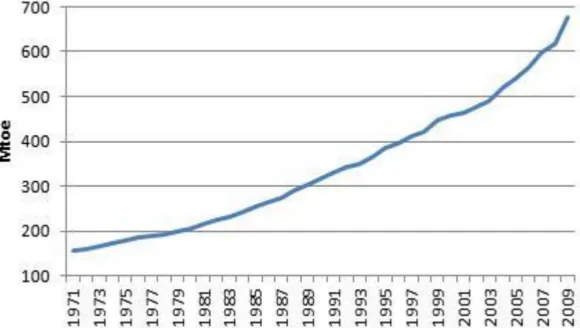
Energy is the essential need of human for development. Universal accessibility and access to clean energy are considered as the most vital components for the growth of nation and success. The excess demand and its consumption lead to the scarcity of underground fuel reserves. Moreover, the industrialization and domestic demand, as well as transportation sector, put additional pressure on fuel reserves. High dependencies on the conventional energy sources as primary energy source give birth to the energy crisis. Looking at the other side, rapid use of fuels and its emissions brings adverse effects on the environment. Therefore, dependability on conventional energy sources such as, coal, natural gas, diesel, and petrol give birth to various problems like, pollution that raise various health issues, environment problem like acid rain, and global warming. In the twenty-first century, the interest is concentrated on cleaner and greener fuel to protect the environment and to look for more alternative and sustainable fuel. The scenario in India is not different in context to biofuel production. India produces only 1% biofuel of the total world output, in which 380 million liters of ethanol and 45 million liters of biodiesel is produced. India is the second largest producer of sugarcane despite that only 1% ethanol is produced in India. Primary energy used in India is increased more than fourfold from 1971-2009 (Figure 1).
[image:2.612.165.455.535.699.2]Crude oil forms a substantial part of the country’s energy carrier, following the coal (Figure 2). The use of crude oil has increased from 12.6 (Mtoe) in 1965 - 162.3 Mtoe (million tonnes) in 2011 shows an increase of approximately ten times. Crude petroleum utilization has remained genuinely steady, continually staying in the scope of 28% to 36% (1971-2011). The developing interest for crude oil is progressively being met through higher imports. Figure 3 introduces the offer of crude oil imports in the aggregate refinery throughput for as long as a couple of years.
Figure 2: Share of fuel sources in primary energy consumption [Source: BP (2012)]
Figure 3 Share of crude oil imports in refinery throughput Source: PPAC, P: Provisional
indicators. These incorporate proportion of oil imports to GDP, oil utilization per unit of GDP, Gross domestic product per capita, and national reserves to usage ratio , India is most vulnerable country among all other nations of the world.
II. PERFORMANCE AND EMISSION CHARACTERISTICS
A. Sahoo et al., (2008)
investigated engine performance and emission characteristic using tractor engine. Biodiesel was produced from jatropha, polanga and Karanja oil, and two blends 20% and 50% were prepared and tested. The research concludes that transesterification process enhances the fuel properties and are similar to neat diesel. Moreover, while performing the full throttle opening test at speed 1200 and 1400 rpm no considerable change in power takes place in three-cylinder tractor engine. While there was significant power drop was obtained during the use of different biodiesel blends KB20, KB100, JB100, PB20, and PB100 at all speed. The maximum power was obtained for jatropha JB50 blend at higher speed. Also, as the percentage of biodiesel blend increases, there was a significant reduction in exhausts emissions such as HC and PM, while there was an increase in NOx.
B. Zhu et al., (2011)
conducted an experiment on the four-cylinder direct D-I engine using biodiesel, ethanol biodiesel blends, and Euro V diesel to study the performance combustion and emission characteristics. The test has been carried out on five loads at 1800 rpm; engine combustion performance was improved with 5 % ethanol in biodiesel (BE5) blend in contrast to biodiesel. Biodiesel and biodiesel ethanol blend have higher brake thermal efficiency as compared to Euro V diesel. Finally, reduction in PM and Nox was observed using BE blends as compared to Euro V diesel, which further decreases with increase in ethanol amount. On the other hand, the use of a significant amount of ethanol further increases the HC and CO emission.
C. Navindgi et al. (2012)
developed an exploratory review to assess the performance of CI engines with various blends of Mahua biodiesel under differing working conditions. The BSFC and BTE of the engine and analyzed the effect of different injection pressure ( 180 bar and 240 bar) and temperature on engine running. They closed the examination by comparing the diesel, Mahua methyl ester oil and its blends under different working conditions. Brahma and Babu (2013) explored in this paper is more worried about a trial examination to concentrate the focus on engine emissions and examine the emission qualities utilizing Mahua oil methyl ester with the assistance of a three-way catalytic converter in the exhaust system and furthermore they reasoned that the hydrocarbon discharge and nitrogen oxides emissions additionally lowers to certain level.
D. Godiganur et al. (2009)
worked on the engine and calculated the BSFC and brake specific energy consumption also worked with exhaust emissions and exhaust temperature. The concluded that at 20% biodiesel blends there was a decrease in brake specific energy consumption while brake thermal efficiency increases. The HC and CO content in emission decreases, while there was slight increase in NOx emission as the biodiesel percentage increases and engine performance, was not affected up to 20% blends.
E. Armas et el., (2009)
has worked on turbodiesel 2.5 litres direct injection engine running at 2400 rpm and 64N m torque, using three different fuels: an neat soybean biodiesel (B100), a synthetic Fisher- Tropsch fuel (FT) and ultra-low sulfur content diesel (BP15)which are free of sulfur and aromatic compounds. The tests were performed with single and split injection without utilizing EGR. In this work, two objectives were simultaneously observed first is the effect of the start of injection on emission and engine performance of all the fuels and the effect of changing injection parameters on pollution emissions for all the fuels. Finally, conclude that in comparison to BP15, mean diameter was reduced using biodiesel. Finally, found that PM emissions are higher using B100 biodiesel.
F. Seyyed et al., (2017)
G. Ghanbaria et al., 2017
investigated the engine performance and emission analysis using Multi wall CNT carbon nano tubes (40, 80 and 120 ppm) and nano silver particles (40, 80 and 120 ppm) mixed with diesel biodiesel blend. The prepared blended mixture was fueled to 6 cylinder, 4 stroke diesel engine and test was performed at different engine speed. Results shows that in contrast to pure diesel the
addition of nano particle to fuel the power increase by 2% while BSFC was decreased by 7.08%. CO2 emission was increased by
17.03% while there was drop in CO emission by (25.17) in contrast to diesel. NOx emissions was increased by 25.32% in contrast to pure diesel.
H. Perumala et al., (2017)
the engine emissions and performance was investigated utilizing pongamia oil biodiesel in CI engine. It was observed that CO content was reduced to 8.2% whereas HC content reduced by 8.9% along with reduction NOx. Moreover, BSFC was increased by 4.2% whereas thermal efficiency reduced by 2.4%.
I. Gnanasekaran Sakthivel., (2016)
Investigates the engine performance, combustion and exhaust emissions using Fuzzy Inference System (FIS) in CI engine fueled with fish oil at different injection time (21°, 24°, 27°bTDC). Different Fuzzy models were developed to predict the BTE, HC, EGT,
NOx, ignition delay (ID), combustion delay (CD), CO CO2 and smoke with experimental data utilizing trapezoidal membership
function. The Multi Input Multi Output (MIMO) fuzzy technique is able to obtain the engine parameters with correlation coefficients in the range of 0.946-0.999 with small percentage of error. It was concluded by validation that, developed Fuzzy Inference System best technique that obtain results with high accuracy with less time that can easily replace the actual costly and time consuming experimental methods.
J. Imdadula et al.,(2017)
studied fuel properties engine emissions and combustion parameters using two additives, 2-ethylhexyl nitrate (EHN) and di-tertiary-butyl peroxide DTBP in different proportion to diesel-biodiesel-pentenol blends that improve the biodiesel properties. Experiment was performed on Single cylinder DI engine fueled with 10% pentenol with 70% diesel- 20% jatropha biodiesel. Different properties such as, cetane number, viscosity, density and oxidation stability are found to be improved significantly, there is minor change in calorific value for the pentenol. Slight increase in BP was observed (0.66-1.52%) which is still less than diesel, while decrease in BSEC was observed. Utilizing pentenol, the emissions like HC, CO, and smoke was reduced while nitric oxide was increased by 2.15% compared Jatropha B20 blend. However, the use of DTBP and EHN decreased the NO (2–4.62%) and smoke (3.45–15.5%) emissions presenting greater CO (1.3–9.15%) and HC (5.1–17.87%) emission based on the amount of ignition promoter utilized. Thus it is concluded that, the use of pentanol and ignition promoters as additives for biodiesel blends shows the improvement of the overall performance of a diesel engine.
K. Huang et al. (2010)
investigated the engine performance by using jatropha oil methyl ester at two engine speed of 1500 rpm and 2000 rpm. The BSFC of jatropha oil is higher than the diesel fuel. Thermal efficiency of jatropha biodiesel and other engine parameters are similar to other biodiesel and diesel fuels. The emissions (CO and HC) at high load from jatropha biodiesel are lower as compared to diesel fuel while at load the similar amounts of emissions are produced.In addition, a different trend for NOx emissions was observed there was slight decrease in NOx at high engine load. Moreover, smoke emission was also very low as compared to diesel fuel.
L. Ganapathy et al. (2011)
worked on four stroke, single cylinder, diesel engine using jatropha oil and analyzed the effect of injection timing on emission and engine performance and combustion characteristics. With the advancement in injection timing maximum pressure and brake thermal efficiency increased while the CO, BSFC, and hydrocarbon are reduced to some extent. Moreover again the NOx emission was found to increase by a certain extent. By retarding the injection timing entirely, opposite trends were obtained.
M. Valente et al., (2010)
various loads with three blends (5%, 20%, 35%) of castor oil with diesel. The specific fuel consumption, increase with increasing
the percentage of biodiesel blend. More CO2 emissions are obtained at low load while small at high load with castor biodiesel in
contrast to diesel. Whereas, using castor oil biodiesel high CO and HC emissions are obtained.
N. Lin et al., (2009)
determined the properties of rice bran oil and find the best method for biodiesel production. Experiment was performed on diesel engine and obtained that SFC and NOx emissions are higher for biodiesel while HC, CO an PM emissions were reduced and power obtained in both the fuels are similar. However, the biodiesel production from rice bran oil is cheaper than the other vegetable oil feedstocks.
M. How et al., (2014)
calculated the emissions, performance and combustion characteristics of biodiesel produced from coconut oil in turbocharged 4 stroke common rail diesel engine running at various loads. It was concluded that, brake specific carbon monoxide decrease by increasing the percentage of biodiesel in blends. Moreover, there is decrease in brake specific energy consumption while there is increase in brake specific fuel consumption. Smoke emissions are also reduced irrespective of load conditions with increasing the biodiesel amount. On the other hand NOx emissions are increased by increasing the ratio of biodiesel and load on the engine. Maximum smoke content was reduced at B50 blend when engine load was 0.86 MPa. With all the blends shorter ignition delay and longer combustion duration were recorded at all the loading conditions.
O. Benjumea et al., (2009)
revealed the influence of palm oil biodiesel on the engine performance and its combustion characteristics High-Speed Direct Injection diesel engines. Founding of the study was that with increase in height from 500 to 2400m the fuel consumption also increases. Increase in altitude results in decrease of combustion duration which further increase the pressure of the cylinder and equivalence ratio when fueled with biodiesel. Brake thermal was also highly influenced by the altitude, it’s brake thermal efficiency decreased moreover exergy destruction was decreased at high altitude.
P. Ilkılıç et al., (2011)
worked on diesel engine utilizing biodiesel from sunflower to analyze the performance and emission. The result depicts that the performance was reduced by 2.2%, 6.3% and 11.2% for blends blends B5, B20 and B50. Moreover, the BSFC of the fuel was increased by 2.8%, 3.9% and 7.8% for all the above blends. Also the addition of biodiesel PM and smoke emissions were reduced to great extent. Similar to all the literature the NOx emissions again increase but CO emissions were reduced. Thus, it is concluded that sunflower biodiesel is bset for biodiesel production and reduction in engine emissions.
Q. Dhar and Agrawal., (2015)
examined the effect of Kranja biodiesel on engine wear on direct injection CI SUV engine. It was found that engine operated using biodiesel has less wear of valves, pistons, and connecting rods. Some parts have high wear such as big end of connecting rods, crank pin and main bearings. The endurance test performed depicts that cylinder liner surface texture was with in permissible limit using Karanja biodiesel blends. Regardless of higher carbon residue and the wear of different components no defect was observed during the test performed during long run while using biodiesel.
R. Dhar and Agrawal., (2014)
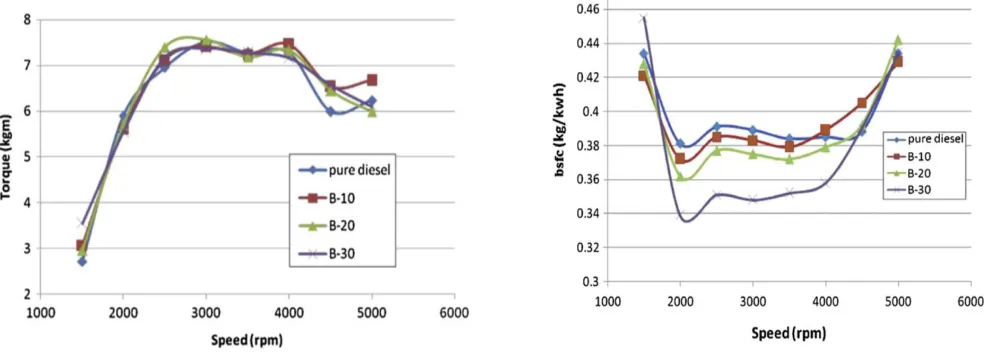
evaluated the emissions, combustion characteristics and engine performance of a naturally aspirated, water cooled diesel engine powered with karanja biodiesel blend (BD50, BD20, BD10 & BD05) with neat diesel at distinctive speed and load. At low percentage of blends reached maximum torque than diesel, with increase in biodiesel blends less torque was produced. BSFC for diesel and lower blends are analogues to each other.
S. Pal et al., (2009)
torque was started decreasing shown in Figure 4. The brake power vary in proportional to speed with small fluctuations beyond 4000 rpm. BSFC decrease sharply with increase of speed up to 2000 rpm, and stable in the speed range of 2000-4000, beyond 4000 it increase with increase of speed Figure 5.
Fig. 4. Comparison of Torque vs. Speed for pure diesel and different biodiesel blends of Thumba oil.
Fig. 4. Comparison of Torque vs. Speed for pure diesel and different biodiesel blends of Thumba oil. Fig. 5. Comparison of brake power vs. Speed for
pure diesel and biodiesel blends from Thumba oil.
III. CONCLUSION
From the investigation of literature reviews, biodiesel was one of the better options to replace diesel fuel in CI engine. And furthermore the literature demonstrates that transesterification procedure is the best and most mainstream approach to produce the biodiesel. The efficiency and quality of biodiesel are altogether higher than petro diesel. The mission like NOx, CO and other poisonous smokes can be decreased by utilizing different biodiesel. High demands, fluctuating prices, non-biodegradability are the real issues for the petroleum based oils. For such sort of issues, the people think about the alternative sources. Today, biodiesel is a non-poisonous, progressively appealing, biodegradable and demonstrates the great substitution to petroleum derivative.
REFERENCES
[1] Pal A, Verma A, Kachhwaha S.S, Maji S. Biodiesel production through hydrodynamic cavitation and performance testing. Renewable Energy 2010; 35: 619– 624.
[2] Soni A. Global Oil Markets and India’s Vulnerability to Oil Shocks. http://www.teriin.org/projects/nfa/pdf/working-paper-No18-Oil-volatility.pdf (assessed on 25/05/2017) The Energy and Resources Institute TERI-NFA (2014) Working Paper Series No.18.
[3] BP. (2012). Statistical Review of World Energy. Retrieved from BP Global: http://www.bp.com/statisticalreview
[4] Petroleum Planning and Analysis Cell (PPAC) ministry of petroleum & natural gas Government of India http://ppac.org.in/ (assessed on 29/05/2017) [5] Archanskaia, E., Creel, J., & Hubert, P.. The nature of oil shocks and the global economy. Energy Policy 2011; 42; 509-520.
[6] Bhanumurthy, N. R., Das, S., & Bose, S. Oil Price Shock, Pass-through Policy and its Impact on India. Working paper( 2012-99). Gupta, E. Oil vulnerability index of oil-importing countries. Energy Policy 2008; 36: 1195-1211.
[7] Sahoo P.K., Das L.M., Babu M.K.G., Arora P., Singh V.P., Kumar N.R., Varyani T.S. Comparative evaluation of performance and emission characteristics of jatropha, karanja and polanga based biodiesel as fuel in a tractor engine Fuel 2009; 88: 1698–1707.
[8] Zhu, Cheung C S, Huang Z,. performance and emission characteristics of a DI diesel engine fuelled with ethanol-biodiesel blends. Fuel 2011; 90: 1743-50. [9] Navindgi M. C., Dutta M, Kumar B.S.P. Performance of a C I Engine with Different Blends of Mahua (Madhuca Longifolia) Biodiesel under Varying
Operating Conditions. International Journal of Engineering and Technology 2012; 2: 1251 -1255.
[10] Brahma H.S, and Babu V. An Experimental Investigation On Emissions Of Neat Mahua Biodiesel Using Urea-SCR, International Journal of Scientific & Technology Research, 2013 ISSN 2277-8616.
[11] Godiganur H , Suryanarayana Murthy C.H. and Reddy RP,.6BTA 5.9 G2 -1 Cummins engine performance and emission tests using methyl ester Mahua (Madhuca indica) oil/diesel blends. Renewable Energy 2009; 34: 2172 –2177.
[12] Armas O, Yehliu K, Andre L. Boehman. Effect of alternative fuels on exhaust emissions during diesel engine operation with matched combustion phasing Fuel 2010; 89: 438–456.
[14] M. Ghanbaria, G. Najafia, , B. Ghobadiana, T. Yusafb, A.P. Carluccic, M. Kiani Deh KianidPerformance and emission characteristics of a CI engine using nano particles additives in biodiesel-diesel blends and modeling with GP approach Fuel Volume 202, 15 August 2017, Pages 699–716.
[15] Varatharaju Perumala, , , M. Ilangkumaranb Experimental analysis of engine performance, combustion and emission using pongamia biodiesel as fuel in CI engine Energy Volume 129, 15 June 2017, Pages 228–236.
[16] Gnanasekaran Sakthivel Prediction of CI engine performance, emission and combustion characteristics using fish oil as a biodiesel at different injection timing using fuzzy logic Fue Volume 183, 1 November 2016, Pages 214–229.
[17] H.K. Imdadula, M.M. Rasheda, b, M.M. Shahinb, H.H. Masjukia, M.A. Kalama, M. Kamruzzamanb, H.K. Rashedula Quality improvement of biodiesel blends using different promising fuel additives to reduce fuel consumption and NO emission from CI engine Energy Conversion and Management Volume 138, 15 April 2017, Pages 327–337.
[18] Huang J, Wang Y, Qin J, Roskilly AP; Comperative study of performance and emissions of a diesel engine using Chinese Pistache and Jatropha biodiesel;Fuel Processing Technology 91 (2010) 1761–1767.
[19] Ganapathy T, Gakkhar RP, Murugesan K; Influence of injection timing on performance, combustion and emission characteristics of Jatropha biodiesel engine;Applied Energy 88 (2011) 4376-4386.
[20] Valente OS, Silva MJ, Pasa VMD, Belchior CRP, Sodre JR ;Fuel consumption and emissions from a diesel power generator fuelled with castor oil and soybean biodiesel; Fuel 89 (2010) 3637-3642.
[21] Lin L, Ying D, Chaitep S, Vittayapadung S ;Biodiesel production from crude rice bran oil and properties as fuel ; Applied Energy 86 (2009) 681-688.
[22] How HG, Masjuki HH, Kalam MA, Teoh YH ;An investigation of the engine performance, emissions and combustion characteristics of coconut biodiesel in a high-pressure common-rail diesel engine; Energy 69 (2014) 749-759.
[23] Benjumea P, Agudelo J, Agudelo A ; Effect of altitude and palm oil biodiesel fuelling on the performance and combustion characteristics of a HSDI diesel engine; Fuel 88 (2009) 725-731.
[24] Ilkılıç C, Aydın S, Behcet R, Aydin H; Biodiesel from safflower oil and its application in a diesel engine; Fuel Processing Technology 92 (2011)356-362. [25] Dhar A, Agarwal AK ;Effect of Karanja biodiesel blends on particulate emissions from a transportation engine ;Fuel 141 (2015) 154-163.
![Figure 2: Share of fuel sources in primary energy consumption [Source: BP (2012)]](https://thumb-us.123doks.com/thumbv2/123dok_us/8310343.857925/3.612.145.465.331.587/figure-share-fuel-sources-primary-energy-consumption-source.webp)