Open Access
Vol 10 No 1
Research
Using simulation for training and to change protocol during the
outbreak of severe acute respiratory syndrome
Simon D Abrahamson
1, Sonya Canzian
2and Fabrice Brunet
31Assistant Professor of Anesthesia, Department of Anesthesia and Division of Critical Care, University of Toronto, St. Michael's Hospital, 30 Bond
Street, Toronto, M5W 1W8, Canada
2Clinical Leader Manager, Trauma and Neurosurgery Intensive Care Unit, St. Michael's Hospital, 30 Bond Street, Toronto, M5W 1W8, Canada 3Professor of Medicine, Department of Medicine and Division of Critical Care, University of Toronto, St. Michael's Hospital, 30 Bond Street, Toronto,
M5W 1W8, Canada
Corresponding author: Simon D Abrahamson, [email protected]
Received: 31 Aug 2005 Revisions requested: 26 Sep 2005 Revisions received: 17 Oct 2005 Accepted: 24 Oct 2005 Published: 24 Nov 2005
Critical Care 2006, 10:R3 (doi:10.1186/cc3916)
This article is online at: http://ccforum.com/content/10/1/R3 © 2005 Abrahamson et al.; licensee BioMed Central Ltd.
This is an open access article distributed under the terms of the Creative Commons Attribution License (http://creativecommons.org/licenses/by/2.0), which permits unrestricted use, distribution, and reproduction in any medium, provided the original work is properly cited.
Abstract
Introduction During the 2003 severe acute respiratory syndrome (SARS) crisis, we proposed and tested a new protocol for cardiac arrest in a patient with SARS. The protocol was rapidly and effectively instituted by teamwork training using high-fidelity simulation.
Methods Phase 1 was a curriculum design of a SARS-specific cardiac arrest protocol in three steps: planning the new protocol, repeated simulations of this protocol in a classroom, and a subsequent simulation of a cardiac arrest on a hospital ward. Phase 2 was the training of 275 healthcare workers (HCWs) using the new protocol. Training involved a seminar, practice in wearing the mandatory personal protection system (PPS), and cardiac arrest simulations with subsequent debriefing.
Results Simulation provided insights that had not been considered in earlier phases of development. For example, a single person can don a PPS worn for the SARS patient in 1 1/ 2 minutes. However, when multiple members of a cardiac arrest team were dressing simultaneously, the time to don the PPS increased to between 3 1/2 and 5 1/2 minutes. Errors in infection control as well as in medical management of advanced cardiac life support (ACLS) were corrected.
Conclusion During the SARS crisis, real-time use of a high-fidelity simulator allowed the training of 275 HCWs in 2 weeks, with debriefing and error management. HCWs were required to manage the SARS cardiac arrest wearing unfamiliar equipment and following a modified ACLS protocol. The insight gained from this experience will be valuable for future infectious disease challenges in critical care.
Introduction
Severe acute respiratory syndrome (SARS) is a newly identi-fied atypical pneumonia that can be life threatening. Attention was drawn to the disease in February 2003 when a physician and subsequently 12 other hotel guests staying in a hotel in Hong Kong became ill [1]. One of these hotel guests returned to Toronto, Canada, died on 5 March 2003, and became the index case for Toronto. The Morbidity and Mortality Weekly
Report published a description of the SARS outbreak on 21
March 2003 [2]. The SARS virus seemed to be highly conta-gious in the hospital setting. A case report suggested that intu-bation of patients produced a high risk for transmission of SARS to healthcare workers (HCWs) [3].
SARS created a crisis in healthcare in Toronto. The lack of lit-erature, uncertainty about treatment, and fear of the disease caused great concern among HCWs. In late April 2003, our Critical Care Department was asked to urgently develop and implement a protocol for the management of cardiac arrest in the SARS patients. At the time there were directives from the Ontario provincial government mandating the use of a per-sonal protection system (PPS) during the intubation of SARS patients [4]. A PPS was defined as 'an apparatus consisting of head, face and neck protection with or without enclosed body protection'. An example of a PPS cited in the directive was the Stryker T4 system (Stryker® Instruments, Kalamazoo, MI, USA).
The cardiac arrest scenario was of great concern because care had to be delivered immediately. We knew from previous simulation experience that a HCW required 1 1/2 minutes to dress in the Stryker T4 [5]. Hence, application of a PPS would increase the time before resuscitation could begin. We needed to develop a protocol that ensured HCW safety as well as timely patient care.
We used simulation to perfect the protocol as well as to train the cardiac arrest team. Simulation has been used to improve individual and team performances [6-9]. It has also been used as an evaluative tool [10,11]. We used the simulated cardiac arrest scenarios to provide an opportunity for deliberate prac-tice, an important concept in effective learning [12]. The rationale for this approach was that simulation improved the retention of advanced cardiac life support (ACLS) guidelines in comparison with textbook review [13].
Materials and methods
Simulation was used to design a protocol and then to train over a two-week period all HCWs who might be involved in a SARS cardiac arrest.
Phase 1: Cardiac arrest protocol
A modified ACLS protocol was designed and referred to as 'Code Blue Special' (CBS). We were aware that there was minimal scientific evidence, and there were no guidelines, for decisions related to having HCWs apply protective equipment that would delay time to definitive ACLS care. The Critical Care Department convened committee meetings involving experts representing the disciplines involved in the treatment of cardiac arrest (anesthesia, cardiology, critical care, emer-gency medicine, nursing, and respiratory therapy). The infec-tion control service provided consultants to the committee. An initial protocol was developed by this committee.
A group of educators then assessed this protocol in a teach-ing area by repeated simulations. The infection control service monitored the simulations for breaches of infection control. After these simulations, discussions between educators and infection control personnel resulted in a modified protocol that was accepted by the multidisciplinary committee (Figure 1). During these simulations we recognized the need for a SARS-specific equipment cart.
Finally, the group of educators conducted a cardiac arrest sim-ulation with a manikin (Laerdal™, SimMan) placed in a bed in an empty negative-pressure patient room on a ward. In prepa-ration, all necessary equipment to manage a SARS cardiac arrest was placed outside the room and all HCWs that would respond to an actual SARS cardiac arrest (nurses, physicians and respiratory therapists) were present. A full arrest scenario was then simulated, including the transport of the resuscitated patient to the intensive care unit (ICU). During this simulation an educator and the director of infection control noted any flaws. Phase 1, the protocol development, took 4 days to complete.
Phase 2: Team training program
The goal of Phase 2 was to train the on-call cardiac arrest teams in CBS. We acquired a dedicated training area in the hospital consisting of five adjoining rooms with computer and Internet access. We obtained call schedules for the arrest teams and began the training with the team members who were on call during the next two days.
Using our experience in Phase 1, we decided to train HCWs in groups of eight. We planned to train HCWs in the use of the PPS in groups of two, and because four educators were avail-able daily we decided that the maximum number of HCWs for each session was eight.
A two-hour training session proceeded as follows:
[image:2.612.56.296.89.396.2]1. All HCWs attended a PowerPoint presentation highlighting pertinent principles for the care of the SARS cardiac arrest patient. Each received a handout and had time for questions and answers. We stressed all the modifications to the
Figure 1
Summary of algorithm for cardiac arrest protocol (Code Blue Special) for a SARS patient
standard ACLS protocol, especially relating to defibrillation, airway management and infection control.
2. The group then observed two educators describing and demonstrating the dress-up and the dress-down method for the PPS.
3. Next, the group was divided into two sets of four who went into separate rooms. Here individualized practice sessions were done with the trainees donning and then removing the PPS (Figure 2). A 2:1 ratio of trainees to supervising educa-tors was used.
4. Last, we simulated cardiac arrest scenarios. Four trainees managed one unknown ACLS scenario (asystole, pulseless electrical activity, pulseless ventricular tachycardia, and ven-tricular fibrillation). We timed how long it took the first person to don the PPS. The other four trainees observed.
5. After the simulation we debriefed the entire group and dis-cussed and reinforced pertinent points. Then the four remain-ing HCWs managed a different simulation. The groups were chosen to mimic the arrest team, namely an anesthesia resi-dent, ICU nurse, medical resident and respiratory therapist.
6. All physicians trained with their peers concurrently on call. There were six anesthesia residents and six medical residents, but many more nurses and respiratory therapists, to be trained. Hence, once we had trained the residents, we modified the simulation for the remaining nurses and respiratory therapists. Subsequent simulations involved only basic cardiopulmonary resuscitation and intubation because hospital policy mandates defibrillation by physicians only.
Results
Cardiac arrest protocol
Time to don the PPS
The first protocol required a PPS for everyone entering the patient's room as part of the arrest team. This was based on the assumption that it would take 1 1/2 minutes to don the PPS and this was felt to be an acceptable delay before provid-ing patient care.
During Phase 1 we found that dressing took longer. When four members of the arrest team were simultaneously dressing it took between 3 1/2 and 5 1/2 minutes for the fastest team member to dress, even with assistants aiding verbally and physically. This longer time seemed to be due to HCWs and assistants talking at the same time to request equipment, and HCWs reaching across each other for equipment.
With the assistance of the logistics department we developed a cart for the PPS. The cart was easily portable and allowed four HCWs to access it simultaneously; it also had numbered equipment labels allowing HCWs to follow the dress-up pro-cedure visually without memorizing the steps.
To expedite dressing we put up wall posters demonstrating the dress-up procedure and we used one dressing assistant per two team members. This represented a realistic number of people probably available to help at an actual arrest. It was also an acceptable total number of people (six) that could fit around the equipment cart.
Time to defibrillation
[image:3.612.60.290.83.381.2]Once we discovered that the time to don the PPS in a team situation was at least 3 1/2 minutes, there was concern about the delay to defibrillation. After discussion with infection con-trol and reviewing the available literature, we determined that there was no evidence that the person defibrillating needed to don a PPS. We therefore changed the protocol so that any physician on the ward could defibrillate, even if not part of the arrest team. This physician was required to wear routine pro-tective SARS gear: an N95 respirator, goggles, a gown and two pairs of gloves. The N95 respirator is a face mask that fil-ters 95% of particles greater than 0.3 µm in diameter. Respi-rator is the terminology used by the Centers for Disease Control and Prevention (USA) and the National Institute for Occupational Safety and Health.
Figure 2
Healthcare worker dressed in T4 Stryker personal protection system (PPS)
We also proposed having all SARS patients on cardiac telem-etry, so that a defibrillator could be brought into the room by the first responder. Available resources did not permit a defi-brillator in each room.
Technique of defibrillation
Although a PPS was not worn for defibrillation, we noted that if instead of applying paddles, multifunction defibrillation elec-trodes capable of both pacing and defibrillation (M3501A; Agilent Technologies, Andover, MA, USA) were applied to the chest, hands-off defibrillation could be accomplished. The defibrillator machine could be placed about 2 m from the patient when multifunction electrodes were used, and the but-tons on the machine could be pressed for defibrillation. There was uncertainty about the mode of transmission of the SARS virus, but 1 m is approximately the distance that organisms travel by droplet spread [14]. We recommended that, on wards with SARS patients, all defibrillators have this multifunc-tion capability.
Ergonomic factors
A problem we encountered previously with the PPS was the risk of dislodging the PPS helmet when a stethoscope was placed in the ears [5]. To minimize stethoscope use, we used a portable end-tidal CO2 detector as the initial method to con-firm tracheobronchial placement of the endotracheal tube. If the end-tidal CO2 was felt to be unreliable owing to low car-diac output we allowed a second person to place the stetho-scope earpieces under direct vision. We did not use an esophageal detector device because of infection concerns with applying negative pressure to the airway of a SARS patient.
We also noted ergonomic limitations when wearing the PPS such as the following: claustrophobia; an inability to balance when removing equipment, which increased the risk of self contamination; the need to perform shorter periods of cardiop-ulmonary resuscitation to avoid heat fatigue; and the need to have an easy-to-follow poster of degowning placed on the wall to avoid making errors during the degowning process.
ACLS modifications
Positive-pressure ventilation was permitted only by HCWs wearing the PPS. To minimize the exposure of HCWs to the SARS virus, patients received a neuromuscular blocker before intubation. In situ intravenous access was added to the proto-col to expedite drug delivery. No drugs were permitted via the endotracheal tube.
Exiting the patient room
During Phase 1 we noted that once the arrest team dressed in the PPS entered the room and began resuscitation, the initial HCWs in the room without a PPS were at risk. HCWs without a PPS were therefore instructed to position themselves at
least 2 m from the patient during positive-pressure airway manipulation.
Infection control skills
During the simulations it became apparent that many seem-ingly simple actions during removal of the PPS were more complicated than expected and had been inadequately described. An example was the difficulty in removing the con-taminated outer pair of gloves without contaminating the clean inner pair of gloves. Most instructions merely instruct one to 'remove the gloves'. The education and infection control team simulated every step of the dressing and undressing to ensure safety and clarity, and then scripted and photographed the process.
Composition of SARS cardiac arrest team and the number of HCWs to train
The usual cardiac arrest team at the time had ward nurses assisting the arrest team. This was changed during Phase 1 because it would have required training too many ward nurses in the application of the required PPS. Instead, ward nurses were trained as dressing assistants.
Negative pressure rooms
When the cardiac arrest was simulated in a negative-pressure room on the ward, we noted that there were items in the room that could not be disinfected, such as cork bulletin boards. Subsequently, we went to every negative-pressure room in the hospital to ensure infection control safety.
Lack of transport policy
During the planning for the simulation on the ward, we realized that the CBS protocol lacked a scripted transport policy for moving the resuscitated patient from the ward to the ICU. This policy was immediately developed in conjunction with the infection control, housekeeping and security services.
Team training program
We trained 275 HCWs over a two-week period. Training ses-sions were held on Monday to Friday. All physicians were suc-cessfully trained in teams that mirrored their on-call schedule. The largest group to train was the 225 ICU nurses. It was dif-ficult to free eight nurses for two hours because of concurrent patient care obligations and because we could not run ses-sions during ICU breaks. We ran three sesses-sions during the day shift (07:30 to 19:30) and one session during the evening shift (20:00 to 22:00).
Evaluation
During each session the educators checked both individual and team performances of the trainees in the cardiac arrest protocol, as well as the infection control policy.
We noted and corrected common ACLS deficiencies, for example an inability to attach the multifunction pacing/defibril-lation electrodes to the defibrillator machine, or an inability to adjust the transcutaneous pacemaker settings such as the pacemaker output.
Mistakes in infection control practice by HCWs were noted and corrected. Common errors noted were the inability to remove the contaminated outer pair of gloves without contam-inating the clean inner pair of gloves, the inability to remove the gown without contaminating the uniform underneath, the fail-ure to disinfect hands appropriately, and not administering neuromuscular blocking agents before intubation.
The theme that needed constant attention was that removing the PPS always posed a great danger of self-contamination. Trainees were required to repeat the PPS removal until no errors in technique were noted. There were no known instances of self-contamination of HCWs in our institution. The effect on bedside practice was difficult to evaluate properly because only one cardiac arrest actually occurred in a patient suspected of having SARS.
Discussion
We describe the use of high-fidelity simulation to design a modified practice of cardiac arrest resuscitation for an 'at risk of contamination' situation and to train caregivers as individu-als and as a team. Simulation was used to delineate flaws and omissions in a modified ACLS protocol. We used scenario-based simulation training as an educational tool for different cardiac arrest etiologies. In all, 275 HCWs were trained in this SARS-specific cardiac arrest protocol.
One unexpected but crucial result was that the time to don the PPS was prolonged for a group (3 1/2 to 5 1/2 minutes) in comparison with a single HCW (1 1/2 minutes) donning the
same equipment. This observation resulted in a major change to the initial protocol, namely not requiring the wearing of a PPS for defibrillation. A PPS was mandatory for any positive-pressure airway manipulation. We designed the protocol to minimize HCW contact with airway secretions.
We were concerned with the possibility of human error in this scenario, especially because of the reported transmission of SARS to protected HCWs involved in the intubation of a SARS patient [3].
We had to repeatedly reinforce our observation that although applying the PPS correctly was important, it was the undress-ing and removal of contaminated clothundress-ing that was even more important to prevent self-contamination. Undressing had to be done without the use of the dressing assistant, while wearing multiple layers of protective equipment. When simulation occurred in a negative-pressure patient room instead of the teaching area, we discovered unexpected infection control problems with furniture as well as our lack of a scripted trans-port protocol to move the patient to the ICU.
Some limitations of our approach became apparent and may help in planning for future disasters. Specific logistical chal-lenges noted during our training period included the following:
1. The need for educators to have dedicated time freed from their regular duties.
2. The need for a high ratio of educators to trainees, to ensure careful observation of newly learned infection control practices.
3. The need for night training sessions for staff who work only night shifts.
4. The limited time in a crisis situation to simulate multiple scenarios.
5. The ongoing need for resources such as a dedicated train-ing area, supplies and assistants.
6. The difficulty of quickly freeing up HCWs to train when they also have patient care obligations.
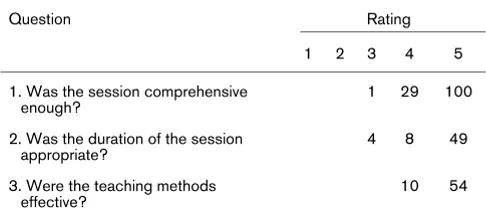
[image:5.612.56.299.117.225.2]Because of the urgent nature of the crisis and time restraints we were unable to make a full evaluation of the effectiveness of our training. We evaluated only satisfaction with the pro-gram content, namely level one of the four levels of evaluation according to Kirkpatrick's model [15]. Although we consid-ered evaluations before and after teaching, the limited time available to HCWs to attend the teaching sessions precluded this. We cannot validate the efficacy of our teaching because only one cardiac arrest occurred in the hospital in a patient suspected to have SARS.
Table 1
Results of evaluation of training session for Code Blue Special
Question Rating
1 2 3 4 5
1. Was the session comprehensive enough?
1 29 100
2. Was the duration of the session appropriate?
4 8 49
3. Were the teaching methods effective?
10 54
The cost of the training program was substantial, although we do not have exact totals. This would include time for the dedi-cated educators, costs for educational materials and costs of the non-reusable equipment. In addition we needed two assistants. One was responsible for bookings, providing hand-outs, keeping sign-in records and collating evaluations. A sec-ond assistant was required to restock disposable equipment (for example gloves, gowns and masks) and to clean the rooms between sessions. Finally this project monopolized the high-fidelity simulator, excluding its use by others.
Planning can improve crisis management for future disasters. High-fidelity simulations of infectious disease protocols can be an invaluable asset for staff and patient safety. A written proto-col can be developed and simulated, and core groups of peo-ple can be trained in the protocol before the crisis occurs. Once the crisis occurs, some HCWs should be immediately transferred from their usual duties to manage the patients. The other previously trained HCWs would immediately begin arranging training sessions in a pre-identified training area.
Conclusion
High-fidelity simulation proved to be a crucial tool in the evalu-ation and implementevalu-ation of a new, urgently developed SARS-specific cardiac arrest protocol, as well as in the subsequent training of team members in the use of unfamiliar protective equipment. It was used to detect and correct flaws and omis-sions in a theoretical protocol specific to the SARS patient. We used scenario-based simulation training to prepare our HCWs to manage a cardiac arrest in a SARS patient.
Competing interests
The authors declare that they have no competing interests.
Authors' contributions
SDA and SC were the lead educators in developing the car-diac arrest protocol and in arranging and delivering the simu-lation-based training. SDA was the lead writer of the article.
SC reviewed the article. FB was involved in helping to develop the cardiac arrest protocol and was involved in the proof read-ing of the article. All authors read and approved the final manuscript.
Acknowledgements
The authors would like to acknowledge the advice and encouragement of Dr Arthur Slutsky in the development of the manuscript. The authors also thank Dr Andrew Baker, Dr Robert Byrick, Mr Paul Doherty, Dr David McKnight and Dr Arthur Slutsky for their expert assistance in reviewing the manuscript.
References
1. Poutanen SM, Low DE, Henry B, Finkelstein S, Rose D, Green K, Tellier R, Draker R, Adachi D, Ayers M, et al.: Identification of severe acute respiratory syndrome in Canada. N Engl J Med
2003, 348:1995-2005.
2. Centers for Disease Control and Prevention (CDC): Outbreak of severe acute respiratory syndrome – worldwide, 2003. MMWR Morb Mortal Wkly Rep 2003, 52:226-228.
3. Centers for Disease Control and Prevention (CDC): Cluster of severe acute respiratory syndrome cases among protected health-care workers – Toronto, Canada, April 2003. MMWR Morb Mortal Wkly Rep 2003, 52:433-436.
4. Directives To All Ontario Acute Care Hospitals for High-Risk Procedures involving SARS Patients Critical Care Areas
[http://www.health.gov.on.ca/english/providers/program/pub health/sars/docs/new_normal/dir_high_risk_procedures.pdf] 5. Working Group on Adjunctive Protective Equipment for
High-Risk Procedures in SARS patients [http://sars.medtau.org/ adjunctreport.doc]
6. Chopra V, Gesink BJ, de Jong J, Bovill JG, Spierdijk J, Brand R:
Does training on an anaesthesia simulator lead to improve-ment in performance? Br J Anaesth 1994, 73:293-297. 7. Holcomb JB, Dumire RD, Crommett JW, Stamateris CE, Fagert
MA, Cleveland JA, Dorlac GR, Dorlac WC, Bonar JP, Hira K, et al.:
Evaluation of trauma team performance using an advanced human patient simulator for resuscitation training. J Trauma
2002, 52:1078-1086.
8. Howard SK, Gaba DM, Fish KJ, Yang G, Sarnquist FH: Anesthe-sia crisis resource management training: teaching anesthesi-ologists to handle critical incidents. Aviat Space Environ Med
1992, 63:763-770.
9. Larbuisson R, Pendeville P, Nyssen AS, Janssens M, Mayne A:
Use of Anaesthesia Simulator: initial impressions of its use in two Belgian University Centers. Acta Anaesthesiol Belg 1999,
50:87-93.
10. Schwid HA, Rooke GA, Carline J, Steadman RH, Murray WB, Olympio M, Tarver S, Steckner K, Wetstone S, Anesthesia Simula-tor Research Consortium: Evaluation of anesthesia residents using mannequin-based simulation: a multiinstitutional study.
Anesthesiology 2002, 97:1434-1444.
11. Morgan PJ, Cleave-Hogg D: Evaluation of medical students' performance using the anaesthesia simulator. Med Educ
2000, 34:42-45.
12. Ericsson KA, Krampe RT, Tesch-Romer C: The role of deliberate practice in the acquisition of expert performance. Psychol Rev
1993, 100:363-406.
13. Schwid HA, Rooke GA, Ross BK, Sivarajan M: Use of a compu-terized advanced cardiac life support simulator improves retention of advanced cardiac life support guidelines better than a textbook review. Crit Care Med 1999, 27:821-824. 14. Garner JS: Guideline for isolation precautions in hospitals. The
Hospital Infection Control Practices Advisory Committee.
Infect Control Hosp Epidemiol 1996, 17:53-80.
15. Boyle MA, Crosby RK: Academic program evaluation: lessons learned from business and industry. J Ind Teach Educ 1997,
3:81-85. Key messages
• We found that simulation was a valuable tool for evalu-ating a new treatment protocol in a novel and rapidly evolving crisis.
• We found that scenario-based simulation training was effective, but resource intense.
• We found that simulation was suited to teamwork train-ing for disaster management.
• We suggest that simulation be used to prepare precise protocols for future serious events.