
Performance Analysis of Constant Modulus
Algorithm and Multi Modulus Algorithm for
Quadrature Amplitude Modulation
Jaswant1, Sanjeev Dhull2
1Research Scholar, Electronics and Communication, GJUS & T, Hisar, Haryana, India; is the corr-esponding author. -
2Associate Professor, Electronics and Communication GJUS & T, Hisar, Haryana, India.
Abstract: in bandwidth-efficient digital transmission, the training of a receiver requires a start-up process. This start-up includes three steps of setting the automatic gain control, recovering timing and converging the adaptive filters. For many applications, some predefined set of bits are sent to the receiver periodically known as training sequence which can be used as an ideal reference by the receiver because it is already known to receiving side. Such system is called supervised or trained. However, sometimes the use of training sequence is not feasible or not desirable. In such case, blind equalization is used which is invariably adaptive in nature. Blind equalization requires less channel bandwidth, but it poses some challenges and also increases system complexity. The most challenging aspect of blind equalization is the convergence of the adaptive equalizer. Without ideal reference, the receiver has to make decisions about what data have been transmitted. Generally, we use a decision device to make assumptions on the input signal. This decision device is called slicer. The decisions are highly unreliable because the received data are corrupted by intersymbol interference (isi) due to distortion introduced by communication channel. As a result, the equalizer does not converge with least mean square (lms) algorithm because the probability of wrong decision is too high. Several algorithms were developed in the past for blind equalization. The most common are the constant modulus algorithm (cma) and multi modulus algorithm (mma). Both algorithms have been successfully used in many practical applications in data communications.
Keywords: equalization, lms, cma, mma, cost function.
I. INTRODUCTION
Blind equalizers are used in micro-wave radio. They were realized in Very Large Scale Integration (VLSI) for High Definition Television (HDTV) set-top cable demodulators, non-invasive medical diagnosis, geophysical exploration and image enhancement and recognition. Blind processing applications are emerging in wireless communication technology. Blind methods are of great importance in digital signal communication systems as they allow channel equalization at the receiver without the use of training signals. The topic of blind equalization of Linear Time Invariant (LTI) channels, both SIMO and MIMO, has drawn considerable attention over the past years and several algorithms have been developed. One of the practical problems in digital communications is Inter-Symbol Interference (ISI), which causes a given transmitted symbol to be distorted by other transmitted symbols. The ISI is imposed on the transmitted signal due to the band limiting effect of the practical channel and also due to the multipath effects (echo) of the channel[1]. One of the most commonly used techniques to counter channel distortion (ISI) is linear channel equalization. The equalizer is a linear filter that provides an approximate inverse of the channel response. Since it is common for the channel characteristics to be unknown or to change over time, the preferred embodiment of the equalizer is a structure that is adaptive in nature. Conventional equalization techniques employ a pre-assigned time slot (periodic for the time-varying situation) during which training signal, known in advance by the receiver, is transmitted. In the receiver, the equalizer coefficients are then changed or adapted by using some adaptive algorithm (e.g., LMS, RLS, etc.) so that the output of the equalizer closely matches the training sequence. However, inclusion of this training sequence with the transmitted information adds overhead and thus reduces the throughput of the system. Therefore, to reduce the system overhead, adaptation schemes are preferred that do not require training, i.e., blind adaptation schemes. In blind equalization (Godard, nov., 1980)[3], instead of using the training sequence, one or more properties of the transmitted signal are used to estimate the inverse of the channel.
s(n) u(n) y(n)
Figure1. Basic Communication System with equalizer
A. Constant Modulus Algorithm
CMA[2],[5] has the assumptions that input to the channel is a modulated signal which has constant amplitude at every instant in time. The advantage of the blind equalization is the bandwidth is high because of there is no training of the pulses. In the conventional equalization process needs the training of the pulse. CM is used for QAM signals where the amplitude of the
modulated signal is not the same at every instant. The error e(n) is then determined by considering the nearest valid amplitude level of the modulated signal as the desired value[1].
Adaptive channel equalization without a training sequence is known as blind equalization. A baseband model with a channel impulse response, channel input, additive white Gaussian noise (AWGN), and equalizer input are denoted by c(n),s(n), w(n ), and u(n) respectively. The data symbols transmitted s(n) , are assumed to consist of stationary independently and identically distributed (i.i.d.), real or complex non-Gaussian random variables.
The equalizer input,
u(n)=s(n)*c(n)+w(n) (1)
is then sent to a tap-delay-line blind equalizer with impulse response , intended to equalize the distortion caused by intersymbol interference (ISI) without a training signal.
The output of the blind equalizer
y(n)=u(n)*f(n) = s(n)*h(n)+w(n)*f(n)
= ∑ h(i)s(n−i) +∑ f(i)w(n−i) (2)
It can be used to recover the data transmitted symbol s(n) where h(n)=c(n)*f(n)
B. Cost Function Of CMA
The cost function of the constant modulus algorithm is
JCMA (n)=E{[│y(n)│2─R2 ]2 } (3) where
R2 =E{│s(n) │4 }/ E{│s(n) │2 }
Depending on the cost function only the blind equalization was determined[2].
C. Multi Modulus Algorithm[7]
The tap weight vectors are the co efficient of the equalizers which is by determining the transfer function of the equalizer. The tap weights are frequently updated to minimize error at the output of the equalizer. It is used to measure of the deviation in the output which provides difference between the actual values. There are two ways of acquiring new tap weights for the equalizer. One is to transmit a training sequence known by both transmitter and receiver at the beginning of the communication. The receiver then detects the impulse response of the channel from the training sequence, and obtains the tap weights by computing the inverse transfer function of the channel. The other way is to predetermine an initial value for each of the tap weights, and design a cost function according to the characteristics of the received signal. The tap weights are continually adjusted by reducing the cost of the
Transmitter Channel c(n) Equalizer f(n)
JMMA =JR(n)+JI(n)
= E{[│yR(n)│2─R2,R ]2 }+ E{[│y
I(n)│2─R2,I ]2 } (4) where
R2,R = E{│sR(n) │4 }/ E{│sR(n) │2 } and R2,I = E{│sI(n) │4 }/ E{│sI(n) │2 }
It allows the both blind equalization and carrier phase recovery .
Decomposing the cost function of MMA [10] into the real and imaginary parts thus allows both the modulus and the phase of the equalizer output to be considered; therefore, joint blind equalization and carrier-phase recovery may be simultaneously accomplished, eliminating the need for a rotator to perform separate constellation-phase recovery in steady-state operation.
The tap-weight vector of the MMA is updated according to
f (n+1)=f(n)-μ.e*(n)u(n)
Where e(n)= eR (n)+jeI (n)
eR (n)= yR(n) (yR(n)2─R2,R )
eI(n)= yI(n) (yI(n)2─R2,I )
The results of the analysis indicate that the MMA alone can remove ISI and simultaneously correct the phase error, because it implicitly incorporates a phase- racking loop, which automatically recovers the carrier phase[8].
D. Variable Step Size Equalization
The variable step size with the parameter which gives smaller then the MMA
0<μ<2/r
Here the r is the greatest Eigen value in the matrix R.
It gives the improved performance when compared to Multi Modulus Algorithm.
II. SIMULATION RESULTS
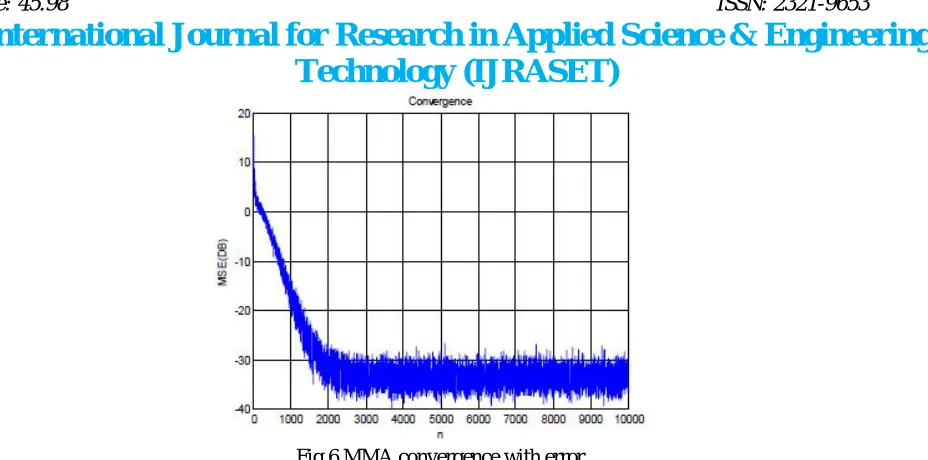
Matlab based simulation and the transmitted symbols are represented in the graph. The second graph involves the symbols which are transmitted over the AWGN channel. When comparing the transmitted and the received symbol which has the more error. And then the next graph the symbol which is after the equalization of the signal. The next graph is plotted between the error signal and the convergence rate. And next graph is the simulation of CMA & MMA systems when comparing two graphs the MMA system has the improved performance.
Fig.3. Received symbol
Fig 6 MMA convergence with error
The novel digital signal processing of multi modulus blind equalization of the QAM[9] signal which applying of the cascaded MMA does not need to have the separate phase recovery system. The cost function gives tap weight vector which gives the coefficients of the equalizer. The equalizer change the frequency components of the channel and the ISI was minimized was demonstrated experimentally. The mean square error and the bit error rate are reduced when comparing simulation results of the system. In future it is needed for the robust algorithms with reduction in the complexity and increase the data rate of the communication system.
REFERENCES
[1] J.R. Treichler, M.G. Larimore and J.C. Harp, “Practical Blind Demodulators for High- order QAM signals", Proceedings of the IEEE special issue on Blind System Identification and Estimation, vol. 86, pp. 1907-1926, Oct. 1998
[2] O. Dabeer, E. Masry, “Convergence Analysis of the Constant Modulus Algorithm,” IEEE Trans. Inform. Theory, vol. 49 , no. 6, Jun. 2003, pp. 1447-1464. [3] D. N. Godard, “Self-recovering equalization and carrier tracking in two dimensional data communication system,” IEEE Trans. Commun., vol. COM-28, no.
11, pp. 1867–1875, Nov. 1980.
[4] J. R. Treichler and M. G. Larimore, “New processing techniques based on the constant modulus algorithm,” IEEE Trans. Acoust., Speech, Signal Process., vol. ASSP-33, no. 4, pp. 420–431, Apr. 1985.
[5] C. R. Johnson et al., “Blind equalization using the constant modulus criterion: A review,” Proc. IEEE, vol. 86, no. 10, pp. 1927–1950, Oct. 1998.
[6] Y. Li and Z. Ding, “Global convergence of fractionally spaced Godard (CMA) adaptive equalizers,” IEEE Trans. Signal Process., vol. 44, no. 4, pp. 818–826, Apr. 1996.
[7] Junwen Zhang, Jiajun, Nan Chi, Ze Dong, Jianguo Yu, Xinying Li, Li Tao, and Yufeng Shao,” Multi modulus Blind Equalizations Of QDB spectrum QPSK Digital Signal Processing”, Journel of Light wave technology, vol31,no7 april 2013.
[8] P.Rambabu, Rajesh Kumar,”Blind Equalizations using Constnt Modulus Algorithm and Multi modulus algorithm”.Internatinal Journel of computer applications , Vol1, no3.
[9] Wei si yuan,”Blind Equalization for Qam signal based on the dual mode algorithm,science direct,pp34-37]
![(Z) 2 [(2,4 Dimethylphenyl)imino] 1,3 thiazinan 4 one](data:image/gif;base64,R0lGODlhAQABAIAAAP///wAAACH5BAEAAAAALAAAAAABAAEAAAICRAEAOw==)