© 2017, IRJET | Impact Factor value: 5.181 | ISO 9001:2008 Certified Journal | Page 1516
Multi-Objective Soft Computing Techniques for Dynamic
Deployment in WSN
Shiwani
Gupta
1, Dr. Shuchita Upadhyaya
21
M.Tech Scholar, Dept. of Computer Science & Applications, Kurukshetra University, Haryana, India
2
Professor, Dept. of Computer Science & Applications, Kurukshetra University, Haryana, India
---***---Abstract -
WSN stands for Wireless Sensor Network. In
WSN deployment, the nodes are deployed in such a way that they cover the maximum area. The sensor nodes have limited amount of energy. The lifetime of nodes cannot be increased. The main problem in WSN deployment is to cover the maximum area and minimize the energy consumption by deploying lesser number of sensor nodes. This problem is known as Coverage Energy balancing Sensor Problem (CEBSP). Most of the work carried out in this field
focuses on how to cover the maximum area or to decrease
the energy consumption separately. The multi objective means having more than one objective. Here, the objectives are coverage and energy, and we are required to cover maximum area and decreasing the energy consumed by nodes in transmitting the information. In this paper, we have focused on increasing coverage area and reducing the energy consumption by deploying lesser number of nodes in the network.Key Words: WSN, energy, coverage, deployment,
Coverage Energy balancing Sensor Problem
1.
INTRODUCTION
1.1
Background
WSN is a system which contains a large number of sensor
nodes which is distributed geographically in the region which is to be monitored. Many applications are – military applications such as battlefield surveillance, industrial such as industrial process monitoring, health and specific area such as habitat monitoring, earthquake observation, environmental conditions such as forest fire control etc. According to these applications, many WSN’s are developed such as wireless sensor networks for multimedia, underground, underwater etc. Sensor nodes are built up of “nodes” from several hundred to thousands. Nodes are of two types:• Homogenous, • Heterogeneous
In
homogenous sensor nodes
, all the nodes are
identical and they have same energy level but in
heterogeneous sensor nodes
, there are two or more
than two types of nodes. The energy level of all nodes is
different. The lifetime of node is limited. The battery
cannot be recharged. Each node consists of three
subsystems and these are:
Sensor subsystem Processing subsystem Communication subsystem
Fig-1: Subsystem of Sensor Nodes
There are certain issues that affect the design and performance of a WSN which are described below:
Hardware and Operating System for WSN Deployment
Localization Synchronization Quality of Service
In this paper, we focus on WSN deployment i.e. how the sensor nodes should be deployed so as to cover maximum area thereby consuming less energy.
For finding appropriate clustering of the network to find shortest path of transmission and to reduce the energy consumption, the genetic algorithm is used as it provides the optimal solutions. The operations of genetic algorithms are selection, crossover, mutation. Before selecting the mating pairs the scaling of fitness function is done.
© 2017, IRJET | Impact Factor value: 5.181 | ISO 9001:2008 Certified Journal | Page 1517
1.2
Authors' Contribution
In this paper, balancing of coverage and energy by deploying less number of sensor nodes is proposed. The Intersection between nodes can be defined as the common covered area by two sensor nodes [1], and, it needs to be minimized. Also, the lifetime of nodes is limited. The Coverage C of a sensor node Si in area A is defined as C (Si ,A) and the energy E of a sensor node Si can be defined as E(Si ,A).
The objectives of this papers are:
Increasing the maximum area covered by nodes. Increasing the lifetime of sensor nodes.
Balancing the energy and coverage by deploying less number of sensor nodes.
The rest of this paper is organized as follows: in Sect.2 the literature review related to the WSN Deployment, coverage and energy in WSN is briefed. In Sect.3 the proposed framework is discussed. In Sect.4 the experimental setup and the experimental results has been discussed and finally the conclusion is outlined in Sect.5.
2. RELATED WORK
Ozan Zorlu et al. [1] proposed the consequence of
advances in wireless communication, digital systems
and microelectronic mechanical system technologies,
Node deployment affects other problem domains
directly or indirectly. Therefore, in this study, node
deployment problem is dealt with. Also, coverage area
of WSN system with an organized deployment
approach is tried to be increased. This problem is
known as maximum coverage sensor deployment
problem (MCSDP) and NP-hard. To do so, a genetic
algorithm proposed for increasing the coverage of
given WSN topology with homogeneous sensors in a
2-D Euclidean area. But this has a limitation, that energy
and coverage cannot be balanced at the same time
means the area covered by sensor nodes should be
maximized while the energy consumed by sensor
nodes should be minimized.
Shiyuan Jin et al. [2]
proposed Many methods related to genetic algorithm
have been evaluated in the literature for energy
efficient WSN in which Coverage is the fundamental
challenge. Deployment can be done in two ways:
Deterministic Deployment
Random Deployment
Mohammad M. Shurman et al.[7] proposed how
Hierarchical clustering is used with the genetic
algorithm. Their results shows that hierarchical
clustering reduces the long distance between sensor
nodes and the sink node. The consumption of energy is
also reduced with reduction of distance. Amol P.
Bhondekar et al. [8] presented The parameters of these
algorithms are Field Coverage (FC), Overlap per cluster
change in error (OPCIE), Sensor out of range(SORE),
Sensors per cluster in charge(SPCI), and network
energy. The result showed that the evolution of
parameters conclude that high number of sensor nodes
can be used with low power consumption and this
approach is used for better network configuration and
sensor placement.
Seyed Mahdi Jameii et al. [5]
proposed algorithms for energy-efficient sensing
coverage. These are further divided into two
categories.
Location-dependent
Location-free
© 2017, IRJET | Impact Factor value: 5.181 | ISO 9001:2008 Certified Journal | Page 1518
CHEN et al. [14] propose a broadcasting
communication protocol with high energy efficiency
and low latency for large scale sensor networks based
on the Small World network theory. Simulation and
experiment results show that our schemes and
protocol have good performance.
Zoran Bojkovic et al.
[15]
proposed that how to deal with challenges for
WSNs deployment, they start with mobility-based
communication in WSNs. In recent years extensive
research has opened challenging issues for wireless
sensor networks (WSNs) deployment.
3.PROPOSED WORK
The proposed approach for balancing coverage and energy by deploying less number of sensor nodes has been given the name “Coverage and Energy balancing Sensor Problem” (CEBSP) because it balances the energy and coverage of WSN network simultaneously.
The proposed CEBSP consists of: MOGA
LEACH
3.1 Dynamic Deployment using MOGA: Multi-Objective Genetic Algorithm
Multi-objective involves more than one object which is
to be optimized simultaneously. The task of finding one
or more optimal solution is known as multi-objective
optimization. In genetic algorithm, only one factor is
considered and when fitness is calculated only one
value is achieved. But if more than one factor is
included then multi objective genetic algorithm is used
because when fitness is calculated then as a result a set
of values is achieved. With multi objective instead of
single solution they get a whole set of solutions. This
set is called a Pareto front. Every solution in set is not
worse than the others. In this, the population is
generated randomly. This population then produces a
population of offspring. Both populations are combined
into one population. Then this population is
transferred to non-dominate sorting procedure. Non
dominated sorting is a procedure in which a rank or
level is assigned to each organisms. The population
members are ranked according to their fitness values
(f
rank) and are selected for genetic operation, on a
pair-wise comparison to produce an offspring in the
generation. If any pair is having the same rank, then the
crowded distance assignment operator provides basis
and helps to maintain diversity in the population. To
change the attributes of offspring, crossover and
mutation operations were performed.
i. Pseudo Code of MOGA
Begin
t=0
Initialize population P(g).
Evaluate population by calculating its fitness P(g).
While not terminate
Do
g:= g+1
Select P(g+1) from P(g)
Crossover P(g+1) from P(g)
Mutate P(g+1) from P(g)
Evaluate P(g+1)
end while
end
ii. Flow Chart of MOGA
© 2017, IRJET | Impact Factor value: 5.181 | ISO 9001:2008 Certified Journal | Page 1519
Here, first the population is initialized within the
specified variable ranges. After evolution of this
population, based on non-dominated sorting
approach, the generated alternatives are classified
into different fronts. The population members are
ranked according to their fitness values (f
rank) and are
selected for genetic operation, on a pair-wise
comparison to produce an offspring in the generation.
If any pair is having the same rank, then the crowded
distance assignment operator provides basis and
helps to maintain diversity in the population. To
change the attributes of offspring, crossover and
mutation operations were performed. Here, first the
population is initialized within the specified variable
ranges. After evolution of this population, based on
non-dominated sorting approach, the generated
alternatives are classified into different fronts. The
population members are ranked according to their
fitness values (f
rank) and are selected for genetic
operation, on a pair-wise comparison to produce an
offspring in the generation. If any pair is having the
same rank, then the crowded distance assignment
operator provides basis and helps to maintain
diversity in the population. To change the attributes of
offspring, crossover and mutation operations were
performed. To preserve the best solutions obtained
through generations and to speed up the convergence,
the algorithm uses elitism, in which combination of
parents and offspring population are grouped into
different individuals selected for next generations.
iii. Pareto Front
With multi objective, instead of single solution a
whole set of solutions is derived. This set is called a
Pareto front. A set of actions with multi-dimensional
output is evaluated by the Pareto front. A very weak
desirability partial ordering applies only when one
process is better for all outputs. Basically Pareto front
is a framework which reduces the set of candidates for
further analysis, operations are performed on all
inputs, the set of better results is created and further
processing is performed on it. It shows the output in
multi-dimensions. It selects only those values which
lie in the specified range and rejects the rest. So for
output, all the factors should be satisfied. If any factor
does not satisfy, then it will not be accepted. Pareto
Front is the factor which generates during Multi
Objective Genetic Algorithm. This factor shows the
output in multiple dimensions. It accepts only those
data which lies in the specified range and rejects the
rest data. In fig-3 the red dots shows that these are
accepted because they satisfies the condition like they
cover the maximum area by consuming lesser amount
of energy. The dots which are blue are rejected
because they are satisfying only one factor i.e.
coverage. They are covering maximum area but
consuming a large amount of energy, so these are
rejected. As the name suggests Multi Objective Genetic
Algorithm there is more than one objective. If there is
a single object which do not satisfies then that data
will not be accepted. From Fig-3, we can see that
there are two objectives. One is coverage and another
is energy. The red dots show that both the conditions
are satisfied, whereas blue dots show that only one
factor is satisfied. Hence these are rejected. For
example: If we have two sets of organisms. The first
organism will dominate the other if all factors of first
organism are satisfied and if any one factor among all
the factors does not satisfy the condition. Further
processing is performed on the accepted values.
Fig-3: Function of Pareto Front
3.2 LEACH
© 2017, IRJET | Impact Factor value: 5.181 | ISO 9001:2008 Certified Journal | Page 1520
Adaptive Clustering Hierarchy. Leach is TDMA based
approach in which the same frequency channels are
used by dividing the signal into different time slots. The
main aim of LEACH is to decrease the energy
consumption required to create and maintain the
clusters which improve the lifetime of WSN. LEACH is a
hierarchical protocol in which cluster heads are
created. The Cluster heads collect the data, compress it
and transmit it to the base station.
i. Pseudo Code of LEACH
a) Set up phases:
Threshold, Cluster heads are selected
All CH’S transmit ADV message to all non-CH nodes. All non-CH nodes select their cluster heads on the
basis of RSSI of ADV message.
After selecting clusters non-CH nodes send join request to Cluster heads. Now TDMA schedule is created by CH and send it to all non-CH nodes.
b) Steady State Phase:
Sensor nodes start sensing and transmitting data to the cluster heads as per their TDMA schedule. After receiving data CH aggregates the data and
transmit it to the base station in a single hop, in this way the energy gets reduced.
After some time network goes back to setup phase and starts another round.
At cluster nodes, different CDMA code is used to reduce
the interference from other nodes.
4. Experimental Setup
The implementation environment was a Windows 8 system on Dell PC with a memory of 500GB and Intel Core i3-2100 CPU (3.1 GHz) and 4GB RAM. All the programs are implemented with MATLAB.
4.1 Experimental Results:
Many assumptions are made to implement the proposed work. In this paper, experiments are conducted in 100x100 2-D Euclidean space domain A-observed area. The number of sensor nodes (N) for each test instances is calculated to match the approximate tightness ratios a=0.60, 0.70, 0.80, 0.90, respectively. The Used formula to define the number N sensor nodes for each instance is depicted in Equation:
N= X*A(area)
3.14*ri2
Here, N- number of nodes to be deployed
A-area
ri- sensing range of nodes for test instances
[image:5.595.315.550.185.280.2]X- The number of sensor nodes for each test instances are calculated to match tightness ratio. The tightness ratio is different for each test instance.
Table-1: Test Data
Area
(A)
Crossover
Rate Id R N X
0.5 i-0.6 14 10 0.61
0.5 i-0.7 6 62 0.70
0.5 i-0.8 8 40 0.80
0.5 i-0.9 12 20 0.90
4.2 Graphs
In the experimentation results comparisons between MCSDP(maximum coverage sensor deployment problem) [1] and CEBSP (coverage energy balancing sensor problem) are shown through graphs. These are:
Randomly deployed nodes in the network, Balancing of Energy and Coverage, and
The comparison of dead nodes which involves first dead node, half dead node and last dead node. The table is provided to differentiate the performance of MCSDP[1] and CEBSP.
The experimentation results of Balancing of energy and coverage by deploying less no. of sensor nodes are shown below:
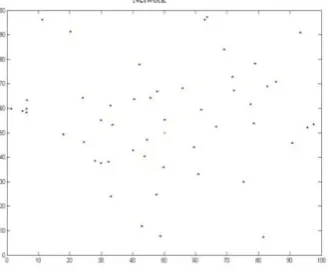
a) Node Deployment
[image:5.595.355.520.582.718.2]A large number of nodes are deployed in the network. They are deployed in such a way so that they cover the maximum area. Nodes are deployed randomly. They are scattered from environment. No calculation is performed to deploy these sensor nodes.
© 2017, IRJET | Impact Factor value: 5.181 | ISO 9001:2008 Certified Journal | Page 1521
b) Function of Pareto Front
The Pareto front shows the output in multi dimensions. Pareto front accepts only those values which lie in its range means if both the factor satisfies the condition. Pareto front accepts only those values in which both the factors perform their own task accurately.
Fig-5: Balancing of Energy and Coverage
From the Fig.-5 it can be seen that there are two factors, energy and coverage. The red colored nodes are covering maximum area and consuming less amount of energy, hence they are satisfying the condition. So, these will be accepted. The blue colored nodes are covering maximum area but consuming a larger amount of energy. Blue nodes are not satisfying the condition. So, these nodes are rejected.
The values of the round number at which the first node, half node and last node dead for the MCSDP(maximum
coverage sensor deployment Problem)[1] and
CEBSP(coverage energy balancing sensor problem)
method is shown in the table.
Table-2: Comparison of dead nodes on the basis of MCSDP [1] and CEBSP method
Comparison MCSDP CEBSP
First node dead 141 150
Half node dead 182 193
Last node dead 306 480
The round number at which the first node dies is known as
First Node dead.
The rounds taken to die the half nodes of the system show the Half Node dead.
The round number at which the last node of the system got dead shows the Last Node dead.
c) FND Comparison
FND stands for First Node dead. The round number at which first node dies is known as First Node dead.
Fig-6: First node comparison
The corresponding graph is shown below which depicts that in the MCSDP[1], at the round number 141 the first node dies whereas, in the CEBSP this round number got increased to 150. Hence, the CEBSP performs better.
d) HND Comparison
HND stands for Half Node dead. Every node has limited energy. If half of nodes from the total deployed nodes go dead, it means half of the nodes of system are dead and the round number at which this occurs is termed as half node dead.
Fig-7: Half node Comparison
© 2017, IRJET | Impact Factor value: 5.181 | ISO 9001:2008 Certified Journal | Page 1522 got dead in MCSDP[1] whereas in CEBSP this number
increased to 193.
e) Network Energy Consumption
Remaining energy is the energy which is left after consumption. Our main motive is to maximize the remaining energy. The energy is required to transmit the information to the destination (base station).
Fig-8: Network Energy Comparison
The Energy consumption by nodes should be minimized or the remaining energy should be maximized. For the same number of round, the comparison of MCSDP [1] and CEBSP is performed and CEBSP consumes less amount of energy than MCSDP[1].
f) Last Node Dead Comparison
Fig-9:
Last Node Dead comparison
The round at which the last node of the system got dead is known as Last Node Dead. The Last node dead comparison of MCSDP [1] and CEBSP is shown in the graph which also shows that the CEBSP performs better than the MCSDP
because the last dead node according to CEBSP occurs later than MCSDP [1].
4.3
Summary of Results
In this section, metrices like first node dead, half node dead, last node dead, energy consumption comparison are defined. It is identified that proposed CEBSP performs better than that of MCSDP [1].
5. CONCLUSIONS
In this paper, our main motive is to perform balancing of the energy and coverage means the nodes should be deployed in such a way in which nodes cover the large area and consume less energy and we have achieved that goal (maximizing coverage and minimizing the energy consumption) by applying multi objective genetic algorithm.
REFERENCES
[1]Ozan Zorlu, Ozgur Koray Sahingoz, “Increasing the coverage of Homogeneous WSN by Genetic Algorithm based deployment,” ISBN:978-1-4673-9609-7 2016 IEEE. [2]Shiyuan Jin, Ming Zhou, Annie S. Wu, “Sensor Network
Optimization Using GA,”School of EECS, University of Central Florida Orlando, FL 32816.
[3]NaeimRahmani, FarhadNematy, Amir MasoudRahmani, Mehdi Hosseinzadeh, “Node Placement for Maximum Coverage Based on Voronoi Diagram Using Genetic Algorithm in WSN,” Australian Journal of Basic and Applied Sciences, 5(12): 3221-3232, 2011 ISSN 1991-8178
[4]Yang SUN†, and Jingwen TIAN, “WSN Path Optimization Based on Fusion of Improved Ant Colony Algorithm and
Genetic Algorithm,” Journal of
ComputationalInformationSystems6:5(2010)1591-1599 [5]Seyed Mahdi Jameii and Seyed
MohsenJameii,“Multi-objective Algorithm for Coverage in sensor networks,” IJCSEIT, Vol.3, No.4, August 2013.
[6]S.M. Hosseinirad, and S.K. Basu,“ Wireless sensor network design through genetic algorithm,” Journal of AI and Data Mining Vol. 2, No .1, 2014, 85-96.
[7]Mohammad M. Shurman, Mamoun F. Al-Mistarihi, Amr N. Mohammad, Khalid A. Darabkh, and Ahmad A. Ababnah, “Hierarchical Clustering Using Genetic Algorithm in Wireless Sensor Networks,” MIPRO 2013, May 20-24, 2013, Opatija, Croatia.
[8]Amol P. Bhondekar, RenuVig, C Ghanshyam, MadanLalSingla, and PawanKapur,“GA-BasedNode Placement Methodology for WSN,” IMECS 2009 Vol. 1. [9]Y Yoon and Y H. Kim, "An Efficient Genetic Algorithm
© 2017, IRJET | Impact Factor value: 5.181 | ISO 9001:2008 Certified Journal | Page 1523 Networks ",IEEE Trans. Cybern., vol. 43, no. 5,
pp.1473-1483, April 2013.
[10]Y Zou and K. Chakrabarty, "Sensor Deployment and Target Localization Based on Virtual Forces", in Proc. Twenty-Second Annual Joint Conf. of theIEEE Computer and Communications, IEEE Societies, San Francisco, CA, April 2003, pp.1293-1303 vol.2.
[11]C. S. Raghavendra (Editor), Krishna M. Sivalingam (Editor), Taeib F. Znati (Editor). “Wireless Sensor Network”, Springer. 2006.
[12]Shashi Phoha (Editor), Thomas F. La Porta (Editor), Christopher Griffin (Editor). “Sensor Network Operations”,Wiley–IEEE Press. 2006
[13]Adam Dunkels ,Fredrik ¨Osterlind and Zhitao He, “An Adaptive Communication Architecture for Wireless Sensor Networks”, November 6–9, 2007, Sydney, Australia.
[14]Xi CHEN,Qianchuan ZHAO and Xiaohong GUAN, “ENERGY-EFFICIENT SENSING COVERAGE AND
COMMUNICATION FOR WIRELESS SENSOR
NETWORKS”, National Natural Science Foundation (No. 60574087, 60574064) and the “111 International Collaboration Project” of China, feb 2007.