Amendment history:
Corrigendum
(May 2010)
The basics of epithelial-mesenchymal transition
Raghu Kalluri, Robert A. Weinberg
J Clin Invest.
2009;
119(6)
:1420-1428.
https://doi.org/10.1172/JCI39104
.
The origins of the mesenchymal cells participating in tissue repair and pathological
processes, notably tissue fibrosis, tumor invasiveness, and metastasis, are poorly
understood. However, emerging evidence suggests that epithelial-mesenchymal transitions
(EMTs) represent one important source of these cells. As we discuss here, processes
similar to the EMTs associated with embryo implantation, embryogenesis, and organ
development are appropriated and subverted by chronically inflamed tissues and
neoplasias. The identification of the signaling pathways that lead to activation of EMT
programs during these disease processes is providing new insights into the plasticity of
cellular phenotypes and possible therapeutic interventions.
Review Series
Find the latest version:
lial-mesenchymal transitions (EMTs) represent one important source of these cells. As we discuss here, processes
similar to the EMTs associated with embryo implantation, embryogenesis, and organ development are
appropri-ated and subverted by chronically inflamed tissues and neoplasias. The identification of the signaling pathways that
lead to activation of EMT programs during these disease processes is providing new insights into the plasticity of
cellular phenotypes and possible therapeutic interventions.
What is epithelial-mesenchymal transition?
An epithelial-mesenchymal transition (EMT) is a biologic process that allows a polarized epithelial cell, which normally interacts with basement membrane via its basal surface, to undergo mul-tiple biochemical changes that enable it to assume a mesenchymal cell phenotype, which includes enhanced migratory capacity, inva-siveness, elevated resistance to apoptosis, and greatly increased production of ECM components (1). The completion of an EMT is signaled by the degradation of underlying basement membrane and the formation of a mesenchymal cell that can migrate away from the epithelial layer in which it originated.
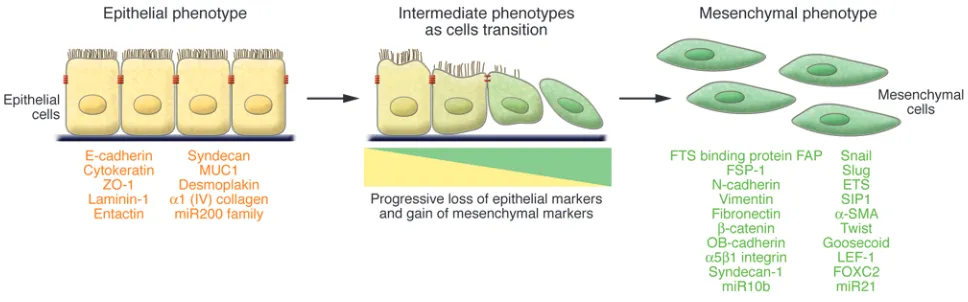
A number of distinct molecular processes are engaged in order to initiate an EMT and enable it to reach completion. These include activation of transcription factors, expression of specific cell-sur- face proteins, reorganization and expression of cytoskeletal pro-teins, production of ECM-degrading enzymes, and changes in the expression of specific microRNAs. In many cases, the involved fac-tors are also used as biomarkers to demonstrate the passage of a cell through an EMT (Figure 1).
The pioneering work of Elizabeth Hay first described an “epithelial-mesenchymal transformation” using a model of chick primitive streak formation (2). In the intervening time, the term “transformation” has been replaced with “transition,” reflecting in part the reversibility of the process and the fact that it is distinct from neoplastic transforma-tion (1). The phenotypic plasticity afforded by an EMT is revealed by the occurrence of the reverse process — a mesenchymal-epithelial tran-sition (MET), which involves the conversion of mesenchymal cells to epithelial derivatives. Relatively little is known about this process; the best-studied example is the MET associated with kidney formation, which is driven by genes such as paired box 2 (Pax2 ), bone morphoge-netic protein 7 (Bmp7), and Wilms tumor 1 (Wt1) (3–5).
Why does EMT occur?
The concept of cell division as a way to generate more cells and expand tissue size emerged about 150 years ago (6). Central to
this concept was an understanding that all cells in a body derive from other cells and the resulting deduction that ultimately all are derived from a single cell, the fertilized egg. An additional level of complexity came from the realization that cells can assume various phenotypic states during development, that is, they can undergo the process of differentiation. As was learned more recently, dur-ing specific steps of embryogenesis and organ development, the cells within certain epithelia appear to be plastic and thus able to move back and forth between epithelial and mesenchymal states via the processes of EMT and MET (7). Upon completion of the development of epithelial tissues, the epithelial cells typically exert tissue-specific function, while the mesenchymal cells in such tis-sue play a supporting role. Implied in this notion was the further idea that a state of terminal differentiation is necessary to carry out such specialized functions and that cells are maintained in a permanent state of differentiation once development is complete.
This concept has been challenged by numerous observations that the cells within a terminally differentiated epithelium can indeed change their phenotype through activation of an EMT program, which enables transdifferentiation, resulting in the conversion of epithelial cells to mesenchymal derivatives during development and adulthood. These programs can also be activated in associa-tion with tissue repair and pathological stresses, including those creating various types of inflammation and high-grade carcino-mas. Accordingly, EMTs now constitute recognized mechanisms for dispersing cells in embryos, forming mesenchymal cells in injured tissues, and initiating the invasive and metastatic behavior of epithelial cancers.
Classification of EMT into three different subtypes
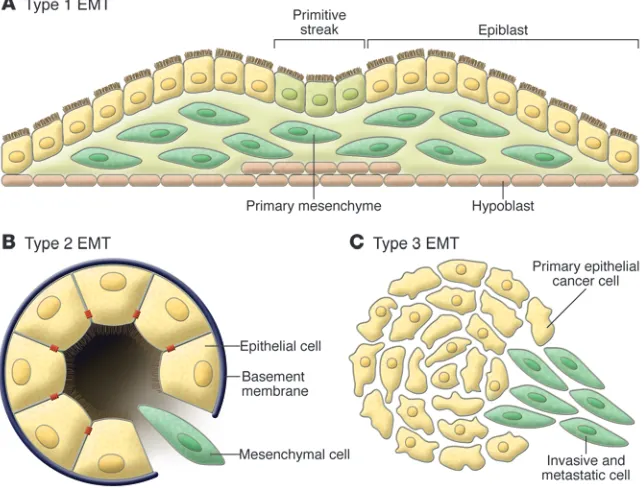
EMTs are encountered in three distinct biological settings that carry very different functional consequences (Figure 2). While the specific signals that delineate the EMTs in the three discrete set- tings are not yet clear, it is now well accepted that functional dis- tinctions are apparent. A proposal to classify EMTs into three dif-ferent biological subtypes based on the biological context in which they occur was discussed at a 2007 meeting on EMT in Poland and a subsequent meeting in March 2008 at Cold Spring Harbor Laboratories. The EMTs that are associated with implantation, embryo formation, and organ development are organized to gen- erate diverse cell types that share common mesenchymal pheno-types. This class of EMTs, which we and others (8) propose to term
Conflict of interest: The authors have declared that no conflict of interest exists. Nonstandard abbreviations used: BMP, bone morphogenetic protein; EMT, epithelial-mesenchymal transition; EndMT, endothelial-mesenchymal transition; FSP1, fibroblast-specific protein 1; LEF, lymphoid enhancer binding factor; MET, mesenchymal-epithelial transition.
review series
“type 1,” neither causes fibrosis nor induces an invasive phenotype resulting in systemic spread via the circulation. Among other out- comes, these type 1 EMTs can generate mesenchymal cells (prima-ry mesenchyme) that have the potential to subsequently undergo a MET to generate secondary epithelia.
The EMTs associated with wound healing, tissue regeneration, and organ fibrosis are of a second type. In these type 2 EMTs, the program begins as part of a repair-associated event that normally generates fibroblasts and other related cells in order to reconstruct tissues following trauma and inflammatory injury. However, in contrast to type 1 EMTs, these type 2 EMTs are associated with inflammation and cease once inflammation is attenuated, as is seen during wound healing and tissue regeneration. In the setting of organ fibrosis, type 2 EMTs can continue to respond to ongo-ing inflammation, leading eventually to organ destruction. Tissue fibrosis is in essence an unabated form of wound healing due to persistent inflammation.
Type 3 EMTs occur in neoplastic cells that have previously undergone genetic and epigenetic changes, specifically in genes that favor clonal outgrowth and the development of localized tumors. These changes, notably affecting oncogenes and tumor suppressor genes, conspire with the EMT regulatory circuitry to produce outcomes far different from those observed in the other two types of EMT. Carcinoma cells undergoing a type 3 EMT may invade and metastasize and thereby generate the final, life-threat-ening manifestations of cancer progression. Importantly, cancer cells may pass through EMTs to differing extents, with some cells retaining many epithelial traits while acquiring some mesenchymal ones and other cells shedding all vestiges of their epithelial origin and becoming fully mesenchymal. It is still unclear what specific signals induce type 3 EMTs in carcinoma cells. For example, such signals may originate in the tumor stroma that is associated with many primary carcinomas.
While these three classes of EMTs represent distinct biologi-cal processes, a common set of genetic and biochemical elements appears to underlie and thus enable these outwardly diverse phe-notypic programs. As more experiments are performed in the
future, we will learn more regarding the similarities and differ-ences among the three classes of EMTs.
Type 1 EMT: EMT during implantation, embryogenesis, and organ development
Following the earliest stages of embryogenesis, the implantation of the embryo and the initiation of placenta formation are both associated with an EMT that involves the parietal endoderm (9). In particular, the trophoectoderm cells, which are precursors of the cytotrophoblast, undergo an EMT in order to facilitate invasion of the endometrium and the subsequent proper anchoring of the placenta, enabling its function in nutrient and gas exchange (10, 11). As described briefly below, this is only the first of many type 1 EMTs that accompany and underlie embryonic morphogenesis; more detail regarding some of the EMTs that occur during devel-opment are discussed elsewhere (12).
A fertilized egg undergoes gastrulation, generating three germ layers. Initially, a primitive streak is generated in the epiblast layer (13). The epithelial cells in this tissue express E-cadherin and exhibit apical-basal polarity. Formation of the primitive streak is considered to be the first sign of gastrulation, which leads in turn to the formation of the three germ layers that generate all tissue types of the body. The primitive streak is formed from a furrowed invagination in the midline of the epiblast layer that forms initially at the lower extremity of the embryo and, later on, extends in the direction of the future head. The epithelial-like cells of the epiblast undergo programmed changes dictated by specific expression of proteins associated with cell migration and differentiation (14).
[image:3.585.50.534.83.234.2]Once formed, the primitive streak, acting via invagination or ingression (depending on the species studied), generates the mesendoderm, which subsequently separates to form the meso- derm and the endoderm via an EMT (also known as epiblast-meso- derm transition) (2) by replacing the hypoblast cells, which pre-sumably either undergo apoptosis or contribute to the mesoderm layer via an EMT. The embryonic mesoderm that forms between the epiblast and hypoblast eventually gives rise to primary mesen-chyme associated with the axial, paraxial, intermediate, and lateral
Figure 1
plate mesodermal layers (15). Cells of the primary mesenchyme exhibit enhanced migratory properties when compared with those of the epiblast and the hypoblast (15).
At the biochemical level, the EMT associated with gastrulation is dependent on and orchestrated by canonical Wnt signaling, and embryos deficient in Wnt3 cannot undergo the EMT associ-ated with gastrulation (16, 17). The subsequent formation of the primitive streak is associated with expression of Wnt8c, and ectopic expression of Wnt8c in embryos leads to multiple primitive streaks (18, 19). TGF-β superfamily proteins, notably Nodal and Vg1, medi- ate the action of Wnts, and their deficiencies can lead to mesoder-mal defects due to the absence of functional EMTs (20–24). Wnts also cooperate with FGF receptors to help regulate an EMT associ- ated with gastrulation (25–28). The Snail, Eomes, and Mesps tran-scription factors orchestrate the EMT associated with gastrulation (29–31). For example, Snail represses E-cadherin and induces EMT mediated by cell adhesion molecules, such as occludins and clau-dins, and by polarity genes, such as Discs large (Dlg) and Crumbs homolog 3 (Crb3) (32–34).
During embryonic development, an EMT involving the epithe-lial cells of the neuroectoderm gives rise to migratory neural crest cells (35). Initially, the premigratory neural crest cells express genes such as Sox, Snail, Slug, and forkhead box D3 (FoxD3), and these cells subsequently undergo an EMT (36, 37). As a consequence, they then dissociate from the neural folds, become motile, and disperse to the different parts of the embryo, where they undergo further differentiation into, among other cell types, the melano-cytes that provide pigment to the skin.
This EMT occurring in the neural crest is triggered by signaling pathways similar to those orchestrating the EMT associated with gastrulation. Thus, signaling pathways mediated by Wnts, FGFs, BMPs, c-Myb, and msh homeobox 1 (Msx-1) conspire to induce EMT (38–40). Among them, BMP most prominently induces the migratory property of neural crest cells. Noggin, an inhibitor of BMP, is essential in negatively regulating this activity,and its
expression places a hold on EMT (41, 42). Additionally, E-cadherin and N-cadherin, two cell adhesion molecules, need to be repressed in order for neural crest EMT to occur (43). By some estimates, EMT programs are deployed during several subsequent phases of embryogenesis, indicating the continued involvement of these pro-grams later in development, such as the endothelial-mesenchymal transition (EndMT) that takes place during heart valve formation.
Type 2 EMT: EMT associated with tissue regeneration and organ fibrosis
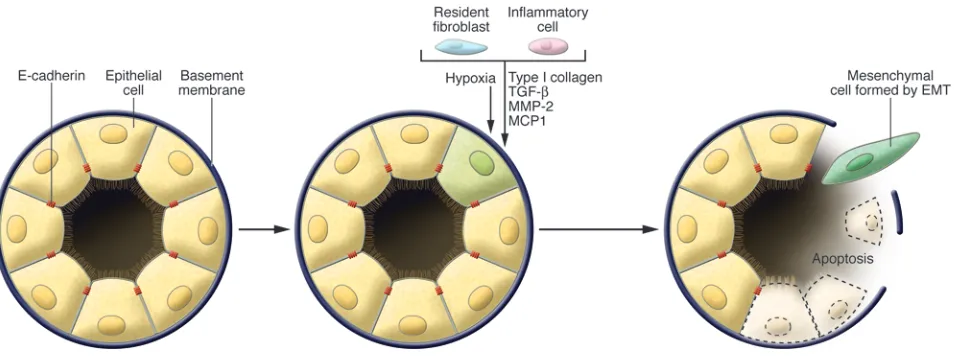
Organ fibrosis, which occurs in a number of epithelial tissues, is mediated by inflammatory cells and fibroblasts that release a vari-ety of inflammatory signals as well as components of a complex ECM that includes collagens, laminins, elastin, and tenacins (Fig-ure 3). More specifically, such EMTs are found to be associated with fibrosis occurring in kidney, liver, lung, and intestine (44–47). Some of the earliest proof of this came from the study of trans-genic mice bearing germ-line reporter genes whose expression was driven by epithelial cell–specific promoters. The behavior of these reporters provided direct evidence for epithelial cells serving, via EMTs, as important precursors of the fibroblasts that arise during the course of organ fibrosis (48–50).
Fibroblast-specific protein 1 (FSP1; also known as S100A4 and MTS-1), an S100 class of cytoskeletal protein, α-SMA, and collagen I have provided reliable markers to characterize the mesenchymal products generated by the EMTs that occur during the develop-ment of fibrosis in various organs (48, 49, 51). These markers, along with discoidin domain receptor tyrosine kinase 2 (DDR2), vimentin, and desmin, have been used to identify epithelial cells of the kidney, liver, lung, and intestine that are in the midst of under-going an EMT associated with chronic inflammation. Such cells continued to exhibit epithelial-specific morphology and molecu-lar markers, such as cytokeratin and E-cadherin, but showed concomitant expression of the FSP1 mesenchymal marker and
α-SMA. Such cells are likely to represent the intermediate stages
[image:4.585.45.367.86.331.2]review series
of EMT, when epithelial markers continue to be expressed but new mesenchymal markers have already been acquired. The behavior of these cells provided one of the first indications that epithelial cells under inflammatory stresses can advance to various extents through an EMT, creating the notion of “partial EMTs” (Figure 1). Eventually these cells leave the epithelial layer, negotiate their way through the underlying basement membrane, and accumulate in the interstitium of the tissue (52), where they ultimately shed all of their epithelial markers and gain a fully fibroblastic phenotype.
Recent experiments in mice have demonstrated that endothelial cells associated with the microvasculature can also contribute to the formation of mesenchymal cells during the course of fibrosis, doing so via an analogous process known as EndMT (44). This pathologic process echoes a similar normal process occurring dur-ing development (45). Thus, during embryogenesis, an EndMT occurs during the organization of the endocardial cushion and the heart valves. In cardiac fibrosis associated with post-ischemic injury of the heart, EndMT, which involves both the endocardium (the inner endothelial layer of the heart) and the microvascular endothelium of the heart, has been demonstrated to play a key role in contributing to the emergence of newly formed fibroblasts (45) (Figure 4). In tissue culture models of EndMT, TGF-β1 induces EndMT of capillary endothelial cells and the loss of endothelial markers, such CD31 and integrin αVβ3, as well as the acquisition of fibroblast- and myofibroblast-specific markers such as FSP1,
α -SMA, DDR2, collagen I, and vimentin. While not yet document-ed, it is plausible that many of the molecular regulators of EMTs also play critical roles in orchestrating EndMTs.
In one analysis (1), lineage-tagging experiments and bone mar-row transplant studies demonstrated that during the course of kidney fibrosis in mice, about 12% of fibroblasts are derived from the bone marrow and about 30% are derived via EMT from the tubular epithelial cells of the kidney. In addition, it has been shown more recently that in kidney fibrosis about 35% of fibro- blasts are derived via EndMT from the endothelial cells nor-mally residing within the kidney. The remaining portions are speculated to arise via activation of resident fibroblasts or other
mesenchymal cells, such as perivascular smooth muscle cells/ pericytes and fibrocytes (53) in the circulation (Figure 4). It is likely that these proportions may vary dramatically, depending on the stage of fibrosis, the organ, and the particular experimen-tal model being studied.
This complex pathologic process may reflect the developmental origins of the kidney. Thus, the entire epithelium of the kidney, including the tubular epithelial cells, is derived from the intermediate mesoderm during the development of the urogenital system. More specifically, a mesenchyme condenses over the ureteric bud (derived from the endoderm) to give rise to the glomerular and tubular epi-thelial structures of the kidney (54), doing so via a MET. This hints at a peculiar aspect of renal biology: by retaining some imprint of their mesenchymal origins, kidney epithelial cells may be particularly prone to return to this state, via the EMTs that occur in response to inflammatory stress and lead to pathologic fibrosis (55, 56).
[image:5.585.56.533.82.263.2]Inflammatoryinjury to the mouse kidney can result in the recruitment of a diverse array of cells that can trigger an EMT through their release of growth factors,such as TGF-β, PDGF, EGF, and FGF-2 (57). Most prominent among these cells are macrophages and activated resident fibroblasts thataccumulate at the site of injury and release these growth factors. In addition, these cells release chemokines and MMPs, notably MMP-2, MMP-3, and MMP-9. Epithelial cells come under the influence of these sig-naling molecules and, acting together with the inflammatory cells, induce basement membrane damage and focal degradation of type IV collagen and laminin (57). Delaminated epithelial cells may then migrate toward the interstitial area (the space between epithelial layers) under the influence of gradients of growth factors and other chemoattractants (57). This initial recruitment of epithelial cells into an EMT can be inhibited by blocking the expression of MMP-9 through the disruption of tissue plasminogen activator (tPA) (58). Other studies have also demonstrated that HGF can decrease levels of TGF-β, restore TGF-β –mediated loss of E-cadherin, and poten-tially decrease amounts of active MMP-9 (59). β 1 integrin and inte-grin-linked kinase (ILK) are also identified as important mediators of the TGF-β–induced EMT associated with tubular epithelial cells
Figure 3
(60). TGF-β induces EMT via both a Smad2/3-dependent pathway and a MAPK-dependent pathway. Recent experiments have also demonstrated a key role for the E-cadherin/β-catenin signaling axis for EMT involving epithelial cells (61, 62).
The significance of TGF-β–induced EMT for progression of organ fibrosis has been demonstrated in studies using BMP-7, an antagonist of TGF-β signaling, in mouse models of kidney, liver, billiard tract, lung, and intestinal fibrosis (51, 63). BMP-7 func-tions as an endogenous inhibitor of TGF-β–induced EMT (51, 63) (Figure 4). Among other effects, it reverses the TGF-β–induced loss of the key epithelial protein, E-cadherin (63). Restoration of E-cad- herin levels by BMP-7 is mediated via its cognate receptors, activin-like kinase–2/3/6 (ALK-2/3/6), and the Smad4/5 downstream transcription factors (63). Systemic administration of recombi-nant BMP-7 to mice with severe fibrosis resulted in reversal of EMT and repair of damaged epithelial structures, with repopula-tion of healthy epithelial cells, all presumably mediated via a MET (63). This reversal was also associated with restoration of organ function, a substantial decrease in FSP1+ and α-SMA+ interstitial
fibroblasts, and the de novo activation of BMP-7 signaling (63). Studies using fibrosis tissue from humans have also demonstrated EMT (50). In a study of 133 patients with kidney fibrosis, an EMT was demonstrated in a substantial number of the samples, as evaluated using double labeling of the tubular epithelial cells with cytokeratin, vimentin, α -SMA, or zona occludens 1 (ZO-1). Simi-larly, in patients with Crohn disease, an EMT was demonstrated in areas of fibrosis in the colon (64). Such studies should provide the necessary confidence to develop novel therapeutic interventions in order to suppress EMTs and potentially reverse organ fibrosis.
Type 3 EMT: EMT associated with cancer progression and metastasis
Excessive epithelial cell proliferation and angiogenesis are hall-marks of the initiation and early growth of primary epithelial cancers (65). The subsequent acquisition of invasiveness, initially manifest by invasion through the basement membrane, is thought to herald the onset of the last stages of the multi-step process that leads eventually to metastatic dissemination, with life-threatening consequences. The genetic controls and biochemical mechanisms underlying the acquisition of the invasive phenotype and the subse-quent systemic spread of the cancer cell have been areas of intensive research. In many of these studies, activation of an EMT program has been proposed as the critical mechanism for the acquisition of malignant phenotypes by epithelial cancer cells (66).
Many mouse studies and cell culture experiments have demon-strated that carcinoma cells can acquire a mesenchymal phenotype and express mesenchymal markers such as α-SMA, FSP1, vimentin, and desmin (67). These cells typically are seen at the invasive front of primary tumors and are considered to be the cells that eventually enter into subsequent steps of the invasion-metastasis cascade, i.e., intravasation, transport through the circulation, extravasation, for-mation of micrometastases, and ultimately colonization (the growth of small colonies into macroscopic metastases) (66, 68, 69).
[image:6.585.49.539.83.338.2]An apparent paradox comes from the observation that the EMT-derived migratory cancer cells typically establish second- ary colonies at distant sites that resemble, at the histopathologi-cal level,the primary tumor from which they arose; accordingly, they no longer exhibit the mesenchymal phenotypes ascribed to metastasizing carcinoma cells. Reconciling this behavior with
Figure 4
review series
the proposed role of EMT as a facilitator of metastatic dissemi-nation requires the additional notion that metastasizing cancer cells must shed their mesenchymal phenotype via a MET during the course of secondary tumor formation (70). The tendency of disseminated cancer cells to undergo MET likely reflects the local microenvironments that they encounter after extravasation into the parenchyma of a distant organ, quite possibly the absence of the heterotypic signals they experienced in the primary tumor that were responsible for inducing the EMT in the first place (66, 71, 72). These considerations indicate thatinduction of an EMT is likely to be a centrally important mechanism for the progression of carcinomas to a metastatic stage and implicates MET during the subsequent colonization process (Figure 5). However, many steps of this mechanistic model still require direct experimental validation. Moreover, it remains unclear at present whether these phenomena and molecular mechanisms relate to and explain the metastatic dissemination of non-epithelial cancer cells.
The full spectrum of signaling agents that contribute to EMTs of carcinoma cells remains unclear. One suggestion is that the genetic and epigenetic alterations undergone by cancer cells dur- ing the course of primary tumor formation render them espe-cially responsive to EMT-inducing heterotypic signals originating in the tumor-associated stroma. Oncogenes induce senescence, and recent studies suggest that cancer cell EMTs may also play a role in preventing senescence induced by oncogenes, thereby facilitating subsequent aggressive dissemination (73–75). In the case of many carcinomas, EMT-inducing signals emanating from the tumor-associated stroma, notably HGF, EGF, PDGF, and TGF-β , appear to be responsible for the induction or func-tional activation in cancer cells of a series of EMT-inducing transcription factors, notably Snail, Slug, zinc finger E-box bind-ing homeobox 1 (ZEB1), Twist, Goosecoid, and FOXC2 (66, 71, 76–79). Once expressed and activated, each of these transcription factors can act pleiotropically to choreograph the complex EMT program, more often than not with the help of other members of this cohort of transcription factors. The actual implementa-tion by these cells of their EMT program depends on a series of intracellular signaling networks involving, among other signal-transducing proteins, ERK, MAPK, PI3K, Akt, Smads, RhoB,
β-catenin, lymphoid enhancer binding factor (LEF), Ras, and c-Fos as well as cell surface proteinssuch as β4 integrins, α5β 1 integ-rin, and αVβ6 integrin (80). Activation of EMT programs is also
facilitated by the disruption of cell-cell adherens junctions and the cell-ECM adhesions mediated by integrins (67, 75, 81–86).
TGF-β is an important suppressor of epithelial cell proliferation and thus primary tumorigenesis. However, it is now clear that in certain contexts it can also serve as a positive regulator of tumor progression and metastasis (87–89). Thus, in vitro studies have demonstrated that TGF-β can induce an EMT in certain types of cancer cells (90). Two possible signaling pathways have been identified as mediators of TGF-β–induced EMT. The first of these involves Smad proteins, which mediate TGF-β action to induce EMTs via the ALK-5 receptor (51, 91–95). Smad-mediated signal-ing induced by TGF-β facilitates motility. Inhibitory Smads modu- late differential effects of relevant transcription factors and cyto-plasmic kinases and induce the autocrine production of TGF-β, which can further reinforce and amplify the EMT program (91, 92, 96, 97). Signaling pathways that mediate the action of β-catenin and LEF also cooperate with Smads (61, 98) in inducing an EMT (61, 99, 100). In this regard, the involvement of LEF and β-catenin in PDGF-induced EMT was recently described (98). These studies collectively demonstrate that the TGF-β/Smad/LEF/PDGF axis is an important inducer of an EMT phenotype in cancer.
[image:7.585.54.538.86.181.2]Evidence for the involvement of a second TGF-β–induced pathway in EMT is also compelling. More specifically, some data indicate that p38 MAPK and RhoA mediate an autocrine TGF-β– induced EMT in NMuMG mouse mammary epithelial cells (96, 101). This process also requires integrin β1–mediated signaling and the activation of latent TGF-β by αVβ6 integrin (96, 101). Fibulin-5, an ECM molecule, augments TGF-β –induced EMT in a MAPK-dependent mechanism (102). TGF-β can induce an EMT in Ras-transformed hepatocytes, mammary epithelial cells (via MAPK), and MDCK cells; at the same time, Ras-activated PI3K inhibits TGF-β–induced apoptosis to facilitate this transition (103–106). Evidence for these connections comes from observations that ERK/MAPK and PI3K/Akt pathways mediate Ras mutant–induced EMT, and that such an EMT is reversed by either wild-type Ras or MAPK kinase 1 (MEK1) inhibitors (106). In this regard, Raf also mediates TGF-β –induced EMT and promotes invasiveness of can-cer cells. In mouse models of skin carcinoma and human colon cancer, the absence of TGF-β receptor expression actually confers better prognosis (107, 108). The connection between inflammation and EMT was demonstrated when COX-2 was shown to inactivate Smad signaling and enhance EMT stimulated by TGF-β through
Figure 5
their mesenchymal phenotype (99, 113). Sequestration of β-catenin in the cytoplasm is important for the preservation of epithelial fea-tures of cancer cells, and acquisition of the mesenchymal phenotype correlates with the movement of β-catenin to the nucleus, where it becomes part of Tcf/LEF complexes (100, 114). Such β-catenin accumulation in the nucleus, which is often associated with loss of E-cadherin expression, correlates with susceptibility to enter into an EMT and acquisition of an invasive phenotype (61, 66). Thus, cells that lose cell surface E-cadherin become more responsive to induc-tion of an EMT by various growth factors (61).
Some studies have demonstrated that the epigenetic control of E-cadherin and β-catenin/LEF activity is important in establishing the metastatic potential of cancer cells (115–118). Cell lines that lack E-cadherin show increased tumorigenicity and metastasis when trans-ferred into immunodeficient mice (118). E-cadherin expression levels vary dramatically in different human tumors, and an inverse relation- ship between levels of E-cadherin and patient survival has been docu-mented (117). In this regard, mutations in the E-cadherin gene have been identified in cancer cells, making them more susceptible to EMT and metastasis (115, 116). A more thorough analysis of such muta-tions and their correlation to metastatic progression is still required. The central role played by E-cadherin loss in the EMT program is further illustrated by the actions of several EMT-inducing transcrip-tion factors that facilitate acquisition of a mesenchymal phenotype, such as Snail and Slug, as well as those encoding two key zinc fin-ger–containing basic helix-loop-helix transcription factors, survival of motor neuron protein interacting protein 1 (SIP1) and E12 (also known as E47-E2A). These transcription factors are induced by TGF-β exposure and, once expressed, repress E-cadherin expression (78). Snail also facilitates an invasive phenotype in mice (31).Loss of E-cadherin promotes Wnt signaling and is associated with high levels of Snail in the nucleus (119). SIP1 represses E-cadherin expres-sion and binds, along with Snail, to the E-cadherin promoter in an overlapping fashion (120, 121). The expression of Snail and E-cad-herin correlates inversely with the prognosis of patients suffering from breast cancer or oral squamous cell carcinoma (119, 122). The use of gene expression analyses to compare expression of genes in metastatic and non-metastatic mouse breast cancer cell lines has led to the identification of Twist and Goosecoid as important genes that facilitate EMT and induce metastasis (85, 123). Some have reported that matrix-degrading enzymes such as MMP-3 facilitate EMT by inducing genomic instability via Rac1b and ROS (124).
Noncoding microRNAs are also components of the cellular sig-naling circuitry that regulates the EMT program. For example, microRNA 200 (miR200) and miR205 inhibit the repressors of E-cadherin expression, ZEB1 and ZEB2, and thereby help in main-taining the epithelial cell phenotype (125–129). In breast carcinoma,
Perspective
It is now clear that EMTs occur in three distinct biological settings. While the outcome is the generation of motile cells of mesenchymal phenotype, the mechanisms of EMT induction and progression vary dramatically from one setting to another. The EMTs associated with implantation, embryogenesis, and organ development (type 1 EMTs) are driven by the evolutionary need to remodel and diversify tissue in order to enable proper morphogenesis and generate a functional organism. Such EMTs occur transiently and are not associated with inflammation, fibrosis, and systemic dissemination. Type 2 EMTs are associated with tissue regeneration and fibrosis, and they depend on inflammation-inducing injuries for their initiation and continued occurrence. Accordingly, these EMTs continue to occur until the pro-voking injuries or infections are removed and, in the case of injuries, the tissue is repaired. Type 2 EMTs generate activated mesenchymal cells, notably myofibroblasts that produce excessive amounts of col-lagen-rich ECM. Type 3 EMTs occur in the context of tumor growth and cancer progression, when cancer cells at the invasive front of the tumors convert to a mesenchymal phenotype. The induction of type 3 EMTs is facilitated by the genomic alterations acquired by cancer cells and these EMTs generate cells with invasive properties that enable them to move into the blood stream and spread systemically to other organs. Future research will surely focus on uncovering the molecular similarities and differences among the EMT programs that occur in the three distinct settings.
EMT research in the next few years promises to be exciting, as new mouse models and molecular probes are identified to address important, still-unanswered questions. For example, what are the identities of the EMT-inducing microenvironmental signals? What is the nature of the changes in cells that render them responsive to such signals? And what signaling machinery within epithelial cells orchestrates the various EMT programs?
Acknowledgments
Research work in the Kalluri laboratory is supported by NIH grants DK55001, DK62978, DK61688, AA13913, and CA125550 and by research funds from the Division of Matrix Biology at Beth Israel Deaconess Medical Center. Research work in the Weinberg labora-tory is supported by NIH grants U54 CA12515 and R01 CA078461 and the Ludwig Center for Molecular Oncology at Massachusetts Institute of Technology.
review series
1. Kalluri, R., and Neilson, E.G. 2003. Epithelial-mesenchymal transition and its implications for fibrosis. J. Clin. Invest. 112:1776–1784.
2. Hay, E.D. 1995. An overview of epithelio-mesenchymal transformation. Acta Anat. (Basel). 154:8–20. 3. Lipschutz, J.H. 1998. Molecular development of
the kidney: a review of the results of gene disrup-tion studies. Am. J. Kidney Dis. 31:383–397. 4. Rothenpieler, U.W., and Dressler, G.R. 1993. Pax-2
is required for mesenchyme-to-epithelium con-version during kidney development. Development. 119:711–720.
5. Hogan, B.L., and Kolodziej, P.A. 2002. Organogen-esis: molecular mechanisms of tubulogenesis. Nat. Rev. Genet. 3:513–523.
6. Virchow, R. 1858. Die Cellularpathologie in ihrer Begru-endung auf physiologische und pathologische Gewebelehre. August Hirschwald. Berlin, Germany.
7. Lee, J.M., Dedhar, S., Kalluri, R., and Thompson, E.W. 2006. The epithelial-mesenchymal transition: new insights in signaling, development, and dis-ease. J. Cell Biol. 172:973–981.
8. Zeisberg, M., and Neilson, E.G. 2009. Biomark-ers for epithelial-mesenchymal transitions. J. Clin. Invest. 119:1429–1437.
9. Vicovac, L., and Aplin, J.D. 1996. Epithelial- mesenchymal transition during trophoblast dif-ferentiation. Acta Anat. (Basel). 156:202–216. 10. Aplin, J.D., Haigh, T., Vicovac, L., Church, H.J.,
and Jones, C.J. 1998. Anchorage in the developing placenta: an overlooked determinant of pregnancy outcome? Hum. Fertil. (Camb.). 1:75–79. 11. Bischof, P., et al. 2006. Implantation of the human
embryo: research lines and models. From the implantation research network ‘Fruitful’. Gynecol. Obstet. Invest. 62:206–216.
12. Acloque, H., Adams, M.S., Fishwick, K., Bron-ner-Fraser, M., and Nieto, M.A. 2009. Epithe-lial-mesenchymal transitions: the importance of changing cell state in development and disease.
J. Clin. Invest. 119:1438–1449.
13. Hay, E.D. 1990. Role of cell-matrix contacts in cell migration and epithelial-mesenchymal transfor-mation. Cell Differ. Dev. 32:367–375.
14. Thiery, J.P., and Sleeman, J.P. 2006. Complex net- works orchestrate epithelial-mesenchymal transi-tions. Nat. Rev. Mol. Cell Biol. 7:131–142.
15. Hay, E.D. 2005. The mesenchymal cell, its role in the embryo, and the remarkable signaling mecha-nisms that create it. Dev. Dyn. 233:706–720. 16. Skromne, I., and Stern, C.D. 2001. Interactions
between Wnt and Vg1 signalling pathways initiate primitive streak formation in the chick embryo.
Development. 128:2915–2927.
17. Liu, P., et al. 1999. Requirement for Wnt3 in verte-brate axis formation. Nat. Genet. 22:361–365. 18. Popperl, H., et al. 1997. Misexpression of Cwnt8C
in the mouse induces an ectopic embryonic axis and causes a truncation of the anterior neuroecto-derm. Development. 124:2997–3005.
19. Thomas, P., Brickman, J.M., Popperl, H., Krumlauf, R., and Beddington, R.S. 1997. Axis duplication and anterior identity in the mouse embryo. Cold Spring Harb. Symp. Quant. Biol. 62:115–125. 20. Chea, H.K., Wright, C.V., and Swalla, B.J. 2005.
Nodal signaling and the evolution of deuterostome gastrulation. Dev. Dyn. 234:269–278.
21. Skromne, I., and Stern, C.D. 2002. A hierarchy of gene expression accompanying induction of the primitive streak by Vg1 in the chick embryo. Mech. Dev. 114:115–118. 22. Collignon, J., Varlet, I., and Robertson, E.J. 1996. Relationship between asymmetric nodal expression and the direction of embryonic turning. Nature. 381:155–158.
23. Varlet, I., Collignon, J., and Robertson, E.J. 1997. nodal expression in the primitive endoderm is required for specification of the anterior axis during
mouse gastrulation. Development. 124:1033–1044. 24. Shah, S.B., et al. 1997. Misexpression of chick Vg1
in the marginal zone induces primitive streak for-mation. Development. 124:5127–5138.
25. Ciruna, B., and Rossant, J. 2001. FGF signaling regulates mesoderm cell fate specification and morphogenetic movement at the primitive streak.
Dev. Cell. 1:37–49.
26. Rossant, J., Ciruna, B., and Partanen, J. 1997. FGF signaling in mouse gastrulation and anteroposte-rior patterning. Cold Spring Harb. Symp. Quant. Biol. 62:127–133.
27. Zhao, H., et al. 2006. Fibroblast growth factor receptor 1 (Fgfr1) is not essential for lens fiber dif-ferentiation in mice. Mol. Vis. 12:15–25.
28. Perea-Gomez, A., et al. 2002. Nodal antagonists in the anterior visceral endoderm prevent the formation of multiple primitive streaks. Dev. Cell. 3:745–756. 29. Lindsley, R.C., et al. 2008. Mesp1 coordinately
regulates cardiovascular fate restriction and epi-thelial-mesenchymal transition in differentiating ESCs. Cell Stem Cell. 3:55–68.
30. Arnold, S.J., Hofmann, U.K., Bikoff, E.K., and Rob-ertson, E.J. 2008. Pivotal roles for eomesodermin during axis formation, epithelium-to-mesenchyme transition and endoderm specification in the mouse. Development. 135:501–511.
31. Nieto, M.A. 2002. The snail superfamily of zinc-finger transcription factors. Nat. Rev. Mol. Cell Biol. 3:155–166.
32. Ikenouchi, J., Sasaki, H., Tsukita, S., and Furuse, M. 2008. Loss of occludin affects tricellular localiza-tion of tricellulin. Mol. Biol. Cell. 19:4687–4693. 33. Cavatorta, A.L., Giri, A.A., Banks, L., and Gardiol, D.
2008. Cloning and functional analysis of the pro-moter region of the human Disc large gene. Gene. 424:87–95.
34. Whiteman, E.L., Liu, C.J., Fearon, E.R., and Margo- lis, B. 2008. The transcription factor snail repress-es Crumbs3 expression and disrupts apico-basal polarity complexes. Oncogene. 27:3875–3879. 35. Duband, J.L., and Thiery, J.P. 1982. Appearance and
distribution of fibronectin during chick embryo gas-trulation and neurulation. Dev. Biol. 94:337–350. 36. Sauka-Spengler, T., and Bronner-Fraser, M. 2008. A
gene regulatory network orchestrates neural crest formation. Nat. Rev. Mol. Cell Biol. 9:557–568.
37. Knecht, A.K., and Bronner-Fraser, M. 2002. Induc-tion of the neural crest: a multigene process. Nat. Rev. Genet. 3:453–461.
38. Liem, K.F., Jr., Jessell, T.M., and Briscoe, J. 2000. Regulation of the neural patterning activ-ity of sonic hedgehog by secreted BMP inhibitors expressed by notochord and somites. Development. 127:4855–4866.
39. Villanueva, S., Glavic, A., Ruiz, P., and Mayor, R. 2002. Posteriorization by FGF, Wnt, and retinoic acid is required for neural crest induction. Dev. Biol. 241:289–301.
40. Karafiat, V., Dvorakova, M., Pajer, P., Cermak, V., and Dvorak, M. 2007. Melanocyte fate in neural crest is triggered by Myb proteins through activa-tion of c-kit. Cell Mol. Life Sci. 64:2975–2984. 41. Burstyn-Cohen, T., Stanleigh, J., Sela-Donenfeld,
D., and Kalcheim, C. 2004. Canonical Wnt activity regulates trunk neural crest delamination linking BMP/noggin signaling with G1/S transition. Devel-opment. 131:5327–5339.
42. Sela-Donenfeld, D., and Kalcheim, C. 2002. Localized BMP4-noggin interactions generate the dynamic patterning of noggin expression in somites. Dev. Biol. 246:311–328.
43. Thiery, J.P. 2003. Epithelial-mesenchymal transi-tions in development and pathologies. Curr. Opin. Cell Biol. 15:740–746.
44. Potenta, S., Zeisberg, E., and Kalluri, R. 2008. The role of endothelial-to-mesenchymal transition in cancer progression. Br. J. Cancer. 99:1375–1379.
45. Zeisberg, E.M., et al. 2007. Endothelial-to-mesenchymal transition contributes to cardiac fibrosis. Nat. Med. 13:952–961.
46. Zeisberg, M., et al. 2007. Fibroblasts derive from hepatocytes in liver fibrosis via epithelial to mesen-chymal transition. J. Biol. Chem. 282:23337–23347. 47. Kim, K.K., et al. 2006. Alveolar epithelial cell
mesenchymal transition develops in vivo dur-ing pulmonary fibrosis and is regulated by the extracellular matrix. Proc. Natl. Acad. Sci. U. S. A. 103:13180–13185.
48. Strutz, F., et al. 1995. Identification and charac-terization of a fibroblast marker: FSP1. J. Cell Biol. 130:393–405.
49. Okada, H., Danoff, T.M., Kalluri, R., and Neilson, E.G. 1997. Early role of Fsp1 in epithelial-mesenchymal transformation. Am. J. Physiol. 273:F563–F574. 50. Rastaldi, M.P., et al. 2002. Epithelial-mesenchymal
transition of tubular epithelial cells in human renal biopsies. Kidney Int. 62:137–146.
51. Zeisberg, M., et al. 2003. BMP-7 counteracts TGF- beta1-induced epithelial-to-mesenchymal transi-tion and reverses chronic renal injury. Nat. Med. 9:964–968.
52. Okada, H., Strutz, F., Danoff, T.M., Kalluri, R., and Neilson, E.G. 1996. Possible mechanisms of renal fibrosis. Contrib. Nephrol. 118:147–154.
53. Zavadil, J., and Bottinger, E.P. 2005. TGF-beta and epithelial-to-mesenchymal transitions. Oncogene. 24:5764–5774.
54. Ekblom, P. 1996. Genetics of kidney development.
Curr. Opin. Nephrol. Hypertens. 5:282–287.
55. Aufderheide, E., Chiquet-Ehrismann, R., and Ekb-lom, P. 1987. Epithelial-mesenchymal interactions in the developing kidney lead to expression of tenas-cin in the mesenchyme. J. Cell Biol. 105:599–608.
56. Ivanova, L., Butt, M.J., and Matsell, D.G. 2008. Mesen-chymal transition in kidney collecting duct epithelial cells. Am. J. Physiol. Renal Physiol. 294:F1238–F1248. 57. Strutz, F., et al. 2002. Role of basic fibroblast
growth factor-2 in epithelial-mesenchymal trans-formation. Kidney Int. 61:1714–1728.
58. Yang, J., et al. 2002. Disruption of tissue-type plas- minogen activator gene in mice reduces renal inter-stitial fibrosis in obstructive nephropathy. J. Clin. Invest. 110:1525–1538.
59. Yang, J., and Liu, Y. 2002. Blockage of tubular epi-thelial to myofibroblast transition by hepatocyte growth factor prevents renal interstitial fibrosis.
J. Am. Soc. Nephrol. 13:96–107.
60. Li, Y., Yang, J., Dai, C., Wu, C., and Liu, Y. 2003. Role for integrin-linked kinase in mediating tubular epi- thelial to mesenchymal transition and renal inter-stitial fibrogenesis. J. Clin. Invest. 112:503–516. 61. Kim, K., Lu, Z., and Hay, E.D. 2002. Direct evidence
for a role of beta-catenin/LEF-1 signaling pathway in induction of EMT. Cell Biol. Int. 26:463–476. 62. Nawshad, A., Lagamba, D., Polad, A., and Hay, E.D.
2005. Transforming growth factor-beta signaling during epithelial-mesenchymal transformation: implications for embryogenesis and tumor metas-tasis. Cells Tissues Organs. 179:11–23.
63. Zeisberg, M., et al. 2003. Bone morphogenic pro-tein-7 inhibits progression of chronic renal fibrosis associated with two genetic mouse models. Am. J. Physiol. Renal Physiol. 285:F1060–F1067.
64. Bataille, F., et al. 2008. Evidence for a role of epithe-lial mesenchymal transition during pathogenesis of fistulae in Crohn’s disease. Inflamm. Bowel Dis. 14:1514–1527.
65. Hanahan, D., and Weinberg, R.A. 2000. The hall-marks of cancer. Cell. 100:57–70.
66. Thiery, J.P. 2002. Epithelial-mesenchymal transitions in tumour progression. Nat. Rev. Cancer. 2:442–454. 67. Yang, J., and Weinberg, R.A. 2008.
malignant breast. Differentiation. 70:537–546. 73. Smit, M.A., and Peeper, D.S. 2008. Deregulating
EMT and senescence: double impact by a single twist. Cancer Cell. 14:5–7.
74. Ansieau, S., et al. 2008. Induction of EMT by twist proteins as a collateral effect of tumor-promoting inactivation of premature senescence. Cancer Cell. 14:79–89.
75. Weinberg, R.A. 2008. Twisted epithelial-mesen-chymal transition blocks senescence. Nat. Cell Biol. 10:1021–1023. 76. Shi, Y., and Massague, J. 2003. Mechanisms of TGF-beta signaling from cell membrane to the nucleus. Cell. 113:685–700. 77. Niessen, K., et al. 2008. Slug is a direct Notch target required for initiation of cardiac cushion cellular-ization. J. Cell Biol. 182:315–325.
78. Medici, D., Hay, E.D., and Olsen, B.R. 2008. Snail and Slug promote epithelial-mesenchymal transi- tion through beta-catenin-T-cell factor-4-depen- dent expression of transforming growth factor-beta3. Mol. Biol. Cell. 19:4875–4887.
79. Kokudo, T., et al. 2008. Snail is required for TGF{beta}-induced endothelial-mesenchymal tran-sition of embryonic stem cell-derived endothelial cells. J. Cell. Sci. 121:3317–3324.
80. Tse, J.C., and Kalluri, R. 2007. Mechanisms of metastasis: epithelial-to-mesenchymal transition and contribution of tumor microenvironment.
J. Cell. Biochem. 101:816–829.
81. Gupta, P.B., Mani, S., Yang, J., Hartwell, K., and Wein- berg, R.A. 2005. The evolving portrait of cancer metas-tasis. Cold Spring Harb. Symp. Quant. Biol. 70:291–297. 82. Yang, J., Mani, S.A., and Weinberg, R.A. 2006.
Exploring a new twist on tumor metastasis. Cancer Res. 66:4549–4552.
83. Mani, S.A., et al. 2007. Mesenchyme Forkhead 1 (FOXC2) plays a key role in metastasis and is asso-ciated with aggressive basal-like breast cancers.
Proc. Natl. Acad. Sci. U. S. A. 104:10069–10074. 84. Mani, S.A., et al. 2008. The epithelial-mesenchymal
transition generates cells with properties of stem cells. Cell. 133:704–715.
85. Hartwell, K.A., et al. 2006. The Spemann organizer gene, Goosecoid, promotes tumor metastasis. Proc. Natl. Acad. Sci. U. S. A. 103:18969–18974.
86. Taki, M., Verschueren, K., Yokoyama, K., Nagaya-ma, M., and Kamata, N. 2006. Involvement of Ets-1 transcription factor in inducing matrix metallo-proteinase-2 expression by epithelial-mesenchymal transition in human squamous carcinoma cells. Int. J. Oncol. 28:487–496.
87. Bierie, B., and Moses, H.L. 2006. Tumour micro-environment: TGFbeta: the molecular Jekyll and Hyde of cancer. Nat. Rev. Cancer. 6:506–520. 88. Oft, M., Heider, K.H., and Beug, H. 1998. TGFbeta
signaling is necessary for carcinoma cell invasive-ness and metastasis. Curr. Biol. 8:1243–1252. 89. Hata, A., Shi, Y., and Massague, J. 1998. TGF-beta
signaling and cancer: structural and functional con-sequences of mutations in Smads. Mol. Med. Today.
and ten Dijke, P. 1999. TGF-(beta) type I recep-tor/ALK-5 and Smad proteins mediate epithelial to mesenchymal transdifferentiation in NMuMG breast epithelial cells. J. Cell. Sci. 112:4557–4568. 96. Bhowmick, N.A., et al. 2001. Transforming growth
factor-beta1 mediates epithelial to mesenchymal transdifferentiation through a RhoA-dependent mechanism. Mol. Biol. Cell. 12:27–36.
97. Saika, S., et al. 2004. Transient adenoviral gene transfer of Smad7 prevents injury-induced epithe-lial-mesenchymal transition of lens epithelium in mice. Lab. Invest. 84:1259–1270.
98. Yang, L., Lin, C., and Liu, Z.R. 2006. P68 RNA helicase mediates PDGF-induced epithelial mesenchymal transition by displacing Axin from beta-catenin. Cell. 127:139–155.
99. Eger, A., Stockinger, A., Schaffhauser, B., Beug, H., and Foisner, R. 2000. Epithelial mesenchymal transition by c-Fos estrogen receptor activation involves nuclear translocation of beta-catenin and upregulation of beta-catenin/lymphoid enhancer binding factor-1 transcriptional activity. J. Cell Biol. 148:173–188.
100. Stockinger, A., Eger, A., Wolf, J., Beug, H., and Fois-ner, R. 2001. E-cadherin regulates cell growth by modulating proliferation-dependent beta-catenin transcriptional activity. J. Cell Biol. 154:1185–1196. 101. Bhowmick, N.A., Zent, R., Ghiassi, M., McDonnell,
M., and Moses, H.L. 2001. Integrin beta 1 signaling is necessary for transforming growth factor-beta activation of p38MAPK and epithelial plasticity.
J. Biol. Chem. 276:46707–46713.
102. Lee, Y.H., Albig, A.R., Maryann, R., Schiemann, B.J., and Schiemann, W.P. 2008. Fibulin-5 initi-ates epithelial-mesenchymal transition (EMT) and enhances EMT induced by TGF-beta in mammary epithelial cells via a MMP-dependent mechanism. Carcinogenesis. 29:2243–2251. 103. Lehmann, K., et al. 2000. Raf induces TGFbeta pro-duction while blocking its apoptotic but not invasive responses: a mechanism leading to increased malig-nancy in epithelial cells. Genes Dev. 14:2610–2622. 104. Gotzmann, J., et al. 2002. Hepatocytes convert to a
fibroblastoid phenotype through the cooperation of TGF-beta1 and Ha-Ras: steps towards invasive-ness. J. Cell. Sci. 115:1189–1202.
105. Oft, M., et al. 1996. TGF-beta1 and Ha-Ras collabo-rate in modulating the phenotypic plasticity and invasiveness of epithelial tumor cells. Genes Dev. 10:2462–2477.
106. Janda, E., et al. 2002. Ras and TGF[beta] coopera- tively regulate epithelial cell plasticity and metasta-sis: dissection of Ras signaling pathways. J. Cell Biol. 156:299–313.
107. Cui, W., et al. 1996. TGFbeta1 inhibits the forma- tion of benign skin tumors, but enhances progres-sion to invasive spindle carcinomas in transgenic mice. Cell. 86:531–542.
108. Watanabe, T., et al. 2001. Molecular predictors of survival after adjuvant chemotherapy for colon cancer. N. Engl. J. Med. 344:1196–1206.
109. Neil, J.R., Johnson, K.M., Nemenoff, R.A., and
conversion. Cell. 71:1103–1116.
114. Gottardi, C.J., Wong, E., and Gumbiner, B.M. 2001. E-cadherin suppresses cellular transformation by inhibiting beta-catenin signaling in an adhesion-independent manner. J. Cell Biol. 153:1049–1060. 115. Muta, H., et al. 1996. E-cadherin gene mutations
in signet ring cell carcinoma of the stomach. Jpn. J. Cancer Res. 87:843–848.
116. Saito, A., et al. 1999. Disruption of E-cadherin-mediated cell adhesion systems in gastric cancers in young patients. Jpn. J. Cancer Res. 90:993–999.
117. Hirohashi, S. 1998. Inactivation of the E-cadherin-mediated cell adhesion system in human cancers.
Am. J. Pathol. 153:333–339.
118. Birchmeier, W., and Behrens, J. 1994. Cadherin expression in carcinomas: role in the formation of cell junctions and the prevention of invasiveness.
Biochim. Biophys. Acta. 1198:11–26.
119. Blanco, M.J., et al. 2002. Correlation of Snail expres-sion with histological grade and lymph node status in breast carcinomas. Oncogene. 21:3241–3246.
120. Comijn, J., et al. 2001. The two-handed E box bind- ing zinc finger protein SIP1 downregulates E-cad-herin and induces invasion. Mol. Cell. 7:1267–1278. 121. Van de Putte, T., et al. 2003. Mice lacking ZFHX1B,
the gene that codes for Smad-interacting protein-1, reveal a role for multiple neural crest cell defects in the etiology of Hirschsprung disease-mental retar-dation syndrome. Am. J. Hum. Genet. 72:465–470.
122. Yokoyama, K., et al. 2001. Reverse correlation of E-cadherin and snail expression in oral squamous cell carcinoma cells in vitro. Oral Oncol. 37:65–71. 123. Yang, J., et al. 2004. Twist, a master regulator of
morphogenesis, plays an essential role in tumor metastasis. Cell. 117:927–939.
124. Radisky, D.C., et al. 2005. Rac1b and reactive oxy-gen species mediate MMP-3-induced EMT and genomic instability. Nature. 436:123–127. 125. Korpal, M., Lee, E.S., Hu, G., and Kang, Y. 2008. The
miR-200 family inhibits epithelial-mesenchymal transition and cancer cell migration by direct tar-geting of E-cadherin transcriptional repressors ZEB1 and ZEB2. J. Biol. Chem. 283:14910–14914. 126. Park, S.M., Gaur, A.B., Lengyel, E., and Peter, M.E.
2008. The miR-200 family determines the epithelial phenotype of cancer cells by targeting the E-cadherin repressors ZEB1 and ZEB2. Genes Dev. 22:894–907. 127. Gregory, P.A., et al. 2008. The miR-200 family and
miR-205 regulate epithelial to mesenchymal tran-sition by targeting ZEB1 and SIP1. Nat. Cell Biol. 10:593–601.
128. Paterson, E.L., et al. 2008. The microRNA-200 fam-ily regulates epithelial to mesenchymal transition.
Scientific World Journal. 8:901–904.
129. Gregory, P.A., Bracken, C.P., Bert, A.G., and Goodall, G.J. 2008. MicroRNAs as regulators of epithelial-mesenchymal transition. Cell Cycle. 7:3112–3118. 130. Zavadil, J., Narasimhan, M., Blumenberg, M., and