http://dx.doi.org/10.4236/ojbm.2015.31009
How to cite this paper: Uysal, H.T. and Kesim, E. (2015) Correlation Analytics of Blue-Collar Employees’ Organizational Le-vels in Coal Mining. Open Journal of Business and Management, 3, 83-95. http://dx.doi.org/10.4236/ojbm.2015.31009
Correlation Analytics of Blue-Collar
Employees’ Organizational Levels
in Coal Mining
*
H. Tezcan Uysal, Emel Kesim
Department of Management and Organization, Zonguldak Vocational High School, Bülent Ecevit University, Zonguldak, Turkey
Email: [email protected]
Received 26 December 2014; accepted 15 January 2015; published 20 January 2015
Copyright © 2015 by authors and Scientific Research Publishing Inc.
This work is licensed under the Creative Commons Attribution International License (CC BY). http://creativecommons.org/licenses/by/4.0/
Abstract
The aims of this study are determining the organizational burnout, organizational commitment and job performance levels of the employees that work in coal mining and finding out the influ-ences of these levels upon each other. In accordance with this purpose, a study, which is aimed at blue-collar workers that work within the facilities of Turkish Hard Coal Enterprise (TTK)—Tur- key’s biggest coal operation, was carried out. Survey technique was used in this study, and the pre- pared questionnaires were conducted to 1238 blue-collar workers through face-to-face method. Maslach’s “Maslach Burnout Inventory” and Allen and Meyer’s “Organizational Commitment Scale” were taken as bases in the preparation of these questionnaires. The data obtained in the research was analyzed through correlation and regression analyses, one-way analysis and independent- samples T-test. In the result of the analyses carried out, a significant relation was not found be-tween the organizational commitment and the organizational burnout levels and bebe-tween the or-ganizational commitment and the job performances of blue-collar workers, while it was deter-mined that 1 unit of increase in organizational burnout level caused 0.460 unit of decrease in job performance. However, the determination of both high organizational burnout and high worker performance in the same TTK organization was interpreted as the development of organizational burnout based on performance, which is rarely seen in the literature.
Keywords
Work Psychology, Coal Mining, Blue-Collar Worker, Organizational Burnout, Job Performance, Organizational Commitment
1. Introduction
Open system organizations are affected by the changes in courses of live. In the result of this response, arising from internal and external factors, organizational changes of the people in the organization are absolute. Rather than the external factors, changes in the organization cause more active changes on individuals that form the or-ganizational structure. Factors such as working places, manners and states of the workers affect these changes experienced in the organization in different levels. Especially the response probability is high for the employees that work in coal mining, an area where physical power is used intensely, performance criteria are high and or-ganizational climate is degenerated. Naturally, the imposed effects create fluctuations in the burnout and com-mitment levels of the employees, so they cause decreases in performance that are debilitative for the perfor-mance policies in coal mining.
The aims of this study are determining the organizational burnout, organizational commitment and job per-formance levels of the employees that work in coal mining and finding out the influences of these levels upon each other. In accordance with this purpose, a study, which is intended for blue-collar workers that work within the facilities of Turkish Hard Coal Enterprise that has Turkey’s biggest production capacity in coal mining, will be carried out. This study, where blue-collar workers under a work load increasing based on the heavy working conditions and the corporation strategies in coal mining are analyzed, is important due to there is not any pre-ceding study in the field with regards to the variables analyzed, and with regards to the determination of in- house organizational erosion and preparing and carrying out the structural works intended for this erosion. In addition, it has an importance also with regards to comparison of organizational levels of the employees that work in coal mines that are in service in different parts of the world and show alterations with regards to work-ing conditions, job security and rates of occupational accidents.
2. Coal Mining and Turkish Hard Coal Authority
As a fossil fuel, coal is used as an energy source for hundreds of years. It is known that the international trade of coal goes back to the period of Roman Empire. Coal commenced industrial revolution in the 19th Century and electric era in the 20th Century. It maintained its importance as the primary source of energy of the world until 1960s, gave its place to petrol towards the end of 60s; however, regained its significance in world’s energy agenda when its importance was understood in electricity production [1]. In our day, coal is one of the world’s most plentiful energy resources, and its use is likely to quadruple by the year 2020 [2].
Coal is a kind of mineral and/or rock that composed of carbon, hydrogen and oxygen; involves in small quan-tities of inorganic compounds and mineral matters that generate sulphur and nitrogen; and has special chemical and physical structures. Coals obtained from collieries are separated into two classes. The first one is Hard Coal, and the second one is Brown Coal. Coal mining is carried out by TTK* in Zonguldak Hard Coal Field. The complex geological structure of Zonguldak Hard Coal Field, where deep underground coal mining is carried out, prevents a complete mechanization, and hard coal production is realized in a labor-intensive structure to a great extent [3] (TTK, 2013). However, an increasing amount of hard coal is imported every year due to its production is not sufficient [4].
There are many factors that may affect the health of mineworker such as firedamp explosion, ventilation, dust, noise, vibration, manual handling, electric shock, insufficient lighting, hygiene and psychological problems. For minimizing these factors, TTK made important improvements in the field of work safety through the projects like work safety enhancement project, training project, OHSAS 18001 (International Occupational Health and Safety Standard) and the project of constituting work security and safety standard. In our day, it is seen that these enhancements are not sufficient for preventing mining accidents. Particularly the need for intensive labor force in the production of hard coal increases the risk of accident. This creates a negative effect in the working psychologies of mineworkers and causes deteriorations in their organizational levels and it was propounded in a study carried out in TTK. Korkmaz [5] (2011) researched the relation between occupational accidents and effi-ciency and determined that the increase in the number of workers who were injured or died affected the moods and motivations of the workers negatively and this created a negative effect on labor productivity.
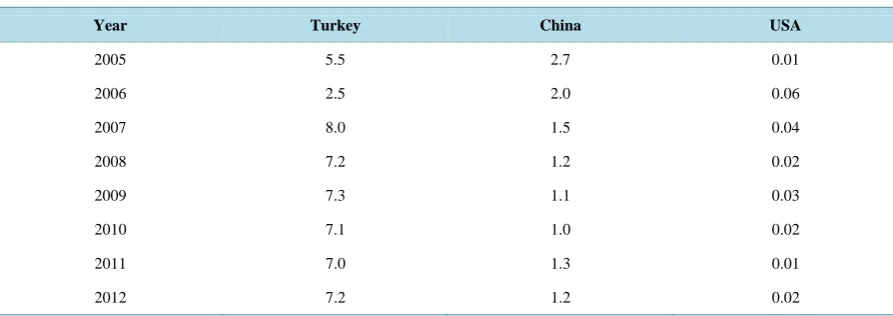
Table 1. Number of deaths per million tons of hard coal production.
Year Turkey China USA
2005 5.5 2.7 0.01
2006 2.5 2.0 0.06
2007 8.0 1.5 0.04
2008 7.2 1.2 0.02
2009 7.3 1.1 0.03
2010 7.1 1.0 0.02
2011 7.0 1.3 0.01
2012 7.2 1.2 0.02
hard coal production are analyzed, it is seen that the death rate in Turkey in the result of the occupational acci-dents in hard coal production was 6 times bigger than China and 360 times bigger than the USA. Death rates to be this much high in Turkey, which has only 0.3% of the world hard coal reserves, shows that the occupational accidents arises from lacking hardware and insufficient work safety, rather than intense production. And the workers in coalmine go down the ground every day despairingly by knowing this and continue working with no confidence. TTK’s policy of high performance with relevant cost triggers this process as well.
3. Organizational Levels
3.1. Organizational Burnout
The burnout syndrome took part in the literature for the first time by being used by Herbert J. Freudenberger in 1974 [6]. He defined burnout syndrome as a state of mental and physical exhaustion caused by one’s profes-sional life [7]. Maslach and Jackson [8] identified organizational burnout as a physical and mental syndrome that involved negative attitudes shown by people against their jobs, lives and other people with the states of physical exhaustion, long time tiredness, desperation and hopelessness. Sarros and Densten [9] defined burnout as a ma-ladaptive coping mechanism to working conditions that were stressful, demanding, or lacking sufficient chal-lenge and recognition [10]. And Pines & Aronson [11] defined burnout as a state of physical, emotional and mental exhaustion caused by long-term involvement in situations that were emotionally demanding [12]. But today, the most widely adopted definition for the “burnout” concept is the one identified by Christiba Maslach, who developed Maslach Burnout Inventory (MBI).
The burnout concept has three sub-dimensions of emotional exhaustion, depersonalization and lacking of personal achievement [13]. While Freudenberger dealt with the emotional exhaustion dimension of burnout, Maslach and Jackson analyzed all three dimensions. These dimensions were summarized below.
-Emotional Exhaustion: Exhaustion is the fundamental stress component of burnout representing a feeling of energy loss and a sense of being completely drained out of emotional and physical strength [14]. Conceptually, emotional exhaustion refers to chronic feelings of being overwhelmed and worn out because of one’s work [15].
-Depersonalization: Paris and Hoge [16] defined depersonalization as an unfeeling and impersonal response toward recipients of one’s service, care, treatment, or instruction. In other words, depersonalization refers to an impersonal and dehumanized perception of recipients, characterized by a callous, negative, and detached attitude [17]. This depersonalization gives rise to feelings of reduced personal accomplishments. Thus, job burnout pro- cess starting from emotional exhaustion ends at personal accomplishments through depersonalization [18].
-Reduced Personal Accomplishment is a decline in an individual’s feeling of competence and productivity within the work environment [19]. Personal accomplishment refers to a decline in one’s feelings of competence and successful achievement in one’s work with people [20]. Reduced personal accomplishment or feelings of inefficacy are prompted by a work situation with chronic, overwhelming demands that erodes one’s sense of ef-fectiveness [21].
levels of personal accomplishment engender burnout [23].
3.2. Organizational Commitment
One of the primary purposes of operations is getting more efficiency from employees by enhancing their skills and increasing their organizational commitment [24]. Affected by the factors such as fairness, satisfaction, job security, organizational communication, worker engagement and reliance to employees within the operation [25], the organizational commitment is also influenced by the factors such as self determination, support from work-fellows and manager/major, promotion, honouring by society, occupational hazard, routine and stress [26].
Cook & Wall [27] identified organizational commitment as the emotional response shown by people to prop-erties of the organization where they work. Meyer et al. [28] developed “Three Dimensional Commitment Mea- sure” consisting of continuance, emotional and normative commitment, and represented organizational com-mitment through these dimensions. O’Driscoll and Randall [29] described continuance commitment as a loyalty depending on the thought of bearing the cost in case of leaving of employment. Commeiras and Fournier [30] identified it as an obligation for employees arising from the costs related to leaving from organization. And emotional commitment is the dependence to organization with emotions like loyalty and love [31], in other words, it is the recognition of organizational aim, values and a strong faith along with the desire of maintaining the membership of the organization [32]. And the last commitment dimension is the normative commitment. This type of commitment is the obligation felt by employees to organization basing on personal values and norms [33] and as a result of the socialization in culture, employees to devote themselves to organization and their loyalty to corporation [34].
Allen and Mayer [35] expressed the commitment types in three dimensional commitment measure as the fol-lowing: employees with strong emotional commitment stay in the organization because they want to do this; employees with strong normative commitment stay in the organization because they ought to do this; employees with strong continuance commitment stay in the organization because they need to do this.
3.3. Job Performance
Job performance is an important factor in organizational practice and research [36]. Because it acts the main role in most personnel decisions such as merit-based compensation, promotion and retention of employees [37]. Especially nowadays, in order to be competitive in a rapidly changing economic and working environment, increasing job performance of employees and consequently the performances of companies has become more crucial [38].
Borman and Motowidlo [39] identified two types of employee behaviour that are necessary for organizational effectiveness: task performance and contextual performance [40]. Task performance refers to an individual’s proficiency with which he or she performs activities that contribute to the organization’s “technical core” [41]. In other words, task performance is an indicator of an employee’s talents, capability, and competence [42]. And contextual performance is defined as “behavioral patterns that support the psychological and social context in which task activities are performed” [43]. Contextual activities are important because they contribute to organizational effectiveness in ways that shape the organizational, social, and psychological context that serves as the catalyst for task activities and processes [44].
Employees working in manufacturing companies exert different levels, frequencies, and durations of the physical effort during performing their jobs [45]. Although their job performances depend on the collaboration and communication with co-workers [46], uncongenial workplace environment such as noisy (much on unfami-liar sound), too low or high temperature, stuffy office, lack of natural light or even cramped working space may affect their job performance [47].
3.4. Literature Review Related to Organizational Level
In a study they performed in Mpumalanga, Mclaggan, Bezuidenhout & Botha [48] analyzed leadership style and organizational commitment in a labor organization working in coal mining and found a positive relation between these two variables. In a study where they analyzed the relation between organizational burnout and occupational accidents in coal mining, Kowalski & Podlesny [49] carried out a research aimed at 154 employees and in conclusion, they determined that the occupational accidents encountered in mine caused moderate orga-nizational burnout. Talachi & Gorji [50] carried out a research on 12 workers, who work in coal mining, about burnout and work satisfaction and determined a negative relation between their organizational burnout and work satisfaction. In the study they performed on 85 workers who work in coal mining in Indonesia, Yusuf et al. [51] analyzed job performance and in the result of the study, they determined that organizational learning culture and organizational citizenship behaviour affected job performance positively. In a study they carried out, Meyer et al. [52] performed an application aimed at first level managers in a catering company, and in conclusion, they found a positive relation between job performance and emotional commitment. In a research carried out by Sa-lehi & Gholtash [53] by using Maslach and Jackson’s Maslach Burnout Inventory and Allen and Mayer’s com-mitment measure, it was determined that burnout levels of employees affected their organizational comcom-mitment. Güneş, Bayraktaroğlu & Kutanis [54] realized a research by using Maslach Burnout Inventory and found a neg-ative relation between burnout levels and organizational commitments of employees. In their study, Marmaya et al. [55] performed an analysis of affective commitment, continuance commitment and normative commitment, which are three sub-dimensions of organizational commitment, and organizational burnout upon 50 employees, and in the result of this study, they found that the affective commitment dimension of organizational commit-ment was the only one that affects organizational burnout. In the research they realized by using the sub-models of organizational burnout, Cropanzano, Rupp & Byrne [56] found a significant and negative relation between emotional burnout and job performance.
According to some researchers in the field of organizational behaviour, there is a permanent existence of a positive relation between job performance and organizational commitment [52]. However, some researchers in the literature put forth some findings on the contrary of this belief. One of them is the study made by Yiing & Ahmad [57]. Researching the effects of organizational culture in the relation between organizational commit-ment, job satisfaction and performance and the relation between leadership behaviour and organizational com-mitment, writers could not determine a significant relation between organizational commitment and job perfor-mance in the result of the research they did on 283 Malaysian people. The writers could not determine a positive relation between job performance and organizational commitment in the literature, and stated that the existing commitment and performance was due to economic conditions, absence of alternative jobs and psychology of unemployment.
4. Research Design and Methodology
4.1. Purpose of the Study
The aims of the study are determining the organizational burnout, job performance and organizational commit-ment levels of the underground and above ground workers who work in coal mining, and finding out the effects of the levels upon each other. In line with these purposes, a research was conducted intended for blue-collar em-ployees who work in the facilities of Turkish Hardcoal Enterprise (TTK).
4.2. Data Gathering Method and Hypotheses of the Research
Hypotheses Intended for Casual Workers;
H1a: There is a significant relation between organizational burnout and job performance of casual workers.
H1b: There is a significant relation between organizational burnout and organizational commitment of casual
workers.
H1c: There is a significant relation between organizational commitment and job performance of casual
workers.
Hypotheses Intended for Technical Staff;
H1e: There is a significant relation between organizational burnout and job performance of technical staff.
H1f: There is a significant relation between organizational burnout and organizational commitment of
technical staff.
H1g: There is a significant relation between organizational commitment and job performance of technical
staff.
Hypotheses Intended for Engineers;
H1j: There is a significant relation between organizational burnout and job performance of engineers.
H1k: There is a significant relation between organizational burnout and organizational commitment of
engineers.
H1m: There is a significant relation between organizational commitment and job performance of engineers.
Difference Hypotheses;
H1a: There is a significant difference between working places and job performance.
H1b: There is a significant difference between working position and job performance.
H1c: There is a significant difference between working location and job performance.
H1d: There is a significant difference between working application and job performance.
H1e: There is a significant difference between working places and organizational burnout.
H1f: There is a significant difference between working location and organizational burnout.
H1g: There is a significant difference between working application and organizational burnout.
H1h: There is a significant difference between working position and organizational burnout. 4.3. Analysis of Data
SPSS 20.0 (Statistical Package for Social Sciences) program was used for the statistical analyses, while evaluat-ing the findevaluat-ings obtained in the study. Reliability analysis was carried out for the determination of research da-ta’s reliability. For the determination of the effects and the direction of the relation between variables, Correla-tion and Regression Analyses, and for the determinaCorrela-tion of the differences between variables, one-way analysis and independent-samples T-test were used in the study.
4.3.1. Reliability Analysis
Alpha coefficient (cranbach’s alpha) was used for testing the reliabilities of the scales used in the research. The alpha coefficient was found as 0.851 in the result of the reliability analysis.
4.3.2. Correlation Analysis
Pearson Correlation Coefficient (r) is used in scaling of direction and strength of a linear relationship between two variables. There are three working positions in the study, which are casual worker, technical staff and engi-neer. Differentiated correlation analysis according to each working positions is as below.
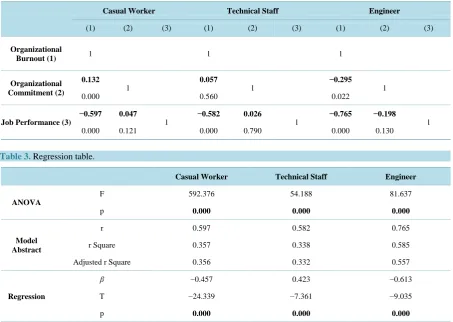
In the result of the correlation analysis performed; a relation between organizational burnout and job perfor-mance for casual workers was found at moderate level (r = 0.597), for technical staff at moderate level (r = 0.582) and for engineers at high level (r = 0.765) of significance. A relation between organizational burnout and organizational commitment for workers was found at low level (r = 0.132), and for engineers at low level (r = 0.295) of significance. And for technical staff, any significant relation was not found between organizational burnout and organizational commitment (Sig. > 0.05). In addition, any significant relation was not found be-tween organizational commitment and job performances for casual workers, technical staff and engineers (Sig. > 0.05) (Table 2).
4.3.3. Regression Analysis
dependent variable. There are three working positions in the research, which are casual worker, technical staff and engineer. The differentiated regression analyses according to each working position were stated in the table below.
The statistical significance value of F, which takes part in ANOVA table, must be under 0.05 (p < 0.05) for regression model to be statistically effective. Accordingly, it is understood that the regression analyses to be es-tablished in the research were statistically significant (Table 3).
According to the data in Table 3, the values that job performance may take for casual workers, technical staff and engineers can be formulated as below;
(Casual Worker) “Job Performance = 9.345 − (0.457 × Organizational Burnout)” (Technical Staff) “Job Performance = 10.336 − (0.423 × Organizational Burnout)” (Engineer) “Job Performance = 6.111 − (0.613 × Organizational Burnout)”
In the model, it is understood that 1 unit of increase in the organizational burnout level of casual workers re-sulted in 0.457 unit of decrease in their job performance, 1 unit of increase in the organizational burnout level of technical staff resulted in 0.423 unit of decrease in their job performance, and 1 unit of increase in the organiza-tional burnout level of engineers resulted in 0.613 unit of decrease in their job performance.
4.3.4. One-Way Analysis
One-way ANOVA test is used for testing the hypotheses in relation to whether differences between the averages of two or more groups are significant or not.
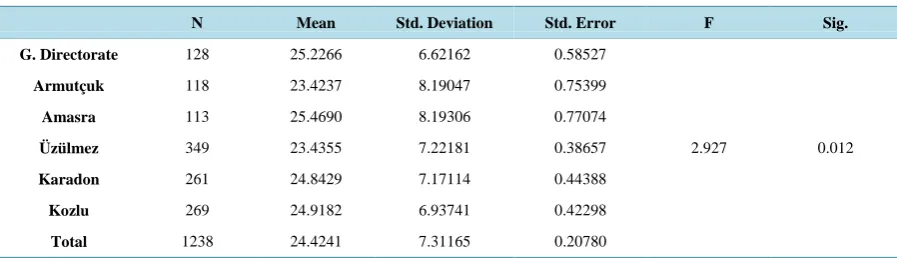
[image:7.595.87.541.400.722.2]According to Table 4, while the job performances of the workers in Amasra Enterprise are at the top level (25.4690), the job performances of the workers in Armutçuk Enterprise are at the lowest level (23.4237). Ac-cording to the result of the F test performed at 95% of confidence level, the significance value for job perfor-mance was found as p = 0.012 < 0.05. Hereunder, the job perforperfor-mances show a significant difference according to working places.
Table 2.Correlation table.
Casual Worker Technical Staff Engineer
(1) (2) (3) (1) (2) (3) (1) (2) (3)
Organizational
Burnout (1) 1 1 1
Organizational Commitment (2)
0.132
1
0.057
1
−0.295
1
0.000 0.560 0.022
Job Performance (3)
−0.597 0.047
1
−0.582 0.026
1
−0.765 −0.198
1
0.000 0.121 0.000 0.790 0.000 0.130
Table 3.Regression table.
Casual Worker Technical Staff Engineer
ANOVA
F 592.376 54.188 81.637
p 0.000 0.000 0.000
Model Abstract
r 0.597 0.582 0.765
r Square 0.357 0.338 0.585
Adjusted r Square 0.356 0.332 0.557
Regression
β −0.457 0.423 −0.613
T −24.339 −7.361 −9.035
According to Table 5, while the job performances of the engineers are at the top level (25.8833), the job per-formances of the technical staff are at the lowest level (23.6759). According to the result of the F test performed at 95% of confidence level, the significance value of job performance was found as p = 0.172 > 0.05. Hereunder, the job performances do not show a significant difference according to working positions.
According to Table 6, while the organizational burnout of the employees in Amasra Enterprise is at the top level (36.0000), the organizational burnout of the employees in Armutçuk Enterprise is at the lowest level (31.6949). According to the result of the F test performed at 95% of confidence level, the significance value for job performance was found as p = 0.002 < 0.05. Hereunder, the organizational burnout levels of workers show a significant difference according to working places.
According to Table 7, while the organizational burnout level of casual workers is at the top level (32.9981),
Table 4.One-way analysis intended for H1a hypothesis.
N Mean Std. Deviation Std. Error F Sig.
G. Directorate 128 25.2266 6.62162 0.58527
2.927 0.012
Armutçuk 118 23.4237 8.19047 0.75399
Amasra 113 25.4690 8.19306 0.77074
Üzülmez 349 23.4355 7.22181 0.38657
Karadon 261 24.8429 7.17114 0.44388
Kozlu 269 24.9182 6.93741 0.42298
Total 1238 24.4241 7.31165 0.20780
Table 5.One-way analysis intended for H1b hypothesis.
N Mean Std. Deviation Std. Error F Sig.
Casual Worker 1070 24.4178 7.35536 0.22486
1.763 0.172
Technical Staff 108 23.6759 6.76001 0.65048
Engineer 60 25.8833 7.38549 0.95346
[image:8.595.88.537.230.359.2]Total 1238 24.4241 7.31165 0.20780
Table 6.One-way analysis intended for H1e hypothesis.
N Mean Std. Deviation Std. Error F Sig.
G. Directorate 128 32.5703 8.57086 0.75756
3.935 0.002
Armutçuk 118 31.6949 10.07452 0.92743
Amasra 113 36.0000 8.90225 0.83745
Üzülmez 349 31.9026 10.93485 0.58533
Karadon 261 32.5594 8.66610 0.53642
Kozlu 269 33.6171 8.72156 0.53176
[image:8.595.88.540.643.723.2]Total 1238 32.8368 9.57399 0.27210
Table 7.One-way analysis intended for H1f hypothesis.
N Mean Std. Deviation Std. Error F Sig.
Casual Worker 1070 32.9981 9.61835 0.29404
1.218 0.296
Technical Staff 108 31.5648 9.30307 0.89519
Engineer 60 32.2500 9.21058 1.18908
the organizational burnout level of the technical staff is at the lowest level (31.5648). According to the result of the F test performed at 95% of confidence level, the significance value of job performance was found as p = 0.296 > 0.05. Hereunder, the burnout levels of workers do not show a significant difference according to their working positions.
4.3.5. Independent-Samples T-Tests
Independent-samples T-test is a method used in the comparison of the measurements of both groups. The data related to the test of the H1c, H1d, H1g and H1h hypotheses through this method is as below.
In Table 8, in the result of the test performed on H1c, H1d, and H1h hypotheses at 95% confidence level, the
significance levels of these hypotheses were found bigger than 0.05 and the significance level of H1g hypothesis
was found under 0.05. Accordingly, the job performances of blue-collar workers working within the facilities of TTK do not show a significant difference according to working locations (underground or above ground) and working practice (in-shift or shiftless). And the organizational burnout levels of the blue-collar workers working within the facilities of TTK show a significant difference according to their working locations (underground or above ground), however they do not show a significant difference according to working practice (in-shift or shiftless).
5. Conclusions
The aims of our study, with the theme of the correlation analytic of blue-collar workers’ organizational levels in coal mining, are determining the organizational burnout, job performance and organizational commitment levels of the employees working in coal mining and revealing the interactions of these levels. In the result of the quota sampling in Turkish Hard Coal Enterprise depending upon this purpose, a research intended for 1238 blue-collar workers was performed.
98.3% of the blue-collar workers who involved in the study were men, and 1.7% was women. When their age distributions were analyzed, it was determined that a majority of 42.2% of the sampling were at the age range of 31 - 40, 26.7% were 40 and above, and 31.1% were under the age of 30. These statistics show that the blue-col- lar workers in the coal enterprise analyzed were young and in a dynamic structure. This assessment is particu-larly an important factor for the burnout analysis of employees.
When the educational backgrounds of the blue-collar workers were analyzed, it was seen that only 9.9% of 1238 employees were higher education graduates, 40.2% were primary education graduates, and 49.8% were high school graduates. The lowness of educational background complicates the comprehension of plans and policies and consciousness raising in coal mining management. This also speeds up the transaction from formal into informal structure in management and distorts the aims and targets requested.
When work practice was analyzed, it was determined that 68.9% of 1238 workers worked in-shift and 31.1% worked shiftless. And the work locations of these workers were 76% underground and 24% above ground. Con-sidering their working positions, 86.4% of the employees stated that they were casual workers, 8.7% were tech-nical staff and 4.8% were engineers. These statistics strengthened the aim of the study. Employees working be-low ground, who provide the main production, to have a share of 76% in the research enables a better analysis of results and suggestions.
In the result of the analysis of organizational burnout, one of the variables in the study, with regards to work-ing places, it was determined the highest and lowest organizational burnout levels were in Amasra and Ar-
Table 8.Independent T-test related to H1c hypothesis.
Levene’s Test for Equality of
Variances T-Test for Equality of Means
F Sig. t df Sig. (2-tailed) Mean Difference Std. Error Difference
H1c 0.686 0.408 0.291 1236 0.771 0.14153 0.48681
H1d 1.088 0.297 −1.670 1236 0.095 −0.74917 0.44860
H1g 0.002 0.961 2.309 1236 0.021 1.46862 0.63609
mutçuk Enterprises respectively. And when the job performance criterion is analyzed, it was determined again that the establishments with highest and lowest job performances were Amasra and Armutçuk Enterprises re-spectively. Even if this creates a contrast perception, it is a usual case as it epitomizes in literature researches. The relation between organizational burnout and job performance is not always inversely proportional. The di-rection of this relation depends upon the structure of the connection between employee and organization. In the research carried out, it was seen that 25.9% of the blue-collar workers went to work reluctantly, 24% did not have sense of belonging to the organization, and only 16.9% have the intent of leaving the job. With this, the di-rect proportion between job performance and organizational burnout can be stated clearly. The job performances of the blue-collar workers within the body of TTK have an impact on their organizational burnout levels. The performance policies have an important role in the development of such a situation. Here, it is seen that the rea-sons for burnout of the workers do not result from the formation of cowed individuals. The above state of bur-nout is related to the work tempo of the employees and the heaviness of the job worked. 43.5% of the blue-collar workers to mention that they were affected by the working conditions directly also support this result.
Another data evaluated in the research is the tendency to teamwork. 72.3% of the blue-collar workers told that they could work in conformity with their workfellows. This is statistically positive with regards to aims and tar-gets of the organization. Employees under heavy working conditions not to spend their energy to social polari-zation affects positively to the performance requested. However, 66% of employees to be afraid of getting healthwise harm were determined as a static factor that slows down the workflow with its negative effect upon working psychologies of the employees.
In the result of discriminant analyses performed within the scope of the research, it was determined that the job performances of the blue-collar workers varied according to their working places, but did not vary according to their working positions (casual worker, technical staff or engineer), working locations (underground or above ground) and working practice (in-shift or shiftless). In addition, it was determined that organizational burnout levels of the employees varied according to working places and working locations (underground or above ground), but did not vary according to working position (casual worker, technical staff or engineer) and working practice (in-shift or shiftless).
In the result of the researches carried out, a relation was not determined between organizational commitment and burnout and job performance. Considering that 45.9% of 1283 blue-collar workers felt sense of belonging to the establishment they worked, it was determined that there was organizational commitment in the establishment, however, this commitment did not decrease with the organizational burnout or the job performance did not in-crease with the inin-crease in commitment. This shows that the employees of the establishment have a sense of be-longing independent from the organizational climate. The reason for this may be it is the best job opportunity in the region considering the educational backgrounds of people, as well as the emotional commitment of a genera-tion grew with mining. No matter its different reasons, employees to have a commitment, independent of orga-nizational climate, are important for the establishment. Particularly, the factors that take people off cynicism have a great influence on the organizational commitment. So, a decrease in the organizational commitment trig-gers the intent of leaving the job. The constant cease of employment and new worker recruitments both hinder the production and create problems with regards to job security. While training and adaptation of a new worker cause a decrease in production, the hazard dimension that can be caused by an inexperienced worker in mine is unclear. Considering in this respect, the existence of an imperative and/or emotional commitment is seen as a positive situation for the operation of the organization. However, considering with regards to performance, it was seen as a negative situation, the type of commitment felt not to affect the performance.
Further Study
In this study, the relations among organizational burnout, job performance and commitment levels were tried to be determined for blue-collar workers in coal mining. However, a comparison for organizational level could not be made due to nonbeing of another study with equivalent content in the literature. So making an international comparison intended for employees in coal mining will be possible and the organizational climates of mines in different countries and the organizational levels of employees will be able to be correlated with researches that will be carried out in coalmines in the future to involve sufficient organizational magnitude and with the analysis of data in detail.
References
[1] Hard Coal Report (2010) Chamber of Mining Engineers of Turkey. http://www.maden.org.tr/resimler/ekler/0f88bfbf93f5078_ek.pdf
[2] TWBG (2007) Coal Mining and Production.
http://www.ifc.org/wps/wcm/connect/79a98080488552b5ac5cfe6a6515bb18/coal_PPAH.pdf?MOD=AJPE RES
[3] TTK (2013) Hard Coal Sector Report.
http://www.enerji.gov.tr/File/?path=ROOT%2F1%2FDocuments%2FSayfalar%2F2012+Y%C4%B1l%C4%B1+ Sekt%C3%B6r+Raporu+(TTK).pdf
[4] Ünalan, G. (2003) General Evaluation of Energy Resources of Turkey. Geotogicat Engineering Journal, 27, 17-44. [5] Korkmaz, O. (2011) The Relationship between Work Accident and Productivity: A Case Study in Turkish Hard Coal
Enterprise. Journal of Yasar University, 23, 3805-3813.
[6] Dargah, G.D. and Estalkhbijari, Z.P. (2012) The Relationship between the Big Five Personality Factors and Job Burn- out. International Journal of Asian Social Science, 11, 1842-1850.
[7] Kraft, U. (2006) The Burned Out. Scientific American Mind, June/July, 28-33.
[8] Maslach, C. and Jackson, S.E. (1981) The Measurement of Experienced Burnout. Journal of Occupatıonal Behavıour,
2, 99-113. http://dx.doi.org/10.1002/job.4030020205
[9] Sarros, J.C. and Densten, I.L. (1989) Undergraduate Student Stress and Coping Strategies. Higher Education Research and Development, 8, 47-57. http://dx.doi.org/10.1080/0729436890080105
[10] Campagne, D.M. (2012) When Therapısts Run out of Steam: Professİonal Boredom or Burnout? Revista de Psico- patología y Psicología Clínica, 17, 75-85. http://dx.doi.org/10.5944/rppc.vol.17.num.1.2012.10370
[11] Pines, A.M. and Aronson, E. (1988) Career Bumout: Causes and Cures. Free Press, New York.
[12] Enzmann, D., Schaufeli, W.B., Janssen, P. and Rozeman, A. (1998) Dimensionality and Validity of the Burnout Mea- sure. Journal of Occupational and Organizational Psychology, 71, 331-351.
http://dx.doi.org/10.1111/j.2044-8325.1998.tb00680.x
[13] Katyal, S. (2013) Burnout among Nurses Working in Government and Private Hospitals. Studies on Home and Com- munity Science, 7, 83-85.
[14] Nagar, K. (2012) Organizational Commitment and Job Satisfaction among Teachers during Times of Burnout. Vıkalpa,
37, 43-60.
[15] Fiksenbaum, L., Marjanovic, Z., Greenglass, E.R. and Coffey, S. (2006) Emotional Exhaustion and State Anger in Nurses Who Worked during the SARS Outbreak: The Role of Perceived Threat and Organizational Support. Canadian Journal of Community Mental Health, 25, 89-103. http://dx.doi.org/10.7870/cjcmh-2006-0015
[16] Paris, M. and Huge, M. (2010) Burnout in the Mental Health Workforce: A Review. The Journal of Behavioral Health Services & Research, 37, 519-528. http://dx.doi.org/10.1007/s11414-009-9202-2
[17] Salanova, M., Llorens, S., García-Renedo, M., Burriel, R., BresÓ, E. and Schaufeli, W.B. (2005) Towards a Four-Di- mensional Model of Burnout: A Multigroup Factor-Analytic Study Including Depersonalization and Cynicism. Edu- cational and Psychological Measurement, 65, 807-819. http://dx.doi.org/10.1177/0013164405275662
[18] Ullah, S. (2012) Behavioral Troubles for the Newcomer Doctors in the Public Sector Hospitals of Pakistan. Asian Jour- nal of Health, 2, 1-15. http://dx.doi.org/10.7828/ajoh.v2i1.115
[19] Principal, P. and Chhabra, U. (2012) A Study of Burnout among Secondary School Teachers in Relation to Their Emo- tional Intelligence and Organizational Commitment. International Journal of Computer Science and Communication En- gineering, 2, 54-60.
16, 501-510. http://dx.doi.org/10.1080/08870440108405523
[21] Emmerik, H.V., Jawahar, I.M. and Stone, T.H. (2005) Associations among Altruism, Burnout Dimensions and Orga- nizational Citizenship Behaviour. Work & Stress, 19, 93-100. http://dx.doi.org/10.1080/02678370500046283
[22] Dorman, J. (2003) Testing a Model for Teacher Burnout. Australian Journal of Educational & Developmental Psy- chology, 3, 35-47.
[23] Knani, M. and Fournier, P.S. (2013) Burnout, Job Characteristics, and Intent to Leave: Does Work Experience Have Any Effect. Journal of Emerging Trends in Economics and Management Sciences, 4, 403-408.
[24] Özler, D.E., Atalay C.G. and Şahin, M.D. (2010) Örgütlerde Sinizm Güvensizlikle Mi Bulaşır? Organizasyon ve Yöne- tim Bilimleri Dergisi, 2, 47-57.
[25] McShane, S.L. and Von Glinow, M.A. (2003) Organizational Behaviour. International Edition, McGraw-Hill Education, New York.
[26] Siğri, Ü. and Basım, N. (2006) İş Görenlerin İş Doyumu İle Örgütsel Bağlılık Düzeylerinin Analizi: Kamu ve Özel Sektörde Karşılaştırmalı Bir Araştırma. Selçuk Üniversitesi İktisadi ve İdari Bilimler Fakültesi Sosyal ve Ekonomik Araştırmalar Dergisi, 12, 131-154.
[27] Cook, J. and Wall, T. (1980) New Work Attitude Measures of Trust, Organizational Commitment and Personal Need Non-Fulfilment. Journal of Occupational Psychology, 53, 39-52.http://dx.doi.org/10.1111/j.2044-8325.1980.tb00005.x [28] Meyer, J.P., Stanley, D.J., Herscovitch, L. and Topolnytsky, L. (2002) Affective, Continuance, and Normative Com-
mitment to the Organization: A Meta-Analysis of Antecedents, Correlates, and Consequences. Journal of Vocational Be- havior, 61, 20-52. http://dx.doi.org/10.1006/jvbe.2001.1842
[29] O’Driscoll, M.P. and Donna, M.R. (1999) Perceived Organisational Support, Satisfaction with Rewards, and Employee Job Involvement and Organisational Commitment. Applied Psychology: An International Review, 48, 197-209. [30] Commeiras, N. and Fournier, C. (2001) Critical Evaluation of Porter et al.’s Organizational Commitment Questionnaire:
Implications for Researchers. Journal of Personal Selling & Sales Management, 17, 239-245.
[31] Chang, E. (1999) Career Commitment as a Complex Moderator of Organizational Commitment and Turnover Intention.
Human Relations, 52, 1257-1278. http://dx.doi.org/10.1177/001872679905201002
[32] Fu, F.Q., Bolander, W. and Jones, E. (2009) Managing the Drivers of Organizational Commitment and Salesperson Ef- fort: An Application of Meyer and Allen’s Three-Component Model. Journal of Marketing Theory and Practice, 17, 335-350. http://dx.doi.org/10.2753/MTP1069-6679170403
[33] Karim, N.H. and Noor, N.H. (2006) Evaluating The Psychometric Properties of Allen and Meyer’s Organizational Commitment Scale: A Cross Cultural Application among Malaysian Academic Librarians. Malaysian Journal of Li- brary & Information Science, 11, 89-101.
[34] Prabhakar, G.V. and Ram, P. (2011) Antecedent HRM Practices for Organizational Commitment. International Jour- nal of Business and Social Science, 2, 55-62.
[35] Allen, N.J. and Meyer, J.P. (1990) The Measurement and Antecedents of Affective, Continuance and Normative Com- mitment to the Organization. Journal of Occupational Psychology, 63, 1-18.
http://dx.doi.org/10.1111/j.2044-8325.1990.tb00506.x
[36] Scullen, S.E., Mount, M.K. and Goff, M. (2000) Understanding the Latent Structure of Job Performance Eatings. Jour- nal of Applied Psychology, 85, 54-60. http://dx.doi.org/10.1037/0021-9010.85.6.956
[37] Shamsuddin, N. and Rahman, R.A. (2014) The Relationship between Emotional Intelligence and Job Performance of Call Centre Agents. Procedia-Social and Behavioral Sciences, 129, 75-81.
http://dx.doi.org/10.1016/j.sbspro.2014.03.650
[38] Yozgat, U., Yurtkoru, S. and Bilginoğlu, E. (2013) Job Stress and Job Performance among Employees in Public Sector in Istanbul: Examining the Moderating Role of Emotional Intelligence. Procedia-Social and Behavioral Sciences, 75, 518-524. http://dx.doi.org/10.1016/j.sbspro.2013.04.056
[39] Borman, W.C. and Motowidlo, S.J. (1993) Expanding the Criterion Domain to IncludeElements of Contextual Per- formance. In: Schmitt, N. and Borman, W.C., Eds., Personnel Selection in Organizations, Wiley, New York, 71-98.
[40] Jankingthong, K. and Rurkkhum, S. (2012) Factors Affecting Job Performance: A Review of Literature. Silpakorn Uni- versity Journal of Social Sciences, Humanities, and Arts, 12, 115-127.
[41] Muchhal, D.S. (2014) HR Practices and Job Performance. Journal of Humanities and Social Science, 19, 55-61. [42] Yun, S., Takeuchi, R. and Liu, W. (2007) Employee Self-Enhancement Motives and Job Performance Behaviors: In-
vestigating the Moderating Effects of Employee Role Ambiguity and Managerial Perceptions of Employee Com- mitment. Journal of Applied Psychology, 92, 745-756. http://dx.doi.org/10.1037/0021-9010.92.3.745
[44] Borman, W.C. and Motowidlo, S.J. (1997) Task Performance and Contextual Performance: The Meaning for Personnel Selection Research. Human Performance, 10, 99-109. http://dx.doi.org/10.1207/s15327043hup1002_3
[45] Kahya, E. (2007) The Effects of Job Characteristics and Working Condition on Job Performance. International Journal on Industrial Ergonomics, 37, 515-523. http://dx.doi.org/10.1016/j.ergon.2007.02.006
[46] Mansi, G. and Levy, Y. (2013) Do Instant Messaging İnterruptions Help or Hinder Knowledge Workers’ Task Per- formance? International Journal of Information Management, 33, 591-596.
http://dx.doi.org/10.1016/j.ijinfomgt.2013.01.011
[47] Rahman, A. and Badayai, A. (2012) Theoretical Framework and Analytical Discussion on Uncongenial Physical Workplace Environment and Job Performance among Workers in Industrial Sectors. Procedia-Social and Behavioral Sciences, 42, 486-495. http://dx.doi.org/10.1016/j.sbspro.2012.04.214
[48] Mclaggan, E., Bezuidenhout, A. and Botha, C.T. (2013) Leadership Style and Organisational Commitment in the Mining Industry in Mpumalanga. SA Journal of Human Resource Management, 11, 483-492.
http://dx.doi.org/10.4102/sajhrm.v11i1.483
[49] Kowalski, K.M. and Podlesny, A. (2000) The Effects of Disaster on Workers: A Study of Burnout in Investigators of Serious Accidents and Fatalities in the US Mining Industry. National Institute for Occupational Safety and Health, Pennsylvania.
[50] Talachi, R.K. and Gorji, M.B. (2013) Job Burnout and Job Satisfaction among Industry, Mine and Trade Organization Employees: A Questionnaire Survey. International Journal of Academic Research in Business and Social Sciences, 3, 21-41. http://dx.doi.org/10.6007/IJARBSS/v3-i7/7
[51] Yusuf, R.M., Hamid, N., Eliyana, A., Bahri, S. and Sudarisman, A. (2012) The Antecedents of Employee’s Per- formance: Case Study of Nickel Mining’s Company, Indonesia. Journal of Business and Managements, 2, 22-28. [52] Meyer, J.P., Paunonen, S.V., Gellaty, I.R., Goffin, R.D. and Jackson, D.N. (1989) Organizational Commitment and Job
Performance: It’s the Nature of the Commitment That Counts. Journal of Applied Psychology, 74, 152-156. http://dx.doi.org/10.1037/0021-9010.74.1.152
[53] Salehi, M. and Gholtash, A. (2011) The Relationship between Job Satisfaction, Job Burnout and Organizational Com- mitment with the Organizational Citizenship Behavior among Members of Faculty in the Islamic Azad University-First District Branches, in Order to Provide the Appropriate Model. Procedia Social and Behavior Sciences, 15, 306-310. http://dx.doi.org/10.1016/j.sbspro.2011.03.091
[54] Güneş, İ., Bayraktaroğlu, S. and Kutanis, R.Ö. (2009) A Relationship on Organizational Commitment of Emploless and Burnout Level: Sample from a State University, Suleyman Demirel University. The Journal of Faculty of Eco- nomics and Administrative Sciences, 143, 481-497.
[55] Marmaya, N.H., Zawawi, N., Hitam, M. and Jody, J.M. (2011) Organizational Commitment and Job Burnout among Employees in Malaysia. International Conference on Business and Economics Research, 1, 185-197.
[56] Cropanzano, R., Rupp, D.E. and Byrne, Z.S. (2003) The Relationship of Emotional Exhaustion to Work Attitudes, Job Performance, and Organizational Citizenship Behaviors. Journal of Applied Psychology, 88, 160-169.
http://dx.doi.org/10.1037/0021-9010.88.1.160
[57] Yiing, L.H. and Ahmad, K.Z.B. (2009) The Moderating Effects of Organizational Culture on the Relationships be- tween Leadership Behaviour and Organizational Commitment and between Organizational Commitment and Job Satis- faction and Performance. Leadership & Organization Development Journal, 30, 53-86.