© 2017, IRJET | Impact Factor value: 5.181 | ISO 9001:2008 Certified Journal
| Page 1279
Study on Compressed Stabilized Earth Block
Shivnath Jangid1, Milind Darade2
1Post-Graduation Student Civil Engineering Department Savetribai Phule, Pune University
Dr. D Y Patil School of Engineering, Lohegaon Pune Maharashtra 412105, India
2Assistant Professor Civil Engineering Department, Savetribai Phule, Pune University
Dr. D.Y. Patil School of Engineering, Lohegaon, Pune Maharashtra 412105, India.
---***---Abstract
The Present Study is used to analysis the soil which is better for stabilized earth block. The Engineering behaviour of Compress stabilized sand block (CSSB) such as compression strength, durability, water absorption etc. are depends on the types of soil and stabilized material as binder. Here the soil will be mixed with suitable proportion of stabilized such as lime, fly ash, cement , coir and Chemicals will be compressed manually or mechanically From literature review it find that by adding different stabilizer in soil upto some fixed proportion will increase technical properties of soil block. The Block produced will have more strength than conventional burnt clay brick. Soil tested and regarded as favourable for CSSB on the basis of density index which manufacture by Block Cotton Soil. It Concluded that the soil have more Compressive strength than normal brick but cannot satisfy the Condition of water absorption.
Keyword: Brick by using Black cotton soil, Brick by using Stabilizer, CSEB.
Introduction
Earth is an ancient building material that has been used in many different ways around the world for thousands of years. A large part of the world’s rural population (55%) still
lives in earth building (5 Kabiraj, Mandal, 2012). But earth
building is not a phenomenon only of the developing world. Many developed countries like France, Australia, and many other European as well as Asian countries, a remarkable percentage of rural population still prefer to live in earthen
buildings (7 Heathcote, 2002). Building with earth materials
can be a way of helping with sustainable management of the Earth’s resources. They can be put in place using simple machinery and human energy. Earth building avoid deforestation and pollution, and can archive low energy costs throughout their lifetime – in the initial manufacture and construction in their use as homes, and eventually in their recycling back to the earth. Many people also value earth construction for its aesthetic qualities.
1.2 Compressed Stabilized Earth Block (CSEB) Bricks
In everyday conversation, the word brick and block sometimes refer to the same object and has ambiguity. The definition of brick and block depend upon the country of origin but British Standard BS 3921: 1985 defines a clay brick as “a masonry unit not exceeding 337.5mm in length, 225mm in thickness (referred to us width in one of the standard) or 112.5mm in height”. As for block, BS 6073: part 1: 1981 Pre-cast concrete masonry units defines a block as “a masonry unit which, when used, in its normal aspect exceeds the length or width or height specified for brick”, CDI (Compressed Earth Blocks,1998)defined composed earth as “ masonry element principally made of raw earth, which are small in size and which have regular and verified characteristic obtained by the static or dynamic compression of earth in a humid state
followed by immediate remoulding” (4Morris 2000) even give
lighter definition for brick and block as a small masonry unit, which can be lift with one hand and a large masonry unit, which can be lift with two hands. The soil, raw or stabilized, for a compressed earth block is slightly moistened, poured into a steel press (with or without stabilizer)and then compressed
either with a manual or motorized press ( 8M. Zami 2007).
The new development of earth construction really started in the nineteen fifties, with the technology of the Compressed Stabilized Earth Blocks (CSEB): a research programmed for affordable houses in Colombia proposed the first manual press the CINVA ram. Since then, considerable scientific researches has been carried out by laboratories
(2Guilaud, 1985).The knowledge of soil laboratories concerning
road building was adapted to earth construction. Since 1960-1970, Africa has been seen the widest world development for CSEB. India developed CSEB Technology only in the nineteen eighty’s, but sees today a wider dissemination and
© 2017, IRJET | Impact Factor value: 5.181 | ISO 9001:2008 Certified Journal
| Page 1280
2 Selection of material2.1 Selection of Soil
Earth as a construction material has been used for thousands of year by Civilisation all over world. But the structure made of earth have less durability, strength & get eroded by water and wind gradually; therefore, they require regular maintenance. In order to overcome all these limitations, methods derived from traditional techniques are developed to improve the quality of earth construction and broaden potential for its application.
According to (9 Walker 2003) generally the range of
different properties are classified LL – (47-93%), PL-(26-50%), PI (13-58%) and LS-(8-18%), Black cotton Soil is largely available in Maharashtra and therefore this study’s aims to evaluate the potential of Black Cotton Soil in CSEB bricks manufacturing industry. From the above Literature and the result of tests conducted on Black Cotton Soil that is proposed to be used in current investigation, it is found that the index properties of Black Cotton soil are fairly agreeable with the literature, so as to use in CSEB bricks.
River slit was tests but the plasticity index that is obtained is very less as compared to plasticity range (i.e. 13% to 58%) given by literature. It was found to be plasticity index was 7.17% River is not available easily as it is obtained only where there is river.
2.2 Selection of stabilizer- The Selection of stabilizer is mainly depends on the properties of soil as Follow.
1. Durability – Durability mainly deals with the ability of structure of withstand in its whole-life against the destructive action or natural hazards. Rain and Frost are main destructive force which causes the degradation of soil structure. So to accelerate durability & strength stabilizer must be used together with soil in different composition.
2. Shrinkage and swelling – After conducting the different test on Black Cotton Soil, red soil and river silt, Black Cotton Soil was selected for the current investigation. Shrinkage and swelling are two main hitches which takes place in Black
Cotton Soil (6Osinubi, 2011). When it comes in contact with
water soil swells and when water content reduces, soil tends to shrinks. Maximum permissible linear shrinkage of 3% is permitted in any soil but Black Cotton Soil has linear shrinkage of 13%. Hence to overcome this objection stabilization process is required. Stabilizers are the materials which are added to soil to improve the quality of soil.
Different stabiliser such as fly ash, coir, lime and chemical (NaOH and NaSiO3) are used to improve strength and erosion resistance property of the block.
3 Plan of project work
3.1. Collection of literature –Literature is important deed which includes thesis, books, investigation reports, and research papers. There are helpful in selecting proper type of
soil according to its property required for making block. It also helps to find out different stabilizer which is good for different condition of soil. These literatures are collected from internet, books, seminar reports & project reports.
3.2 Selection of material –By making in mind all the important properties of materials for manufacturing of blocks the selection of materials was done. Black Cotton Soil, lime, fly ash, coir, & Chemicals which increase density & durability of soil were selected for the production of block.
3.3 Collection of material
The BLACK COTTON SOIL is taken from field of
Pimprala and Faizpur of Jalgaon district.
Fly ash is taken from Deepnagar, Bhusawal which is
thermal power station producing electricity.
Coir is waste product of coconut and obtained from
furnishing shop.
Lime is purchased from local help
Chemical are purchased from local chemical shop and
prepared in laboratory by standard procedure which is discussed later in detail.
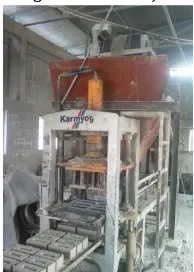
3.4 Machine – Many machines and manufacturing procedure of different block are examined at different places in Jalgaon city and nearby area, like Khotenagar, V- sector and F- sector of MIDC, Jalgaon. Out of these, a Hydraulic pressure of Rakesh Bricks Industries, 192 V-sector, MIDC, Jalgaon was chosen. This machine can impart pressure of 3 tonne and manufacture six blocks at a time. The machine is an indigenous type, make of Karmyog Manufacturing Industries, Gujarat.
Fig. 1 Hydraulic Compression Machine
3.5 Mixing and Batching –In batching process the content of stabilizer are varied from 5% to 15% and up to 30% Lime alone do not give advisable strength, hence coir is added along with lime and also along chemical to improve strength of block. Fly ashes itself have cohesive property. So it is use along and also with chemicals to improve strength of block. This all materials according to their proportions are kept in bag and utilise at time of dry mixing process.
[image:2.595.388.485.464.600.2]© 2017, IRJET | Impact Factor value: 5.181 | ISO 9001:2008 Certified Journal
| Page 1281
water will be added slowly into dry mixing by keeping liquid limit and plastic limit test carried out into laboratory. Later than wet mixture is carry on mould and Hydraulic pressure will apply according to requirement in block are comes out from machine and going further next step.
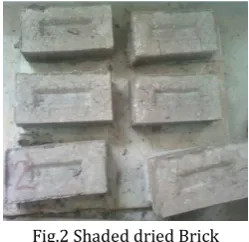
[image:3.595.95.220.209.330.2]3.7. Drying- After making block, it place in shed for drying process because crack are take place on block. This crack arises due to rapid loss of water from block and quick shrinkage.
Fig.2 Shaded dried Brick
3.8 Testing-The CSEB bricks prepared in factory were brought to laboratory for testing of compressive strength (IS Code 1725-1984). Every proportion had six bricks out of which three were tested for compressive strength in Compression Testing Machine (CTM). The specimen was placed in CTM with flat faces horizontal and dry sand filled face facing upwards between two 3 ply plywood sheets each of 3 mm thickness and carefully centred between plates of the testing machine. Load was applied axially at a uniform rate of 14 N/mm (140 kgs/cm2) per minute till failure occurs and the maximum load at failure was noted. The load at failure was the maximum load at which the specimen failed to produce any further increase in the indicator reading on the testing machine.
4. Procedure of casting block
4.1. Batching – The batching is defined as calculation of amount Weighting and initial blending of raw materials prior to forming operation is known as Batching.
4.1.1 BCS with fly ash
Table No 1. Various Properties of Black Cotton Soil and fly ash
Black Cotton Soil Fly ash
90% 10%
80% 20%
70% 30%
60% 40%
50% 50%
As discussed in above percentage of fly ash is varied from 10% -50% of total weight of mixture for one block. If percentage various above 50% Then it becomes fly ash block also more percentage of fly ash reduce the strength of soil block
4.1.2 BCS with fly ash and Chemical
Table No 2. Various Proportion of Black Cotton Soil, Fly ash and Chemicals.
BSC Fly ash Chemical
87.50% 10% 2.50%
75.00% 20% 5.00%
62.50% 30% 7.50%
50.00% 40% 10.00%
Chemicals and fly ash both individually are binding material but when mixed together in certain fixed proportion
acts as good adhesive material. As same chemicals (Na2SiO3,
NaOH) with equal percentage will improve compressive strength and properties are varies from 1.25%-5% individually.
4.1.3 BCS with lime and Coir
As same the percentage of fibre should not be more than 3% because it creates difficulty in mixing and reduce compressive
Table No 3. Various Proportion of Black Cotton Soil, Fly ash and Chemicals.
Black Cotton Soil Lime Coir
96% 3% 1%
93% 6% 1%
90% 9% 1%
87% 12% 1%
84% 15% 1%
95% 3% 2%
92% 6% 2%
89% 9% 2%
86% 12% 2%
83% 15% 2%
Lime with coir used in 3%-12% because 6%-12% of lime improve bulk density to 2200kg/m3. The fig. No 3 is shows dry mixing of 2% of coir when mixed with 6% lime and 92% Black Cotton Soil. It is clear from the picture that the volume of coir is huge as compressed to volume of mixture of Black Cotton Soil and lime, which impart difficulty in uniform mixing of the mixture.
4.1.4 Stone dust with Fly ash and Chemical
Table No 4. Various Properties of Stone Dust, Fly ash, Chemical
Stone Dust Fly ash Chemicals
87.50% 10% 2.50%
75.00% 20% 5.00%
62.50% 30% 7.50%
50.00% 40% 10.00%
[image:3.595.357.520.373.507.2] [image:3.595.346.529.651.708.2]© 2017, IRJET | Impact Factor value: 5.181 | ISO 9001:2008 Certified Journal
| Page 1282
effort were made to replace lime by chemicals and this increase the compressive strength of bricks prepared by stone dust, fly ash and chemicals.
New technique developed by industries was manufacturing of gypsum bricks. So gypsum bricks are also examined for their engineering properties and found that Gypsum bricks have good compressive strength compared to Lime bricks.
In this way all types of bricks manufactured in Jalgaon industries was studied for their compressive strength.
Fig.3 Dry mixing of BCS, Lime & Coir
4.2 Wet mixing-
Wet mixing is most essential procedure for proper casting and homogeneous strength of block. It is much better to add little water at a time or by sprinkling and mix with suitable tool such as spades, hoe or shovels on hard surface. A little more water is added and whole mixture is turned over and over again. The procedure is repeated till advisable quantity of water is added for wet mixing. Wet mixing is easy in case of mixture of Black cotton and fly ash, whereas it is difficult to mix the mixture of Black Cotton Soil, lime and coir. Due to high volume of fibres, hand mixing is not homogeneous which result in poor quality uneven surface finish. When lime is used as stabilizer, it is suitable to allow the mix to stand for a short period before moulding for better moisture of soil particles with water. However When Chemicals are used as stabilizer then it is suitable to mould the mix as soon as possible because it gain its strength after wetting by water and it will result poor quality bricks.
4.4 Casting – Following are consideration which takes into account while production of compressed earth stabilizer block.
Amount and type of stabilizer
Type of soil and suitability for production
Building standard for quality of brick
The procedure of casting is discussed 3.6 Wet mix is compressed by using hydraulic press machine and blocks obtained are kept for drying to gain strength.
Fig.4 Casting of brick in Hydraulic Compression Machine
Table no.5 Different pressure applied to various brick
Types Of Brick Pressure applied in kg/cm2
Black cotton soil +fly ash 1500
Black Cotton Soil + Fly ash
+ Chemical 2000
Black Cotton Soil +Lime +
Coir 1500
Results and Discussion
Introduction: In general sense, a “brick” is standard sized weight bearing building unit.
The Geometrical properties such as Length, Width, Breadth and Weight plays significant role in building structure.
For efficiency handling and lying, bricks must be made by small and less weighted. As per IS the length of the bricks should be twice the width so that thy allow bricks to be laid bonded in structure which increase stability and strength.
The correct bricks for a job can be selected from a choice of colour, surface texture, density, weight, absorption etc.
5.1 Geometrical Properties
Following are some geometrical properties which were examined and result obtain are shown below
1) Comparison Between Length Of Different Bricks:-As per IS 1725-1982, Length of convection brick should be 190mm
100 200 300
1
Len
gth
…
Comparison Between
Length Of Different …
Burnt Conventional Brick
[image:4.595.87.230.234.342.2] [image:4.595.313.539.640.758.2]© 2017, IRJET | Impact Factor value: 5.181 | ISO 9001:2008 Certified Journal
| Page 1283
Graph 1: Average length of Different BrickTable No.6 Length Of Different Bricks
Types Of Brick Length In mm
Burnt Convection brick 200
Block Cotton + Fly ash brick 220.23
Stone Dust + Gypsums
bricks 220
Stone dust +fly ash
+chemical 235.75
Black cotton +lime +coir 220
Black cotton fly ash
+Chemical 222.83
Manufacture fly ash brick 220
From above result, it is clear that length of CSEB bricks is 220mm which is more than that of convectional burnt bricks 200mm. the length of stone dust bricks is 235mm. The increase in length helps in faster construction. If the length of bricks is large number of bricks required for the construction work will be less e cost effective.
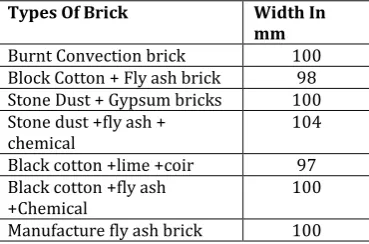
2) Comparison between Width of different Bricks:-As per IS 1725-1982 width of convectional bricks should have 90mm
[image:5.595.343.531.265.377.2]Graph no. 2 Average width of different Brick
Table No.7 Width of Different Bricks
Types Of Brick Width In
mm
Burnt Convection brick 100
Block Cotton + Fly ash brick 98
Stone Dust + Gypsum bricks 100
Stone dust +fly ash +
chemical 104
Black cotton +lime +coir 97
Black cotton +fly ash
+Chemical 100
Manufacture fly ash brick 100
It is seen from graph that bricks made of BC + Lime +Coir combination has least Width of 97mm and bricks made of stone dust + flay ash +chemical and gypsum has highest Width i.e. 104mm. hence it can be concluded that the manufactured CSEB bricks has large width than that of convectional bricks. If the width of bricks is increase the width of wall will increase which will result in good thermal comfort for structure.
3) Comparison between Height of Different Bricks:-As per IS code 1725-1982 Height of convectional bricks should have 90mm.
Graph No.3 Average height of Different Brick
Table no. 8 Height of different brick
Types Of Brick Height In
mm
Burnt Convection brick 60
Block Cotton + Fly ash brick 63
Stone Dust + Gypsums bricks 70
Stone dust + fly ash + chemical 80
Black cotton +lime + coir 71
Black cotton +fly ash
+Chemical 57
Manufacture fly ash brick 70
4) Comparison between Weights of Different Bricks:-As per IS code 1725-1982 weight of the burnt convectional bricks should be 3.5kg
Table No 9. Weight of Different Bricks
Types Of Brick Weight In mm
Burnt Convection brick 3.5
Block Cotton + Fly ash brick 2.17
Stone Dust + Gypsums bricks 3.32
Stone dust +fly ash + chemical 4.19
Black cotton + lime+ coir 2.19
BCS + fly ash +Chemical 2.55
Manufacture fly ash brick 3.13
From a bar chart it is observed that the Weight of black cotton + fly ash is 4.191kg. From this it is concluded that the bricks manufacture by using black cotton & fly ash are light in weight than other. If light weight bricks are manufactured the dead load of the structure will be less. Hence it can be effectively used in internal partition wall. It will be cost effective in the region where Black Cotton Soil is available in large amount it can be transported for manufacture of bricks.
5.2. Compressive strength Of Different CSEB Brick
1) Fly ash brick with Black Cotton soil:-Compressive strength of bricks is important as an indicator of masonry strength and as a result brick has become an important brick design. AS per IS 1325-1992 pages number 1, the Compressive strength of bricks should be 3.5N/mm2
80 100 120
1
Wid
th
…
Comparison
Between Width Of …
BC+lime+coirFlyash brick
conventional brick
0 100
1
He
ig
th
in
…
Comparison Between
Height Of Different …
BC+flyash+chemical [image:5.595.35.250.365.477.2] [image:5.595.66.251.523.645.2]© 2017, IRJET | Impact Factor value: 5.181 | ISO 9001:2008 Certified Journal
| Page 1284
Graph no. [image:6.595.349.525.341.450.2]5: Compressive Strength of Fly ash Brick
Table No. 10. Compressive Strength for Varying % Of Fly ash In Bricks
Fly ash Compressive strength in N/mm2
10% 146.67
20% 125.00
30% 113.33
40% 131.67
50% 33.33
X- axis indicated % of fly ash and Y- axis indicated the compressive Strength in N/mm2 From graph it is seen that as the% of fly ash increase the compressive Strength decrease. Maximum Compressive strength is obtained at10% fly ash content which is 6.819N/mm2 and minimum compressive strength of 1.616N/mm2 at 50% fly ash content.
2) 1% Coir with Lime and BLACK COTTON SOIL:- after studying different literature it was found that ordinary bricks get crushed at 3.5.N/mm2 but the brick prepared by using coir as stabilizer do not get crushed just get compressed and it is ready to take more loads. The bricks were prepared by adding 1% and2% of coir in Black Cotton Soil with percentage of lime varying from 3% to 15%.
[image:6.595.36.250.517.636.2]Graph No. 10: Compressive Strength Of Black Cotton Soil, Lime And 1% Coir Bricks
Table No.11 Compressive Strength at various % reduction in Heigth
Compressive Strength at various % reduction in Height
Lime % 5% 10% 15%
3% 53.33 235.33 300
6% 61.67 120 182
9% 28.33 65 101.67
12% 26.67 41.67 71.67
15% 35 58.33 86.67
The compressive strength was noted for different reduction in height such as 5%, 10% and 15% reduction in height. It is concluded from graph that the compressive strength get reduce as the percentage of lime is increase. Table represents maximum and minimum compressive strength at 5%, 10% and 15% reduction in height with % of lime.
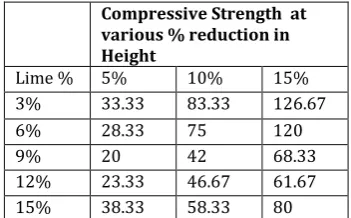
3) 2% Coir with Lime and BLACK COTTON SOIL:- The brick were prepared by adding 1% of coir in Black Cotton Soil with percentage of lime varying from 3% to 15% The procedure of testing is same as discussed above for 1% Coir.
Table No. 12. Comp. strength at various % reductions in Height
Compressive Strength at various % reduction in Height
Lime % 5% 10% 15%
3% 33.33 83.33 126.67
6% 28.33 75 120
9% 20 42 68.33
12% 23.33 46.67 61.67
15% 38.33 58.33 80
The Compressive strength noted for different height such as 5%, 10% and 15% reduction in height. It is concluded from graph that the compressive strength get reduce as the percentage of lime is increase. Table represented maximum and minimum compressive strength at 5%, 10% and 15% reduction in height.
4) Strain v/s % of Lime Graph:- The strain obtained by adding 2% coir in Black Cotton Soil and lime is more than strain obtained by adding 1% coir in Black Cotton Soil lime. From graph it is seen that the maximum strain of sample of 1% coir brick is 1.791 at 12% of lime and for 2% coir is 1.800 at 9% of lime. The minimum strain for 1% and 2% coir brick are 0.060 and 0.081 at 6% and 3% of lime respectively.
Graph No. 8 Strain at different % of Lime and Coir
0 10
10% 20% 30% 40% 50%
Co
m
p
re
…
Fly Ash(%)
Compressive Strength
v/s % of Fly Ash
c…
0 500
3 6 9 12 15
Co
m
p
ressiv
e
Streng
th
…
Lime(%)
Comp. Strength v/s Lime
and 1% coir
0 0.1 0.2
3 6 9 12 15
Strain
Lime(%)
[image:6.595.344.531.622.727.2]© 2017, IRJET | Impact Factor value: 5.181 | ISO 9001:2008 Certified Journal
| Page 1285
Table No.13 Strain At Various % Of Lime And CoirMaterial % of Coir
Lime 1% 2%
3% 0.067 0.084
6% 0.060 0.094
9% 0.123 0.179
12% 0.177 0.106
15% 0.121 0.080
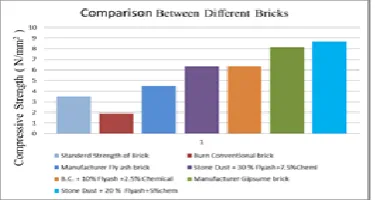
5) Comparison b/n Compressive strength of different brick:- As per 1325-1992 page no.2 specify that the strength of
Graph. No.9: Comparison b/n compressive strength of different brick
Table No.14 Compressive Strength of Different Brick
Types of Brick Compressive
strength in N/mm2
Burnt Convectional brick 1.92
Black Cotton + Fly ash brick 4.47
Stone dust + Gypsums brick 8.18
Stone dust+20%fly + chem. 8.18
Stone dust+30%fly + chem. 8.71
Black cotton +fly ash +Chemical 6.36
Standard strength of Brick 3.5
After testing the brick manufacture using different percentage of stabilizer. It was observed that the minimum strength is1.916N/mm2 of convectional brick are maximum strength is8.712N/mm2 of stone dust+20% fly ash+5% of chemical
Conclusion
The present study was conducted verify the potential of black cotton soil, which is present abundantly in local region. The following conclusion is drawn based on the current investigation:
The compressive strength of CSEB bricks decrease as the
percentage of fly ash is increase when mixed with black cotton soil.
The CSEB brick made of Black Cotton Soil +fly ash
+Chemical yielded better geometrical properties but were weak in compressive strength.
Although, the mixture of Cotton Soil +10% fly ash +5 %
Chemical when casted as CSEB brick, this gave compressive strength almost 3 times the strength of convectional burnt
clay bricks. The same mixture with higher percentage of fly ash and chemicals yields
Weaker compressive strength.
When black cotton soil was mixed with lime and coir the
bricks underwent compressive but did not fail by crushing like convectional burnt clay bricks.
Stone dust+20% fly ash +5% chemical showed almost 4
times the compressive strength as compared to convection bricks and manufactured Bricks. This proves that convectional practice of using lime can be replaced by using chemicals for better compressive strength.
When black cotton soil is mixed with different stabilizer,
the water absorption test could not be conducted on such types of CSEB bricks. Hence, the resistance to water of CSEB bricks, when manufactured using Black cotton soil as basic material, as questionable and needs further research and experiments.
Finally, it can be said that when black cotton soil is stabilized with different stabilizers for manufacturing compressed stabilized earth block, its compressive strength increase but water resistance is negligible. Although, such bricks will gives better compressive strength when compared with different types of convectional as well as compressed stabilized earth blocks.
Reference
1. ASTM D559-44 Wetting and Drying Test of Compacted Soil-
Cement Mixture’ Journal of civil engineering, Bangladesh vol. CE 30,page No.13,2002.
2. Hubert Guillaud, Thierry Jaffory, Pascal Odul, ‘Comprresed
stabilized Earth Block: Manual of Design & Construction, vol. II, pg. no. 10, 1985.
3. Indian Standard, specification for ‘ Soil- cement blocks used in
general building construction,’ Indian Standards Institution, New Delhi 1725,1960.
4. John Morris and Quintin Booysen, ‘ Earth Construction in africa’
proceedings : Strategies for a sustainable built Environment, Pretoria, 23-25, 2000.
5. Kabiraj.K., Mandal.U.K. ‘ Experimental investigation and
feasibility study on stabilized compacted earth block using local resources’ IJCSE vol. 2, p.g. no. 838, 2012.
6. K.J. Osinubi, M.A. Oyelakin and A.O. Eberemu ‘ improvement of
black cotton soil with ordinary Portland cement- Locust Bean Waste ash blend’ vol. 16, 2011.
7. Kevan Aurbrey Heathcote ‘An investigation into the Erodibility
of earth wall units’ p.g. no. 13, 2002.
8. M. Sharif Zami & dr. Angela Lee ‘Contemporary earth
construction in Urban housing- stabilized or Unstabilized’ School of built environment, university of Salford, U.K. 2007.
9. Peter Walker & Vasilios Maniatidis ‘A review of rammed Earth
construction for DTi Partners in Innovation project ‘ developing rammed earth for UK Housing’ p.g. 17, 2003.
0 10
1