© 2017, IRJET | Impact Factor value: 5.181 | ISO 9001:2008 Certified Journal
| Page 3453
Enhancing FSO link performance in turbulent environment using Fiber
bundle based receiver
Prakash Chandra jat
1, Dr Pranay joshi
2, Dr Sunil joshi
31
M.Tech. Student, Department of Electronics and Communication, CTAE, Udaipur, Rajasthan, India
2
Assistant Professor, Madhav University, Abu Road, Sirohi, Rajasthan, India
3
Professor & Head, Department of Electronics and Communication, CTAE, Udaipur, Rajasthan, India
---***---Abstract - Free space optical (FSO) communication uses infrared (IR) or visible wavelengths to broadcast high-speed data wirelessly through the atmospheric turbulence channel. The performance of FSO communications is mainly dependent on the random atmospheric turbulence. The presence of turbulence, create received power fluctuation of the laser beam between the transmitter and receiver lead to performance degradation of the communication link. To mitigate this effect, The fiber bundle based receiver design is simulated in OptiSystem which consists of a hexagonal array of fiber to capture light. These fiber allow more power to be collected that would be less to a standard receiver due to turbulence. The simulation results show that some reduction in bit error rate (BER) by introducing fiber bundle based receiver in FSO system and increase in Q- factor.
Key Words: Free space optical (FSO), bit error rate
(BER), Q-factor, Gamma-Gamma Channel Model, Atmospheric Turbulence, Fiber bundle based receiver.
1. INTRODUCTION
The last decade has seen tremendous development in the growth of broadband access networks around the globe. The interest for faster data rates in the evolution towards 5G wireless systems has brought rapid innovation in new optical technologies to accommodate the rise in a number of subscribers. The growth of Internet traffic together with an increase in the number and range of new services have placed pressure on legacy low-speed optical networks. This calls for effective modern optical communication systems that support high transmission rates and enhanced coverage. It has been very hard for the International Telecom Unions (ITU) to allocate the limited radio frequency (RF) Spectrum among the operators due to the explosive growth of subscribers every year. The ITU has reported 7.5 billion cellular subscribers in 2013 [1]. FSO is a promising technology for increasing broadband penetration, enabling transmission of multiple signals via a high-speed optical carrier without expensive optical fiber cabling or licensing for radio frequency (RF) solutions. In FSO links, transportation of signals is carried out through the atmosphere instead of an expensive optical fiber, thus eliminating the need for costly cabling of fiber optics in sparsely-populated rural areas. Another main advantage of
FSO is that contrary to wireless RF communications, no license is required for transmission in FSO [2]. Thirdly, in some rural areas where current wireless RF technology and inaccessible such as hilly terrains and areas far from radio base stations, FSO technology may be integrated with existing mobile cellular radio technology to promote more rapid deployment of a universal wireless architecture [3] as well as mobile environment also [4]. Although (FSO) guarantees high-speed data rates, there are some challenges such as scintillations and atmospheric turbulences which need to be addressed in order to improve the performance of the FSO link. In this paper, we have simulated the performance of Fiber bundle based receiver design under the effect of scintillation by varying channel’s refractive index structure parameter (CR2) for different link range. Q-factor and received powers are analysed over different link ranges.
Section 2 denotes basics of FSO link. Section 3 describes the mathematical analysis of atmospheric turbulence channel. Section 4 introduces fiber bundle based receiver design and sections 5 and 6 give simulation results and conclusion to new receiver design.
2. FSO System
© 2017, IRJET | Impact Factor value: 5.181 | ISO 9001:2008 Certified Journal
| Page 3454
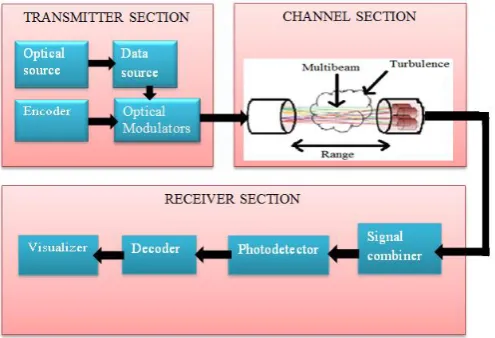
Fig-1: Block Diagram of FSO System
2.1 FSO Transmitter system
This functional block has the optical source, the modulator, the driver circuit and the transmitter optics. The main function of the transmitter is to provide transmission of source data onto the optical carrier, which is then propagated through the atmosphere to the receiver at sufficient power level, and with sufficient signal quality that would enable data to have recovered at the receiver. Lasers are the most important light sources for outdoor FSO communications, while the LEDs are used for indoor FSO systems at low data rates and short haul communications. Modulation of the light beam can be achieved by direct modulation, which involves varying the driving current of the optical source directly in sympathy with the data to be transmitted or via an external modulator, such as the Mach-Zehnder interferometer.
2.2 FSO Receiver system
The FSO receiver consists of a photo-detector, a low pass filter and a visualizer. The laser beam is received by the photodetector and converted back into electrical signal. This electrical signal is recovered by bessel low pass filter. This low pass Bessel filter removes any high-frequency noise present in the received electrical signal. The received signal is then further analysed by BER analyser.
3. ATMOSPHERIC TURBULENCE MODEL
Atmospheric turbulence is induced due to the random fluctuation of atmospheric refractive index along the path of the optical radiation traversing the atmosphere. In a sunny day, Solar radiation absorbed by the Earth’s surface causes the air near the earth surface gets warmer than the air at the higher altitude. This layer of warm air gets to be much less dense and then goes up from the earth to combine with the surrounding cooler air and cause the air temperature to
fluctuate randomly [8]. This random fluctuation of temperature create random change in refractive index of atmosphere which is a function of the atmospheric air pressure, elevation, and wind flow speed and also time of the day [8]. This turbulence result by inhomogeneity present in the atmosphere and can be viewed as discrete cells eddies of different temperature, acting like refractive prisms of different sizes and indices of refraction.The interaction between the optical beam and the turbulent media results in random amplitude variations (scintillation) and phase of the information-bearing optical beam which results in random variation of the received optical power which lead to the FSO system performance degradation [8]. This scintillation of the optical beam is modelled gamma -gamma model.
3.1 The Gamma-Gamma Turbulence Model
Andrews and Phillips developed a universal PDF model of irradiance fluctuations [5], In which the modulation of the inner scale size over the optical link length by the outer scale size of the atmosphere, making it suitable for modelling weak-to- strong turbulence conditions. The total normalised received irradiance I am thus given as the product of two statistically independent random processes Ix and Iy:
I = I x I y
The resultant probability of a given intensity (I) is given by as: [5]
p(I)= (2 )
where and are the variances of the small and large
scale eddies, respectively, is the Gamma function and is the modified Bessel function of the second kind. And coefficient is given by as:
α=exp -1
β=exp -1
The Rytov variance is calculated from:
Where is the parameter Index refraction structure, k is the optical wavenumber and z is the range.This model will then be used to characterise the behaviour of the received signal and for the error performance of short to very long FSO links.
Encoder
Data
source
Transmitter
Telescope
Optical
Modulators
Optical
source
Visualize
© 2017, IRJET | Impact Factor value: 5.181 | ISO 9001:2008 Certified Journal
| Page 3455
4. Fiber bundle based FSO receiver design
[image:3.595.312.555.103.253.2]The random nature of atmospheric turbulence, which affects every FSO system regardless of the transmission distance, makes the effects difficult to predict and to counteract. This random nature of atmospheric turbulence causes the random walk of focal point of the incident optical beam in the focal plane receiver [6], effectively the SNR of the FSO link falls below the threshold in a way that causes periods of disconnection. However, the performance degradation due to atmospheric turbulence can be reduced through the redesign of a traditional receiver [6]. The solutions to this problem are a redesign of the receiver in which an array of lenses at the receiver, rather than a single lens, coupled to an array of large-core fibers in an effort to maximise both optical power collected and misalignment tolerance [7]. In this receiver design, a numerical simulation was designed and used to investigate how the turbulence, link length, and the number of collecting fiber at the receiver interact and influence the design and control of turbulence problem in FSO link. With this design, the fiber bundle-based receiver is able to capture more signal power. Another advantage of this receiver is that it has more lens for capturing light so as the signal moves off one of the lenses it will move onto another lens which will collect it, thus maintaining signal strength and integrity.
Fig-3: Block diagram of fiber bundle based receiver in FSO system
4.1 Signal Combination Approaches
In fig-2, all the signals coming from MM fiber is combined using MM Fiber power combined into a single fiber then put onto the photodetector.
Fig- 2: Diagram of MM fiber power combiner
Table -1: Simulation parameter
Parameter value
Operational
wavelength 1550nm
Output power 1mW
FSO Tx aperture 50mm FSO Rx aperture 250mm
Data rate 2Gbps
Turbulence level Strong (10^ -13)
Number of fiber 19 Core diameter 400 um
4.2 MIMO FSO System without fiber bundle
[image:3.595.38.286.417.586.2]In fig- 4 shown simulation layout of conventional MIMO FSO system which uses a fork to duplicate the transmitting laser beam into multiple beams. Then it is to be detected at the receiver. At receiving end all signal from multiple beams is detected individually by pin diode and then combined into single one. BER analyser and electrical power meter are used in this simulation.
[image:3.595.309.562.574.740.2]© 2017, IRJET | Impact Factor value: 5.181 | ISO 9001:2008 Certified Journal
| Page 3456
4.2 Fiber bundle based FSO receiver
In fig-5 shown simulation layout of fiber bundle based FSO receiver which is used to collect multiple beams coming from transmitter and then all signal is combined back using MM Fiber power combiner into single fiber and then processed further as conventionally.
Fig-5: Fiber bundle based FSO receiver
Fig-6: Inside view of fiber bundle in Optisystem
5. Simulation results
The simulation results show the results between conventional FSO receiver and Fiber bundle based FSO receiver for the Gamma-Gamma turbulence model in deep free space FSO link. All below figures illustrates the comparison between conventional FSO receiver and Fiber bundle based FSO receiver in term of BER, Q factor and
received total electrical power with respect to varying distance.
Fig-7: Total electrical power vs range
Fig-7 shows the simulation results of fiber bundle based receiver and conventional receiver. The results show that fiber bundle based receiver providing more received power to some distance after that it is less compared to conventional receiver because of the contribution of dark current.
Fig-8: Q-factor vs range
Fig-9: log of BER vs range
© 2017, IRJET | Impact Factor value: 5.181 | ISO 9001:2008 Certified Journal
| Page 3457
3. CONCLUSIONS
It is concluded that fibre bundle based receiver provides more received power compared to conventional receiver system in strong turbulence regime. Simulation results also show that low BER and high Q-factor is achieved for fiber bundle based FSO receiver in compared to conventional FSO receiver system.
REFERENCES
1. http://www.itu.int/en/ITUD/Statistics/Documents /facts/ICTFactsFigures2013-e.pdf.
2. Al-Raweshidy H., Sh_z K. eds., 2002. Radio over fiber technologies for mobile communications networks. Artech house universal communication service, 1st ed.: 363-364.
3. Amphawan A., Chaudhary, S., Din R., Omar M. N., ‘’ 5Gbps HG[ 0,1] and HG [0,3] optical mode division multiplexing for Ro-FSO’’. Signal Processing & Its Applications (CSPA), IEEE 11th International Colloquium : 145 – 149 , 2015.
4. Nathan F. H., ‘’ Enhancing FSO Link Performance in Adverse Conditions Using a Fiber- Bundle Based Receiver Design’’, The University of Tulsa, Dissertation, 2015.
5. L. C. Andrews and R. L. Phillips, Laser beam propagation through random media, SPIE Press, Bellingham, Washington, 2005.
6. Peter G. LoPresti; Hazem Refai; James J. Sluss, ‘’Mitigating angular misalignment from atmospheric effects in FSO links’’, Proc. SPIE 6551, Atmospheric Propagation IV , 65510K (May 04, 2007).
7. LoPresti, H. Refai and M. Atiquzzaman,'' experimental demonstration/ analysis of fiber-bundlebased receiver performance’’, 28th digital avionics systems conference, 23-29 Oct. 2009. 8. Kshatriya A. J., ‘’investigation on the performance