2019 International Conference on Applied Mathematics, Modeling, Simulation and Optimization (AMMSO 2019) ISBN: 978-1-60595-631-2
The Computer Simulation and Verification Analysis of Fire Scene
Te-Chi Chen
1,*, Chia-Chun Yu
1, Hung-Chin Lin
1and Guei-Heng Chen
2 1Department of Industrial Management, Vanung University, Taiwan 32061, R.O.C 2Department of Mechanical Engineering, Yuan Ze University, Taiwan 32003, R.O.C*Corresponding author
Keywords: Numerical simulation, Arson attack, Fire protection engineering.
Abstract. It is the most direct way to study fire cases through the actual fire. Therefore, if the process of fire can be reconstructed and quantified, we can not only more realize the actual action of the fire but also enhance the practicability of fire prevention. The research discusses an actual fire event of a residence in Chiayi County, Taiwan. The case was an arson attack with gasoline, and it caused the tragedy of 3 deaths and 1 severe injury. This research applies FDS (Fire Dynamics Simulator) developed from NIST to numerical simulation of the fire, makes proper assumptions under the fire description and program limitations, uses qualitative and quantitative methods for restoring and verifying the fire scene, and discusses the distribution of the temperature. Analytical result of this research could be served as the references for fire prevention engineering.
Introduction
Arson attack is a serious crime, and it is also regarded as a civilized disease nowadays. Arson attacks are like walking bombs in the city, and it can damage citizen's lives and properties severely. There were 294 arson attacks in Taiwan in 2009, and 271 cases in the next year, these cases seem to be endless. Most of the cases are that the arsonists used gasoline to ignite cars and motorcycles. The features are fast burning speed and spreading large area. They tend to commit crimes at midnight when people are sleeping and lacks of awareness, so it is difficult for residents to escape. For example, in 2003, in Daxi community, located at Lu Zhou City, Taipei County, was on fire because of the artificial arson on the motorcycles, and there were 13 deaths and 71 injuries in that severe incident. Therefore, how to alarm everyone about fire within the shortest times, prevent stack effect, and slow down the fires spreading are issues that worth studying.
Apply the fire simulation program to stimulate actual fire can get a better understanding of the flow of high temperature smoke and the temperature variation of the fire scene. The simulation result can not only estimate the evacuation time effectively and also be taken as the references for the design of firefighting equipment. The research takes the fire happened in a residence in Chiayi County as a case study, applying FDS to build a numerical model of the fire scene to calculate the on-scene temperature, burning speed, the distribution of the smoke concentration for the analysis of the situation at that time, and raising related quantitative result as the references of fire prevention engineering.
Research Method
Smoke View programs such as in 3D present smoke, heat, other gases, and the variation along with time, so it has become the major research mode of fire studies [1~15].
Situation of the Fire Scene and Model Building
The Description of Situation at Fire Scene
[image:2.595.95.502.285.388.2]The fire happened in a two-storied residence located at Zhong Zheng Road, Sikou Town, ChiayiCounty at around one o’clock June 11th, 2010. There was an office, living room, kitchen, and storage on the first floor, and the bedrooms on the second floor. The fire was started due to man-made fire; the arsonist broke the glass of the storage on the first floor, poured gasoline in the storage, and then ignited with papers. Fire and heavy smoke soon spread to the whole building. Because the building was pretty small and it was mostly partitioned with wooden boards along with a lot of combustibles in it, the entire building was seriously damaged except for the office on the right side of the first floor. This fire caused the tragedy of three deaths and one injury. The photo of the exterior of the fire scene and Configuration of 3D Model is presented in Figure 1.
Figure 1. The Exterior of the Fire scene and Configuration of 3D Model.
Build Numerical Model of the Fire Scene
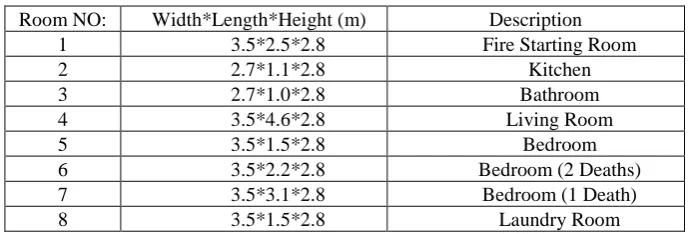
The case is a two-storied building, and based on the floor plan of the fire scene provided by the fire department, geometric space models of the interior and exterior areas were built based on the actual building (like in Figure 2) as same as the actual proportions presented in Table 1. The length of the building is 6m, the width is 8m, and the height is 7m. Mainly, deaths and injuries happened on the second floor. Eight rooms were planned in the simulation, 4 on the first floor, and another 4 on the second floor. Stimulated grids are 24,300. The fire was started by igniting wooden boards with gasoline, and Heat Release Rate (HRR) is set based on the literature review and the test report [16], the maximum value of HRR is 175KW, and the total simulation time is 900 seconds.
1F 2F
[image:2.595.127.443.544.636.2]Victims
Figure 2. The Stimulated Floor Plan of the Fire scene. Table 1. The room dimensions in the simulation.
Room NO: Width*Length*Height (m) Description
1 3.5*2.5*2.8 Fire Starting Room
2 2.7*1.1*2.8 Kitchen
3 2.7*1.0*2.8 Bathroom
4 3.5*4.6*2.8 Living Room
5 3.5*1.5*2.8 Bedroom
6 3.5*2.2*2.8 Bedroom (2 Deaths)
[image:2.595.125.470.677.794.2]Conclusion and Discussion
The actual fire scene is very complicated. For better understanding and analysis the cause of fire to propose the effective suggestion, it is very essential to rebuild the situation. The research uses photos of the actual damages taken after the fire to verify the actual situation qualitatively and quantitatively, also, to get a closer approach of what really happened at the fire scene.
Verification (1): The Stairs from the First Floor to the Second Floor was Burnt Down
As it shows on the left hand side in Figure3, the wooden stairs were burnt and carbonized at that time. Usually, the carbonization temperature of wood is between 280℃~320℃. To learn the temperature from the temperature curve chart and section map, the simulation result is shown on the right-hand side in Figure3, between the 50th second and 710th second, the temperature was over 300
℃; it was even over 500 ℃ between 400th second and 700th second later. The temperature was high enough to carbonize the stairs, so the simulation result is close to the actual situation at the fire site.
[image:3.595.122.472.257.342.2](Sec) (℃)
Figure 3. The stars burned simulation verification Figure.
Verification (1): The Window in Room6 was Burnt Through
It is easy to tell from the left hand side in Figure4, the glass of the window in Room6 is broken. According to the literature review, glass will be broken under the temperature over 400℃. To learn the temperature from the temperature curve chart and section map, the simulation result is shown like on the right hand side in Figure4, at the 508th second, the temperature is over 400℃ and keeps remaining for a while, causing glass breaking. The simulation result is similar to the actual situation.
(Sec)
(
℃
[image:3.595.123.473.467.548.2])
Figure 4.Window burned breaking simulation verification Figure.
Verification (3): PVC Pipe at the Front Door was Burnt Down
There was a PVC pipe in front of the building on the left hand side in Figure5. The pipe was black and deformed. PVC pipe will get softened when the temperature exceeds 76℃. To learn the temperature from the temperature curve chart and sectional map of the front door, the simulation result is shown like on the right-hand side in Figure5, between the 30th second and 635th second, the temperature of PVC pipe was over 76℃. The simulation result is similar to the actual situation.
(℃)
(
℃
)
[image:3.595.109.486.663.751.2]The Fire Spread Simulation
The research mainly focuses on what had happened during the fire; therefore, the purpose of discussing the variety of the spreading fire under different transient time was to reconstruct the burning situation at that time.
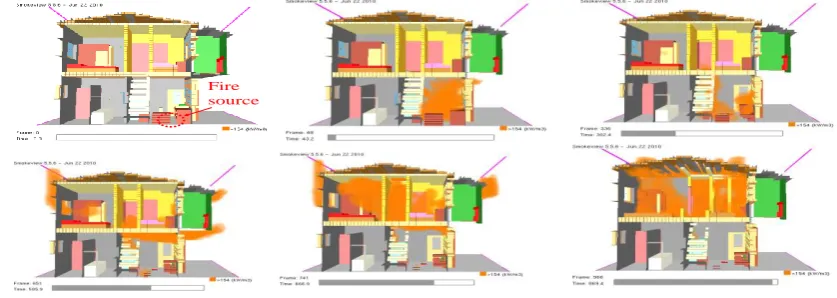
It shows individually that how the fire spread at the fire scene at the transient of 0 second, 43rd second, 302nd second, 585th second, 666th second, and 869th second in Figure6. The fire starting point was at the storage, Room1, on the first floor. At the 43rd second, it was still burning in Room 1. Later, combustibles were burnt along with the fire soon. The fire was transferred by heat radiation, thermal convection, heat transfer, and burnt rapidly. After 302ndsecond, the fire spread to the second floor along with the stairs. At the 585th second, the second floor was on fire. At 666th second, the room with wooden decoration speeded up the burning. The fire and heavy smoke took control of the whole area on the second floor, and that was why it was fairly difficult for the evacuation. Because there were a lot of combustibles, the fire was still burning ragingly when the simulation ended at the 869th second.
[image:4.595.85.504.272.421.2]Fire source
Figure 6. Fire simulation transient 0,43, 302,585,666 and 869 sec.
Conclusions
The research focuses on applying value simulation methods of reconstructing the situation at the fire scene. It also describes and discusses about the original fire scene qualitatively and quantitatively. According to the simulation result, there were lots of combustibles to spread the fire up. After the fire started in 60 seconds, it burnt and spread so quickly, and spread to the second floor along with the stairs. The evacuation corridor was full of heavy smoke; therefore, the evacuation time was limited, and it led to 3 deaths and 1 severe injury on the second floor. Additionally, one single stair and the iron grating blockage of windows are the major reasons of causing deaths and injuries in this fire. In one word, residents should not install windows with iron grating without exits, and fireproof doors are strongly suggested to be installed around the corners of the stairs on the first and the second floor. Also, correct fire prevention and evacuation knowledge are helpful for avoiding such tragedy to happen again.
Acknowledgments
The authors would like to thank the National Science Council of the Republic of China, Taiwan, for financially supporting this research under Contract No. NSC 100-2221-E-155-076.
References
[1] N. L. Ryder, J. A. Sutula, C. F. Schemel, A. J. Hamer and V. V. Brunt: Journal of Hazardous
Materials, 115 (2004) 149-154.
[3] C. S. Lin, S C. Wang, C. B. Hung and J. H. Hsu: Heat Transfer-Asian Research, 35 (2009) 387-401.
[4] C.S. Lin, C.C. Yu and S C. Wang: Numerical Investigation of Fire Dynamic Behavior for a
Commercial Building Basement, Advanced Materials Research, 594-597 (2012) 2213-2218.
[5] C.S. Lin, T.C. Chen and T.Y. Lee: Applied Mechanics and Materials, 372 (2013) 630-634.
[6] R. C. Dubes and A K. Jain: J. Applied Statistics, 16 (1989) 131-164.
[7] Z Zhai and Q. (Yan) Chen: Building and Environment, 2005, pp. 1001-1009.
[8] C.S. Lin, T.C. Chen, C.C. Yu, M.E. Wu and Y.H. Tu: International Conference on
Computational & Experimental Engineering and Science, Vol. 15 (2010) No. 3, pp. 103-110.
[9] S.C. Wang, C.S. Lin and C.C. Yu: Heat Transfer-Asian Research, 37(2008) No. 3, 153-164.
[10]J. H. Mammoser III and F. Battaglia: Fire Safety Journal, 39 (2004) 277-296.
[11]W.K. Chow and C.L. Chow: Building and Environment, 40 (2005) 95-106.
[12]W.K. Chow: Journal of Fire Sciences, 16(1998) No. 595-106.
[13]T. S. Shena, Y. H. Huangb and S. W. Chiena: Building and Environment, Vol. 43, 2008, pp. 1036–1045.
[14]C.S. Lin, T.C. Chen and S.C. Wang: 2012 IEEE Symposium on Electrical & Electronics
Engineering, 2012, pp. 113-116.
[15]C.S. Lin, C.C. Yu and S.C. Wang: Advanced Materials Research, 594-597 (2012) 2213-2218.
[16]Anthony D. Putorti and Jr. Dr. David G. Boyd: National Institute of Justice Office of Science