R E S E A R C H
Open Access
A novel finite-time average consensus
protocol based on event-triggered nonlinear
control strategy for multiagent systems
Xiaobo Wang
1*, Juelong Li
1,2, Jianchun Xing
1and Ronghao Wang
1*Correspondence: [email protected] 1College of Defense Engineering, PLA University of Science and Technology, Nanjing, 210007, China Full list of author information is available at the end of the article
Abstract
We present a novel finite-time average consensus protocol based on event-triggered control strategy for multiagent systems. The system stability is proved. The lower bound of the interevent time is obtained to guarantee that there is no Zeno behavior. Moreover, the upper bound of the convergence time is obtained. The relationship between the convergence time and protocol parameter with initial state is analyzed. Lastly, simulations are conducted to verify the effectiveness of the results.
Keywords: multiagent system; finite-time; event-triggered control; consensus; protocol
1 Introduction
In recent years, many applications required a lot of vehicles or robots to work cooperatively and accomplish a complicated task. Given this, many researchers have devoted themselves to the studies of coordination control of multiagent systems [, ]. The primary researches in this field include the problems of consensus [], flocking [], formation control [, ], collective behavior of swarms [, ], etc. Of these, the issue of consensus is the basis of studying other problems. Multiagent consensus refers to the design of a proper consensus protocol based on the local information of each agent such that all agents can reach an agreement with regard to certain quantities of interest [].
In practical multiagent systems, each agent is usually equipped with a small embedded microprocessor and has limited energy, which usually has only limited computing power and working time. These disadvantages drive researchers to develop event-triggered con-trol schemes, and some important achievements have been made recently [–]. For ex-ample, in [] the authors introduced the deterministic event-triggered strategy to develop consensus control algorithms, and the lower bound of the interevent time was obtained to guarantee that there is no Zeno behavior. In [] the problems of event-triggered in-tegrated fault detection, isolation, and control for discrete-time linear systems were con-sidered. It was shown that the amount of data that is sent through the sensor-to-filter and filter-to-actuator channels are dramatically decreased by using an event-triggered tech-nique applied to both the sensor and filter nodes. In [], the authors proposed a new multiagent consensus event-based control approach. The measurement broadcasts were scheduled in an event-based fashion, and the continuous monitoring of each neighbor’s
state is no longer demanded. In [] the authors proposed a combinational measurement strategy to event design and developed a new event-triggered control algorithm. In this strategy, each agent is only triggered at his own event time, which lowers the frequency of controller updates and reduces the amount of communication. In [] the authors pro-posed a self-triggered consensus algorithm for multiagent systems. The algorithm is sim-pler in formulation and computation. Thus, more energy can be saved using the proposed algorithm in practical multiagent systems.
Moreover, the convergence time is a significant performance indicator for a consensus protocol in the study of the consensus problem. In most works the protocols only achieve state consensus in infinite time interval, that is, the consensus is only achieved asymptoti-cally. However, the stability or performance of multiagent systems in a finite time interval needs to be considered in several cases. The finite-time stability focuses on the behavior of system responses over a finite time interval [, ]. Therefore, studying the finite-time stability of multiagent systems is valuable to some degree. The multiagent finite-time sta-bility analysis has also elicited the attention of many researchers [–].
Recently, there are few results reported in the literature to address finite-time event-triggered control consensus protocols for multiagent systems. To the best of our knowl-edge, in [] the authors presented two novel nonlinear consensus protocols based on event-driven strategy to investigate the finite-time consensus problem of leaderless and leader-following multiagent systems. However, many parameters exist in the proposed protocols, making the protocols complex and restricted, and the relationship between the convergence time and parameters is unclear. Inspired by these, a new consensus protocol based on the event-triggered control strategy is proposed in this paper.
The main contributions of this paper can be summarized as follows: () a new finite-time consensus protocol based on the event-triggered control strategy for multiagent systems is presented, and the system stability is proved. The protocol is simpler in formulation and computation. () The lower bound of the inter-event time is gotten to guarantee there is no Zeno behavior. () The upper bound of convergence time is obtained. The relationship between the convergence time and protocol parameter, the initial state, is analyzed.
The rest of this paper is organized as follows. In Section , we introduce some essential background and present the problem statement. The main results and the proof are pro-vided in Section . The simulation results are shown in Section , and the conclusions and the future works are provided in Section .
Notations = [, , . . . , ]Twith compatible dimensions,In={, , . . . ,n}.|x|is the abso-lute value of a real numberx, · denotes the -norm inRn,span{}={ε∈Rn:ε=r,r∈ R}, andEis the Euler number (approximately .).
2 Background and problem statement
2.1 Preliminaries
In this subsection, we introduce some basic definitions and results of algebraic graph the-ory. Comprehensive conclusions on algebraic graph theory are found in []. Moreover, we present two essential lemmas.
V: (vi,vj)∈E}, and then the verticesviandvjare called adjacent. A path fromvitovjis a sequence of distinct vertices starting withviand ending withvjsuch that consecutive vertices are adjacent. A graph is regarded as connected if there is a path between any two distinct vertices. The Laplacian of a graphL= [lij]∈Rn×nis defined bylij=nk=,k=iaik fori=jandlij= –aijotherwise.Lhas always a zero eigenvalue, and is the associated eigenvector. We denote the eigenvalues ofLby =λ(L)≤λ(L)≤ · · · ≤λn(L). For an undirected and connected graph,λ(L) =minε=,Tε=ε
TLε
εTε > . Therefore, if Tε= , then εTLε≥λ
(L)εTε.
Lemma ([]) Suppose that a function V(t) : [,∞)→[,∞)is differentiable and sat-isfies the condition
dV(t)
dt ≤–KV(t)
α, ()
where K> and <α< .Then V(t)reaches zero at t∗,and V(t) = for all t≥t∗,where
t∗= V() –α
K( –α). ()
Lemma ([]) Ifξ,ξ, . . . ,ξn≥and <p≤,then n
i= ξi
p ≤
n
i=
ξip≤n–p n
i= ξi
p
. ()
2.2 Problem formulation
The multiagent system investigated in this study consists ofn agents, and the state of agentiis denoted byxi,i∈In. Denote the vector x = [x,x, . . . ,xn]T. The dimension of xican be arbitrary as long as it is the same for all agents. For simplicity, we only analyze the one-dimensional case. The results are still valid for multidimensional cases through the introduction of the Kronecker product and inequality (). We suppose that each agent satisfies the dynamics
˙
xi(t) =ui(t), ()
whereuiis the protocol, which is designed based on the state information received by the corresponding agent from its neighbors.
With the given protocolui, for any initial state, if there is a stable equilibriumx∗and a timet∗satisfyingxi=x∗for alli∈Inwitht≥t∗, then the finite-time consensus problem is solved []. In addition, the average consensus problem is solved if the final consensus state is the average value of the initial state, namely,xi(t) =ni=xi()/nfor alli∈Inwith t→ ∞.
2.3 Event-triggered control consensus protocol
the events are triggered are defined by the conditionf(e(ti)) = . Suppose the triggering time sequence of vertexviisti= ,τ
, . . . ,τsi, . . . .
Between events are triggered, the value of the inputuis held constant and can be for-malized as
ui(t) =ui(τs), t∈[τs,τs+). ()
It is well known that the control algorithm is a piecewise constant function, and the value of the input is equal to the last control update.
The protocol based on event-triggered control utilized to solve the finite-time average consensus problem is
ui(t) = n
j=
aijsignxj(τs) –xi(τs)xj(τs) –xi(τs)α, t∈[τs,τs+), ()
where <α< , and thesign(·) is the sign function defined as
sign(x) = ⎧ ⎪ ⎪ ⎨ ⎪ ⎪ ⎩
, x> ,
, x= ,
–, x< .
()
3 Main results
3.1 Stability analysis
In this subsection, we study protocol (). Now, we are in a position to present our main results.
Theorem Suppose that the communication topology of a multiagent system is undirected and connected and that the triggered function is given by
fit,ei(t),δi(t)=ei(t)–
μ(λ(D))(+α)/ (–α)/
/α
δi(t), ()
where D= [dij]∈Rn×n,dij= (aij)/(+α),and <μ< .
Then,protocol()solves the finite-time average consensus problem for any initial state. Moreover,the settling time T satisfies
T≤ V()
(–α)/ ( –μ)(λ(D))(+α)/( –α)
. ()
Proof Given that the topology is undirected and connected,aij=ajifor alli,j∈In. We obtain
n
i= ˙
xi(t) = . ()
Let
κ= n
n
i=
Therefore,κis time invariant. Consequently,
Tδ(t) = n
i=
xi(t) –nκ= n
i= xi(t) –
n
i=
xi(t) = . ()
Define the measurement error as follows:
ei(t) = n
j=
aijsignxj(τs) –xi(τs)xj(τs) –xi(τs)α
– n
j= aijsign
xj(t) –xi(t)xj(t) –xi(t) α
/α
, t∈[τs,τs+). ()
Then we get
eαi(t) = n
j=
aijsignxj(τs) –xi(τs)xj(τs) –xi(τs)α
– n
j= aijsign
xj(t) –xi(t)xj(t) –xi(t) α
. ()
Letδ(t) = [δ(t),δ(t), . . . ,δn(t)]Tandxi(t) =κ+δi(t). Thus,
˙
δi(t) =xi(t) =˙ n
j=
aijsignxj(t) –xi(t)xj(t) –xi(t)α+eαi(t). ()
Here we have taken the Lyapunov function
V(t) = δ
Tδ. ()
By differentiatingV(t) we obtain
dV(t) dt =
n
i= δiδ˙i
= n i= δi n j= aijsign
xj(t) –xi(t)xj(t) –xi(t) α
+eα i(t) = n i= δi n j=
aijsignδj(t) –δi(t)δj(t) –δi(t)α+eαi(t) = n i= δi n j=
aijsignδj(t) –δi(t)δj(t) –δi(t)α+ n
i= δieαi(t)
=
n
i,j=
aijδisign
+δjsign
δi(t) –δj(t)δi(t) –δj(t)α+ n
i= δieαi(t)
= –
n
i,j=
aijδj(t) –δi(t) +α
+ n
i= δieαi(t)
= –
n
i,j=
(aij)/(+α)δj(t) –δi(t)(+α)/+ n
i=
δieαi(t). ()
Equation () results from δj–δi=xj–xi. For <α< , we have . < ( +α)/ < . Denote
S(t) = –
n
i,j=
(aij)/(+α)δj(t) –δi(t)(+α)/,
S(t) = n
i= δieαi(t).
()
Suppose thatV(t)= ; thenδ(t)= . By Lemma we have
S(t)≤–
n
i,j=
(aij)/(+α)δj(t) –δi(t) (+α)/
= –
n
i,j=(aij)/(+α)(δj(t) –δi(t))
V(t) V(t)
(+α)/
= –
n
i,j=(aij)/(+α)(δj(t) –δi(t))
n
i=δi(t)
V(t) (+α)/
. ()
Then we get
n
i,j=
(aij)/(+α)δj(t) –δi(t)= n
i,j=
dijδj(t) –δi(t)= δTL(D)δ, ()
ni,j=(aij)/(+α)(δj(t) –δi(t)) n
i=δi(t)
=δ TL(D)δ
δTδ ≥λ
L(D)> . ()
Then
S(t)≤–
λ
L(D)(+α)/V(+α)/(t), ()
S(t) = n
i=
δi(t)eαi(t)
=δT(t)eα(t)≤δ(t)eα(t)
=δ(t)e(t)
αV(+α)/(t) V(+α)/(t)
=δ(t)e(t)
αV(+α)/(t) (+α)/δ+α =δ(t)
–αe(t)αV(+α)/(t)
Combining the above formulas results in
dV(t) dt ≤–
(λ(D))(+α)/V(+α)/(t)
+
δ(t)–αe(t)αV(+α)/(t) (+α)/
≤
δ(t)–αe(t)α (+α)/ –
(λ(D))(+α)/
V(+α)/(t). ()
According to the triggered function of Theorem , we get
ei(t)α≤μ(λ(D)) (+α)/δ
i(t)α
(–α)/ . ()
Then we get
dV(t) dt ≤
(μ– )
λ(D)
(+α)/
V(+α)/(t). ()
Therefore, according to Lemma , the differential in equation () makesV(t) reach zero in finite time. Moreover, the settling timeTsatisfies
T≤ V()
(–α)/ ( –μ)(λ(D))(+α)/( –α)
. ()
IfV(t) = , thenδ(t) = , which implies thatui= ,i∈In. Thus,x(t)∈span(). There-fore, the system stability is guaranteed, and the novel protocol can solve the finite-time
average consensus problem.
Remark For each agent, an event is triggered as long as the triggered function satisfies fi(t,ei(t),δi(t)) = .
Remark The role of the parameterμin the triggered function () is adjusting the rate of decrease for the Lyapunov function. From equation () we know that when the param-eterμis large, the allowable error is large. This means that whenμis large, the trigger frequency is low. From equation () we know that whenμis large, the convergence time is long.
Remark Note that if we setμ= , then the protocol becomes the typical finite-time consensus protocol studied in []. However, the finite-time consensus protocol in [] does not adapt event-triggered control strategy, so that the energy consumption of the system is large.
3.2 Existence of a lower bound for interevent times
In the event-triggered control conditions, the agent cannot exhibit Zeno behavior. Namely, for any initial, the interevent times{τi+–τi}defined by equation () are lower bounded by a strictly positive timeτ. This is proven in the following theorem.
by
τmin=
μ/αθ
L( +μ/αθ), ()
whereθ= ((λ(D))(+α)/
(–α)/ )/α.
Proof Similarly to the main result in [], define
fi(t) =ei(t)/δi(t). ()
By differentiatingfi(t) we obtain
d(ei(t)/δi(t))
dt = –
eT i(t)δ˙i(t) ei(t)δi(t)–
δT iδ˙i(t) δi(t)
ei(t) δi(t) ≤ ei(t)
ei(t) ˙δi(t) δi(t)
+˙δi(t) δi(t)
ei(t) δi(t)
=
+ei(t) δi(t)
˙δi(t) δi(t) ≤
+ei(t) δi(t)
L(ei(t)
+δi(t)) δi(t)
=L
+ei(t) δi(t)
. ()
Then
˙
fi(t)≤ L +fi(t). ()
Then we can get that the interevent times are bounded by the time as follows:
ψ(τi, ) = τiL
–τiL. ()
From equation () we know
ψ(τi, )≤
μ(λ(D))(+α)/ (–α)/
/α
. ()
Combining the above formulas results in
τmin=
μ/αθ
L( +μ/αθ), ()
and the proof is complete.
Remark Note that if we setα= in protocol (), then the finite-time nonlinear event-triggered control strategy becomes the typical event-event-triggered linear consensus proto-col studied in []. However, the event-triggered linear consensus protoproto-col can only make agents achieve consensus asymptotically, whereas the proposed consensus protocol in this paper can solve the consensus problem in finite time.
3.3 Performance analysis
In this subsection, the relationship between convergence time and other factors, including initial state and parameterαis studied.
Firstly, we study the relationship between convergence time and initial states. In the consensus problem, rather than the size of the initial states, the disagreement between states is more concerned. By definition,V() measures the disagreement of the initial states with final state. From equation () we easily see that the convergence time increases asV() increases.
Then we study the relationship between convergence time and parameterα. Supposing thatTuis the upper bound of the communication time by equation () we obtain
Tu(α) = V()
(–α)/ ( –μ)(λ(D))(+α)/( –α)
. ()
Then
dTu(α) dα = –
V()(–α)/(λ
(D))(+α)/ ( –μ)
(( –α)lnV() + ( –α)ln(λ(D)) – ) ((λ(D))(+α)/( –α))
. ()
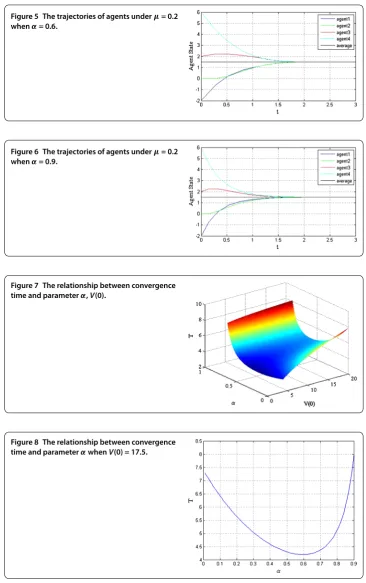
LettingdTu(α)/dα= , we getα= – /ln(V()λ(D)). Therefore, given that <α< , ifV()λ(D) <E/, then the convergence time increases as increases; ifV()λ(D) >E/, then the convergence time decreases initially and then increases asαbecomes large, and whenα= – /ln(V()λ(D)), the convergence time gets the minimum value. Generally, the value ofV()λ(D) is always large, and to reduce the convergence time, we can set α= – /ln(V()λ(D)).
Remark Convergence time is defined as the amount of time the system consumes to reach a consensus. The precise convergence time of the studied nonlinear protocol is dif-ficult to obtain. The above conclusions were obtained based on the upper bound of con-vergence time in equation ().
4 Simulations
In this section, the simulations are conducted to verify the efficiency of the conclusions. Consider the multiagent system withn= agents. The communication topology is shown in Figure , and the communication weight is assumed to be . Through calculation we can obtainλ(L) = andL= . We suppose that the initial state is [–, , , ]T.
The trajectories of agents under protocol () whenα= . andμ= . are shown in Fig-ure . We can see that the final consensus state isni=xi()/ = .. Thus, protocol () can solve the finite-time average consensus problem. Figure shows the evolution of the error norm of agent under protocol (). The red solid line represents the evolution ofe(t). It stays below the specified state-dependent thresholde(t)max= (μ(λ(D))
(+α)/
Figure 1 The communication topology of four agents.
Figure 2 The trajectories of agents under α= 0.3,μ= 0.2.
Figure 3 The evolution of the error norm of agent 1 underα= 0.3,μ= 0.2.
Figure 4 The evolution of the control input of agents underα= 0.3,μ= 0.2.
which is represented by the blue dotted line in the figure. Figure shows the evolution of the control input of agents under protocol (). We can see that the control input is a piece-wise constant value. Moreover, when the system error norm is small, the control input is small, and when the control input tends to zero, the system reaches equilibrium states.
Whenμ= ., the trajectories of agents underα= . andα= . are shown in Fig-ures and , respectively. Comparison with Figure and FigFig-ures and shows that if V()λ(D) >E/ whenα= – /ln(V()λ(D)) (approximately . in this paper), the convergence time is shorter than that whenα= . andα= ..
Figure 5 The trajectories of agents underμ= 0.2 whenα= 0.6.
Figure 6 The trajectories of agents underμ= 0.2 whenα= 0.9.
Figure 7 The relationship between convergence time and parameterα,V(0).
Figure 8 The relationship between convergence time and parameterαwhenV(0) = 17.5.
5 Conclusions
We presented a novel finite-time average consensus protocol based on event-triggered control strategy for multiagent systems, which guarantees the system stability. The upper bound of convergence time was obtained. The relationship between convergence time and protocol parameter with initial state was analyzed. The following conclusions were obtained from simulations.
() The proposed protocol can solve the finite-time average consensus problem. () The lower bound of the interevent time was obtained to guarantee that there is no
Zeno behavior.
() The larger the difference in the initial state, the longer the convergence time. Moreover, ifV()λ(D) >E/, then the convergence time decreases initially, then increases asαbecomes large, and whenα= – /ln(V()λ(D)), the convergence time gets the minimum value.
In this paper, the authors only considered first-order multiagent systems. Our future works will focus on extending the conclusions to second-order or higher-order multiagent systems with switching topologies, measurement noise, time delays, and so on.
Acknowledgements
This project was supported by the National Natural Science Foundation of China (Grant No. 61603414). We would like to express our appreciation to the anonymous referees and the Associate Editor for their valuable comments and suggestions.
Competing interests
The authors declare that there is no conflict of interests regarding the publication of this paper.
Authors’ contributions
All authors contributed equally and significantly in writing this article. All authors read and approved the final manuscript.
Author details
1College of Defense Engineering, PLA University of Science and Technology, Nanjing, 210007, China.2Research Center of Costal Defense Engineering, Beijing, 100841, China.
Publisher’s Note
Springer Nature remains neutral with regard to jurisdictional claims in published maps and institutional affiliations.
Received: 25 May 2017 Accepted: 20 September 2017
References
1. Olfati-Saber, R, Fax, JA, Murray, RM: Consensus and cooperation in networked multi-agent systems. Proc. IEEE95(1), 215-233 (2007)
2. Davoodi, M, Meskin, N, Khorasani, K: Simultaneous fault detection and consensus control design for a network of multi-agent systems. Automatica66(5), 185-194 (2016)
3. Li, H, Karray, F, Basir, O, Song, I: A framework for coordinated control of multi-agent systems and its applications. IEEE Trans. Syst. Man Cybern., Part A, Syst. Hum.38(3), 534-548 (2008)
4. Olfati-Saber, R: Flocking for multi-agent dynamic systems: algorithms and theory. IEEE Trans. Autom. Control51(3), 401-420 (2006)
5. Dong, W, Farrell, JA: Decentralized cooperative control of multiple nonholonomic dynamic systems with uncertainty. Automatica45(3), 706-710 (2009)
6. Fax, JA, Murray, RM: Information flow and cooperative control of vehicle formations. IEEE Trans. Autom. Control49(9), 1465-1476 (2004)
7. Freeman, RA, Yang, P, Lynch, KM: Distributed estimation and control of swarm formation statistics. In: American Control Conference, pp. 749-755 (2006)
8. Olfati-Saber, R: Swarms on sphere: a programmable swarm with synchronous behaviors like oscillator networks. In: 45th IEEE Conference on Decision and Control, pp. 5060-5066 (2006)
9. Dimarogonas, DV, Johansson, KH: Event-triggered cooperative control. In: European Control Conference, pp. 3015-3020 (2009)
10. Heemels, WPMH, Johansson, KH, Tabuada, P: An introduction to event-triggered and self-triggered control. In: IEEE 51st Annual Conference on Decision and Control, pp. 3270-3285 (2012)
12. Dimarogonas, DV, Frazzoli, E, Johansson, KH: Distributed event-triggered control for multi-agent systems. IEEE Trans. Autom. Control57(5), 1291-1297 (2012)
13. Davoodi, MR, Meskin, N, Khorasani, K: Event-triggered fault detection, isolation and control design of linear systems. In: International Conference on Event-Based Control, Communication, and Signal Processing, pp. 1-6 (2015) 14. Seyboth, GS, Dimarogonas, DV, Johansson, KH: Event-based broadcasting for multi-agent average consensus.
Automatica49(1), 245-252 (2013)
15. Fan, Y, Feng, G, Wang, Y, Song, C: Technical communique: distributed event-triggered control of multi-agent systems with combinational measurements. Automatica49(2), 671-675 (2013)
16. Fan, Y, Liu, L, Feng, G, Wang, Y: Self-triggered consensus for multi-agent systems with Zeno-free triggers. IEEE Trans. Autom. Control60(10), 2779-2784 (2015)
17. Wang, R, Xing, J, Wang, P, Yang, Q, Xiang, Z: Finite-time stabilization for discrete-time switched stochastic linear systems under asynchronous switching. Trans. Inst. Meas. Control36(5), 588-599 (2014)
18. Huang, T, Li, C, Duan, S, Starzyk, J: Robust exponential stability of uncertain delayed neural networks with stochastic perturbation and impulse effects. IEEE Trans. Neural Netw. Learn. Syst.23(6), 866-875 (2012)
19. Wang, L, Xiao, F: Finite-time consensus problems for networks of dynamic agents. IEEE Trans. Autom. Control55(4), 950-955 (2010)
20. Zuo, Z, Lin, T: A new class of finite-time nonlinear consensus protocols for multi-agent systems. Int. J. Control87(2), 363-370 (2014)
21. Feng, Y, Li, C, Huang, T: Periodically multiple state-jumps impulsive control systems with impulse time windows. Neurocomputing193, 7-13 (2016)
22. Wang, X, Li, J, Xing, J, Wang, R, Xie, L, Zhang, X: A novel finite-time average consensus protocol for multi-agent systems with switching topology. Trans. Inst. Meas. Control (2016). doi:10.1177/0142331216663617 23. Zhu, Y, Guan, X, Luo, X, Li, S: Finite-time consensus of multi-agent system via nonlinear event-triggered control
strategy. IET Control Theory Appl.9(17), 2548-2552 (2015) 24. Godsil, C, Royle, GF: Algebraic Graph Theory. Springer, Berlin (2013)
25. Bhat, SP, Bernstein, DS: Finite-time stability of continuous autonomous systems. SIAM J. Control Optim.38(3), 751-766 (2000)
26. Lick, WJ: Difference Equations from Differential Equations. Springer, Berlin (1989)