2018 International Conference on Computer, Communication and Network Technology (CCNT 2018) ISBN: 978-1-60595-561-2
AutoNet: Knowledge Graphs for Occasions Object Recognition
Zheng LIU* and Yang HUANG
School of Software Engineering, University of Science and Technology of China, Suzhou, Jiangsu 215123, China
*Corresponding author
Keywords: Knowledge graphs, GGNN, Object recognition, GG-CSNN.
Abstract. Object recognition in images fields is a novel and importance challenge in Computer
Vision. We can through computer vision algorithms, which is the ability to acquire various knowledge about the world. Meanwhile, we are utilized knowledge to understanding about the visual world. However, the present have many state-of-the-art algorithms, which is include deep learning, but focus on using images of features to implementation applications. We have been neglected the vast amount of background knowledge of relations about the real world. In this paper, we have proposal a novel knowledge graphs framework for occasions object recognition called AutoNet, which shows using this knowledge graphs improves performance on image recognition. We utilize end-to-end learning on graphs, which is introducing the Gated Graph Neural Network (GGNN) and the Gated Graph Choose Search Neural Network (GG-CSNN) as a way of efficiently incorporating large knowledge graphs into a computer vision recognition pipeline. We have a novel method, which is a hierarchical approach for generating descriptive images paragraphs and generating a text to knowledge extraction. We have demonstrated through experiments that our method outperforms the general neural network approach through the datasets of MSCOCO-2015 and VOC2012 for images recognition.
Introduction
Image classification attracts increasing research interests in computer vision community due to its potential applications in video surveillance, human computer interaction, and image content analysis. However, image classification remains as a difficult problem when focusing on realistic datasets collected from movies, web images, and TV shows. Currently, the method available for image classification can be divided into two types. Early works utilized hand-crafted local descriptors for image representation and classification. Many types of hand-crafted local features are proposed to represent the image include HOG [1], SIFT [2], and LBP [3]. Inspired by the remarkable successes of deep learning for image recognition, recent works have explored deep convolutional neural networks (CNN) for image classification. A class of models such as VGG [4], Res-net [5] et al. which enable image description learning was first proposed in and shows that this theme is generally applicable to visual content modeling. However, most of the method only focus on extracting local image features from the image, which prevent them from learning the relationship between different kind of the class, so that output many classification results which is offensive to the common sense. For example, a classical deep learning-based model such as Faster-RCNN sometimes detect both a bicycle and an elephant on one image which is nearly impossible in nature environment.
between different label of content can surely improve the accuracy of image classification. The reason why knowledge graph is useful for image recognition is that two concepts with a higher degree of semantic consistency are more likely to appear in the same image with comparable probability. However, the way that using knowledge graph to improve the image classification accuracy still need a long way to go.
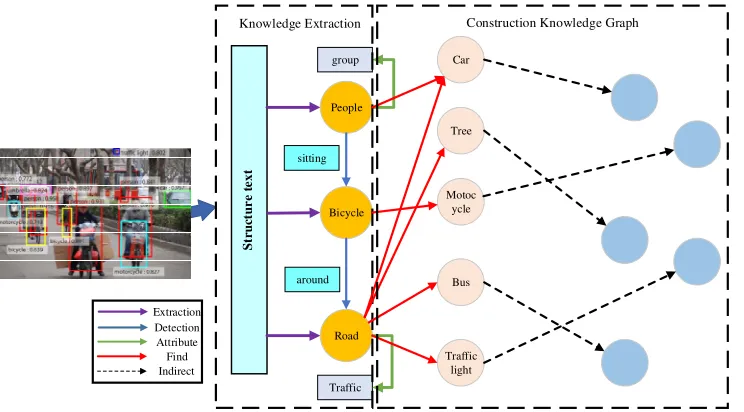
Motivated by these analysis, this paper tries to get the best way to train an image classification model with the incorporation of knowledge graph. We think the method of knowledge graph can automatically represent the relation between class, which is effective for the accuracy improvement of recognizing class with relationship in one image. To accomplish the goal of this problem, we propose an improved knowledge graph-based image classification framework called AutoNet. Figure 1 provides an overview.
People
Bicycle
Road
S
tr
u
ct
u
r
e
te
x
t sitting
around group
Traffic
Bus Car
Tree
Traffic light Motoc
ycle Knowledge Extraction
Extraction Detection Attribute Find Indirect
[image:2.612.130.502.209.415.2]Construction Knowledge Graph
Figure 1. The image to Unstructured Text display and used Unstructured Text for generating the entity nodes of knowledge graph. We employ scheme that knowledge extraction entity nodes to mapping in the
set as initial nodes, then, through neural graph network for learning a Knowledge Graphs.
The major contributions of this paper can be listed as follows: (a) the introduction of build knowledge graph from the structure context generating from the image; (b) a framework for using knowledge graphs for image classification; (c) the experiment shows that our method achieves the state-of art accuracy for multi-label classification.
Related Work
In recent years, many researches go further and use knowledge graph to investigate the relation between different object in the image which helps improving the understanding of the image. For example, in [11], Fang et al. propose a novel framework of knowledge-aware object detection, which enables the integration of knowledge graphs into any object detection algorithm. The framework employs the notion of semantic consistency to quantify and generalize knowledge, which improves object detection through a preoptimization process to achieve better consistency with background knowledge. In [12], Lee et al. Propose a novel architecture of knowledge-aware multi-label zero-shot learning algorithm, which incorporates knowledge graphs for describing the relationships between multiple labels and is able to predict multiple unseen class labels for each in- put instance. In [13], Li et al. Propose a framework that use knowledge graph the problem of recognizing situations in images. In this paper, the situation is recognized through a model based on Graph Neural Networks to efficiently capture joint dependencies between roles using neural networks defined on a graph.
Methodology
Image to Graph Neural Models
Images to Unstructured Text. There are many ways to build a graph neural model. We adopt that
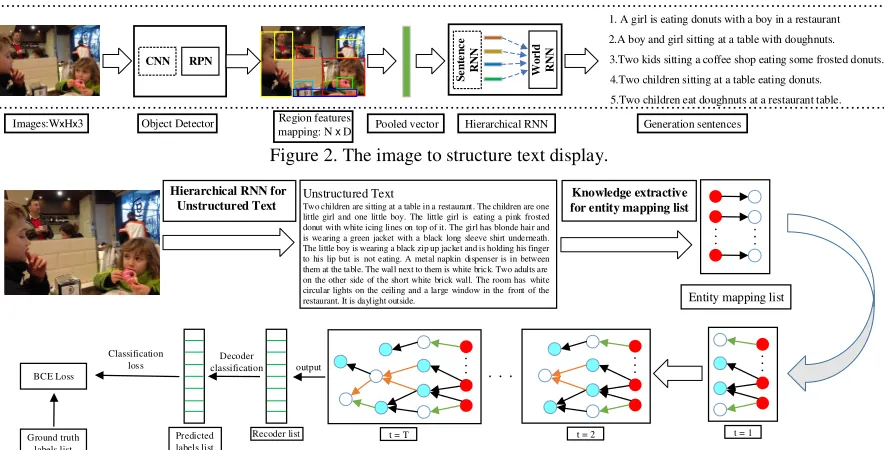
a hierarchical approach for generating descriptive images paragraphs for generating unstructured text. Figure 2 provides an overview. This is a model for generating text to description an image. We thought input an image to this model, which we first decompose the input an image by detecting entity objects and included some regions of interest. Then, we employ aggregate features mapping to across these regions to generation a pooled representation richly describing the image semantics. What’s more, these feature vectors input to the hierarchical recurrent neural network composed of two levels, which is a sentence recurrent neural network and a word recurrent neural network. The sentence recurrent neural network receives the image of some feature mapping vectors, which is decided how many sentences to produce in the resulting paragraph and each sentence have generated an input topic vector. Given this topic vector, the word recurrent neural network generates the words of each a sentence.
CNN RPN
S
e
n
te
n
c
e
R
N
N
W
o
rl
d
R
N
N
1. A girl is eating donuts with a boy in a restaurant 2.A boy and girl sitting at a table with doughnuts. 3.Two kids sitting a coffee shop eating some frosted donuts. 4.Two children sitting at a table eating donuts. 5.Two children eat doughnuts at a restaurant table. Images:WxHx3 Object Detector Region features
[image:3.612.86.528.453.678.2]mapping: N x D Pooled vector Hierarchical RNN Generation sentences Figure 2. The image to structure text display.
Unstructured Text
Two children are sitting at a table in a restaurant. The children are one little girl and one little boy. The little girl is eating a pink frosted donut with white icing lines on top of it. The girl has blonde hair and is wearing a green jacket with a black long sleeve shirt underneath. The little boy is wearing a black zip up jacket and is holding his finger to his lip but is not eating. A metal napkin dispenser is in between them at the table. The wall next to them is white brick. Two adults are on the other side of the short white brick wall. The room has white circular lights on the ceiling and a large window in the front of the restaurant. It is daylight outside.
Hierarchical RNN for Unstructured Text
Knowledge extractive for entity mapping list
Entity mapping list
t = 1 t = 2
t = T output
Recoder list Decoder classification
Predicted labels list Ground truth
labels list BCE Loss
Classification loss
Figure 3. The image can generation a paragraphs Unstructured Text, and the Unstructured Text produce graph entity nodes mapping and expended progress.
Unstructured Text for Knowledge Extraction Entity. We thought images for generating those
knowledge graph. In [14], introduce produce word vector from the context. Figure 3 displays image to unstructured text and we used method word mapping to a set of entity nodes mapping in unstructured text. The aim of the knowledge extraction entities information is to map an entity in unstructured text to as output for taking as initialization of the graph neural network.
In the knowledge extraction entity mapping model, entities are recognized from unstructured text to create a set of extracted entities to "Emapping = {ex: entities}". In the unstructured text, if entity
nodes extracted information recognized, we need to create a set of new entity. However, if an extracted entity node can be mapped to an existing entity node in any knowledge graphs, we should be a mapping of resource (Through to map an entity node in unstructured text) to use as a representative for the extracted entity node. For example, consider "Emapping = {road: car}". If the
entity car in unstructured text is mapped to entity mapping and takes as a new initial entity.
AutoNet for Occasions Object Recognition Task Definition
We extract entity mapping set denoted as Emappingfrom unstructured text, and we assumes a discrete
set of verbs V nouns N, entity roles E , and images switch to unstructured text I.Each variable
∈
v V ,n∈N , and e∈E ,is associated with an image from unstructured text. Each e∈Ei and
∈ i mapping
e E (here
∈
i I) is paired with a noun value ne =N ∪ Ω{ }here Ω is indicates that the noun
is unknown variables.
A set of entity roles is composed of nouns, verbs and entity in unstructured text from the image, and we are denoted that entity roles representation as Ei ={( ,e ne) | ,v ei ∈E ii, ∈I},where each role is with a noun. For a given image, we first turn it into unstructured text and then extract the knowledge from it. On the other hand, our task is to get the entity role Ei={( ,e ne) | ,v ei ∈E ii, ∈I}, by
extracting the knowledge information.
Gated Graph Neural Networks
In Graph Neural Network, there is no point in initializing entity node representations for input in the graph neural network, because of the contraction map constraint ensures that the fixed point is independent of the initializations. However, this is no longer the case with Gated Graph Neural Network (GGNN), which lets us incorporate labels of entities nodes, and take as inputs. To representation these entities nodes labels used as inputs from the ones introduced before, we call them node annotations, and these entities nodes to annotations denoted as vector x.
We adopt the GGNN framework to object recognize in images. The GGNN is a graph with N nodes, we can produce some output, which can be an output some nodes o o1, 2,...,on in graph. Each
an image i turn into unstructured text is associated with generating noun n verb v that corresponds
to an image with a set of entities roles Ei. We instantiate a graph Gi( , )E V for each image, which is
turn into unstructured text generation entity node E and Edges variables V , here Edges in the graph
( , )
= s t
V E E represent the edge between entity node s and node t.We used Chain RNN structure,
which is done by learning a propagation Chain RNN similar to an LSTM.
For each entity node in the graph structure e we have a hidden state representation h te( ) at every
time step t. We start at t=0 with initial hidden states xe that depends on the problem. To illustrate
how the entity node annotations are used, consider an task of learning training a graph neural network to solve reach ability task, which is whether entity node s can be reached from next entity node t on
the graph. We used two bits vector that indicates whether an entity node is the source or destination node. For instance, we assume a set xs =[1, 0]
, xt =[0,1]
, and xv =[0, 0]
for any other node v. In this reachability task example, if all nodes reachable from matrix variables A have their first bit of
node representation set to 1 after the propagation update node, then a classifier can easily tell whether node s is reachable from tusing the node representations. At the same time, how to a node
similar to Chain RNN. The basic recurrence of the propagation network can be expressed as the following formula:
( )1
, 0
v v
h =x
(1)
( )1 ( 1) ( 1)
1
t t
v v N
a =A h − …h − +b
(2)
( ) ( )
(
t t1)
t z z
v v v
z =σ W α +U h −
(3)
( ) ( )
(
t t1)
t r r
v v v
r =σ W α +U h −
(4)
( ) ( )
(
)
(
)
~
1
tanh t t
t t
v v v v
h = Wa +U r h −
(5)
(
)
( 1) ~1 t
t t t t
v v v v v
h = −z h − +z h
(6) Where hv( )t is the propagation hidden state for node v at time step t, xv is the initial specific
annotation, Av is the the adjacency matrix of the graph for node v, and here
σ
( ) 1 / (1 exp )−
= + x
x is
the logistic sigmoid function. The parameters W and U is learned value in the GGNN. What’s more, equation 1. is represented initialization of hidden state. The equation 2. is indicated the propagation updates. The equation 3 to 6 shows that compute next hidden state for the adjacent nodes and current hidden state of the nodes.
When propagation T time steps after, we can produce final hidden states nodes, and the node can
be computed as:
(
T,)
v v v
o =g h x
(7) Where g is a fully connected network, the
v
x is initial entity node annotation.
Gated Graph Choose Search Neural Network
In [15], from the important point of view of GGNN structure computation of a large number of task images will result in difficult convergence, and computational scalability. To address, we employ Gated Graph Choose Search Neural Network(GG-CSNN) for learning Graph Neural Network. However, we don’t update all nodes at once, because of all nodes make a large of computing and complexion. Therefore, we propose a method, which is conditional selection of initial nodes to output useful nodes in our network model. Thus, we only need to compute the update steps over a subset of the graph. How do we choose the initial node by generating entities nodes? We utilize score ways for some chosen threshold, and we select the corresponding entities nodes over threshold in the graph network as our initial set of active entities nodes. When we determine the initialized node, we also want to add an adjacent node to the initial node set, but often propagation once all the adjacent nodes will be added to the initial node set. In order to reduce the addition of adjacent nodes, we propose a method for deciding which nodes to expand next. We use a scoring strategy on the output entities pre-nodes and learn an entities per-nodes scoring strategy function for estimates the important of entities nodes how.
( )t
(
,)
v i v v
s =g h x
( )
(
)
(
)
( )( )
tanh vT, v tanh vT v
h s h x h
ξ σ
=
∑
(9)where equation 8 of giis learned Pivotal Network, each node v output node scores and applying a
softmax over node scores. For graph-level outputs, we define a graph level representation vector as equation 9, here ( ( )T , )
v v
s h x is a neural network that takes the concatenation of ( )T v
h and
v
x as input and
outputs real-valued scores. In the learning network process, we used the top Kscoring entities nodes, which add them to our expanded active node set. What’s more, we take add all entities nodes adjacent to those nodes to our active node set. Figure 3 illustrates a graph generate and entity node expansion from an Unstructured Text in the images. To train the Pivotal Network, we assign target score value
to each entity node in the graph network from the unstructured text for a given image. Entity nodes corresponding to ground truth nodes concepts in an image are assigned a score value of 1, At the same time, those adjacent nodes are assigned a score value of ξ. The entity nodes which are two steps
away have score value 2
ξ and so on. Only this idea, the final output of the node is the most pivotal expansion. Our graph network is an end-to-end structure. The input to the network is the initial set of entity nodes and corresponding annotations, and output is the predicted entity node to the active node set in the graph network. The graph network consists of have three parts components: the propagation components, the Pivotal Network and output component respectively. In the step 0, the initial entity node xinit , and the detection confidence node
(1)
init
h , the initial entity nodes that detected in the hidden
states. The hadj(1)1=0 is hidden states of the adjacent nodes. Then, we used propagation component to
update the hidden states. The Pivotal Network is output nodes score s(1)by the value of h(2). The output score s(1)are used to choose the next nodes to add set of
2
adjacent . These entities adjacent
nodes are initialized with (2) 2=0 adj
h and we are update again hidden states through the propagation
component. Continue to iterate until after T step, we can predict the GG-CSNN outputs for all the active entity nodes set. We utilized binary cross entropy loss (BCE−loss) function as fed backward through the output component in the back-propagation process. What’s more, the Pivotal Network loss are fed network parameters through learning and updating. In GGNN, output entity pre-node through ov =g h( v( )T ,xv)function, which need the hidden state
( )T v
h and initial annotation xvof the
entity node v to compute. We consider the entity nodes could represented various of relationship to compute in the graph. Thus, we need a more relevant and close entity nodes, and we want to constrain the conceptual relationship in the unstructured text. We introduce bias node term (βv), which has
some learned values in our graph every entity node. So, the output of GGNN is ov =g h( v( )T ,xv,
β
v),here βv is a particular entity node v bias term in the overall graph. Through the above structure can
be our AutoNet, which is knowledge graphs for occasions object recognition.
Evaluation
To evaluate the performance of our proposed method for image classification, we perform experiments on several different datasets. The results of the experiments are promising, which indicates that our knowledge graph-based image classification method outperform the state-of-art methods in the classification accuracy.
Dataset
contains 91 common object categories with 82 of them having more than 5,000 labeled instances. In total the dataset has 2,500,000 labeled instances in 328,000 images. The VOC2012 dataset consists of annotated consumer photographs collected from the flickr2 photo-sharing website. After deduplication, random images from the set of 500,000 were presented to the annotators for annotation. During the annotation event, 44,269 images were considered for annotation, being either annotated or discarded as unsuitable for annotation e.g. containing no instances of the 20 object classes, according to the annotation guidelines, or being impossible to annotate correctly and completely with confidence.
Baseline
To evaluate our method, we compare its performance with some baseline method. VGG: A famous 19-layer CNN architecture that ranked 2nd place in ILSVRC 2014 image classification competition, which is widely used in many image classification taks for its excellent performance in transfer learning. ResNet: A widely used 152-layer CNN architecture that ranked 1st place on the ILSVRC 2015 classification task. The ensemble of serveral residual nets achieves 3.57% error on the ImageNet test set, which is a large improvement of the former work. SENet: The newest image classification benchmark that won the first place in ILSVRC 2017 classification task with achieving a < 25% relative improvement over the winning entry of 2016. GSNN: The recent work that investigate the use of knowledge graph to improve the performance on image classification. This work use guns as a way of incorporating potentially large knowledge graphs into an end-to-end learning system and propose a framework for using noisy knowledge graphs for image classification, which significantly outperforms baselines for multi-label classification.
Implementation
We use the TensorFlow implement of paper: A Hierarchical Approach for Generating Descriptive Image Paragraphs to generate the image description. After generating the description, we use MSCOCO-15 and VOC2012 as a source for our knowledge graph. Using only the train split, we build a knowledge graph connecting the concepts using the most common object-attribute and object-object relationships in the dataset. Specifically, we counted how often an object/object relationship or object/attribute pair occurred in the training set, and pruned any edges that had fewer than 200 instances. This leaves us with a graph over all of the images with each edge being a common relationship. The idea is that we would get very common relationships (such as grass is green or person wears clothes) but not relationships that are rare and only occur in single images (such as person rides zebra). Training is done by stochastic gradient algorithm (SGD) and Momentum with mini-batch size of 20 examples. Initial learning rate is = 0:04 and attenuation factor is set to = 0:5, and is divided by 4 every 10 epochs. The optimization is stopped at 60 epochs. We set our GG-CSNN hidden state size to 10, importance factor to 0.3, number of time steps T to 3, initial confidence threshold to 0.5 and our expand number P to 5. Our GG-CSNN pivotal and output networks are single layer networks with sigmoid activations. The configuration of the training computer is Ubuntu 16.04, an NVIDIA Titan X, CUDA8.0 and cuDNN V5.
[image:7.612.90.522.627.704.2]Result and Analysis
Table 1. Comparison of our knowledge-aware approaches with baselines on COCO15 and VOC12.
Method MSCOCO VOC
VGG 89.7 70.6
ResNet 90.8 71.8
SENet 91.3 72.9
GSNN 91.3 73.1
AutoNet 91.7 73.6
outperforms the state-of-art method by up to 0.5 and 0.8, respectively. This suggests that including the outside semantic knowledge from WordNet and performing explicit reasoning on a knowledge graph allows our model to learn better representations compared to the other models.
In Table 2, we show detail results on the MSCOCO-15 multi-label dataset of every class. We can see from the result that our knowledge graph based image classification method obtains improvement on most of the classes in the MSCOCO-15 dataset compared to the state-of-art method. We can see that the boost from using graph knowledge is more significant than it was on VOC2012. One possible explanation is that the VOC2012 knowledge graph provides significant information which helps improve the performance on the COCO dataset itself.
Table 2. Comparison of AP and mAP in of our model and state-of-the-art methods on the PASCAL VOC 2012 dataset. Method mAP aero bike bird boat bottle bus car cat chair cow table dog VGG 89.7 98.9 95.0 96.8 95.4 69.7 90.4 93.5 96.0 74.2 86.6 87.8 96.0 ResNet 90.8 98.8 97.2 98.1 95.7 75.6 94.6 95.7 97.6 73.2 90.3 80.2 97.2 SENet 91.3 98.5 96.6 95.9 95.8 73.9 92.3 95.7 96.9 76.9 92.5 87.6 96.7 GSNN 91.3 97.7 97.3 96.6 95.7 74.3 91.2 96.7 96.8 75.1 89.7 87.3 96.2 AutoNet 91.7 98.6 97.6 96.5 96.3 78.8 92.6 96.7 97.5 83.3 92.7 90.2 96.8
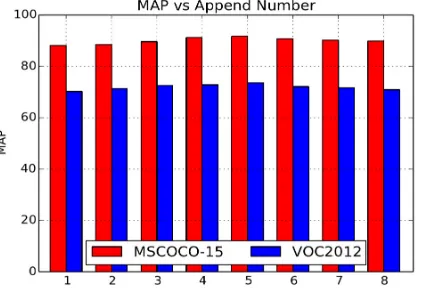
[image:8.612.203.415.374.520.2]In this graph network, we set the expand number of GGCSNN in each iteration step to 5, this selection is based on the result of the experiment. At first, we set the expand number of the system to 1, which means that in each iteration step of GG-CSNN we only append one new node to the knowledge graph. Then, at each time we add the number of expand number one by one. We can see from figure 4 that when the expand number is larger than 5, the mAP tends not to become better with the raise of expand number and the mAP various small when the expand number is 1, 2, 3, and 4. In consideration of the accuracy in the experiment, we choose the sensor number as two.
Figure 4. Comparison of AP and mAP in of our model and stateof-the-art methods on the PASCAL VOC2012 dataset. Comparison of our knowledge-aware approaches with baselines on COCO15 and VOC12.
The assessment performance between different expand number.
Conclusion
generation method, more accuracy knowledge graph generation method etc., and we will also apply our method on more dataset. In addition, we may also try to apply multi-modal sources to create the knowledge graph to find weather it can get higher performance.
References
[1] N. Dalal and B. Triggs. Histograms of oriented gradients for human detection. In 2005 IEEE Computer Society Conference on Computer Vision and Pattern Recognition (CVPR’05), volume 1, pages 886–893 vol. 1, June 2005.
[2] D. G. Lowe. Object recognition from local scale-invariant features. In Proceedings of the Seventh IEEE International Conference on Computer Vision, volume 2, pages 1150–1157 vol. 2, 1999.
[3] T. Ojala, M. Pietikainen, and T. Maenpaa. Multiresolution gray-scale and rotation invariant texture classification with local binary patterns. IEEE Transactions on Pattern Analysis and Machine Intelligence, 24(7):971–987, Jul 2002.
[4] Karen Simonyan and Andrew Zisserman. Very deep convolutional networks for large-scale image recognition. CoRR, abs/1409.1556, 2014.
[5] Kaiming He, Xiangyu Zhang, Shaoqing Ren, and Jian Sun. Identity mappings in deep residual networks. CoRR, abs/1603.05027, 2016.
[6] Sören Auer, Christian Bizer, Georgi Kobilarov, Jens Lehmann, Richard Cyganiak, and Zachary Ives. Dbpedia: A nucleus for a web of open data. In Karl Aberer, Key-Sun Choi, Natasha Noy, Dean Allemang, Kyung-IlLee, Lyndon Nixon, Jennifer Golbeck, Peter Mika, Diana Maynard, Riichiro Mizoguchi, Guus Schreiber, and Philippe Cudré-Mauroux, editors, The Semantic Web, pages 722–735, Berlin, Heidelberg, 2007. Springer Berlin Heidelberg.
[7] Kenneth Marino, Ruslan Salakhutdinov, and Abhinav Gupta. The more you know: Using knowledge graphs for image classification. CoRR, abs/1612.04844, 2016.
[8] Alex Krizhevsky, Ilya Sutskever, and Geoffrey E. Hinton. Image net classification with deep convolutional neural networks. In Proceedings of the 25th International Conference on Neural Information Processing Systems-Volume 1, NIPS’12, pages 1097–1105, USA, 2012. Curran Associates Inc.
[9] Jie Hu, Li Shen, and Gang Sun. Squeeze and-excitation networks. CoRR, abs/1709.01507, 2017.
[10] Xiangyu Zhang, Xinyu Zhou, Mengxiao Lin, and Jian Sun. Shufflenet: An extremely efficient convolutional neural network for mobile devices. CoRR, abs/1707.01083, 2017.
[11] Jie Lin, Cheston Tan, Vijay Chandrasekhar, Yuan Fang, Kingsley Kuan. Object detection meets knowledge graphs. In Proceedings of the Twenty-Sixth International Joint Conference on Artificial Intelligence, IJCAI17, pages 1661–1667, 2017.
[12] Chung-Wei Lee, Wei Fang, Chih-Kuan Yeh, and Yu-Chiang Frank Wang. Multi-label zero-shot learning with structured knowledge graphs. CoRR, abs/1711.06526, 2017.
[13] Ruiyu Li, Makarand Tapaswi, Renjie Liao, Jiaya Jia, Raquel Urtasun, and Sanja Fidler. Situation recognition with graph neural networks. CoRR, abs/1708.04320, 2017.
[14] N Kertkeidkachorn and Richise. T2kg: An end-to-end system for creating knowledge graph from unstructured text. In Proceedings of AAAI Workshop on Knowledge-based Techniques for Problem Solving and Reasoning, pages 743–749, 2017.