R E S E A R C H A R T I C L E
Open Access
Differences between patients with chronic
widespread pain and local chronic low back pain
in primary care - a comparative cross-sectional
analysis
Annika Viniol
1*, Nikita Jegan
1, Corinna Leonhardt
1, Markus Brugger
2,3, Konstantin Strauch
2,3, Jürgen Barth
4,
Erika Baum
1and Annette Becker
1Abstract
Background:Chronic pain is a common reason for consultation in general practice. Current research distinguishes between chronic localized pain (CLP) and chronic widespread pain (CWP). The aim of this study was to identify differences between CWP and chronic low back pain (CLBP), a common type of CLP, in primary care settings. Methods:Fifty-eight German general practitioners (GPs) consecutively recruited all eligible patients who consulted for chronic low back pain during a 5-month period. All patients received a questionnaire on sociodemographic data, pain characteristics, comorbidities, psychosomatic symptoms, and previous therapies.
Results:GPs recruited 647 eligible patients where of a quarter (n = 163, 25.2%) met the CWP criteria according to the American College of Rheumatology. CWP patients had significantly more comorbidities and psychosomatic symptoms, showed longer pain duration, and suffered predominantly from permanent pain instead of
distinguishable pain attacks. CWP patients were more often females, are less working and reported a current pension application or a state-approved grade of disability more frequently. We found no other differences in demographic parameters such as age, nationality, marital status, number of persons in household, education, health insurance status, or in health care utilization data.
Conclusions:This project is the largest study performed to date which analyzes differences between CLBP and CWP in primary care settings. Our results showed that CWP is a frequent and particularly severe pain syndrome. Trial registration:German Clinical Trial Register, DRKS00003123.
Keywords:Chronic low back pain, Chronic widespread pain, Chronic localized pain
Background
Chronic pain is a common reason for consultation in gen-eral practice. Current research distinguishes between chronic localized pain (CLP) and chronic widespread pain (CWP). CLP is defined as chronic pain restricted to one or few body regions (e.g. head, back, or knee). In contrast, CWP means chronic pain in several body regions. The American College of Rheumatology (ACR) defines CWP as pain in the left and right side of the body, as well as
above and below the waist plus pain in the axial skeleton [1]. It is still unclear whether CWP is a complication of CLP or an independent pain syndrome [2].
Population based studies reported a CWP point-prevalence of 4.7%-15% depending on the country [3-8]. Nordeman et al. found a CWP prevalence of 28% in a sample of female chronic low back pain (CLBP) patients consulting primary care in Sweden [9]. The high CWP prevalence and the associated high social and economic burden for patients and health care systems [10] illus-trate the need for further knowledge about CWP.
Several studies have investigated differences in physical and psychological factors between CWP patients and * Correspondence:[email protected]
1
Department of General Practice/Family Medicine, University of Marburg, Karl-von-Frisch-Str. 4, 35043 Marburg, Germany
Full list of author information is available at the end of the article
healthy adults: CWP patients are more frequently fe-male, older, less educated [11], have a decreased health-related quality of life [7,11], are less physically active [12], and a receive disability pension more often [13] than patients without pain. They show a high prevalence of physical and psychological comorbidities [4,6,14-17] and an increased mortality risk [18].
In addition to differences in the pain distribution, it is also important to know if CWP patients are more nega-tively affected in other wellbeing areas when compared to CLP patients.
To date, few studies have examined differences between CWP and CLP. Two studies present population based data on neck-shoulder pain [19] and myofacial face pain [20]. They found a higher rate of pain intensity, pain duration, de-pression, and somatization symptoms among CWP patients. Among all CLP syndromes, CLBP is the most common [21]. Back pain is the second most frequent consultation reason in German primary care practices [22].
Only one study investigated differences of CLBP and CWP in primary care patients: Nordeman et al. [9] found an increased rate of activity limitation, impaired physical performance, work disability, severe pain, tender points, fatigue, depression, and severe clinical stress symptoms in CWP patients compared to CLBP patients. The authors also reported a lower health-related quality of life and a re-duced private social support in CWP patients [9]. How-ever, Nordeman et al. studied only women.
The aim of this study is to identify differences between CWP and chronic low back pain (CLBP), a common type of CLP, in primary care settings. This would enable us to suggest priorities for health care interventions in CWP.
Methods
Study design
The present study refers to the cross sectional baseline analysis of a 12-month cohort study which evaluates risk factors and protective factors of pain generalization in primary care CLBP patients. A detailed study protocol has been published elsewhere [23].
This project is part of the research consortium LOGIN
“Localized and Generalized Musculoskeletal Pain:
Psycho-biological Mechanisms and Implications for Treatment”
funded by the German Federal Ministry of Education and Research. The study was approved by the local ethics commission of Philipps University in Marburg, Germany (Ethik: 11.06.2010, AZ 88/10) and is in accordance with the Declaration of Helsinki.
Study population
We invited all general practitioners (GPs) in the north-ern part of Germany’s state of Hessen to participate in our study. We asked participating GPs to consecutively recruit all eligible patients consulting for CLBP as a
primary or secondary consulting reason (inclusion
cri-teria), during a 5-month period. The symptom “chronic
low back pain” was defined as pain in the back area
under the costal arch, but over the bottom fold (with or without pain radiation), during most days in the last three months. Patients under 18 years, pregnant women, and patients with insufficient understanding of the German language or severe cognitive impairments (e.g., dementia) were excluded from the study.
Data collection
Doctors asked patients for study participation directly after consultation. All participating patients received a pen and paper questionnaire. Patients who refrained from participation were asked to give reasons for their decline. During the recruitment period, trained clinical monitors conducted two random quality control checks of the GPs’performance.
Measurements
To explore distinctive features with regards to pain char-acteristics and sociodemographic data between CLBP and CWP patients, we evaluated the following physical and psychological parameters (for detailed information please see Viniol et al. [23]).
Pain characteristics and sociodemographic data
For definition of CLBP and CWP, we assessed pain localization with the body pain drawing model from Pfau et al. [24]. The CWP definition was derived from the ACR criteria from Wolfe et al. [1]. Pain anamnesis was assessed with the German Pain Questionnaire, the offi-cial pain questionnaire of the German Association for the Study of Pain [25]. We chose the modules referring to duration, characteristics, course of pain, sociodemo-graphic data, health care utilization, and medication.
In addition, we used the 3-item social support subscale of the West Haven-Yale Multidimensional Pain Inventory (MPI) to explore the partner’s reaction in response to pa-tient’s pain (internal consistency of the subscales:α= 0.63-0.90) [26,27]. We rated the severity of chronic pain with
the German translation of von Korff’s Graded Chronic
Pain questionnaire [28]. Severity is computed from “pain intensity”and“pain-related disability”(internal consistency of the subscales: α= 0.68-0.88). The lower range of the scale is determined by pain intensity; the higher range of the scale refers to pain intensity and pain-related disability [29].
Comorbidities
disease, diabetes, high blood lipid level, kidney disease, osteoarthritis/degenerative arthritis, rheumatoid arthritis, osteoporosis, cancer disease, depression, other psychiatric diseases) [8,30]. Patients were asked to specify if they suf-fer from any of these traits, whether they receive treat-ment for it, and whether it causes functional limitations.
Psychosomatic symptoms
The Symptom Checklist-90-R (SCL-90-R) assess typical physical symptoms which accompany functional dys-functions, but could also arise in somatic disorders.
The SCL-90-R is a commonly used psychological sta-tus symptom inventory for psychopathology (internal consistency:α= 0.81) [31].
General practitioners case report
Potential red flags, which are frequently used risk factors for identifying serious disorders causing low back pain, were documented by the GPs for each patient [32].
Statistical analysis
We calculated summary statistics (mean, median, stand-ard deviation, percentiles, frequencies, and percentages) for each of the two study groups, i.e., CWP and CLBP.
Testing for differences in outcome variables between CWP and CLBP patients was done using chi-square tests (for categorical data with expected cell frequencies of n≥5), Fisher’s exact tests (for categorical data with ex-pected cell frequencies of n < 5), t-tests accounting for
unequal variances (Welsh tests), and Mann–Whitney U
tests (for ordinal data).
Results
Enrollment of general practitioners and patients
Fifty-eight of the 284-invited GPs (20.4%) participated in the study. The majority of them were male (58.6%), aver-aged 53 years old, and worked in practices with differing sizes from both urban and rural locations and having varying organizational structures (solo/group practices).
During the recruitment period, 746 eligible patients were asked to participate. Seventy-six patients declined participation at once, and fifteen patients withdrew con-sent when seeing the questionnaire. Therefore, 655 par-ticipants completed the questionnaire. We excluded eight additional subjects from analyses because they did not report lower back pain on the pain drawing. A total of, 647 patients were analysed.
Total group characteristics
A quarter of all participating CLBP patients (163, 25.2%) met CWP criteria in the pain drawing. The majority (52.1%) of all CLBP patients reported having back pain for more than ten years. On average, the participating patients were 56.5 years old. The majority was female (61.6%),
married (65.1%), and lived in a two-person household (48.6%). Half of the participants are working (50.5%). Of the non-working participants, 75.2% were retired.
Differences between CLBP and CWP patients
Sociodemographic data
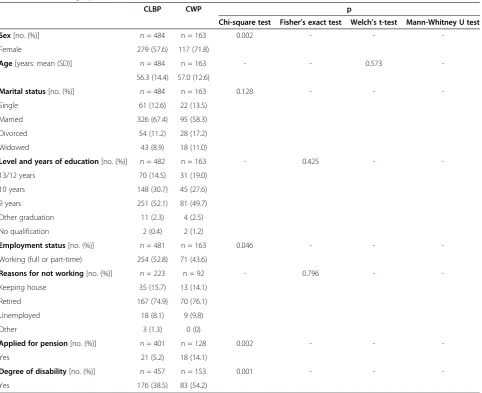
A higher fraction of females was observed among CWP patients compared to CLBP patients (CWP 71.8% vs. CLBP 57.6%). CWP patients were less working (CWP 52.8% vs. CLBP 43.6%). Reasons for not working were comparable between groups. CWP patients more fre-quently reported a current pension application (CWP 14.1% vs. CLBP 5.2%) and having a degree of disability (CWP 54.2% vs. CLBP 38.5%). Other sociodemographic parameters such as age, marital status, education and rea-sons for not working, showed no differences between the two groups. For a detailed description of the sociodemo-graphic data see Table 1.
Pain characteristics
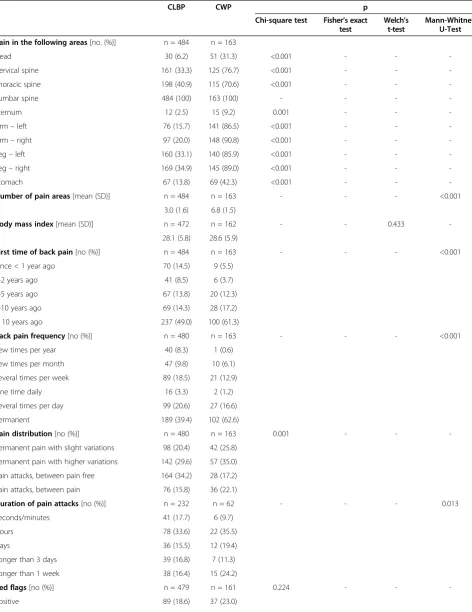
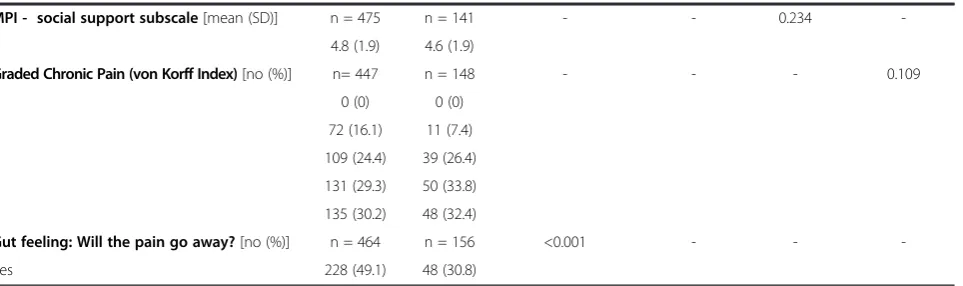
The majority of CWP patients (61.3%) and 49.0% in the CLBP group reported long-lasting pain for more than ten years. While CLBP patients tended to have more pain attacks with pain-free time periods, CWP subjects suffered more frequently from permanent pain. With regards to the severity of chronic pain, we did not find significant differences between the groups. Similarly, no differences were found for the social support scale of the MPI or for the frequency of red flags between CWP and CLBP patients. More details about the pain characteris-tics are shown in Table 2.
Health care
CWP patients [mean (SD) 7.3 (4.1)] received a significantly higher number of different therapeutic strategies compared to CLBP patients [mean (SD) 5.7 (3.6)]. However, we found no differences in the number of GP consultations, the num-ber of different doctors consulted, and stays in hospital dur-ing a six-month period prior to recruitment.
Comorbidities and psychosomatic symptoms
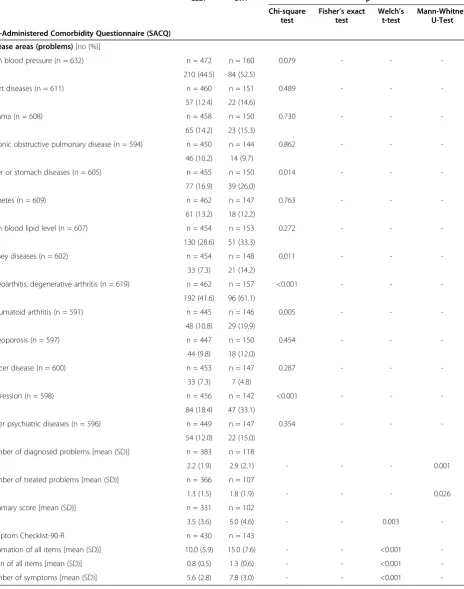
In general, the CWP group showed a higher number of comorbidities referring to a higher frequency of ulcer/ stomach disease, kidney disease, osteoarthritis/degenera-tive arthritis, rheumatoid arthritis, and depression. In comparison to CLBP patients, CWP patients suffered more often from psychosomatic symptoms. All data are shown in Table 3.
Discussion
A quarter of all included CLBP patients satisfy the ACR criteria for CWP. Altogether, CWP patients are predominantly female and showed more psychosomatic symptoms and comorbidities than CLBP patients.
The observed high prevalence of CWP (25.2%) is in accordance with the findings of Nordeman et al., who reported a CWP prevalence of 28% in females in pri-mary care settings [9]. The slightly higher prevalence in the study of Nordeman et al. can be explained by the female sample, which is associated with higher risk for CWP [7,11].
Apart from the apparently higher proportion of females in the CWP group, which confirms similar findings of other investigators [7,11], we found no group differ-ences in other sociodemographic data. Again, this obser-vation is in accordance with the findings of Nordeman et al. They found no significant differences in the fol-lowing sociodemographic parameters: age, nationality,
education, and social status between female CLBP and CWP patients.
In contrast, a population-based study from Bergman et al. found a lower educational and social status among CWP patients [11]. There is no clear reason for this con-trast. A possible explanation could be the different set-ting of the populations in the study (primary care vs. population based) and that Bergman et al. compared CWP versus chronic regional pain in general.
[image:4.595.58.541.98.491.2]The role of somatization processes in CWP is still un-clear. In the literature, two hypotheses are discussed: First, somatization could be a consequence of CWP. Second, CWP could be a manifestation of the process of somatization [11]. We only assessed typical physical symp-toms which accompany functional dysfunctions; these symptoms could also arise in somatic disorders. The in-creased prevalence of these symptoms in the CWP group emphasizes a slight association between CWP and the
Table 1 Sociodemographic data: differences between CLBP and CWP (n = 647)
CLBP CWP p
Chi-square test Fisher’s exact test Welch’s t-test Mann-Whitney U test
Sex[no. (%)] n = 484 n = 163 0.002 - -
-Female 279 (57.6) 117 (71.8)
Age[years: mean (SD)] n = 484 n = 163 - - 0.573
-56.3 (14.4) 57.0 (12.6)
Marital status[no. (%)] n = 484 n = 163 0.128 - -
-Single 61 (12.6) 22 (13.5)
Married 326 (67.4) 95 (58.3)
Divorced 54 (11.2) 28 (17.2)
Widowed 43 (8.9) 18 (11.0)
Level and years of education[no. (%)] n = 482 n = 163 - 0.425 -
-13/12 years 70 (14.5) 31 (19.0)
10 years 148 (30.7) 45 (27.6)
9 years 251 (52.1) 81 (49.7)
Other graduation 11 (2.3) 4 (2.5)
No qualification 2 (0.4) 2 (1.2)
Employment status[no. (%)] n = 481 n = 163 0.046 - -
-Working (full or part-time) 254 (52.8) 71 (43.6)
Reasons for not working[no. (%)] n = 223 n = 92 - 0.796 -
-Keeping house 35 (15.7) 13 (14.1)
Retired 167 (74.9) 70 (76.1)
Unemployed 18 (8.1) 9 (9.8)
Other 3 (1.3) 0 (0)
Applied for pension[no. (%)] n = 401 n = 128 0.002 - -
-Yes 21 (5.2) 18 (14.1)
Degree of disability[no. (%)] n = 457 n = 153 0.001 - -
Table 2 Pain anamnesis: differences between CLBP and CWP (n = 647)
CLBP CWP p
Chi-square test Fisher’s exact test
Welch’s t-test
Mann-Whitney U-Test
Pain in the following areas[no. (%)] n = 484 n = 163
Head 30 (6.2) 51 (31.3) <0.001 - -
-Cervical spine 161 (33.3) 125 (76.7) <0.001 - -
-Thoracic spine 198 (40.9) 115 (70.6) <0.001 - -
-Lumbar spine 484 (100) 163 (100) - - -
-Sternum 12 (2.5) 15 (9.2) 0.001 - -
-Arm–left 76 (15.7) 141 (86.5) <0.001 - -
-Arm–right 97 (20.0) 148 (90.8) <0.001 - -
-Leg–left 160 (33.1) 140 (85.9) <0.001 - -
-Leg–right 169 (34.9) 145 (89.0) <0.001 - -
-Stomach 67 (13.8) 69 (42.3) <0.001 - -
-Number of pain areas[mean (SD)] n = 484 n = 163 - - - <0.001
3.0 (1.6) 6.8 (1.5)
Body mass index[mean (SD)] n = 472 n = 162 - - 0.433
-28.1 (5.8) 28.6 (5.9)
First time of back pain[no (%)] n = 484 n = 163 - - - <0.001
Since < 1 year ago 70 (14.5) 9 (5.5)
1-2 years ago 41 (8.5) 6 (3.7)
2-5 years ago 67 (13.8) 20 (12.3)
5-10 years ago 69 (14.3) 28 (17.2)
> 10 years ago 237 (49.0) 100 (61.3)
Back pain frequency[no (%)] n = 480 n = 163 - - - <0.001
Few times per year 40 (8.3) 1 (0.6)
Few times per month 47 (9.8) 10 (6.1)
Several times per week 89 (18.5) 21 (12.9)
One time daily 16 (3.3) 2 (1.2)
Several times per day 99 (20.6) 27 (16.6)
Permanent 189 (39.4) 102 (62.6)
Pain distribution[no (%)] n = 480 n = 163 0.001 - -
-Permanent pain with slight variations 98 (20.4) 42 (25.8)
Permanent pain with higher variations 142 (29.6) 57 (35.0)
Pain attacks, between pain free 164 (34.2) 28 (17.2)
Pain attacks, between pain 76 (15.8) 36 (22.1)
Duration of pain attacks[no (%)] n = 232 n = 62 - - - 0.013
Seconds/minutes 41 (17.7) 6 (9.7)
Hours 78 (33.6) 22 (35.5)
Days 36 (15.5) 12 (19.4)
Longer than 3 days 39 (16.8) 7 (11.3)
Longer than 1 week 38 (16.4) 15 (24.2)
Red flags[no (%)] n = 479 n = 161 0.224 - -
process of somatization [33]. Although we cannot make any causal attributions due to the cross-sectional nature of our data, population-based cohort studies showed somatic symptoms to be a predictive factor for the onset of CWP [34,35]. This supports the hypothesis: CWP is a manifest-ation of the somatizmanifest-ation process.
In comparison to individuals without back pain [8], our total study population has an increased prevalence of co-morbidities. The increased rates of osteoarthritis and de-generative arthritis, rheumatoid arthritis, depression, ulcer or stomach diseases, and kidney diseases among CWP pa-tients correspond with the observations of Kato et al. [15]. They extracted CWP cases and their healthy siblings from the Swedish Twin Registry and assessed their comorbidi-ties. A comparative analysis showed that CWP patients have an increased odds ratio for having joint pain, depres-sive symptoms, irritable bowel syndrome, and chronic fa-tigue syndrome.
The increased rates of ulcer/stomach and kidney diseases in our CWP sample might be related to a higher consump-tion of non-steroidal anti-inflammatory drugs (NSAID). Furthermore, ulcer and stomach diseases are typical symp-toms of somatization processes as discussed above [36]. Apart from this, depression is a well-known comorbidity of CWP [36]. GPs should immediately consider the parallel comorbidities while treating CWP patients.
The definition of chronic widespread pain comprises duration and local extension of the pain [1]. It is an op-erational definition on a symptomatic level which does not allow for any conclusions with respect to the aeti-ology of CWP. Consequently, it is impossible to differen-tiate between patients with multiple regional pain and patients who experience a generalization of their pain by somatic causes (e.g. arthrosis in joint, hallux valgus). With a sensitivity of 98% and a specificity of 31% of the current definition from the ACR [37], it is most likely that there is a high proportion of patients in our sample that suffers from multiple regional pain since the major-ity of patients in general practices are older and suffer
from multimorbidity, including degenerative diseases. However, based on epidemiological findings, Macfarlane postulated that a differentiation of these would be artifi-cial and obscuring important aspects of aetiology [37].
In discussing group differences, we must emphasize that our study population is comprised of patients with a severe disease pattern (52%: pain > 10 years). There-fore, we assume that our subgroups do not greatly differ due to the already extreme nature of our subjects. This might also be a reason for the similarity of CLBP and CWP patients regarding pain severity according to von
Korff [28]. Both groups showed high rates of “pain
re-lated disability”, which forms the upper two grades of se-verity independent of the dimension“pain intensity”.
With respect to methodological limitations, we have to think of selection bias in our study. In our study, some participations denied participation due to the long, de-manding questionnaire. Selective recruitment might have occurred because general practitioners might forget to recruit patients due to a high workload. Furthermore, it might be possible that GPs are more likely to recruit special cases (e.g., patients with higher disease severity or unique personality). This might reduce the external validity of our results.
Although a GP recruitment rate of about 20% is normal in our research field, we should consider selection bias. We do not know if non-participating GPs have CLBP pa-tients with characteristics different than the participating GPs. However, regarding sociodemographic data and prac-tice characteristics, the GP sample seems to be representa-tive for the region of northern Hessen.
Conclusion
[image:6.595.61.543.101.244.2]Our primary finding is the high CWP prevalence among CLBP patients in primary care settings. Therefore, CWP is a frequent and particularly severe pain syndrome. Al-though it is impossible to identify CWP patients with the help of typical sociodemographic profiles, we showed that CWP patients are more likely to suffer from psychosomatic Table 2 Pain anamnesis: differences between CLBP and CWP (n = 647)(Continued)
MPI - social support subscale[mean (SD)] n = 475 n = 141 - - 0.234
-4.8 (1.9) 4.6 (1.9)
Graded Chronic Pain (von Korff Index)[no (%)] n= 447 n = 148 - - - 0.109
0 0 (0) 0 (0)
1 72 (16.1) 11 (7.4)
2 109 (24.4) 39 (26.4)
3 131 (29.3) 50 (33.8)
4 135 (30.2) 48 (32.4)
Gut feeling: Will the pain go away?[no (%)] n = 464 n = 156 <0.001 - -
Table 3 Comorbidities + psychosomatic symptoms: differences between CLBP and CWP (n = 647)
CLBP CWP p
Chi-square test
Fisher’s exact test
Welch’s t-test
Mann-Whitney U-Test
Self-Administered Comorbidity Questionnaire (SACQ)
Disease areas (problems)[no (%)]
High blood pressure (n = 632) n = 472 n = 160 0.079 - -
-210 (44.5) 84 (52.5)
Heart diseases (n = 611) n = 460 n = 151 0.489 - -
-57 (12.4) 22 (14.6)
Asthma (n = 608) n = 458 n = 150 0.730 - -
-65 (14.2) 23 (15.3)
Chronic obstructive pulmonary disease (n = 594) n = 450 n = 144 0.862 - -
-46 (10.2) 14 (9.7)
Ulcer or stomach diseases (n = 605) n = 455 n = 150 0.014 - -
-77 (16.9) 39 (26.0)
Diabetes (n = 609) n = 462 n = 147 0.763 - -
-61 (13.2) 18 (12.2)
High blood lipid level (n = 607) n = 454 n = 153 0.272 - -
-130 (28.6) 51 (33.3)
Kidney diseases (n = 602) n = 454 n = 148 0.011 - -
-33 (7.3) 21 (14.2)
Osteoarthitis, degenerative arthritis (n = 619) n = 462 n = 157 <0.001 - -
-192 (41.6) 96 (61.1)
Rheumatoid arthritis (n = 591) n = 445 n = 146 0.005 - -
-48 (10.8) 29 (19.9)
Osteoporosis (n = 597) n = 447 n = 150 0.454 - -
-44 (9.8) 18 (12.0)
Cancer disease (n = 600) n = 453 n = 147 0.287 - -
-33 (7.3) 7 (4.8)
Depression (n = 598) n = 456 n = 142 <0.001 - -
-84 (18.4) 47 (33.1)
Other psychiatric diseases (n = 596) n = 449 n = 147 0.354 - -
-54 (12.0) 22 (15.0)
Number of diagnosed problems [mean (SD)] n = 383 n = 118
2.2 (1.9) 2.9 (2.1) - - - 0.001
Number of treated problems [mean (SD)] n = 366 n = 107
1.3 (1.5) 1.8 (1.9) - - - 0.026
Summary score [mean (SD)] n = 331 n = 102
3.5 (3.6) 5.0 (4.6) - - 0.003
-Symptom Checklist-90-R n = 430 n = 143
Summation of all items [mean (SD)] 10.0 (5.9) 15.0 (7.6) - - <0.001
-Mean of all items [mean (SD)] 0.8 (0.5) 1.3 (0.6) - - <0.001
-symptoms and comorbidities than CLBP patients. These comorbidities must be considered when a GP makes treatment decisions based on the fact that a patient has CWP. Further research is needed to clarify the role of somatization in conjunction with chronic widespread pain to infer the direction of causality.
Abbreviations
ACR:American College of Rheumatology; CLBP: Chronic low back pain; CLP: Chronic localized pain; CWP: Chronic widespread pain; GP: General practitioner; MPI: West Haven-Yale Multidimensional Pain Inventory; SCL-90-R: Symptom Checklist-90-R.
Competing interests
Annika Viniol, Nikita Jegan, Markus Brugger, Konstantin Strauch, Jürgen Barth, Erika Baum and Corinna Leonhardt do not state any financial or non-financial conflicts of interests.
Annette Becker was a consultant for Grünenthal GmbH, from whom she has also received a speaker’s fee.
Authors’contributions
AV collected and analyzed data and wrote the manuscript. NJ collected and analyzed data. MB and KS gave statistical support and planned the study. JB and EB planned and revised the study design. CL and AB planned the study, discussed the results, and revised the manuscript critically. All authors edited the drafted version of the manuscript. All authors read and approved the final manuscript.
Acknowledgements
We thank our study nurses, Muazzez Ilhan and Marion Herz-Schuchhardt, for their excellent work. Furthermore, thank you to all participating doctors and patients. We also would like to thank Juliette Rautenberg for providing English-language editing, improving the precision and fluency of the manuscript.
Funding
This work was supported by the German Federal Ministry of Education and Research.
Author details
1
Department of General Practice/Family Medicine, University of Marburg, Karl-von-Frisch-Str. 4, 35043 Marburg, Germany.2Institute of Medical Informatics, Biometry and Epidemiology, Chair of Genetic Epidemiology, Ludwig-Maximilians-Universität, Ingolstädter Landstr 1, Munich 85764, Neuherberg, Germany.3Institute of Genetic Epidemiology, Helmholtz Zentrum München–German Research Center for Environmental Health, Ingolstädter Landstr 1, 85764 Neuherberg, Germany.4Institute for Social and Preventive Medicine (ISPM), University Bern, Niesenweg 6, 3012 Bern, Switzerland.
Received: 29 August 2013 Accepted: 10 December 2013 Published: 13 December 2013
References
1. Wolfe F, Smythe HA, Yunus MB, Bennett RM, Bombardier C, Goldenberg DL, Tugwell P, Campbell SM, Abeles M, Clark P:The American College of Rheumatology 1990 Criteria for the Classification of Fibromyalgia. Report of the Multicenter Criteria Committee.Arthritis Rheum1990,33:160–172. 2. Natvig B, Bruusgaard D, Eriksen W:Localized low back pain and low back
pain as part of widespread musculoskeletal pain. Two different disorders? A cross-sectional population study.J Rehabil Med2001,33:21–25. 3. Gerdle B, Bjork J, Coster L, Henriksson K, Henriksson C, Bengtsson A:
Prevalence of widespread pain and associations with work status. A population study.BMC Musculoskelet Disord2008,9:102.
4. Hunt IM, Silman AJ, Benjamin S, McBeth J, Macfarlane GJ:The prevalence and associated features of chronic widespread pain in the community using the‘Manchester’definition of chronic widespread pain. Rheumatology (Oxford)1999,38:275–279.
5. Macfarlane GJ, Pye SR, Finn JD, Wu FC, Silman AJ, Bartfai G, Boonen S, Casanueva F, Forti G, Giwercman A, Han TS, Huhtaniemi IT, Kula K, Lean ME,
O’Neill TW, Pendleton N, Punab M, Vanderschueren D:Investigating the determinants of international differences in the prevalence of chronic widespread pain. Evidence from the European Male Ageing Study. Ann Rheum Dis2009,68:690–695.
6. Croft P, Rigby AS, Boswell R, Schollum J, Silman A:The prevalence of chronic widespread pain in the general population.J Rheumatol1993,
20:710–713.
7. Cho NH, Kim I, Lim SH, Kim HA:Prevalence of widespread pain and its influence on quality of life. Population study in Korea.J Korean Med Sci
2012,27:16–21.
8. Hüppe A, Raspe H:Amplifizierte Rückenschmerzen und Komorbidität in der Bevölkerung.Schmerz2009,23:275–283.
9. Nordeman L, Gunnarsson R, Mannerkorpi K:Prevalence and characteristics of widespread pain in female primary health care patients with chronic low back pain.Clin J Pain2012,28:65–72.
10. Spaeth M:Epidemiology, costs, and the economic burden of fibromyalgia.Arthritis Res Ther2009,11:117.
11. Bergman S:Psychosocial aspects of chronic widespread pain and fibromyalgia.Disabil Rehabil2005,27:675–683.
12. McBeth J, Nicholl BI, Cordingley L, Davies KA, Macfarlane GJ:Chronic widespread pain predicts physical inactivity. Results from the prospective EPIFUND study.Eur J Pain2010,14:972–979.
13. Overland S, Harvey SB, Knudsen AK, Mykletun A, Hotopf M:Widespread pain and medically certified disability pension in the Hordaland Health Study.Eur J Pain2012,16:611–620.
14. Kadam UT, Thomas E, Croft PR:Is chronic widespread pain a predictor of all-cause morbidity? A 3 year prospective population based study in family practice.J Rheumatol2005,32:1341–1348.
15. Kato K, Sullivan PF, Evengard B, Pedersen NL:Chronic widespread pain and its comorbidities. A population-based study.Arch Intern Med2006,
166:1649–1654.
16. Palm O, Moum B, Jahnsen J, Gran JT:Fibromyalgia and chronic widespread pain in patients with inflammatory bowel disease: a cross sectional population survey.J Rheumatol2001,28:590–594.
17. Benjamin S, Morris S, McBeth J, Macfarlane GJ, Silman AJ:The association between chronic widespread pain and mental disorder. A population-based study.Arthritis Rheum2000,43:561–567.
18. Andersson HI:Increased mortality among individuals with chronic widespread pain relates to lifestyle factors. A prospective population-based study.Disabil Rehabil2009,31:1980–1987.
19. Andersson HI, Ejlertsson G, Leden I, Rosenberg C:Characteristics of subjects with chronic pain, in relation to local and widespread pain report. A prospective study of symptoms, clinical findings and blood tests in subgroups of a geographically defined population. Scand J Rheumatol1996,25:146–154.
20. Raphael KG, Marbach JJ, Klausner J:Myofascial face pain. Clinical characteristics of those with regional vs. widespread pain.J Am Dent Assoc2000,131:161–171. 21. Willweber-Strumpf A, Zenz M, Bartz D:Epidemiologie chronischer
Schmerzen. Eine Befragung in 5 Facharztpraxen in Bochum. Schmerz2000,14:84–91.
22. Kühlein T, Laux G, Gutscher A, Szecsenyi J:Kontinuierliche
Morbiditätsregistrierung in der Hausarztpraxis: Vom Beratungsanlass zum Beratungsergebnis.München: Urban & Vogel GmbH; 2008.
23. Viniol A, Jegan N, Leonhardt C, Strauch K, Brugger M, Barth J, Baum E, Becker A:Study protocol: transition from localized low back pain to chronic widespread pain in general practice: identification of risk factors, preventive factors and key elements for treatment - a cohort study.BMC Musculoskelet Disord2012,13:77.
24. Pfau DB, Rolke R, Nickel R, Treede R, Daublaender M:Somatosensory profiles in subgroups of patients with myogenic temporomandibular disorders and fibromyalgia syndrome.Pain2009,147:72–83. 25. Deutsche Gesellschaft zum Studium des Schmerzes (DGSS):Deutscher
Schmerzfragebogen.Köln.
26. Kerns R, Turk D, Rudy T:The West Haven-Yale Multidimensional Pain Inventory (WHYMPI).Pain1985,23:345–356.
27. Flor H, Rudy TE, Birbaumer N, Streit B, Schugens MM:Zur Anwendbarkeit des West Haven-Yale Multidimensional Pain Inventory im deutschen Sprachraum. Daten zur Reliabilität und Validität des MPI-D.Schmerz1990,
4:82–87.
29. Klasen BW, Hallner D, Schaub C, Willburger R, Hasenbring M:Validation and reliability of the German version of the Chronic Pain Grade questionnaire in primary care back pain patients.Psychosoc Med2004,1:Doc07.
30. Sangha O, Stucki G, Liang MH, Fossel AH, Katz JN:The Self-Administered Comorbidity Questionnaire. A new method to assess comorbidity for clinical and health services research.Arthritis Rheum2003,49:156–163. 31. Franke G, Stäcker K:Reliabilität und Validität der Symptom-Check-Liste
(SCL-90-R; Derogatis 1986) bei Standardreihenfolge versus inhaltshomogener Itemblockbildung.Diagnostica1995,41:349–373.
32. Tulder M, Becker A, Bekkering T, Breen A, Gil del Real MT, Hutchinson A, Koes B, Laerum E, Malmivaara A:Chapter 3 European guidelines for the management of acute nonspecific low back pain in primary care. Eur Spine J2006,15:s169.
33. Lipowski ZJ:Somatization: the concept and its clinical application. Am J Psychiatry1988,145:1358–1368.
34. McBeth J, Macfarlane GJ, Hunt IM, Silman AJ:Risk factors for persistent chronic widespread pain. A community-based study.Rheumatology (Oxford)2001,
40:95–101.
35. Gupta A, Silman AJ, Ray D, Morriss R, Dickens C, Macfarlane GJ, Chiu YH, Nicholl B, McBeth J:The role of psychosocial factors in predicting the onset of chronic widespread pain. Results from a prospective population-based study.Rheumatology (Oxford)2007,46:666–671. 36. Kroenke K:Mulitisomatoform disorder. An alternative to undifferentiated
somatoform disorder for the somatizing patient in primary care. Arch Gen Psychiatry1997,54:352–358.
37. Macfarlane GJ:Generalized pain, fibromyalgia and regional pain: an epidemiological view.Baillieres Best Pract Res Clin Rheumatol1999,
13:403–414.
doi:10.1186/1471-2474-14-351
Cite this article as:Viniolet al.:Differences between patients with chronic widespread pain and local chronic low back pain in primary care - a comparative cross-sectional analysis.BMC Musculoskeletal Disorders201314:351.
Submit your next manuscript to BioMed Central and take full advantage of:
• Convenient online submission
• Thorough peer review
• No space constraints or color figure charges
• Immediate publication on acceptance
• Inclusion in PubMed, CAS, Scopus and Google Scholar
• Research which is freely available for redistribution