2018 International Conference on Computer, Electronic Information and Communications (CEIC 2018) ISBN: 978-1-60595-557-5
Study on Layered Coding of W-Z Frame in Distributed Encode
Jian ZHANG
*, Jing ZHAO, Hui-long YU and Cui QIN
Department of Communication Engineer, Nanjing Institute of Technology, Nanjing, China
*Corresponding author
Keywords: Distributed encode, W-Z frame, Layered coding.
Abstract. In order to use distributed encode on the condition of the limited bandwidth, this paper introduced a layered coding method into the distributed coding, and a new coding method of w-z frame was advanced using high-frequency information in the distributed coding side. Experimental results show that the effect of this algorithm is superior to H.263+ when the bandwidth is small.
Introduction
With the development of wireless sensor network, especially the widespread use in areas such as video surveillance, the development of appropriate coding scheme is very necessary for wireless multimedia terminals. The distributed lossless coding theory was proposed in 1970s, realized that the coding complexity was transferred from the encoding side to the decoding side[1][2][3]. And the claim is met that the processing capacity of terminal apparatus and very limited power resources[4][5][6][7]. However, it did not consider likely to cause the wireless link bandwidth changes in the environment[8][9][10].
This article introduced layered coding ideas into distributed encode. W_Z frame was adopted by a layered frequency domain approach, where the low-frequency part in the W_Z frame served as the base layer of the image, and the high-frequency part served as an enhancement layer[11]. While using the side information features in distributed encode, the partial side information was instead of the enhancement layer ones in layered coding when the network bandwidth is small. A simple and efficient coding scheme was designed to meet the change of the wireless network.
Design on W-Z Frame Layered Coding
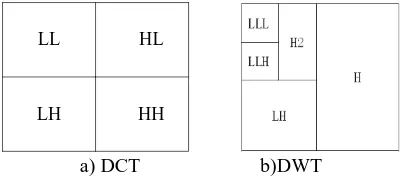
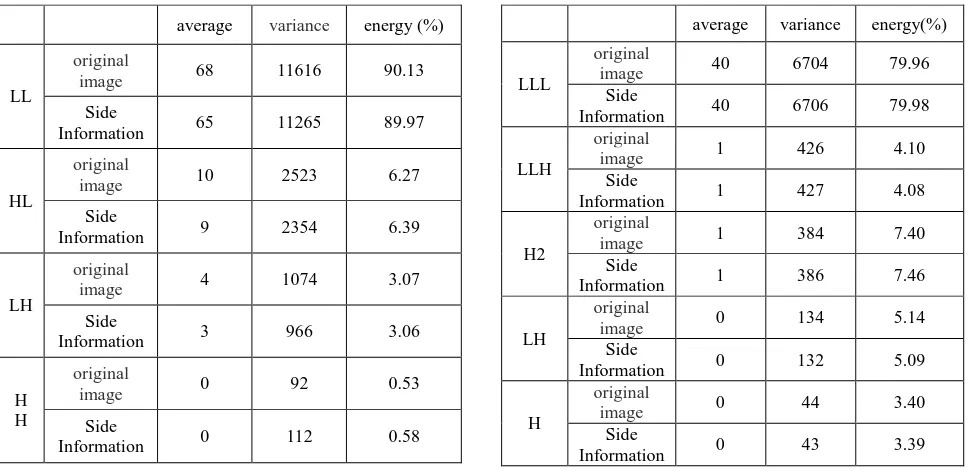
Based on statistical analyzing the orthogonal transform coefficients of encoded image and edge information, the transform domain coefficients were layered transmission. The video image after the DCT transform can be divided into four sub-blocks as shown in Figure 1 (a)[12]. The images after a second DWT simplified calculation can be divided into five sub-blocks as shown in Figure 1 (b)[13]. Table 1 and Table 2 are given the statistical DCT and DWT coefficients of side information between the foreman and the coastguard images. It can be found that the low frequency region (DCT: LL area, WDT: LLL region) contains most of the energy of the original image, while that of the rest is less. Meanwhile the statistical characteristics of the side information are very similar to those of the original image.
LL
HH HL
LH
[image:1.595.197.400.644.734.2]
a) DCT b)DWT
Table 1. The statistical properties of orthogonal transform coefficients for image foreman. DCT
average variance energy (%)
LL
original
image 68 11616 90.13
Side
Information 65 11265 89.97
HL
original
image 10 2523 6.27
Side
Information 9 2354 6.39
LH
original
image 4 1074 3.07
Side
Information 3 966 3.06
H H
original
image 0 92 0.53
Side
Information 0 112 0.58
DWT
average variance energy(%)
LLL
original
image 40 6704 79.96
Side
Information 40 6706 79.98
LLH
original
image 1 426 4.10
Side
Information 1 427 4.08
H2
original
image 1 384 7.40
Side
Information 1 386 7.46
LH
original
image 0 134 5.14
Side
Information 0 132 5.09
H
original
image 0 44 3.40
Side
Information 0 43 3.39
[image:2.595.61.541.485.731.2]When the image was manipulated by DCT transform, LL coefficients served as the base layer, and the remaining three sections served as enhancement layer. When the image was manipulated by DWT transform, LLL and LLH coefficients served as the base layer, and the remaining three sections served as enhancement layer for encoding and transmitting, as shown in Figure 2. At the decoder, the base layer and enhancement layer were gradually received. If the network was restricted, the bit stream of enhancement layer did not receive, instead of the relevant portion of the side information.
Table 2. The statistical properties of orthogonal transform coefficients for image coastguard.
DCT
average variance energy(%)
LL
original
image 88 10716 91.07
Side
Information 86 10295 90.14
HL
original
image 7 1194 4.02
Side
Information 5 920 4.21
LH
original
image 8 1297 4.27
Side
Information 9 1470 5.18
HH
original
image 0 84 0.44
Side
Information 0 101 0.47
DWT
average variance energy(%)
LLL
original
image 47 6977 80.02
Side
Information 46 6814 79.88
LLH
original
image 1 441 4.05
Side
Information 1 460 4.11
H2
original
image 1 378 6.90
Side
Information 1 387 7.06
LH
original
image 0 130 5.24
Side
Information 0 129 5.19
H
original
image 0 53 3.79
Side
Figure 2. Layered code for W_Z fram.
Experimental Results and Analysis
DCT Transform
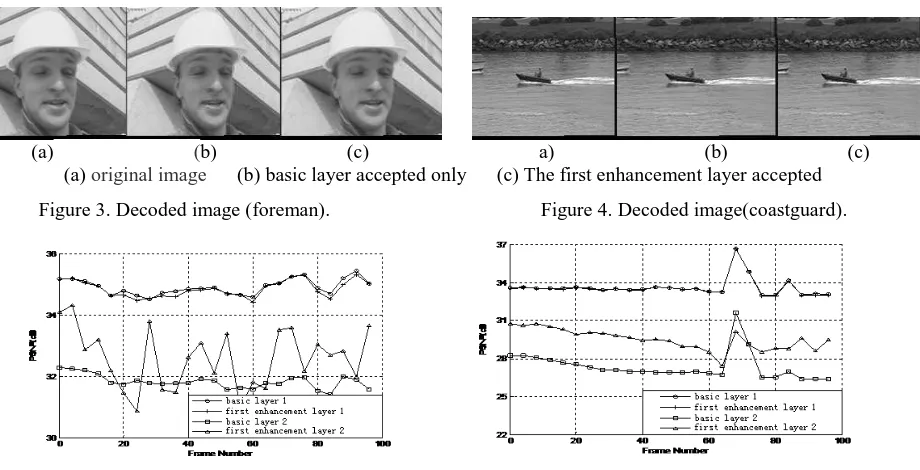
For DCT transform in the image, this article would divide enhancement layer into two parts where HL and LH as the first enhancement layer, HH as the second one. At the receiver, the phenomenon was simulated that only the basic layer and the first enhancement layer were received. Figure 3 and 4 show the decoded image of the foreman and coastguard video sequence with the help of the side information. When all enhancement layers were received, decoded image was the same as the original image.
[image:3.595.76.536.380.615.2]
(a) (b) (c) a) (b) (c) (a) original image (b) basic layer accepted only (c) The first enhancement layer accepted
Figure 3. Decoded image (foreman). Figure 4. Decoded image(coastguard).
Figure 5. The result layered decode(foreman)(DCT). Figure 6. The result layered decode(coastguard)(DCT).
to the motion in video sequence of foreman is gently, the SNR of decoding is better than video sequence of foreman coastguard.
DWT Transform
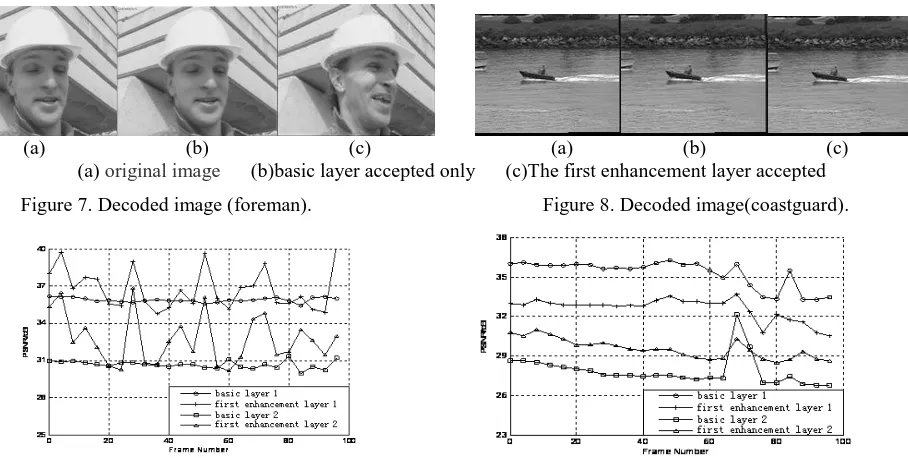
When the image is performed by the DWT transform, H2/LH layer served as the first enhancement layer, and H sub-block served as the second enhancement layer. At the receiver, the base layer or enhancement layer is received only in simulation. Figures 7 and 8 show decoded images of the video sequence of foreman and coastguard with the help of the side information. When all enhancement layers were received, decoded image is the same as the original image.
[image:4.595.80.534.197.426.2]
(a) (b) (c) (a) (b) (c) (a) original image (b)basic layer accepted only (c)The first enhancement layer accepted
Figure 7. Decoded image (foreman). Figure 8. Decoded image(coastguard).
Figure 9. The result layered decode(foreman)(DWT). Figure 10. Coastguard The result layered ecode (coastguard) (DWT).
Figure 9 and Figure 10 respectively show the SNR of decoded image for two sequences with the first 100 received frames. For the video of foreman, SNR with side information is better than SNR without the side information. The same is true for video of coastguard. However, the SNR of coastguard with side information.is better than without side information after receiving the first enhancement layer. The high speed motion of the image makes the information of H sub block of the image change rapidly, and the H sub block of the side information is different from the H sub block of decoding frame.
Decoded SNR under the Limited Bandwidth
Figures 11 and 12 were the SNR of w-z frame after using Hierarchical encode, and compared with two standard coding (those are H.263 + intra-frame encoding and H.264 intra-coding[14]).
Figure 11. RD performance comparison (foreman /QCIF). Figure 12. RD performance comparison (coastguard /QCIF).
rate, the effect grows slowly and is lower than H.263 + and H.264. Meanwhile, the effect of the foreman is superior than the coastguard. It is shown that the algorithm of this paper has better effect when the image change is relatively smooth.
Conclusion
The layered coding method and the distributed coding is combined in this paper. The w-z frame was divided into high frequency and low frequency portions. The low frequency portion served as the base layer in the layered coding, and the high frequency portion served as the enhancement layer. When the transmission bandwidth was restricted, high-frequency information of the side information in the distributed encoding was instead of the enhancement layer for image decoding. Experimental results show that the effect is better than H.263 + at low bit rates.
Acknowledgement
This research was financially supported by the National Science Foundation. (Grant No. 61701220), Jiangsu Higher School Natural Science Research Project (Grant No. 17KJB510023) and Research fund of nanjing institute of engineering (CKJB201406).
Reference
[1] Shang Fei, Ye Juanjuan, “Review of Distributed Video Coding” IEEE 13th International Conference on Electronic Measurement & Instruments 2017, pp: 315-320.
[2] Deligiannis N et al. “Maximum likelihood Laplaci correlation
hannel estimation in layered Wyner-Ziv coding”. In: IEEE Transactions on Signal Processing, 2014, pp 892–904an
[3] K. Ramchandran, R. Puri. “PRISM: A reversed multimedia coding paradigm”. IEEE Int. Conference Image Processing, Barcelona, August 2003.
[4] M. Ouaret, F. Dufaux, T. Ebrahimi. “Codec-independent scalable distributed video coding”. International conference on image processing, San Antonio, TX, September 2007.
[5] Pier Luigi Dragotti, Michael Gastpar. “Distributed Source Coding: Theory, Algorithms, and Applications”. 2011, pp. 133-168.
[6] N. Deligiannis, J. Barbarien, M. Jacobs, et al.. “Side-Information Dependent Correlation Channel Estimation in Hash-Based Distributed Video Coding”. IEEE Transactions on Image Processing, vol. 21, no. 4, pp. 1934–1949, 2012.
[7] F. Verbist, N. Deligiannis, M. Jacobs, et al.. A statistical approach to create side information in distributed video coding. The Fifth ACM/IEEE International Conference on Distributed Smart Cameras, Aug. 2011, 22–25.
[8] Yonghong Kuo, Peng Zhang, Jian Chen, "Feedback free multiple description distributed video coding for robust transmission", in Proc. Electronics Letters, January 2012, Page(s): 217-220.
[9] Ying Cao , Lijuan Sun , Chong Han, Jian Guo “Improved side information generation algorithm based on naive Bayesian theory for distributed video coding” IET Image Process., Vol. 12 No. 3, pp. 354-360, 2018.
[11] Wan, Juan “An image compression coding method based on improved discrete cosine transform” Technical Bulletin, vol. 55, no. 2, 2017, pp. 211-218.
[12] Yin M, Gao J, Shi D, et al. “Band-level correlation noise modeling for Wyner–Ziv video coding with Gaussian mixture models”, Circuits, Systems, and Signal Processing, Vol. 34, No. 7, pp. 2237-2254, 2015.
[13] Mehboob Alam, Wael Badawy, Vassil Dimitrov, Graham Jullien “An Efficient Architecture for a Lifted 2D Biorthogonal DWT” Journal of VLSI signal processing systems for signal, image and video technology, Vol.40, Issue 3, July 2005:pp. 335-342.