© 2016, IRJET ISO 9001:2008 Certified Journal Page 186
Performance and Exhaust Emissions of a Diesel Engine Using Custard
based Biodiesel
G. Venkatakoteswara Rao
1, Chenga Reddy. P
2, V.V. Kalyan Chakravarthy
3, R.Parthasarthy4
1
Assistant Professor, Dept. of Mechanical Engineering, SCSVMV University, Kanchipuram, Tamil Nadu
2Assistant Professor, Dept. of Mechanical Engineering, SCSVMV University, Kanchipuram, Tamil Nadu
3
PG Scholar, Dept. of Mechanical Engineering, SCSVMV University, Kanchipuram, Tamil Nadu
4PG Scholar, Dept. of Mechanical Engineering, SCSVMV University, Kanchipuram, Tamil Nadu
---***---Abstract
- In the present study a 4-stroke twin cylinder 6.4hp diesel engine was tested with mineral based fuel and custard seed oil blends. The blends in different proportions (0, 20, 40, and 60 percent by volume) were tested at constant speed of 1500 rpm. The Diesel engine is operated at different loads and characteristics are like Fuel consumption, Specific fuel consumption, Indicated power, Fuel power, Brake power, Brake Thermal Efficiency, Mechanical efficiency etc. Engine performance for blends resulted as lower brake thermal efficiency compared to mineral based fuel. Smoke is also found to increase with the blends. The results of the present experimental investigations reveal that the performance of the blends is comparable with that of diesel. Hence blends can profitably be employed in an existing CI engine without major engine modifications.Key Words: Diesel engine –Performance—Emission—
Blends.
1. INTRODUCTION
Due to higher prices of fuel and scarcity of conventional fuel resource (petrol diesel etc.) and the environmental pollution caused by these fuels we need to find the alternative fuel resource which can run the engines with higher efficiency lower fuel consumption and better ecofriendly. As most of the developing countries depend on agriculture we can use the plenty of oilseeds produced by them in producing various new blends showing better results. In the present investigation we prepared a new blend by mixing diesel with the oil extracted from the custard apple seed. In this investigation blend is tested over a diesel engine in the account of recent events sarvanan et al [1-3] reduced the viscosity of vegetable oil by blending it in different proportions with diesel, and analyzed its viscosity at various temperatures and used it as a fuel in a Compression Ignition (CI) engine. They reported that a remarkable improvement in the performance of the engine was noticed. There is a
reduction in smoke, CO and HC emissions were also noticed for 60% of cottonseed oil diesel blend.
© 2016, IRJET ISO 9001:2008 Certified Journal Page 187 pinnatta methyl ester at various blends and they reveal that
40 % blends by volume provide better performance and improved exhaust emissions. Nazar et al [10] have studied the use of coconut oil as an alternative fuel in direct injection diesel engine. It has been reported that the peak thermal efficiency for coconut oil was 28.67% and for diesel. It was 32.51%.It has also been concluded that the smoke, CO, HC and NO emissions were lower than diesel emissions while the exhaust gas temperature was higher than diesel.
Literature:
Vegetable oils have been taken the modest interest to become the alternate source of fuel in the C.I Engines. For the very first time Rudolf Diesel himself used the peanut oil as fuel for the C.I Engine. Now it is time to find the alternate fuel as the uncertainty in the adequate availability and supply of petroleum products as fuel to Engines. Initially the usage of bio oil may be in the rural areas where these vegetable oils are readily available. Majorly their usage can be done on the farm equipment’s like water pumps, generators, tractors and various other equipment’s. However we may get reduced or increased efficiency by having more emissions from the engines on which we have used initially. Further we may have problems in combustion of fuels and gum formation on the walls of cylinder. The main aim of this experimental study is to find the following objectives
I. Effect of custard apple seed oil plus diesel oil blend on the engine performance and its characteristics. II. Pre starting conditions for the engine when used
this blend for combustion process.
III. Increased heating and the vibrations produced in the engine when used this particular diesel blend IV. Effect on the emissions when used this blend
V. The availability of custard apple seed oil in the case of emergency when there is no availability of diesel oil
VI. Determination of optimum percentage of the custard apple seed oil in the blend to have optimum output from the engine.
Many studies had proved that the bio oil (vegetable oil) can be used directly in the engines without any major modifications. Gerhard vellguth studied the performance of a diesel engine when injected with vegetable oils. He conducted various tests with variable loads on the engine with rapeseed oil, peanut oil and soybean oil. He stated that vegetable oils produce the
same power output with a
reduced thermal efficiency and increased emissions
(smoke). However their performance is slightly
reduced to the performance produced by the diesel. He
concluded that vegetable oils could be used as fuels in
diesel engines. One major obstacle in using vegetable oils is its high viscosity which leads to problems of fuel flow in the injector fuel lines and filter. High viscosity leads to poor atomization of the oil and leads to high levels of smoke. In order to improve the performance of vegetable oils different methods like heating, dual fueling, and transesterification have been tried.
1.2 Abbreviations
B.P: Break Power in K.W I.P : indicated power in K.W F.P: frictional power in K.W Fc : fuel consumption in kg/hr
SFC =specific fuel consumption in Kg/kWh
2. ENGINE SPECIFICATIONS
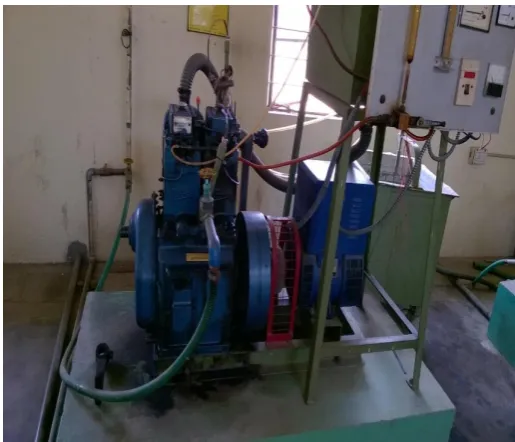
Type: four stroke twin cylinder, electrical dynamometer, diesel engine, water cooled, stationary engine test rig.
Make: Kirloskar.
Speed: 1500 rpm.
Bore: 87.5mm.
[image:2.595.307.565.523.744.2]Stroke: 110mm
© 2016, IRJET ISO 9001:2008 Certified Journal Page 188 The present investigation is carried out on the 4-stroke twin
[image:3.595.307.562.463.614.2]cylinder 6.4hp diesel engine at 1500 rpm. Which is coupled with the electric dynamometer for loading purposes. The engine is made to run for various blends (0%, 20%, 40%, 60 %.) The fuel consumption is taken into account and the smoke intensity is measured Bosch smoke meter. The temperature of the exhaust gas was measured by using K-type (chrome – alumel) thermocouple with digital indicating unit. The injection timing and compression ratio were unaltered during the entire testing. By keeping the speed constant at 1500 rpm and without changing any of engine settings the following parameters were studied, brake power output, brake thermal efficiency, exhaust gas temperature, exhaust particulate matter etc. Before testing, all the modules are investigated and flushed properly. Crankcase lubricating oil is changed because partially burned fuel reacts with cylinder walls to dilute or contaminated lubricant. Initially the engine is operated on 100% diesel and results are received and are tabulated.
Figure 2 Exhaust gas analyzer
Chart -1: B.P Vs S.F.C
Comparison of performance characteristics of different blends with graphical parameters:
Specific Fuel consumption:
The fuel consumption characteristics of an engine are generally expressed in terms of specific fuel consumption in kilograms of fuel per kilowatt-hour. It is an important parameter that reflects how good the engine performance is. It is inversely proportional to the thermal efficiency of the engine. Specific Fuel Consumption characteristics of biodiesel, diesel, and their blends are plotted. The graph between BP and SFC may show that the Specific fuel consumption of B20, B40&B60 is almost similar to that of Diesel
Brake Thermal Efficiency:
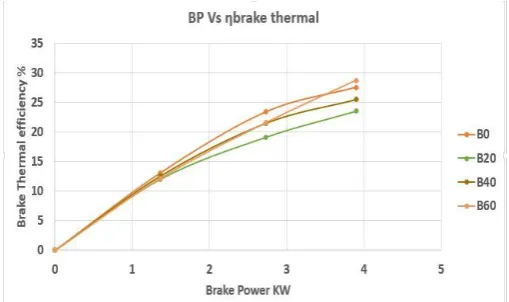
Brake thermal efficiency is the ratio of energy in the brake power to the input fuel energy. The brake Thermal Efficiency characteristics of Annona Squamosa seed (Custard apple seed) Biodiesel, diesel blends has been plotted. The graph may indicate the increase of Brake thermal efficiency with load. When compared between blends, The Brake thermal efficiency is increased due to the lower viscosity of Annona Squamosa seed Biodiesel.
Chart-2: BP Vs BRAKE THERMAL EFFICENCY
Mechanical Efficiency:
© 2016, IRJET ISO 9001:2008 Certified Journal Page 189
Chart – 3: BP Vs Mechanical Efficiency
Emission Analysis:
The environmental pollution is mainly due to automobile exhaust. To minimize the formation of pollutants, biodiesel are used as a fuel for the diesel engines. The effects of reduction in pollutants from the diesel engine are measured. The major emission parameters are discussed here are Carbon Monoxide, Hydrocarbon, Carbon dioxide, Oxygen, and Oxides of nitrogen.
Carbon dioxide (Co
2):
[image:4.595.308.546.564.679.2]The CO2 emission from a compression ignition engine is the result of better combustion, while HC and CO are of poorer combustion. The CO2 emission of diesel and different blends of Annona Squamosa seed biodiesel is shown in the below table.
Table 1: Carbon Dioxide (% vol)
In the above table it can be clearly seen that the Co2 emissions are higher in volume % for pure diesel compared to the biodiesel-diesel blends. The Co2 emission is 4.8% at 60% load condition for pure diesel which is noted as the
highest value of all loads. The blends of biodiesel B20 shows 4.6% and B40,B60 shows 3.9% at 60% load conditions.
Chart -4: Load Vs CO2 emission
Hydro Carbons (HC):
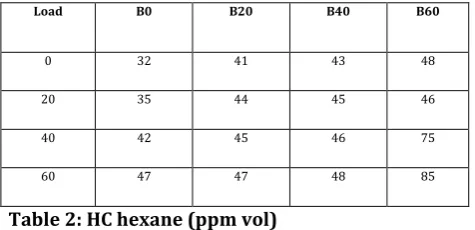
The effect of load on unburned hydro-carbon (HC) emissions for diesel and Annona Squamosa seed biodiesel and their blends is shown in the table. It can be seen from the table that the HC emissions of pure diesel were lower than that of other blends. This shows that there were some unburnt hydro carbons in the blends.
HC hexane (ppm vol)
Lower HC emissions in the exhaust gas of the engine may be attributed to the efficient combustion of Annona Squamosa seed biodiesel and blends due to the presence of fuel bound oxygen and warmed-up conditions at higher loads. The graph corresponding to HC emissions of different blends has
Load B0 B20 B40 B60
0 32 41 43 48
20 35 44 45 46
40 42 45 46 75
60 47 47 48 85
Table 2: HC hexane (ppm vol)
plotted and shown below. The increase in HC emission shows that at over load the unburnt emission increases .So, the supply of rich mixture may help in reduction of this emissions.
Load B0 B20 B40 B60
0 2.4 2.60 2.50 2.20
20 3.3 3.60 2.70 2.50
40 4 4.10 3.10 2.90
© 2016, IRJET ISO 9001:2008 Certified Journal Page 190
Chart -5: Load VS Hydrocarbon emission
Carbon Monoxide:
It can be seen from the table that the lower CO emissions were obtained with blends of Annona Squamosa biodiesel and diesel. CO emissions in the exhaust gas of the engine may be attributed to the polymerization that takes place at the core of the spray; this also caused concentration of the spray core and decreased the penetration rate. Low volatility polymers affected the atomization process and mixing of air and fuel causing locally rich mixture, which leads to difficulty in atomization and vaporization of Annona Squamosa seed biodiesel due to improper spray pattern produced. The CO emission is also undesirable one from the exhaust of the engine. The CO emission of the biodiesel and its blends with diesel and the pure
diesel fuel is compared to identify the
less emission fuel.
Load B0 B20 B40 B60
0 0.05 0.05 0.05 0.06
20 0.05 0.05 0.05 0.06
40 0.06 0.06 0.07 0.08
[image:5.595.310.523.533.682.2]60 0.08 0.09 0.09 0.09
Table 3 : Carbon Monoxide (in % vol)
Chart -6: Load Vs Carbon monoxide emission
Oxides of Nitrogen (NOx):
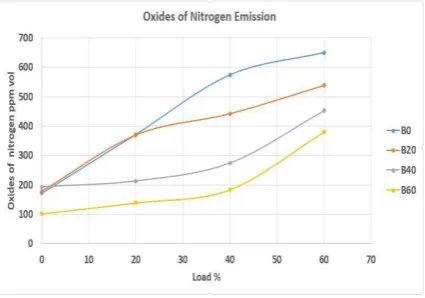
Oxides of Nitrogen (NOx) are generally formed at a temperature higher than 15000C especially in the regions
containing O2. The amounts of N2 and O2existing in the region are also factors in NOx formation. The below shows NOx variations depending on the load of the engine. However, the higher viscosity and density of biodiesel caused delayed combustion phase which results in the slower combustion characteristics of Annona Squamosa biodiesel. The significant decrease in the amount of NOx
emission might shows that the fuel is burning at low temperatures.
© 2016, IRJET ISO 9001:2008 Certified Journal Page 191
Rheological
characteristics
and
Molecular
Interaction Properties of Annona Squamosa
Biodiesel-diesel blends:
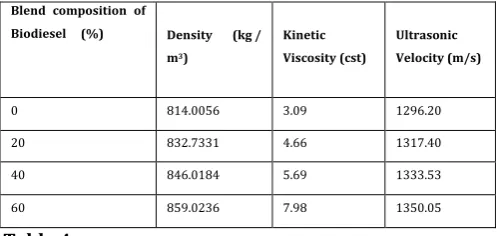
[image:6.595.36.288.246.364.2]The measured parameters like relative viscosity (η), density (ρ) and ultrasonic velocity are given in Table. This shows that the ultrasonic velocity increases with increase in the composition of biodiesel. This indicates the presence of strong interaction at higher compositions of biodiesel. The
Table 4
Viscosity values follow similar trend to ultrasonic velocity in These systems. It may be due to more frictional forces that are developed between the layers of the biodiesel. The density results show uniform increase with the increase in the composition of bio diesel
Blend compositi on of Biodiesel (%) Adiabatic compressi bility (x10-10
m2N-1)
Inter molecul ar free Length (x10-11 m) Relaxati on Time (x10-12 s) Specific Acoustical Impedanc e (x 106
Kg m-2 S-1)
Classical Absorption Co-efficient (x10-14 m -1 S-2)
0 7.3118 5.6108 2.4570 1.0551 3.7375
20 6.9191 5.4581 3.5800 1.0970 5.3579
40 6.6468 5.3496 4.2720 1.1281 6.3167
60 6.3869 5.2440 5.8420 1.1597 8.5329
Table 5
Adiabatic compressibility (β) of a fluid is a measure of the relative volume change of the fluid as a response to pressure change. It is the reciprocal of bulk modulus. From Table 2, it is observed that adiabatic compressibility (βad)
decreases with increase in composition of biodiesel as expected. It might indicate that biodiesel can be compressed enough to use it instead of conventional diesel fuel. The distance between two molecules in a free expansion state of
a liquid is termed as intermolecular free length. The increase in free length signifies weak molecular interaction or due to repulsion and decrease in free length signifies specific interaction. The deviation of free length with the increase in ultrasonic velocity indicates the presence of significant interaction between solute and solvent molecules due to which the structural arrangement in the neighborhood of constituent ions is considerably affected.
In the present system, the intermolecular free length for biodiesel decreases with the increase in composition as shown in Table. The intermolecular free length is maximum
for 0% and minimum for 100%composition range. In general, for Biodiesel, at lower composition range the
molecules exhibit weak interaction due to dominant repulsive force and at higher concentration there is a specific interaction among the molecules. In view of greater forces of interaction between solute and solvent molecules forming hydrogen bonding, there will be a decrease in free length in the mixture.
Molecular interaction properties
The free length values show that the molecules are loosely packed. This might indicate that biodiesel can be easily transported. Viscous relaxation time indicates the packing of molecules in the biodiesel. From Table, it is understood that the viscous relaxation time increases drastically. The relaxation time for biodiesel is minimum in lower composition and maximum at higher composition range. The relaxation time increases with increase in concentration throughout the system. The increase in relaxation time confirms the presence of intermolecular interaction. These refers that the molecules are lightly packed. Similar trend was observed in classical absorption co-efficient. The specific acoustical impedance of a material is defined as the product of its density () and Ultrasonic velocity (U).Acoustic impedance is important in the determination of acoustic transmission and reflection at the boundary of two materials having different acoustic impedances, the design of ultrasonic transducers and assessing absorption of sound in Blend composition of
Biodiesel (%) Density (kg /
m3)
Kinetic Viscosity (cst)
Ultrasonic Velocity (m/s)
0 814.0056 3.09 1296.20
20 832.7331 4.66 1317.40
40 846.0184 5.69 1333.53
© 2016, IRJET ISO 9001:2008 Certified Journal Page 192 a medium. In the present study the specific acoustical
impedance values increase with increase in blend composition of biodiesel.
CONCLUSION
The present study deals with the Custard seed biodiesel and its performance on twin cylinder engine with different blend proportions (B0, B20, B40, B60) with diesel. The Transesterification process is selected and prepared Biodiesel by using methanol and KOH as Catalyst. The blends are prepared by mixing with Diesel using Inline mixing method at different proportions like B0, B20 (20%), B40 (40%), B60 (60%). The performance and emission characteristics of Biodiesel is performed and following inferences are found
1. Biodiesel showed low emission of CO and CO2 similar to
Diesel and increase in HC emission compared to that of diesel
2. Biodiesel emitting less NOx when compared with Diesel,
this may show that the Biodiesel is burning at low temperatures
3. The O2 and HC emission is increasing with load which
shows the presence of unburnt fuel when load is increased. There is a requirement of supplying rich mixture in over load conditions
4. The low viscosity of biodiesel may lead to increase in Brake thermal efficiency when compared with Diesel 5. The specific fuel consumption is almost similar to that of diesel at different loads
6. The mechanical efficiency is being increased among the blends which shows a positive behavior in increasing load condition.
The rheological properties like the ultrasonic velocity, density, viscosity and other related parameters are calculated. The observed increase of ultrasonic velocity indicates the presence of significant solute-solvent interaction. The computed acoustical parameters and their values point to the presence of specific molecular interaction
in the mixtures. Hence it may be concluded that the biodiesel may be used at all circumstances.
REFERENCES
1. S. Senthil Kumar K.Purushothaman & P.K.Devan Performance and Emission Characteristics of a Diesel Engine using Rubber Seed oil and its Diesel Blends
2. Lapuerta M, Armas O, Rodriguez-Fernandez J. Effect of bio-diesel fuels on bio-diesel engine emissions. Progress in Energy & Combustion Science., 2008, 34: 198–223.
3. Pramanik K. Properties and use of Jatropha curcas oil and diesel fuel blends in compression Ignition Engine. Renewable Energy., 2003, 28: 239–248.
4. Bari S, Lim TH, Yu CW. Effects of preheating of crude palm oil (CPO) on injection system, performance and emission of a diesel engine. Renewable Energy., 2002, 27(3): 339-351.
5. ErkanÖztürk. Performance, emissions, combustion and injection characteristics of a diesel engine fueled with canola oil–hazelnut soap stock biodiesel mixture. Fuel Processing Technology., 2015, 129: 183–191.
6. Deepak Agarwal, Shailendra Sinha, Avinash Kumar Agarwal. Experimental investigation of control of NOx emissions in biodiesel-fueled compression ignition engine. Renewable Energy., 2006, 31: 23562369.
7. Suresh Kumar KR, Velraj R, Ganesan R. Performance and Exhaust emission characteristics of a CI engine fueled with Pongamia pinnata methyl ester and its blends with diesel. Renewable energy., 2008, 33: 2294-2302.
8. Rajan K, Senthil Kumar KR. Performance and Emission Characteristics of Diesel Engine with Internal Jet Piston using Bio diesel. International Journal of Environmental Studies. 2010, 67 (4): 556-567.
9. Lakshmi Narayana Rao G, Saravanan S, Sampath S. Raja Gopal K. Combustion and emission characteristics diesel engine fueled with rich bran oil methyl ester and its diesel blends. Thermal Science. 2008, 12(1): 139-150.