doi:10.4236/am.2011.26089 Published Online June 2011 (http://www.SciRP.org/journal/am)
A Primal-Dual Simplex Algorithm for Solving Linear
Programming Problems with Symmetric Trapezoidal
Fuzzy Numbers
Ali Ebrahimnejad
Department of Mathematics, Qaemshahr Branch, Islamic Azad University, Qaemshar, Iran E-mail: [email protected], [email protected]
Received December 2, 2010; revised March 28, 2011; accepted April 1, 2011
Abstract
Two existing methods for solving a class of fuzzy linear programming (FLP) problems involving symmetric trapezoidal fuzzy numbers without converting them to crisp linear programming problems are the fuzzy pri-mal simplex method proposed by Ganesan and Veeramani [1] and the fuzzy dual simplex method proposed by Ebrahimnejad and Nasseri [2]. The former method is not applicable when a primal basic feasible solution is not easily at hand and the later method needs to an initial dual basic feasible solution. In this paper, we develop a novel approach namely the primal-dual simplex algorithm to overcome mentioned shortcomings. A numerical example is given to illustrate the proposed approach.
Keywords: Fuzzy Linear Programming, Fuzzy Arithmetic, Fuzzy Orders, Primal-Dual Simplex Algorithm
1. Introduction
In optimizing real world systems, one usually ends up with a linear or nonlinear programming problem. For many cases, the coefficients involved in the objective and constraint functions are imprecise in nature and have to be interpreted as fuzzy numbers to reflect the real world situation. The resulting mathematical problem is therefore referred to as a fuzzy mathematical program- ming problem. After the pioneering work on fuzzy linear programming by Tanaka et al. [3,4] and Zimmermann [5], several kinds of fuzzy linear programming problems have appeared in the literature and different methods have been proposed to solve such problems [6-12]. One important class of these methods that has been high- lighted by many researches is based on comparing of fuzzy numbers using ranking functions. Based on this idea, Maleki et al. [13] proposed a simple method for solving fuzzy number linear programming (FNLP) pro- blems. They also applied an special kind of FNLP pro- blems, involving fuzzy numbers only in objective func- tion, as an auxiliary problem for solving fuzzy variable linear programming (FVLP) problems. Ebrahimnejad et al. [14] developed their method for solving bounded linear programming with fuzzy cost coefficients. Then Mahdavi- Amiri and Nasseri [15] used the certain linear ranking
function to define the dual of FNLP problem as a similar problem that lead to an efficient algorithm called the dual simplex algorithm [16] for solving FNLP problems. Based on these algorithms, Ebrahimnejad [17] inves- tigated the concept of sensitivity analysis in FNLP pro- blems. Of course, Mahdavi-Amiri and Nasseri [18] and Mahdavi-Amiri et al. [19] proposed two efficient algo- rithms for solving FVLP problems directly without need of any auxiliary problem. Moreover, Nasseri and Ebra- himnejad [20] suggested the fuzzy primal simplex me- thod to solve the flexible linear programming problems directly without solving any auxiliary problem. Then, Ebrahimnejad et al. [6] gave another efficient method namely primal-dual simplex method to obtain the fuzzy solution of FVLP problems. Ebrahimnejad and Nasseri [21] used the complementary slackness for solving both FNLP problem and FVLP problem. Hosseinzadeh Lotfi et al. [9] discussed full fuzzy linear programming (FFLP) problems of which all parameters and variable are triangular fuzzy numbers. They used the concept of the symmetric triangular fuzzy number and proposed an approach to defuzzify a general fuzzy quantity. After that Kumar et al. [11] proposed a new method to find the fuzzy optimal solution of same type of fuzzy linear programming problems.
new method based on primal simplex algorithm for solving linear programming problem with symmetric trapezoidal fuzzy numbers without converting them to crisp linear programming problems. Ebrahimnejad et al. [7] extended their method for situations in which some or all variables are restricted to lie within fuzzy lower and fuzzy upper bounds. After that, Nasseri and Mahdavi- Amiri [22] and Nasseri et al. [23] developed the concept of duality of such problems that led to a new method based on dual simplex algorithm [2]. However, dual simplex algorithm begins with a basic (not necessarily feasible) dual solution and proceeds by pivoting through a series of dual basic fuzzy solution until the associated complementary primal basic solution is feasible. In this paper, we describe a new method for solving linear programming problem with symmetric trapezoidal fuzzy numbers, called the primal-dual algorithm, similar to the dual simplex method, which begins with dual feasibility and proceeds to obtain primal feasibility while main- taining complementary slackness. An important diffe- rence between the dual simplex method and the dual simplex method is that the primal-dual simplex method does not require a dual feasible solution to be basic.
This paper is organized as follows: In Section 2, we give some necessary concepts of fuzzy set theory. A review of linear programming problems with symmetric trapezoidal fuzzy numbers and two methods for solving such fuzzy problems are given in Section 3. We develop and present a fuzzy primal-dual algorithm to solve the fuzzy linear programming problems in Section 4 and explain it by an illustrative example. Finally, we con- clude in Section 5.
2. Preliminaries
In this section, we review the fundamental notions of fuzzy set theory (see [1,7,24]).
Definition 2.1. A fuzzy number on (real line) is said to be a symmetric trapezoidal fuzzy number if there exist real numbers
R L
a and U,
a aLaU and > 0, such that
, ,
1, ,
=
, ,
0, otherwise.
L
L L
L U U
U U
x a
x a a
x a a a x
x a
x a a
We denote a symmetric trapezoidal fuzzy number a by =
L, U, ,
a a a , where
L , Ua a
is the support of and its core, and the set of allra al fuzzy
a aL,aU
symmetric t pezoid numbers by F R
. Let a=
aL,aU, ,
and b=
b bL, U, ,
be two
symmetric trapezoidal fuzzy numbers. Then the arith-
metic operations on a and b are given by (taken from [1]):
= L L, U U, , a b a b a b
= L U, U L, , a b a b a b
= ,
2 2 2 2
, ,
L U L U L U L U
U U U U
a a b b a a b b
ab
a b a b
,
where
2 1
= 2 t t
t1= min
a b a bL L, L U,a b a bU L, U U
, ,
x L L, L U, U L, U U t2= ma a b a b a b a b .
t From the above definition it can be seen tha
0, ; = L, U, ,
a a a
< 0, ; a= aU, aL, , .
Note that depending upon the need, one can also use a smaller in the definition of multiplication involving symmetric trapezoidal fuzzy numbers.
Definition 2.2. Let a=
aL,aU, ,
and
= b bL, U, ,
b be two symmetric trapezoidal fuzzy numbers. Define t
1)
he relations and as given below: ab (or ba) if and only if
<
L U L U
a a b
2 2
b
,
that is <
2 2
L U L U
a a b b
(in this case, we m y write
2) o
a
a b),
r = , <
2 2
L U L U
L L
a a b b
b a
and
3) or
< U U a b ,
= , = , =
2 2
L U L U
L L U U
a a b b
b a a b
and
.
n cases (2) and (3), we also write
Note that i ab
num-and say that a and b are equivalent.
Remark 2.1. Two symmetric trapezoidal fuzzy bers a=
aL,aU,
, b=
b bL, U,
are equivalent ifand o =
2 2
L U L U
a a b b . nly if
, if there exist
we define a0 0 and 0 such
that a
, , denote
, ,
by symm 0.
ly . We also
Note that 0 is equivalent to
0, 0, 0 = 0
. Natural , one may c r 0 = 0, 0, 0
e zero etrictrape mber.
Remark 2.2. If x0, then onside
oidal fuzzy
as th
z nu
x u
is said to be a zero symmetric trapezoid mber. It is to be noted that if x= 0, then x0, but the converse need not be tru
al fuzzy n
is
e. If x0 (that x is not equivalent to 0), then it is said to be a non-zero symmetric trapezoidal fuzzy number. It is to be noted that if x0, then x0, but the conve need not be true. If x 0
x
finition 2.1.
w
er
ma
1) The relation me
z rse
.
o following
, a b and
b
2.3. If
tric trapez
0
easy to
form
such
[1].
oidal fuzzy
on t
on on th
and
0
x, then is said to be a positive (negative) symmetric trapezoidal fuzzy number and is denoted by
,
, and
e taken f symmetric
, then
numbers.
0 0
x x . Now if a, bF
it is showc
rom trapez
order relation elati that if ab, then a b0.
The following lemma immediately follows
De-that
e set
set Lemma 2.1. If
c
,a b F
a cb .results ar
c, we hav
,a bF is a partial oidal f
is a linea o
0
, then 1) abba
nu
h of
e of
2) c ab
ca b tThe
Lemma 2.2. For any
mb e:
1) c a b
ca cb
. 2) c a
ca cb
.Lem
sym uzzy
2) The relation r order r symmetric trape idal fuzzy numbers.
3) For any two symmetric trapezoidal fuzzy numbers a and b, if ab then a
1
abb, for all , 0 1.3.
pe
h
ezo
Fuzzy Linear rogramm
an
P
ani [1]
ber is defined
ing
introduce
as [1] d a
tions
: G esan a Veeram
idal f nd
uzzy num
new ty fuzzy whic
of num-are fuzzy arithmetic for symmetric trapezoidal
ers. Here, we first review these new no b
useful in our further consideration. After that we review the concept of duality for such problems proposed by Nasseri and Mahdavi-Amiri [22] and Nasseri et al. [23]. 3.1. A Fuzzy Primal Simplex Algorithm
efinition 3.1. A linear programming problem with tra-D
p
min z cx
. .
0
s t Ax b x
(1)
where n are given
and
is a feasible solution to (1) if and only if
m, T
n, mb F c F A
nx F is to be deter nition 3.2. We say that a f
Defi
mined.
uzzy vector x
F
n x satisfies theconstra f the pro-
blem
ints and non-negativity restrictions o .
Definition 3.3. A fuzzy feasible solution x* is said to
be a fuzzy optimal solution to (1), if for all fuzzy feasible solution x for (1), we have cx*cx.
Defi pr
nition 3.4. Consider fuzzy linear programming oblem (1) in its standard form as follows:
min z cx
0
s.t. Ax b x
(2)
where the parameters of the problem are as defined in (1). Let = ij
m n
A a
. Assume rank
A =m. Partition A
B N
where B m m, , is nonsingular. It is asobvious that rank B
=m. Let yj be the solution to = jBy a . It is apparent that the basic solution
,
T 1Bm
x x
1
= , , 0
B xB B b x N
(3)
is a solution of Ax=b In fact, x=
xBT,xNT
T . If then the fuzzy basic solution is feasibl .
objecti
0
B
x , e and
e is:
the corresponding fuzzy ve valu zcBxB, where
1
= ,,cBm
B B
c c . Now, corresponding to every n 1, , ,
on- basic variable xj,1 j n j, B ii, = m
1
.
define
j B j B j
z c y c B a (4) e some important results concerning to
the optimality zy feasible
Below, we stat
conditions improving a fuz solution and unbounded criteria (taken
Theorem 3.1. If we have a fuzzy b tio
from [1]).
asic feasible solu- n with fuzzy objective value z such that z k ck for some nonbasic variable xk, and yk 0, then it is possible to obtain a new basic feasible solution with new fuzzy objective value z, that satisfies zz.
Theorem 3.2. If we have a fuzz basic feasibl tion with z k ck for some onbasic a le k
y e
solu-n v riab x , and 0
k
y , then the problem (2) has an unbounded solution. Theorem 3.3. (Opti ality conditionsm ) If a fu basic so
zzy lution xB =B b x1 , N 0
is feasible to (2) and j j
z c for all j, 1 j n , then the fuzz basic is a fuzzy optimal solution to (2).
y
new algorithm fo
we give a summary of their method in tableau format. solution
Algorithm 3.1. A fuzzy primal simplex method Initialization step
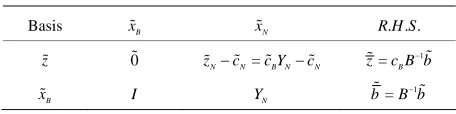
lutions y, and
, then Suppose an initial fuzzy basic feasible solution with
basis B is at hand. Form the following initial Table 1. Main step
1) Calculate zjcj for all nonbasic variables. Sup- pose zjcj=
h hjL, Uj,h hj, j
. Let
= max
U L U L
k k j j
h h h h
j T w
les.
, then stop solution is
optim , go to (2). 2) Let
here T is the index set of the current nonbasic variab
If U L 0 ; the current
k k
h h al. Otherwise
1
=
k k
y B a . nd
If then stop; the problem u
0 k y ,
is unbo ed. Otherwise, suppose bi =
biU,biL, i, i
and determine the index r as follows:
1i m ik
ik
3) Update the tableau by pivoting at fuzzy basic and nonbasic variables where
= min
U L
U L
i
r r b b
b b
i > 0 .
rk
y
y y
Update the rk
y . k
x enters the basis and xBr leaves the basis, and go t
3.2. A Fuzzy Dual Simplex Algorithm
) is
(5)
is including the fuzzy variab nstraints of problem (1). In fact,
the roblem as the DFLP
problem.
shall discuss here the re
s (taken from N
m 3.4. (The weak duality property.) If o (1).
Definition 3.5. Dual of the FLP problem (1 defined as follows [22,23] :
max s.t.
u wb wA c
0
w where = ( 1, , )
m m
w w w F les corresponding to co
, = 1, ,
i
w i m is defined f oblem (1). We name this p
or the ith constraint of pr
We lationships between the
FLP problem and its corresponding dual and omit the proof asseri and Mahdavi-Amiri [22] and Nasseri et al. [23]).
Theore x0 and
0 are fuzzy feasible solutions to FLP and DFLP
problems, respectively, then cx0w b0.
Corollary 3.1. If 0
w
[image:4.595.57.285.666.723.2]x and w0 are fuzzy feasible so-
Table 1. The initial primal simplex tableau.
Basis xB xN R H S. . .
z 0 zNcN=c YB NcN
1
= B
z c B b
B
x I YN
1
=
b B b
to FLP and DFLP problems, respectivel
0 0
cx w b x0 r respective
and are fuzzy optimal solu-
i s
Corollary 3.2. any one of the FLP or DFLP problem is unbounded, then the other problem has no
0
w problem
tions to the .
If
fuzzy feasible solution.
Theorem 3.5. (Strong duality.) If any one of the FLP or DFLP problem has an fuzzy optimal solution, then both problems have fuzzy optimal solutions and the two optimal objective fuzzy values are equal. (In fact, if x* is fuzzy optimal solution of the primal problem then the fuzzy vector w* =c BB 1, where B is the optimal basis, is a fuzzy optimal solution of the dual problem).
Theorem 3.6. (Complementary slackness). Suppose
*
x and w* are feasible solutions of the FLP problem
and its corresponding dual, the DFLP problem, respec- tively. Then x* and w are respectively optimal if and
only if
*
w A c x*
*0, w b*
Ax*
0.Ebrahimnejad and Nasseri [2] using the above results, introduced a new fuzz dual algorithm for solving pro- blem (2).
Algorit
y
hm 3.2. A fuzzy dual simplex algorithm Initialization step
Suppose that basis be dual feasible for the pro- blem (2). Form the Tableau 3.1 as an initial dual feasible simplex tableau. Suppose =
L, U, ,
B
j j j j j j z c h h , so U L
hj hj 0 for all j. Main step
1) Suppose b=B1b
. If b0 , then Stop; the current fuzzy solution is optimal.
Else suppose bi =
biL,biU, i, i
and let
in U L
i i b
1
r i m
= m
U L r
b b b .
for all Stop
pivot column by t ng test: 2) If yrj 0 , then ; the problem (2) is infeasible.
j
Else select the k he followi
1
= min < 0 . U L
U L
j j k k
rj j n
rk rj
h h h h
y
y y
3) Update the tableau by pivoting at . Update the fu
rk zzy basic and nonbasic variables where k
y
x enters the
Br
x
basis and leaves the basis, and go t
4. A Fuzzy Primal-Dual Algorithm
W sed
basis by le bases of tion of the o (1).
e note that the method which is propo by Ganesan and Veeramani in [1], starts with a fuzzy basic feasible solution for FLP and moves to an optimal
ptimal basis obtained in fuzzy primal simplex algorithm o
don’t satisfy the optimality criteria for FLP or feasibility condition for DFLP. But their method has no efficient when a primal basic feasible solution is not at hand. So, Ebrahimnejad and Nasseri [2] developed a new dual simplex algorithm to overcome this shortcoming by using the duality results which have been proposed by Nasseri and Mahdavi-Amiri [22] and Nasseri et al. [23]. This algorithm starts with a dual basic feasible solution, but primal basic infeasible solution and walks to an optimal solution by moving among adjacent dual basic feasible solutions. However, the dual simplex method for solving FLP problem needs to an initial dual basic feasible solution. Here, we develop the fuzzified version of conventional primal-dual method of linear programming problems that any dual feasible solution, whether basic or not, is adequate to initiate this method.
Corollary 4.1. [22,23] The optimality criteria 0
j j
z c , for all j, for the FLP problem is equi- valent to the feasibility condition for the DFLP problem.
To explain the main strategy employed by this method, we consider the following standard FLP:
min z cx s .
0 .t Ax b
x
(6)
Let w=
w w 1, 2,,wm
be the row of dual vectorvariables. The Dual of FLP problem (6) is
The complementary slackness conditions are
Let be the initial fuzzy
Supp
lowi primal
pr
where and
by the method which is proposed by Ganesan and Veeramani in [1] beginning the fuzzy feasible basic solution
max s.t.
u wb wA c
(7)
cjwa j
xj0 = 1, j ,n (8) ˆw ose
dual feasible solution. Now consider the fol-
ˆ= j wa: j cj 0
.
ng problem known as the restricted fuzzy oblem corresponding to ˆw .
min 0 1
s.t.
0
j a
j j
a
x x a x Ix
0, for , ,
i
a i
j
b
x j
x
(9)
1
= , , m
a a ma
x x x F
1, 0, 0 ,, 1,1, 0, 0
F The restricted fuzzy primal probl
1 = 1, m
em .
(9) is now solved
a
x . In this process, once an artificial variable ja
x dr ut of the basic variables, discard it from the
. Let
ops o
problem xˆ and x0 alue
be the imal solution and fuzzy obj e v obtained at termination in this re
fuzzy pr ectiv
stricted fuzzy primal problem, respectively. If x00,
ˆ
x and wˆ are optimal to (6) and (7), respectively. If
0
0
x , let vˆ be the optimal solution to the dual of the restricted zzy primal problem (9).
ow, we construct the new fuzzy dual solution for (6) such that all th basic imal variables in the restricted fuzzy primal problem remain in the new restricted fuzzy primal problem and in addition, at least one
riables that did not belong to the set would get to res icted fuzzy primal problem. Furthermore, this variable would reduced 0
fu N
d
e
r
pr
primal va
passe t
x if introduced in the basic.
In order to construct such a dual fuzzy vector, consider the following fuzzy dual w , where > 0:
ˆ ˆ
=
w wv Then
ˆ ˆ
ˆ
ˆj j j j j j j
wa c wv a c wa c va (10) Now, if xˆj with j is a basic variable in the restricted fuzzy primal problem, then from compl
acknes
ementary sl s vaˆ j0 and hence wa jcj 0, per
primal problem. If
mitting j j in the new restricted fuzzy and vaˆ j0, then from (10) we have wa jc j 0.
a
Fin lly, if j and vaˆ j0, we show there is a
> 0
such that wa jcj0 for j with at least one compone equal t y zero.
First, we show in this case for each j there is an nt o fuzz
j
such that wa jcj
waˆ jcj
j
vaˆ j
0. Let
1 2
1= , , , , 2
j j j j j j j wa c w w l l w w j
1 2
1 2
= , 0,
ˆ ˆ
ˆ ˆ , <
j j j j j
j j
c w h h
w w
w w
ˆ ˆ j,wˆ ,
1 2 0
2
j j
and
wa
1 21j v2 1 2
ˆ ˆ
ˆ , , 0, ˆ ˆ , 2
j j
j j j j j
v v
va k k v v
Now
ˆ j = vˆ , > 0
ˆ j j
j ˆ j 0wa jcj wa c va , if and only if
wˆ1jjvˆ1j,wˆ1jjvˆ1j,hjjk hj, jjkj
0if and only if
2
ˆ
1 1 2
ˆ j jˆj = ˆ j j j
w v w v if and only if
ˆ1 ˆ2
= ˆ1 ˆ2
j vjv j wjw j
1 2 1 2
ˆ ˆ
= .
ˆ ˆ
j j
j
j j
w w
v v
Note that j> 0, since vˆ1jvˆ2j> 0 and f w
1 2
ˆ j ˆ j < 0
w w . That is, i e choose j as above, then
0
j j
wa c . Now, we define as follows:
1 2
1 2
1 2 1 2
ˆ ˆ
ˆ ˆ
ˆ
= = = min 0
ˆ ˆ ˆ ˆ
j j k k
k .
j
k k j
w w
va
v v v v
j
j
w w
ion of
By definit , we see wa kck 0. In ad e show
dition, w wa jcj0 for each with vaˆ j 0 .
ion of
j
From definit , we have j for all j. Thus
So, we have
vˆ1j vˆ2j
j
vˆ1j vˆ2j
.
wˆ1jwˆ2j
vˆ1j vˆ2j
wˆ1jwˆ2
j
vˆ1jvˆ2j
.or
j
1 1 2 2
1 1 2 2
1
ˆ ˆ ˆ ˆ
2
ˆ ˆ ˆ ˆ
j j j j
j j j j j j
w v w v
w v w v
that is
1 2
waˆ jcj
vaˆ j waˆ jcj
j vaˆ j
But, we know
waˆ jcj
j vaˆ j 0. Therefore
ˆ c
vaˆ 0 . Hence,
j j j j j
wa c wa odifying
the dual fuzzy vector leads to a new feasible dual fuzzy Also, all the variables that belonged to the ed fuzzy primal problem basis are passed to the new basis. In addition, a new fuzzy variable
m
solution. restrict
k x t can e basis, is passed to th
fu lem. Thus, we continu
present restricted fuzzy primal prob
hat is a didate to enter th e restricted
zzy primal prob e from the
lem basis by entering
k
x , which leads to a potential reduction in x0
. This process is continued until x00
in which case we have an optimal solution or else x 0 0
and vaˆ j0
all j
for . We explain this case as Theorem 4.1 as below.
Theorem 4.1. If at the end of the restricte
primal m, we have x 0 0 and vaˆ j0 for all j
d fuzzy proble
, then the FLP (6) has no solution.
Proof. In this case consider w=wˆvˆ . Since
ˆ j j 0
wa c , for all j a assum vaˆ j0
j
nd by ption
for all , then from (10), w is a dual feasible fuzzy solution for all > 0. In he dual
y value is
addition, t objective fuzz
ˆ ˆ
ˆ ˆwb wv b wbvb Since x0
and vbˆ are the optimal objective values for the al problem and its dual, we have
restricted fuzzy prim
0
ˆ
vb x . Also x 0 0, so wb
can be increased indefinitely by choo ing s arbitrarily large. Therefore the DFLP is unbounded and hence from corollary 3.2 the FLP is ble.
Algorithm 4.1. A fuzz primal-dual simplex algo- rithm
1) {dual feasibil infeasi
y
ity Choose a fuzzy vector such th
} w
at zjcj0 for all j.
2) Q=
j:wa jcj 0
and solve the edfu c
e be the optima blem.
all then stop (the FLP problem is
restrict zzy rimal problem. If x0 0 then Stop (the urrent
solution mal). p
is opti let vˆ
).
Els l dual fuzzy solution to the restricted fuzzy primal pro
3) If vaˆ j0, for j infeasible
Else let
1 2
1 2
1 2 1 2
ˆ ˆ
= = w w
ˆ ˆ = min ˆ 0 .
ˆ ˆ ˆ ˆ
j j k k
j j
k k j j
w w
va v v v v
and re by
k
place wˆ wˆvˆ
n of the
and go to (2).
Fo io fuzzy primal-dual algorit ,
we co ng example.
ider th See (11)) r an illu
nsider the followi .1
strat hm
Example 4 . Cons e FLP problem: (
Thus, with introducing the slack variables x6 and 7
x , the above FLP problem reduces to the standard form: (See (12))
x3
6,8,1,1
x
0, 2,1,1
x
4
4 5
1 2 3 4 5
1 2 3 4 5
, 2
5 4,8, 2, 2
2 2 1, 5,1, 2
, , , , , 0
x
x x x x x
x x x x x
1 2
1 2 3
min 1, 5,1,1 2, 6,1,1 5, 7, 2
s.t. 2 6
z x x
x x x x
5
(11)
1 2 3 4
1 2 3 4 5 6
1 2 3 4 5 7
1 2 3 4 5 6 7
min 1, 5,1,1 2, 6,1,1 5, 7, 2, 2 6,8,1,1 0, 2,1,1
s.t. 2 6 5 4,8, 2, 2
2 2 1, 5,1, 2
, , , , , , 0
z x x x x
x x x x x x
x x x x x x
x x x x x x x
5
x
(12)
The dual problem is given by the following:
1
w
(13)
Now we solve the FLP problem (13) by the fuzzy primal-dual simplex algorithm.
Initialization step: The initial fuzzy dual solution is given by
1 2
1 2 1 2
1 2
1 2
1 2 1 2
max 4,8, 2, 2 1, 5,1,1
s.t. 2 1, 5,1,1
2, 6, 2, 2
6 6,8,1,
5 2 0, 2,1,1
0 0 , unrestricted.
w w
w w w w
w w
w w
w w w w
1 2 2 5, 7, 2, 2
w w
1 2
= , = 0, 0
w w w .
First iteration: Substituting w =
w w 1, 2
= 0, 0
ineach dual constraint, we find that the last two dual constraints hold at equality. Thus, = 6, 7
. The rest-pri es as follows:
ricted fuzzy mal problem becom
9
8 6 8 7 9 6 7 8 9
min 1,1, 0, 0 1,1, 0
s.t. 4,8, 2, 2
1, 5,1,
, , , 0
, 0 1
x x
x x x x x x x x
(14)
where x8 and x9 are the artificial fuzzy variables.
Solving this problem by Ganesan’s met optimal fuzzy solution and the optima value as follows:
hod [7] gives the l objective fuzzy
6 7 8
0 8
0, 4,8, 2, 2 , 1, 5,1,1 , 5,12, 3, 3 .
x x x
x x
0,
So, we have ,and . Thus,
Complementary slackness gives the dual solution as
ˆ= ˆ ˆ, = 1,1
1 1 , 0, 0 , 1,1, 0, 0
v v v .
1
ˆ 3, 3, 0, 0 0
va , vaˆ 2 0, vaˆ 3
3, 3, 0 0
0
,
4
ˆ 7, 7, 0, 0 0
va vaˆ 5
5, 5, 0, 0
0 is determined as follows:
5 1 7 5 6 8
, = 1,
= min ,
3 3 3 7 7
and we replace
3
w by
0, 0, 0, 0 , 0, 0, 0, 0 1 1,1, 0, 0 , 1,1, 0, 0
= 1,1, 0, 0 , 1,1, 0, 0
.
mputing of with new dual
vesSecond iteration: Reco solution
, gi
1,1, 0, 0 , 1,1, 0, 0w = 1, 4
problem:
8 9
1 4
1 4 9 1 4 8 9
min 1,1, 0, 0 1,1, 0, 0 s.t. 2 6
1, 5,1,1
, , , 0
x x
x x
x x x x x x x
8 4,8, 2, 2
x
(15)
The optimal fuzzy solution to this problem is given by
1 2, 4,1,1 , 02 8
x x x x9
with x00. Thus, we have an optim solution to the main prob s llows:
al as fo
lem
1 2, 4,1,1 , 0.2 3 4 5 6 7
x x x x x x x Remark 4.1. If we want to solve the problem (11) directly by use of Algorithm 3.1 proposed by
and Veeramani [1], we must first solve the
linear programming problem with introducing the slack variables
Ganesan following
and the following new restricted fuzzy primal
6
x and x7 and the fuzzy artificial fuzzy
variables x8 and x9, which minimize the sum of the
artificial fu va les to obtain a initial fuzzy basic feasible solution:
zzy riab
8
9min 1,1, 0, 0 1,1, 0, 0
s.t. 2 6
z x x
x x x x
1 2 3 4 5 6 8
1 2 3 4 5 7 9
5 4,8, 2, 2
2 2 1, 5,1 2
x x x
x x x x x x x
1, 2, 3, 4, 5, 6, 7, 8, 9 0
x x x x x x x x x
,
n t
ly at hand.
5. Conclusions
Ganesan and Veeramani in [1] proposed a new approach based on primal simplex algorithm to obtain the fuzzy solution of fuzzy linear programming problem sy
ased on the interesting been established by Ganesan and ch can be expected to be
(16) After finding a initial fuzzy basic feasible solution by solving the problem (16), we must minimize the original objective fu ction of he problem (11). So, this process is time consuming and has no efficiency computationally for solving such problems in which an initial fuzzy basic solution is not easi
with mmetric trapezoidal fuzzy numbers without converting them to crisp linear programming problems. In this paper, we reviewed the dual of a linear programming problem with symmetric trapezoidal fuzzy numbers. Then, we introduced a fuzzy primal-dual algorithm for solving the FLP problems directly without converting them to crisp
near programming problems, b li
results which have
eeramani [1]. This approa V
and P. Veeramani, “Fuzzy Linear Program uzzy Numbers,” Annals of
Op-43, No. 1, 2006, pp. 305-315. network primal-dual simplex algorithm for solving such problem in fuzzy environment may also produce inter- secting results.
6. Acknowledgments
The author would like to thank Prof. Tian Huang, Editorial Assistant in AM Editorial Board, and anony- mous referees for the various suggestions which have led to an improvement in both the quality and clarity of the paper. Finally, the author greatly appreciates to the office of vice chancellor for research of Islamic Azad Uni- versity-Qaemshahr Branch.
7. References
] K. Ganesan
[1
-ming with Trapezoidal F
erations Research, Vol. 1
doi:10.1007/s10479-006-7390-1
[2] A. Ebrahimnejad and S. H. Nasseri, “Linear Programs with Trapezoidal Fuzzy Numbers: A Duality Approach,”
International Journal of Operations Research, in Press. [3] H. Tanaka and K. Asai, “Fuzzy Linear Programming
Problems with Fuzzy Numbers,” Fuzzy Sets and Systems, Vol. 13, No. 1, 1984, pp. 1-10.
doi:10.1016/0165-0114(84)90022-8
y, “A Dual Approach to Solve the F ming Problems,” Fuzzy Sets and Systems, Vol. 14, No. 2, 1984, pp. 131-141.
[4] J. L. Verdega Linear Program
uzzy
doi:10.1016/0165-0114(84)90096-4
[5] H. J. Zimmermann, “Optimization in Fuzzy Environ-ment,” Presented at XXI International TIMES and 46
ORSA Conference, San Juan, 8-11
th
July 1974.
[6] A. Ebrahimnejad, S. H. Nasseri, F. H. Lotfi and M. Sol-tanifar, “A Primal-Dual Method for Linear Programming Problems with Fuzzy Variables,” European Journal of Industrial Engineering, Vol. 4, No. 2, 2010, pp. 189-209.
doi:10.1504/EJIE.2010.031077
[7] A. Ebrahimnejad, S. H. Nasseri and F Linear Programs with Trapezoidal F
. H. Lotfi, “Bounded uzzy Numbers,” In-ternational Journal of Uncertainty, Fuzziness and Knowl-edge-Based Systems, Vol. 18, No. 3, 2010, pp. 269-286.
doi:10.1142/S0218488510006532
[8] A. Ebrahimnejad and S. H. Nasseri, “A Dual Simplex
2-779. Method for Bounded Linear Programmes with Fuzzy Numbers,” International Journal of Mathematics in Op-erational Research, Vol. 2, No. 6, 2010, pp. 76
doi:10.1504/IJMOR.2010.035498
[9] F. H. Lotfi, T. Allahviranloo, M. A. Jondabeh and L. Alizadeh, “Solving a Full Fuzzy Linear Programming Using Lexicography Method and Fuzzy Approximate Solution,” Applied Mathematical Modelling, Vol. 33, No. 7, 2009, pp. 3151-3156.doi:10.1016/j.apm.2008.10.020
[10] M. Inuiguchi and M. Sakawa, “Possible and Necessary Optimality Tests in Possibilistic Linear Programming
Problems,” Fuzzy Sets and Systems, Vol. 67, No. 1, 1994, pp. 29-46.doi:10.1016/0165-0114(94)90206-2
[11] A. Kumar, J. Kaur and P. Singh, “A New Method for Solving Fully Fuzzy Linear Programming Problems,”
Applied Mathematical Modelling, Vol. 35, No. 2, 2011, pp. 817-823.doi:10.1016/j.apm.2010.07.037
[12] J. L. Verdegay, “A Dual Approach to Solve the Fuzzy Linear Programming Problems,” Fuzzy Sets and Systems, Vol. 14, No. 2, 1984, pp. 131-141.
doi:10.1016/0165-0114(84)90096-4
[13] H. R. Maleki, M. Tata and M. Mashinchi, “Linear Pro-gramming with Fuzzy Variables,” Fuzzy Sets and Systems, Vol. 109, No. 1, 2000, pp. 21-33.
doi:10.1016/S0165-0114(98)00066-9
[14] A. Ebrahimnejad, S. H. Nasseri and S. M. Mansourzadeh, “Bounded Primal Simplex Algorithm for Bounded Linear Programming with Fuzzy Cost Coefficients,” Interna-tional Journal of OperaInterna-tional Research and Information Systems, Vol. 2, No. 1, 2011, pp. 96-120.
doi:10.4018/IJORIS.2011010105
[15] N. Mahdavi-Amiri and S. H. Nasseri, “Duality in Fuzzy Number Linear Programming by Use of a Certain Linear Ranking Function,” Applied Mathe
tion, Vol. 180, No. 1, 2006, pp. 206-2
matics and
Computa-16.
doi:10.1016/j.amc.2005.11.161
[16] S. H. Nasseri and A. Ebrahimnejad, “A Fuzzy Dual Sim-plex Method for Fuzzy Number
Problem,” Advances in Fuzzy Sets an
Linear Programming
d Systems, Vol. 5, No. 2, 2010, pp. 81-95.
[17] A. Ebrahimnejad, “Sensitivity Analysis on Fuzzy Num-ber Linear Programming Problems,” Mathematical and Computer Modelling, Vol. 53, No. 9-10, 2011, pp. 1878- 1888.doi:10.1016/j.mcm.2011.01.013
[18] N. Mahdavi-Amiri and S. H. Nasseri, “Duality Results and a Dual Simplex Method for Linear Programming Problems with Trapezoidal Fuzzy Variables,” Fuzzy Sets and Systems, Vol. 158, No. 17, 2007, pp. 1961-1978.
doi:10.1016/j.fss.2007.05.005
[19] N. Mahdavi-Amiri, S. H. Nasseri and A. Yazdani, “Fuzzy
brahimnejad, “A Fuzzy Primal Primal Simplex Algorithms for Solving Fuzzy Linear Programming Problems,” Iranian Journal of Operational Research, Vol. 1, No. 2, 2009, pp. 68-84.
[20] S. H. Nasseri and A. E
Simplex Algorithm and Its Application for Solving Flexi-ble Linear Programming ProFlexi-blems,” European Journal of Industrial Engineering, Vol. 4, No. 3, 2010, pp. 372-389.
doi:10.1504/EJIE.2010.033336
[21] A. Ebrahimnejad and S. H. Nasseri, “Using Complemen-tary Slackness Property to Solve Linear Programming with Fuzzy Parameters,” Fuzzy Information and Engi-neering, Vol. 1, No. 3, 2009, pp. 233-245.
doi:10.1007/s12543-009-0026-9
[22] S. H. Nasseri and N. Mahdavi-Amiri, “Some Duality Results on Linear Programming Problems with Symmet-ric Fuzzy Numbers,” Fuzzy Information and Engineering, Vol. 1, No. 1, 2009, pp. 59-66.
82.
1-X
[23] S. H. Nasseri, A. Ebrahimnejad and S. Mizuno, “Duality in Fuzzy Linear Programming with Symmetric Trapezoi-dal Numbers,” Applications and Applied Mathematics, Vol. 5, No. 10, 2010, pp.1467-14
[24] A. Zadeh, “Fuzzy Sets,” Information and Control, Vol. 8, No. 3, 1965, pp. 338-353.